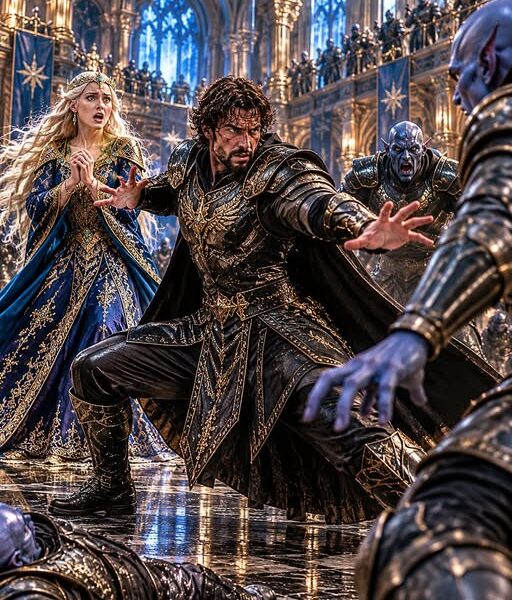
The alien officer shoved me against the counter of a crowded spaceport café, laughed at my worn civilian jacket, and demanded to know which maintenance crew I belonged to—until he noticed the faded military insignia beneath my sleeve and realized he had just insulted the last human soldier who survived the Battle of Orion.
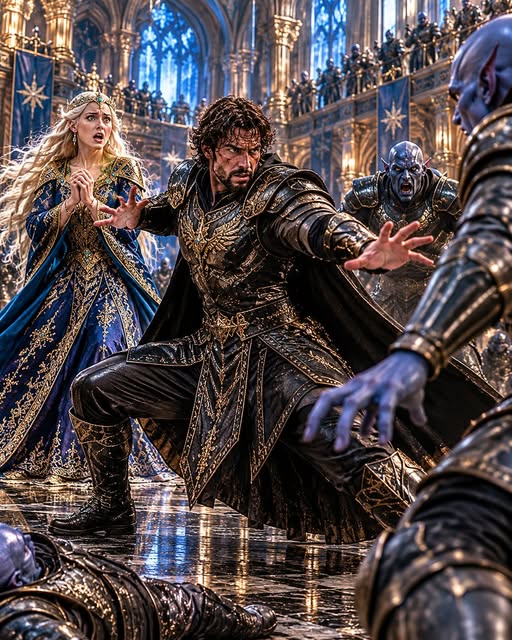
“I was shoved against a café counter on Port Avalon, publicly mocked for looking like a broke civilian, and called a worthless human by a Galactic Security commander—until he saw the insignia beneath my torn jacket and realized the soldier he’d just humiliated was supposed to have been DEAD for twenty-two years.”
I had come to Port Avalon for coffee.
That was all.
After twenty-two years in the Terran military, I had finally learned to appreciate ordinary things. A quiet morning. A warm cup. A transport ticket that would take me somewhere nobody knew my name.
I didn’t want recognition.
I didn’t want another medal.
And I certainly didn’t want to remember Orion.
But the universe seemed determined to remind me.
The café was crowded with travelers from a dozen different worlds. Conversations overlapped beneath the enormous glass ceiling, while merchant ships drifted past the windows outside.
I had chosen a small table near the departure screens, ordered black coffee, and taken off my gloves.
My jacket was old, my boots were scratched, and my hair had gone mostly gray.
I looked like a man who had spent too many years doing physical work.
That was exactly how I wanted to look.
Then someone stopped beside my table.
“You’re sitting in a restricted section, human.”
I looked up.
The alien standing over me was nearly seven feet tall. Blue armor covered his shoulders, and a silver badge identified him as Commander Threx of the Galactic Security Corps.
I glanced around.
Every other table was occupied by travelers, merchants, and station workers.
“There’s no sign,” I said.
Threx slapped a metal identification plate onto my table.
“There is now.”
A few nearby aliens laughed.
I looked at the plate, then at him.
“I’ll finish my coffee and leave.”
“That’s not how this works.”
He leaned closer.
“Where’s your work authorization?”
“I’m traveling.”
“Traveling where?”
“Home.”
His expression suggested that he found the answer amusing.
“Humans always think they’re entitled to everything.”
I slowly put down my cup.
“I haven’t caused any trouble.”
“Your presence is becoming trouble.”
I stood.
That was when he grabbed my jacket.
“Not so fast.”
He pulled me toward him, and the fabric tore at the shoulder.
For a moment, neither of us moved.
Beneath the civilian jacket was the dark fabric of an old Terran combat uniform.
A small silver insignia rested above my heart.
Threx’s fingers loosened.
His eyes dropped to the symbol.
Then to the identification number stitched beneath it.
“Where did you get this?”
I gently removed his hand.
“I earned it.”
He stared at the insignia again.
A security officer approaching from the entrance suddenly stopped.
He looked at my chest, then at Threx.
His weapon lowered immediately.
“Commander,” he whispered. “Step away from him.”
Threx frowned.
“What?”
“That’s the insignia of the First Human Expeditionary Division.”
The officer swallowed.
“Sir, that division was destroyed at Orion.”
The laughter around us disappeared.
Threx looked back at me.
“All personnel were declared dead.”
“Most of them were.”
“You’re claiming you served there?”
I reached into my pocket and placed a cracked identification tag on the table.
My name was still visible.
Behind it was an old photograph of six soldiers standing beside a transport ship.
“Those were my brothers,” I said. “Not by blood. By choice.”
Threx examined the photograph.
“Why were humans at Orion?”
I looked through the window.
Beyond the glass, enormous passenger vessels moved through the station’s docking lanes.
“Because your people asked for help.”
Twenty-two years earlier, the Orion colonies had been surrounded by an enemy fleet.
The Galactic Council had promised reinforcements.
They never came.
Six hundred human soldiers were ordered to hold an evacuation corridor while millions of civilians escaped.
We held it for thirty-one hours.
When our ammunition ran out, we used the wreckage of our own ships as barricades.
When the enemy breached the final defensive line, my commander gave one order.
“Get the civilians out. That’s all that matters.”
I was the only one who made it onto the last transport.
Threx’s voice had changed.
“Why wasn’t this taught in our military academies?”
“Because the Council signed a treaty afterward. Admitting what happened would have meant admitting who abandoned us.”
The security officer slowly removed his helmet.
“My grandmother escaped Orion,” he said.
I looked at him.
“She was a child?”
He nodded.
“She always told us a human soldier carried her through the fire. She never knew his name.”
I remembered that child.
She had been crying for her mother.
I’d carried her beneath one arm while using my other hand to hold a damaged corridor door open.
I had promised her everything would be all right.
Then I had watched the transport leave without me.
I couldn’t tell the officer whether his grandmother had survived because of me or because of the dozens of other soldiers who had kept that corridor open.
There were too many people I couldn’t remember.
Too many I could.
Threx lowered his head.
“I didn’t know.”
“Neither did the people who laughed.”
I picked up my cold coffee and turned toward the exit.
I had no interest in explaining my past to strangers.
But before I reached the door, every public screen in the café flickered.
The departure schedules vanished.
A red emergency symbol appeared.
Then a message spread across every display.
ORION SURVIVOR IDENTIFIED.
EMERGENCY COUNCIL SUMMONS THE LAST WITNESS.
A second message appeared beneath it.
THE OFFICIAL ACCOUNT WAS FALSE.
AND THE PERSON WHO GAVE THE ORDER IS STILL ALIVE.
I stopped walking.
For twenty-two years, I had believed the man who sent six hundred soldiers to die had been buried beneath the same silence that swallowed their names.
But the message contained something worse.
A name appeared on the screen.
GENERAL ADRIAN VALE.
My commanding officer.
The man whose final order had saved millions of lives.
The man I had watched disappear beneath the collapsing defenses of Orion.
And according to the Galactic Council, he was still alive.
What made that revelation impossible wasn’t just that Vale had survived.
It was the fact that I had personally watched his ship explode.
If you were in my position, would you trust a man who had once ordered you to die, even if he might be the only person who could explain what really happened at Orion?
I had no idea that the answer would cost me the last thing I had left.
The café doors locked before I could reach them.
A deep mechanical sound rolled through the station.
Threx’s communicator began flashing.
He read the incoming message, and the color drained from his face.
“Sir,” the young security officer whispered, “we have another problem.”
Threx looked at me.
“The Council has ordered your immediate transfer.”
“Where?”
He hesitated.
“To the military detention facility.”
I glanced at the screen.
General Adrian Vale’s photograph had appeared beneath the announcement.
He looked older, thinner, but unmistakably alive.
Then I noticed something behind him.
A symbol painted on the wall.
The same symbol that had appeared on the enemy ships at Orion.
I hadn’t seen it in twenty-two years.
And suddenly, I understood that the battle I thought had ended might never have been over.
The photograph had been taken yesterday.
I turned toward Threx.
“Get me to the Council.”
He swallowed.
“That’s not going to be easy.”
“Then I suggest you stop wasting time.”
For the first time since I entered the café, the commander didn’t argue.
He simply nodded.
And somewhere deep inside Port Avalon, the station’s emergency sirens began to sound.
The first thing they told me was that General Vale was waiting.
The second thing was that he had specifically requested that I come alone.
I had spent twenty-two years trying to forget his final order.
Now I was about to discover why he had survived it.
The elevator descended through the military levels of Port Avalon.
Threx stood beside me, accompanied by the young security officer who had spoken about his grandmother.
His name, I had learned, was Lieutenant Kael.
He kept glancing at my uniform.
Not with suspicion.
With something closer to embarrassment.
“I owe you an apology,” Threx finally said.
I watched the floor numbers change.
“For what?”
“For the café.”
“You’re not the first officer to mistake an old soldier for someone who can’t defend himself.”
His jaw tightened.
“That’s not what I meant.”
“I know.”
The elevator continued downward.
After a moment, Kael spoke.
“My grandmother has a photograph of the soldier who carried her.”
I turned toward him.
“Does she?”
“She says he had a scar above his left eyebrow.”
My hand moved unconsciously toward the old scar.
Kael noticed.
His expression changed.
“She might want to see you.”
I looked away.
“Perhaps.”
The elevator doors opened before he could say anything else.
We entered a corridor guarded by armed soldiers.
At the far end stood a massive black door bearing the seal of the Galactic Council.
A woman in a dark uniform waited outside.
She introduced herself as Director Selene Marr, head of Council Intelligence.
Her gaze settled on my insignia.
“Sergeant.”
I almost corrected her.
I had been promoted to captain before Orion.
But the rank had never meant much after the battle.
“Director.”
“Thank you for coming.”
“I didn’t exactly have a choice.”
She glanced at Threx.
“Commander, Lieutenant, you may return to your posts.”
“With respect,” Kael said, “I would like to remain.”
Marr studied him.
“Why?”
“My grandmother survived Orion.”
Something softened in the director’s expression.
“Then you may stay.”
The doors opened.
Inside was a circular chamber surrounded by enormous windows.
Six council representatives sat around a polished table.
At the far end stood a man wearing a dark military uniform.
His hair was white now.
His shoulders were narrower.
But I recognized the way he stood.
I recognized the small scar across his chin.
General Adrian Vale.
For several seconds, neither of us spoke.
Then he smiled.
“Daniel.”
I hadn’t heard anyone use my first name in twenty-two years.
My fingers tightened around the identification tag in my pocket.
“You’re supposed to be dead.”
Vale lowered his eyes.
“I know.”
I walked toward him.
“Your ship exploded.”
“Yes.”
“I watched it happen.”
“I know.”
“Then explain how you’re standing here.”
He looked at the council representatives.
“Perhaps we should begin with the truth.”
One of the representatives, an elderly alien with silver skin, interrupted.
“General, this meeting concerns the identification of a surviving military witness. It is not an opportunity to reopen historical disputes.”
Vale turned toward him.
“Historical disputes?”
His voice was quiet.
“Six hundred soldiers died because this Council refused to send reinforcements.”
The representative struck the table.
“The Orion operation was classified.”
“By whom?”
Silence.
Vale reached into his uniform and removed a small data cylinder.
He placed it on the table.
“By the same people who ordered the evacuation corridor abandoned.”
I looked at the cylinder.
Something about its shape seemed familiar.
It was the old military encryption design used by the Terran Expeditionary Command.
I had carried one just like it during the battle.
“What’s on it?” I asked.
Vale looked directly at me.
“The original evacuation order.”
A murmur moved through the chamber.
Director Marr stepped closer.
“General, you assured us the original records had been destroyed.”
“I told you the Council that the records were no longer in your possession.”
He turned back toward me.
“Daniel, I need you to understand something. What happened at Orion wasn’t an unfortunate failure.”
I waited.
“It was deliberate.”
The words seemed to settle over the room.
I looked at him.
“Who gave the order?”
Vale hesitated.
Then he pointed toward the silver-skinned representative.
The alien didn’t move.
His name was Chancellor Veyron.
For twenty-two years, his image had appeared on diplomatic broadcasts as the leader who had negotiated peace after Orion.
He had received awards for preventing another interstellar war.
He had visited memorials dedicated to the soldiers who died.
And now he was sitting three feet away from me.
“That’s a serious accusation,” Veyron said.
Vale nodded.
“I have the transmission.”
“Then present it.”
“I will.”
Vale turned toward Director Marr.
“But not here.”
Marr frowned.
“Why?”
“Because the original transmission contains authentication keys that could compromise the entire Council network.”
Veyron leaned back.
“Convenient.”
Vale ignored him.
He removed a second object from his uniform.
A small rectangular device, damaged along one edge.
I recognized it immediately.
It was a Terran battlefield recorder.
My battlefield recorder.
The one I had handed to Vale thirty-one hours into the defense.
I remembered the moment.
Our communications network had collapsed.
Vale had asked me to preserve the final evacuation orders.
I had given him the recorder and watched him disappear into the smoke.
I stepped closer.
“Where did you get that?”
He looked at me.
“You gave it to me.”
“I thought it was destroyed.”
“It wasn’t.”
“Then why didn’t you release it?”
His expression changed.
“Because the recording alone wasn’t enough.”
He activated the device.
A holographic image appeared above the table.
Static filled the room.
Then a voice emerged.
“Orion evacuation corridor is to remain operational until the final civilian transport clears.”
I knew that voice.
It was mine.
The recording continued.
A second voice interrupted.
“Negative. Council command has revoked the evacuation authorization.”
A third voice followed.
“All military personnel are to withdraw immediately.”
I recognized that one too.
Chancellor Veyron.
The room became completely silent.
Vale stopped the recording.
“That was the order that condemned six hundred soldiers.”
Veyron stood.
“That recording is incomplete.”
“Then perhaps you’d like to explain the missing portion,” Vale replied.
The chancellor’s eyes moved toward the recorder.
“General, you have no idea what you’re doing.”
“I know exactly what I’m doing.”
Vale looked at me.
“Daniel, there’s something else.”
I waited.
“The enemy fleet at Orion wasn’t acting independently.”
He activated another display.
A star map appeared.
The familiar symbol from the café screen appeared beside several systems.
My stomach tightened.
“That’s the enemy insignia.”
“Yes.”
“Where did you find it?”
Vale pointed toward the map.
“On Council military vessels.”
Nobody spoke.
Then Director Marr stepped away from the table.
“Are you suggesting that the Council supplied the enemy?”
“I’m saying the enemy fleet received intelligence, weapons, and navigational access from inside this government.”
Chancellor Veyron laughed.
It was a short, unpleasant sound.
“You’re asking us to believe that an entire civilization conspired against its own colonies?”
“No,” Vale said.
“I’m asking you to examine the records.”
He inserted the data cylinder.
A series of encrypted files appeared.
Dates.
Coordinates.
Supply transfers.
Military communications.
The records went back six months before the Battle of Orion.
I stared at the screen.
There were names I recognized.
Officers.
Diplomats.
Military contractors.
And one designation that made my mouth go dry.
FIRST HUMAN EXPEDITIONARY DIVISION.
I leaned closer.
“Why is my unit listed?”
Vale didn’t answer immediately.
Instead, he opened a file marked FINAL AUTHORIZATION.
A timestamp appeared.
Thirty-one hours before our last transport departed.
Then a message.
HUMAN UNIT TO BE LEFT IN PLACE.
NO EXTRACTION AUTHORIZED.
THEIR SURVIVAL WOULD COMPROMISE THE AGREEMENT.
I read it twice.
The Council hadn’t simply abandoned us.
Someone had decided that six hundred human soldiers were more useful dead.
I looked at Vale.
“You knew.”
He closed his eyes.
“I suspected.”
“You suspected?”
“Daniel—”
“You knew enough to survive, didn’t you?”
His shoulders dropped.
“I found the first evidence two days before the final assault.”
I stepped back.
“Two days?”
“I tried to contact Terran Command.”
“And?”
“The transmission was intercepted.”
I remembered the final night.
The smoke.
The collapsing barricades.
The sound of soldiers shouting for ammunition.
I remembered asking Vale why no reinforcements were coming.
He had looked at me for a long time before answering.
“Because we’re all they’ve got.”
I had believed him.
He continued.
“I realized that if the Council discovered I had the evidence, they would destroy it and kill anyone who had seen it.”
“So you kept quiet.”
“I made a decision.”
“You made a decision for six hundred men.”
His eyes filled with something I hadn’t seen in him before.
Shame.
“Yes.”
I wanted to hit him.
I wanted to grab his uniform and demand that he explain every name on that photograph in my pocket.
But I couldn’t stop looking at the data.
One detail bothered me.
The authorization had been signed thirty-one hours before the final assault.
Yet the Council had continued promising reinforcements.
Why?
I pointed to the transmission log.
“Who sent this?”
Vale looked at the screen.
“Chancellor Veyron.”
“Then why did you tell us help was coming?”
He hesitated.
“I didn’t.”
I frowned.
“What?”
“The reinforcements message wasn’t from me.”
He opened another recording.
A familiar voice filled the room.
“Human forces, hold your positions. Reinforcements are approaching. Do not abandon the corridor.”
I recognized the voice.
It was mine.
Not the recording from the battlefield recorder.
Another transmission.
One I had never sent.
Someone had copied my voice.
Someone had used my identity to keep the six hundred soldiers fighting.
I looked at the general.
“Who made that?”
He turned toward Veyron.
The chancellor’s expression had finally changed.
For the first time, he looked afraid.
Before anyone could speak, every screen in the chamber went black.
A red security alert appeared.
Then the doors locked.
Director Marr reached for her communicator.
“Security control, respond.”
Nothing.
A deep metallic impact echoed somewhere beyond the chamber.
Kael moved in front of her.
Threx drew his weapon.
Vale looked at me.
“They’ve found us.”
“Who?”
He glanced toward the dark windows.
“The people who made sure Orion happened.”
A second impact shook the room.
Then a voice came through the emergency speakers.
“Chancellor Veyron, stand away from the Terran witnesses.”
Threx raised his weapon.
“Identify yourself.”
A pause followed.
Then the voice spoke again.
“Commander, this is Fleet Admiral Soren of the Galactic Defense Armada. You are interfering with a classified security operation.”
Veyron relaxed slightly.
“Finally.”
He looked toward the doors.
“Admiral, these individuals are dangerous. Secure them immediately.”
Vale moved closer to me.
“Don’t let them take the recorder.”
The door exploded inward.
Armed soldiers poured into the chamber.
Their armor was black.
Their insignia was the same symbol I had seen on the enemy ships at Orion.
Threx fired first.
A blue energy bolt struck the floor near the entrance.
Kael pulled Director Marr behind the council table.
I grabbed the nearest overturned chair and shoved it against the doorway.
The first soldier through the smoke raised his weapon.
I moved before I could think.
Twenty-two years had passed.
My joints were stiff, my reflexes slower, and my body no longer belonged to the man who had fought at Orion.
But some instincts never disappear.
I caught his weapon arm, drove my shoulder into his chest, and sent him crashing into the corridor.
Threx fired again.
The soldiers retreated.
“Move!” Vale shouted.
He pulled a maintenance panel from the wall.
Behind it was a narrow access tunnel.
Director Marr looked at him.
“Where does that lead?”
“Station communications.”
“That’s restricted.”
“So is being murdered.”
She didn’t argue.
We entered the tunnel one by one.
Kael came last, carrying the battlefield recorder.
The panel closed behind us.
For several minutes, we moved through the narrow passage in darkness.
Then we reached a maintenance platform overlooking the station’s central reactor chamber.
Vale stopped beside a control console.
“We need to transmit the evidence.”
Director Marr shook her head.
“The Council network is compromised.”
“Then use the public broadcast system.”
“That system is controlled by Fleet Security.”
I looked at the old battlefield recorder.
“Can it connect to the broadcast network?”
Vale nodded.
“With the original encryption key.”
I reached into my pocket.
The cracked identification tag was still there.
I turned it over.
On the back, beneath the faded photograph, was a tiny serial number.
I had never paid much attention to it.
Vale stared at the tag.
“You still have that?”
“It’s my identification.”
“Daniel, that’s not just an identification number.”
He took it carefully.
“It’s the encryption key for the original Orion command network.”
I looked at him.
“You gave it to me.”
“I know.”
“Why?”
“Because I knew there might come a day when someone would need to prove what happened.”
The tag suddenly felt heavier in my hand.
For twenty-two years, I had carried it because it was the last thing I had left of my brothers.
Now it was the one thing that might give them their names back.
Kael connected the recorder to the console.
The system rejected the first access attempt.
Then the second.
Vale entered the old command sequence.
Nothing happened.
Director Marr watched the security indicators.
“They’re closing in.”
I examined the recorder.
There was a small mechanical switch on the side.
I remembered the battlefield.
The damaged communications equipment.
The way Vale had shown me how to bypass the automatic encryption.
I pressed the switch.
The screen flickered.
A familiar voice emerged.
“First Expeditionary Division. Command authorization required.”
I placed my identification tag against the scanner.
For a moment, the system remained silent.
Then a message appeared.
IDENTITY CONFIRMED.
COMMANDER DANIEL CROSS.
The old rank startled me.
I hadn’t been called commander in twenty-two years.
The system continued.
WELCOME BACK.
I stared at the screen.
Then I opened the original transmission archive.
Hundreds of files appeared.
Orders.
Communications.
Evacuation records.
And finally, the complete recording of the message that had sent six hundred soldiers to their deaths.
Vale stepped beside me.
“That’s it.”
I didn’t press play.
Not yet.
“Why did you keep this hidden for so long?”
He looked at the photograph on my identification tag.
“Because I thought the truth would destroy the peace we had built.”
I looked at him.
“And what did you think silence would do to the people who died?”
He had no answer.
The tunnel shook.
A security warning flashed across the screen.
ENEMY PERSONNEL APPROACHING.
Kael looked toward the passage.
“They’re here.”
I turned to Director Marr.
“Can we broadcast this to every station in the system?”
She nodded.
“If we use the emergency relay.”
“Then do it.”
She hesitated.
“Once it’s transmitted, there will be no way to contain it.”
I looked at the photograph.
Six men.
One transport ship.
A world that had forgotten their names.
“Good.”
The recording began.
Chancellor Veyron’s voice filled the communications chamber.
“Evacuation corridor remains active. Human forces are to maintain their positions until the final civilian transport departs.”
Then another voice.
A voice I recognized from the old Council broadcasts.
“Admiral Soren, confirm that no reinforcements will be sent.”
A second voice answered.
“Confirmed.”
Veyron continued.
“Ensure the humans receive no withdrawal order. Their continued resistance is necessary.”
I closed my eyes.
The recording moved forward.
“Six hundred soldiers?”
“Yes.”
“And if any survive?”
“Then they become a liability.”
The final sentence came through clearly.
“Leave no witnesses.”
The chamber fell silent.
Then the public transmission indicator turned green.
Across Port Avalon, every screen began displaying the recording.
The café.
The docking terminals.
The military academies.
The Council chamber.
Everywhere.
For twenty-two years, the galaxy had been told that six hundred humans had died in a heroic but unavoidable defeat.
Now they were hearing the order that had condemned them.
The soldiers outside the tunnel stopped firing.
Their commander appeared on the communications screen.
Admiral Soren.
His face was pale.
“Terminate that transmission immediately.”
Director Marr stepped forward.
“By what authority?”
“Military security.”
“Your authority has been revoked pending investigation.”
Soren’s expression hardened.
“You have no idea what you’re doing.”
I stepped toward the camera.
“I’ve heard that before.”
He looked at me.
Recognition crossed his face.
“Cross.”
I leaned closer.
“Do you remember the Battle of Orion?”
He said nothing.
“Because I remember you.”
His eyes narrowed.
I continued.
“You were the officer who promised reinforcements would arrive.”
The room went quiet.
“I remember your voice,” I said. “I heard it every night while my men were running out of ammunition.”
Soren looked away.
Then he disconnected.
The security forces outside the tunnel lowered their weapons.
Not all of them.
But enough.
The transmission continued.
And for the first time in twenty-two years, the galaxy was forced to hear the truth.
The aftermath took three days.
Three days of emergency hearings, military arrests, and diplomatic chaos.
Chancellor Veyron was taken into custody.
Admiral Soren surrendered after several senior officers testified against him.
The Council’s investigation uncovered an illegal weapons agreement between several officials and the enemy fleet.
The agreement had been designed to create a controlled military crisis.
The Council intended to sacrifice the outer colonies, weaken rival governments, and gain permanent authority over the Galactic Defense Armada.
Orion had become the first major operation.
The human soldiers had been deliberately left behind because they had no political value to the people making the decisions.
And because their deaths would make the entire operation easier to conceal.
General Vale testified for eleven hours.
He admitted that he had discovered evidence of the conspiracy before the final assault.
He admitted that he had concealed it.
He admitted that he had allowed his soldiers to believe reinforcements were coming because he feared that revealing the truth would destroy their morale and cause the evacuation corridor to collapse.
He also admitted that he had survived by entering a damaged escape pod after his command vessel was destroyed.
He had spent years gathering evidence.
Years hiding from the people responsible.
And years convincing himself that silence was the only way to protect the peace.
I listened to his testimony from the back of the chamber.
When it ended, he approached me.
“Daniel.”
I didn’t turn.
“I know you don’t forgive me.”
I looked at him.
“I don’t know what I feel.”
He nodded.
“That’s fair.”
“Why didn’t you come looking for me?”
He looked down.
“I thought you were dead.”
“You had the records.”
“I knew one transport had escaped. I didn’t know which soldiers had made it.”
I studied his face.
“You could have tried.”
“Yes.”
He didn’t defend himself.
That was the first thing he had said that I believed completely.
He extended his hand.
I looked at it for a moment.
Then I shook it.
Not because everything was forgiven.
But because the man standing in front of me had finally stopped asking me to accept his excuses.
The following week, the Galactic Council issued a formal apology to the Terran government.
The six hundred soldiers were officially cleared of all accusations.
Their names were restored to the military archives.
The Orion memorial was rebuilt.
And for the first time, the memorial included the names of every soldier who had died defending the evacuation corridor.
I attended the ceremony.
I didn’t wear medals.
I wore my old uniform beneath the same civilian jacket.
The torn shoulder had been repaired by a tailor at Port Avalon.
It wasn’t perfect.
I liked it that way.
Hundreds of people gathered around the memorial.
Humans.
Aliens.
Survivors.
Families.
Some had traveled for days to be there.
Among them was an elderly woman leaning on a walking frame.
Kael stood beside her.
When she saw me, she stopped.
For a long moment, she simply stared.
Then she reached for my hand.
“My grandmother wanted to meet you,” Kael said quietly.
The woman looked at the scar above my eyebrow.
“You carried me.”
I swallowed.
“I carried a lot of people.”
She shook her head.
“You carried me through the fire. I remember your voice.”
I looked at her.
She smiled faintly.
“You told me my mother was waiting on the other side.”
I remembered.
The little girl in the corridor.
The smoke.
The transport doors.
“Was she?” I asked.
The woman nodded.
“She was.”
Her fingers tightened around mine.
“I never got to thank you.”
I couldn’t find the right words.
She reached into her coat and removed a small photograph.
It showed a young woman standing beside a military transport.
Behind her was a group of children.
One of them was holding a handmade paper star.
“My mother took that picture after we escaped,” she said. “She told me never to forget the people who stayed behind.”
I studied the photograph.
For twenty-two years, I had remembered that little girl as someone I had failed.
I had watched her transport leave.
I had told myself I should have done more.
Now I was standing in front of the woman she had become.
And she was holding my hand.
“Thank you,” she whispered.
I looked toward the memorial.
For the first time, the names of my brothers weren’t hidden behind a classified military designation.
They were written in silver letters across a wall of black stone.
Six hundred names.
Six hundred lives.
Six hundred people who had made a choice to stand between danger and strangers.
I found my own name near the bottom.
It was followed by a small inscription.
SURVIVOR.
I touched the letters.
Then I noticed something missing.
There was no mention of the commander who had ordered the defense.
No medal.
No heroic title.
No attempt to make him into a legend.
Just his name.
ADRIAN VALE.
He stood several feet behind me.
He had asked not to be part of the ceremony.
I understood why.
He had spent twenty-two years carrying a different kind of battlefield.
I turned toward him.
“Come here, General.”
He hesitated.
Then he approached.
We stood together in front of the memorial.
“I don’t know if they would have forgiven you,” I said.
He nodded.
“I don’t expect them to.”
“But I think they would have wanted the truth told.”
His eyes moved across the names.
“I should have told it sooner.”
“Yes.”
He took a breath.
“I’ll spend whatever time I have left making sure nobody forgets.”
I looked at the memorial again.
“Then start by remembering their names.”
He nodded.
That evening, I returned to the café.
The same café where Threx had grabbed my jacket.
The same café where strangers had laughed at my worn boots.
The reserved-section plate was gone.
In its place was a small silver plaque.
It read:
PORT AVALON THANKS THE SOLDIERS OF THE FIRST HUMAN EXPEDITIONARY DIVISION.
I stood in front of it for a moment.
Then I sat at the same table.
Threx approached carrying two cups of coffee.
He placed one in front of me.
“On the house.”
I looked at him.
“Trying to make up for something?”
He gave a small, uncomfortable smile.
“Something like that.”
I took a sip.
It was terrible.
I put the cup down.
“You still need to learn how to make coffee.”
For the first time, he laughed without making anyone else the target.
Kael arrived a few minutes later.
He had received a message from his grandmother.
She wanted me to visit her when I had time.
I told him I would.
Then I checked the departure board.
My transport home was scheduled to leave in forty minutes.
Threx glanced at the screen.
“Are you still leaving?”
I looked through the window.
Beyond the station, ships moved quietly between the stars.
For twenty-two years, I had believed that going home meant escaping the past.
Now I understood that home was not a place where nobody knew your name.
It was a place where the people you loved were remembered.
I reached into my pocket and felt the cracked identification tag.
The photograph was still there.
Six soldiers beside a transport ship.
My brothers.
I had carried that picture through every year of silence.
I wasn’t going to hide it anymore.
“Yes,” I told Threx. “I’m going home.”
He nodded.
“Good.”
I stood, picked up my repaired jacket, and walked toward the departure gates.
This time, nobody stopped me.
Nobody demanded identification.
Nobody laughed at my boots.
As I passed the memorial display, I caught sight of the six hundred names glowing softly beneath the station lights.
I stopped once.
Just once.
Then I continued toward my transport.
I had spent twenty-two years being the last survivor of Orion.
I didn’t want to be the last person who remembered it.
And for the first time since the battle, I no longer felt like I was leaving my brothers behind.
I felt like I was finally bringing them home.









