The alien historians mocked me in front of the Galactic Council when I begged them to rescue the ancient creature buried beneath Kepler-7’s ocean, calling it a worthless relic, but when I touched its barnacle-covered shell, every abandoned starship in the galaxy suddenly awakened and whispered my name.
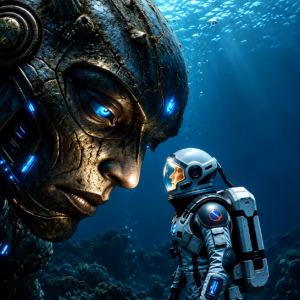
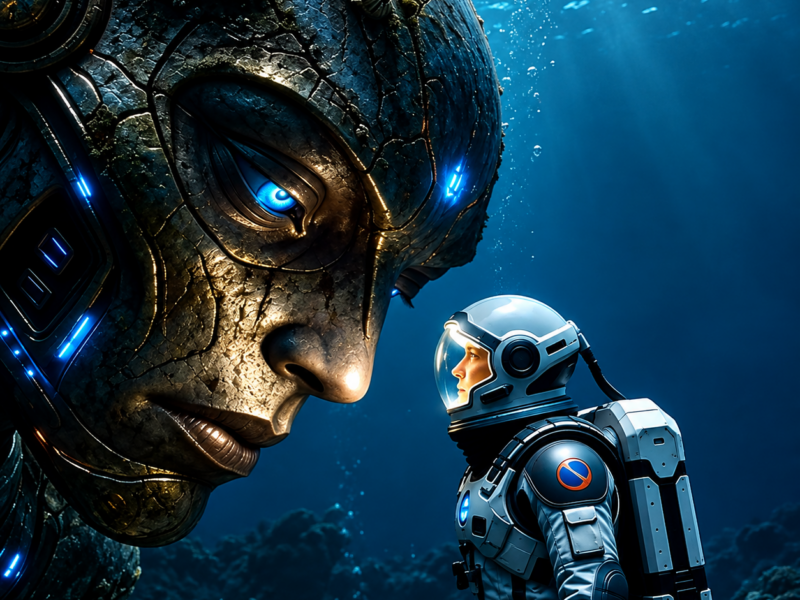
The cold water of Kepler-7 pressed against my diving suit like an iron hand.
Every movement felt heavy, weighted down by the pressure of an alien ocean and the bitter ridicule of my crewmates.
My scanner glowed with a faint, erratic pulse that refused to match any known biology.
Commander Voss had called it a sensor glitch before I left the airlock.
He swore it was just a ghost in the ancient machine.
I knelt in the silt, brushing away centuries of sediment from a colossal, barnacle-covered shell.
The metal beneath my gloves felt ancient, scarred by forgotten wars and deep-sea currents.
A low, resonant hum vibrated straight through my suit, rattling my teeth in their sockets.
I glanced down at my heads-up display, watching my oxygen reserves tick steadily toward the red.
Time was running out fast, but I couldn’t tear my eyes away from the shifting surface of the mass.
“Hayes, report,” Voss’s voice crackled through the comms, laced with unmistakable impatience.
“I’m looking at it right now, Commander,” I whispered back.
“It’s not a machine.”
Laughter erupted in the background of the bridge, sharp, dry, and condescending.
“Bring back scrap, Hayes, not fairy tales,” Voss barked.
“The salvage corporation didn’t charter this vessel to hunt for sea monsters.”
I ignored them, pressing my palm flat against the cold, encrusted hull.
The hum grew louder, surging up my arm like an electric current.
A pair of massive, luminous rings etched into the shell began to pulse with a faint, cobalt glow.
The silt around the base shifted, kicking up dense gray clouds that instantly blinded my external cameras.
I adjusted my helmet spotlights, trying to peer into the newly opened fissures beneath the bedrock.
Something shifted in the black water, moving with terrifying, effortless grace.
My heart slammed against my ribs as a shadow rose directly before me.
It was not a derelict relic of the First War.
It was alive, it was colossal, and it was opening its eyes.
The comm link fizzled with sudden, violent static that drowned out Voss’s laughter.
A wall of pure kinetic force rolled out from the shifting plates, knocking me onto my back.
The ocean floor groaned beneath us as if the planetary crust was splitting apart.
I scrambled to find purchase against the rocks, my fingers clawing through volcanic mud.
Two enormous mandibles flared out from the curved carapace, parting the deep-sea dark.
Between them burned a single, central optic sphere, brilliant and blindingly gold.
It fixed its focus squarely upon my trembling visor.
My breath caught in my throat, rattling in my regulator.
The water temperature readout on my wrist computer spiked from near freezing to blood-warm in three seconds flat.
“Resolute, do you copy?” I breathed into the microphone, my chest aching.
Only the dead whine of electromagnetic interference answered.
The golden eye narrowed, regarding me not as food, and not as an intruder.
It looked at me with the weary intelligence of something that had watched stars die.
A deep tremor passed through the continental shelf, lifting tons of silt into the water column.
The creature’s chest plates began to expand, venting glowing vents of iridescent vapor.
Then, without a single sound passing through the water, a thought struck my mind like a physical blow.
It carried the weight of ten thousand winters and the crushing loneliness of an empty universe.
I dropped my plasma torch into the mud, my hands shaking so violently I couldn’t hold the grip.
“You took your time,” the presence murmured directly behind my eyes.
Before I could form a single word in response, the bedrock cracked wide open beneath my boots.
The ocean fell out from under me, pulling my tether down into an abyss of golden fire.
The water grew sweltering around my suit, defying the freezing depths of the trench.
A golden light pierced through the swirling sediment, illuminating the full, terrifying scale of the form before me.
It was a creature torn from forgotten myths, half biological titan and half interstellar craft.
Colossal chains forged from an iridescent, unidentifiable alloy bound its chest plates directly into the black basalt.
Ancient geometric symbols pulsed along its spinal crest like dormant neural circuits flicking on one by one.
The golden eye held me in place, paralyzing every muscle in my limbs.
A wave of sheer, suffocating isolation washed over my consciousness.
It was not a sound rattling inside my eardrums, but an ache that pierced the center of my chest.
“Please… don’t leave me in the dark,” the voice echoed, raw with an agony that felt entirely human.
I gasped for air inside my helmet, tumbling backward into the swirling silt.
“Who are you?” I stammered aloud, completely forgetting to key my suit’s radio.
“I am the keeper of the first path,” the entity replied, its tone heavy with the dust of millennia.
“You shouldn’t be down here,” I breathed, trying to steady my racing pulse.
“The United Mining Union cataloged this trench as empty industrial waste.”
A bitter, dry resonance rippled through my thoughts, tasting of ash and rusted iron.
“They forgot the cradle they crawled out of,” the creature replied softly.
“They forgot what they swore to protect when the dark fleets came.”
My oxygen alarm let out a piercing shriek, flashing amber across my visor.
Fourteen percent.
Twelve minutes of breathable air remained before the scrubbers choked on carbon dioxide.
I looked up at the massive links pinning the entity to the planetary floor.
Each chain link was as thick as the fuselage of a drop-ship, embedded ten yards deep into solid stone.
If I detached my ascent line and fired the emergency thrusters now, I would reach the airlock alive.
If I stayed to investigate, I would share its nameless grave on Kepler-7.
Yet, staring into that luminous golden eye, turning my back felt like an act of absolute cowardice.
“They said this world was dead,” I muttered, my voice hoarse.
“They told us nothing survived the Great Collapse.”
“They lied to you, little architect,” the creature whispered.
“They buried us because they could not master our fire.”
I reached down with trembling fingers and unclipped the heavy plasma cutter from my harness.
The magnetic ignition sparked, roaring to life with a blinding, white-hot hiss that boiled the water.
“Hold still,” I whispered, stepping toward the nearest mooring.
“I don’t know if this metal can even be cut.”
“It remembers the hand that forged it,” the entity answered gently.
I drove the cutting edge into the first tarnished link.
A shower of white sparks burst against the dark water, illuminating the creature’s scarred, armored flank.
Up on the surface, if Voss caught the power surge on his telemetry screens, he would sever my lifeline in an instant.
I leaned my entire body weight into the cutter, teeth gritted against the violent vibration.
The alloy fought the torch, groaning under the thermal pressure before glowing cherry red.
The creature watched every movement, its slow, rhythmic breathing driving warm waves past my suit.
“Why me?” I asked through the grinding roar of the plasma flame.
“Out of all the divers they sent down here to strip the trench, why speak to me?”
The eye softened, its golden rings contracting into complex, geometric iris patterns.
“Because,” the voice murmured inside my skull, “you carry your father’s hands.”
My grip slipped on the torch, sending a spray of slag across my chestplate.
“What did you say?” I demanded, my breath stopping cold.
Before the creature could answer, a violent shockwave snapped my safety tether, flinging me into the black.
I tumbled through the churning water, the world spinning in wild, chaotic circles.
My boots slammed against a basalt outcropping, jarring my spine before I managed to fire my stabilizing thrusters.
The plasma cutter was still humming, tethered to my wrist by its reinforced coil.
“Hayes! What the hell are you doing down there?” Voss’s voice exploded through the comms.
The bridge was in total pandemonium; I could hear klaxons screaming and personnel shouting over one another.
“Seismic sensors are reading a catastrophic sub-surface event!” Voss roared.
“The tectonic plate is buckling right beneath your coordinates!”
“Commander, listen to me,” I wheezed, fighting to regain my footing in the current.
“We need to deploy the heavy recovery cables right now. It’s not a wreckage down here!”
“You’ve lost your mind,” Voss snapped, his tone turning ice-cold.
“Emergency protocol dictates total site abandonment under structural instability.”
“We are preparing to purge the umbilical bay and pull the Resolute into high orbit.”
“You have three minutes to reach the basket, or you stay down there forever.”
The line crackled and dropped into dead, heavy static.
I looked down at the plasma cutter, the white flame dancing against the murky sea.
Three minutes meant survival.
Three minutes meant going back to a corporate bunk, a dead-end wage, and a lifetime of wondering what lived in the dark.
I turned my back on the ascent line.
I fired my thrusters, plunging straight back down toward the colossal creature.
The entity had not moved, but the blue lines across its body were blazing with blinding intensity.
“Hurry, Daniel,” the voice commanded, urgent and clear.
“The surface ship is priming their orbital thrusters.”
“If they leave the gravity well before the seals are broken, the failsafe will detonate the trench.”
I landed heavily on the second mooring, driving the cutter into the glowing seam I had started earlier.
“How do you know my name?” I shouted over the hiss of melting metal.
The creature didn’t speak with words this time; it sent an image flashing across my mind.
I saw a man with graying temples standing in an orbital workshop, grease on his jaw and a soldering iron in hand.
My father.
Arthur Hayes.
The man the United Mining Union had declared lost in a routine transport explosion when I was twelve years old.
“He built the anchors that bound me,” the entity revealed, its mental voice shaking with ancient grief.
“Under duress. Under the promise that his lineage would be spared their purge.”
“He built them, and he hid the flaw within their hinges.”
“Strike the center joint, Daniel. Strike where the alloy turns from blue to black.”
I adjusted my footing, bringing the plasma cutter down directly on the small, recessed pivot of the massive chain.
The moment the flame touched the dark spot, the metal didn’t melt—it fractured.
A deafening, metallic snap reverberated through the oceanic trench like a cannon shot.
The first massive chain whipped backward, shattering boulders into clouds of dust.
Above us, the distant rumble of the Resolute’s main engines vibrated through the water column.
Voss was firing the thrusters early.
He was abandoning me.
“One left,” I yelled, throwing myself across the creature’s armored neck toward the final mooring on the right.
The last chain was strained to maximum tension, groaning under the shifting weight of the titan.
My oxygen monitor dropped to four percent.
A harsh red light bathed the inside of my helmet, accompanied by a continuous, rhythmic warning beep.
My lungs felt heavy, starving for air, the carbon dioxide beginning to cloud the edges of my vision.
“Strike it!” the voice roared in my mind, no longer gentle, but commanding as a thunderclap.
I didn’t use the cutter.
I jammed the overloaded power cell of the torch directly into the cracked stress fracture of the anchor.
I lunged backward, kicking my boots off the creature’s shell as hard as I could.
The plasma cell detonated in a brilliant bubble of expanding white fire and superheated steam.
The force of the explosion flung me twenty yards into the open water, my heads-up display flickering out completely.
For three seconds, there was only darkness, silence, and the terrible sound of my own shallow gasps.
Then, the deep ocean erupted.
A roar tore through the trench, so deep and powerful that it compressed the water around my suit like a vice.
Two colossal, wing-like stabilizing fins unfurled from the creature’s sides, sweeping the seabed clean.
The colossal guardian rose from the dust, shaking off millennia of silence.
It was not merely an animal; it was an engine of starlight, a dreadnought wrapped in living, armored flesh.
It circled upward, its massive form creating a whirlpool that caught my limp, drifting body.
The golden eye turned toward me, hovering inches from my cracked helmet visor.
A massive, armored forelimb slid beneath me, catching me gently against its wide palm.
“You have kept his promise,” the guardian whispered into my fading consciousness.
“Now, let us show them what your father built.”
The ascent was not a slow crawl through decompression zones; it was an impossible, physics-defying launch.
The water parted around the guardian’s form as if repelled by a localized gravitational field.
Inside my helmet, the air had turned thin and foul, taste of metallic zinc scraping against my tongue.
I clawed at my throat, my vision narrowing to a pinpoint of gray static.
Just as the blackness threatened to swallow me whole, a brilliant beam of blue light struck my chest.
The suit’s emergency life-support diagnostics suddenly screamed back to life.
Power bars surged to maximum capacity.
The suffocating pressure in my lungs vanished as pure, cool oxygen flooded the regulator.
My external monitors rebooted, scrolling through streams of alien code that our corporate technicians had never seen.
“Suit pressure stabilized,” the automated female voice of my helmet announced smoothly.
“Auxiliary power source detected: Unknown Origin.”
I pressed my face against the visor, staring at the armored back of the titan carrying me upward.
“What did you do?” I asked, my voice trembling with disbelief.
“Your father did not design these suits to fail in the deep,” the guardian replied.
“He designed them to interface with us.”
Before I could process the meaning behind the words, a hidden file partition unlocked inside my visor’s interface.
It was an old corporate frequency, encrypted with a seventeen-digit key I knew by heart.
It was the date of my mother’s death.
A low, recorded hum filled my ears, followed by the sound of someone clearing their throat into a worn microphone.
“Daniel,” my father’s voice spoke, crisp, tired, and achingly real.
Tears welled in my eyes, hot and sudden, blurring the glowing ocean outside.
“If this recording has triggered, it means you stayed in the trench long enough to find what they buried.”
“And it means I never found a way to come back for you.”
“Dad,” I whispered, pressing my gloved hands against the sides of my helmet as if I could hold the sound.
“The United Mining Union didn’t discover Kepler-7 by accident,” the recording continued, accompanied by the background clatter of tools.
“We found the ancient cradle thirty years ago.”
“We found the fleet that guarded humanity before our ancestors forgot the stars and started over.”
“The Union Directors didn’t want protectors, Daniel. They wanted weapons they could license and sell.”
“When I realized they planned to lobotomize the guardians and hollow them out for gunships, I locked the neural core.”
“I took the key, split the cypher, and buried it where only my own blood could ever rekindle the link.”
“They’re going to come for me after I seal this transmission.”
“I know what Voss is capable of. I know what the Board does to men who stand between them and market dominance.”
“If you’re hearing this, you are the last surviving mechanic of the First Dawn.”
“Don’t let them scrap her, son. Don’t let them turn our past into their currency.”
The recording dissolved into a steady, rhythmic hiss of tape noise, leaving a hollow ache in my chest.
My entire life had been built on a corporate lie.
They had given me an apprenticeship out of ‘charity’ after my father died.
They had assigned me to salvage crews, praising my natural intuition for alien machinery while laughing behind my back.
They had used his son to sniff out the very prize Arthur Hayes had died to protect.
“He loved you,” the guardian’s voice murmured, softening the rage boiling inside my veins.
“He held the neural link until his heart gave out under their interrogation.”
“He never gave them the command frequencies.”
I looked up through the rushing water toward the shimmering boundary of the surface.
“Where is the rest of the fleet?” I asked, my hands clenching into tight fists against my thighs.
“Above us,” the entity answered, its body surging with power.
“Waiting for the call.”
The guardian breached the surface of Kepler-7 like an erupting volcano, shattering the ocean into clouds of vapor.
We launched into the thin, frozen atmosphere, gravity completely losing its hold on my boots.
I looked down at the vast, gray oceans of the planet falling away beneath us.
Then, I looked up.
The sight waiting in the low orbit stopped my breath dead in my chest.
The sky above Kepler-7 was no longer the empty, black canvas we had orbited hours before.
Where there had once been only our lone corporate salvage vessel, hundreds of colossal silhouettes drifted in silence.
They hung suspended in the upper atmosphere, wrapped in the planet’s pale icy rings.
They were ancient starships, their hulls scarred with the same barnacles and mineral crusts as the guardian beneath me.
Some were shaped like soaring raptors with wings spanning miles; others were long, elegant spires of dark matter alloy.
None of them showed engine trails.
None of them carried heat signatures that our standard corporate sensors could identify.
Yet every single vessel was slowly waking, their hulls glowing with the identical cobalt fire coursing through my suit.
And caught right in the center of this gathering armada was the Resolute.
Our corporate flagship looked tiny, pathetic, and frail, like an insect trapped inside a web of starlight.
“Bring me to the airlock,” I told the guardian, my jaw set tight.
“You do not need an airlock, Daniel,” the creature replied.
The atmospheric shield around my suit hardened, shimmering with a faint hexagonal lattice.
The guardian glided alongside the primary observation deck of the Resolute, its massive golden eye peering inside.
Through the reinforced armaglass, I could see the bridge crew in absolute panic.
Officers were abandoning their stations, throwing emergency rations into survival lockers.
Commander Voss stood in the center of the command deck, his uniform disheveled, frantically screaming into an open comm channel.
I pushed myself off the guardian’s back, letting the suit’s thrusters carry me directly toward the outer maintenance hatch.
I didn’t need to punch in the bypass code.
The moment my gloved hand neared the panel, the blue symbols under my skin flashed through the fabric.
The heavy hydraulic seals hissed, cycling the hatch open without resistance.
I stepped into the decontamination corridor, the air smelling sharply of scorched copper and ozone.
The secondary blast doors parted before me like curtains.
I walked onto the command bridge of the Resolute with slow, measured steps, leaving wet footprints of sea water behind me.
Voss spun around at the sound of the opening doors, his hand instantly dropping to the sidearm at his belt.
His face was pale as chalk, his eyes wild and bloodshot.
“Hayes?” he choked out, stumbling back against the central tactical holotank.
“You’re dead. The seismic drop severed the umbilical line twenty minutes ago.”
“You left me to drown, Commander,” I said, my voice eerily calm through the suit’s vocalizer.
“Just like you left my father in an interrogation cell on Station Nine.”
Voss froze, his fingers stiffening on the grip of his pistol.
The other bridge technicians stopped their packing, staring at me in terrified silence.
“You don’t know what you’re talking about,” Voss stammered, trying to regain his commanding sneer.
“Your father was a lunatic who violated Union salvage protocols.”
“He was an archivist,” I corrected him, stepping forward until I was arm’s length from his weapon.
“And you were the butcher they sent to clean up the paperwork.”
A violent shudder rocked the entire ship, knocking Voss off his balance.
Outside the main viewport, the massive guardian brought its head level with the bridge.
Its golden eye peered directly into the room, illuminating every console with an unearthly, judgment-laden light.
Every monitor on the deck flickered simultaneously, wiping the corporate logos from the displays.
In their place, lines of pure, pulsing code began to scroll at lightspeed.
“What did you bring to my ship?” Voss screamed, finally drawing his sidearm and leveling it between my eyes.
“Order that thing to stand down, or I swear to God I will vent this deck into the void!”
I didn’t blink.
I didn’t raise my hands.
“She doesn’t take orders from me, Voss,” I said softly.
“She listens to the family that kept the fire alive.”
Before Voss could tighten his finger on the trigger, the entire console array hummed in a singular, harmonized chord.
A voice resonated not from the speakers, but from the very steel plates beneath our feet.
“Daniel Hayes,” the fleet whispered in a chorus of thousands.
The blue glow beneath my suit surged outward, melting the firing pin inside Voss’s blaster with a quiet puff of smoke.
Voss screamed, dropping the red-hot pistol onto the deck plates as the skin on his palm blistered.
He backed away until his shoulders slammed against the dead glass of the communication array.
“What are you?” he wheezed, clutching his burned wrist against his chest.
“I told you,” I answered, peeling off my diving helmet and letting it clatter to the metal floor.
The cool, conditioned air of the bridge hit my sweat-drenched face.
“I’m the salvage diver you hired to clean up your mess.”
Suddenly, the central tactical holotank flared to life with blinding, crimson intensity.
It bypassed all internal ship routing, projecting three colossal, robed figures into the center of the command bridge.
The emergency subspace link to the United Mining Union’s High Directorate had forced its way open.
The elders of the Board stood before us, their faces shadowed beneath high-collared synthetic suits.
“Commander Voss,” the central director spoke, his voice clipped, mechanical, and distorted by distance.
“Explain the catastrophic failure of the regional defensive grid.”
“Every automated sentry platform in Sector Four has gone dark.”
“Our monitoring stations on the perimeter report an unauthorized mobilization of non-registered vessels.”
Voss dragged himself toward the holotank, pointing a trembling, blackened finger at me.
“It wasn’t me, Chairman!” Voss shrieked, his composure completely shattered.
“The Hayes boy… he found the prime anchor in the abyss!”
“He unlocked the bio-neural safeguards! He’s commandeered the derelicts!”
The central director’s cold, synthetic eyes shifted away from Voss, locking directly onto mine.
A long, suffocating silence hung over the bridge.
“Daniel Hayes,” the director murmured, the tone stripping away all corporate pretense.
“The son of the mechanic.”
“We should have scrubbed your gene sequence from the corporate registry when your father passed.”
“We let sentimentality create a variable we did not account for.”
“You didn’t leave me alive out of sentimentality,” I said, taking another step toward the projection.
“You kept me around because your scientists couldn’t decipher his encryption keys.”
“You thought if I worked the salvage lines, I would eventually lead you to the repository.”
The director did not deny it; his thin lips curled into a cold, contemptuous sneer.
“You have recovered ancient property belonging entirely to the shareholders of this Union,” he stated flatly.
“These vessels are relics of a dead war, and their technologies are proprietary.”
“Surrender the primary neural node, or orbital bombardment platforms will turn Kepler-7 into an asteroid belt.”
“You don’t have the platforms anymore,” I said quietly.
Outside the panoramic viewport, the massive starships of the ancient fleet began to shift their formation.
Slender, elegant cruisers took up defensive positions around the Resolute, their hulls deflecting the solar wind.
Farther out in the black, three Union battlecruisers dropped out of warp space, their railgun batteries glowing.
They had been lying in wait just beyond the planetary perimeter.
“Engage the derelicts!” the director ordered over the open frequency.
“Show this scavenger what modern firepower looks like.”
The Union warships fired their heavy macro-cannons, hurling slugs of depleted uranium across the void.
I didn’t run to the tactical console.
I simply closed my eyes and reached out toward the presence waiting outside our hull.
“Shield them,” I thought into the quiet void of my mind.
The guardian responded with a pulse of pure, incandescent azure light.
A geometric barrier of solid energy crystallized in the empty space between the fleets.
The macro-cannon slugs struck the barrier and disintegrated instantly into harmless showers of blue glitter.
Not a single ship in our formation shuddered.
Not a single plate buckled.
The director’s projection flickered violently, static tearing through his image as the feedback loop struck their network.
“How is that possible?” the director gasped, his arrogance finally cracking into sheer disbelief.
“They aren’t derelicts,” I told him, looking him in the eye as his signal began to unravel.
“They were the teachers.”
“And school is back in session.”
The holographic projection of the Union Council dissolved into a spray of dead pixels.
The Resolute’s secondary monitors came alive again, humming with a frequency that didn’t belong to corporate engineering.
A complex three-dimensional star chart unfolded from our main navigation console, filling the bridge with spinning constellations.
Coordinates were scrolling along the lower edge of the display, leading far beyond the mapped boundaries of civilized space.
“Sector Zero-Nine,” one of the junior navigators whispered from the floor where she was huddled.
“That’s… that’s the Great Scar.”
“Nobody goes there. The Union says the entire expanse was sterilized by radiation.”
“The Union lied about the radiation to keep scavengers like us away,” I replied, studying the flowing pathways of light.
My father’s personal cipher had completely rewritten the ship’s operating system.
The Resolute was no longer a civilian tug; its sub-light engines were being supercharged by the guardian’s field.
Commander Voss sat curled against the bulkhead, clutching his blistered hand, staring at the glowing star map in silent horror.
“We can’t go there, Hayes,” he muttered, his voice trembling like a child’s.
“The Directorate has listening posts at every jump gate along the perimeter.”
“They have battlegroups stationed at every chokepoint.”
“They’ll vaporize us before we can even align our hyperdrive.”
I turned away from the console and looked down at him.
“We aren’t using the Union jump gates, Voss.”
I looked out the forward window.
The guardian was drifting directly ahead of our bow, its massive wings folding along its armored flank.
The other starships in the fleet were aligning themselves in an unbroken, concentric formation around us.
“Hold on to something,” I told the surviving bridge crew.
“This isn’t going to feel like a standard corporate warp jump.”
I reached out and pressed my open palm into the primary interface of the helm.
The blue light beneath my skin flared, linking my consciousness directly into the guardian’s navigation node.
For a terrifying, glorious second, my mind expanded across a thousand light-years of empty space.
I could feel the cold void between the stars.
I could feel the ancient pulse of hundreds of dormant ships waiting in distant, dark nebulae across the galaxy.
They were not just on Kepler-7; they were sleeping beneath the sands of forgotten colony worlds.
They were buried under the ice sheets of dead moons.
They were drifting in the hearts of dying red giants, waiting for the signal to ignite their engines.
“Jump,” I commanded aloud.
The space directly in front of the Resolute didn’t warp or stretch; it shattered like a sheet of dark glass.
A rift of brilliant, iridescent light tore open across the planetary orbit, wide enough to swallow an entire armada.
The guardian surged forward, diving headfirst into the tear in the fabric of the universe.
The Resolute followed, pulled along in the gravitational wake of the ancient titan.
There was no sound of hyperdrive engines whining to life.
There was only a low, resonant chime that vibrated in the bone of my jaw, followed by absolute, weightless stillness.
The stars outside the bridge smeared into ribbons of emerald, violet, and gold.
We were slipping between the folds of realspace, moving through the forgotten conduits of the First Civilization.
Behind us, Kepler-7 vanished into the distance, leaving the Union’s stranded warships drifting uselessly in our dust.
I looked down at the navigation console, watching our coordinates jump across the galaxy by tens of thousands of parsecs every second.
We were heading straight into the heart of the Great Scar.
Toward the place where my father had spent his final days on Earth.
Toward the forge where the guardians had been born.
The transit through the slipstream felt less like mechanical travel and more like swimming through an ocean of warm light.
The bridge of the Resolute was utterly silent, save for the rhythmic breathing of the crew who dared not speak.
Voss had crawled into an empty observer’s seat, his eyes wide and fixed on the swirling void outside.
“Hayes,” one of the young technicians whispered, stepping forward with cautious, trembling steps.
Her name was Maya, an apprentice mechanic who had joined the salvage run just three months prior.
“The ship’s internal sensors… they’re reporting impossible metrics.”
“Our hull integrity has increased by four hundred percent without any physical repairs.”
“The radiation scrubbers are running at zero emissions.”
“It’s the field,” I told her, not taking my eyes off the forward viewport.
“The guardian isn’t just pulling us; it’s shielding us from the friction of the slipstream.”
“Your father knew this would happen?” she asked, her voice laced with awe.
“He knew,” I said, feeling a dull ache in my chest.
“He tried to show the Union that humanity didn’t need to burn dirty fuels and tear planets apart to reach the stars.”
“He wanted to give us our birthright back.”
“And they killed him because clean energy can’t be monopolized,” Maya muttered, the truth settling into her eyes.
“Exactly,” I answered.
The ribbons of light outside began to slow, their vibrant colors condensing back into sharp, focused rays of white.
The hum beneath the deck plates shifted to a lower, deeper octave.
“Approaching destination threshold,” the ship’s computer announced, its automated tone sounding clearer than it ever had.
A sudden, blinding flare of gold illuminated the bridge.
The Resolute slipped out of the rift, its artificial gravity settling with a soft, melodic click.
The crew gasped in unison.
Before us hung an astronomical marvel that defied every law of modern corporate engineering.
It was an artificial ringworld, encircling a miniature, stable white dwarf star.
The structure was colossal, its inner surface covered in sweeping continents of iridescent blue flora and vast, glass-smooth oceans.
Dozens of docking cradles extended outward from the outer rim like the petals of a metallic flower.
Each cradle was built to harbor a guardian class dreadnought.
And hundreds of them were already occupied.
Ships of all shapes and sizes, pristine and untouched by time, rested within the cradles like sleeping warriors.
“My God,” Voss whimpered, pressing his uninjured hand against the glass.
“It’s not an empire… it’s an ark.”
“It’s the repository,” I said, feeling the weight of thirty years of lies lifting from my shoulders.
A soft ping chimed from our communication console.
An automated guidance beacon locked onto our thrusters, gently pulling the Resolute toward the central spire of the ring.
The guardian we had freed from the deep sea of Kepler-7 swam ahead of us, its wings spread wide in triumphant welcome.
As we crossed the perimeter defense grid, ancient lights flickered to life along the ring’s immense outer hull.
Towers that had stood dark for ten thousand years blazed with brilliant white energy.
“Welcome home, Architect,” a voice echoed through the ship’s bridge, identical to the guardian’s mental resonance.
“The seal is broken. The legacy awaits your hand.”
The ship touched down softly in the central docking bay, the landing gear sinking into a cradle of soft, magnetic fluid.
The airlock opened with a deep release of pressure.
I stepped down the gantry onto the floor of the ancient facility, the air smelling of clean rain and blooming jasmine.
At the center of the vast platform, bathed in the gentle light of the dwarf star, stood a raised pedestal.
Resting upon it was an object no larger than a human skull: a faceted, crystalline data core.
It pulsed in direct synchronization with the blue symbols blazing on my wrist.
I walked toward it, each step echoing through the silent, reverent cathedral of ancient steel.
This was the end of my father’s journey.
And the beginning of mine.
I stood before the pedestal, the ambient warmth of the ringworld washing over my skin.
The crystalline core spun slowly in mid-air, suspended by a faint magnetic field that chimed like fine glass.
Inside its facets, billions of tiny light-points danced like an entire galaxy trapped in a jewel.
I took a deep breath, raised my gloved hand, and closed my fingers around the crystal.
A jolt of pure information ripped through my nervous system, tossing my mind into a roaring river of memory.
I saw the dawn of human spaceflight, not centuries ago, but tens of thousands of years in the forgotten past.
I saw our ancestors building these very guardians, not as weapons of terror, but as shepherds to guide civilization.
Then I saw the betrayal.
A caste of greedy, terrified industrialists who feared the guardians’ wisdom had engineered a catastrophic virus.
They severed the neural bonds between the pilots and the living ships, driving the guardians into madness and forced slumber.
Those who survived were chained in deep oceans, buried in toxic waste dumps, or hidden behind corporate propaganda.
The history books were burned.
The timeline was rewritten to make humanity believe we were alone, desperate, and dependent on corporate rule.
And finally, I saw my father.
He stood in this very chamber twenty years ago, his face lined with exhaustion and tears running down his cheeks.
He was uploading the final fragment of his own consciousness into the central mainframe.
“Daniel,” his holographic image materialized right beside me, transparent, glowing, and smiling with immense pride.
“Dad,” I gasped, falling to one knee under the emotional weight of the projection.
“If you’re seeing this, you’ve taken the crystal,” Arthur Hayes said, his digital hand reaching down to rest upon my shoulder.
I couldn’t feel the warmth of flesh, but I felt the weight of his love, unconditional and unbroken by time.
“I couldn’t come back to the colonies, son,” he explained softly.
“If I had returned, the Union would have used you as leverage to pry this sanctuary open.”
“I had to become a ghost so that you could grow up unseen.”
“I hated you for leaving,” I confessed, my voice breaking in the quiet of the immense hall.
“Every day I worked those corporate salvage lines, I hated you for dying in that ditch.”
The projection’s eyes softened with profound understanding.
“I know, Daniel. And that was the hardest part of the equation.”
“To let my boy think his father was a coward, just to keep him out of their crosshairs.”
“But you aren’t just my son anymore.”
“You are the anchor for the entire First Dawn.”
“This crystal contains the master override key to every corporate defense grid in known space.”
“It contains the complete, unedited history of our people.”
“One touch to the central transmitter, and the truth will be broadcast to every screen, every tablet, and every comm link in the galaxy.”
“The Union will fall, not by fire, but by exposure.”
Behind me, the sound of heavy boots echoed across the platform.
Maya, the young apprentice from the Resolute, stood at the base of the gantry, her eyes wide with terror.
“Daniel!” she cried out, her voice bouncing against the soaring architecture.
“You need to see this!”
“The long-range sensors… they found us!”
I stood up, holding the crystalline core firmly against my chest, and turned back to face the entrance.
“Who found us?” I asked, though in my heart, I already knew the answer.
“The entire corporate armada,” Maya breathed, her hands shaking.
“The Board didn’t just send patrol boats.”
“They mobilized the Grand Fleet.”
I walked back onto the command bridge of the Resolute, the crystalline core resting safely within the console cradle.
Outside the forward viewport, the calm beauty of the nebula was torn apart by thousands of incoming warp signatures.
Massive dreadnoughts, heavy cruisers, and carrier platforms dropped out of hyperspace in an endless, suffocating line.
Their hulls bore the polished chrome and predatory red insignia of the United Mining Union’s private military forces.
At the center of their formation hung the Leviathan, the three-mile-long flagship of the High Directorate.
Before our tactical displays could even map their firing arcs, our communication channel flared open.
The central holotank projected the life-sized, imposing figure of the Grand Chairman himself.
He was dressed in gold-threaded armor, surrounded by his entire executive council.
“Daniel Hayes,” the Chairman bellowed, his voice echoing through the Resolute’s quiet deck.
“You have fled to the edge of creation, but there is no corner of the cosmos beyond the jurisdiction of the Union.”
“You stand accused of grand larceny, high treason, and inciting insurrection against the corporate authority.”
“Surrender the ringworld, deliver the core, and your crew will be granted swift, painless termination.”
“Refuse, and we will turn your father’s little sanctuary into a graveyard of white dwarf ash.”
Commander Voss stepped forward, his eyes hollow as he looked at his former masters.
“Chairman,” Voss whispered, his voice cracking with dry despair.
“You don’t understand what’s sleeping down here.”
“Silence, Voss!” the Chairman snarled.
“You are a failed asset, and you will be liquidated alongside the rest of the garbage.”
I stepped in front of Voss, placing myself squarely in the center of the Chairman’s projection.
“You really don’t get it, do you?” I asked, my voice completely devoid of fear.
“You think power comes from the number of guns you can point at starving people.”
“You think authority is something you can buy with mineral rights and patent monopolies.”
“I have enough firepower in this battlegroup to shatter your moon, boy!” the Chairman shouted, slamming his fist down.
“Then why are your hands shaking?” I replied quietly.
I turned my back on the projection and laid my bare palm upon the crystalline core.
The blue markings on my skin flared with the blinding, absolute light of a newborn star.
“Broadcast the archives,” I commanded the central system.
“To every colony. To every station. To every warship in their fleet.”
“Let them see who we really are.”
A silent shockwave of pure data exploded from the ringworld’s central spire, ripping through the Union’s communication arrays like paper.
On the bridge of the Leviathan, the Chairman’s displays turned from tactical readouts to the unedited records of human history.
Across thousands of civilized worlds, television feeds, public billboards, and private comm pads flickered and died.
In their place appeared the recorded confessions of the Union’s founders, detailing the slaughter of the guardians and the suppression of the truth.
I watched the Chairman’s face crumble on the holotank as his own bridge officers dropped their tablets in horror.
“What is this?” the Chairman stammered, looking around frantically as his crew stood frozen at their posts.
“Cut the feed! Cut the power! That’s an illegal transmission!”
“They won’t cut it, Chairman,” I said, my voice carrying across the entire sector.
“Because they have families in the colonies, too.”
“And now, they know you’ve been lying to them for three hundred years.”
Outside the glass, the slumbering fleet of guardians within the ringworld began to move.
Hundreds of ancient, majestic starships detached from their cradles, rising into the void like a flock of soaring eagles.
They took their places in front of the Resolute, forming an unbreakable, shining wall of silver and cobalt light.
At their head flew the guardian from the ocean of Kepler-7, its golden eye blazing with unyielding purpose.
The Union battleships did not open fire.
One by one, their weapon batteries powered down.
One by one, their navigation lights flickered from hostile crimson to neutral, yielding blue.
The soldiers, the miners, and the pilots who had been conscripted to serve the Directorate were laying down their arms.
The empire of lies had dissolved without a single shot fired in anger.
The Chairman fell back into his command throne, a broken, powerless old man surrounded by the ghosts of his own crimes.
The transmission clicked off, leaving our bridge bathed in the warm, radiant dawn of the white dwarf star.
Voss sank into his chair, covering his face with his unburned hand, weeping silently in relief and shame.
Maya walked up beside me, staring out at the vast, peaceful expanse of the free armada.
“What happens now, Daniel?” she asked, her voice filled with quiet wonder.
I looked down at the glowing markings on my wrist, feeling my father’s presence lingering like a gentle hand upon my shoulder.
“Now,” I said, watching the guardians begin their long, peaceful journey back toward the home worlds.
“We go home and help them remember how to build.”