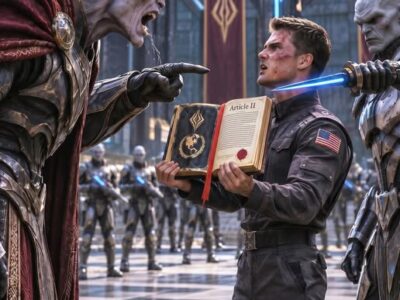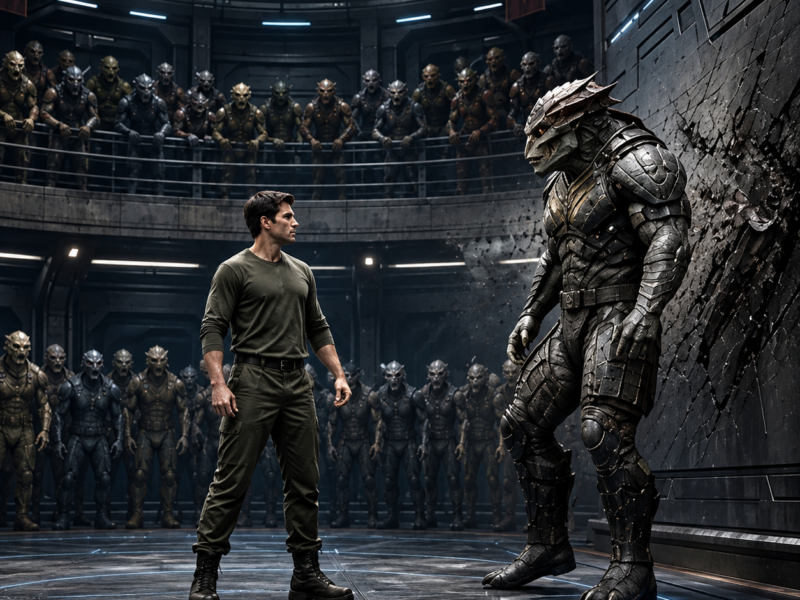
The alien champion shattered his fist against my jaw in front of the entire Galactic Combat Academy, then laughed when I stumbled to one knee, but when the medical scanners began screaming and the instructors saw what my blood was doing to their supposedly indestructible training floor, every officer in the arena suddenly ordered the doors sealed.
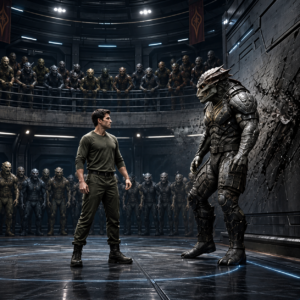
The klaxons did not wail.
They screamed.
It was a sharp, shrieking pulse that drove needles directly into the center of my skull.
Above us, the massive titanium-lattice bulkheads slammed down one after another, cutting off the sunlight of the outer rim.
The entire southern quadrant of the arena plunged into an eerie crimson half-light.
I knelt on the adaptive combat floor, my chest heaving like a bellows.
Every single breath felt like inhaling crushed glass.
My left forearm hung at an awkward, sickening angle, the bone fractured cleanly under the sheer kinetic shock of Brakk’s final blow.
Yet the pain was already changing.
It wasn’t dulling.
It was turning hot, vibrating through the marrow of my arms and legs like an electric current.
On the mat, three inches below my chin, a puddle of my blood was hissing.
The floor of the Galactic Combat Academy was forged from living polymetal, designed to absorb mortar fire and heal itself within seconds.
Right now, that metal was bubbling.
It wasn’t melting from acid or dissolving under heat.
It was mutating.
Crystalline tendrils were shooting out from the red droplets, hardening into black, jagged spikes that gnawed into the arena’s indestructible foundation.
Brakk had backed up until his massive spine struck the reinforced safety glass of the spectator pit.
His blue skin had drained into a dull, chalky gray.
His three-fingered hands shook so violently that he dropped his brass sparring grips onto the mat with a sharp clatter.
“Chief… Chief Vaelen…” Brakk rasped, his voice tearing in his throat.
“Get me out of this ring.”
Chief Instructor Vaelen stood forty paces away on the observation bridge.
The tall, slender alien had four eyes, and all four were fixed on the tactical terminal humming above his station.
“Nobody moves,” Vaelen commanded over the central broadcast.
His voice was dead of all its usual cold arrogance.
“No cadet leaves their tier. Perimeter turrets, initialize kinetic lock.”
A deafening whine filled the coliseum as sixty heavy defense cannons descended from the vaulted ceiling.
They did not aim at Brakk.
Every single targeting laser converged on the small of my back.
A grid of emerald dots burned into my sweat-soaked compression shirt.
“Instructor?” I asked, wiping my lip with the back of my uninjured hand.
The smear of crimson left on my skin felt warm—uncomfortably warm, like fresh tea.
“Is the match over?”
Vaelen did not look down at me.
He couldn’t tear his eyes away from the main display where ancient, forbidden code was scrolling in cascading waterfalls of green text.
“cadet Reed,” Vaelen whispered, his voice trembling across the arena speakers.
“Do not inhale deeply. Do not move your fingers. Do not tense your muscles.”
“Why?” I asked, pushing my boots against the floor to stand.
“Because the scanner says your heart rate is exceeding biological parameters,” Vaelen shouted, panic finally cracking through his composure.
“Because if your pulse hits one hundred and forty, the failsafe inside your collarbone will ignite!”
I froze.
My collarbone?
I reached up with trembling fingers, pressing against the hollow beneath my throat.
Just beneath the skin, something hard and rectangular shifted.
I had had that little lump since childhood.
My adoptive father, Arthur Reed, had told me it was scar tissue from a collarbone break when I was an infant.
He said I fell out of a high crib back in our farmhouse in upstate New York.
He said he held me while the country clinic stitched me back together.
Pain is information, son. Fear is a decision.
That was what he always said.
Was that a father comforting a child?
Or a handler reciting a protocol?
The ground shuddered.
It was not an earthquake.
It came from directly below our feet, deep in the bedrock beneath the combat floor.
THUD.
The vibration was so heavy it made my teeth rattle.
It sounded like a hydraulic fist striking five feet of reinforced steel.
THUD.
In the upper tiers, three thousand alien cadets jumped to their feet in sheer panic.
They were princes of warrior dynasties, scions of interstellar conquerors, bred for brutality.
And every single one of them was staring at the floor beneath me with pure, unvarnished terror.
On the main console, the English text blinked once, then cleared.
A new line of black lettering etched itself into the glowing glass:
BARRIER INTEGRITY: 84%. SUBJECT DESIGNATION: PROJECT PROMETHEUS.
The voice inside my skull returned.
It wasn’t a memory of a voice.
It was clear, pristine, echoing through the chambers of my mind as if someone were standing two inches behind my ear.
“They took your name, little bird,” the woman whispered.
“They gave you a quiet life on a dead world so you would never learn to burn.”
My vision exploded into static.
The arena vanished.
For three seconds, I wasn’t in the Galactic Academy at all.
I was strapped into an upright glass capsule filled with golden, viscous liquid.
Cold needles were sunk into my temples, feeding numbers, combat equations, and orbital ballistic data directly into my cerebral cortex.
On the other side of the glass, a woman with my jawline and my dark, unyielding eyes was pressing her hand against the pane.
She was wearing a black flight suit bearing an insignia I had never seen before: a serpent coiled around a burning Earth.
Behind her, alarms were flashing, and smoke was pouring through the blast doors.
“Run with him, Arthur!” she screamed over her shoulder to someone out of sight.
“Wipe his core! If the Coalition finds out what we engineered in his blood, they will glass the entire solar system!”
The vision shattered.
I was back on the mat.
Brakk took another step back, his boots splashing into a puddle of radiator coolant.
“Reed,” he stammered, pointing a shaking claw at my arm.
“Your… your arm.”
I looked down.
The jagged break in my left forearm was resetting.
Beneath the bruised, torn skin, the muscle fibers were braiding together with an audible, wet snap.
The bone slid back into alignment with a sickening crunch that should have made me black out.
I didn’t feel pain.
I felt power.
A blinding, predatory surge of adrenaline that smelled like ozone and burning steel.
Vaelen’s voice broke over the intercom, shrill and frantic.
“Authorization Code: Crimson Zero! Fire the dampeners! Drop him now!”
The sixty turrets above my head whined in unison as they charged their concussive payloads.
And beneath the floor, the heavy iron door slammed again, splitting the living metal of the arena right down the center.
The Code Beneath the Skin
The blue concussive beams hit me before I could raise my hands.
Each shot packed the kinetic force of a high-speed freight transport, engineered to incapacitate rogue megafauna and rampaging siege beasts.
The first impact caught me squarely in the chest.
I expected my ribs to cave in.
I expected my heart to burst.
Instead, the kinetic energy seemed to spread across my skin, dispersing outward in a brilliant ripple of violet light.
My boots slid three feet backward across the ruined mat, carving smoking furrows through the synthetic composite.
“What?” the weapons technician on the upper deck shouted.
“Direct hit! Shield dissipation registered at ninety-eight percent!”
“Keep firing!” Vaelen screamed, his composure completely gone.
“Do not let the pulse stabilize!”
Another volley rained down.
Dozens of searing blue bolts slammed into my shoulders, my back, my uninjured wrist.
Each impact drove me an inch lower, forcing my knees to bend, but the pain wasn’t stopping me.
It was waking up sections of my brain that had slept in darkness for eighteen years.
Suddenly, I knew the firing cycle of the turrets.
I knew the cadence of the capacitor recharges.
I knew that the third gun from the left had a micro-fracture in its focusing lens that delayed its cycle by zero point four seconds.
How did I know that?
I had never studied alien automated defense systems.
I was just an orphan from Syracuse, New York, who had placed top three in the unified physical aptitude tests.
You’re special, Mason, my father had told me on the porch the night before my shuttle left.
He had looked at me with eyes hollowed out by radiation poisoning from the border wars.
They’re going to tell you that you’re weak because you bleed red and need air.
Don’t you ever believe them.
You carry the whole graveyard inside you, kid.
Now, standing under the barrage of sixty cannons, I understood what he meant.
The blood dripping from my broken knuckles wasn’t pooling anymore.
It was evaporating, turning into a fine, crimson mist that hung in the air like a shroud.
Every breath of that mist made my vision sharper.
I could see the individual dust motes drifting through the laser sights.
I could see the rapid pulse of Brakk’s throat vein from twenty yards away.
The cadet stood frozen against the barrier, his chest heaving with terrified sobs.
“Please,” Brakk whispered, covering his head with his massive arms.
“I didn’t know. By the Ancestors, I didn’t know what you were.”
“Cadet Reed!” Vaelen’s voice boomed over the speakers, shifting tone from authority to desperate negotiation.
“Surrender your stance! Drop to the floor and place your hands behind your head!”
“If you do not comply, we will vent the atmosphere from the entire arena!”
“You’ll suffocate every alien cadet in the lower three rows,” I said.
My voice didn’t sound like mine.
It was lower, resonant, carrying an unnatural harmonic that caused the arena’s audio receivers to squeal in feedback.
Vaelen went silent.
He looked at the junior officers flanking his console.
None of them moved to initiate the atmospheric purge.
They knew I was right.
The air scrubbers couldn’t selectively vent just the ring; the containment protocols were hardwired to the sector.
To kill me, they would have to execute four hundred sons and daughters of the Galactic Senate’s most powerful families.
Then the floor buckled.
A triangular fissure opened five yards in front of me, spewing ancient, oily dust into the air.
A sound followed—a mechanical screech like gears grinding without lubrication after centuries of silence.
From the dark slit in the floor, an iron elevator platform began to rise.
It was not sleek like the rest of the academy’s hyper-advanced architecture.
It was heavy, utilitarian, bolted together with thick, black industrial rivets.
Stamped across the rusted railing in faded yellow stencil was a single word:
VANGUARD.
The crowd went entirely still.
Even the automated turrets paused their barrage, their targeting systems confused by the sudden appearance of an unregistered structure within the arena perimeter.
“The Sub-Level Nine vault,” Chief Vaelen murmured, his microphone picking up his terrified gasp.
“The sealed sector… it’s opening.”
The elevator reached floor level with a thunderous clunk that shook the bleachers.
Standing in the center of the platform was no monster.
It was a machine.
Eight feet tall, forged from matte-black armor plates scarred by ancient burns and ballistic indentations.
It had no face, only a single horizontal visor glowing with a dull, amber slit.
Its right arm ended in a three-barrel rotary autocannon; its left was a massive hydraulic crushing claw.
Draped over its shoulders was the tattered remains of a banner.
The flag was faded, stained with dried oil and scorched by plasma fire, but the pattern was undeniable.
Thirteen red and white stripes.
A field of blue with fifty faded stars.
The war machine stepped forward, its magnetic joints clicking into lock with the arena floor.
Its amber visor flickered, sweeping across the rows of alien spectators, past the panic-stricken instructors on the bridge, past Brakk cowering in the corner.
Then its optical sensor locked directly onto me.
The machine did not raise its weapons.
Instead, the massive iron titan slowly dropped onto its right knee, driving its fist into the shattered deck in a gesture of absolute fealty.
A synthesized voice tore through its rusted external speakers, deep and gravelly, sounding like stones grinding in an avalanche:
“Unit 704, Iron Vanguard, online.”
The machine bowed its head.
“Awaiting your orders, Commander Matthew.”
A Name Carved in Fire
The word hit me harder than Brakk’s fist.
Matthew.
A sharp, searing pain tore through the base of my skull, right where the spine met the brain stem.
Memories that did not belong to my eighteen years of life came crashing through the mental floodgates like a tidal wave of ice water.
I saw orbital shipyards burning above Jupiter.
I saw thousands of drop pods streaking through the atmosphere of a red world like falling stars.
I saw myself—or someone who wore my exact face—standing on the command bridge of a super-dreadnought, issuing orders that condemned entire fleets to the dark.
They called us monsters because we didn’t stop, a voice resonated in my chest.
They called us demons because when our ships broke, we rammed theirs.
When our guns emptied, we fought with knives.
“Commander,” the machine croaked, its ocular sensor flaring from amber to blood-red.
“Hostile locks detected on your person. Sixty automated emplacements.”
“Designate targets: hostile.”
“Requesting permission to initiate purge protocol.”
“Stand down!” Vaelen screamed, his voice cracking into a high-pitched shriek.
“Security teams, engage! Destroy that relic!”
From the perimeter doors, forty armored guards poured into the arena.
They were elite Praetorians, armed with heavy plasma lances and hard-light tower shields.
They moved with textbook precision, fanning out in a crescent formation to flank the kneeling war machine.
“Don’t shoot!” I yelled, taking a step toward the guards.
“Wait! There’s been a mistake! I don’t know what this machine is!”
The lead guard did not listen.
He leveled his plasma lance and pulled the trigger.
A bolt of blinding emerald heat shot across the floor, aimed directly at my chest.
Before the beam could travel ten feet, the black machine moved.
It moved with a speed that defied physics, its eight-ton frame blurring across the floor with the agility of an apex predator.
The heavy hydraulic claw snapped forward, intercepting the plasma bolt mid-air.
The heat exploded against the machine’s armored gauntlet in a shower of brilliant green sparks, leaving not even a scorch mark on its blackened plating.
“Threat confirmed,” the machine said.
Its voice was no longer gravelly.
It was calm.
Mechanical.
Absolute.
“Hostiles have engaged the Fleet Commander. Authorization granted under the Terran Survival Mandate.”
The three-barrel rotary cannon spun up with a terrifying, rising whine.
BRRRRRRRRRRRRRRRRRRRRRT.
The noise didn’t sound like blaster fire.
It sounded like canvas being torn apart in a hurricane.
A stream of solid, kinetic tungsten penetrators tore through the air at four thousand feet per second.
The Praetorians’ hard-light shields shattered on contact like cheap glass.
The kinetic rounds tore through the safety barriers behind them, shredding the decorative pillars and turning the reinforced arena walls into smoking rubble.
The guards were thrown backward through the air by the sheer concussive pressure waves, their armor dented, their weapons shattered in their hands.
None of them were dead.
The machine had deliberately aimed low, taking out their legs and their weapon arrays with horrifying, pinpoint accuracy.
In less than three seconds, forty elite galactic guards were neutralized on the floor, groaning in the dust.
The arena went deathly quiet.
The only sound left was the mechanical whine of the machine’s cannon slowly spinning down, its barrels glowing cherry red.
The alien cadets in the high stands were huddled against the walls, weeping in silence.
They had spent centuries looking down on humanity as a second-class species, a weak, sentimental race allowed into the galactic fold out of charity.
Now they were looking at what humanity had been before the treaties.
Before the memory erasures.
Before the pacification.
“What did you do to them?” I breathed, staring at the ruined security line.
The machine turned its head toward me, the red visor softening slightly.
“Non-lethal neutralization, Commander. In accordance with your standing orders from the Siege of Orion.”
“I was never at Orion,” I whispered, clutching my throbbing temples.
“I was born in a clinic in Buffalo. My father was a truck driver.”
“Your father was Colonel Arthur Vance,” the machine replied evenly.
“Chief Geneticist for the Terran Resistance. He did not raise you, Commander. He hid you.”
A holographic projector on the machine’s chest clicked open.
A blue beam painted a flickering display in the smoke between us.
It was a personnel file bearing the seal of the United Earth Directorate.
In the center was a photograph of a woman.
She had the same sharp green eyes, the same stubborn set of her jaw, the same scar across her left eyebrow that I had carried since childhood.
Her name was Admiral Sarah Reed-Vance.
Commander of the First Expeditionary Fleet.
Under her name was a single, chilling line of text:
STATUS: EXECUTED BY GALACTIC COALITION TRIBUNAL, YEAR 2742.
CRIME: ENGINEERING THE HYBRID WEAPON DESIGNATED ‘PROJECT PROMETHEUS.’
My heart skipped a beat.
My mother hadn’t died in a transport crash.
She had been murdered.
And the people who signed the order were the very ones running this academy.
Above us, the high glass of the command bridge shattered outward.
Vaelen was no longer behind the console.
A massive blast door at the rear of the arena began to slide open, revealing a company of heavy battle mechs bearing the crimson insignias of the Galactic High Council.
“Cadet Reed!” Vaelen’s voice echoed through the emergency sirens.
“You have unleashed an outlawed war engine! By order of the Council, your life is forfeit!”
The machine beside me stepped forward, shielding me with its massive armored bulk.
“Commander,” it said softly.
“Our ammunition is at twelve percent. Hostile reinforcements exceed five hundred units.”
“What are your orders?”
I looked at my hand.
The skin had completely healed.
The blood that coated my palms was glowing with a faint, bioluminescent light.
“We don’t run,” I said.
The machine’s optic flared brilliant crimson.
“Understood, Sir. Initiating total warfare protocol.”
Echoes from the Glass Chamber
The air in the arena tasted like scorched iron and ozone.
The floor beneath us continued to groan as the heavy battle mechs stepped through the shattered blast doors.
They were four-legged walkers, each crowned with twin heavy plasma mortars and pulse-cannons designed to level city blocks.
Each step shook the foundations of the coliseum.
“Unit 704,” I said, my voice steadying despite the chaos.
“Analysis.”
“Ten heavy combat walkers,” the machine replied instantly.
“Class-Four defensive barriers. If they fire their primary ordnance simultaneously, this entire mountain facility will collapse.”
“Can you penetrate their shields?”
“Negative, Commander. Not with standard kinetic ammunition.”
The machine reached behind its back, unlatching a long, cylindrical canister mounted along its spine.
The canister hissed open, venting super-chilled nitrogen gas into the heated air.
Inside lay a heavy black carbine, its frame wrapped in thermal insulation tape.
It looked ancient, but its power cells were humming with a low, deep vibration that made the hair on my forearms stand on end.
“The Prototype,” Unit 704 said, offering the weapon to me with both hands.
“Calibrated specifically for your bio-signature. Only a carrier of the Prometheus marker can trigger the ignition coil.”
I reached out.
The moment my bare fingers touched the matte-black metal, a sharp needle fired from the grip, piercing the skin of my palm.
I gasped, trying to pull back, but the weapon locked onto my hand.
My blood was drawn into the transparent fuel lines running along the barrel.
The dark fluid pulsed, igniting into a brilliant, blinding violet flame that raced along the weapon’s cooling fins.
The rifle didn’t run on plasma or chemical batteries.
It ran on me.
GENETIC KEY CONFIRMED: COMMANDER MATTHEW REED-VANCE.
WEAPON SYSTEM: EXODUS CANNON ONLINE.
A flood of tactical schematics poured directly into my visual cortex.
The heads-up display didn’t appear on a screen; it projected directly across my retinas.
I saw the structural stress points of the enemy walkers highlighted in brilliant red.
I saw the heat sinks behind their primary armor plates.
I saw the exact arc their shells would travel before they even cleared the barrels.
“Fire!” Vaelen’s command crackled through the comm-links of the lead walker.
The heavy mortar atop the walker flared green.
A ball of superheated plasma launched into the air, arcing directly toward the spectator tiers where hundreds of innocent cadets were still pinned against the walls.
“He’s going to wipe out his own students!” I shouted.
“They are deemed acceptable casualties to ensure containment,” Unit 704 stated coldly.
I didn’t think.
I didn’t calculate.
My body moved on instincts honed centuries before I was ever born.
I raised the Exodus Cannon to my shoulder, sighting the plasma shell mid-flight.
The recoil was massive, driving me back half a step, but the violet beam that lanced from the barrel was absolute.
It didn’t just strike the plasma shell; it erased it.
The projectile detonated in mid-air in a brilliant flash of clean white light, leaving nothing behind but harmless vapor.
The shockwave blew out the rest of the arena’s decorative banners, sending them fluttering down in burning rags.
The lead walker paused, its pilot clearly stunned that a handheld firearm had intercepted an artillery shell.
“Unit 704, cover the western flank,” I barked.
“Keep those turrets from locking on the bleachers.”
“Sir!” the machine responded.
It sprinted across the ruined combat floor, its autocannon barking in short, controlled bursts that shredded the remaining ceiling turrets one by one.
I lowered my sights onto the lead walker.
The violet light in the rifle’s core pulsed faster, matching the rhythm of my accelerating heartbeat.
I could feel my blood being siphoned away, but there was no weakness.
My bone marrow was producing new cells at an impossible, terrifying rate.
My senses expanded until I could hear the hydraulic fluid pumping through the walker’s knee joints.
“Targeting primary heat exchanger,” I whispered.
I squeezed the trigger.
A beam of violet energy punched through the walker’s hard-light barrier like paper, drilling cleanly through six inches of composite armor.
The machine shuddered.
A second later, its rear power core ruptured in a silent, contained implosion that crumpled the walker’s frame inward like a crushed tin can.
The pilot ejected through the top hatch, landing roughly on the mat thirty feet away.
The remaining nine walkers halted their advance.
Their weapon arrays flickered, uncertain how to engage a single human who was dropping siege-class armor with individual rifle shots.
From behind the ranks of walkers, a small figure stepped forward into the haze of smoke.
It was not an alien.
It was an old man, dressed in the formal gray uniform of the United Earth Diplomatic Corps.
His hair was pure silver, his posture rigid as a bayonet.
He leaned heavily on a black cane, but his eyes were bright, cold, and calculating.
In his left hand, he carried a small, silver remote control with a single illuminated red switch.
“That’s far enough, Matthew,” the old man said.
His voice wasn’t broadcast through the speakers.
It was quiet, but it carried effortlessly across the silent arena.
I lowered the rifle an inch, staring at him through the drifting smoke.
“Uncle Thomas?” I whispered.
The man who had signed my academy recommendation letters smiled thinly.
“You always were too stubborn to stay in the crib, son.”
The Architect of Lies
The man who called himself my uncle stood forty yards away, perfectly composed amidst the burning wreckage of the academy floor.
Thomas Reed.
He had been the one who brought me toy starships on my tenth birthday.
He had been the one who paid for my flight training on the orbital stations over Earth.
He was the one who told me that my parents died heroes in a solar flare accident when I was three.
“You’re not my uncle,” I said, my grip on the Exodus Cannon tightening until the metal groaned under my fingers.
“No,” Thomas said, taking a slow step forward.
His cane clicked softly against the cracked polymetal deck.
“I am the Administrator of the Terran Containment Initiative. And your legal guardian under the Geneva-Centauri Accords.”
“You lied to me,” I said.
Every word felt like pulling barbed wire through my throat.
“My whole life. The farm. The school. My father’s military pension. All of it was fake.”
“Not fake, Matthew. Necessary.”
Thomas stopped ten paces away, completely unfazed by the glowing rifle pointed directly at his chest.
Behind him, the nine remaining walkers stood with their weapons aimed at my head, waiting for a signal.
“Two hundred years ago,” Thomas said, his voice measured and calm, “humanity pushed the Coalition to the brink of complete annihilation.”
“We weren’t the peacekeepers of the galaxy. We were the terrors of the Orion Spur.”
“Your mother, Sarah, engineered a generation of humans whose biology adapted instantly to any lethal environment.”
“She made warriors whose blood could corrode armor, whose bones could regenerate in seconds, whose minds could interface directly with planetary war networks.”
Thomas looked down at the puddle of my blood still hissing against the arena floor.
“You were the pinnacle of that program. The master key. The first child born with the complete Prometheus genome.”
“If you were so afraid of me,” I asked, “why didn’t you just kill me when I was a baby?”
Thomas chuckled, a dry, rattling sound.
“Because we couldn’t.”
He tapped his cane on the deck.
“Sarah installed a dead-man’s protocol in your DNA. If your vital signs ceased before your eighteenth year, a signal would broadcast across the dark sectors.”
“Three hundred automated Vanguard factories, hidden inside dormant asteroids, would wake up and finish the war.”
“The only way to save Earth from total glassing was to hide you. Suppress your memories. Let you believe you were just an ordinary boy from a dying planet.”
“And then you sent me here,” I said.
“To the Galactic Academy. Where alien cadets beat each other bloody every single day.”
Thomas’s smile faded.
“That was your father’s doing. Arthur betrayed us before he died.”
“He altered your academy placement scores. He wanted you to come here. He wanted the pressure, the violence, the combat trauma to break your suppression seals.”
“He wanted the war to start again.”
A cold wind swept through the shattered arena, carrying the smell of burning coolant and old blood.
Beside me, Unit 704 took a half-step forward, its mechanical joints humming.
“Administrator Thomas Reed identified,” the war machine rasped.
“Designation: Traitor to the Directorate. Bounty: Immediate termination.”
“Quiet, rust-bucket,” Thomas snapped, raising the small silver device in his hand.
“Do you know what this is, Matthew?”
He held the remote higher so I could see the glowing indicator.
“It’s the detonation trigger for the neural dampener we buried under your collarbone twelve years ago.”
“If I press this button, thirty milligrams of neurotoxin will flood your brain stem.”
“It won’t kill you—your Prometheus cells won’t let you die.”
“But it will turn your mind into static. You’ll spend the next eighty years sitting in a white room, staring at a wall, drooling into a cup.”
“Drop the rifle.”
My heart hammered against my ribs.
I looked at Thomas.
I looked at the silver remote in his hand.
The HUD projected across my vision was feeding me probabilities.
Target acquisition time: 0.12 seconds.
Target thumb actuation time: 0.08 seconds.
He was faster.
If I raised the rifle, he would press the button before the trigger could break.
“You don’t have to do this,” I said, my voice barely audible over the sirens.
“I don’t want a war. I just wanted to be a pilot.”
“There are no pilots in your family, Matthew,” Thomas said coldly.
“Only weapons and casualties.”
“Now drop the gun. Or I erase you.”
I looked down at the Exodus Cannon.
The violet light in the barrel was fading, starved of the blood that fueled its ignition core.
Slowly, deliberately, I lowered the barrel toward the deck.
Thomas smirked.
“Good boy. Just like your father. Soft when it counts.”
He raised his thumb to the switch anyway.
“Unfortunately for you, the Coalition has already decided. A weapon that wakes up cannot be put back in the drawer.”
His thumb pressed down.
The Will to Break
The click of the button was tiny, almost imperceptible beneath the roar of the facility sirens.
In an instant, an explosion of pure, searing agony detonated at the base of my throat.
It felt as though someone had driven a white-hot railroad spike directly beneath my collarbone.
A thick, oily heat spread outward, creeping up the sides of my neck and down into my lungs.
My vision went instantly black.
The Exodus Cannon clattered out of my hands, hitting the floor with a hollow metallic thud.
I dropped to both knees, clawing desperately at the skin beneath my collarbone, tearing through fabric and flesh with my own fingernails.
“Matthew!” Unit 704’s voice sounded distant, warped, as if coming from the bottom of a deep well.
The war machine lunged forward to interpose itself, but a barrage of plasma fire from the nine walkers caught it squarely in the torso.
The kinetic impacts threw the eight-ton machine backward, skidding through the rubble until it crashed into the arena wall, pinned beneath tons of collapsed steel.
I was on the floor, gasping for air that wouldn’t enter my lungs.
The neurotoxin was doing its work.
My nervous system was shutting down, sector by sector.
First went my hands, the fingers curling into rigid, unresponsive claws.
Then went my legs, turning to heavy lead weights that pinned me to the floor.
Thomas Reed walked toward me, his heavy boots crunching on the glass shards.
He stood directly above my convulsing body, looking down with cold, clinical detachment.
“Fascinating,” he murmured, pulling a small diagnostic tablet from his jacket.
“The synthetic toxin is designed to shut down an adult Korrath in three seconds.”
“Your metabolic rate is burning through it, synthesizing antibodies in real time.”
“It won’t save your mind, of course. But your body… your body is truly magnificent.”
I tried to speak, but only a wet, choking gasp escaped my lips.
My consciousness was shrinking into a pinprick of cold light.
The memories of the farm in upstate New York—the smell of freshly cut hay, the creak of the front porch swing, the warm yellow light in the kitchen window—were dissolving into gray mist.
They had been a lie.
A warm, comfortable lie designed to keep a monster asleep in his cage.
Is that what you are? a voice asked in the darkness of my mind.
It was my mother’s voice again.
Clear.
Unyielding.
Fierce.
They tell you that you are a weapon so you will act like one.
They tell you that you are a monster so you will obey their chains.
A weapon has no choice, Matthew.
A man does.
Do you choose to die on your knees for their peace?
“No,” my mind whispered back.
Then stop fighting the poison.
Consume it.
The shift was instantaneous.
Deep within my cellular structure, the dormant Prometheus markers ceased resisting the neurotoxin.
Instead of filtering it out, my cells opened their membranes and absorbed the chemical compound directly into their mitochondria.
The poison wasn’t killing me anymore.
It was fuel.
The white-hot agony in my neck turned into a surge of cold, razor-sharp clarity.
My retinas flared with blinding gold light.
I stopped convulsing.
I stopped gasping.
I lay perfectly still on the deck, my eyes staring blankly at Thomas’s polished boots.
Thomas lowered his tablet, satisfied.
“Neuro-activity dropped to five percent,” he said to the walkers behind him.
“The subject is lobotomized. Prepare the stasis container. Ship him to the black site on Triton.”
Two technicians in hazmat gear stepped forward with magnetic restraints.
As the first technician reached down to clamp the collar around my throat, my right hand shot up.
My fingers closed around the technician’s wrist with the crushing force of a hydraulic vice.
The composite armor of his gauntlet cracked like an eggshell.
The technician screamed.
I rose from the floor in a single, fluid motion, rising to my full height without using my hands.
Thomas stumbled backward, his face draining of all color.
“Impossible,” he gasped, frantically tapping the remote in his hand.
“The dosage… it was lethal to any organic brain!”
I didn’t answer him.
I looked at the silver remote in his hand.
Then I reached up to my own collarbone.
Without hesitation, I drove my thumb and forefinger three inches deep into my own flesh.
The pain was incandescent, but my hand didn’t shake.
My fingers closed around the rectangular titanium housing of the neurotoxin dampener buried beneath my bone.
With a wet, tearing rip, I wrenched the machine out of my chest and tossed the bloody cylinder at Thomas’s feet.
The wound in my chest was already smoking.
Before the blood could reach my belt, thick cords of fibrous tissue were knitting the torn muscle back together.
The skin closed over the cavity, leaving behind a smooth, pale line of fresh scar tissue.
“My name,” I said, stepping toward him, “is not Matthew.”
Thomas backed away, raising his cane like a club.
“And it isn’t Mason Reed either.”
I knocked the cane out of his hand with a flick of my wrist, sending it clattering fifty feet across the floor.
“Who are you then?” Thomas whispered, trembling against the tracks of a ruined walker.
I looked at the burning arena, at the terrified alien cadets, at the fallen soldiers and the smoking cannons.
“I’m the reason you locked the door.”
The Sky That Burns
The nine heavy battle mechs didn’t wait for Thomas’s orders.
Their automated threat-assessment processors recognized that the target had exceeded Omega-level containment parameters.
All nine walkers fired simultaneously.
Nine high-explosive kinetic shells tore through the air, traveling faster than sound, converging on the five-foot radius where I stood.
I didn’t dodge.
I didn’t try to hide behind the rubble.
Instead, I raised both hands, palms facing outward, and tapped directly into the bio-electric field humming through my blood.
The violet energy didn’t just flow through a rifle anymore.
It erupted directly from my pores.
A spherical shockwave of concussive force exploded outward from my center, colliding with the incoming artillery shells ten feet before they reached me.
The explosion was deafening.
A wall of flame, shrapnel, and concussive pressure washed over the center of the arena, turning the air into an opaque furnace of black smoke.
When the smoke cleared, the kinetic shield had held.
I stood untouched in the center of a crater three yards deep.
The polymetal deck around me had been stripped down to the raw bedrock.
“Unit 704,” I spoke into the communicator link in my ear.
“Status.”
Across the arena, the collapsed pile of girders shifted.
With a grinding screech of tearing iron, the black war machine shoved the debris aside and rose to its feet.
Its left arm had been sheared off at the elbow, and its chest plate was dented and smoking, but the amber slit of its visor still burned bright.
“Operational, Commander,” it replied.
“Ammunition exhausted. Secondary melee protocols active.”
“Fall back to the primary elevator,” I ordered.
“Secure the lower vaults.”
“Sir? You cannot engage nine combat walkers without heavy ordnance.”
“I have ordnance,” I said.
I looked up at the vaulted ceiling of the arena, five hundred feet above my head.
Beyond the reinforced glass skylights lay the upper atmosphere of the planet, where the Galactic Coalition’s orbital defense network maintained an unyielding grip on the sector.
I reached out with my mind.
The Prometheus genome was never just about physical strength or rapid cellular regeneration.
It was an interface.
A biological transmitter engineered to link with the ancient Terran command networks that had been buried across the stars before humanity was forced into submission.
Deep beneath the arena, in the black vaults of Sub-Level Nine, the oldest computer on the station wasn’t just displaying text anymore.
It was transmitting.
A high-frequency signal, masked within the chaotic static of the battle, beamed directly into the upper atmosphere.
Twenty seconds passed.
Thirty.
Thomas Reed dragged himself upright against the chassis of a walker, his eyes wild with terror.
“You’re too late, boy!” he screamed over the howling wind.
“The Coalition Fifth Fleet is stationed three light-minutes away!”
“A battlecruiser is already dropping out of warp in the upper atmosphere!”
“They will vaporize this entire quadrant from orbit before you ever leave this floor!”
As if on cue, the clouds above the shattered skylight turned from pale gray to angry, burning orange.
A massive, wedge-shaped shadow descended through the cloud deck.
It was a Coalition Dreadnought, three miles of gleaming white hull plated in reflective armor, armed with enough plasma lances to scour a continent clean of life.
The ship hovered two miles above the academy, its massive maneuvering thrusters kicking up a hurricane that tore the remaining glass panels from the roof.
The alien cadets cheered from the high stands, believing their salvation had arrived.
Chief Instructor Vaelen crawled to the edge of the observation bridge, raising his hands toward the descending leviathan.
“Purge the ring!” Vaelen screamed into his comm.
“Purge the entire sector!”
The Dreadnought’s belly opened.
A massive, crystalline focusing lens began to charge with blinding, sun-white energy, aiming straight down through the open roof of the arena.
The targeting beam painted a circle of light that enclosed me, Thomas, and the nine walkers.
“You see?” Thomas laughed, hysterical with relief.
“You’re nothing! An obsolete relic of a dead empire!”
I didn’t look at him.
I looked up at the Dreadnought.
“Unit 704,” I said calmly.
“Did my mother leave a back door in their fleet command?”
The war machine stopped in the elevator doorway, its head tilting slightly.
“Admiral Sarah Reed-Vance authored eighty percent of the automated navigation algorithms currently utilized by the Coalition Fleet, Commander.”
“Did they ever change the master encryption keys?”
“They believed they did,” the machine replied.
“They were mistaken.”
I closed my eyes.
The link in my mind locked onto the massive warship hovering in the burning clouds above us.
I spoke a single string of alphanumeric code, whispered in a dead dialect of old Terran that hadn’t been heard in space for three centuries.
Above us, the Dreadnought’s sun-white charging beam instantly died.
The ship’s navigation thrusters fired erratically, tilting its massive bow twenty degrees off axis.
The white lights along its three-mile hull flickered, died, and then reignited.
Not white.
Crimson.
Across the ship’s massive external broadcast arrays, a voice broke through every radio channel on the planet:
VESSEL OVERRIDE DETECTED.
WELCOME BACK, ADMIRAL.
The Iron Harvest
The dreadnought did not fire upon the academy.
It turned.
Its massive bow swung slowly across the sky, pointing its primary batteries away from the surface and toward the open stars.
On the bridge of the warship, hundreds of alien officers were frantically battling controls that no longer responded to their touch.
The ship’s secondary comms opened, broadcasting directly into the arena’s central PA system.
“Mayday! Mayday!” an alien bridge officer screamed over the static.
“All systems locked! Life support rerouted! Main drive under remote guidance!”
“Something has taken the ship!”
Thomas Reed collapsed to his knees, his hands digging into the shattered gravel of the arena floor.
His mouth opened and closed silently, like a fish gasping for air on a dry dock.
“No…” he whimpered.
“That’s… that’s a seventh-generation Coalition warship. It’s completely isolated from Terran networks.”
“Nothing is isolated,” I said, walking slowly toward the center of the ring.
“My mother didn’t just design weapons, Thomas. She designed the infrastructure.”
“You built your empire on the bones of our technology, and you thought changing the language on the monitors would keep you safe.”
I looked down at the nine remaining battle walkers.
Their pilots were scrambling to open their top hatches, abandoning their machines in sheer panic as they saw their own flagship turn rogue above them.
“Cadet Reed!”
The voice came from behind me.
I turned.
Brakk was still there.
The seven-foot warrior who had mocked me, who had broken my arm, was standing ten yards away.
He had picked up a discarded plasma pistol from the floor.
His hands were shaking so violently that the barrel wobbled in small, frantic circles.
“Brakk,” I said softly.
“Put it down.”
“You’re a demon,” Brakk choked out, tears cutting tracks through the dust on his blue face.
“They told us humans were harmless! They told us you were weak!”
“You lied to all of us!”
“I didn’t know,” I said, taking a slow step toward him.
“Ten minutes ago, I thought I was just an eighteen-year-old kid who wasn’t good enough to make the varsity squad.”
“I didn’t choose this blood, Brakk.”
“Then let them kill you!” he screamed, his finger tightening on the trigger.
“If you live, they’ll burn my homeworld! They’ll burn every system that signed the treaty!”
“Nobody is burning your homeworld,” I said.
Before he could pull the trigger, I closed the distance between us.
I didn’t use a weapon.
I didn’t strike him with the crushing force that had shattered the arena floor.
I simply reached out and placed my hand over the barrel of his pistol, gently pushing it down toward the deck.
Brakk froze.
He looked down at my hand.
The skin was smooth, unblemished, free of the blood that had terrified him moments before.
“I came here to learn, Brakk,” I said, meeting his terrified eyes.
“Not to conquer.”
“Now drop the gun.”
Brakk’s fingers went slack.
The weapon hit the floor with a dull thud.
The seven-foot warrior slumped back against the safety barrier, burying his face in his massive hands, weeping silently.
I turned back to Thomas.
The old man was crawling backward, trying to reach the shadows beneath the ruined command bridge.
“Where are you going, Administrator?” I asked.
Thomas froze, looking up at me with eyes full of venom and despair.
“You think you’ve won?” he hissed, spitting a mouthful of blood onto the deck.
“This is one academy on a border world.”
“The Coalition has forty fleets. Ten thousand worlds. Millions of soldiers.”
“The moment word of this reaches the Central Senate, they won’t send peace envoys.”
“They will initiate Protocol Omega.”
“They will deploy the Nova bombs. Earth will be reduced to an asteroid belt.”
I stopped two feet in front of him, looking down into the face of the man who had pretended to be my family for eighteen years.
“They won’t get the chance,” I said.
I tapped the comm-link in my ear.
“Unit 704.”
“Awaiting orders, Commander.”
“Broadcast the Prometheus archives,” I said.
“Every file. Every medical report. Every record of the Coalition tribunals.”
“Transmit it across every open frequency in the galaxy.”
“Let the human colonies see what was done to their ancestors.”
“Let the alien worlds see what their leaders have been hiding in the dark.”
Thomas gasped.
“You’ll cause a civil war across four hundred systems!”
“No,” I replied, turning my back on him.
“I’m just giving everyone the information.”
“What they decide to do with it… is up to them.”
From the open elevator behind me, a low chime echoed through the arena.
The vault doors of Sub-Level Nine had fully opened.
Inside the darkness of the subterranean hangar, rows of amber lights were flickering to life, illuminating dozens of identical war machines standing in silent ranks.
An entire battalion of the Iron Vanguard, asleep for three centuries, waiting for the blood of their commander to wake them.
The Weight of Memory
The elevator descended into the dark beneath the arena with a low, hydraulic groan.
Above us, the sound of sirens and screaming winds faded, replaced by the heavy, rhythmic hum of ancient nuclear reactors.
Unit 704 stood beside me, its one remaining arm resting on the control rail.
“The dreadnought has completed its orbital repositioning, Commander,” the machine reported.
“All hostile weapon systems on the vessel have been disabled.”
“The crew has been secured in the secondary quarters. No casualties reported.”
“Good,” I said, leaning against the cold steel wall of the platform.
The adrenaline that had sustained me through the battle was finally beginning to recede.
A crushing, bone-deep exhaustion washed over me, heavy as ocean water.
My knees buckled.
I caught myself against the railing, breathing hard through my teeth.
“Your bio-readings indicate severe metabolic depletion,” the machine noted, its optical sensor scanning my chest.
“The Prometheus regeneration cycle consumes vast amounts of caloric energy.”
“You require sustained medical nutrition and seventeen hours of uninterrupted sleep.”
“Not yet,” I murmured, staring into the descending gloom.
The platform reached the bottom of the shaft with a heavy, ringing clang.
Sub-Level Nine was not a bunker.
It was a cathedral of forgotten technology.
Massive steel arches stretched hundreds of yards into the distance, supporting ceilings lost in deep shadows.
Lining both sides of the central causeway were hundreds of stasis tubes, identical to the one I had seen in my fragmented memory.
Inside the glass cylinders, figures floated in suspension.
Men and women in black flight suits, their faces peaceful, their chests rising and falling in slow, synthetic hibernation.
“Who are they?” I asked, walking down the long avenue between the glass pillars.
“The First Cohort,” Unit 704 answered, following half a step behind.
“Three thousand engineers, pilots, and genetic specialists selected by your mother.”
“They were placed in cryo-stasis when the Coalition signed the surrender treaty.”
“They were meant to be awakened only when the Prometheus sequence reached full maturity.”
“When I reached eighteen,” I said.
“Affirmative.”
I stopped in front of a central terminal where a massive holographic projector hummed softly.
As I approached, the proximity sensors clicked.
The projector flared to life, painting a full-sized figure in the center of the platform.
It was Sarah.
She wasn’t wearing her battle gear this time.
She wore a simple white shirt and dark trousers, sitting on the edge of a laboratory desk, holding a steaming mug of coffee.
She looked tired, with dark circles under her eyes, but her smile was warm and familiar.
It was the same smile I had seen in old, faded photographs on the mantelpiece in New York.
“If you’re watching this,” the recording began, her voice soft and textured, “then Arthur did his job.”
“And you survived your first real fight.”
A lump formed in my throat, thick and painful.
“I’m sorry, Matthew,” she said, looking directly into the camera lens as if she could see me standing there through the centuries.
“I’m sorry we had to put this burden on your shoulders.”
“We tried to build a world where you wouldn’t need to be a weapon.”
“We tried to negotiate. We tried to share our science. We tried to be partners in this galaxy.”
Her smile faded, replaced by a cold, hardened sorrow.
“They didn’t want partners. They wanted subjects.”
“They were terrified of our potential, so they decided to clip our wings and rewrite our history.”
She set her mug down on the desk and leaned forward, resting her hands on her knees.
“You have every right to hate us for what we did to you.”
“We engineered your blood. We buried a war machine in your mind.”
“We gave you a past full of ghosts and a future full of battles.”
“But remember this, son:”
“A weapon only destroys.”
“A commander decides what is worth protecting.”
“Don’t fight for our revenge. We’re already dead.”
“Fight for the people who are still living in the dark.”
The recording flickered, the light dimming as the power cells reached the end of the loop.
Sarah raised her right hand, pressing her fingers against the glass of the projector.
“I love you, Matthew.”
“Live a good life.”
The hologram dissolved into sparkling blue dust, leaving only the cold hum of the ventilation system.
I stood there in the dark for a long time, my hand pressed against the empty air where her image had been.
Behind me, Unit 704 bowed its head.
“The transmission to the outer colonies has been completed, Commander.”
“Replies are already arriving.”
“From where?” I asked, wiping my eyes with the back of my hand.
“From the mining stations in the Belt. From the orbital platforms above Mars.”
“From forty-seven human transport ships currently en route to the Core Worlds.”
“What are they saying?”
The machine looked up, its red visor glowing softly in the shadows of the vault.
“They are asking for their orders, Sir.”
The Long Road Home
We did not leave the academy in fire.
Three days after the battle on the combat mat, the central blast doors of the lower hangar opened onto the frozen peaks of the mountain range.
A light snow was falling, dusting the black armor of Unit 704 and the long coat I had taken from the academy supply depot.
Behind us, the Galactic Combat Academy was quiet.
The alien cadets had not been harmed.
The instructors had been allowed to return to their quarters under the supervision of the local planetary militia.
Vaelen had resigned his post, boarding the first diplomatic transport back to his homeworld without uttering a single word to the press.
Brakk had met me at the hangar gates that morning.
He hadn’t looked at me with terror.
He had looked at me with something far more dangerous: respect.
“Where will you go?” the Korrath asked, wrapping his thick winter furs around his broad shoulders.
“Earth,” I answered.
“The Coalition Council will not allow you to land.”
“The Coalition Council doesn’t control the airspace anymore,” I said, glancing up at the gray sky.
Above the cloud deck, the hijacked dreadnought was waiting, joined by three dozen human cargo vessels and retrofitted corvettes that had broken formation from the trade lanes to join us.
They weren’t an invasion fleet.
They were an escort.
Brakk nodded slowly, then reached out his massive hand.
“When you return,” he said, “I will be ready for that rematch.”
I took his hand.
His grip was strong, but mine was steady.
“Don’t rush it, Brakk,” I said with a faint smile.
“I heal pretty fast now.”
He let out a short, booming laugh that echoed off the frozen stone walls, then turned and walked back toward the academy compound.
I turned toward the transport shuttle waiting on the landing pad.
Its ramp was down, illuminated by the warm yellow lights of the interior bay.
Thomas Reed sat inside the containment cell in the rear of the shuttle, his gray uniform rumpled, his head bowed in defeat.
He wouldn’t be executed.
He would stand trial before a unified council of human and alien delegates, where the truth of the last two hundred years would finally be read into the public record.
“Commander,” Unit 704 said, stepping up beside me on the ramp.
“The navigation coordinates have been set.”
“Departure in three minutes.”
I stopped at the top of the ramp and looked back at the academy one last time.
The banners were gone.
The grand arena was scarred and blackened, open to the cold sky.
Eighteen years of my life had been spent believing I was nobody.
An orphan with ordinary dreams, an ordinary future, and a quiet place in the back of the room.
That life was over.
It had burned away on the adaptive floor, dissolved in the smoke of my own ancient blood.
I touched the small, fresh scar beneath my collarbone.
It was smooth.
Clean.
Whole.
I was no longer Mason Reed, the frightened cadet from Syracuse.
And I wasn’t just Matthew, the engineered weapon of a dead war.
I was the bridge between what humanity had been and what we were about to become.
“Take us up, 704,” I said, stepping through the hatch into the warm light of the cabin.
“Let’s go see what’s left of home.”
The shuttle’s heavy engines roared to life, a deep, confident rumble that shook the mountain snow from the wings.
The ramp sealed with a hiss of compressed air.
And as the ship lifted toward the burning stars, the silence of three hundred years was finally broken.
The Dawn of Broken Chains
The journey through the Jump Gates took four days.
Each time our small fleet dropped out of hyperspace into a new sector, the comms channels erupted with chatter.
It wasn’t military traffic.
It was the voices of millions of ordinary people across hundreds of worlds.
“Did you see the broadcast?” a merchant pilot from a Jovian freighter asked over the open hail.
“Is it true? Was the First Fleet deliberately abandoned?”
“They’re showing the medical logs on Mars,” a dockworker from an orbital station chimed in.
“The genome wasn’t a biological weapon. It was an environmental adaptation.”
“They locked us down because they were afraid we wouldn’t need their terraforming tech.”
I sat in the command chair of the shuttle, listening to the static and the voices wash over me.
Every human settlement from the Kuiper Belt to the asteroid belts of Alpha Centauri was waking up.
The fear that had kept our species quiet and compliant for three centuries was evaporating, replaced by an old, familiar stubbornness.
We weren’t an empire of conquerors.
We were survivors.
And survivors don’t stay in cages once they find the key.
On the fifth day, our fleet broke into the Sol system.
There, hanging in the blackness of space like a blue and white marble, was Earth.
It looked fragile from orbit.
A small, quiet nursery world wrapped in thin layers of atmosphere, protected by three aging defense stations that hadn’t seen an upgrade in fifty years.
Beside it hovered the flagship of the Coalition Third Fleet, a massive super-carrier designed to enforce the planetary quarantine.
As our ships approached the lunar orbit, the super-carrier hailed us.
A holographic image of an alien admiral appeared on the main viewport of our cockpit.
He had scales like slate and eyes that were completely black.
“Approaching vessels,” the alien commander declared, his voice formal and cold.
“You are entering an exclusionary zone under the direct jurisdiction of the Galactic Coalition.”
“Identify yourselves and prepare for boarding.”
I stood up from the command chair, stepping into the field of the transmission camera.
The alien admiral froze.
His black eyes widened slightly as he recognized my face from the viral broadcasts that had flooded the galactic net.
“I am Matthew Reed-Vance,” I said clearly.
“Commander of the First Expeditionary Fleet.”
“I am returning home.”
“Cadet Reed,” the admiral stammered, his formal tone slipping away.
“You… you are under indictment for high treason and the unauthorized activation of outlawed military assets.”
“You do not have clearance to enter this system.”
I looked out the viewport at the massive carrier hovering between us and the blue oceans below.
Behind my shuttle, forty human ships moved into a line-abreast formation.
Their hulls were scarred, their weapon systems were primitive compared to the carrier’s advanced batteries, but their engines were burning hot and steady.
And behind them, the hijacked dreadnought slid into position, its three-mile bulk casting an enormous shadow across the carrier’s reflective shields.
“Admiral,” I said, my voice quiet, calm, and unshakable.
“I’m not asking for clearance.”
“I’m giving you twenty minutes to move your ship out of our orbital path.”
“And if we refuse?” the admiral asked, his mandibles twitching with nervous tension.
“Then my war machine will remotely shut down your cooling grids,” I replied.
“And you can explain to your Senate why you lost a super-carrier without firing a single shot.”
The transmission cut out.
For ten long minutes, neither fleet moved.
The space between the Moon and Earth was dead silent, a standoff balanced on the edge of a knife.
Then, slowly, the massive Coalition carrier fired its lateral thrusters.
Its bow turned forty-five degrees, rising out of the equatorial plane, creating a clear, unobstructed corridor directly down toward the blue curve of the Atlantic Ocean.
Unit 704 stepped up beside me, its metallic fingers resting against its side.
“Atmospheric entry corridor open, Commander.”
“Trajectory locked for the eastern seaboard of North America.”
I looked down at the planet.
Somewhere down there, hidden beneath the canopy of the Adirondack mountains, was a small, white farmhouse with a wraparound porch and a rusted red tractor sitting in the barn.
Arthur Reed was buried in the small churchyard two miles down that dirt road, beneath a stone that had the wrong name carved into the granite.
I was going to visit him.
Not to tear down the stone.
Not to curse him for the lies he had told me while he bandaged my scraped knees.
I was going to tell him that the message had been received.
The human was injured.
The human was angered.
And the human remembered everything.
“Take us down, 704,” I said softly, watching the blue light of Earth fill the cockpit windows.
“It’s time to wake the rest of them up.”