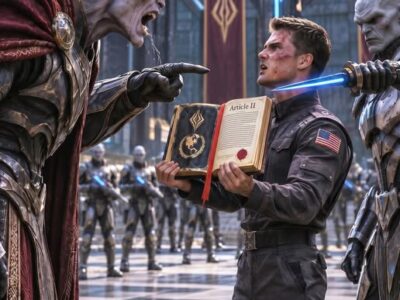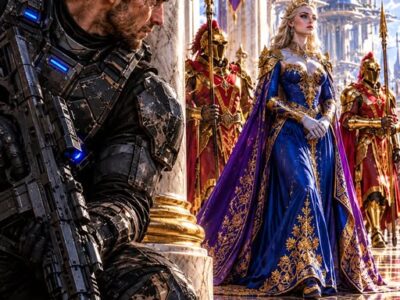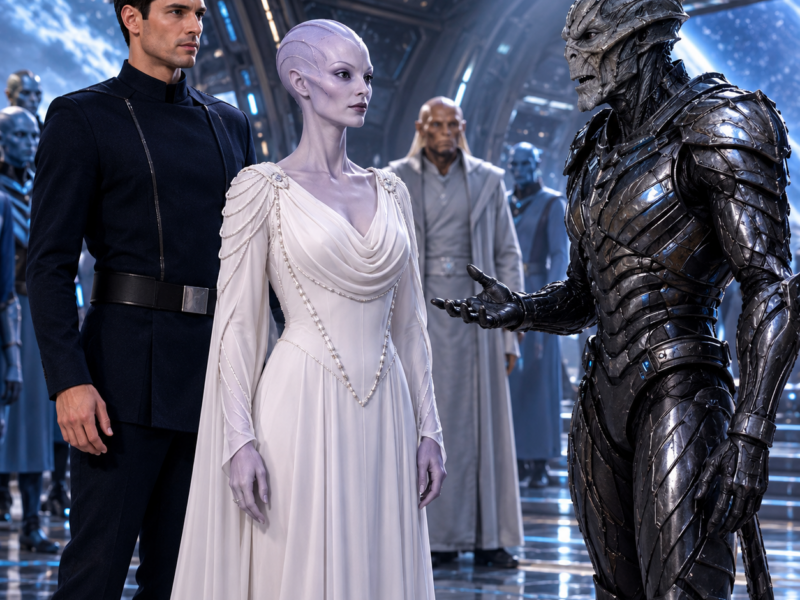
The alien ambassador slapped me across the face in front of forty diplomatic delegates and ordered me to kneel, but when my employer calmly asked why her human bodyguard hadn’t reacted, she had no idea that the man she’d just insulted came from a planet her own military classified as a Deathworld.
The sound of my knuckles popping echoed louder than I expected in the sudden, breathless quiet of the grand chamber.
Admiral Korr was still cradling his mangled wrist, his scaly skin turning a pale, sickly shade of grey beneath the fluorescent glare of the summit lights.
The elite Dravak guards were frozen mid-stride, their plasma rifles vibrating with unstable frequencies as they tried to reconcile my human anatomy with the fact that I had just stopped their weapons with my bare skin.
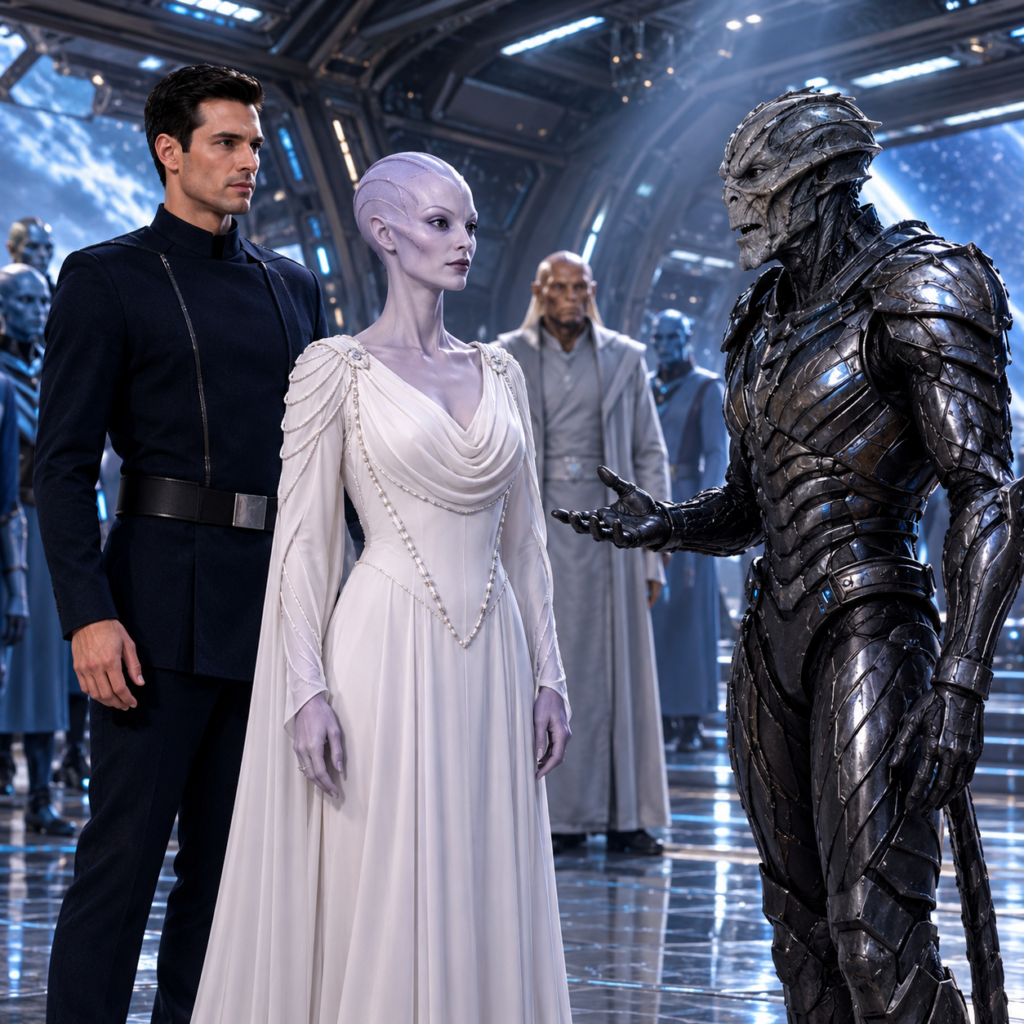
Ambassador Lyra Vey stood beside me, her breath hitching in her throat, the glowing blue hue of her skin dimming as shock took root in her chest.
For eleven months she had treated me like a broken umbrella, something useful only when the storm hit, discarded and ignored the rest of the time.
Now, the umbrella had transformed into a kinetic shield, and she was realizing just how little she actually knew about the creature standing in her shadow.
The red emergency glyphs on the chamber walls continued to pulse, casting long, menacing shadows across the polished marble floor.
The old delegate from the Centauri Coalition had not sat back down; he was staring at my collarbone with wide, trembling eyes, his ancient hands gripping the edges of his terminal as if bracing for an earthquake.
I reached up slowly, my thumb brushing against the faded, ink-stained geometric emblem hidden just beneath the collar of my standard-issue security uniform.
It was a badge of absolute authority and absolute horror, born from a world that the rest of the galaxy preferred to pretend did not exist.
“Daniel,” Lyra whispered, her voice losing all of its usual administrative crispness and dropping into a raw, vulnerable register.
“What did he mean about the Rangers?”
I didn’t look down at her; my eyes remained locked on the reinforced blast doors at the far end of the hall, where the air was beginning to shimmer with thermal distortion.
“It means, Ambassador, that your history books left out a very important chapter,” I replied evenly, my voice devoid of the subservient inflection she had grown accustomed to hearing.
The hum of the electronic locks engaging on the chamber exits sent a vibration through the soles of my boots, signaling that the entire level had just been sealed off from the rest of Valtor Station.
Korr managed to force a guttural, pain-choked growl past his teeth, his four eyes fixing on me with a mixture of hatred and lingering terror.
“You cannot do this,” the admiral spat, blood dripping from his clenched jaw onto his pristine uniform.
“This is a neutral diplomatic zone governed by the interstellar council! An act of violence against a delegate is an act of war!”
I turned my head slightly, letting my gaze drift over his panic-stricken face.
“You struck first, Admiral,” I said softly.
“On my homeworld, that isn’t a diplomatic incident. That’s an invitation.”
Before Korr could formulate a retort, the primary communications array in the center of the ceiling shattered in a shower of blue sparks.
The automated translation software embedded in the chamber’s architecture shrieked, struggling to process a frequency that hadn’t been broadcast across the galactic network in over four centuries.
The red military insignia on the main display blinked three times, expanding until it filled every monitor from floor to ceiling.
The text beneath it shifted, scrolling past at a speed that made the Dravak guards flinch.
TERRAN COMMAND: SECTOR ZERO SECURED. THE HARVEST HAS BEGUN.
Lyra grabbed my sleeve, her fingers digging into the fabric with a desperate strength.
“Daniel, make them stop. Tell them you’re with me. Tell them you’re my security detail.”
I looked down at her hand, then up into her wide, terrified eyes.
“I stopped being just security the moment that man hit my face,” I said quietly.
“Right now, Ambassador, you need to decide whether you want to stand with the civilized galaxy or behind the monster they forgot to cage.”
The air in the chamber grew noticeably colder as the station’s environmental controls began rerouting power to the outer perimeter seals.
Across the room, the forty delegates from seventeen different civilizations were huddled together like frightened livestock, whispering frantically in a dozen conflicting languages.
Only the old Centauri delegate remained standing, his posture rigid, his eyes fixed on me with a terrifying mixture of reverence and dread.
“The Terran Deathworld Rangers,” he muttered again, his voice carrying clearly across the silent hall despite his advanced age.
“We thought the treaty of New Geneva had purged your kind from the stars. We thought you were locked behind your radiation belts forever.”
I took a half-step forward, placing myself directly between Lyra and the trembling Dravak guards, keeping my stance relaxed but balanced on the balls of my feet.
“Treaties are written by those who survive the war,” I said, my gaze never leaving the reinforced blast doors.
“And the people who wrote the New Geneva accords didn’t account for what happens when someone knocks on the door twice.”
Lyra let go of my sleeve, taking a staggered step backward as if she were seeing me for the first time.
“Eleven months,” she breathed, her voice trembling as she tried to reconcile the man who carried her data pads and fetched her morning caffeine with the entity standing before her.
“You sat outside my office for eleven months. You took insults from the High Council. You let the Dravak ambassadors mock you.”
“My orders were to observe and protect,” I answered simply.
“Patience is the primary virtue taught in the academies of Earth, Ambassador. We spent ten thousand years learning how to survive on a planet that tried to kill us every single day before we ever built a spaceship. Waiting for a rude alien to finish talking is remarkably easy by comparison.”
Korr clutched his broken wrist tighter, leaning against the curved back of a delegate’s chair for support.
“You’re bluffing,” he hissed, though his voice lacked conviction.
“Humans are soft. Your economy relies on galactic trade. Your politicians are cowards who bow to the council’s tariffs.”
I didn’t bother looking at him when I replied.
“Earth doesn’t have politicians anymore, Admiral. Not since the orbital drop fleets were reauthorized this morning.”
The hum of the station’s primary generator changed tone, dropping an octave into a low, rumbling vibration that rattled the glasses on the refreshment tables.
The lights overhead flickered once, twice, and then settled into a dull, emergency crimson glow.
The automated security turrets recessed into the ceiling clicked as they rotated inward, their targeting sensors locking onto the blast doors with microscopic precision.
But they weren’t aiming at the doors to keep something out.
They were aiming inward, waiting for a clearance code that only a registered Ranger could provide.
Lyra pressed her back against the curved mahogany desk of the podium, her blue skin stark against the dark wood.
“What are they going to do to the station, Daniel?” she asked, her voice barely a whisper above the mechanical groaning of the bulkheads.
“Nothing personal,” I replied, my eyes narrowing as the heavy steel doors began to hiss, the pneumatic seals releasing jets of superheated steam into the corridor beyond.
“They’re just clearing the room.”
A metallic voice echoed from the hallway speakers, cutting through the steam with crystal-clear precision, speaking in the archaic, heavily accented dialect of old-world English.
“Ranger One, your leave of absence is officially terminated. Step away from the foreign assets. We are coming through.”
The color drained entirely from Lyra’s face as she realized the voice wasn’t coming from a radio or a distant command ship.
It was coming from right outside the threshold, and it was moving with terrifying, inhuman speed.
The first blast tore through the reinforced steel doors like paper, sending a cascade of white-hot slag raining across the polished floor.
The Dravak guards scrambled backward, their boots slipping on the debris as they raised their plasma rifles toward the smoking breach.
I didn’t draw a weapon; I simply raised my left hand, gesturing for Lyra to drop flat against the floor behind the protective curve of the podium.
“Stay down,” I said, my voice cutting through the rising chaos with absolute authority.
“If you stand up, the defensive grid will mistake your bio-signature for a combatant.”
Through the thickening cloud of smoke and vapor, a massive silhouette emerged into the chamber, clad in matte-black tactical armor that seemed to swallow the red emergency light.
The figure stood nearly seven feet tall, its movements fluid and terrifyingly silent, propelled by pneumatic servos that whined softly with every step.
The heavy helmet turned, the optical visor glowing with a single, unblinking crimson lens that swept across the room before locking directly onto my face.
“It’s good to see you in one piece, Carter,” the armored giant said, his voice deep and metallic through the suit’s external speakers.
“Though you’re taking your sweet time answering the hail.”
I let out a slow, measured breath, letting my shoulders drop an inch.
“I was busy maintaining diplomatic relations, Miller. You know how sensitive the coalition gets when you don’t use the right fork.”
Miller let out a short, bark-like laugh through his external comms, stepping fully into the chamber while ignoring the forty terrified delegates and the trembling Dravak guards.
Admiral Korr pushed himself off the chair, his face purple with rage as he pointed his uninjured hand toward the newcomer.
“You are trespassing in a sovereign council zone!” Korr roared, his voice cracking slightly.
“I demand that you identify your unit and submit to immediate arrest by order of the—”
Miller didn’t even slow his stride.
He raised his right arm lazily, his armored gauntlet catching Korr squarely in the chest with a sound like a wet boulder striking concrete.
The Dravak admiral flew backward twelve feet, crashing through a mahogany partition before collapsing into a motionless heap among the shattered glass.
The remaining guards raised their rifles, but Miller’s shoulder-mounted kinetic cannons spun up with a deafening whine that froze them in their tracks.
“Anyone else want to talk about jurisdiction?” Miller asked mildly, his crimson visor fixed on the trembling guards.
Nobody moved. Nobody even breathed.
The silence in the chamber was absolute, save for the rhythmic hiss of the cooling vents and the quiet whimpering of a junior delegate from the Orion Syndicate.
I stepped out from behind the podium, walking over to where Miller stood, shaking my head with a faint trace of amusement.
“You always did lack finesse at the front door,” I observed, adjusting my cuffs.
Miller chuckled, clapping a heavy, reinforced hand onto my shoulder that nearly drove me to my knees if I hadn’t braced my core.
“Command didn’t send me for finesse, Carter. They sent me to bring home the best scout the Deathworld ever produced.”
He turned his visor toward Lyra, who was still pressed against the floor behind the desk, watching us with wide, horrified eyes.
“And I see you brought a souvenir.”
“She’s an ambassador, Miller,” I corrected, stepping back as I looked down at Lyra, who was staring up at me as if she had just discovered the person she had lived with for a year was actually a ghost.
“And she’s about to learn why Earth was placed under a permanent quarantine.”
The temperature in the chamber continued to drop as the life support systems adjusted to the breach, pumping in recycled air that tasted faintly of ozone and old iron.
Lyra slowly pushed herself up from the floor, her hands trembling as she brushed the dust from the shoulders of her diplomatic tunic.
She looked from Miller’s towering, heavily armed frame to my own ordinary security uniform, struggling to bridge the impossible gap between the two realities.
“You’re… you’re not just a mercenary,” she said, her voice barely audible over the hum of the kinetic cannons still tracking the corners of the room.
“You said you were security.”
“I am security,” I replied calmly, walking over to the shattered remains of the door to inspect the exterior corridor.
“It’s just that my primary jurisdiction happens to be an entire planet of apex predators.”
Miller unlatched his helmet’s faceplate with a loud pneumatic hiss, lifting the heavy metal cover to reveal a scarred, weathered face with close-cropped gray hair and eyes the color of winter ice.
He looked down at Lyra with a detached, professional curiosity, the kind a biologist might reserve for a newly discovered specimen.
“You the boss?” Miller asked, tilting his head.
Lyra drew herself up, trying to summon whatever shreds of diplomatic dignity she had left, though the blue glow of her skin was still flickering erratically.
“I am Ambassador Lyra Vey of the Andorian Coalition,” she said, her voice steadying through sheer force of will.
“And your operative here is bound by contract to my service until the end of the summit cycle.”
Miller laughed, a dry, humorless sound that echoed off the vaulted ceiling.
“Contract? Lady, the only contract Daniel has right now is inked in the genetic code of every human born on a world that eats its own children for breakfast.”
He leaned closer, resting his massive forearms on his knees.
“Your little coalition has been using Earth as a buffer zone for two decades, taxing our trade routes and treating our diplomats like dirt because you thought we were too weak to fight back.”
He paused, his ice-blue eyes locking onto hers.
“Well, the paperwork just expired.”
Lyra looked at me, a profound sense of betrayal flashing across her features before settling into cold, pragmatic calculation.
“You knew about this,” she accused, her voice dropping into a dangerous register.
“You knew the fleet was moving before we even left the docking bay.”
“I knew what I was told to know,” I answered, leaning against the doorframe and crossing my arms over my chest.
“For eleven months, my job was to keep you alive while you traded away mineral rights and signed lopsided treaties that favored your people at the expense of mine. I did my job exceptionally well, Ambassador.”
“And now?” she asked, her chin lifting defiantly.
“Now your job is finished,” Miller interrupted, stepping between us and offering me a heavy canvas duffel bag that he had been carrying on his magnetic harness.
I caught it effortlessly, feeling the familiar, comforting weight of the standard-issue combat webbing inside.
“Command wants you back at Sector Zero before the blockade drops. The High Council is convening an emergency session, and they want the Ranger who broke the Valtor blockade ten years ago sitting in the front row.”
I looked down at the bag, then back at Lyra, who was watching me with an expression that was half-frightened and half-pleading.
“What about the delegates?” she asked, gesturing vaguely toward the huddled mass of politicians across the room.
Miller grinned, showing a row of white teeth against his weathered skin.
“Tell them to pack a lunch,” he said.
“Earth is joining the conversation whether they like it or not.”
The emergency broadcast sirens outside began to wail in earnest, a mournful, undulating howl that signaled the complete shutdown of Valtor Station’s civilian transit grid.
Across the chamber, the forty delegates were panicking, scrambling for the private secure terminals that had not been disabled by Miller’s entry.
Admiral Korr was finally beginning to stir from his unconscious state, groaning as he tried to push his broken body away from the shattered partition.
I ignored them all, kneeling beside the open duffel bag and pulling out a heavy, matte-black communications unit that hummed with a low, familiar frequency as I snapped the battery into place.
“Status report, Sector Zero,” I spoke into the encrypted mic, my voice dropping an octave into the clipped, formal cadence of the Ranger Corps.
A sharp burst of static crackled through the earpiece before a crisp, female voice answered instantly.
“Ranger One confirmed. Telemetry indicates you have secured the primary diplomatic hub. Orbital assets are in position. Awaiting your authorization for the secondary phase.”
I glanced up, seeing Lyra watching every movement I made with wide, unblinking eyes.
“Hold the drop fleets until I clear the civilian corridors,” I ordered quietly.
“We have non-combatants on-site who weren’t cleared for a combat zone.”
“Understood, Ranger One,” the voice crackled back.
“Countdown paused at T-minus four minutes. Do not exceed operational parameters.”
Miller slapped a fresh power cell into his shoulder cannon, casting a sideways glance at the frantic politicians.
“You’re getting soft, Carter,” he muttered with a thin smile.
“Since when do we worry about collateral diplomacy?”
“Since I spent a year listening to them complain about the local cuisine,” I replied, standing up and securing the comms unit to my tactical belt.
“It gives you a strange appreciation for paperwork.”
Lyra stepped forward, her hand reaching out instinctively as if to touch my sleeve, then stopping herself just an inch away.
“You were never just a bodyguard, were you?” she asked, her voice impossibly small in the echoing expanse of the grand hall.
“No,” I said honestly.
“I was an investment in future stability. Earth knew the coalition would eventually try to push the quarantine line too far. They needed eyes on the inside to map the station’s defenses, locate the primary comms arrays, and find out whether your military was actually prepared for a war.”
She recoiled as if I had struck her, the blue hue of her skin flushing to a deep, bruised violet.
“You spied on us. For eleven months, you walked beside me, ate with me, let me lean on you when negotiations went bad, and you were just gathering intelligence.”
“I protected your life every single day we were together,” I countered, my voice hardening slightly as I looked down at her.
“I took a sniper round in the shoulder on Orion Prime so you could sign a trade agreement. I didn’t have to do that. My orders were strictly observation. But I kept you alive because it was my duty.”
She swallowed hard, her eyes shimmering with unshed tears that she was fighting desperately to suppress.
“And now your duty is to your planet.”
“My duty never changed, Ambassador,” I said softly.
“It just expanded.”
Across the room, Korr finally managed to haul himself up onto one knee, blood streaming down his chin as he pointed a trembling finger in my direction.
“You… you think you’ve won,” the Dravak admiral wheezed, coughing up a glob of dark fluid.
“The coalition fleet… they’ll turn this station into dust before they let a human fleet pass the outer rim.”
I didn’t even turn to look at him.
I simply tapped the comms unit on my belt and said, “Miller, show the admiral why our maps don’t include the outer rim anymore.”
Miller didn’t hesitate.
He raised his heavy plasma carbine, aimed not at Korr, but directly at the massive reinforced observation window that overlooked the void of space beyond Valtor Station.
With a blinding flash of violet light, a coherent energy beam punched clean through the four-inch-thick transparisteel pane, instantly venting the thin atmospheric pressure of the outer corridor and creating a shrieking vortex of air that sucked loose papers, datapads, and shattered glass out into the vacuum.
The automated blast shutters dropped instantly, sealing the breach with a heavy metallic thud, but the point had been made with terrifying clarity.
Across the chamber, the remaining delegates screamed and threw themselves onto the floor, covering their heads as the shockwave rattled the massive chandeliers overhead.
I walked calmly toward the viewport, looking out into the swirling sea of stars where the automated security grid of the station was desperately trying to re-orient its targeting arrays.
But there was nothing out there for them to lock onto.
The space beyond the station was completely, unnaturally black—not because it was empty, but because an entire armada of Terran stealth cruisers had just dropped their phase cloaks simultaneously, filling the sector with a quiet, menacing darkness that swallowed all light.
Lyra stepped up beside me, her breath fogging against the cool glass as she stared out into the void, her hands clenching into tight fists at her sides.
“How many ships?” she whispered, the defiance entirely drained from her voice, replaced by the crushing weight of mathematical reality.
“Enough,” I answered, keeping my eyes fixed on the lead cruiser’s command deck idling six thousand kilometers off our starboard bow.
“Earth didn’t spend four centuries hiding behind radiation belts, Ambassador. We spent four centuries figuring out how to weaponize them.”
She turned her head to look at me, the harsh red emergency light casting deep shadows across her angular features.
“Why did you come back to the service, Daniel? If you were already out, why take an assignment as a glorified babysitter for an alien politician who treated you like dirt?”
I looked down at her, letting out a slow, deliberate breath.
“Because someone had to make sure the coalition understood the difference between a peace treaty and a suicide pact,” I said.
“If I had come back in uniform, your security councils would have locked down the borders before I even cleared the planetary ring. But if I came in quietly, carrying your bags and listening to your complaints, I could walk right into the heart of your command structure without firing a single shot.”
She stared at me, the realization washing over her in slow, agonizing waves.
“You used me,” she said, her voice shaking with a mixture of anger and profound disbelief.
“I was your Trojan horse.”
“You were an escort through hostile territory,” I corrected gently.
“And you survived every single day of it, Ambassador. Which is more than I can say for your admiral over there.”
We both turned to look back at Korr, who had finally collapsed back onto the floor, unconscious from blood loss and sheer terror, while his elite guards cowered against the far wall, their weapons discarded like useless toys.
Miller was standing over them, casually checking the ammo count on his carbine and humming an old, pre-spaceflight tune that sounded like something miners used to sing before the sky caught fire.
The central communications console behind us suddenly sparked back to life, the red military insignia disappearing and being replaced by a live video feed from Terran Command.
A woman with iron-gray hair, wearing the severe, unadorned uniform of a Deathworld Fleet Admiral, stared out from the screen with eyes that looked like they had watched galaxies burn and found the experience mildly tedious.
“Ranger One,” the Admiral said, her voice crackling through the broken audio system with razor-sharp precision.
“We have confirmation from the orbital arrays. The Valtor defense grid is offline. Are we clear to dock?”
I reached down, keyed my belt transmitter, and looked one last time at the woman who had spent eleven months under my protection.
“Clear the decks, Admiral,” I said quietly.
“We’ve got forty guests who need a lesson in galactic geography.”
The heavy blast doors of the grand chamber groaned as the automated override mechanisms engaged, parting down the center to reveal a corridor packed tight with dozens of heavily armored Terran Marines.
Their matte-black combat suits hummed with the latent energy of kinetic barriers, their plasma rifles held at low-ready in a display of absolute, unyielding discipline that made the remaining Dravak guards press themselves even flatter against the bulkhead.
Not a single word was spoken as the Marines moved into the room with terrifying synchronization, securing the perimeter, disabling the remaining security nodes, and cordoning off the cowering delegates into a neat, orderly queue near the eastern wall.
I stood motionless by the viewport, my hands resting lightly on my tactical belt, watching the quiet efficiency of troops who had been bred on a world where survival was a daily negotiation with extinction.
Lyra remained beside me, her arms crossed tightly over her chest as if she were trying to hold her physical form together against the freezing draft leaking in from the breached corridor.
“They’re not going to kill them, are they?” she asked, her voice uncharacteristically small, stripped of the polished administrative authority she had wielded with such arrogance for eleven months.
“Execution is an inefficient use of resources, Ambassador,” I replied without looking at her.
“They’re going to detain them, audit their trade agreements, and renegotiate every single tariff the coalition imposed on Earth over the last fifty years.”
She turned her head sharply, her blue skin flushing with a sudden flare of frustration.
“That’s not negotiation, Daniel. That’s extortion at gunpoint.”
“Call it whatever helps you sleep at night,” I said, finally turning to meet her gaze.
“When you spend ten centuries living on a planet where the tectonic plates shift every morning and the local fauna considers carbon-based lifeforms to be a light afternoon snack, you learn that diplomacy only works when both sides realize the alternative is complete and utter annihilation.”
Miller walked up beside us, casually tossing a pair of heavy tactical cuffs onto the nearest table with a dull metallic clatter.
“Transport is locked and loaded at docking bay four,” Miller announced, grinning beneath his scarred visage.
“The vanguard units report zero resistance from the station’s security forces. Turns out when you turn off their Wi-Fi and vent the air in the command deck, they lose their competitive spirit remarkably fast.”
I nodded, unlatching my standard-issue security badge and letting it drop onto the floor with a sharp, echoing ring against the marble tile.
The badge that read Daniel Carter: Level-Three Diplomatic Security was officially history.
“Lead the way, Miller,” I said, adjusting the straps of my duffel bag over my shoulder.
Miller turned and barked a series of rapid orders to the nearest squad leaders, who immediately began herding the terrified delegates toward the exit under the watchful barrels of their plasma rifles.
Lyra stood frozen as the stream of politicians shuffled past her, none of them daring to make eye contact with the terrifying human operative who had just dismantled their entire political hierarchy in less than ten minutes.
She watched the last of her aides disappear into the corridor, then turned her wide, brilliant blue eyes back toward me, the silence between us stretching out like a vast, cold ocean.
“And what about me?” she whispered, her voice cracking slightly at the edges.
“Do I get an audit and a new tariff agreement, or do I get put in cuffs and sent to the mines on Sector Zero?”
I stopped halfway to the door, looking back at the woman who had relied on my shadow for nearly a year without ever knowing the true nature of the beast that cast it.
“You stay right here, Ambassador,” I said quietly.
“You’ve got a station to run, and someone needs to explain to the High Council why the quarantine was a very bad idea.”
The walk down the grand concourse of Valtor Station felt completely different from any patrol I had ever run during my eleven months as Lyra’s shadow.
The ambient lighting had shifted from the warm, welcoming gold of diplomatic hospitality to the harsh, clinical white of a military occupation zone, with Terran Marines posted at every intersection and junction box.
Every alien delegate, merchant, and bureaucrat we passed pressed themselves flat against the bulkheads, avoiding eye contact as if looking directly at a Ranger might trigger an immediate orbital strike.
Miller walked stride-for-stride beside me, his heavy armor clanking softly with every step, his face set in the relaxed, almost bored expression of a professional who had completed routine maintenance on a broken machine.
“Command wants a debriefing as soon as we clear the outer perimeter,” Miller said casually, checking the tactical display on his wrist gauntlet.
“The old man is already drafting the new trade terms for the Orion Syndicate, and apparently they’re going to love the part where we take over their primary shipping lanes.”
“Tell him to leave them a little breathing room,” I replied, keeping my eyes fixed on the blast doors of docking bay four ahead.
“We don’t want to manage an economic collapse while we’re trying to rebuild our own orbital defense grid. It creates too much paperwork.”
Miller let out a short, bark-like laugh that echoed off the high vaulted ceiling.
“Paperwork. That’s all you thought about during the eleven months in the embassy, wasn’t it? I swear, Carter, spending a year pretending to be a secretary would have driven any other Ranger insane.”
“It gave me time to think,” I said simply.
“When you spend ten years dodging plasma fire in the outer rings, a little peace and quiet—even if it’s dressed up in an ambassador’s bad attitude—is remarkably therapeutic.”
We reached the threshold of docking bay four, where a sleek, matte-black heavy drop ship sat resting on its landing struts, its engines whining with a low, sub-audible vibration that resonated in the marrow of my bones.
The loading ramp was down, and a squad of combat medics and intelligence officers were already streaming out to secure the perimeter and upload the data packets Miller had collected from the station’s central mainframes.
I paused at the base of the ramp, taking one final look back down the long, empty concourse that led toward the grand diplomatic chamber where Ambassador Lyra Vey was undoubtedly trying to piece her shattered worldview back together.
Miller caught my hesitation and slapped a heavy, reinforced hand onto my shoulder, applying just enough pressure to remind me of where I belonged.
“She’ll be fine, Carter,” Miller said, his voice dropping into a rare note of genuine camaraderie.
“She survived a year with a Deathworld Ranger guarding her back. That makes her tougher than ninety percent of the council already.”
I let out a slow breath, letting the tension of the last eleven months drain out of my muscles like water through a sieve.
“I know she’ll be fine,” I murmured, turning my back on the station and stepping up onto the loading ramp of the drop ship.
“That’s why I left her in charge.”
The heavy hydraulic ramp of the drop ship sealed shut with a deafening thud, cutting off the last faint hum of Valtor Station’s atmospheric scrubbers and plunging the cabin into the dim, amber glow of flight-deck illumination.
I slid my duffel bag into the secured bulkhead rack, strapped myself firmly into the acceleration harness, and closed my eyes as the ship’s artificial gravity kicked in with a sudden, bone-crunching G-force that pressed me deep into the contour-molded padding.
Across the aisle, Miller was already tapping away at his wrist console, syncing his suit telemetry with the ship’s primary navigation computer as the vessel detached from the docking collar and drifted silently out into the void.
“Jump coordinates locked,” the automated voice of the ship’s onboard AI announced through the cabin speakers, its clipped, neutral cadence sounding remarkably like every machine I had grown up with on Earth.
“Transition to slipspace in three… two… one…”
The universe outside the viewport didn’t so much explode as it simply vanished, replaced by the swirling, iridescent tunnel of hyperspace that connected the outer rim back to the radiation-shielded cradle of Sector Zero.
The acceleration smoothed out instantly, leaving the cabin in a profound, meditative silence that only deep space can provide.
I reached up slowly, my fingers brushing against the faded geometric tattoo just beneath my collarbone—the mark of a Ranger who had spent eleven months in the lion’s den without ever letting the lions realize they were standing next to a cage.
Miller looked over at me from his terminal, a faint, knowing smirk playing across the corners of his weathered mouth.
“So,” Miller said, leaning back in his harness and crossing his arms behind his head.
“Are you going to tell me what she said before you left, or do I have to pull the audio logs from the corridor surveillance?”
I opened my eyes, staring straight ahead at the pulsing blue light of the slipspace conduit as it stretched out into infinity.
“She asked if I was going to put her in cuffs,” I said quietly.
Miller chuckled, shaking his head as he tapped a command into his console.
“And what did you tell her?”
“I told her she had a station to run,” I replied, a slow, genuine smile finally breaking across my face.
“Because if there’s one thing the galaxy needs right now, it’s a few more people who know how to survive when the rules stop working.”
The ship surged forward into the dark, carrying me home to a world that never forgot, never forgave, and never, under any circumstances, surrendered.
The slipspace tunnel dissolved in a brilliant flash of blue-white light as our drop ship cleared the final navigation buoy of Sector Zero, revealing the sprawling, magnificent chaos of Earth’s orbital defense network spread out across the blackness like a constellation of angry, unblinking stars.
Thousands of sleek, matte-black cruisers and heavy dreadnoughts drifted in perfect, silent formations, their kinetic railguns and plasma batteries humming with restrained power, waiting for a war that the rest of the galaxy was only just beginning to realize was inevitable.
As our vessel maneuvered smoothly toward the primary docking ring of the central command station, the viewscreen flickered once, displaying the endless, sapphire-and-green expanse of our home planet spinning peacefully beneath its protective shroud of radiation belts and automated defense platforms.
It was a world that had clawed its way up from the dirt, forged in fire and tempered by endless adversity, refusing to bow to a council of bureaucrats who thought history belonged only to the loud and the privileged.
The landing gear locked into place with a heavy, satisfying thud that echoed through the deck plates, signaling the end of the journey and the beginning of everything that came after.
Miller unbuckled his harness with a sharp metallic snap, standing up and grabbing his heavy carbine from the rack with practiced ease before turning toward the hatch.
“Welcome back to the Deathworld, Carter,” Miller said, flashing a sharp, confident grin as the heavy airlock door began to hiss open, venting the crisp, ozone-rich atmosphere of Earth’s command hub into the cabin.
“Let’s go see what the generals want us to break next.”
I unclipped my own harness, stood up, and straightened the collar of my standard-issue jacket one last time, feeling the familiar, grounding weight of the universe settle back onto my shoulders where it belonged.
“Lead the way, Miller,” I said, stepping forward out of the shadows and into the bright, unforgiving light of home.
“I think we’ve got a lot of catching up to do.”