The airport lounge fell strangely silent when I rolled my wheelchair toward a tired single father and asked, “Is this seat taken?” because the moment he looked into my eyes, the color drained from his face, and I realized he knew something about the accident that had taken away my legs.
The rain struck the glass walls of Chicago O’Hare with a rhythmic, unrelenting violence.
Inside the terminal, the low hum of delayed announcements faded into a blur of ambient static.
I pushed the wheels of my chair forward, the metallic hum of the rims a familiar baseline to my life.
Every joint in my upper body ached from the damp Midwestern cold.
I was looking for a quiet corner, away from the glaring fluorescent lights and the restless crowds.
Near Gate B12, I spotted a single vacant spot next to a man slumped in a vinyl chair.
He looked entirely hollowed out by life.
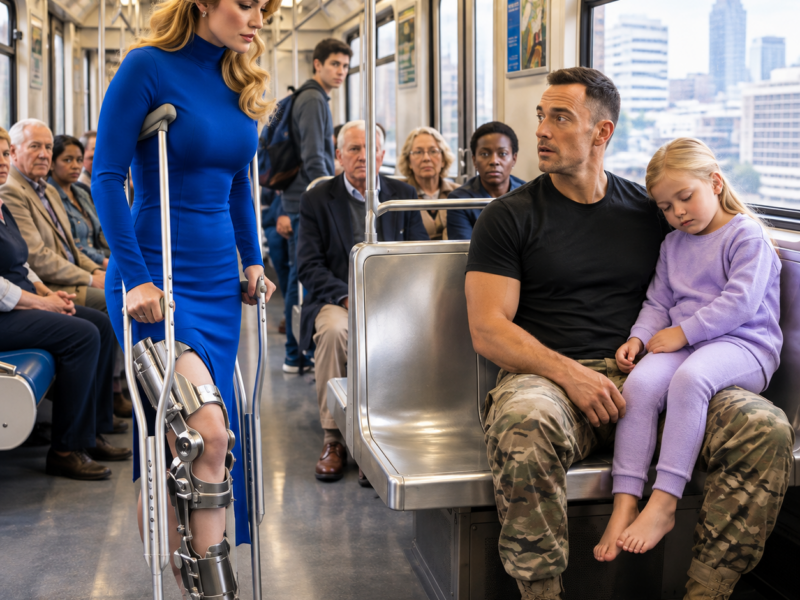
In his arms, a little girl was fast asleep, her tiny forehead pressed tightly against his rumpled dark coat.
“Is this seat taken?” I asked, keeping my voice gentle so as not to startle the child.
He didn’t answer immediately.
He shifted his weight, his eyes bleary and rimmed with red, slowly lifting his gaze from the carpet to meet mine.
The moment his eyes locked onto mine, the faint color left his face entirely.
His jaw went slack, and his pupils dilated as if he were staring directly into a ghost.
“No,” he rasped, his voice barely a breath.
“It’s open.”
I locked the brakes on my wheelchair and settled into the space beside him.
The silence between us felt heavy, thick with a sudden, unexplainable tension.
He was staring at me—not with the usual pity people reserved for the chair, but with pure, unadulterated shock.
His hands began to tremble around the paper cup of cold coffee he was holding.
“You look like you need a fresh cup,” I said, trying to break the suffocating quiet.
He swallowed hard, his eyes still fixed on my face.
“I’ve needed more than coffee for about six years,” he whispered.
The specific frame of time made my spine stiffen.
Six years was the exact duration of my own personal nightmare.
“Single dad?” I asked, pointing subtly toward the sleeping girl.
He nodded slowly, his fingers tightening around his daughter’s jacket.
“Since she was two,” he said.
His eyes drifted downward, settling on the thick scar spilling out from beneath my left sleeve.
Instinctively, I reached down and pulled the fabric over the jagged mark.
“I’m sorry,” he said quickly, looking away as if caught doing something forbidden.
“It’s fine,” I replied.
“I’m used to people looking.”
“What happened?” he asked softly.
“Car accident,” I said, the words coming out automatically after thousands of repetitions.
“When?”
“Six years ago,” I said.
His cup crumpled under the sudden pressure of his grip, spilling dark liquid over his knuckles.
“Where did it happen?” he asked, his voice shaking dangerously.
I gave him the intersection—Route 41 and Lake Cook Road.
He stopped breathing entirely.
The noise of the airport seemed to drop away, leaving only the sound of rain hammering against the glass.
“My God,” he breathed, leaning back against the seat as if struck.
He looked down at his daughter, then back at me, his eyes wide with an ancient horror.
“I was there,” he said.
My stomach dropped into a cold void.
“You were the driver who hit me?” I asked, my voice barely audible.
“No,” he said, a tear escaping the corner of his eye.
“I was the man who pulled you out.”
The breath caught in my throat, freezing the air in my lungs.
For six years, the police report had listed my rescuer as an unknown bystander who fled before emergency services arrived.
“It was you?” I asked, my heart hammering against my ribs like a trapped bird.
He nodded slowly, wiping his damp cheek with the back of his sleeve.
“I was driving home late from work,” he said, keeping his voice down.
“My daughter was asleep in the back seat.”
“I saw the smoke before I saw the metal.”
“Your car was flipped on its side, wedged against the guardrail.”
“The engine was already on fire.”
I closed my eyes, and for a split second, the smell of burning oil and hot copper filled my senses.
“I smashed the passenger window with a tire iron,” he continued.
“I reached inside and unbuckled you.”
“You were completely unconscious.”
“I dragged you across the wet grass just seconds before the fuel tank caught.”
“Why did you leave?” I asked, tears stinging my own eyes.
“Why didn’t you stay for the ambulance?”
He looked around the crowded terminal, his expression paranoid and sharp.
“Because I didn’t just pull you out,” he whispered.
“I took something from the scene.”
He reached into his back pocket and pulled out a worn, battered leather wallet.
His hands shook so violently he could barely extract the laminated photo tucked inside.
He handed it to me.
It was an instant polaroid, grainy and dark.
It showed me lying on the muddy embankment, soaked in blood and rain, completely unmoving.
Around my neck in the photo was the silver starburst pendant my mother had given me before she passed away.
The exact same pendant currently resting against my collarbone.
“Who took this?” I demanded, my hands trembling as I held the plastic frame.
“I found the camera on the ground near your car,” he said.
“It was a disposable camera, lying in the mud.”
“I picked it up without thinking.”
“When I got home that night, I had the film developed.”
“Turn it over,” he said quietly.
My fingers felt numb as I flipped the photograph.
Written on the back in thick, aggressive black marker was my full name: Elena Vance.
And directly beneath my name were six words that chilled me to the absolute bone.
SHE WASN’T SUPPOSED TO SURVIVE.
I stared at the black ink until the letters bled together in my vision.
The air around me felt suddenly thin, as if the oxygen was being sucked out of the terminal.
“This doesn’t make sense,” I whispered, my voice breaking.
“The police said it was a hit-and-run.”
“They said a drunk driver clipped my rear bumper.”
“It wasn’t an accident, Elena,” the man said, leaning closer.
“My name is Marcus, by the way.”
“Marcus,” I repeated, trying to anchor myself to reality.
“Why would someone write this?”
“Because someone paid to have you cleared off the road,” Marcus whispered.
“And that camera was left behind by the person sent to verify your death.”
A cold sweat broke out across my forehead.
“You’re telling me someone tried to murder me?”
“I’m telling you I saw them,” Marcus replied, his eyes dark with memory.
“After I dragged you to the grass, I ran back to my truck to get my phone.”
“Before I could dial 911, a black SUV pulled up on the shoulder.”
“A figure got out and walked calmly toward your burning car.”
“They weren’t trying to help.”
“They were looking inside the burning wreck to check for a body.”
“When they realized you weren’t in the driver’s seat, they dropped the camera and panicked.”
“I grabbed my daughter and drove away because I was terrified they saw my license plate.”
“I’ve spent six years looking over my shoulder, wondering if they ever found you.”
I grabbed the armrests of my wheelchair, my knuckles turning white.
My whole life since that night had been framed around recovery, around accepting loss.
I had spent years learning to navigate the world without the use of my legs.
I had forgiven the anonymous drunk driver in my prayers.
Now, in an instant, my entire tragic past was re-written as an unfinished execution.
“Why tell me this now?” I asked, my voice tight with panic.
“Because of her,” Marcus said, looking down at his daughter.
“She woke up five minutes before you sat down.”
“She pointed at the terminal entrance and said something that made my blood freeze.”
“What did she say?”
Marcus didn’t get the chance to answer.
The little girl shifted in his arms, her eyelids fluttering open.
She stretched a small arm out, pointing right past my ear toward the wide concourse.
“Look, Daddy,” the child whispered softly.
“It’s the lady with the matching necklace.”
My heart plummeted straight into my stomach.
I turned my head slowly, every muscle in my neck stiff with dread.
Fifty yards away, standing near the security checkpoint, was a woman dressed in a tailored charcoal trench coat.
Her dark hair was pulled back into a slick, uncompromising bun.
She was completely still, completely unbothered by the chaotic rush of travelers swarming around her.
Her eyes were fixed directly on me.
And resting between her leather-gloved fingers was a silver starburst pendant.
It was identical to mine in every single detail.
“Marcus,” I whispered, my eyes locked on the woman.
“Who is that?”
“I don’t know,” Marcus said, his hand sliding under his jacket to press his daughter close.
“But she was standing outside my apartment building three days ago.”
“She followed us to the airport.”
“She followed you?” I asked, turning back to him in horror.
“No, Elena,” Marcus said, his eyes wild with realizations he was only now piecing together.
“She wasn’t following me.”
“She was tracking the silver necklace.”
“She knew whoever rescued you took something from that crash site.”
“She’s been hunting us both.”
The woman across the concourse began to walk toward us.
Her steps were deliberate, measured, and entirely unhurried.
She didn’t look like a fanatic or a street thug; she looked like corporate precision given human form.
“We need to move,” Marcus said, standing up with his daughter in his arms.
“Where?” I asked, looking down at my wheels.
“The terminal is packed, and our flight isn’t for an hour.”
“I don’t care about the flight,” Marcus said, grabbing the handles of my wheelchair.
“We need to get to the security personnel.”
He pushed me forward into the flow of pedestrian traffic just as the woman accelerated her pace.
“Wait,” I said, reaching up to check my pocket.
“My bag—”
“Forget the bag!” Marcus hissed, swerving around a family hauling luggage.
I looked back over my shoulder.
The woman in the trench coat was weaving smoothly through the crowd, never losing eye contact.
She reached inside her coat pocket.
In her hand, a small black device flashed with a pulsing red LED light.
Instantly, the main terminal lights flickered violently and died.
The massive digital departure boards went completely black.
Emergency backup lights buzzed to life, casting an eerie, pale yellow glow over the sudden panic of the crowd.
“She just cut the power,” Marcus gasped, pushing me faster down the darkened corridor.
“She isn’t here to talk, Elena.”
“She’s here to finish what was started six years ago.”
The sudden plunge into relative darkness sparked instant chaos throughout Gate B.
Travelers began shouting, confused by the failure of the security gates and the sudden loss of flight monitors.
Marcus shoved his way through the gathering knot of frightened tourists.
“Stay close to the wall!” he shouted over the rising din.
My mind was racing, trying to connect dots that made no logical sense.
I was an ordinary archivist for a local university library.
I had no deep secrets, no massive inheritance, no powerful enemies.
“Why me?” I yelled back to Marcus as he pushed my chair around a stranded baggage cart.
“Why would anyone want to kill a twenty-two-year-old college student six years ago?”
“It wasn’t about who you were!” Marcus shouted back, sweat dripping from his chin.
“It was about what you saw!”
I froze, even as the chair kept moving beneath me.
“What I saw?”
“Think, Elena!” Marcus urged, ducking into a service hallway labeled Authorized Personnel Only.
He pushed the crash bar open, taking us into a brightly lit, tiled service corridor away from the main crowd.
He let go of the handles and leaned against the wall, chest heaving, his daughter trembling silently in his arms.
“The night of the crash,” Marcus panted.
“Where were you coming from?”
“The university archive,” I said, my voice shaking.
“I was working late on a digitization project for the city’s historical records.”
“Did you take anything home?”
“Just a box of old land registry files,” I recalled, the memories surfacing like rusty needles from the depths of my mind.
“The city was clearing out old paper deeds from the 1970s.”
“One of the boxes had been mislabeled.”
“It contained corporate transfer documents for the whole northern industrial corridor.”
Marcus stared at me, the pieces falling into place behind his eyes.
“The land deals,” he whispered.
“Someone didn’t want those paper records scanned.”
“If they were digitized, they would become public record.”
“They didn’t hit your car because of a grudge, Elena.”
“They hit your car to destroy the physical files in your trunk.”
“And they couldn’t risk leaving a witness who had actually read them.”
A cold shockwave washed over my body.
The trunk of my car had burned completely to ash that night.
I had spent six years mourning my legs, thinking I was just the unlucky victim of a random disaster.
Instead, I was target practice for corporate land grabbers who viewed human life as collateral damage.
Before I could process the terrifying weight of that truth, the heavy steel door at the end of the corridor clicked.
The handle turned slowly.
The door opened, and the woman in the charcoal coat stepped into the bright white light of the hallway.
She closed the door behind her with a soft, decisive click.
In the confined, quiet hall, her leather boots sounded like small gunshots against the linoleum floor.
Marcus stepped in front of my chair, shielding his daughter with his torso.
“Don’t come any closer,” he warned, his voice remarkably steady despite his pounding heart.
The woman didn’t stop.
She pulled a heavy silver pen-like object from her coat, clicking the top.
“Marcus Vance,” she said, her voice smooth, low, and completely devoid of accent.
“And Elena.”
“You’ve been remarkably difficult to bring into alignment.”
“Alignment?” I spat, pushing myself up slightly in my chair.
“You ran me off the road!”
“You stole my legs!”
“You ruined my life for paper files!”
The woman paused, tilting her head with a chilling flick of mild curiosity.
“The files were worth four hundred million dollars to our clients, Miss Vance,” she said calmly.
“Your legs were simply an unfortunate variable in an otherwise clean operation.”
“And the photographer,” she added, flicking her cold gaze toward Marcus.
“You weren’t supposed to take that photograph, Mr. Vance.”
“You picked up a piece of evidence that linked our team to the scene.”
“We’ve spent six years monitoring every database query matching that exact silver pendant.”
“When you ran that photograph through an online deep-search forum two days ago trying to identify the jewelry…”
“A flag went off,” Marcus realized, his face turning pale.
“I was trying to find out who made the pendant… to see if I could find you, Elena.”
“And instead, you guided us straight to both of you,” the woman said, raising the heavy pen.
It wasn’t a pen.
A quiet pfft echoed through the hallway.
Marcus gasped, stumbling back as a small, high-density tranquilizer dart slammed into his shoulder.
He collapsed against the wall, his knees giving out instantly.
His daughter shrieked, tumbling to the floor beside him.
“Marcus!” I screamed, reaching out for him, but my legs were dead weight beneath me.
The woman stepped past Marcus, her eyes locked entirely on me.
“It’s time to close this account, Elena,” she said smoothly.
Panic was a blinding, white-hot rush in my veins.
I couldn’t run.
I couldn’t stand up to fight.
For six years, I had thought my chair was my ultimate limitation, the symbol of what had been taken from me.
In that split second, I realized it was also ninety pounds of hardened aluminum and steel.
As the woman reached for another dart, I grabbed the handrims of my wheels with everything I had.
I threw all my upper-body strength forward, driving the chair directly into her shins with terrifying speed.
The heavy metal footrests smashed into her legs.
She gasped in genuine pain, losing her footing on the slick linoleum floor.
She fell backward hard, her head cracking against the wall.
The small dart weapon clattered out of her grip, skidding across the tile.
“Run, Marcus!” I screamed, whipping my chair around.
Marcus was groggy, his eyes rolling back from the sedative, but the sheer instinct to protect his child kicked in.
He grabbed his crying daughter, hauling her against his chest as he pulled himself up using the handrail.
“The fire exit!” Marcus rasped, pointing toward a door marked with red neon at the end of the hall.
The woman on the floor groaned, shaking her head as she struggled to pull a small blade from her boot.
I didn’t wait for her to recover.
I wheeled down the hall as fast as my arms could drive the rims, my shoulder muscles burning with sheer agony.
Marcus scrambled after me, his legs heavy and uncooperative from the drug.
I slammed my body weight against the crash bar of the emergency door.
The alarm blared instantly, a high-pitched, deafening screech that filled the narrow corridor.
The door popped open, bursting out into the cold, rainy air of the airport tarmac ramps.
Rain lashed against my face as my wheels hit the wet, slippery concrete outside.
Behind us, the woman pushed through the door, her face contorted in cold, venomous rage.
She didn’t care about the alarm.
She didn’t care about the open air.
She lunged toward Marcus, the silver blade flashing in the dim exterior floodlights.
“Get behind me!” I yelled, spinning my chair around to block the narrow pathway between two luggage carts.
She lunged forward, her knife sweeping toward my neck.
I ducked, reaching up with both hands to grab her wrist, relying on six years of intense upper-body rehabilitation strength.
Our hands locked.
She was strong, but I was fighting with the rage of a woman who had finally found the monster under her bed.
“You took my life!” I screamed into the rain, twisting her wrist with all my might.
The blade slipped from her wet fingers, falling down through the metal grating into the drainage storm sewer below.
She struck me across the face with her free hand, forcing me back against the wheelchair headrest.
She raised her hand to strike again, but a heavy shadow threw itself across us both.
The Storm Breaks
Marcus threw his entire body weight into her from the side, tackling her off my chair and onto the wet tarmac.
They hit the slick ground hard.
The sedative was rapidly taking over Marcus’s nervous system, but his grip on her coat was absolute.
“Get the girl!” Marcus roared, pinning the woman’s arms beneath his torso.
“Elena, take my daughter!”
The four-year-old girl was huddled beneath a luggage trailer, crying hysterically into the rain.
I wheeled my chair over to the trailer, leaning down as far as I could without tipping over.
“Come here, baby,” I called out, my voice desperate but soft.
“Come to Elena. I’ve got you.”
The little girl looked at me, her small frame shivering in the freezing downpour.
She saw the silver starburst necklace hanging from my neck, shining under the floodlights.
She scrambled out from under the cart and threw her tiny arms around my neck.
I hauled her up into my lap, wrapping my coat around her shivering body.
Behind us, the woman managed to twist out from under Marcus’s weakening grip.
She stood up, panting, her dark hair plastered to her forehead by the rain.
Marcus lay on the concrete, unable to push himself up as the dart’s toxin fully paralyzed his limbs.
She looked down at Marcus, then turned her cold, dark eyes back toward me and the child.
“It doesn’t end here, Elena,” she said, her voice cutting clearly through the roar of rain and jet engines.
“There are no witnesses left who matter.”
She stepped toward my chair, her hands bare, ready to tip me backward onto the concrete.
Suddenly, bright white lights cut through the rain.
Two airport security vehicles came tearing around the corner of the hangar, sirens blaring, tires screaming against the wet pavement.
The blaring emergency alarm from the door had drawn every officer on the tarmac.
“Drop to the ground! Hands where we can see them!” a loudspeaker boomed over the engine noise.
The woman froze.
She looked at the approaching vehicles, then back at me.
For the first time, a flicker of genuine frustration crossed her calm face.
She didn’t run.
She simply raised her hands slowly into the air, stepping back from my chair.
“You think this saves you?” she whispered quietly to me as the guards swarmed out of the trucks with weapons drawn.
“You have no idea how deep the ledger goes.”
Two hours later, the private medical room inside the airport security office was quiet.
The rain was still streaming down the high windows, but the noise of the terminal had been replaced by the steady beep of a heart monitor.
Marcus was lying on a gurney, an IV drip hooked into his arm to flush the fast-acting sedative from his system.
His daughter was fast asleep on the small cot beside him, exhausted from the terror of the night.
I sat in my chair near the foot of his bed, holding a warm cup of tea in my lap.
A detective from the Chicago Police Department had just finished taking my statement.
“We ran the woman’s prints,” the detective had told me before stepping out.
“Her name is Vance—no relation to you—and she’s wanted by federal authorities across three states.”
“She’s part of a private security firm linked to several high-profile corporate asset destructions.”
“You two just blew open a six-year-old federal investigation.”
I looked over at Marcus as he stirred, his eyes slowly blinking open against the bright lights.
“Marcus?” I asked softly.
He turned his head, his face pale but conscious.
“Elena…” he rasped, his voice rough.
“Is my daughter okay?”
“She’s sleeping right beside you,” I said, wheeling my chair closer to his bedside.
“She’s completely safe.”
He let out a long, ragged breath, his shoulders finally dropping the tension he had carried for six long years.
“I thought I failed you twice,” Marcus whispered, looking up at the ceiling.
“The night of the crash… I felt like a coward for driving away.”
“I felt like I left you to die.”
“You pulled me out of a burning car, Marcus,” I said, reaching out to take his trembling hand.
“You saved my life.”
“And tonight, you gave me something even more important.”
“What?” he asked, looking at me.
“You gave me the truth,” I said, a tear finally falling down my cheek.
“For six years, I hated my body.”
“I hated the world because I thought I was just a victim of bad luck.”
“Knowing that I survived an intentional attempt to erase me…”
“It changes everything.”
“I wasn’t just lucky to be alive.”
“I was stronger than what tried to break me.”
The morning sun broke through the heavy Chicago clouds, casting long rays of gold across the tarmac.
The rain had finally stopped.
Marcus was released from the medical bay at 7:00 AM, walking slowly with his arm draped over my shoulder for balance.
His daughter walked beside us, holding tightly to the armrest of my wheelchair.
We stood near the large glass windows of the main terminal, watching the planes rise into the clear blue sky.
The police had confiscated the disposable photograph as evidence, but the words written on the back would never leave my mind.
SHE WASN’T SUPPOSED TO SURVIVE.
I reached down and unclasped the silver starburst pendant from around my neck.
I held it in my palm, feeling the cool weight of the metal one last time.
“What are you going to do now?” Marcus asked, looking down at me.
“The police are going to seize those old land records from the city archive,” I said, looking out at the runways.
“They’re going to expose every single person involved in that cover-up.”
“I’m going to make sure my story is read in open court.”
I looked up at Marcus and smiled softly.
“And you?”
“I’m going to stop running,” Marcus said, looking down at his daughter.
“I’m going to take her home.”
“No more looking over my shoulder.”
I reached out and took the little girl’s hand, placing the silver starburst pendant into her palm.
“Keep this,” I said to her softly.
“It’s a reminder that no matter how dark the road gets, you’re never as helpless as you think.”
The child closed her fingers around the silver star, her small face brightening with a wide, innocent smile.
“Thank you, Elena,” Marcus said, his voice thick with emotion.
“Thank you for stopping at B12.”
“I didn’t stop there by accident, Marcus,” I said, unlocking my brakes.
“We were both waiting for that seat.”
I turned my chair around and began rolling smoothly down the bright, sunlit concourse, moving forward toward my own life—unbroken, unafraid, and finally free.