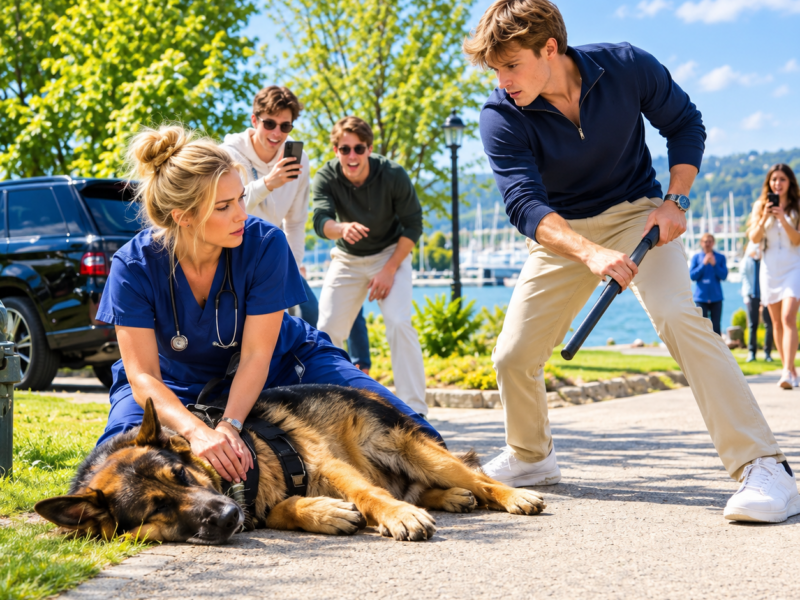
I watched three wealthy teenagers kick my K9 outside a Seattle hospital while their father laughed and called me “just a nurse,” but when I finally stepped between them and my dog, the laughter stopped because the quiet woman they had humiliated had once carried wounded soldiers through enemy fire.
The cold October wind swept off Puget Sound, cutting through the heavy wool of my navy scrub jacket.
Harborview Medical Center loomed behind me, its tall windows reflecting the gray Seattle sky like sheets of polished steel.
Rex walked closely at my left heel, his large paws making soft, rhythmic sounds against the damp concrete.
He was a ninety-pound German Shepherd with a dark saddle coat and eyes that seemed to hold a quiet, ancient intelligence.
To the patients on the third floor, he was the gentle therapy dog who rested his broad head on their hospital beds.
To the floor nurses, he was the quiet shadow that followed me down the long, fluorescent corridors during sixteen-hour shifts.
None of them knew the truth about the scar that ran beneath his thick fur, or the nightmare that bound us together.
I kept my hands buried deep inside my pockets, my fingers cold despite the mild autumn air.
After eight years in combat boots, wearing soft scrubs still felt like an elaborate disguise.
Patients knew me simply as Emily Carter, the nurse who rarely raised her voice and always stayed late to hold a patient’s hand.
They saw a quiet, slender woman with tired eyes and dark hair pulled back into a simple knot.
They didn’t see the woman who had sprinted through burning sand while artillery shells tore the horizon apart.
They didn’t see the blood that had washed off my hands only to stain my memory forever.
I was fine with that.
I preferred the silence of my current life, far away from the thunder of rotor blades and the metallic tang of fear.
As we neared the courtyard entrance, three young men stepped out from behind a large concrete pillar.
They were dressed in high-end streetwear, designer hoodies draped casually over expensive sneakers.
They moved with the careless, arrogant freedom of youth that had never known real consequence or fear.
The tallest boy, a broad-shouldered teenager with styled blond hair, locked his eyes on Rex.
“Cool dog,” he called out, his voice dripping with condescension.
Rex did not flinch, bark, or break his stride, remaining focused entirely on my left side.
“Hey, stupid, I said cool dog,” the boy sneered, taking a aggressive step into our direct path.
I slowed down, my fingers instinctively tightening inside my scrub jacket pockets as my body went on high alert.
Before I could speak, the boy pulled his right leg back and kicked Rex hard directly in the ribs.
The dull, heavy thud of shoe meeting flesh echoed off the high brick walls of the courtyard.
Rex gave a soft, choked whimper and sagged slightly against my leg, his breath catching in his chest.
My body moved before my conscious mind had time to fully register what was happening.
In a fraction of a second, eight years of muscle memory took complete control of my frame.
I shifted my weight forward, plant-stepping to shield Rex’s body completely behind my own legs.
“Don’t touch him,” I said.
My voice came out flat, stripped entirely of emotion, sharp enough to cut glass.
The second boy, wearing a black puffer coat, let out a harsh, sharp laugh.
“What are you gonna do about it, lady?” he sneered, lunging around my hip to kick Rex a second time.
The heavy boot caught Rex along his hip, forcing the big dog down onto one knee against the damp pavement.
Rex whimpered again, a small, heartbroken sound that tore right through the center of my chest.
Yet, despite the sudden pain, he did not snap or show his teeth.
He remained rigidly in place because I had not given him the tactical command to defend himself.
Something deep inside my chest snapped, replaced instantly by an icy, absolute stillness.
It was the same terrifying calm that used to settle over me when the first mortars began to fall in the valley.
The noise of the surrounding city traffic faded away into a muffled, meaningless hum.
A few yards away, an older man in a tailored wool coat stood holding an expensive paper coffee cup.
He was watching the scene unfold with an expression of mild amusement, completely unbothered.
“Control your animal,” he said coolly, taking a slow sip from his warm drink.
“He is completely under control,” I said, my gaze locking onto his smug, prosperous face.
The man smirked, looking me up and down, taking in my faded scrubs and cheap athletic shoes.
“You’re a nurse, right?” he asked, his tone laced with heavy, casual disdain.
“I am,” I replied evenly.
“Then act like one and stop causing trouble,” he snapped, taking a step toward us. “You people always think you’re special just because you wear a badge.”
The three boys chuckled, emboldened by their father’s presence, moving closer together like a pack of young coyotes.
I paid them no further attention as I slowly dropped to my knees beside my fallen dog.
My hands slid beneath his thick fur, gently feeling along his rib cage for any signs of fracture or swelling.
Rex rested his heavy head on my knee, his dark eyes wide and wet with confusion and pain.
“Stay with me, buddy,” I whispered softly into his soft ear. “Just stay right here with me.”
Standing in the Crosshairs
The father stepped closer, the sharp leather soles of his Italian shoes clicking against the wet pavement.
He loomed over me as I remained knelt beside Rex on the ground.
“You’re making a scene, woman,” he growled, his voice dropping into a low, threatening register. “Get your filthy dog off the walkway.”
I slowly let my hands fall away from Rex’s warm flank and stood up to my full height.
I was nearly a foot shorter than the man standing before me, yet I felt no urge to step back.
I looked directly into his eyes, staring past his expensive clothes and his smooth, unblemished skin.
“I’ve seen men twice your size panic under actual gunfire,” I said, my voice barely above a quiet whisper.
The man froze, his smirk instantly faltering for a brief second before turning into a sneer of pure rage.
“Are you threatening me?” he demanded, taking another deliberate step into my personal space.
“No,” I said calmly, looking him straight in the eye without blinking. “I’m warning you to walk away.”
His face flushed a deep, mottled red as he snatched his smartphone out from his expensive coat pocket.
“Security!” he roared at the top of his lungs toward the hospital’s glass main doors. “Security, get out here now!”
Within seconds, a young hospital security guard came hurrying out through the sliding glass doors.
The father immediately jabbed a finger toward my face, his voice rising in dramatic indignation.
“This woman just assaulted my sons!” he shouted, stepping back as if he had been physically threatened. “She threatened us, and her dangerous dog tried to bite my children! I want her arrested and fired immediately!”
The young guard stopped, looking back and forth between the wealthy man, the teenagers, and me.
I stood completely still, my arms relaxed at my sides, my expression unreadable and calm.
I didn’t offer a single word of defense or excuse.
I had learned long ago that in moments of sudden chaos, the person making the most noise is usually the weakest link.
Rex remained seated behind my legs, his dark head low, his chest heaving with shallow breaths.
The young guard reached for the radio on his tactical vest, looking visibly stressed by the escalating scene.
“Ma’am, is this true?” the guard asked, looking at my hospital identification badge.
Before I could answer, a second guard stepped out from the glass doors, holding a sleek silver tablet in his hand.
He moved quickly, his boots slapping heavily against the concrete courtyard.
“Hold on, Mark,” the second guard said, his tone flat and icy as he kept his eyes glued to the digital screen. “We just pulled the live courtyard feed.”
The father scoffed, crossing his arms over his broad chest. “Good! Then you saw her attack my family.”
“No, sir,” the second guard said softly, turning the tablet screen so everyone present could see the footage. “We saw everything.”
The high-definition camera mounted above the main entrance had captured every frame in crystal clarity.
On the screen, the three teenagers were clearly seen stepping out from behind the pillar to block our path.
The screen showed the tall boy lifting his heavy boot and violently kicking Rex in the chest without warning or provocation.
It showed the second boy swinging his foot to kick him again while I stood trapped between them.
It showed the father standing off to the side, smiling as he took a slow sip of his coffee.
And it showed me simply dropping to my knees to protect my wounded dog from further blows.
The father’s face drained of all color in an instant, his mouth opening and closing silently like a landed fish.
The three teenagers looked down at the ground, their previous bravado completely evaporating into thin air.
The courtyard had suddenly grown deathly quiet, save for the distant sound of city traffic.
“Sir,” the guard said, turning his hard gaze toward the father. “I suggest you put your phone away before we call the police for filing a false report.”
The man swallowed hard, his hands trembling slightly as he shoved his phone deep into his coat pocket.
“Look, it was just a misunderstanding,” he stammered, his posture deflating completely. “Boys will be boys, right?”
I said nothing, keeping my cold, unwavering gaze fixed directly on his face.
He took a step backward, grabbing his oldest son by the arm to pull him away from the scene.
“We were just leaving,” the father muttered, turning to walk toward the parking garage.
“Wait,” a strong, clear voice called out from the hospital doors.
Dr. Richard Vance, the head of trauma surgery, walked out into the crisp afternoon air.
His coat was open, his stethoscope hanging loosely around his neck as his eyes took in the assembled crowd.
He looked at the security guards, then at the shaken teenagers, and finally at Rex resting on the cold ground.
When his eyes landed on me, his entire expression softened into one of deep, profound recognition.
“Emily?” he asked, stepping quickly down the shallow concrete stairs.
I nodded slightly. “Dr. Vance.”
He looked around at the awkward silence hanging over the courtyard, sensing the deep tension in the air.
“What’s going on out here?” he asked, his eyebrows knitting together in concern.
“Just a little incident, Doctor,” the guard replied softly. “These gentlemen were causing some trouble with Nurse Carter.”
Dr. Vance turned his gaze toward the father, his eyes narrowing sharply into a dark glare.
“Do you have any idea who this woman is?” Dr. Vance asked, his voice ringing out clearly across the wide courtyard.
The father paused, looking back over his shoulder with a mix of irritation and growing embarrassment.
“She’s a nurse,” the man muttered defensively. “Look, we’re already leaving—”
“She was a Staff Sergeant in the United States Army,” Dr. Vance interrupted, his voice dropping into a deep, reverent tone.
The three teenagers stopped in their tracks, turning around to stare at me with wide, disbelieving eyes.
“She spent eight years as a flight medic in the Korengal Valley,” Dr. Vance continued, stepping closer to my side. “She received the Bronze Star with Valor for saving twelve wounded men during an ambush.”
The courtyard seemed to grow even colder as his words hung heavy in the damp air.
I felt a sudden, familiar tightness in my throat as the past threatened to break through my carefully constructed walls.
I didn’t like people talking about my medals or my service.
To me, those pieces of metal were just heavy reminders of the men we couldn’t bring back.
The father stared at me, his eyes wide with shock, taking in my plain scrubs and quiet posture with a whole new perspective.
“You?” he whispered, his voice trembling slightly.
I looked away from him, keeping my eyes fixed on the gray sky above the hospital roof.
“Dr. Vance, please,” I said quietly. “It doesn’t matter.”
“It does matter, Emily,” Dr. Vance insisted, turning back to face the stunned family. “She carried three bleeding soldiers through heavy enemy fire while taking shrapnel to her own leg.”
He looked down at Rex, who had slowly pushed himself up from the ground to stand at my side.
“And that dog right there was her military working dog,” Dr. Vance added quietly. “He stayed beside her through every single deployment.”
Rex lifted his broad head and leaned his weight against my hip, offering his familiar, comforting presence.
I reached down, my fingers sinking into his thick coat, feeling the warm, steady rhythm of his breathing.
“He didn’t just stay beside me,” I said, my voice barely audible over the wind. “He saved my life.”
The father stared at Rex, then lowered his eyes to the wet pavement beneath his feet.
For the first time since the confrontation began, the arrogant man looked genuinely, deeply ashamed.
“I… I didn’t know,” he stammered, his voice choked with embarrassment.
I looked him directly in the eye, my voice steady and cold as steel.
“That’s the problem,” I said quietly. “You shouldn’t need to know someone’s history to treat them with basic human respect.”
The father had no answer for my words.
Without another word, he turned on his heel and hurried his three sons toward the glass doors of the parking garage.
They walked quickly, their heads ducked down, completely stripped of their earlier arrogance.
The security guards offered me a quiet nod of respect before heading back inside the main lobby.
Dr. Vance lingered by my side for a few moments, his face etched with genuine concern and warmth.
“Are you okay, Emily?” he asked gently, resting a hand briefly on my shoulder.
“We’re fine, Richard,” I said, forcing a small, tight smile. “Thank you.”
He looked down at Rex, reaching out to gently pat the dog’s large, dark head.
“Take the rest of the day off,” Dr. Vance offered softly. “I can easily cover your floor shifts.”
“No,” I replied instantly, shaking my head. “The floor is busy today. I’m better off working.”
He searched my face for a long moment, recognized the familiar stubbornness in my eyes, and finally nodded.
“If you need anything, you know where my office is,” he said, turning back toward the sliding glass doors.
Once he was gone, I sank down onto the cold concrete bench near the entrance, pulling Rex close to my chest.
I buried my face in his thick coat, letting the scent of pine and rain wash over my senses.
My hands were shaking violently now that the immediate adrenaline rush had finally begun to fade away.
Rex leaned heavily against me, letting out a long, contented sigh that vibrated deep in his chest.
Images I had spent years trying to forget began to flood back into the dark corners of my mind.
The screaming sound of incoming mortars cutting through the cold night air.
The metallic smell of blood mixed with burning diesel fuel in the back of a medical chopper.
The weight of a young soldier’s hand holding onto mine as his pulse slowly faded away.
I squeezed my eyes shut, taking three long, deep breaths until the phantom noises of combat faded back into the quiet afternoon.
Rex nudged my chin with his cold nose, forcing me to open my eyes and look down at his dark, faithful face.
“Good boy,” I whispered, kissing the top of his soft head. “We’re safe now.”
A Healing Touch
Two weeks passed, and the incident in the hospital courtyard slowly faded into a quiet memory.
The father had sent a written letter of apology to the hospital administration, along with a massive donation to the veterans’ fund.
I didn’t read the letter, nor did I ask about the money.
I simply went back to my routine, arriving at Harborview before dawn every morning with Rex walking faithfully by my side.
His ribs had healed completely, and he was back to visiting the pediatric oncology ward twice a week.
Watching him interact with the children was the only thing that truly brought a genuine smile to my face these days.
He would rest his massive jaw on the side of their small hospital beds, letting them stroke his soft ears for hours.
To those sick children, Rex wasn’t a retired military working dog with scars and nightmares.
He was just a big, loving bear who made the scary hospital room feel a little less lonely.
One rainy Tuesday afternoon, I was preparing a fresh bag of IV fluids for a patient in room 314.
An elderly man named Arthur sat in the leather armchair by the window, staring out at the grey Seattle downpour.
He was a retired navy veteran who had been admitted three days prior with severe pneumonia.
He had been quiet and withdrawn since his arrival, refusing to eat or speak to any of the nursing staff.
Rex walked slowly into the room, his nails clicking softly on the clean linoleum floor.
He approached the old man’s chair and gently rested his heavy chin directly on Arthur’s frail knee.
Arthur froze, his thin hands trembling as he stared down at the large, dark-coated shepherd.
Slowly, painfully, the old man reached out his frail fingers and began to stroke Rex’s broad head.
A single tear rolled down the deep wrinkles of Arthur’s pale cheek as he closed his eyes.
“I had a dog like you once,” Arthur whispered, his voice raspy and cracked with deep emotion. “A long time ago, in Vietnam.”
Rex gave a soft, reassuring sigh and pushed his head firmer against the old man’s frail knee.
I stood quietly in the doorway, watching the two of them connect without needing a single word of explanation.
It was in moments like these that I remembered why I had chosen to become a nurse after leaving the military.
We couldn’t fix the world, and we couldn’t bring back the people we had lost along the way.
But we could stand in the quiet dark with those who were hurting, ensuring they never had to face it alone.
The Unexpected Discovery
By the time my shift finally ended at eight o’clock that evening, the heavy rain had turned into a thick, misty drizzle.
The hospital corridors were quiet and dim, lit only by the soft glow of night security lights.
I walked back down to my small locker in the break room to pack up my belongings for the long drive home.
Rex waited patiently by the wooden bench, his leash draped loosely over his neck like a familiar scarf.
I grabbed my wet navy wool jacket, feeling the cold weight of the day settle heavy into my aching shoulders.
As I reached down to clip Rex’s leather leash back onto his collar, I noticed something tucked beneath the leather strap.
It was a thick, pale yellow paper envelope, slightly worn around the edges as if it had been handled many times.
I frowned, stepping back to look around the empty, silent break room.
There was no one else in the room, save for the faint hum of the vending machine in the corner.
I slowly reached down and slipped the envelope out from beneath Rex’s collar.
It was unsealed, with no name or address written on the front side of the paper.
My thumb slid beneath the flap, pulling out a faded four-by-six color photograph.
The picture was grainy and washed out by the harsh glare of a desert sun, instantly taking my breath away.
It showed a young woman in dusty tactical gear standing beside a large German Shepherd in front of a dust-covered chopper.
It was me and Rex, taken nine years ago at a remote forward operating base in the Korengal Valley.
My heart began to hammer wildly against my ribs as a cold sweat broke out across the back of my neck.
I hadn’t seen this photograph in nearly a decade; I didn’t even know it existed.
My fingers trembled as I slowly turned the faded photograph over to look at the back.
Written in dark blue ink was a message written in a rough, familiar handwriting.
“Emily, he survived because of you.”
Below the handwritten words was a name that made my world spin completely off its axis.
It was a name I had carved into my memory, a name I had grieved for nearly ten long years.
Corporal Daniel Miller.
My knees buckled slightly, and I had to grab the edge of the wooden bench to keep from falling.
Corporal Daniel Miller had been the point man on our final, disastrous patrol in the valley.
The official military report had stated clearly that he was killed instantly when our squad was ambushed in the narrow canyon.
I remembered the blinding flash of the explosion, the deafening roar of fire, and the sheer chaos that followed.
I remembered fighting my way through the smoking debris to reach his motionless body on the rocky ground.
I remembered screaming his name into the dust, applying torn tourniquets while bullets chewed up the dirt around us.
Rex had stood over both of us, barking furiously into the smoke to keep the enemy fighters from advancing on our position.
When the extraction chopper finally arrived, the doctors pulled me away from Daniel’s pale, lifeless form.
They told me he was gone before we even cleared the canyon walls.
They told me there was nothing more anyone on earth could have done to save his life.
I had carried the heavy, crushing guilt of his death every single day of my life since that terrible afternoon.
Now, holding this photograph in my trembling hands, my mind raced to process the impossible truth.
The handwriting on the back of the photo was unmistakably Daniel’s sharp, jagged print.
He had survived that bloody afternoon in the canyon.
He was alive.
I stared down at Rex, who was looking up at me with his intelligent, dark eyes, his tail giving a soft thud against the bench.
“Someone gave this to you today,” I whispered, my voice shaking with raw, unchecked emotion.
Rex let out a quiet whine, tilting his head as if he understood the gravity of the moment.
Whoever had placed this photograph under Rex’s leash had been standing right next to us inside the hospital.
They had walked past me in the crowded hallways, watching me, waiting for the right moment to deliver this message.
My mind raced through every patient, every visitor, and every stranger I had passed over the last two weeks.
Was it possible that Daniel himself had been standing right in front of me without my knowing?
The realization sent a sudden, electric shock straight down my spine.
I shoved the photograph deep into my coat pocket and grabbed Rex’s leather leash with a firm grip.
“Come on, Rex,” I said, my voice sharp with a renewed sense of urgency.
We hurried out of the break room, our footsteps echoing loudly through the long, quiet hospital corridors.
We burst through the heavy sliding glass doors and stepped out into the dark, misty Seattle night.
The cool rain hit my face, instant clarity returning to my racing thoughts as I scanned the wide, empty courtyard.
The streetlights cast long, amber reflections across the dark, wet pavement where the confrontation had occurred weeks ago.
A few hospital staff members were walking toward their cars, their heads ducked down against the steady drizzle.
Near the far edge of the courtyard, standing beneath the shadow of a large oak tree, was a tall figure.
The person was wearing a dark waterproof jacket with a hood pulled low over their face, standing completely motionless.
They weren’t walking toward a car or heading into the hospital doors.
They were staring directly at me.
Rex instantly stopped at my side, his ears perking up high as his dark body went completely rigid.
A low, deep rumble started deep in his chest, a subtle warning signal he hadn’t used in many years.
I took a slow, cautious step forward into the open courtyard, the rain soaking through my navy scrubs.
“Daniel?” I called out, my voice cutting through the soft sound of the falling rain.
The figure beneath the tree did not answer, but they shifted their weight slightly, their hands buried deep in their pockets.
I took another step closer, my heart beating so hard against my ribs I could hear it ringing in my ears.
“Is that you?” I asked again, my voice cracking under the weight of ten years of hidden grief and hope.
The figure slowly raised one hand to pull back the dark hood of their rain jacket.
The amber light from the nearby streetlight illuminated a heavily scarred face and a pair of familiar, tired blue eyes.
A slow, soft smile spread across Daniel Miller’s face as he looked at me and the dog standing at my side.
“Hey, Doc,” he said softly, his voice rough and deep like grinding stones. “It’s been a long time.”
I stood frozen in the rain, unable to move or speak as tears mixed freely with the raindrops on my cheeks.
Ten years of heavy guilt, of restless nights and silent nightmares, seemed to melt away in a single, breathing moment.
The man I thought I had failed was standing right in front of me, alive, whole, and breathing the same cool night air.
Daniel stepped out from beneath the dark shadow of the oak tree, walking with a slight, deliberate limp in his left leg.
Rex broke away from my side, moving forward with his tail wagging low and fast, recognizing the smell of his old teammate.
Daniel dropped to his knees in the damp grass, wrapping his strong arms around Rex’s thick neck.
“Hey, buddy,” Daniel whispered, burying his scarred face into the dog’s warm fur. “I missed you too, boy.”
Rex licked the side of Daniel’s face, letting out happy, high-pitched whines that filled the quiet courtyard.
I slowly walked over to them, stepping onto the wet grass until I was standing right beside my old comrade.
“They told me you died in the medical evacuation,” I said, my voice barely a whisper against the falling rain.
Daniel looked up at me, his blue eyes bright with unspilled tears as he gently held Rex’s face in his hands.
“I almost did,” Daniel said quietly. ” spent three months in an induced coma in Germany before they brought me home.”
He stood up slowly, leaning slightly on his right leg, looking at me with profound gratitude and deep respect.
“By the time I woke up, your unit had been reassigned, and you were out of the service,” he explained softly. “It took me years to track you down, Emily.”
“Why didn’t you come forward earlier?” I asked, looking at his scarred face. “Why wait until now?”
Daniel let out a soft, gentle laugh, looking back toward the hospital entrance where the wealthy man had insulted me weeks ago.
“I was actually going to approach you that afternoon,” Daniel said, his smile widening slightly. “But then I saw those kids messing with Rex.”
He shook his head, a bright spark of old military humor flashing in his eyes.
“I was about to step in and handle it myself,” he added quietly. “Until I saw you look at that father with your medical sergeant gaze.”
He reached out and gently took my cold hand in his warm, steady grip, squeezing it firmly.
“I realized then that you were still the same brave woman who carried me through hell ten years ago,” Daniel said softly. “You didn’t need my protection, Emily. You never did.”
I looked at him, then down at Rex, who was leaning happily against both of our legs in the steady rain.
For the first time in ten long years, the dark, heavy silence inside my chest was replaced by an overwhelming sense of peace.
The scars of our past remained, deeply carved into our bodies and our memories.
But standing together in the quiet Seattle rain, surrounded by the soft amber light of the hospital, I finally knew we were home.









