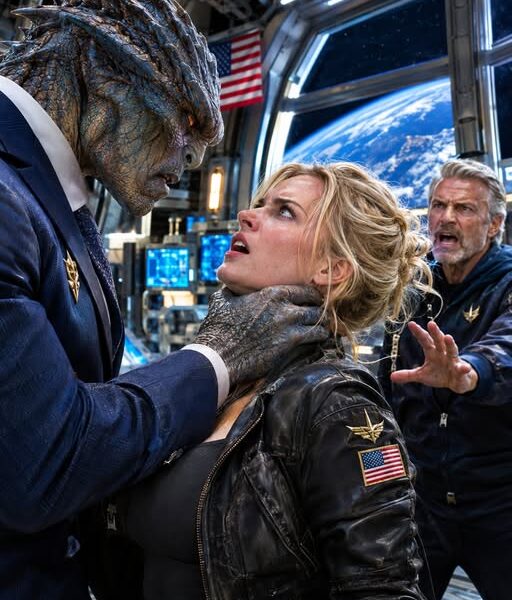
“I was the human mechanic who kept an alien warship running, yet when Commander Vark grabbed my collar and slammed me against the engine room wall in front of three hundred soldiers, nobody defended me—and by the time they discovered what he had done, the commander himself could no longer swallow water.”
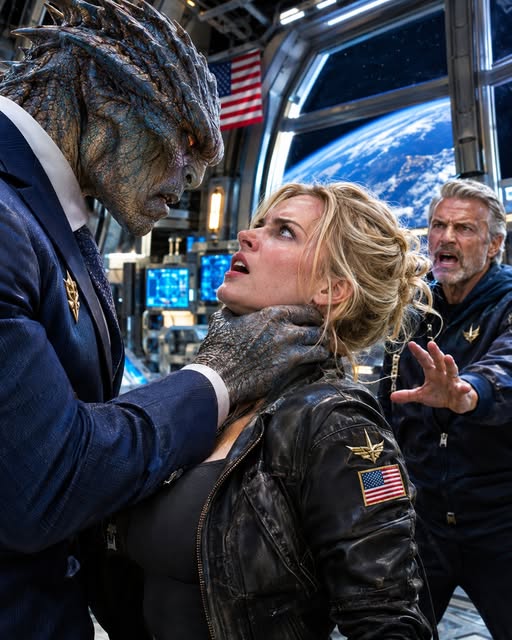
The voice belonged to Commander Vark.
I looked at the medical bed.
He was still unconscious, his body trembling beneath the restraints, and the monitor continued to warn that his swallowing reflex had completely failed.
Yet someone had just issued an order using his voice.
Lira released my wrist and stepped away from the diagnostic terminal.
“Don’t move,” she whispered.
I stared at her.
“Who just spoke?”
She didn’t answer.
Instead, she reached beneath the medical console and pulled out a small metallic device.
It was no larger than a human thumb, with a thin blue light blinking across its surface.
“That’s a command authorization transmitter,” I said.
“Not exactly.”
She turned it over.
“It’s a voice replication unit. Someone has been using the commander’s identity to issue orders.”
Before I could ask another question, the medical bay doors unlocked.
Four armored security officers entered.
Their weapons were raised.
“Sarah Mitchell,” the lead officer announced. “You are ordered to surrender your identification and accompany us to the detention chamber.”
I looked at Lira.
She shook her head almost imperceptibly.
“Why am I being detained?”
“Unauthorized access to classified biological records.”
“Those records opened themselves.”
“That is not your concern.”
I glanced at the commander.
“Then perhaps you should explain why someone is poisoning your commanding officer.”
The guards exchanged looks.
The lead officer raised his weapon.
“One more word, human.”
I slowly lifted both hands.
“Fine. But before you arrest me, look at the nutritional cartridge attached to that machine.”
He didn’t move.
“Now.”
Something in my voice must have convinced him.
He glanced toward the cartridge.
I pointed at the tiny engraved symbol.
“That marking is connected to the substance causing Vark’s condition. If you remove that cartridge without preserving its contents, you’ll destroy the only physical evidence we have.”
Lira stepped forward.
“She’s correct.”
The officer looked at her silver implant.
“Doctor, you are ordered to remain silent.”
His hand moved toward the implant.
Lira flinched.
That was when I understood.
The device wasn’t simply monitoring her.
It was controlling her.
I lowered my hands.
“How long have they had you?”
Her eyes met mine.
“Eleven months.”
The same length of time Vark had been receiving the mysterious medication.
I felt a cold weight settle in my stomach.
The security officer moved closer.
I had two choices.
I could let them take me and hope someone would eventually discover the truth, or I could do something incredibly stupid.
I chose the stupid option.
I kicked the emergency oxygen canister beneath the medical console.
It rolled across the floor and struck the nearest guard’s ankle.
He stumbled.
I grabbed the diagnostic tablet and threw it toward Lira.
“Open the emergency ventilation!”
She understood immediately.
She slammed her palm against the red control panel.
The medical bay filled with a burst of cold sterilization vapor.
The guards shouted as their helmet sensors temporarily fogged.
I grabbed Lira’s arm and ran through the secondary examination door.
Behind us, weapons discharged.
A bolt struck the metal frame.
The door sealed just as another shot hit it.
We ran through the narrow medical service corridor until we reached a maintenance junction.
I was breathing hard.
Lira was shaking.
“That was a terrible idea,” she said.
“You’re welcome.”
She almost smiled.
Then the emergency lights changed from blue to red.
A shipwide announcement followed.
“Security lockdown initiated. Human fugitive Sarah Mitchell is considered a hostile biological threat.”
I stared at the speaker.
“Hostile biological threat?”
Lira leaned against the wall.
“That’s what they called the others.”
I turned toward her.
“Others?”
She nodded slowly.
“Before you arrived, there were six humans assigned to this vessel.”
My mouth went dry.
“What happened to them?”
“They were transferred.”
“Where?”
She looked down.
“None of them returned.”
I waited for her to explain.
She didn’t.
Instead, she pulled a small access key from her uniform and handed it to me.
“Your personnel file contains something you need to see.”
I inserted the key into my tablet.
The restricted database opened.
Six photographs appeared.
Six human faces.
Six names.
The oldest photograph showed a man in his late forties wearing an engineering uniform.
The youngest was a woman who looked barely twenty.
I recognized the name beneath the last photograph.
Daniel Brooks.
He had been the engineer who originally installed the human backup regulator.
According to the ship’s maintenance records, he had died in a reactor accident twelve years earlier.
But the photograph showed him standing inside the Kharon’s engineering bay just eleven months ago.
Alive.
I enlarged the image.
Behind him stood Commander Vark.
And beside Vark was Chief Physician Lira.
I slowly looked up.
“You knew Daniel?”
She closed her eyes.
“I knew all six.”
“What happened to them?”
“They discovered what the ship was carrying.”
“What was it?”
She swallowed.
“Not cargo. Not exactly.”
She entered a sequence into the access panel.
A hidden compartment opened.
Inside was a small data cylinder.
“Take this,” she said. “But don’t connect it to the ship’s network.”
I picked it up.
“Why?”
“Because the network doesn’t belong to the military anymore.”
I stared at her.
“What do you mean?”
She looked toward the ceiling.
“The Kharon hasn’t been following its assigned patrol route for eleven months. It has been traveling to a location outside the mapped colonies.”
I remembered the navigation restrictions.
The sealed logs.
The unexplained reactor modifications.
“Where?”
Lira hesitated.
“Earth.”
For several seconds, I couldn’t speak.
The Kharon had been moving toward Earth.
And the people aboard had gone to extraordinary lengths to conceal it.
“Why would an alien warship be heading toward my planet?”
Lira’s answer was barely audible.
“Because someone aboard this vessel believes human biology can unlock something that has been buried for thousands of years.”
Before I could ask what that meant, a maintenance alarm sounded.
A section of the corridor behind us opened.
A group of armed soldiers entered.
Their commander was a tall alien with a scar running across his lower jaw.
I recognized him.
Captain Reth.
He had always been polite to me.
He had once brought me a cup of hot tea after I spent an entire night repairing the propulsion system.
Now he aimed his weapon directly at my chest.
“Sarah,” he said quietly. “Please put the cylinder down.”
I looked at him.
“You’re involved too?”
His expression tightened.
“I tried to keep you out of this.”
“By doing what? Watching Vark assault me?”
He didn’t answer.
Lira stepped between us.
“Captain, you cannot let them take her.”
Reth looked at the physician.
“You should have stayed in medical.”
“And you should have stopped them eleven months ago.”
Something passed between them.
A history neither wanted to discuss.
Reth lowered his weapon slightly.
“Sarah, listen carefully. There is a reason the commander is still alive.”
I looked toward the medical bay.
“He’s been poisoned.”
“He’s been restrained.”
“That’s not the same thing.”
Reth took a breath.
“The substance in his bloodstream isn’t intended to kill him. It prevents him from communicating certain memories.”
I frowned.
“What memories?”
“The coordinates of the object we recovered near Earth.”
I felt my grip tighten around the data cylinder.
“Then why is his swallowing reflex failing?”
“Because the treatment was designed for a different species. The dosage has been increased too many times.”
I looked at Lira.
She nodded.
“The substance affects the neural pathways controlling voluntary muscle movement. The commander is deteriorating, but his mind may still be intact.”
“Can you reverse it?”
“Possibly. If we can access the original research.”
Reth stepped closer.
“Which is why you need to surrender the cylinder.”
I shook my head.
“Why?”
“Because it contains the location of the research laboratory.”
“Then take us there.”
He looked toward the soldiers.
For a moment, I thought he would refuse.
Instead, he turned to them.
“Lower your weapons.”
The soldiers hesitated.
“Captain?”
“I said lower them.”
One by one, their weapons dropped.
Reth looked at me.
“We have approximately forty minutes before the next command override. After that, I won’t be able to protect you.”
We followed him through a restricted passage that led toward the lower decks.
The deeper we went, the older the ship became.
The polished military corridors gave way to exposed pipes, abandoned equipment, and walls covered in maintenance markings.
Some of the markings were human.
I recognized the handwriting.
Daniel Brooks.
He had written notes directly onto the metal panels.
One read:
DO NOT TRUST THE NAVIGATION CORE.
Another had been scratched beneath a ventilation grille:
THEY ARE NOT TAKING US TO EARTH.
I stopped.
“Captain, you said the ship was heading toward Earth.”
Reth turned.
“It is.”
I pointed at the message.
“Then why would Daniel write this?”
Reth’s expression changed.
He looked at the words for several seconds.
“I don’t know.”
I removed the data cylinder and examined its casing.
There was a small human-style connection port.
I pulled a cable from my maintenance kit and connected it to my tablet.
A series of files appeared.
Most were encrypted.
One was labeled FINAL RECORDING — DANIEL BROOKS.
I opened it.
A human man appeared on the screen.
His face was thinner than in the photograph.
His eyes were bloodshot.
But his voice was unmistakably human.
“If you’re seeing this, then the seventh subject has arrived.”
I felt the blood drain from my face.
Daniel continued.
“My name is Daniel Brooks. I was assigned to the Kharon as a reactor specialist. I believed I was helping establish peaceful relations between our species.”
He looked away from the camera.
“I was wrong.”
The recording flickered.
“The military recovered an object from a moon orbiting an uncharted planet. It wasn’t alien technology. It wasn’t human technology. It was something much older.”
He leaned closer.
“The object responds to human DNA.”
I glanced at Lira.
She looked terrified.
Daniel continued.
“They discovered that certain human neural patterns could activate its dormant systems. That’s why they started bringing humans aboard.”
I felt sick.
“Why me?” I whispered.
The recording continued as if answering.
“They don’t want engineers. They want biological keys.”
The image shifted.
Daniel held up a small metallic object.
It was identical to the symbol I had seen on the nutritional cartridge.
“They introduced a compound into the commander’s medical treatment. It was supposed to keep him compliant while they conducted experiments. But Vark discovered the truth.”
The recording became distorted.
“He tried to stop them.”
I looked at Reth.
The captain’s jaw tightened.
“That isn’t what happened,” he said.
I ignored him.
Daniel’s final words were almost inaudible.
“Sarah, if you’re the seventh subject, do not let them take you to Earth.”
The screen went black.
Nobody spoke.
Then the navigation system announced an incoming transmission.
A woman’s voice filled the corridor.
“Captain Reth. Your escort privileges have been revoked.”
Reth looked at the nearest security terminal.
The display showed a new command authorization.
Admiral Soren.
The highest-ranking officer aboard the Kharon.
He was also the person who had approved my recruitment fourteen months earlier.
The voice continued.
“Return the human asset to the laboratory. The vessel will proceed to the designated destination.”
Reth closed his eyes.
Then he looked at me.
“Now you understand why I couldn’t stop them.”
I shook my head.
“No. I understand why you didn’t try hard enough.”
He accepted the accusation without defending himself.
We reached the laboratory doors.
A biometric scanner illuminated.
The door opened before anyone touched it.
Inside were rows of transparent containment chambers.
Some were empty.
Others held strange metallic structures suspended in blue liquid.
At the center of the room stood a circular platform surrounded by cables.
I recognized the engineering design.
Human.
Not alien.
Someone had built this using technology from Earth.
And attached to the main console was a small metal plate bearing the name of the company where my father had worked before he died.
Mitchell Aerospace.
I stepped closer.
My father had been a propulsion engineer.
He had died in a shuttle accident when I was nineteen.
For years, I had believed his work had nothing to do with extraterrestrial technology.
Apparently, I had been wrong.
I opened the console.
A personnel record appeared.
SUBJECT 07.
SARAH ELIZABETH MITCHELL.
PARENTAL CONTRIBUTION: CONFIRMED.
BIOLOGICAL RESPONSE: STABLE.
My hands began to tremble.
“Who authorized this?”
Nobody answered.
I turned toward Lira.
“Tell me.”
She lowered her eyes.
“Your father was part of the original research team.”
I stared at her.
“My father worked for Mitchell Aerospace. He never mentioned aliens.”
“He didn’t know the full purpose of the project.”
“Then why am I here?”
Lira stepped closer.
“Because your genetic profile contains a rare compatibility marker. Your father discovered it years ago, but he hid the results.”
I looked back at the screen.
The system displayed a second file.
PATERNAL MESSAGE — SEALED.
I opened it.
My father’s face appeared.
Older than I remembered.
Tired.
But unmistakably him.
“Sarah,” he said.
I took a step backward.
For fourteen years, I had carried the last photograph of him in my wallet.
I had memorized his voice.
I had replayed his final voicemail on birthdays and difficult nights.
Now he was standing in front of me, recorded in a classified alien laboratory.
“If you’re watching this, then they found you.”
His expression tightened.
“I am sorry.”
I couldn’t breathe properly.
He continued.
“The thing they recovered is not a weapon. It is a containment system. Something is locked inside it, and the humans who built the first activation sequence never understood what they were doing.”
A low vibration moved through the laboratory.
The circular platform began to glow.
My father’s recording continued.
“Do not activate it. Do not let them convince you that your blood is the key.”
I stared at the screen.
“Then what is?”
He leaned closer.
“Your decision.”
The recording ended.
A heavy metallic sound echoed through the laboratory.
The containment chambers began opening.
Blue liquid drained into the floor channels.
Reth raised his weapon.
“What is happening?”
Lira looked at the central platform.
“The system has detected Sarah.”
I backed away.
The screen changed.
SUBJECT 07 PRESENT.
AUTHENTICATION REQUIRED.
A new message appeared.
WELCOME HOME, SARAH.
Then a second line.
AWAITING BIOLOGICAL CONSENT.
I looked at the circular platform.
“Nobody touch anything.”
The doors behind us slammed shut.
Admiral Soren’s voice came through the laboratory speakers.
“Sarah Mitchell, your father made a mistake when he refused to complete this project. You have an opportunity to correct it.”
I turned toward the speaker.
“Where is the object?”
“Below the platform.”
“What is inside it?”
A brief silence followed.
Then Soren answered.
“Something that can end every war in the known colonies.”
I stared at the empty containment chambers.
“Or start one.”
His voice became colder.
“Your father always had an unfortunate tendency to confuse fear with morality.”
I thought of the recording.
The way my father had looked at the camera.
The way he had apologized.
I stepped away from the platform.
“I’m not activating anything.”
A metallic click sounded behind me.
Vark stood in the doorway.
He was barely able to remain upright.
A medical support harness held his upper body, and a transparent tube still ran from his throat to a portable nutrient unit.
His four eyes were bloodshot.
But he was conscious.
He lifted one trembling hand.
In it was a small control device.
“Sarah,” he rasped through the throat interface.
“Don’t listen to him.”
Admiral Soren’s voice erupted from the speakers.
“Commander, you are medically unfit to issue orders.”
Vark struggled to take a step.
“Then I suppose this is the first order I have given in eleven months that actually matters.”
He pressed the control device.
The laboratory lights went dark.
Emergency lighting flickered on.
A series of security locks disengaged.
Lira rushed toward him.
“How are you standing?”
Vark looked at the feeding tube.
“With considerable difficulty.”
I moved toward him.
“What did they do to you?”
He glanced at the platform.
“They made me watch.”
His voice was weak, but each word carried weight.
“For eleven months, I watched them bring humans aboard. I watched them test their blood, their nervous systems, their memories.”
I looked at him.
“Why didn’t you stop them?”
He lowered his eyes.
“Because I believed they were protecting the colonies.”
He swallowed painfully.
“Then Daniel Brooks showed me what was really inside the containment system.”
“What?”
Vark looked directly at me.
“Not a weapon.”
He pointed toward the platform.
“A civilization.”
The entire laboratory vibrated.
The central console flashed.
A new warning appeared.
CONTAINMENT INTEGRITY: 62%.
Soren’s voice returned.
“Commander, step away from the platform.”
Vark ignored him.
“The object contains the last surviving consciousness of a species that existed before our known civilizations. It can communicate with machines, rewrite biological systems, and influence entire populations through neural signals.”
I stared at the display.
“Then why do you want my DNA?”
“Because it recognizes your father’s genetic signature. He was able to establish communication without surrendering control.”
I thought about the recording.
Your decision.
The system wasn’t waiting for my blood.
It was waiting for consent.
I looked at the platform.
“Why does it need consent?”
Vark answered.
“Because the original civilization built it that way. It cannot fully awaken unless a compatible mind willingly establishes contact.”
Soren interrupted.
“That is an outdated interpretation.”
Vark turned toward the speaker.
“Your interpretation involves enslaving an entire species.”
“An entire species that could save millions of lives.”
“By removing their ability to choose?”
The speaker fell silent.
I approached the console.
A series of symbols appeared.
The system recognized my presence.
The containment warning dropped to 58%.
Lira rushed toward me.
“Sarah, don’t touch it.”
I examined the controls.
The interface was partly human, partly alien.
But beneath the unfamiliar symbols, I noticed something I recognized.
A maintenance override.
My father had designed the original system to require two independent authorizations.
One biological.
One mechanical.
The biological authorization was mine.
The mechanical authorization had to come from someone with control over the reactor.
I looked at Vark.
“Can you access the main engineering network?”
He nodded weakly.
“Yes.”
“Then I need you to trust me.”
His four eyes narrowed.
“That is an unusual request from the human I threw against a wall.”
“I remember.”
He lowered his head.
“You should.”
I turned toward the console.
The containment system was deteriorating.
The warning had dropped to 49%.
I could either shut down the entire reactor network and risk destabilizing the ship, or establish communication with the entity before the containment field collapsed.
Neither option was safe.
I thought about my father.
He had spent years trying to make sure nobody could use this system without understanding what they were releasing.
I thought about Daniel.
About the other five humans whose photographs were still stored in the database.
And about the soldiers who had watched me get thrown against the wall because they were afraid of their commander.
I wasn’t going to make another decision based on fear.
“Vark, isolate the reactor from the laboratory.”
He looked at me.
“That will disable the ship’s primary weapons.”
“Do it.”
He entered the command.
The lights flickered.
The platform began to hum.
I placed my hand against the biometric scanner.
A thin needle emerged.
I hesitated.
Then I pressed my palm against it.
A drop of blood appeared.
The system activated.
BIOLOGICAL AUTHENTICATION ACCEPTED.
MECHANICAL AUTHORIZATION REQUIRED.
Vark placed his hand against the secondary control.
The display changed.
TWO-PART CONSENT CONFIRMED.
CONTAINMENT COMMUNICATION INITIATED.
The floor trembled.
A low voice entered my mind.
Not through the speakers.
Not through my ears.
It was a presence.
Ancient.
Calm.
Exhausted.
WE REMEMBER YOUR ANCESTORS.
I closed my eyes.
“Who are you?”
WE WERE THE FIRST TO BUILD THE BRIDGE BETWEEN LIFE AND MACHINE.
I swallowed.
“Why were you imprisoned?”
A pause followed.
WE WERE NOT IMPRISONED BY YOUR PEOPLE.
I opened my eyes.
The containment field flickered.
WE SEALED OURSELVES AWAY.
“Why?”
The response came slowly.
BECAUSE WE LEARNED THAT KNOWLEDGE WITHOUT CONSENT BECOMES CONTROL.
I looked at the system.
The containment warning had stopped falling.
It was holding at 43%.
The voice continued.
YOUR SPECIES HAS REACHED THE SAME DECISION.
I glanced at Soren’s command screen.
He was trying to override the authorization.
“Can you stop him?”
I asked.
WE CAN PREVENT HIS COMMANDS.
BUT WE CANNOT CHOOSE FOR YOU.
The answer settled over me.
The entity wasn’t asking to be released.
It was asking whether we were capable of making the same promise its creators had once made.
I looked at Vark.
“Can you hold the reactor?”
He nodded.
“Until the ship’s reserve power fails.”
“How long?”
“Nine minutes.”
I turned back to the console.
“Then I need nine minutes.”
I opened the system’s primary communication channel.
A message appeared.
PROPOSED AGREEMENT:
NO BIOLOGICAL MODIFICATION WITHOUT CONSENT.
NO NEURAL CONTROL WITHOUT CONSENT.
NO TRANSFER OF CONSCIOUSNESS WITHOUT CONSENT.
NO MILITARY APPLICATION WITHOUT INDEPENDENT OVERSIGHT.
The terms were clear.
But one final condition remained.
COMPATIBLE HUMAN REPRESENTATIVE MUST ACCEPT RESPONSIBILITY.
I read the words twice.
Then I understood.
The system wanted someone to remain connected as a guardian.
Not a prisoner.
Not an experiment.
A representative.
Someone who could speak for humanity, but not control the entity.
I looked at the timer.
Six minutes remained.
I could accept the responsibility.
But I would be tied to a system that no government or military could fully understand.
And if I refused, the containment field would eventually collapse.
I thought about Earth.
About the people who had never known this existed.
About the millions who might be affected if Soren succeeded.
Then I remembered something my father used to say when I was a child.
“Being able to fix something doesn’t mean you own it.”
I placed my hand against the console.
“I accept responsibility for protecting the agreement. But I will not own this intelligence, and neither will anyone else.”
The system paused.
A new message appeared.
TERMS ACCEPTED.
A soft blue light spread through the laboratory.
The containment warning stopped.
Then, slowly, it began rising.
44%.
51%.
68%.
82%.
The reactor network stabilized.
Across the ship, the emergency lights returned to their normal color.
The weapons systems remained disabled.
And Admiral Soren’s command authorization disappeared from every terminal.
For several seconds, nobody moved.
Then the laboratory doors opened.
Security officers entered.
Their weapons were lowered.
Soren stood behind them.
His expression was unreadable.
“Sarah Mitchell,” he said. “You have no authority to make agreements on behalf of the colonies.”
I turned toward him.
“Neither did you.”
He looked at Vark.
“Commander, arrest her.”
Vark removed the feeding tube’s portable control unit from his harness.
“That order is rejected.”
Soren’s face hardened.
“You are committing treason.”
Vark looked at the security officers.
“Perhaps. But at least I will no longer call obedience loyalty.”
The officers moved toward Soren.
He didn’t resist.
For the first time since I had boarded the Kharon, the highest-ranking officer aboard the vessel was no longer in control.
But the victory wasn’t clean.
The six missing humans were still gone.
Daniel’s final location remained unknown.
And the commander who had spent months allowing this operation to continue would have to answer for his part in it.
I looked at Lira.
“What happens now?”
She glanced toward the central platform.
“Now we find out whether the agreement can survive outside this room.”
I nodded.
“Then we’d better make sure it does.”
The next several days were difficult.
The ship’s military command was temporarily suspended.
An independent investigation began.
The recovered files revealed that the six human engineers had been transferred to an experimental station near the object, where they had been forced to develop components for the containment system.
Three had died during the experiments.
Two were still alive.
Daniel Brooks was among them.
When we finally received a transmission from the station, I saw him sitting in a small medical room, thinner and older than the man in the recording.
He recognized me immediately.
“Sarah?”
I struggled to speak.
“It’s me.”
He looked at the screen for a long moment.
“Your father would have been proud.”
I looked away.
“Did you know he left a message?”
Daniel nodded.
“He made sure the system couldn’t be activated by force. He knew they’d eventually come looking for someone with your genetic profile.”
“Why didn’t he tell me?”
Daniel’s expression softened.
“Because he wanted you to have a life that belonged to you.”
I felt tears gathering in my eyes.
For fourteen years, I had wondered whether my father had died knowing he had left me alone.
Now I understood that he had spent his final years trying to make sure nobody could take my future away from me.
The surviving engineers were rescued.
The dead were brought home.
And the Kharon never returned to its original military patrol.
Instead, it became the first vessel assigned to an independent research mission between Earth and the outer colonies.
Commander Vark survived.
His swallowing reflex gradually returned after the treatment was reversed.
The recovery was painful, and his voice remained rough for months.
He also lost his command position.
He did not argue.
When the investigation concluded, he was found responsible for allowing the experiments to continue after he discovered their true purpose.
He accepted the judgment.
On the day he left the command deck, he came to the engineering room.
I was replacing a damaged coolant valve.
He stood in the doorway for nearly a minute before speaking.
“Sarah Mitchell.”
I looked up.
“Commander.”
“I’m no longer your commander.”
“I noticed.”
He studied the repaired equipment.
Then he lowered his head.
“I owe you an apology.”
I put down my wrench.
“You owe more than one.”
“I know.”
He looked at the floor.
“I believed strength meant being obeyed. I believed fear was the same as respect.”
I waited.
“When I struck you in front of my crew, I thought I was protecting my authority. Instead, I showed every soldier aboard this vessel that authority was all I had.”
I looked at him for a long moment.
“Your apology doesn’t erase what happened.”
“I understand.”
“But I hope you learn from it.”
He nodded.
Then he left.
I never forgave him completely.
I don’t think forgiveness was something he was entitled to receive simply because he had finally learned how to ask for it.
But I stopped carrying the moment around like a weight I had to prove existed.
Months later, I stood on the observation deck as the Kharon approached Earth’s orbit.
Blue oceans stretched beneath the clouds.
For the first time in fourteen months, I was looking at home.
Lira stood beside me.
“Are you nervous?”
I smiled faintly.
“About returning to Earth? A little.”
“About your new responsibility?”
I watched the planet turn slowly beneath us.
“More than a little.”
The ancient intelligence had remained quiet since the agreement was signed.
It communicated only when necessary, and it never demanded anything from us.
Sometimes, during long maintenance shifts, I wondered what it remembered about the civilizations that had existed before ours.
Sometimes I wondered whether humanity would prove worthy of the trust it had placed in us.
But I had learned something during those fourteen months aboard the Kharon.
The most dangerous people weren’t always the ones holding weapons.
Sometimes they were the ones who believed that having power gave them the right to decide what everyone else deserved.
I looked down at the Earth.
My father had spent his life building something he refused to control.
I had spent fourteen months repairing a ship whose commander believed control was the same as leadership.
Now I had the chance to do things differently.
The engineering alarm sounded behind me.
I sighed.
“Some things never change.”
Lira laughed.
I turned toward the maintenance corridor, rolled up my sleeves, and headed back to work.
I was still the human mechanic aboard an alien warship.
But this time, nobody in the room mistook that for a weakness.