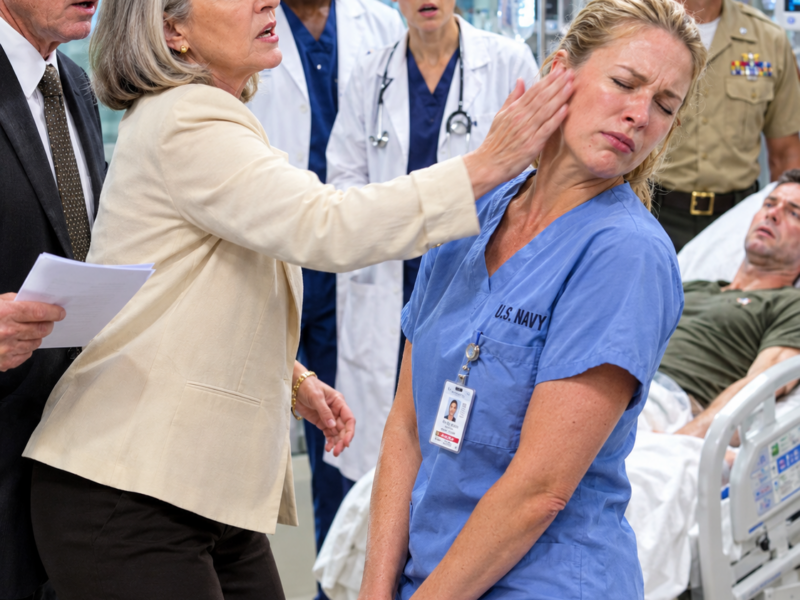
“I was standing beside a hospital bed in a crowded military medical center when a wealthy woman slapped me so hard my glasses hit the floor
The room remained silent long enough for the heart monitor to fill it with its steady, electronic rhythm.
Richard recovered first.
“He’s confused,” he said, turning toward the doctor who had just entered. “He’s been heavily medicated. Surely you can explain that to him.”
Dr. Patel approached the bed without looking at Richard.
“Daniel, can you tell me your full name?”
“Lance Corporal Daniel Whitmore.”
“Do you know where you are?”
“The medical center at Camp Pendleton.”
“Do you know what happened to you?”
Daniel closed his eyes for a moment.
“I remember the explosion.”
Dr. Patel checked his pupils and asked a few more questions. Daniel answered slowly, pausing whenever the pain in his head became too much.
When the examination was over, the doctor turned to the family.
“He’s awake, but he’s still recovering from a significant traumatic brain injury. He needs a calm environment and limited stimulation.”
“Then remove the nurse,” Richard said.
Dr. Patel finally looked at him.
“Ms. Brooks is his assigned nurse. She’s qualified to care for him, and I have no medical reason to remove her.”
Patricia’s lips tightened.
“We will be speaking to someone about this.”
“You certainly may,” the doctor replied. “But right now, your son needs rest.”
He asked me to check Daniel’s pain level and then quietly requested that the family wait outside while he assessed the patient’s condition further.
Richard looked as though he’d never been asked to leave a room in his life.
Still, he followed his wife into the hallway.
Before she stepped through the door, Patricia glanced back at me.
There was no apology in her expression.
Only a warning.
When the door closed, Daniel’s shoulders eased against the pillow.
I adjusted his blanket and checked the line delivering his medication.
“You’re safe here,” I told him.
He looked at the bruise forming along my cheek.
“I’m sorry.”
“You didn’t do it.”
“I should’ve stopped her.”
“You’ve got a head injury and an IV in your arm. Let’s not add superhero duties to your recovery plan.”
The corner of his mouth moved, almost a smile.
Then his expression turned serious.
“Did my father bring a black leather folder?”
I thought back to the family’s arrival that morning. Richard had carried a slim briefcase, but I hadn’t noticed its color.
“Why?”
“Because if he has it, you need to keep him away from my medical records.”
I stopped adjusting the blanket.
“Daniel, what happened that night?”
He glanced at the door.
“I can’t tell you everything yet.”
“Why not?”
“Because I don’t know who else he’s talked to.”
The words unsettled me more than his father’s anger had.
I had spent six years working with military patients. I understood operational security, confidential records, and the difference between a frightened family and a dangerous one.
Daniel wasn’t simply afraid of his father.
He was measuring every word as though someone might use it against him.
“I’ll make sure your records are handled properly,” I said. “But if you believe someone is trying to interfere with your care, I need you to tell your doctor.”
“I will.”
He hesitated.
“And Hannah?”
“Yes?”
“If anyone asks you to change what you documented from the night I came in, don’t.”
Before I could answer, his eyes drifted shut.
His monitor remained steady.
I stood beside the bed, listening to the ventilation system hum above us, and felt the first real crack appear in my understanding of the last four days.
I had documented everything.
At 3:12 a.m. on the night of Daniel’s admission, his blood pressure had fallen dangerously low. At 3:19, he had responded to his name. At 3:22, he’d gripped my wrist and tried to speak.
I’d written down the words I thought I heard, along with the fact that they were indistinct.
A routine note.
Nothing more.
Or so I’d believed.
That afternoon, a woman named Captain Elise Morgan arrived at the nurses’ station.
She wore a Marine uniform and carried a tablet tucked beneath one arm.
“I’m looking for Lance Corporal Whitmore,” she said. “I’m assigned to assist with the administrative side of his recovery.”
I checked her credentials and confirmed her identity through the appropriate channels.
“He’s stable, but his physician has restricted visitors.”
“I understand. I don’t need to see him without permission. I need to know whether any documents related to his admission have been altered or requested by outside parties.”
My fingers rested on the keyboard.
“Why would they be altered?”
Elise studied me for a moment.
“Has anyone asked you to revise your notes?”
I thought of Richard’s black briefcase.
I thought of Daniel’s warning.
“Not yet.”
“Then let me know immediately if anyone does.”
She gave me her official contact information and left without another word.
I watched her walk down the corridor.
There was something deliberate about her visit, something that suggested she hadn’t come because a family had complained about a nurse.
She’d come because someone was already asking questions.
That evening, Richard returned alone.
He had removed his suit jacket and loosened his tie, but his expression remained as controlled as ever.
“Hannah, may I speak with you privately?”
“I’m on duty.”
“This will take a minute.”
He led me a few steps away from the nurses’ station, where he lowered his voice.
“I understand there was an unfortunate incident this morning.”
I said nothing.
“My wife has been under tremendous strain. She thought you were deliberately keeping her away from Daniel.”
“His physician made the visitor restrictions.”
“Yes. Well, I would appreciate it if we could put the matter behind us.”
He reached into his briefcase and removed a folded piece of paper.
It was a formal complaint.
My name was printed at the top.
The document accused me of withholding information, mistreating a patient’s family, and behaving in a manner inconsistent with professional standards.
“I haven’t been given a chance to respond,” I said.
“You’ll have one.”
He placed the paper on the counter.
“However, these situations can become unnecessarily complicated. A misunderstanding can follow a nurse for years.”
His gaze dropped briefly to my badge.
“I would hate for that to happen to someone who has otherwise had a respectable career.”
I understood the threat.
“You want me to apologize?”
“I want you to recognize that my family deserves cooperation.”
“I have cooperated with Daniel’s medical team.”
Richard’s smile thinned.
“Then we shouldn’t have a problem.”
He walked away, leaving the complaint on the counter.
I didn’t touch it for several seconds.
Then I photographed the document according to hospital policy, notified my supervisor, and submitted a factual account of the incident.
My cheek had begun to swell.
A colleague named Melissa brought me an ice pack.
“You know,” she said quietly, “most people apologize after hitting someone.”
“Maybe she has a different definition of manners.”
Melissa almost laughed, but her eyes stayed worried.
“Be careful with this family.”
“I intend to be.”
At midnight, I returned to Daniel’s room.
He was awake, staring at the ceiling.
“Your father came to see me,” I said.
His jaw tightened.
“What did he want?”
“He filed a complaint against me.”
Daniel turned his head toward me.
“For what?”
“Apparently, following your physician’s orders.”
He closed his eyes.
“I knew he’d try something.”
“Daniel, I can’t help you if you don’t tell me what’s happening.”
For a long moment, he said nothing.
Then he asked, “Have you ever watched someone make a decision that you knew would get people hurt, and realized they were counting on everyone else to stay quiet?”
I pulled a chair closer to the bed.
“Yes.”
It wasn’t the answer he expected.
During my second year as a nurse, I’d cared for a young service member whose injuries had been worsened by a delay in getting him proper treatment. The review that followed was exhausting, and several people had urged me to leave the matter alone.
I hadn’t.
The investigation eventually corrected the record, but it had taught me something about silence.
Sometimes silence protected people.
Sometimes it protected the people who had caused the harm.
Daniel watched me.
“I was part of a convoy overseas,” he said. “We were transporting equipment and medical supplies. Our route had been cleared, and our communications were working.”
He paused to swallow.
“Then someone changed our movement instructions.”
“Who?”
“I don’t know yet.”
His answer sounded honest, and that frightened me more than a confident accusation would have.
“We were redirected through an area we’d been told to avoid. Our vehicle was hit. The blast killed two Marines and injured several others.”
His eyes fixed on the blanket.
“I remember the vehicle rolling. I remember trying to reach the radio. Then I remember waking up here.”
“I’m sorry.”
“After the explosion, I heard someone on the radio say the route change had been approved by a civilian contractor.”
He took a shallow breath.
“I recognized the name.”
“Whose?”
“My father’s company.”
I felt the air leave my lungs slowly.
Richard Whitmore’s businesses included senior-living communities, real estate holdings, and a logistics subsidiary that had recently won several government contracts.
I knew that much because he’d mentioned it during one of his visits, speaking about the contracts as though they were family achievements.
“Are you sure you heard correctly?”
“No. That’s the problem.” Daniel’s voice tightened. “I was injured. There was static. I could’ve misunderstood. But I remember the name, and I remember someone arguing that the route shouldn’t have been changed.”
He looked at me.
“If I was wrong, I need to prove it. If I was right, people died because someone made a decision they shouldn’t have made.”
The monitor continued its steady rhythm.
I thought about his mother’s hand falling away from the bed.
I thought about Richard’s complaint, the black briefcase, and the way he had reacted when Daniel woke up.
“What does your father want from you?”
“An affidavit.”
“What kind?”
“He wants me to state that the route change was authorized by military command and that I heard no concerns about it before the convoy moved.”
“Did you sign it?”
“No.”
“Then why would he need you unconscious?”
Daniel looked away.
“Because he wanted me to sign before I could talk to anyone about what I remembered.”
The next morning, Dr. Patel informed us that Daniel’s condition had improved enough for a longer conversation, provided he rested afterward.
Captain Morgan returned shortly after lunch.
This time, she brought a second officer and a secure document packet.
She spoke with Daniel privately for several minutes, then came out to find me.
“We’re reviewing the route change,” she said. “We have communications records that don’t match the original movement plan.”
“Does that mean the contractor was responsible?”
“It means we have discrepancies. We don’t make accusations until we establish what happened.”
She glanced toward Daniel’s room.
“His recollection may help, but he shouldn’t be pressured into giving a statement before he’s medically ready.”
“I agree.”
“And if anyone tries to obtain his signature without authorization, contact us.”
Her words were calm, but their meaning was unmistakable.
Someone had already tried.
That afternoon, Patricia appeared with a leather folder.
I recognized it immediately.
She approached the nurses’ station with a paper cup of coffee and an expression of practiced concern.
“I’ve brought Daniel some things from home,” she said. “And his father asked me to have him sign a few documents.”
“What documents?”
“Family paperwork.”
“His physician has not cleared him to sign legal documents while he’s recovering.”
Her smile vanished.
“He’s my son.”
“He’s also a patient. If the documents are legal, they can wait until his doctor determines he’s able to review them.”
She leaned closer.
“You seem to have forgotten your place in all this.”
“I haven’t.”
For a second, I thought she might strike me again.
Instead, she set the coffee down hard enough to splash it over the lid.
“You’re making a terrible mistake.”
She walked toward Daniel’s room.
I followed at a respectful distance and entered just as she pulled a packet from the folder.
“Sweetheart,” she said, her voice suddenly gentle, “your father needs this taken care of. It’s just a statement clearing up the confusion about the convoy.”
Daniel looked at the pages.
Then he looked at her.
“Did Dad tell you what happened to the two Marines who died?”
Patricia’s face changed.
“Don’t do this.”
“Did he tell you?”
“I know you were hurt. I know you’re upset.”
“Two men died, Mom.”
She glanced at me, as though I had somehow put the words in his mouth.
“Your father is trying to protect you.”
“From what?”
“From making a mistake you’ll regret.”
Daniel’s fingers curled against the blanket.
“Signing something I don’t believe would be a mistake.”
Patricia put the packet on the bedside table.
“You’re not thinking clearly.”
“Then why do you need my signature today?”
She had no answer.
For the first time, I saw something other than anger in her face.
Fear.
She gathered the papers and left without taking the folder.
I waited until Daniel’s breathing settled.
“That was a difficult conversation,” I said.
He gave a tired, humorless smile.
“Most conversations with my mother are.”
“Do you think she knows what happened?”
“I think she’s spent a long time believing my father can fix anything if we let him.”
He looked toward the door.
“And I think she’s starting to realize there are things he can’t fix.”
Two days later, Daniel was cleared for a carefully supervised interview with Captain Morgan and an investigator from the relevant military authorities.
I wasn’t present for the interview itself, but I helped ensure his medication schedule was documented and that his pain remained controlled.
When it ended, Daniel looked exhausted.
Captain Morgan thanked the medical team and left with the investigator.
I expected Daniel to feel relieved.
Instead, he stared at the closed door.
“They have the radio recordings,” he said.
“That’s good, isn’t it?”
“It means my memory isn’t the only thing they have to work with.”
He hesitated.
“But there’s something else.”
I waited.
“My father didn’t just know about the contract. His company had a financial reason to push the new route. The original route required equipment his subsidiary hadn’t delivered on time.”
“Would changing the route save the contract?”
“Maybe. Or it might have hidden a delay that would have cost him a fortune.”
He rubbed his forehead carefully.
“I don’t know whether he ordered the change himself. I don’t know who approved it. I don’t know whether anyone understood the risk.”
“Then that’s what the investigation has to establish.”
“What if it proves he knew?”
I pulled the chair beside his bed closer.
“Then you’ll have to decide what kind of relationship you can have with him after that.”
He looked at me as though the thought had never occurred to him in quite those terms.
“I’ve spent my whole life thinking he was hard on people because he expected them to do better.”
“And now?”
“Now I wonder if he expected them to do whatever he wanted.”
He didn’t say anything more.
I let the silence remain.
The next week brought small improvements.
Daniel could sit up without becoming dizzy. He could walk short distances with assistance. His speech grew clearer, and the headaches that had made conversation difficult began to ease.
His father stopped visiting.
His mother came once, sat beside the bed for ten minutes, and asked whether Daniel needed anything from home.
He told her he needed the truth.
She left without answering.
On the ninth day after his admission, I was checking Daniel’s discharge planning notes when my supervisor called me into her office.
The complaint Richard had filed was still active.
A review panel wanted to speak with me about the incident and the documentation surrounding Daniel’s admission.
I provided the facts, the timestamps, and the names of everyone who had been present.
The review was uncomfortable, but my notes were complete.
When I returned to the ward, Daniel was sitting in a chair beside the window.
“Did they give you trouble?” he asked.
“They asked questions. I answered them.”
“Because of my father?”
“Because your father filed a complaint. The hospital has to review it.”
He looked down at his hands.
“I’m sorry.”
“You’ve apologized enough for things you didn’t do.”
He studied me for a moment.
“Why didn’t you just leave the room that day?”
“I did leave.”
“You know what I mean.”
I thought about Patricia’s raised hand, Richard’s contemptuous voice, and the administrator calculating the safest path through a difficult situation.
“Because leaving the room doesn’t mean I have to change the truth,” I said.
Daniel nodded slowly.
“I hope I can remember that.”
“You don’t need to remember everything today. You need to heal.”
For the first time, he laughed without wincing.
“Yes, ma’am.”
The following afternoon, Captain Morgan returned with news.
The military investigation had identified irregularities in the convoy’s movement authorization. Electronic records showed that the change had been submitted through a contractor-linked account, then approved using credentials that were not supposed to be available to that account.
The original radio traffic also supported Daniel’s recollection that someone had questioned the route.
But the evidence did not yet establish who had personally authorized the change or whether the decision had been made with knowledge of the danger.
That distinction mattered.
Richard Whitmore’s name appeared in company records connected to the contract, but being associated with the company was not proof that he had directed an unsafe movement.
The investigators needed more.
Daniel listened to the update with his hands folded tightly in his lap.
“So what happens now?”
“The investigation continues,” Captain Morgan said. “We’ll review the authorization trail, interview the people involved, and compare the records with the contractor’s submissions.”
“And my father?”
“He’ll have the opportunity to respond to any allegations supported by the evidence.”
Daniel looked at me.
For once, nobody was asking him to sign anything.
Nobody was telling him what he had heard.
He was simply being allowed to speak.
That evening, Patricia returned.
She came alone, without her designer coat or leather folder. Her hair was pulled back carelessly, and she carried a small paper bag from a bakery near the hospital.
“I brought you the lemon cookies you like,” she said.
Daniel looked at the bag but didn’t reach for it.
“Why?”
She swallowed.
“Because I remembered you used to eat them after baseball games.”
“I haven’t played baseball in eleven years.”
“I know.”
She placed the bag on the table.
For a while, neither spoke.
Then Patricia looked at me.
“Could we have a few minutes?”
Daniel answered before I could.
“Hannah can stay.”
His mother flinched slightly, but she nodded.
“I owe you an apology,” she said to me.
I didn’t make it easy for her.
“Yes, you do.”
Her eyes dropped to the floor.
“I was frightened. I thought if I could get you to leave, someone else might tell me what was happening.”
“You could have asked me.”
“I know.”
She twisted her wedding ring around her finger.
“Your father has always handled difficult situations. When something goes wrong, he takes control. He tells me what needs to happen, and I trust that he knows more than I do.”
Daniel’s voice was quiet.
“Even when people get hurt?”
She looked at him.
“I don’t know what happened overseas.”
“But you wanted me to sign a statement before the investigators finished their work.”
“Your father said it would protect you.”
“Did you read it?”
Her mouth opened, then closed.
“No.”
The answer landed harder than any excuse could have.
Daniel turned toward the window.
“That’s the problem, Mom. You keep trusting him to protect me, but you don’t ask what he’s protecting me from.”
Patricia began to cry, silently at first, then with the uneven breathing of someone who had spent too long holding herself together.
“I thought I was helping.”
“I believe you thought that.”
He looked back at her.
“But you hurt someone who was taking care of me, and you tried to make me sign something I didn’t believe.”
She wiped her cheeks with a tissue.
“Can you forgive me?”
Daniel didn’t answer immediately.
“I don’t know yet.”
She nodded, as though she’d expected nothing more.
“I understand.”
For the first time, she didn’t ask him to make her feel better.
She stayed for another ten minutes, talking about ordinary things: the dog she’d left with a neighbor, a leak in the kitchen ceiling, a cousin who had called to ask about Daniel’s condition.
When she left, she took the empty paper bag with her.
The cookies remained on the table.
Daniel looked at them for a long time.
“Do you think she really didn’t know?” he asked.
“I think she knows more now than she did when she walked in.”
“That’s not the same thing.”
“No,” I said. “It isn’t.”
Three weeks after the explosion, Daniel was cleared to leave the hospital for rehabilitation.
His father appeared on the morning of the discharge meeting.
Richard wore a dark suit and carried no briefcase.
He stood at the foot of Daniel’s bed while the physician explained the recovery plan.
When the doctor finished, Richard waited until the others had stepped outside.
“I’d like to speak with my son.”
Daniel looked at me.
I stayed where I was until he nodded.
Then I moved to the doorway, close enough to intervene if Daniel needed assistance, but far enough away to give them room.
Richard pulled a chair beside the bed.
“I’ve been advised not to discuss the investigation with you,” he said.
“Then don’t.”
His father accepted the rebuke without reacting.
“I want you to know that I never intended for anyone to get hurt.”
Daniel’s expression remained still.
“Did you authorize the route change?”
Richard rubbed his palms together.
“I approved a revised logistics schedule. I was told the route had been reviewed by the appropriate people.”
“Did you know the original route was safer?”
“I knew it was the established route.”
“That’s not what I asked.”
Richard looked toward the window.
“I knew the revised schedule would save the company money.”
Daniel’s jaw tightened.
“Did you know Marines would be sent through an area that had been flagged as dangerous?”
“I was told the risk assessment had been updated.”
“By whom?”
Richard didn’t answer.
Daniel waited.
Finally, his father said, “I don’t know if I can give you the answer you want.”
“I want the answer that’s true.”
Richard’s eyes were red at the edges.
“I should have asked more questions.”
“Yes.”
“I trusted the people working for me.”
“So did the people in that convoy.”
The words seemed to leave Richard without a response.
He sat with his hands clasped, looking older than I had ever seen him.
“I have spent my life believing that if I could keep this family secure, I could keep you safe,” he said.
Daniel looked at him.
“You keep saying you wanted to protect me. But when I woke up, you wanted me to sign a statement that might have protected you.”
Richard’s face tightened.
“I was trying to prevent a public scandal before we knew all the facts.”
“You were trying to control the facts.”
His father lowered his head.
For a long time, he said nothing.
Then he reached into his jacket and removed a folded document.
Daniel watched him carefully.
“What is that?”
“A statement for the investigators. My attorney reviewed it, but I haven’t signed it.”
“Why bring it here?”
“Because I wanted you to see it first.”
Daniel didn’t reach for the paper.
“Read it aloud.”
Richard unfolded the pages.
He described the contract, the revised schedule, and the information he’d received from his employees. He acknowledged approving the financial changes and admitted that he had not personally verified the final risk assessment.
He did not claim to know who had altered the movement authorization.
He did not accuse the military.
And he did not ask Daniel to clear him.
When Richard finished, the room was quiet.
“Is it true?” Daniel asked.
“It’s what I know to be true.”
“Then give it to the investigators.”
Richard folded the pages.
“I will.”
Daniel looked away.
“I don’t know if I can forgive you.”
His father nodded once.
“I understand.”
“No, Dad. You don’t. You think because you regret something, the people who got hurt should help you live with it.”
Richard’s eyes filled, but he didn’t interrupt.
“I might forgive you someday,” Daniel continued. “But I won’t lie for you. And I won’t pretend this didn’t happen just so we can go back to being a family at Thanksgiving.”
Richard pressed his lips together.
“I wouldn’t ask you to.”
“You already did.”
His father looked down at the unsigned statement.
Then, slowly, he placed it on the table beside the untouched cookies.
“I’ll give this to the investigators today.”
He stood.
At the doorway, he paused and looked toward me.
“I’m sorry for what my wife did to you.”
I met his gaze.
“She needs to tell me that herself.”
He nodded, accepting the answer without argument, and left.
Daniel leaned back against the pillow.
His hands were trembling.
I moved closer and checked his blood pressure, giving him time to recover before asking whether he needed pain medication.
“Was that the right thing to do?” he asked.
“Which part?”
“Not forgiving him.”
I adjusted the cuff on his arm.
“Forgiveness isn’t a discharge order. Nobody gets to decide you’re ready except you.”
He watched the numbers appear on the monitor.
“I used to think being a good son meant believing my father.”
“Maybe being a good son means telling him when he’s wrong.”
Daniel breathed out slowly.
For the first time in weeks, his shoulders relaxed.
The investigation continued for several months.
The evidence established that the contractor’s scheduling process had been manipulated to conceal a delay and that required safety reviews had not been properly completed before the convoy moved.
Richard’s company had benefited financially from the revised schedule, and his approval of the changes had helped create the conditions in which the unsafe movement was authorized.
Investigators did not establish that Richard had deliberately ordered an attack or knowingly sent the convoy into an ambush.
They did establish that he had accepted assurances without demanding the documentation that should have supported them.
The contractor’s operations manager was charged with falsifying records and improperly using authorization credentials. Richard cooperated with the investigation and surrendered the relevant company records.
His company lost the contract, faced civil claims, and was required to overhaul its compliance procedures.
The families of the two Marines who had died received the findings they had been waiting for.
Nothing in the report brought their sons home.
Nothing could undo Daniel’s injuries.
But the official record no longer blamed a routine military decision for what had happened.
Daniel completed rehabilitation slowly.
Some mornings, the headaches were so severe that he could barely tolerate sunlight. Other days, he walked the therapy corridor without stopping, determined to regain enough strength to return to his unit in a different capacity.
He kept a small notebook beside his bed and wrote down what he remembered, not because he trusted every memory, but because he wanted to distinguish what he knew from what he feared.
I saw him once more before my shift ended on his final day at the medical center.
He stood beside the window, wearing civilian clothes, his discharge papers tucked into a folder.
“You’re leaving,” I said.
“Apparently, they think I can recover without you reminding me to drink water every twenty minutes.”
“It’s an evidence-based treatment plan.”
He smiled.
Then his expression softened.
“I never thanked you properly.”
“You thanked me.”
“For keeping my records accurate. For not letting them push you out of the room. For listening when I didn’t know how to explain what I remembered.”
I glanced at the faint mark still visible along my cheekbone.
“I was doing my job.”
“No,” he said. “You were doing your job when it would’ve been easier to let someone important decide what your job meant.”
I didn’t know what to say to that.
He reached into his folder and pulled out a small envelope.
Inside was a handwritten note.
It wasn’t a medal or an elaborate gift, just a few lines thanking me for treating him like a patient rather than a problem to be managed.
I folded it carefully and put it in my pocket.
“Take care of yourself, Daniel.”
“I’ll try.”
He walked out with the physical therapist beside him, one careful step at a time.
His mother was waiting in the lobby.
She stood when she saw him, then stopped herself from reaching for him before he had a chance to decide what he wanted.
“Would you like me to drive you to rehabilitation?” she asked.
Daniel looked at her for several seconds.
“Yes. But I want to stop somewhere first.”
“Where?”
“The cemetery.”
Patricia’s eyes filled.
She nodded.
“I’ll take you.”
It wasn’t forgiveness.
Not yet.
But when they walked toward the exit, she matched her pace to his instead of pulling him along.
Months later, I received a letter from Daniel.
He had moved into a small apartment near the coast and was continuing rehabilitation. He wrote that some days were still difficult, that he had begun counseling, and that he was learning to live with the parts of the explosion he couldn’t remember.
He also wrote that his father had started attending meetings with the investigators without his lawyers answering every question for him.
Their relationship remained strained.
They spoke occasionally, usually about ordinary things, and sometimes about the investigation. Daniel had not agreed to restore the old closeness simply because his father had finally acknowledged his mistakes.
His mother was trying, too.
She had written me a separate apology, one without excuses or requests for forgiveness.
I accepted it.
I didn’t forget the slap.
I didn’t need to hate her forever, either.
On my next shift, I returned to the same medical room where Daniel had first opened his eyes.
A young Marine lay in the bed, frightened by an upcoming procedure, while his older brother sat nearby pretending not to be afraid.
I checked the monitor, explained what would happen next, and waited until the young man nodded that he understood.
Outside the window, the afternoon sun fell across the parking lot.
My glasses rested safely on my face.
For a moment, I thought about Daniel’s first sentence after waking, and the silence that had followed it.
I used to believe the hardest part of nursing was keeping someone alive long enough to heal.
Now I knew there was another kind of care: making sure that when a person finally found the strength to speak, nobody could take the truth away from them again.
THE END.