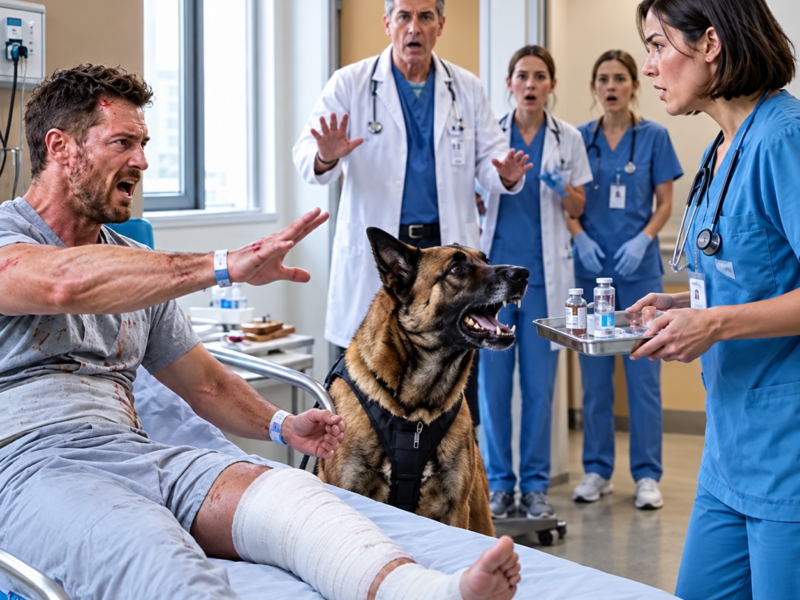
I was publicly warned not to touch the Navy SEAL’s K9 outside a Charleston emergency room, and when the officer sneered that the dog would bite me, nobody understood why the supposedly vicious animal walked past him and pressed its wounded head against my chest.
Rain soaked my scrubs as I knelt beside the German shepherd, whose front leg was bleeding badly after a roadside accident. The torrential downpour turned the tarmac of the emergency room bay into a dark, reflective mirror under the pulsing blue lights.
The air smelled of ozone, warm asphalt, and metallic blood. Every breath came cold and sharp against my throat.
“Don’t touch him,” the SEAL snapped, his voice crackling like gunfire through the storm.
I looked up at him, wiping a streak of freezing rain from my eyes. His jacket was torn, his knuckles bruised, and his posture was rigid with tension.
“I’m a nurse,” I said, keeping my hands level and visible.
“I said don’t.”
His voice carried across the ambulance bay, bouncing off the steel girders, and several orderlies and paramedics turned to watch.
The dog growled when I reached into my pocket for a sterile pressure bandage. It was a guttural, terrifying vibration that echoed deep within the animal’s massive chest.
But I didn’t move away.
I had stood down worse things than an injured animal in my previous life. I sank lower into the pavement, letting the mud coat my knees.
“Easy, boy,” I murmured, lowering my center of gravity and softening my gaze.
Something strange happened.
The growling stopped completely, cut off in an instant like a severed wire.
The dog lowered his heavy dark head, his ears flattening slightly as he stared directly into my eyes.
Then he crawled toward me, dragging his shattered front limb through the puddles without making a single sound.
The SEAL went silent.
“That’s impossible,” he whispered, his hand hovering over his sidearm. “He doesn’t let anyone near him. Not even the base vets.”
I carefully wrapped the wound, applying firm, practiced pressure to stifle the dark pulse of blood.
The dog never resisted.
Instead, he pressed his wet nose firmly against my inner wrist, inhaling deeply as if he recognized me.
I felt a cold memory rise from somewhere deep inside—a dark, suffocating place I had spent six years trying to bury.
“What’s his name?” I asked, my voice barely audible over the rush of water into the drainage grates.
“Ranger.”
My hands froze against the damp fur.
That name had belonged to a working dog I knew overseas in the dust of the Euphrates valley. A dog that had disappeared during the chaos of a night extraction that destroyed my entire tactical medical unit.
But this couldn’t be him.
I had been told Ranger died in the wreckage of that compound. I had seen the fire with my own eyes before the shrapnel took my consciousness.
The SEAL noticed my sudden immobility and the gray drain of color from my face.
“You know him?” he demanded, stepping closer, his boots splashing heavy water over my shoes.
“No.”
The lie came too quickly, sharp and defensive.
Ranger suddenly barked, a sharp, urgent command, and pulled hard toward my heavy canvas backpack lying open near the bay door.
I turned on my knees and opened it.
Nothing seemed out of place—just my extra uniform, a stethoscope, and an empty water flask.
Then Ranger thrust his snout deep into the bag, his teeth catching the zipper of the hidden bottom compartment.
Inside was an old, laminate-protected photograph I hadn’t looked at since the night I was honorably discharged with a artificial knee and a classified file.
Four operatives stood beside a younger, unscarred German shepherd against a backdrop of desert sun and military transport vehicles.
My young, unburdened face was among them.
The SEAL stooped down and picked up the photograph before I could grab it.
His eyes scanned the faded image, then shifted back to my wet, scarred collarbone.
His expression changed from defensive hostility to utter disbelief.
“Who are you?”
I couldn’t answer him. My tongue felt like lead.
On the back of the photograph, written in faded black permanent marker, were six words I had never seen before.
“She survived because Ranger remembered.”
My heart stopped beating for three long seconds.
The handwriting wasn’t mine. It belonged to the squad leader who was supposed to have been killed alongside the rest of our team six years ago.
The SEAL looked at me, his eyes narrowing as he read the tactical unit insignia painted on the shoulder patches in the photo.
“That’s you, isn’t it?”
Before I could speak or pull the photograph from his fingers, Ranger suddenly whined, spun on his three good legs, and growled toward the automatic glass doors of the hospital entrance.
Everyone turned toward the sound.
A man stood beneath the harsh fluorescent lights of the lobby.
He was older now, his hair silver at the temples, wearing an expensive tailored overcoat that looked entirely out of place in an emergency ward.
He was unmistakable.
He was the former military commander who had authorized our ill-fated deployment, the man who had officially pronounced my entire squad dead while I lay in a coma in Landstuhl.
He smiled when his dark eyes locked onto mine.
Then he stepped through the sliding glass into the rain and whispered something that made my blood run cold.
“You’re not supposed to be alive, Captain.”
The shadows of forgotten missions
The heavy rain kept falling, hammering against the concrete canopy above us like a drumbeat.
The SEAL’s body went taut as a bowstring beside me. His instinct was immediate, honed by years of active duty.
He reached beneath his jacket for his concealed sidearm, his fingers wrapping around the grip.
I stood up quickly, ignoring the sharp, biting pain in my reconstructed left knee, and stepped directly between the SEAL and the man in the overcoat.
“Don’t,” I said softly to the SEAL. “Not here. Not now.”
Because I finally understood why Ranger had remembered me after all these years.
He wasn’t just showing affection. He was warning me.
And the secret he had carried across continents and military custody was about to expose the person who had betrayed us all.
“Look at you, Evelyn,” Commander Vance said, stepping forward until the smell of his expensive cologne mixed with the wet dog and bleach. “Working the night shift in a civilian trauma center. How low the brave have fallen.”
“Get back, sir,” the SEAL said, his voice flat and deadly, stepping up shoulder-to-shoulder with me. “I don’t care who you are. This bay is restricted to medical personnel.”
Vance chuckled, a dry, cold sound that rattled in his chest.
He pulled a leather wallet from his coat, flipping it open to reveal a high-ranking federal intelligence badge.
“Special Agent Miller,” Vance said, reading the name tag on the SEAL’s jacket. “You can stand down. This woman is a classified intelligence liability.”
Ranger let out a low, gut-wrenching bark that shook the wet air between us.
The dog didn’t look at Vance with wild anger; he looked at him with calculating, predatory focus.
“Ranger knows him,” Miller muttered, his eyes darting between the dog and the commander. “Ranger only acts like this around high-value targets.”
“The dog is unstable,” Vance said smoothly, taking another step closer. “He was supposed to be euthanized after the incident in Sector 4. I’m surprised he made it out of the facility.”
“He didn’t escape alone,” I said, my voice finally finding its edge. “Who brought him back to the States, Vance?”
Vance’s smile faltered for a fraction of a second.
“You always did ask too many questions, Evelyn. That was your flaw in the valley, and it’s your flaw now.”
He reached into his pocket, and Miller instantly drew his weapon, pointing it straight at Vance’s chest.
“Hands where I can see them!” Miller barked.
Vance didn’t flinch. He slowly pulled out a slender silver satellite phone and held it up.
“I’m not pulling a gun, son. I’m making a call. In thirty seconds, this hospital will be surrounded by federal marshals. You will hand over the animal and the former captain.”
“On what grounds?” Miller growled.
“Treason,” Vance replied softly.
My breath caught in my chest.
“Treason?” I yelled over the rain. “I was an army nurse! I tried to save those men while you fed our coordinates to a private military contractor!”
“History is written by the survivors, Evelyn,” Vance said. “And right now, you are the only survivor who hasn’t been properly cataloged.”
Ranger suddenly lunged forward, despite his broken leg, snapping his heavy jaws inches from Vance’s leather shoes.
Vance stepped back hastily, his polished calm cracking for a moment.
“Shoot the damn dog, Miller!” Vance ordered, his voice dropping its aristocratic veneer. “That’s a direct order from defense oversight!”
Miller didn’t move his sight off Vance’s sternum.
“I don’t take orders from civilian badges, sir. And this dog saved three men in Mosul last month. He stays with me.”
“Then you’re a traitor too,” Vance said coldly.
He pressed a button on the satellite phone and raised it to his ear.
“Execute the recovery protocol at the Charleston station,” he said into the receiver. “Use full force.”
Behind us, the double doors of the emergency room suddenly locked shut with a loud electronic click.
The overhead bay lights flickered and died, plunging us into the dim blue strobe of the waiting ambulance.
“We need to move,” Miller said under his breath, dropping his weight into a tactical stance. “Now.”
I grabbed Ranger’s tactical harness, bracing his weight against my hip.
“My car is in the lower lot,” I whispered.
“No good,” Miller said. “They’ll have the exits pinned. We go through the old maintenance tunnels beneath the morgue.”
As we turned to run into the darkness of the side alley, Vance’s voice echoed through the dark bay behind us.
“You can run, Evelyn! But Ranger is carrying the only copy of the drive! He won’t survive the night anyway!”
Whispers beneath the stone
We scrambled down the narrow concrete steps leading into the hospital’s sub-basement, the metallic scent of damp earth and rust rising to meet us.
I carried Ranger’s rear quarters while Miller supported his front, the massive dog remaining eerily quiet despite the agony in his shattered leg.
“What drive was he talking about?” Miller demanded as we hit the bottom landing, his flashlight beam cutting through the thick darkness.
“I don’t know,” I panted, setting Ranger down gently on a stack of dry wooden pallets. “I haven’t seen this dog in six years. I thought he died in Iraq.”
“Dogs don’t live six years in combat zones without a handler,” Miller said, shining his light down the long, arching brick tunnel ahead of us. “Someone kept him hidden. Someone brought him back.”
Ranger nudged my hand again, hard.
He turned his body sideways and presented his dark belly to me, whining softly.
I ducked down, my nursing instincts taking over despite the adrenaline surging through my veins.
I ran my fingers through his thick fur, searching past the wet dirt and blood.
Near his ribs, beneath a thick, jagged surgical scar, I felt a hard, rectangular lump under the skin.
“Miller, look at this,” I whispered.
Miller leaned over, running his calloused thumbs across the ridge.
“That’s not a microchip,” Miller said, his voice dropping an octave. “That’s a subdermal military data vault. Encrypted, hardened steel.”
“Who would put that inside a dog?”
“Someone who knew Vance was going to sweep the compound,” Miller replied. “Someone who knew a dog was the only thing that wouldn’t get searched at a border checkpoint.”
Suddenly, the heavy steel fire door at the top of the stairs blew inward with a deafening metallic bang.
Heavy boots began echoing down the concrete steps—fast, disciplined, and heavy.
“They’re inside,” Miller said, drawing his firearm again and backing down the corridor. “How long is this tunnel?”
“It runs two blocks under the city and vents near the old naval docks,” I said, picking up Ranger in a fireman’s carry, his heavy body pressing against my chest. “My father worked maintenance here thirty years ago. He showed me the path.”
“Lead the way,” Miller said, keeping his weapon trained on the stairwell archway. “I’ll cover our rear.”
We moved fast through the dark, the air growing colder and thick with the smell of salt water as we approached the coast.
Every step sent a jolt of white-hot pain through my bad knee, but I refused to slow down.
Behind us, suppressed gunfire began to tear through the brickwork, sending clouds of red dust and sparks into the damp air.
Miller returned fire, three measured shots that echoed like cannon fire in the narrow tunnel.
“Keep moving!” he yelled.
Ranger pressed his face into the neck of my scrubs, his hot breath rapid and shallow.
“Hang in there, boy,” I whimpered. “Just a little further.”
We reached a heavy iron grate choked with rust and padlocked with an old brass chain.
Through the bars, I could see the dark, swollen waters of the Charleston harbor churning under the midnight storm.
“It’s locked!” I yelled, pulling at the chain.
Miller ran up, pushed me aside, and fired two rounds directly into the padlock.
The brass shattered, and the heavy door swung open into the cold sea breeze.
We spilled out onto the rotting wooden planks of an abandoned pier, the rain instantly blinding us again.
Off in the darkness of the bay, a sleek black boat without running lights was idling near the pilings.
A spotlight snapped on from the vessel, blinding us with a blinding beam of brilliant white light.
A voice boomed over a loudspeaker across the water.
“Drop your weapons and step away from the dog.”
It wasn’t Vance’s voice.
It was a voice I recognized even better—a voice that belonged to a man who had died in my arms six years ago.
Ghosts in the rain
The spotlight held us pinned against the dark wooden pilings of the pier like insects under a microscope.
I dropped to my knees, holding Ranger close to my chest to protect his wounded leg from the slippery, algae-covered planks.
Miller stood over us, his body angled toward the water, his handgun steadily trained on the silhouette standing on the bow of the idling craft.
“Evelyn,” the voice came again through the metallic rasp of the megaphone. “Tell your friend to put the gun down before my men take his head off.”
My hands began to tremble so violently I could barely hold the dog’s harness.
“Marcus?” I shouted into the wind, the storm driving cold salt spray straight into my face. “Marcus, is that you?”
The boat bumped softly against the thick rubber fenders of the pier.
A figure stepped down onto the wooden dock, moving with a slight, familiar limp.
He was wearing tactical gear, unbadged and black, with a night-vision rig pulled up over his forehead.
When he stepped inside the halo of the spotlight, I saw his face.
It was Marcus Kane—my former squad leader, the man whose blood had soaked my gloves in the sands outside Fallujah. The man who had written on the back of the photograph.
“You’re dead,” I breathed, the words tearing out of my throat. “I signed your death certificate. I watched them load your body bag into the transport.”
“You signed what Vance put in front of you, Evelyn,” Marcus said softly, stopping ten feet away. “You were delirious, half-blind from shrapnel, and scared out of your mind.”
“You let me believe everyone died,” I screamed, tears finally breaking through despite the rain. “Six years! I lived with that guilt for six years!”
“It was the only way to keep you safe,” Marcus said, his eyes shifting down to the dog resting between my legs. “And it was the only way to keep Ranger hidden.”
Miller didn’t lower his gun. “He’s not telling you everything, Captain. Ask him who he works for now.”
Marcus looked at Miller, his jaw tightening. “I work for the people trying to undo what Vance started. I’m the one who brought Ranger across the border last week.”
“Then why did you run him into an accident outside my hospital?” I demanded.
“It wasn’t an accident,” Marcus said. “Vance’s team intercepted us on Route 17. They shot up our vehicle. Ranger took a round in the leg, but he broke loose. He knew where you were.”
Ranger let out a low, long whine, his tail thumping once against the damp wood of the pier.
“He remembered your smell from the field hospital,” Marcus continued, his voice dropping its tactical edge. “He came to find you because he knew you were the only nurse who could extract the drive without destroying the data.”
“What’s on the drive, Marcus?” I asked, looking up at him.
“The complete payroll records of the private military contractor Vance used to sell out our position,” Marcus said. “It contains the names of twenty active senators, generals, and intelligence directors who took bribes to bury our unit.”
Suddenly, a red laser sight danced across Marcus’s chest.
A sharp rifle crack echoed from the top of the maintenance tunnel entrance behind us.
Marcus stumbled back as a round clipped his shoulder armor, knocking him to his knees.
“Sniper!” Miller yelled, dragging me and Ranger behind a heavy wooden crane structure on the pier.
Vance stepped out from the darkness of the tunnel mouth, flanked by four heavily armed men in unmarked tactical uniforms.
“Did you really think I wouldn’t track the boat, Marcus?” Vance shouted over the wind. “You were always too predictable.”
Vance walked down the pier slowly, his shoes echoing like pistol shots on the wet planks.
“Now,” Vance said, pointing a finger directly at me. “Give me the dog, or every single person on this dock dies in the next ten seconds.”
The incision of truth
The wind roared off the harbor, whipping dark whitecaps against the pilings beneath our feet.
We were pinned between Vance’s kill team on the pier and the open water behind us.
Marcus was bleeding from his shoulder, propped up against a crate, holding an automatic pistol with a trembling hand.
“Evelyn,” Marcus rasped, reaching into his vest and tossing a small, sterile field surgical kit across the deck to me. “You have to take it out now. If Vance gets his hands on Ranger, he’ll kill the dog and burn the chip.”
“I can’t perform surgery on a pier in a hurricane!” I shouted back, grabbing the kit.
“You’re a surgical nurse,” Miller said, slamming another magazine into his sidearm. “And I’m giving you ninety seconds of cover fire. Make it work.”
Miller leaned out from behind the crane and began firing with rapid, terrifying precision, driving Vance’s men back toward the safety of the brick tunnel mouth.
I fell to my knees beside Ranger, ripping open the sterile pack with my teeth.
The dog looked at me with deep, calm intelligence in his dark eyes, as if he knew exactly what had to happen.
“Hold him,” I told Marcus, who dragged himself over and wrapped his good arm gently around Ranger’s neck.
“I’m sorry, boy,” I whispered, my fingers working with fast, cold efficiency.
I used a pair of medical shears to cut through the heavy, scarred skin over his ribs.
Ranger didn’t bite. He didn’t even growl. He just buried his snout into my neck and bore the pain.
My scalpel slid through the thick scar tissue, finding the hardened metal casing nestled deep near his ribcage.
Blood warm and thick covered my hands, but my grip remained steady.
I clamped the edge of the metallic cylinder with my forceps and pulled.
With a sickening suction sound, the small, thumb-sized steel capsule popped free from his flesh.
“I got it!” I yelled.
At that exact moment, a heavy flashbang grenade clattered across the wooden planks, coming to a rest right at Miller’s feet.
“Cover your eyes!” Miller screamed.
A blinding light and a concussive roar exploded across the pier, throwing me backward onto the wet wood.
My ears rang with a high-pitched, deafening scream, and my vision turned entirely white.
When the spots cleared from my eyes three seconds later, Vance was standing directly over me.
He kicked the scalpel from my hand, his polished shoe heavy on my chest, pressing me down into the wet planks.
He leaned down, his face twisted in a cold, triumphant sneer, and grabbed the bloody steel drive right out of my hand.
“Thank you, Captain,” Vance whispered, slipping the drive into his pocket. “Your medical skills are as efficient as ever.”
He drew a small, suppressed pistol from his belt and pointed it straight between my eyes.
“Regrettably, your service ends tonight.”
The weight of small choices
The rain fell in torrents, washing the blood from my open hands as I stared up the dark barrel of Vance’s gun.
My mind went completely still, the high-pitched ringing in my ears fading into the rhythm of the ocean against the wood.
“Any last words for the archive, Captain?” Vance asked softly, his finger tightening slowly on the trigger.
I didn’t answer him. I looked past his elbow, right at the dark shadow rising silently behind his legs.
Ranger wasn’t down.
Despite his shattered leg, despite the open incision in his chest, the heavy German shepherd rose to his feet like an ancient, unstoppable force.
He didn’t bark. He didn’t growl.
He lunged with every ounce of muscle left in his body, snapping his heavy jaws onto Vance’s wrist.
The suppressed pistol discharged harmlessly into the air as Vance screamed in sudden, agonizing shock.
The force of the dog’s surprise attack threw Vance off balance, sending him staggering backward over the low wooden guardrail of the pier.
Vance and Ranger crashed down together into the dark, churning waters of the harbor below.
“Ranger!” I screamed, tearing myself off the wood and throwing my body against the railing.
Below us, the black water was churning wildly in the rain.
Miller ran up beside me, pulling a heavy tactical flash flare from his belt, cracking it open, and throwing it into the bay.
The red light illuminated the water, casting eerie shadows across the foam.
Fifty feet out, Vance was thrashing wildly in the current, gasping for air, his heavy overcoat weighing him down like anchor chain.
Near the pilings, a dark head broke through the surface.
Ranger was paddling frantically with his three good legs, struggling to keep his nose above the rising swells.
“He’s drowning!” I cried, swinging my leg over the rail.
“Evelyn, no!” Marcus yelled, grabbing my coat collar. “The current will take you under!”
“He came back for me!” I screamed, kicking myself free from Marcus’s grip. “I’m not leaving him again!”
I plummeted twelve feet through the night air, hitting the freezing salt water with a bone-jarring crash.
The cold shock emptied my lungs instantly, darkness swallowing me whole as the tide dragged me under.
Into the dark water
The freezing salt water pounded in my ears like a hammer on an anvil.
I fought my way up toward the faint, reddish glow dancing on the surface, my lungs burning for oxygen.
When my head broke through the swell, I inhaled a desperate breath of sea spray and air.
“Ranger!” I shouted, turning in the rough water.
A few yards away, the red flare cast a bloody reflection across the dark fur of the dog’s head.
His movements were slowing down, his nose barely breaking the surface as the exhaustion and blood loss took their toll.
I kicked through the freezing current, ignoring the sharp, tearing sensation in my surgical knee, until my fingers caught the handle of his tactical harness.
“I’ve got you,” I gasped, pulling his head up onto my shoulder. “I’ve got you, boy.”
Ranger rested his heavy head against my neck, his hot breath mixing with the icy spray of the ocean.
A few feet away, Vance’s hand broke the water once, clawing uselessly at the air, before the weight of his coat pulled him down into the black abyss beneath the pilings.
He didn’t come back up.
“Evelyn! Grab the line!” Miller’s voice called down from above.
A thick navy rescue rope hit the water next to my face, attached to a life ring from the pier.
I wrapped the line twice around my torso and secured the carabiner to Ranger’s harness.
“Pull us up!” I yelled, my jaw chattering so hard my teeth clicked together.
Slowly, painfully, Miller and Marcus hauled us out of the water, dragging us over the edge of the pier onto the rough wooden planks.
I collapsed onto my side, shivering uncontrollably, wrapping my arms around the dog’s body to give him whatever warmth I had left.
Marcus fell to his knees beside us, throwing a heavy emergency blanket over both of our shoulders.
“Is he breathing?” Marcus asked, his face white with pain from his own gunshot wound.
I pressed my ear against Ranger’s wet chest, listening past the sound of the wind.
A faint, steady beat echoed beneath his ribs.
“He’s alive,” I whispered, tears mixing with the salt water on my cheeks. “He’s alive.”
Miller walked back from the edge of the pier, holding something small and metallic in his palm.
“He dropped this when he fell over the rail,” Miller said, holding out the steel drive I had extracted from Ranger’s chest.
The silver capsule caught the faint blue light of the distant hospital windows, untouched by the water.
“What do we do with it now?” Marcus asked, looking up at Miller.
Miller took a deep breath, looked at the dog resting his head on my lap, and then looked down at the drive.
“We don’t give it to the marshals,” Miller said softly. “We take it straight to the federal prosecutor in Washington.”
The cost of quiet truths
Two days later, the rain had finally cleared, leaving behind a crisp, golden autumn sun over the coast.
I sat on the wooden porch of a small, unlisted cabin deep in the low country marshlands, watching the salt grass sway in the morning breeze.
My knee was tightly wrapped, and my scrubs had been replaced by a heavy flannel shirt and jeans.
Beside my chair, Ranger lay on a thick memory foam bed, his front leg encased in a clean, white fiberglass cast.
His chest was neatly bandaged where the drive had been removed, and he was sleeping deeply, his paws twitching slightly in his dreams.
The screen door creaked open, and Miller stepped out onto the porch, holding two steaming mugs of black coffee.
He handed one to me and leaned back against the porch railing.
“The news broke twenty minutes ago,” Miller said softly, his voice calm.
“What are they saying?” I asked, taking a sip of the hot liquid.
” Vance’s death is being reported as an accidental drowning during a private marine vessel inspection,” Miller replied. “They found his body near the harbor entrance yesterday.”
“And the drive?”
“Marcus handed it directly to the Inspector General at dawn,” Miller said. “Three federal arrest warrants were signed an hour ago. The men who betrayed your unit are being taken into custody right now.”
I closed my eyes, letting the warm sunlight fall across my face for the first time in six years.
A heavy, invisible weight that had been resting on my chest since Iraq seemed to slowly dissolve into the breeze.
“What happens to Marcus?” I asked.
“He’s entering federal protection,” Miller said. “He’ll have to testify for the next six months, but he’s clean. He can finally go home.”
Ranger let out a long sigh in his sleep, his tail thumping once against his bed.
I reached down, running my hand gently over his soft, warm ears.
“And what about him?” I asked, looking up at Miller.
“Officially?” Miller smiled, a rare, genuine expression that softened his hard, tactical features. “Officially, military working dog Ranger was retired due to medical injuries sustained in the line of duty.”
“And unofficially?”
“Unofficially, he was reassigned to a civilian medical specialist who knows how to take care of him.”
The blood on the stone
Miller left an hour later, his black truck disappearing down the long dirt driveway between the hanging Spanish moss.
I stayed on the porch, watching the light shift across the tidal marsh as the afternoon settled in.
Marcus came out of the cabin, carrying a small leather satchel over his good shoulder.
“The transport to DC will be here in a few minutes,” he said, standing beside my chair.
“You don’t have to go through this alone, Marcus,” I said, looking up at him.
“I have to finish it, Evelyn,” he said, his eyes filled with a quiet, solemn peace. “I owe it to the guys who didn’t make it back.”
He stepped down to Ranger’s bed and knelt on one knee, pressing his forehead gently against the dog’s muzzle.
“Thank you, old friend,” Marcus whispered.
Ranger licked his cheek once, a slow, dignified gesture of goodbye.
Marcus stood up, handed me a thick manila envelope from his satchel, and walked toward the gravel road where an unmarked sedan was pulling up.
“What’s this?” I called out.
“Your reinstatement papers,” Marcus said, stopping at the car door. “And the full discharge record clear of any dishonorable discharge. You’re a free woman, Evelyn.”
He got into the back seat, and the car pulled away, leaving only a small plume of dust in the bright air.
I opened the envelope.
Inside was my official discharge certificate, signed by the Secretary of Defense, along with a small velvet box.
I opened the box.
Inside lay the Silver Star medal I had been denied six years ago when Vance buried our unit’s survival.
Beneath the velvet padding was another folded piece of paper—the original photograph from the desert.
I flipped it over.
Beneath the original line, Marcus had added one more sentence in fresh black ink.
“And now they can both rest.”
I held the small piece of paper to my chest, letting the cool wind blow past me.
A silent vow
By evening, the temperature dropped, and a light mist began to roll over the low waters of the marsh.
I built a small fire in the stone pit in the yard, watching the bright orange sparks rise into the darkening purple sky.
Ranger limped slowly out from the porch, his heavy cast making a rhythmic thud against the dirt.
He didn’t wait for an invitation; he sat down right beside my chair, pressing his shoulder firmly against my leg.
I reached down and wrapped my arm around his neck, pulling him close.
“We made it, boy,” I whispered into his fur.
He rested his heavy head on my knee, his deep, dark eyes reflecting the flickering light of the fire.
In the distance, the soft sound of the ocean tide coming in echoed through the tall marsh grass.
For the first time in six years, there were no gunshots in my mind.
There were no burning transports, no dark tunnels, and no cold lies from men in expensive suits.
There was only the quiet crackle of the wood, the smell of salt pine, and the steady, warm pulse of the life sitting beside me.
Ranger let out a long, peaceful breath, closing his eyes as the embers drifted up toward the stars.
I looked down at the photograph lying in my lap, then threw it gently into the heart of the flames.
The paper caught fire instantly, curling into bright ash before floating up into the dark night sky.
The past was finally buried.
And as the last spark vanished into the darkness, the dog beside me let out a soft, contented sigh, knowing his final mission was complete.









