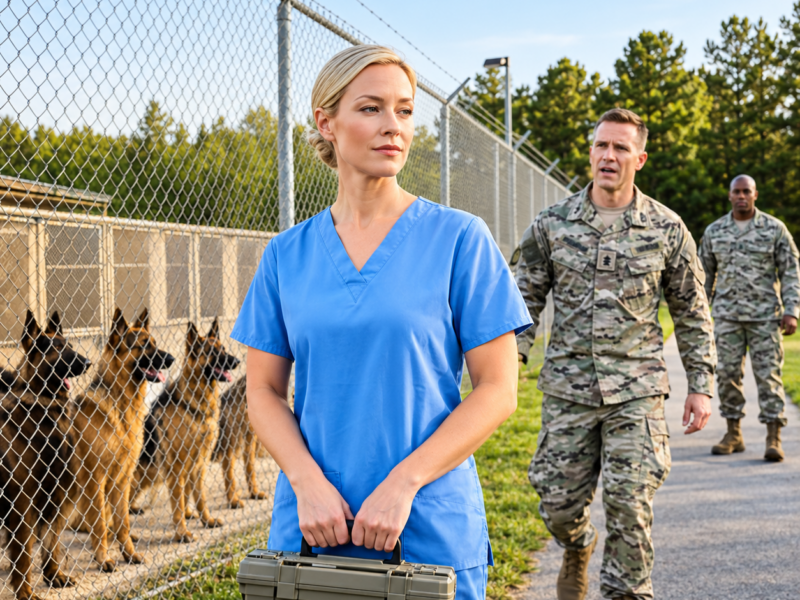
I was publicly thrown out of a military kennel in San Diego after a furious handler accused me of trespassing, but when six combat K9s suddenly refused to obey anyone except me, the shouting stopped because the quiet woman they had dismissed as a civilian was hiding a past built around saving war dogs.
The morning air in San Diego was thick with salt and exhaust, carrying the steady rumble of the Pacific fleet off in the distance.
I kept my eyes down, dragging the heavy rubber hose across the wet concrete floor of the main kennel block.
My hands were raw, calloused, and smelled perpetually of harsh disinfectant and dog shampoo.
To the men in uniform, I was just Hannah, the quiet civilian tech who cleared urine trays and scrubbed feeding bowls without complaint.
They didn’t look at my face, and they certainly didn’t look at my hands.
If they had, they might have noticed the faint white line running from my left wrist up to my elbow—a souvenir from a night spent in the gravel outside Kandahar.
I preferred it this way.
The anonymity was a blanket I had pulled over my head three weeks ago when I took this job.
No questions, no memories, no ghosts.
Just four walls, a bucket, and dogs that didn’t care about the past as long as you were calm.
Then I walked past Bay 14.
He was a Belgian Malinois, lean and muscular, with coat the color of burnt sugar and a deep black mask that stretched over his muzzle.
A jagged white scar bisected his snout, cutting through the dark fur like a lightning bolt.
His name was Ranger.
When I stopped near his run, he didn’t bark or hurl himself against the chain-link fence like the young Dutch Shepherds in the next row.
He sat perfectly still, his dark eyes locked on mine, tracking every rise and fall of my chest.
His ears were pinned flat, his tail rigid against the concrete.
“Don’t get too close,” Sergeant Miller said, his boots heavy on the wet ground behind me.
Miller was a large man with a thick neck and eyes that looked like they hadn’t seen a full night’s sleep in five years.
“He doesn’t trust strangers,” Miller added, leaning against the doorframe with a mug of black coffee.
I nodded slowly, taking a step back without turning my shoulder away from the dog.
“Understood,” I said.
My voice was flat, devoid of the gentle baby-talk most civilians used around dogs.
Miller grunted, satisfied, and turned back toward the administrative office.
I stood there for a long moment, watching Ranger’s breathing.
It was shallow and rapid—the breathing of a soldier who thought he was still in the kill zone.
I lowered my gaze, break off the eye contact, and quietly dropped a small piece of dried liver on the floor just outside his fence before walking away.
The Sound of Breaking Faith
By noon, the San Diego sun was pounding down on the gravel exercise yard.
Dust rose in hot, pale plumes as handlers led their working dogs through bite-work drills and agility ramps.
I was carrying a crate of medical supplies toward the vet clinic when the raised voices started.
“Get out of my kennel!”
The voice cracked across the yard like a pistol shot.
I froze, turning to see Staff Sergeant Vance stepping out of Bay 12, his face flushed red beneath his cover.
Sergeant Miller was standing right beside him, his jaw set in a hard, angry line.
I was kneeling on the hot concrete just outside Ranger’s door, where the dog had collapsed after a high-intensity patrol simulation.
Ranger was panting heavily, his sides heaving, his eyes rolling back until the whites showed.
He was shaking violently, trapped in a heat-induced tremor that the handlers were mistaking for stubbornness.
“I was checking his paw,” I said softly, staying low so I wouldn’t loom over the panicked dog.
“You’re not his handler,” Vance barked, stepping into my personal space.
“I know,” I said.
“Then stay out of my kennel,” Miller spat, his voice dropping into that quiet, dangerous register reserved for insubordinate recruits.
The entire yard seemed to go dead quiet.
Decels, handlers, and civilian contractors all paused, turning their heads toward the commotion.
My face burned with a sudden, humiliating heat.
I felt the eyes of twenty men digging into my spine, assessing me as a meddling civilian who had stepped out of line.
I stood up slowly, keeping my hands visible, and took two steps back to clear the doorway.
“I’m sorry,” I murmured.
I turned my back on Miller and began walking toward the main office, my heart hammering against my ribs like a trapped bird.
Then came the sound of nails clicking rapidly against the concrete.
I didn’t turn around, but I could hear the rhythmic pad of four heavy paws right at my heels.
Ranger had slipped past Vance and was walking directly behind me, his nose inches from my left hand.
The yard fell into a terrifying silence—the kind of quiet that precedes an explosion on an optics range.
“Ranger, heel!” Vance yelled, his voice strained with authority and sudden embarrassment.
The dog didn’t even twitch an ear.
He kept his pace perfectly synced to mine, his shadow overlapping my own on the bright gravel.
“Stop,” Miller commanded, his voice sharp enough to cut glass.
I stopped instantly in the middle of the courtyard.
Ranger stopped beside me, leaning his heavy chest against my leg and letting out a long, ragged exhale.
I looked down at him, my throat tight.
Miller stepped forward, his face dark, his fists clenched at his sides.
“What did you do to him?” Miller demanded.
Before I could answer, a low, collective noise began to echo through the outdoor runs.
Bay 8: Duke, a German Shepherd with three tours in Iraq.
Bay 10: Bella, a tiny Dutch Shepherd trained in explosive detection.
One by one, six different combat dogs stepped to the fronts of their cages.
They didn’t bark wildly or hurl themselves at the wire.
They sat down in unison, facing us, and began a low, rhythmic baying that vibrated through the asphalt beneath our boots.
It was an old, mournful chorus—a collective posture of protection that only dogs who had lived through heavy fire understood.
The base veterinarian, Dr. Aris, came running out of the clinic doors, his stethoscope swinging wildly around his neck.
“What happened out here?” Aris asked, looking from the line of baying dogs to me.
Miller pointed an accusatory finger at my chest, though his hand was slightly unsteady.
“She has some kind of connection with them,” Miller said, his voice laced with suspicion. “She’s messing with their training.”
I shook my head, shrinking back slightly under the weight of their combined stares.
“No,” I whispered. “I was just checking his pulse.”
Miller stepped closer, his eyes narrowing as he took in my stance, my balanced posture, and the way Ranger was leaning into my hip.
“Who are you?” he asked.
The Ghosts We Keep Buried
For several long, agonizing seconds, the only sound was the wind blowing off the bay and the distant hum of traffic on Highway 75.
I looked down at my worn sneakers.
I had sworn I would never talk about it.
I had buried the uniform, the medals, and the nightmares in a steel trunk in my sister’s attic in Ohio.
Ranger nudged my hand with his wet nose, forcing his snout under my palm until I was forced to touch him.
My fingers automatically moved to the pressure points behind his ears, massaging the tense muscles at the base of his skull.
I finally looked up, meeting Miller’s harsh glare.
“I trained combat K9s,” I said, my voice barely above a whisper, but carrying clearly through the silent yard.
Dr. Aris stepped closer, his brow furrowed in confusion.
“Where?” Aris asked.
“Helmand Province,” I said. “And outside Kandahar.”
Miller’s face shifted, the anger draining away, replaced by a sudden, sharp calculation.
“You were military?” Vance asked, his voice dropping its hostile edge.
“I was a civilian contractor attached to Special Operations,” I said quietly, looking back down at Ranger. “I worked with military working dogs during deployments… especially the ones suffering from severe combat stress.”
As if responding to the words, Ranger suddenly dropped flat onto his stomach on the hot concrete.
His eyes rolled up, his legs going rigid as his breathing spiked into rapid, panic-stricken gasps.
“He’s having a flashback,” Vance shouted, reaching for his leash. “Get back, he’s gonna snap!”
“Don’t touch him!” I snapped, my voice taking on a iron tone that stopped Vance in his tracks.
I dropped to my knees beside the shaking Malinois, placing one hand flat on his sternum and the other firmly behind his neck.
“Easy, buddy,” I murmured, matching my breathing to the rate I wanted his to reach. “You’re in California. The dust is gone. The sky is clear. I’m right here.”
I began counting aloud in a slow, steady rhythm, pressing down firmly on his chest with every third count to stimulate his vagus nerve.
Within twenty seconds, Ranger’s rigid legs relaxed.
He let out a deep, shuddering sigh, his tongue lolling out as he rested his heavy chin directly on my knee.
Dr. Aris stared at us, his mouth slightly open, the medical file in his hand completely forgotten.
“How did you do that?” Aris asked softly.
“Same way I used to,” I said, rubbing Ranger’s soft ears. “You have to show them you’re grounded, or they’ll think the threat is still real.”
That evening, the orange sun was dipping below the horizon, painting the San Diego sky in long streaks of violet and gold.
I stood outside the door of the station commander’s office, my hand hovering over the wood before I finally knocked.
“Come in,” Commander Harris called out.
I pushed the door open.
Harris was sitting behind a massive oak desk, a thick manila folder open in front of him.
Beside him stood Sergeant Miller, looking unusually quiet, his hands folded behind his back.
“Take a seat, Hannah,” Harris said, gesturing to the leather chair opposite him.
I sat down on the edge of the seat, my spine straight, my hands clasped tightly in my lap.
“I ran your social security number through the DOD database,” Harris said, leaning forward and resting his elbows on the desk. “Hannah Vance. Formerly Lead K9 Handler, 3rd Tactical Support Group.”
“Yes, sir,” I said softly.
“You have two commendations for battlefield medical care,” Harris continued, flipping a page. “You pulled three dogs and two handlers out of an ambush site in 2018. Then you vanished from the system.”
“I resigned my contract,” I said. “I never told anyone here because… I was trying to leave that part of my life behind.”
“Why?” Harris asked, his eyes fixing on mine.
“Because when you stay in that world too long, you start seeing every dog as a soldier you’re going to lose,” I said quietly.
Harris nodded slowly, running a hand over his cropped hair.
He pushed six red-labeled folders across the polished wood toward me.
“These six dogs—including Ranger—are scheduled for reassignment or medical discharge next month,” Harris said. “They’re aggressive, unmanageable, and two of them have bite incidents on record.”
I looked at the files, seeing the dark photos of Duke, Bella, and Ranger clipped to the covers.
“They aren’t broken,” I said, feeling a sudden surge of heat in my chest. “They’re just terrified.”
Harris leaned back in his chair.
“If I give you four weeks to work with them, can you get them operational?”
I looked through the window toward the kennels, where the shadow of the chain-link fences stretched across the concrete under the floodlights.
“Let me work with them,” I said.
The next three weeks became a blur of early mornings and midnight sessions.
While the rest of the base slept, I stayed behind in the floodlit training yards, stripping away the rigid military discipline to focus on trust.
I brought the handlers in one by one, forcing them to put away their choke chains and loud commands.
“They don’t care about your rank, Sergeant,” I told Vance one rainy Tuesday night as we stood in the mud with Duke, the aggressive German Shepherd.
“He thinks you’re going to leave him behind if he makes a mistake,” I explained, taking the leash from Vance’s hand.
I sat down in the mud, completely unconcerned with the dirt staining my clothes.
Duke growled softly, his hackles raised, his teeth bared in a defensive display.
I ignored him, looking out at the fence line, tossing small bits of boiled chicken onto the ground between us.
Slowly, the tension left the shepherd’s shoulders.
By the second week, Duke stopped lunging at the handlers who walked past his run.
Bella, the tiny Dutch Shepherd who used to tear her own paws raw trying to dig out of her crate during thunderstorms, was sleeping soundly through the night on an orthopedic bed I had bought with my own money.
And then there was Ranger.
He became my shadows.
Whenever I was on the yard, he was off-leash, trotting three paces behind me, his dark eyes constantly scanning the perimeter for threats that no longer existed.
The handlers stopped shouting at me.
Instead, they began standing around the edges of the fence during their breaks, watching silently as I worked magic they couldn’t understand.
“You gave them back their minds,” Dr. Aris said to me one afternoon as we watched Ranger comfortably fetch a rubber ball for a young private.
“They always had their minds,” I replied, wiping sweat from my forehead. “They just needed someone to remind them that the war was over.”
By Friday of the fourth week, the final evaluations were complete.
All six dogs had passed their behavioral assessments with flying colors, their discharge orders officially rescinded by Commander Harris.
The kennel yard was quiet, wrapped in the cool night air of a San Diego weekend.
I was packing my small canvas bag in the vet clinic, preparing to take my first full day off in a month.
Ranger was resting quietly in Bay 14, his head propped on his paws, watching me through the wire mesh.
I walked over to his run to give him one last piece of dried liver before I left.
As I reached through the low slot to place the treat, my foot brushed against a small piece of paper tucked between the wall and the heavy wire frame.
It was an old Polaroid photo, faded at the edges and yellowed by sun and humidity.
I pulled it out curiosity, holding it up to the dim fluorescent light overhead.
My breath caught instantly in my throat.
The photo showed a much younger version of myself, dressed in desert camo, standing in front of a ruined brick wall in Helmand Province.
Beside me was a massive black-masked Malinois—the dog I had known ten years ago as ‘Ares.’
The dog I had been told was killed in the same rocket attack that destroyed my forward operating base.
My hand began to shake, the paper fluttering between my fingers like a dead leaf.
“This is impossible,” I whispered into the quiet room.
I turned the photo over.
On the back, written in thick black marker that had faded to gray, was a handwritten message:
You thought he died.
My heart pounded violently against my ribs, each thud ringing like a hammer in my ears.
I stared at the faded ink, my thumb trembling as I traced the familiar, jagged handwriting.
I knew that handwriting.
I had spent two years looking at it on mission logs, supply manifests, and dog health records in Afghanistan.
It belonged to Captain Marcus Cole—my former unit commander and the lead handler who had vanished into the mountain night during the ambush at Sector 7.
Official reports said he had been KIA, his body swept away by the river after the bridge was blown.
I had spent ten years carrying the guilt of leaving that valley without him.
“Hannah?”
I spun around, slamming my back against the wire run.
Sergeant Miller was standing in the doorway of the kennel block, holding a heavy ring of brass keys.
His eyes fell on the photo in my shaking hand, his expression unreadable in the dim light.
“Is something wrong?” Miller asked, taking two steps forward into the hallway.
I tried to tuck the photo into my pocket, but my fingers were too numb to move properly.
“Where did this dog come from, Miller?” I asked, my voice cracking under the sudden weight of the memory.
Miller stopped, looking down at Ranger, who had stood up and was now leaning against the wire, his tail slowly wagging.
“Ranger?” Miller said quietly. “He came in through a civilian surrender three months ago out of Arizona.”
“Who surrendered him?” I demanded, stepping toward him. “What was the name on the intake form?”
Miller frowned, reaching into his pocket and pulling out his phone.
“I don’t know, it was handled by the district office… let me check the digital ledger.”
The seconds stretched out like rubber bands as Miller swiped through the base database.
The only sound in the building was the low, rhythmic hum of the ventilation fans and the soft panting of the six dogs line up down the aisle.
“Here it is,” Miller muttered, squinting at the screen. “Delivered to the front gate by a private transport company out of Yuma.”
He paused, his brow furrowing as he read the secondary notes.
“The owner of record was listed as a private security contractor,” Miller said. “Name’s listed as M. Cole.”
The floor seemed to tilt beneath my feet.
Marcus was alive.
“Did he leave anything else?” I managed to ask, my voice barely audible above the hum of the air units.
Miller looked at me, then back down at his phone, his face growing paler by the second.
“There’s a note attached to the intake manifest,” Miller said slowly, looking up to meet my eyes. “The guard at the gate noted that the driver left a sealed envelope for the lead tech.”
“Where is it?” I asked, taking another step forward.
Miller walked over to the main office desk, unlocked the bottom drawer, and pulled out a thick yellow envelope with my name written across the front.
I took it from his hands, my chest heaving as if I had just run five miles through the sand.
I tore the seal open with my thumb and pulled out a single sheet of heavy paper.
Beneath the original message was four more words, written in fresh, dark blue ink that smelled faintly of copper and oil.
He’s looking for you.
I stood in the center of the quiet kennel block, holding the paper against my chest.
Outside, the cool San Diego wind rattled the chain-link gates of the empty training yard.
Ranger let out a soft, low whine from behind the wire, placing his massive paw through the lower gap in the door until it rested directly on the toe of my boot.
I looked down at the dog—not Ranger, but Ares.
The dog I thought I had lost to the gravel and the fire ten years ago had been brought back to me, step by step, across thousands of miles of dust and bureaucracy.
Marcus hadn’t sent him here to be saved by the navy.
He had sent him here because he knew I was the only one who could fix him.
And because he knew I would see the sign.
Miller looked from the paper in my hands to the dog sitting patiently at my feet, his expression shifting from confusion to a deep, silent understanding.
“What are you going to do, Hannah?” Miller asked softly.
I folded the note carefully and slipped it into the inner pocket of my jacket, right next to my heart.
Then I reached down, unlocked the heavy latch on Bay 14, and swung the iron door wide open.
Ranger stepped out into the hallway, his head held high, his dark eyes fixed entirely on my face.
“I’m going to get my gear,” I said, clipping his leather leash onto his collar with a clear, sharp metallic click.
I looked at Miller, then down the long row of runs where five other heads were watching us in complete, respectful silence.
“And then I’m going to find my captain.”









