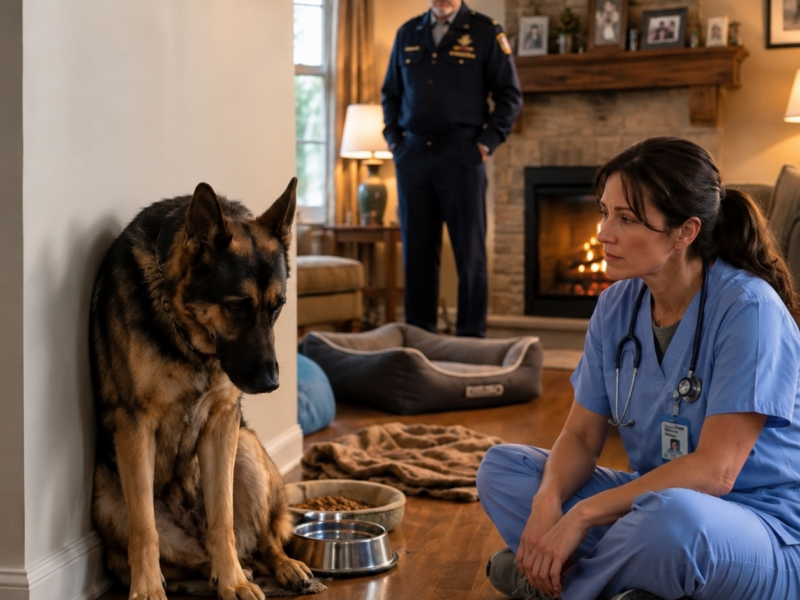
I was humiliated in the admiral’s private wing when his security chief ordered me away from his K9, saying, “He doesn’t need a nurse,” but the dog kept staring at one blank wall as if someone had hidden a terrible secret behind it.
The fluorescent lights of Naval Medical Center San Diego hummed with a low, relentless vibration that usually lulled me into a trance by four in the morning.
I was leaning against the nurses’ station desk, rubbing my temples and trying to finish my charting before the shift change.
The corridor was quiet, save for the squeak of soft-soled rubber shoes on polished linoleum down in the main concourse.
I expected the night to wrap up without incident, just like every other Sunday shift on the acute recovery floor.
Then my phone buzzed against the mahogany counter, startling me out of my weary haze.
“Nurse Evelyn Vance?” a voice asked, crisp and hurried, before I could even properly greet the caller.
“Speaking,” I replied, straightening up and pulling my stethoscope around my neck.
“We need you upstairs in the private wing immediately,” the voice said without identifying itself. “Bring a basic trauma kit and a sedative protocol, just in case.”
I frowned, glancing at the empty hallway.
“The private wing is off-limits to night shift floating staff unless there’s a medical code called,” I pointed out.
“This isn’t a code, but it’s an emergency,” the caller replied coldly. “Just get up here.”
I grabbed my gear, curious and slightly uneasy, before stepping into the service elevator.
When the heavy doors slid open on the restricted top floor, two armed guards stood flanking the main double doors, their faces unreadable.
One of them stepped forward, eyeing my hospital badge with intense scrutiny.
“It’s about the admiral’s dog,” the guard whispered, his voice cracking slightly with an emotion he tried hard to conceal.
I paused, looking between the two men.
“It’s a dog? I’m a registered human nurse, not a veterinarian.”
“Just step inside,” the guard insisted, opening the door just wide enough for me to slip through.
His name was Atlas, a massive, muscular Belgian Malinois who had served beside Admiral Thomas Reed for nearly a decade.
When I entered the lavish, dimmed suite, Atlas didn’t bark, nor did he even turn his head toward the door.
He simply sat rigid beside the high-backed leather armchair, his dark eyes fixed intently on the blank wooden wall across the room.
“He hasn’t eaten or drank a drop since the admiral disappeared,” the guard whispered from behind me.
I frowned, my hand lingering near my kit.
“Disappeared? I heard the admiral was transferred off-site.”
“Officially, he’s on medical leave,” the guard said quickly, looking over his shoulder toward the hallway.
That answer bothered me deeply.
The admiral had been rushed away three days earlier after what the official hospital memos called a sudden medical emergency.
Yet Atlas looked less like a grieving dog and more like a sentry standing watch over a active target.
I knelt softly on the carpet, keeping my distance so as not to startle the giant animal.
“Hey, buddy,” I whispered softly, extending the back of my hand.
His ears lifted slightly, twitching toward my voice, but his gaze remained locked on the oak paneling.
Then, slowly, Atlas stood up, stepped past me, and pressed his black nose firmly against the cold wood.
I reached out, running my fingers along the seam of the wall paneling.
It felt completely hollow.
Before I could press down, a heavy hand clamped down hard around my wrist.
“Don’t,” a ice-cold voice commanded from right behind me.
I spun around to see Security Chief Marcus Vance standing over me, his shadow blotting out the dim lamp.
His face was drawn tight, his eyes sharp and completely devoid of warmth.
“You’re here to check the dog’s vitals and leave, Nurse Vance,” he said, holding my wrist a second longer than necessary.
I pulled my arm back, massaging the faint red mark his fingers had left on my skin.
“If the dog is suffering from severe stress, I need to know the environmental triggers,” I said smoothly, keeping my voice steady.
“Then why is he guarding that specific wall?” I challenged.
Nobody in the room answered me.
Chief Vance stepped between me and the paneling, staring down at Atlas with a look that bordered on contempt.
“He’s an old military working dog going senile,” Vance barked quietly. “He doesn’t need a nurse, and he doesn’t need your curiosity.”
Atlas let out a low, vibrating growl from deep within his chest, his upper lip curling back just enough to flash his white teeth.
Vance sneered, taking a half-step back from the powerful dog.
“Keep him quiet, give him a sedative if you have to, and get out of this wing before sunrise.”
Vance turned on his heel and marched out of the suite, the heavy oak doors clicking shut behind him.
I was left alone in the vast, quiet room with the silent dog and the hollow wall.
I took a deep breath, sitting down cross-legged on the floor next to Atlas.
“He’s wrong about you, isn’t he?” I murmured gently.
Atlas didn’t relax, but he allowed me to reach out and touch his ribs, checking his rapid respiration rate.
I opened my bag, pulling out a wet cloth to clean his dust-covered paws and check for any physical injuries.
As I wiped down his front left paw, something hard and stiff scratched against my palm.
I gently pried his paw pad open and pulled out a tiny, wedged piece of material.
It was a tiny strip of black fabric, soaked through with dried, dark sweat and faint dirt.
I recognized the high-grade tactical weave immediately.
It was a tear from the collar of an admiral’s working uniform.
“Where did you get this, Atlas?” I whispered, holding the cloth up to the dim light.
Atlas suddenly spun around and growled violently at the bottom of the oak wall.
I followed his fierce gaze and noticed a tiny, almost invisible scratch along the base of the floor molding.
I glanced back at the locked double doors, listening intently for any approaching footsteps.
The hall outside remained dead silent.
I pulled a small stainless steel bandage scissor out of my medical pouch and slid the flat blade beneath the loose trim.
With a soft pry, the decorative wood popped forward with a faint metallic snap.
Behind it sat a narrow, custom-built steel compartment hidden deep inside the wall cavity.
Inside sat a battered burner phone, a blood-stained military dog tag, and a tightly folded handwritten note.
My hands trembled violently as I unfolded the yellowed paper.
It said, in jagged, rushed penmanship: If Atlas leads you here, trust him, not them.
Before I could even process the words, the screen of the burner phone lit up with a blinding blue light all on its own.
A single audio file popped onto the display, and a timer began counting down from three seconds.
The speaker crackled once, and then Admiral Thomas Reed’s deep, authoritative voice filled the tight space around me.
“If you’re hearing this, they’ve already told the base that I died or ran,” the recording spoke quietly.
My heart hammered against my ribs like a trapped bird.
“The breach didn’t come from outside,” the admiral’s voice continued, slightly strained with pain. “It came from inside our own security detail.”
I stared at the tiny phone, barely daring to draw a breath.
“Chief Vance sold the routing codes for the Pacific supply lines,” the admiral confessed on the tape. “I caught him in my office three nights ago.”
The recording paused, accompanied by the muffled sound of a physical struggle in the background.
“He thinks he wiped the server, but Atlas saw everything. Atlas knows where I hid the hard drive.”
The recording abruptly cut out with a sharp static buzz.
I froze, the burner phone burning cold in my trembling palm.
Atlas stepped silently beside me, his entire body rigid as iron, his ears pinned back flat against his head.
He wasn’t looking at the wall anymore.
He was staring directly at the heavy double doors leading out to the main hallway.
I held my breath, listening into the suffocating darkness of the suite.
Through the narrow gap beneath the door, I could clearly hear heavy, rhythmic breathing.
Someone was standing right outside, listening.
Then a quiet, raspy voice whispered through the crack.
“Nurse, step away from the wall.”
I slowly backed away, my eyes wide as the door handle began to turn downward millimeter by millimeter.
I looked down at Atlas, expecting him to cringe or cower from the authority in that voice.
For the first time all night, the giant dog wasn’t afraid.
His tail was straight, his eyes were sharp, and his deep chest expanded as he prepared to strike.
He was ready.
The door swung open with a slow, agonizing creak.
Chief Vance stood in the threshold, a heavy tactical sidearm drawn and lowered at his hip.
“I gave you a simple order, Vance,” he said softly, stepping inside and shutting the door behind him.
“You should have just cleaned his paws and gone home.”
“He’s not senile,” I said, my voice shaking despite my best efforts to sound brave. “And you’re not protecting this base.”
Vance smiled, a cold, empty expression that didn’t reach his dark eyes.
“Hand over the phone, Evelyn.”
“I don’t have anything,” I lied, stepping back until my shoulder hit the wooden wall.
“Don’t make this difficult,” Vance said, raising the barrel of his weapon directly toward my chest. “No one expects a night shift nurse to make it through a chaotic night intact.”
Atlas didn’t wait for my command.
With an explosion of power, the two-hundred-pound Malinois launched himself off the hardwood floor.
He crossed the room in a fraction of a second, his jaws clamping down hard on Vance’s gun arm.
Vance screamed out in pain, dropping the heavy sidearm as he slammed back against the doorframe.
The gun skidded across the smooth floor, sliding directly beneath the heavy leather sofa.
“Get him off me!” Vance roared, punching wildly at the dog’s flanks with his free fist.
Atlas held his grip with unbreakable military precision, twisting his weight to drag the larger man to the floor.
I didn’t hesitate for a single second.
I lunged toward the sofa, scrambling on my knees to grab the cold steel frame of the dropped weapon.
My fingers brushed against the grip, pulling it out from the dust.
“Stop!” I shouted, holding the heavy pistol with both hands, pointing it straight at Vance.
Vance froze, his face pale and dripping with sweat as Atlas held him pinned against the baseboard.
“Call him off,” Vance panted, his breath coming in ragged gasps. “You don’t know what you’re stepping into, girl.”
“Tell me where the admiral is,” I demanded, stepping closer while keeping the front sight aligned with his chest.
“He’s dead,” Vance sneered, bleeding through his torn sleeve. “He was dead the second he looked at my files.”
Atlas let out a fierce growl, tightening his jaws just enough to make Vance cry out in agony again.
“He’s lying,” I whispered to myself, remembering the blood-stained tags in the hidden compartment.
The blood was fresh when I touched it earlier—it hadn’t fully dried.
“Where is he?” I repeated, my finger tightening slightly against the smooth trigger.
Vance looked at my eyes, realizing I wasn’t going to break or lower the gun.
“Sub-basement four,” Vance spat out, coughing violently. “The old holding cells near the boiler room.”
“Why keep him alive?” I asked.
“Because he’s the only one with the biometric key to the master server,” Vance growled.
Suddenly, the red emergency light on the wall began to flash silently.
The secondary security alarm had been tripped somewhere else in the building.
Vance grinned through his pain, his teeth stained red.
“My men are on their way up,” he warned softly. “You have about ten seconds to run.”
I looked down at Atlas, whose dark eyes were locked on mine, waiting for direction.
“Release,” I commanded gently, using the standard handler call I had heard on the wards.
Atlas instantly unclasped his jaw and sprang back to my side, his coat bristling with adrenaline.
I grabbed the burner phone and the handwritten note from the hidden panel, shoving them deep into my scrub pocket.
“Come on, boy,” I whispered, slipping out the private wing’s back service door just as heavy footsteps echoed down the main corridor.
We sprinted down the narrow, dimly lit service stairwell, skipping steps in the dark.
The air grew cooler and thicker with every flight of stairs we descended.
San Diego’s naval medical facility was built over old military bunkers dating back to the Second World War.
By the time we reached the lowest level, the pristine white linoleum of the upper floors had vanished.
In its place were damp concrete walls, exposed steaming pipes, and flickering yellow light strips.
Atlas took the lead, his nose low to the cold floor, sniffing frantically through the thick smell of engine oil and rust.
“Find him, Atlas,” I whispered, keeping the heavy pistol raised as we navigated the maze of corridors.
He paused at a heavy steel door marked UTILITY ACCESS – AUTHORIZED PERSONNEL ONLY.
The lock had been freshly tampered with; scratch marks encircled the keycard reader.
Atlas nudged the door with his head, and it swung inward with a heavy, metallic groan.
Inside, the sound of a steady, rhythmic beep rang out through the damp air.
It was a portable heart monitor.
I stepped carefully over thick cables running along the damp floor, my heart pounding in my ears.
In the center of the room, strapped to an old transport gurney, lay Admiral Thomas Reed.
He was pale, an IV line running into his bruised arm, but his chest was rising and falling steadily.
“Admiral?” I breathed, rushing to his side and checking his pulse.
His eyes flickered open slowly, unfocused and heavy with powerful sedatives.
“Evelyn…?” he rasped, his voice barely a whisper. “How… how did you…”
Before he could finish, Atlas placed his huge head gently on the old man’s chest, letting out a soft, whimpering whine.
The admiral’s hand trembled as he raised it slightly to touch the dog’s soft velvet ears.
“Good boy,” the admiral whispered, a tear carving a clear line through the grime on his cheek. “You brought help.”
“We have to get you out of here right now,” I said, working quickly to unbuckle the heavy leather restraints around his wrists.
“It’s too late,” the admiral grunted, wincing in pain as he sat up slowly. “Vance has the entire night shift security lock down.”
“He doesn’t have the hard drive,” I replied, pulling the hidden phone from my pocket.
The admiral looked at the device, then up at me with renewed clarity in his eyes.
“The drive is still inside the dog’s collar,” the admiral revealed softly. “Sealed in the lining.”
I froze, looking down at Atlas’s heavy leather collar.
Before I could reach for it, the heavy steel door behind us slammed shut with a deafening boom.
The metallic click of an external deadbolt rang out through the heavy steel door, echoing off the damp concrete walls.
“Nurse Vance!” a voice shouted through the small reinforced glass window in the door.
It wasn’t Vance this time—it was one of his junior security officers, holding a heavy iron bar over the latch.
“Chief Vance says to leave you both down here until the morning shift arrives,” the officer called out, his voice laced with nervous tension.
“You don’t have to do this!” I yelled back, slamming my palm against the reinforced glass. “He’s committing treason!”
“He pays my mortgage,” the officer replied coldly before the small viewing hatch clicked shut, plunging us into near total darkness.
The only remaining light came from the faint green glow of the portable heart monitor screen.
“Evelyn,” the admiral said, his voice steady despite his physical weakness. “Look at the ventilation shaft above the generator.”
I looked up toward the ceiling where a rusted air duct hung suspended by thick iron chains.
It was narrow, barely two feet wide, but it led directly toward the exterior utility courtyard.
“I can’t fit through there,” I said, looking at the tight space.
“You don’t need to,” the admiral said, turning his head toward the dog. “Atlas can.”
Atlas looked up at the vent, his ears pricking up as if he understood every word.
I quickly unbuckled Atlas’s thick collar, using my bandage scissors to slice open the reinforced inner seam.
Inside lay a tiny, metallic micro-drive, no larger than a fingernail, wrapped in waterproof tape.
“Take this,” the admiral instructed, handing me his personal dog tags from my pocket. “Attach the drive to the tags and put them around his neck.”
I quickly looped the chain through the drive’s casing and secured it around Atlas’s neck.
“If he gets to the main gate, the automated scanners will trigger an emergency signal to the base commander,” the admiral explained. “It’s an old fail-safe.”
I dragged a heavy plastic supply crate over to the wall beneath the ventilation duct.
“Can you make that jump, boy?” I asked, looking up into the dark shaft.
Atlas placed his front paws on the crate, whining softly as he looked back at the admiral on the gurney.
“Go, Atlas,” the admiral commanded, his voice ringing out with supreme authority. “Execute order home base.”
Atlas didn’t hesitate.
He bounded onto the crate and launched his massive body straight up into the open air duct, his claws gripping the corrugated metal.
With a heavy rustle and the scrape of iron, his long tail disappeared into the darkness of the pipe.
We sat in the dim green light, listening as the sound of his paws faded into the distance above us.
“Now we wait,” the admiral said softly, leaning his head back against the thin pillow.
“What if Vance finds him outside?” I asked, sitting on the edge of the gurney, holding the pistol tight.
“Vance trained him,” the admiral said with a grim smile. “He knows better than anyone that you can’t stop that dog once he has a mission.”
Outside the room, the distant hiss of steam pipes sounded like a ticking clock marking down our remaining minutes.
Then, from somewhere deep within the wall cavity, we heard the sudden, violent sound of breaking glass and shouting.
The sound of footfalls echoed wildly through the metal pipes above our heads.
Shouts rang out from the hallway outside, followed by the muffled pop of warning shots being fired into the air.
“He made it outside,” I whispered, standing up and pressing my ear against the cool steel door.
“Or they caught him,” the admiral muttered grimly, his knuckles white as he gripped the edge of the frame.
Suddenly, the heavy iron deadbolt on the door rattled violently.
Someone was frantically trying to insert a master key into the lock from the outside.
I raised the handgun again, lining up my sights with the center of the door frame, my heart hammering against my ribs.
“Don’t shoot unless you see black uniforms,” the admiral warned quietly.
The lock clicked back with a sharp, heavy thud, and the door burst open.
A bright beam of tactical light cut through the gloom, blinding me instantly.
“Drop the weapon! Naval Security Forces!” a voice bellowed through a loudspeaker.
I squinted through the glare to see four fully geared master-at-arms officers spilling into the room, their shields raised high.
Behind them stood the Base Commander, Captain Miller, his face pale and furious.
And right beside Captain Miller was Atlas, his tongue hanging out, his nose covered in soot, and his dog tags gleaming under the bright lights.
“Nurse Vance, lower your gun,” Captain Miller ordered softly, stepping past his men.
I slowly lowered the weapon, letting out a long, shaky breath I felt like I’d been holding for hours.
“Where is Chief Vance?” the admiral asked from the gurney, his voice raspy but firm.
“We picked him up at the main perimeter gate,” Captain Miller reported, coming forward to salute the old man. “He was trying to board a civilian transport.”
“He had help,” I added, pointing toward the doorway.
“We’ve already secured the perimeter guards,” Captain Miller assured us. “Your dog tripped the main base alarm at the entry portal with your encrypted drive.”
Atlas walked past the armed guards, completely ignoring their heavy gear, and trotted straight over to my side.
He nudged my hand with his cold, wet nose, leaning his heavy weight against my legs.
“You did it, buddy,” I whispered, kneeling down to wrap my arms around his massive neck.
The medical team rushed into the room seconds later, wheeling in a proper gurney and emergency supplies to stabilize the admiral.
As they carefully lifted Admiral Reed onto the transport, he reached out and caught my hand.
“You listened when everyone else told you to look away,” the admiral said, looking deep into my eyes.
“I just followed the nurse’s instinct,” I replied with a faint smile. “And a very smart dog.”
“You’re not working night shift floats anymore, Evelyn,” the admiral said firmly. “I need someone I can actually trust on my permanent staff.”
They wheeled him out toward the elevator, the tactical team forming an escort around his gurney.
Atlas stayed right by my side, refusing to leave until I stepped into the hallway with him.
As we walked back up toward the main concourse, the first pale blue light of dawn was beginning to break through the glass windows.
The hospital floor looked completely different in the morning sun.
The terrifying shadows of the night had dissolved into the mundane routine of day-shift doctors and changing shifts.
Chief Vance was led through the main lobby in heavy wrist restraints, flanked by federal marshals, his head bowed low in silence.
He didn’t look at me as he passed, nor did he look at the dog who had undone his entire operation.
Atlas sat calmly beside the main reception desk, his coat freshly brushed and a fresh bowl of water sitting before him.
I sat on the bench next to him, sipping a hot cup of black coffee that finally began to warm my frozen hands.
“He’s going to be fine, you know,” I whispered down to the Malinois. “The doctors say the admiral will make a full recovery in a few weeks.”
Atlas let out a soft huff, resting his heavy chin directly on my knee.
My phone rang on the desk beside me—a formal notification from the Chief of Nursing transferring my permanent station to the Command Suite.
I looked at the transfer order, then down at the brave animal sitting at my feet.
The silence of the hospital night shift would never feel the same again.
I reached down, scratching Atlas behind his soft, pointed ears, feeling the steady rhythm of his heart beneath his ribs.
He didn’t look at the blank wall anymore.
His eyes were fixed forward, watching the bright morning light stream through the front doors, watching over the place he had saved.
And for the first time since I met him, he looked entirely at peace.