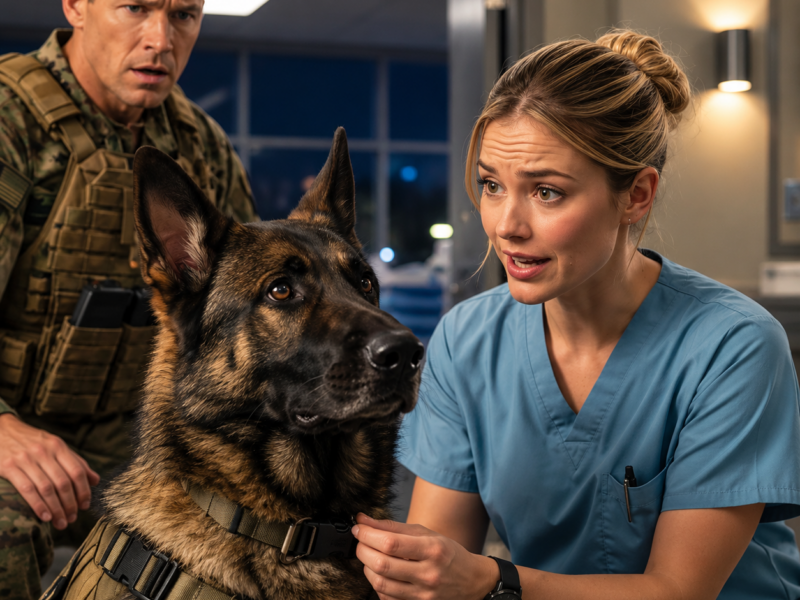
At the VA hospital in San Diego, a decorated Navy SEAL’s K9 suddenly lunged at everyone near his owner’s empty bed, and when the commander ordered me to sedate the animal, I noticed something on its collar that made me realize the dog wasn’t grieving—it was warning us about a secret someone had buried.
The third floor of the San Diego VA Medical Center always smelled like industrial floor wax and stale coffee.
I had been a nurse here for six years, working double shifts until my feet burned and the fluorescent lights turned into white blurs.
I thought I knew every type of heartbreak this hospital had to offer.
I had held the hands of veterans who woke up screaming from nightmares of cities halfway across the world.
I had sat with young wives who carried toddlers in their arms while waiting for doctors to bring them news they weren’t ready to hear.
But I had never seen an animal look at a hospital room the way Ranger did.
He was a Belgian Malinois with coat the color of smoked oak and eyes as sharp and brown as cracked glass.
He was a retired military working dog, trained to sniff out plastic explosives and track targets across desert terrain.
He was trained to follow commands without hesitation, to move like a shadow, and to die for his handler if necessary.
His handler was Chief Petty Officer Daniel Hayes, a decorated Navy SEAL who had survived three tours in Afghanistan and two in the Middle East.
Daniel had been brought back to the States two weeks ago on a medical transport, unconscious and suffering from severe pulmonary trauma.
They put him in Room 417, right at the end of the long corridor where the sunlight never quite reached.
Ranger had never left his side, sleeping on the thin linoleum floor with his heavy jaw resting on Daniel’s boots.
Then, three days ago, the military liaison came into the ward with a clean Manila folder and a blank expression.
He told us Chief Hayes had passed away during an emergency transfer to a specialized military facility across state lines.
They said his body had already been moved for a closed-door honor ceremony.
The bed in Room 417 was stripped down to the bare mattress, leaving only crisp white sheets pulled tight over the corners.
That was when Ranger stopped obeying everyone.
He refused food, turning his head away from raw beef and fresh water.
He wouldn’t leave the perimeter of Room 417, pacing back and forth like a trapped wolf.
And whenever someone mentioned Daniel’s name, his ears lifted like he was waiting for a door to open.
His chest would expand, his nostrils flaring as he tested the sterile air for a scent that was no longer there.
I stood near the nurses’ station with a tray of fresh IV bags, watching him through the reinforced glass window.
He wasn’t acting like a dog in mourning.
He was acting like a soldier on high guard, watching the perimeter for an incoming assault.
Suddenly, a loud crash echoed down the quiet hallway, followed by the harsh scrap of boot rubber against tile.
I dropped the IV bags onto the counter and ran toward Room 417.
A heavy-set security officer named Miller was flat on his back near the doorway, his baton clattering against the wall.
Ranger was standing over him, his front paws planted on Miller’s chest, his lips curled back to reveal sharp white teeth.
A low, vibrating growl hummed deep inside the dog’s throat, shaking his entire shoulders.
“Get that dog away from me!” the officer screamed, his hands flying up to protect his face.
“Don’t move, Miller!” I shouted, dropping to my knees a few feet away. “If you struggle, he’ll strike!”
Footsteps thundered down the hall behind me, heavy and precise.
Commander Richard Brooks, the regional director of veteran health affairs and a former surface warfare officer, stormed down the hallway.
His uniform was immaculate, but his skin was flushed red with anger.
“What the hell is going on here?” Brooks barked, reaching for the leather holster on his hip.
“He tried to clear out the personal items in the closet!” Miller gasped, his breath coming in ragged gasps under Ranger’s weight. “The beast lunged at me!”
Commander Brooks drew his sidearm halfway out of its holster, his eyes cold.
“Sedate him,” Brooks ordered, staring directly at me. “Do it right now, Nurse Clara, or I will put this animal down myself.”
I stepped directly between the Commander’s drawn weapon and the snarling Malinois.
“Wait!” I yelled, raising both hands in front of my chest.
Brooks flared his nostrils, his jaw tightening into a hard block.
“He’s dangerous, Clara,” Brooks said, his voice dropping into a stern command tone. “He’s an unguided missile with combat training. Step aside.”
“No,” I said quietly, keeping my voice level and calm. “He’s scared.”
I slowly turned my back on the Commander and dropped down to my knees until my eyes were level with Ranger’s.
I didn’t reach out to grab him, and I didn’t make any sudden movements.
“Ranger,” I whispered, using the low, soft cadence Daniel used when he brought the dog into the triage bay. “Easy boy. Down.”
The dog’s ears twitched at the tone of my voice.
He looked at me, his deep amber eyes searching my face with an uncanny, human-like intensity.
Slowly, the heavy vibration in his chest faded into a soft whine.
He lifted his heavy paws off Officer Miller’s chest and stepped back into the doorway of Room 417.
Miller scrambled to his feet, pulling his duty belt straight and backing away toward the wall.
Ranger sat on his haunches, staring at me without blinking.
As he lowered his head, his thick neck muscles relaxed slightly, causing the heavy fur around his neck to shift.
That was when I noticed something hanging beneath his official military collar.
It wasn’t Daniel’s silver military identification tags.
It was a small, scratched piece of rectangular metal, attached to the leather by a thin piece of brass wire.
It had a hospital room number roughly engraved into its face with a nail or a pocket knife.
Room 417.
My room.
The room where Daniel had spent his final days, and the room I was assigned to clean out by midnight.
“Get animal control up here,” Commander Brooks ordered from behind me, re-holstering his sidearm with a sharp click. “I want this dog locked in a kennel by eighteen hundred hours.”
“Commander, he’s a decorated service animal,” I said, standing up and keeping myself positioned between them. “Give me until the end of my shift to calm him down.”
Brooks looked at the open door of Room 417, then at the scratched metal tag swinging beneath Ranger’s throat.
His eyes narrowed for a fraction of a second, a flicker of nervous energy passing over his rigid features.
“You have until midnight,” Brooks said coldly. “If that animal makes one more aggressive movement, he gets put down. Is that clear?”
“Understood,” I replied.
Brooks turned on his heel and walked away, his polished shoes clicking sharply against the tile.
I looked down at Ranger, who was watching the Commander’s retreating back with his ears pinned flat against his skull.
I stepped closer to the dog and carefully reached down toward his neck.
Ranger didn’t flinch or growl.
He leaned his weight into my shins, allowing my fingers to slip beneath his thick collar.
My fingertips made contact with the cold metal tag.
When I flipped it over, I felt my heart drop into my stomach.
On the back of the metal tag, underneath the crude numbers of Room 417, were two initials scraped fresh into the steel.
E. V.
Those were my mother’s initials.
Elena Vance.
My mother had been dead for fourteen years.
The rest of my shift passed in a blur of routine chart updates and medication rounds.
Every time I walked past Room 417, Ranger was there, sitting like a stone statue in the center of the doorway.
He wouldn’t let the cleaning staff enter to wipe down the bed frames.
He wouldn’t let the orderly remove the bedside locker.
The staff grew nervous, whispering in the breakroom that the dog was haunted by his handler’s ghost.
By 11:00 p.m., my shift was officially over, but I couldn’t bring myself to clock out and drive home to my empty apartment.
Instead, I used my administrator keycard to sign Ranger into the hospital’s temporary overnight holding bay—a small, windowless office near the back on the four floor.
Commander Brooks had already gone home for the night, or so I thought.
I brought a bowl of fresh water and a blanket into the office for Ranger.
He didn’t drink, nor did he lie down on the fleece blanket.
He sat by the door, his nose pressed against the gap between the frame and the floor, sniffing constantly.
I sat at my desk, pulling up my mother’s old digital medical records on the hospital’s archive system.
Elena Vance had been an orthopedic surgical nurse at this very same VA hospital back in the early 2000s.
When I was twelve years old, two police officers had come to our front door in the middle of a rainy Tuesday night.
They told me my mother had been killed in a multi-vehicle collision on Interstate 5 on her way home from a night shift.
Her car had caught fire after tumbling down an embankment, and the remains had been identified through dental records.
I had spent the last fourteen years accepting that story as a heartbreaking, tragic truth.
I held a small memorial for her every October, lighting a candle near her framed photograph on my mantle.
So why were her initials scraped onto the collar tag of a Navy SEAL’s combat dog?
Daniel Hayes was thirty-two years old when he was brought to our unit.
Fourteen years ago, he would have been an eighteen-year-old enlistee, nowhere near San Diego or this hospital.
There was no logical connection between a decorated SEAL team leader and a surgical nurse who died in a highway crash over a decade ago.
Unless the story I had been told was a lie.
The clock on the wall read 2:10 a.m.
The hospital was quiet, save for the rhythmic humming of the floor buffer two levels down and the occasional chirp of a cardiac monitor.
I rested my head on my arms at the desk, my eyes heavy with exhaustion.
At 2:13 a.m., a soft sound jerked me wide awake.
It was a sharp, rhythmic sound—the sound of hard dog nails scraping frantically against linoleum.
I snapped my head up.
Ranger wasn’t sitting by the door anymore.
He was standing right beside my swivel chair, his front paws planted firm on the ground.
His nose was thrust into my lap, pushing hard against my forearm, nudging me upward.
“Ranger?” I whispered, my heart beginning to race. “What is it?”
He didn’t make a sound.
He turned toward the door, his tail stiff, his body locked in an intense, rigid pose.
He scratched at the base of the heavy oak door with one paw, then looked back over his shoulder at me.
His eyes were wide, white showing around the edges, reflecting the dim emergency lighting of the office.
He wasn’t angry.
He was urgency made flesh.
I stood up, taking my master keycard from the desk drawer.
As soon as my hand touched the brass door handle, Ranger let out a breathy, suppressed huff.
I slowly turned the handle and cracked the door open an inch.
The third-floor hallway was dark, bathed in the faint blue glow of the exit signs.
Ranger slipped through the narrow gap before I could even open the door fully.
He moved without making a sound, his paws barely clicking against the wax.
“Ranger, come back,” I hissed, keeping my voice down to avoid waking the overnight patients in the recovery ward.
He didn’t listen.
He sprinted down the corridor, passing the nurses’ station, passing the supply closets, and passing Room 417 without stopping.
He made a sharp left turn into the service hallway—the dimly lit corridor that led toward the old administration wing.
That wing had been closed off six months ago for structural renovations and asbestos abatement.
It was supposed to be completely empty, locked behind heavy steel fire doors.
I ran after him, my rubber-soled nursing shoes squeaking against the floor.
When I rounded the corner into the service corridor, I saw that the steel fire door was sitting slightly ajar.
The yellow cautionary tape that usually sealed the frame had been clean cut with a razor blade.
Ranger was standing right outside the crack, his head turned back toward me, waiting for me to catch up.
My breath caught in my throat.
The air coming through the cracked door smelled different than the rest of the hospital.
It didn’t smell like floor wax or bleach.
It smelled like damp concrete, stagnant water, and copper.
Ranger pushed the steel door open with his snout and slipped into the pitch-black hallway beyond.
I pulled my flashlight from my pocket, clicked the beam on, and followed him into the dark.
The narrow beam of my flashlight cut through a cloud of thick, hovering dust.
The old administration wing felt like a tomb preserved in plastic sheeting and rusted steel.
Construction framing lined the walls, and exposed pipes ran across the ceiling like black veins.
“Ranger?” I called out in a low whisper, sweeping the light across the floor.
He was waiting at the end of the hall, standing in front of a heavy wooden door marked STORAGE 4-B.
The paint on the door was peeling in long, curled strips, revealing graying timber underneath.
A heavy brass padlock held the latch closed, but as I stepped closer, I saw the lock was hanging open.
Someone had unlocked it recently.
Ranger nudged the door with his shoulder, pushing it inward with a long, slow creak that raised the hair on my arms.
I pointed my flashlight into the darkness of the room.
It was filled with decommissioned hospital equipment—broken wheelchair frames, outdated cathode-ray monitors, and stacks of water-damaged cardboard boxes.
In the center of the room, sitting on top of an old metal gurney, was a heavy black canvas duffel bag.
It wasn’t covered in dust like the rest of the room.
It was clean, waterproof, and marked with a white military stencil: HAYES, D.
My stomach churned.
This was Daniel’s personal kit.
When a soldier died in care, their personal belongings were supposed to be cataloged by the military liaison and turned over to their immediate family.
This bag wasn’t supposed to be hidden in an abandoned wing behind an unlocked brass padlock.
I walked over to the gurney, my hands shaking so violently I almost dropped the flashlight.
Ranger sat down at my side, pressing his heavy head against my thigh, offering a firm, solid warmth.
“What did he leave here, Ranger?” I murmured.
I reached out and unzipped the main compartment of the heavy duffel bag.
The zipper sounded like tearing metal in the quiet room.
Inside lay a neatly folded set of Navy camouflage fatigues, bearing the trident emblem on the chest pocket.
Tucked beside the uniform was a silver-cased tactical watch, its glass face cracked down the middle and stained with dark, dried blood.
Below the watch was a thick Manila folder stamped with red ink: CLASSIFIED – MEDICAL DISCHARGE – SPECIAL OPERATIONAL UNITS.
I set the flashlight on the edge of the gurney so the beam lit up the contents of the bag.
I reached down and lifted the Manila folder.
As I moved the file, something slid out from between the pages and fell onto the canvas floor of the bag.
It was a glossy photograph, worn at the edges as if it had been carried in a chest pocket for a long time.
I picked it up and held it under the light.
My breath seized in my chest, and the world seemed to tilt beneath my feet.
The photograph showed a young Navy SEAL in combat gear, standing beside a woman in a white nursing uniform.
They were standing outside a red-brick building with sea breeze blowing her dark hair across her face.
The woman was smiling—a brilliant, familiar smile that I hadn’t seen in fourteen years.
It was my mother.
She was standing next to Daniel Hayes, her arm linked through his, looking healthy, vibrant, and very much alive.
The date stamped in yellow digits at the bottom corner of the photograph read: MAY 14, 2018.
Fourteen years after she was supposed to have died in a burning car on Interstate 5.
Fourteen years after I sat in a living room while two police officers handed me a folded flag and a death certificate.
My mother hadn’t died when I was twelve.
She had been alive eight years ago.
She had been alive, standing next to the Navy SEAL whose empty bed sat down the hall.
My fingers trembled so hard the photograph rattled against my nails.
I turned the photograph over.
On the back, written in thick black permanent marker, was a single line of messy, rushed handwriting:
“Ranger knows where she was taken. Trust no one in command. 417.”
A cold wave of terror swept from the back of my neck down into my spine.
Daniel hadn’t been an unknown patient randomly assigned to my care.
He had come to this hospital looking for me, or bringing a message that was meant for me all along.
Before I could process the words, a loud, metallic slam echoed through the abandoned wing behind us.
The heavy steel fire door at the end of the main corridor had just been pushed shut.
Ranger instantly spun around, his chest lowering to the floor, a guttural, terrifying growl erupting from his throat.
Footsteps began to echo down the concrete hallway.
They were slow, deliberate, and heavy.
Click. Click. Click.
The sound of polished uniform shoes against concrete.
I shoved the photograph and the Manila folder into the front pocket of my scrubs.
I picked up the flashlight, pointing the beam toward the open doorway of the storage room.
The shadows along the corridor stretched and warped as the footsteps grew closer.
Ranger didn’t retreat.
He moved three steps forward, placing himself directly in the center of the doorway, his body vibrating with tension.
A figure emerged from the dust-filled darkness.
It was Commander Richard Brooks.
He was no longer wearing his pristine service dress coat.
He was in his shirtsleeves, his tie loosened at the collar, and his eyes were cold, dark, and entirely unbothered by the late hour.
In his right hand, he held a long, thin brass key.
In his left, he held a sleek black taser pistol.
“You really shouldn’t have come down here, Clara,” Brooks said, his voice flat and lacking any of the professional warmth he usually projected.
“You were supposed to be in your office, signing the handover papers for the dog.”
“Where is she?” I demanded, my voice cracking under the weight of the panic rising in my throat.
I pulled the photograph out of my pocket and held it up into the light of the flashlight.
“Where is my mother, Brooks? She didn’t die in 2012!”
Brooks looked at the photograph, his jaw working silently for a second.
He let out a long, weary sigh, as if dealing with an annoying clerical error.
“You weren’t supposed to find that duffel bag,” Brooks said softly. “Chief Hayes was supposed to be transferred out of state before he could establish contact with you.”
“He was killed, wasn’t he?” I asked, taking a slow step back toward the gurney as Ranger growled louder.
“He didn’t die of pulmonary failure in a transport vehicle. You did something to him!”
“Chief Hayes suffered complications from an operational hazard,” Brooks said smoothly, taking another step forward.
Ranger bared his teeth, his upper lip pulling back to expose inches of pink gums and canine teeth.
“Hold that beast back, Clara, or I will discharge twenty thousand volts into his heart,” Brooks warned, raising the taser pistol.
“Answer me!” I screamed, the echo bouncing off the cold concrete walls. “Why did my mother disappear? Why did everyone tell me she was dead?”
Brooks stopped ten feet away from us, his shadow looming large against the peeling walls of the storage room.
“Your mother was an exceptional nurse, Clara,” Brooks said quietly. “Too exceptional.”
“Fourteen years ago, she discovered that certain high-ranking officials were using this facility’s clinical trials unit to run unauthorized pharmaceutical testing on active-duty personnel.”
“She was going to go to the Inspector General. She had compiled a list of names, dates, and medical records.”
My heart hammered against my ribs like a trapped bird.
“So you killed her?” I whispered.
“We couldn’t kill her,” Brooks said, a grotesque, calm smile touching the corner of his lips. “She was too prominent. Her absence would have triggered a full federal inquiry.”
“So we staged the accident. We gave her a new identity, a new life in a secure psychiatric facility, and told the world she was ash.”
“You locked her away?” I felt tears burst from my eyes, burning hot against my cheeks. “You stole her from me for fourteen years?”
“She was safe, Clara,” Brooks said, taking another step. “Until Chief Hayes found out.”
“Daniel was stationed at the facility where she was kept during his recovery three years ago. She recognized his unit patch. She gave him a message.”
“She told him about you. She told him where they kept her.”
“And Daniel brought Ranger here to find me,” I realized, the pieces finally falling together into a horrific, clear picture.
“Chief Hayes thought he was being clever,” Brooks said, his voice turning cold as steel. “He brought the dog because he knew Ranger was trained to track human scent markers from military gear.”
“He hid the evidence down here, intending to contact you after his surgery.”
“Unfortunately for him, his surgery was moved up.”
Ranger suddenly let out a sharp, ear-splitting bark that bounced off the metal shelves.
He didn’t lunge at Brooks.
Instead, he turned his head sharply to the right, glaring at the dark back corner of the storage room.
Behind a stack of rusted filing cabinets, partially hidden under a heavy painter’s tarp, was a heavy steel hatch set directly into the concrete floor.
It was locked with an electronic keypad that flickered with a faint red light.
Ranger dropped his nose to the seam of the hatch and began to dig frantically at the steel edging with his claws.
“Get away from that door!” Brooks roared, dropping his calm demeanor instantly.
He raised the taser pistol and aimed it directly at Ranger’s chest.
“No!” I screamed, throwing myself forward.
I shoved Commander Brooks with all the weight in my body, slamming my shoulder into his ribs.
The force of the impact caught him off balance on the slick concrete.
The taser discharged with a sharp crack, firing its twin metal prongs into the air, sparks showering against the rusted metal shelves.
Brooks hit the floor hard, his head bouncing off the side of a wooden crate.
The brass key flew from his hand, skidding across the floor and striking Ranger’s front paw.
Ranger didn’t hesitate.
He snatched the brass key in his jaw, turned around, and bounded toward the back corner of the room where the steel hatch lay.
Brooks groaned, shaking his head and reaching for a heavy iron pipe lying on the floor beside him.
“You don’t know what you’re doing, Clara!” Brooks spat, blood trickling from his hairline as he tried to scramble to his feet. “You open that hatch, and you ruin everything!”
I didn’t answer him.
I ran to the back of the room, ducking under the painter’s tarp.
The steel hatch set into the floor was an old civil defense access door, built during the Cold War to link the hospital to the underground utility tunnels.
Next to the electronic keypad was a small manual emergency override lock.
Ranger dropped the brass key onto the cold steel plate near my knees.
My hands were shaking so violently I could barely pick it up.
Behind us, Brooks was pushing himself up, swinging the heavy iron pipe with a terrifying, wild desperation.
“Clara!” he yelled, his boots scraping against the floor as he lunged toward the corner.
I shoved the brass key into the manual override lock and twisted it with all the strength in my wrists.
A heavy mechanical clunk echoed from beneath the floorboards.
The red light on the keypad turned to a solid, bright green.
I grabbed the heavy iron handle of the hatch and yanked it upward with a grunt of exertion.
The steel door swung open, releasing a rush of cold, stagnant, metallic air into the storage room.
Below us lay a narrow set of steep concrete stairs, plunging down into absolute darkness.
“Go, Ranger! Down!” I screamed.
The Belgian Malinois didn’t pause.
He leapt over the threshold, his body disappearing into the black hole below.
I threw myself in right behind him, pulling the heavy steel hatch down over my head just as Commander Brooks’ iron pipe slammed against the outer frame.
BANG!
The metal ringing reverberated through the narrow stairwell like a gunshot.
I found the heavy latch on the inside of the door and threw the deadbolt home.
Outside, Brooks began pounding on the steel with the pipe, his muffled shouts sounding distant and furious.
“Clara! Open this door! You can’t survive down there!”
I ignored him, my heart slamming against my ribs like a sledgehammer.
I pointed my flashlight down into the abyss.
The stairs were slick with moisture, covered in green algae and rust flakes from the overhead pipes.
Ranger was already three steps below me, his nose pressed to the edge of every concrete riser, moving with absolute purpose.
“Ranger,” I whispered, my voice trembling in the dark. “Where is she?”
The dog turned, looked back at me once with his glowing amber eyes, and let out a single, low whimper.
He turned back and began trotting down into the darkness, his claws clicking on the stone.
I clamped my jaw shut, tightened my grip on the flashlight, and followed him down into the secret heart of the hospital.
The Lost Sub-Level
The staircase descended far deeper than I thought possible for a three-story medical building.
We passed through three distinct levels of piping, heavy junction boxes, and rusted air ducts.
The air grew colder with every step, turning my breath into small white clouds in the beam of the flashlight.
At the bottom of the flight, the stairs ended at a long, barrel-vaulted tunnel built of old red brick and concrete.
This was part of the original 1940s naval hospital infrastructure that was supposed to have been demolished decades ago.
Pipes ran along the ceiling, dripping cold water into narrow channels cut into the floor sides.
Ranger didn’t pause at the base of the stairs.
He put his nose directly to the concrete floor and began trotting down the long, dark corridor.
He was no longer sniffing for general scents.
He was tracking a specific, concentrated trail—a scent he had been trained to recognize through months of preparation with Daniel Hayes.
I ran to keep up with him, my flashlight beam cutting through long hanging cobwebs and patches of black mold.
“Mom?” I called out softly, my voice swallowed up by the endless dark. “Elena?”
There was no answer, only the steady drip-drip-drip of water from the ceiling and the heavy sound of my own breathing.
We ran for what felt like hundreds of yards, heading deep beneath the hospital’s main footprint toward the old eastern grounds.
Suddenly, the brick tunnel opened up into a wider, modern concrete hallway.
The air here was different.
It didn’t smell like mold or old water.
It smelled like ozone, rubbing alcohol, and fresh air scrubbers.
Recessed LED lighting strips ran along the top of the walls, casting a dim, cold blue glow over everything.
Set into the walls were heavy, windowless steel doors marked with simple white numbers: 401, 402, 403.
This wasn’t an abandoned utility tunnel.
This was an active, hidden ward—a shadow facility operating completely off the grid, right beneath the feet of hundreds of doctors, nurses, and patients.
Ranger stopped dead in his tracks outside door number 408.
He didn’t bark.
He raised his right paw and placed it gently against the cold steel surface of the door.
Then he let out a long, quiet whine that broke my heart into a thousand pieces.
I rushed over to the door.
There was a small, thick glass observation port set high on the steel frame, covered from the inside by a black privacy shade.
Next to the handle was a electronic door lock, its light glowing red.
“Mom?” I cried out, pressing my palms flat against the cold steel. “Are you in there?”
Silence for two terrifying seconds.
Then, from the other side of the heavy door, I heard a sound that made my knees buckle.
It was a soft, gasping breath, followed by the faint scrape of a chair leg against tile.
“Clara?” a faint, raspy voice whispered from behind the door. “Is that… is that my little girl?”
My tears burst forth instantly, hot and uncontrollable, blurring the light of the flashlight in my hand.
Fourteen years of grief, fourteen years of visiting a quiet grave under a cedar tree, evaporated in a single second.
“Mom!” I sobbed, pressing my forehead against the steel door. “It’s me! I’m here! I’m right outside!”
“Clara… oh god, Clara…” her voice trembled, paper-thin and weak, but unmistakable.
It was the same voice that used to sing me to sleep when I was a child.
It was the same voice that taught me how to tie my shoes and how to wrap a bandage.
“You shouldn’t have come down here,” she gasped, her words interrupted by a wet, painful cough. “It’s not safe… Brooks… he has people everywhere…”
“I know about Brooks,” I said, wiping my face with the back of my hand. “Ranger brought me to you. Daniel’s dog.”
“Daniel…” she breathed. “Did he make it? Is he alright?”
My chest tightened, a fresh wave of pain hitting me.
“No, Mom,” I whispered. “Daniel… Daniel didn’t make it. But he got his message to me. He brought Ranger.”
Through the heavy steel door, I heard her let out a quiet, heartbroken sob.
“He promised me,” she whispered. “He promised he would find you if anything happened to him.”
“How do I open this door, Mom?” I asked desperately, grabbing the heavy lever handle and pulling down with all my weight.
It was locked tight, deadbolted by electro-magnetic solenoids.
“You can’t open it from the outside without the master override keycard,” she said, her voice filled with panic. “Clara, you have to leave! You have to go to the federal authorities! If Brooks finds you down here—”
“I’m not leaving you again!” I screamed, kicking the bottom of the door in frustration. “I spent fourteen years believing you were dead! I am not walking away from this door!”
Ranger suddenly stepped in between me and the door handle.
He raised his heavy snout and began sniffing the outer edges of the door frame, focusing on the lower right corner where the electrical conduit entered the wall.
He thrust his head under a loose metal access panel near the baseboard and pulled with his teeth.
The plastic cover popped off with a sharp snap, revealing a bundle of thick red, black, and blue wires.
“Ranger, wait!” I said, dropping to my knees beside him.
The dog didn’t destroy the wires.
He put his nose to the blue cable—the thick power line supplying electricity to the magnetic door lock—and looked up at me.
He pulled back his lips, exposing his sharp teeth, preparing to bite through the heavy insulation.
“No, boy! You’ll get shocked!” I shouted, grabbing his heavy collar.
I reached into my scrubs pocket and pulled out my heavy utility scissors—the medical shears I used for cutting through heavy trauma clothing.
They were insulated with thick black plastic handles.
“Stand back, Ranger,” I commanded.
I jammed the thick blades of the medical shears around the blue power cable.
I squeezed my eyes shut, gripped the handles with both hands, and clamped down with all my strength.
SPARK!
A bright orange flash illuminated the cold concrete hallway, accompanied by a loud pop and the smell of scorched plastic.
The blue LED light on the door lock flickered once, turned purple, and then died completely.
A heavy metallic THUD echoed inside the door frame as the electromagnetic lock lost power and disengaged.
The heavy steel door slowly swung open three inches.
I threw the door wide open, dropping the shears onto the floor.
The room inside was small, painted a sterile off-white, with a single narrow bed, a small wooden desk, and a windowless bathroom.
Sitting on the edge of the bed was an older woman with thin, graying dark hair pulled back into a loose ponytail.
She was wearing gray hospital scrubs, her face pale, lined with exhaustion and years of isolation.
Her hands were thin, her skin translucent, but her dark eyes were wide and burning with a fierce, motherly love.
“Clara…” she breathed, standing up on shaky legs.
“Mom!” I cried out, throwing my arms around her shoulders.
We collided in the middle of the small room, collapsing together onto the edge of the mattress.
Her arms wrapped around my neck, tight and trembling, her fingers burying themselves in my hair just like she used to do when I was a little girl.
She smelled like soapy water and lavender—the same soap she had always used.
“My baby… my sweet girl…” she sobbed into my shoulder, holding me so tightly I could feel the sharp outline of her ribs. “Look at you… you’re so grown up… you’re a nurse…”
“I thought you were gone,” I sobbed, burying my face in her neck, letting fourteen years of bottled-up grief wash out of me in a torrent of tears. “I went to your grave every year… I carried your picture everywhere…”
“I’m so sorry, Clara,” she cried, pulling back slightly to frame my face with her thin, cold hands. “I tried to get word to you… but they threatened to hurt you if I ever tried to escape or contact the outside world.”
“They told me if I stayed quiet and worked on their research data down here, they would make sure you were taken care of… that you got into nursing school…”
My blood ran ice cold as I realized the full scope of Brooks’ cruelty.
My entire life, my career, my scholarship—it had all been funded by the silence of my imprisoned mother.
Ranger walked slowly into the room, his heavy paws treading softly over the linoleum.
He rested his massive head gently on my mother’s knee, letting out a soft, low sigh.
Elena looked down at the Belgian Malinois, her eyes softening as fresh tears spilled down her cheeks.
She reached out with a trembling hand and scratched him gently behind his ears, right in the soft spot he loved.
“Hello, sweet boy,” she whispered softly. “Where is Daniel? Is he outside?”
I squeezed her hands, looking down at the floor, unable to meet her eyes.
She froze, her fingers tightening in Ranger’s fur.
“Oh, Daniel…” she whispered, her voice breaking. “He sacrificed everything to bring you here…”
“He did,” I said, looking up at her with newfound determination. “And we are not going to let his sacrifice be for nothing. We are getting out of here right now.”
“We can’t,” she said, panic darting back into her eyes. “The upper level is completely locked down. Brooks controls every security gate in this facility. You can’t just walk out the front door!”
“We aren’t going to walk out the front door,” I said, reaching into my scrubs pocket and pulling out the classified Manila folder I had taken from Daniel’s duffel bag.
“We have Daniel’s evidence. We have the names, the clinical records, and we have you.”
“We just need to get to a phone or a computer that isn’t connected to the hospital’s internal network.”
Suddenly, a loud, metallic screech echoed down the long concrete corridor from the direction of the stairs.
The emergency sirens began to wail—a slow, pulsing high-pitched tone that vibrated through the floorboards.
A cold, synthetic voice crackled over the intercom speakers set into the ceiling:
“SECURITY BREACH SUB-LEVEL THREE. ALL CONTAINMENT TEAMS REPORT TO SECTOR FOUR. AUTHORIZATION CODE DELTA-NINE.”
Ranger immediately stood up, his ears pinning back, his chest expanding as he faced the open doorway.
Footsteps—not just one pair, but several—were thundering down the concrete corridor toward us.
“They’re coming,” my mother gasped, her face draining of what little color it had left. “Clara, you have to leave me! Take the files and run!”
“I am NOT leaving you!” I snapped, grabbing her arm and pulling her toward the door. “We move together, or we don’t move at all!”
We ran out into the bright LED-lit corridor, Ranger taking the lead, his body low to the ground.
To our left, the corridor led back to the stairwell where we had come down—but heavy iron security grates were already sliding down from the ceiling, sealing off the exit with loud mechanical clangs.
“The old utility tunnel!” my mother shouted, pointing toward the opposite end of the hallway. “It leads to the old boiler room behind the hospital’s laundry facility!”
“Is it open?” I yelled over the deafening wail of the sirens.
“It has a manual hand-crank lock!” she said as we ran. “I saw the maintenance workers use it two years ago!”
Behind us, three armed security guards in dark tactical gear rounded the corner of the corridor.
“Stop right there!” one of them yelled, raising a rubber-bullet rifle. “Patterson, take the dog!”
Ranger didn’t wait for them to aim.
He spun around on his hind legs and launched himself back down the hallway like an arrow fired from a bow.
He hit the lead guard full in the chest before the man could bring his weapon up, sending both of them crashing into the wall with a heavy crack.
The second guard aimed his weapon at Ranger, but I grabbed a heavy metal fire extinguisher from the wall mount and threw it with all my strength.
It struck the guard in the shoulder, knocking his aim off just as he pulled the trigger.
A rubber projectile ricocheted off the concrete wall with a sound like a whip crack.
“Ranger! HEEL!” I screamed.
The Malinois released the lead guard’s vest, leapt over the fallen officer, and sprinted back toward us without missing a beat.
We reached the end of the corridor, where a massive, circular iron door—looking like something off a submarine—was set into the concrete face.
A heavy cast-iron hand crank was mounted in the center of the door, covered in thick yellow grease.
“Help me!” I yelled, grabbing the iron wheel with both hands and pulling downward.
It was rusted tight, refusing to budge.
My mother grabbed the opposite side of the wheel, her thin hands straining, her veins standing out on her arms.
“Together! On three!” she gasped. “One… two… THREE!”
We threw our combined weight onto the wheel.
With a deafening screech of rusted gears, the wheel snapped free, spinning counter-clockwise.
Inside the frame, heavy iron locking bars slid backward with loud THUNK-THUNK-THUNK sounds.
“Get in!” I yelled, shoving the iron door open six inches.
My mother slipped through the narrow gap into the pitch-black tunnel beyond.
The third guard was scrambling to his feet thirty yards down the hall, raising his rifle again.
“Ranger, move!” I yelled.
The Belgian Malinois dove through the opening, his hind legs clearing the frame just as a volley of pepper-spray rounds slammed into the iron door.
I shoved myself through behind him, grabbed the interior hand-crank, and spun it with everything I had.
The iron bars slammed back into their sockets just as the guards reached the outside of the door, their fists pounding uselessly against the heavy metal.
We were in absolute darkness again.
The air here was hot, thick, and filled with the roar of heavy industrial machinery nearby.
I clicked on my flashlight, illuminating a narrow, brick-lined pipe trench that sloped steeply upward.
“Where does this lead?” I gasped, helping my mother stand up as she leaned against the damp brick wall.
“To the laundry exhaust building,” she panted, her chest heaving. “It opens out behind the main parking structure… near the highway…”
“Then we run,” I said, grabbing her hand tightly. “We run and we don’t look back.”
We crawled through the narrow pipe trench for ten agony-filled minutes, the roar of the hospital’s main heating systems growing louder with every foot we gained.
Ranger stayed right in front of us, pushing his way through hanging dust and old wire mesh, clearing a path.
Finally, the trench ended at a heavy wooden louvre vent that let in tiny slashes of cool, night air and distant streetlights.
I kicked the wooden slats with my heavy boots once, twice, three times.
The old cedar frame shattered, collapsing outward into a pile of dry leaves and wood chips.
We tumbled out of the wall into the cold San Diego night air.
We were standing in the narrow alleyway behind the hospital’s central laundry facility, surrounded by heavy industrial dumpsters and tall chain-link fencing.
Across the access road lay the multi-story visitor parking garage, its upper decks bathed in the yellow glow of sodium vapor lights.
“Clara,” my mother whispered, looking up at the night sky with wide, tear-filled eyes.
She hadn’t seen the stars in fourteen years.
She held her hand up to the cool breeze, letting it blow across her skin, a soft, disbelieving laugh escaping her lips.
“We aren’t safe yet,” I said, looking back at the dark silhouette of the hospital’s main building.
Flashlights were already flickering in the upper windows of the administration wing, and the sound of police sirens was beginning to rise in the distance.
“We need to get to the main street and find a state trooper or news crew,” I said, pulling my cell phone from my scrub pocket.
My phone had no service down in the tunnels, but as I stepped out into the open alleyway, the signal bars suddenly jumped to full strength.
I dialed 911, pressing the phone to my ear as I pulled my mother toward the parking garage structure.
“911 emergency, what is your location?” a calm female operator answered.
“My name is Clara Vance,” I said, my voice ringing clear and strong through the quiet night air. “I am a registered nurse at the San Diego VA Hospital.”
“I am standing outside the laundry facility with a federal witness who was illegally held in an underground facility beneath the hospital for fourteen years.”
“I have classified documents proving corruption, illegal medical experimentation, and murder involving Commander Richard Brooks.”
“I need federal marshals and state police at my location immediately.”
On the other end of the line, the operator went dead silent for two seconds.
“Ma’am, stay where you are,” the operator said quickly. “Units are already en route to the facility for a reported security breach. I am routing this directly to the FBI regional field office.”
I hung up the phone and looked down at Ranger.
The Belgian Malinois was sitting at the edge of the alleyway, looking back up at the third-floor window of Room 417.
The light in that room was turned off, dark and silent against the white concrete face of the hospital.
Daniel Hayes was gone.
His war was finally over.
But his final mission—the mission he had trained his loyal companion to finish—was complete.
Ranger let out one long, clear bark into the cool night air, then turned around and sat firmly beside my mother’s legs, placing his heavy paw over her shoe.
Three minutes later, five state police cruisers pulled into the hospital access road with their blue and red lights flashing, sealing off the exits.
Commander Richard Brooks was arrested ninety minutes later inside his third-floor office while attempting to shred patient transport manifests.
Six months later.
The morning sun was warm over the waters of San Diego Bay, casting bright golden sparks across the calm surface of the harbor.
My mother and I sat on a wooden bench at the end of the public pier, wrapped in warm wool sweaters, watching the gulls circle overhead.
It had taken four months of intense physical therapy and medical care for my mother to regain her strength, but her spirit was stronger than ever.
The story had broken across every national news network within forty-eight hours of our escape.
The hidden sub-level was completely dismantled by federal investigators, resulting in the indictment of twelve high-ranking officials and the full exposure of the illegal testing program.
Chief Petty Officer Daniel Hayes was posthumously awarded the Distinguished Service Cross for his extraordinary heroism in uncovering the operation and protecting my mother’s life.
His family had held a full military honors ceremony at Arlington National Cemetery three weeks ago.
I looked down at the grass near our bench.
Ranger was lying stretched out in the sun, his heavy tail thumping slowly against the ground every time a runner passed by.
He was no longer a ward of the state or an unassigned military asset.
His official discharge papers had been processed, and his adoption papers bore my signature at the bottom.
He was wearing a new collar now—a soft leather one with a polished brass tag that bore a simple name and an address.
No room numbers.
No secret codes.
Just his name, and the word: HOME.
My mother reached over and rested her hand over mine, her skin warm and soft in the morning sunlight.
“What are you thinking about, sweetie?” she asked softly.
I looked out at the navy ships anchored in the deep water of the bay, their gray hulls gleaming in the sun.
“I was thinking about Daniel,” I said quietly. “About how he brought Ranger to Room 417.”
“He knew he wouldn’t make it,” my mother said, tears glinting in her eyes, though she was smiling. “He told me once that a good SEAL never leaves a team member behind, no matter how long it takes.”
Ranger suddenly lifted his heavy head, his sharp amber eyes scanning the horizon where the blue sky met the dark ocean water.
His ears pricked up, catching the distant sound of a ship’s horn echoing across the bay.
He didn’t growl.
He didn’t whine.
He simply let out a low, satisfied breath, leaned his head against my knee, and closed his eyes to rest in the sun.