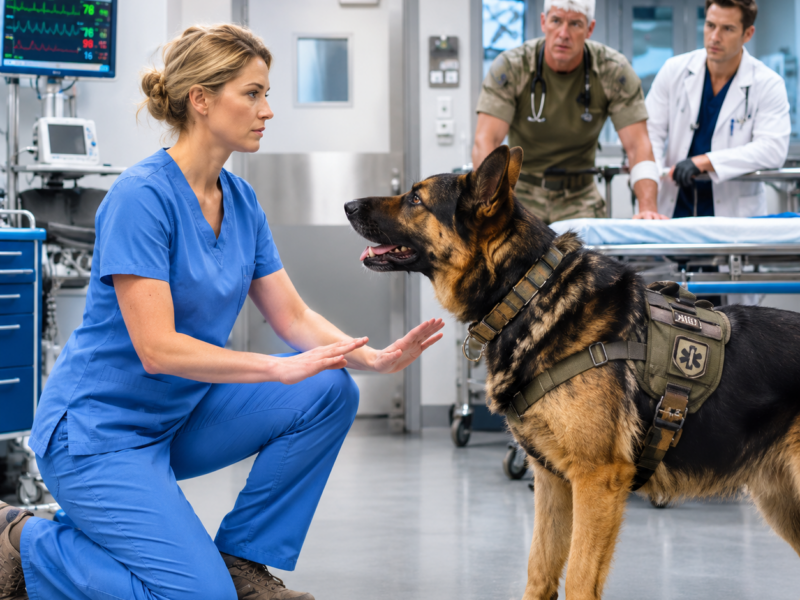
At the county hospital, I was dragged into a locked K9 holding room while three officers laughed and called me a helpless nurse, but when the dogs suddenly stopped growling and stood behind me, the commander realized they had just trapped the wrong woman with a secret military past.
The heavy steel door of the K9 holding room slammed shut with a deafening bang that echoed down the concrete corridor.
The metallic click of the deadbolt locking into place sounded like a final judgment, sealing me inside the cold, windowless space.
Outside the reinforced glass window, three county officers stood in the fluorescent light, their shadows stretching long across the floor.
Officer Miller smirked, leaning his hip against the doorframe while tapping his flashlight against his belt.
“Let’s see if a few minutes with the heavy hitters teaches our quiet little nurse some respect,” Miller chuckled, his voice muffled by the thick glass.
Beside him, two junior officers joined in, their harsh laughter ringing through the quiet hallway of the county hospital basement.
To them, I was just Emily Carter, the soft-spoken ER nurse who worked the graveyard shift and never made a sound.
They saw a woman in faded blue scrubs, always keeping her head down, carrying trays and wiping down trauma bays without complaint.
They had no idea where I had learned to stay completely still while under direct threat.
They didn’t know about the dusty roads of Al Anbar, the hum of tactical radios, or the sharp scent of copper and gunpowder.
Ten minutes earlier, I had refused to step away from a critically injured patient when their security detail demanded immediate access to the bay.
Patient care comes first, no matter who is standing in the doorway with a badge and an attitude.
My refusal had bruised Miller’s ego, prompting him to drag me down here to “cool off” under the guise of an obstruction inquiry.
Inside the room, three Belgian Malinois and two German Shepherds paced nervously on the polished concrete floor.
Their deep, resonant barks echoed off the cinderblock walls, creating a disorienting wall of sound meant to intimidate.
I didn’t back away.
I pressed my shoulders lightly against the back wall, regulating my breathing into a slow, steady four-second rhythm.
Panic is a luxury you can’t afford when high-drive working animals are assessing your stress markers.
The largest Shepherd, a massive ninety-pound sable male with scars across his muzzle, stopped his frantic pacing.
His dark eyes locked onto mine, his ears shifting forward as he caught the subtle change in my posture.
He didn’t smell fear; he smelled absolute stillness, the unmistakable scent of a handler who understood command structure.
I lowered my left hand slowly, keeping my palm flat and open, fingers trailing down toward my side without sudden motion.
“Easy, boy,” I murmured, keeping my voice deep, quiet, and dropped into a low chest tone.
The sable Shepherd took two slow steps forward, his broad head dipping as he sniffed the back of my hand.
He gave a single, soft exhale, the tension dropping from his muscular shoulders in an instant.
Then, to the complete shock of the men watching through the glass, the top-tier war dog sat down right beside my knee.
The four remaining dogs followed his lead immediately, their low growls instantly melting into quiet, alert silence.
They formed a semi-circle around me, their bodies turned outward toward the locked door, facing the hallway like a disciplined squad.
Outside, the officers’ mocking laughter died instantly, replaced by a sudden, heavy awkwardness.
Officer Miller straightened up, his smirk vanishing as he stared through the thick glass window in disbelief.
“What the hell is wrong with those dogs?” one of the junior officers whispered, stepping closer to the frame.
“They’re supposed to tear anybody up who steps into that room without a suit on.”
The county shift commander, a veteran named Vance, walked down the hallway, his boots clicking sharply against the tile.
He stopped in front of the glass, his brow furrowing as he looked from the sitting dogs to my calm face.
“Open the door, Miller,” Vance ordered, his tone shifting from casual annoyance to sharp professional concern.
“Something isn’t right here.”
Before Miller could key his access card into the electronic reader, the sable Shepherd beside me let out a low, vibrating rumble from deep in his chest.
All five dogs stood up in unison, stepping forward to form a solid, rigid wall between me and the reinforced door.
My heart began to hammer against my ribs, not out of fear for the animals, but because I recognized that posture instantly.
These weren’t aggressive displays directed at me; they were adopting an active defense perimeter against an external threat.
From somewhere above us, in the complex web of air ducts and dropped ceiling tiles, came three faint, deliberate metallic clicks.
Then, absolute silence descended over the basement corridor.
The sable dog raised his head, his dark eyes tracking movement through the drop-ceiling panels directly above the hallway.
Commander Vance noticed the shift in my eyes and stepped right up to the window, knocking on the glass to get my attention.
“Carter! What do you see?” Vance called out, his hand hovering near his holstered sidearm.
I didn’t answer his question directly; instead, I looked at the small green indicator light on the wall-mounted security camera above his head.
The green light was dead.
“Your security feed was looped and disabled eight minutes ago, Commander,” I said, my voice carrying clearly through the intercom vent.
Vance froze, his eyes darting up to the dark camera lens before snapping back to me with sudden intensity.
“How could you possibly know that?”
“Because the secondary power sweep on this floor runs on a ten-minute pulse,” I replied smoothly, taking a slow step toward the corner of the room.
“And the status LED on that ceiling junction box stopped blinking when you were still arguing with me in the hallway.”
I knelt down in the far corner of the holding room, where a steel air register was set into the cinderblock.
The dogs shifted with me, maintaining their tight formation without a single verbal command required.
I reached out, my fingers finding the edge of the loose metal grate, and pulled it forward half an inch.
Hidden behind the lip was a sleek, black signal transmitter with a tiny, pulsing blue diode.
I pulled it free and held it up toward the glass so Vance could see the military-grade hardware resting in my hand.
Vance’s face drained of color as he recognized the high-end signal jammer.
“Where did you get that?” Vance demanded, his hand finally unsnapping the leather retention strap on his holster.
“It wasn’t me,” I said softly, my eyes scanning the ceiling grid above his head.
“Someone prepared this room before your men ever dragged me down here.”
Before Vance could process the information, the overhead fluorescent lights flickered once, hummed loudly, and plunged the entire floor into pitch darkness.
The emergency generators failed to kick in, leaving only the dim, red glow of the exit signs at the end of the hall.
Instantly, the holding room erupted into calculated action, the dogs dropping into low growls as the sound of heavy footfalls echoed above.
In the hallway, shouting broke out followed by the sharp, metallic crunch of the heavy fire doors being forced off their magnetic tracks.
My muscle memory kicked in before my conscious mind could overthink the situation.
I didn’t freeze like an untrained civilian; I immediately dropped my center of gravity and slid into a tactical stance.
I reached out and placed a firm hand on the sable Shepherd’s harness, keeping him locked at my hip until the right moment.
Outside, the shadow of a tall figure moved through the red emergency light, moving with practiced, silent precision toward our door.
Commander Vance drew his weapon, but a heavy blow struck him from the side, knocking him hard against the glass before he could fire.
The intruder used a master bypass key, slamming it into the manual override slot of the holding room door.
The heavy steel door swung inward with a rush of cold air.
The intruder stepped over the threshold, raising a suppressed handgun directly toward the center of the room.
“You said you were just an ER nurse,” Vance gasped from the hallway floor, clutching his bleeding temple as he looked up at me.
“I am a nurse,” I answered quietly, stepping out of the shadows into the faint red light.
I pulled back the sleeve of my scrub top, revealing the dark ink tattooed on the inside of my forearm—a Trident wrapped in stylized anchor line.
“But before I joined this hospital, I served six years with Naval Special Warfare as a multi-purpose K9 operator.”
The intruder didn’t hesitate; he raised the suppressed pistol to target my center mass.
“Take him down!” I commanded, launching my hand forward in a sharp, decisive motion.
The sable Shepherd unleashed a fierce bark and leaped through the air, hitting the attacker’s chest with massive kinetic force.
The other four dogs moved as a synchronized unit, sweeping the intruder’s legs and securing his free arm before he could pull the trigger.
The gun clattered across the polished concrete floor, spinning to a stop near the corner wall.
Within five seconds, the intruder was pinned flat on his back, immobilized under the weight and jaws of the trained animals.
I stepped forward, placing my boot firmly on the man’s wrist to prevent him from reaching for any secondary weapons tucked in his belt.
“Hold,” I whispered, and the dogs immediately ceased their tearing, maintaining a tight, crushing grip on his limbs without breaking skin.
The overhead emergency lighting suddenly buzzed back to life, flooding the room with a harsh, flickering yellow glow.
Commander Vance scrambled into the room, weapon drawn, his eyes wide as he looked from the subdued attacker to me.
He looked at me as if he were seeing a complete stranger wearing the uniform of a local hospital worker.
I didn’t care about Vance’s reaction, nor was I paying attention to the tactical situation anymore.
My entire world narrowed down to the intruder’s left wrist, which was pinned beneath the sole of my work boot.
Wrapped around his forearm was a thick, hand-braided black paracord bracelet with a tarnished silver clasp.
It was the exact same custom weave my younger brother, Leo, had made for himself before his deployment six years ago.
Engraved on the underside of the metallic clasp was a small, five-digit serial number: 84921.
That number was Leo’s military ID tag, a sequence I had memorized, grieved over, and carved into a memorial stone back home.
My breath caught in my throat, a cold wave of shock washing over me as my knees nearly gave out beneath my weight.
“Where did you get this?” I whispered, my voice trembling as I dropped down to one knee beside the pinned man.
The attacker spit a mouthful of blood onto the concrete floor, his eyes locking onto mine with a cold, mocking glint.
“Your brother gave it to me,” he gasped through bruised lips, a jagged smile spreading across his face.
“He told me if I ever ran into you, I should make sure you were still wearing your dog tags.”
The words hit me like a physical blow, sending my mind racing back six years to a rainy night in Norfolk.
Leo had been reported killed in action during a classified reconnaissance mission in the mountains of Eastern Europe.
There was no body recovered, only a burnt dog tag and a official letter signed by a department head expressing regret.
I had spent six long years learning to accept that he was gone, building a quiet, normal life inside the hospital walls to bury the pain.
Now, this stranger was standing in front of me, wearing my brother’s bracelet and speaking his words in a basement holding room.
“You’re lying,” I said, my voice dropping into a harsh, dangerous register as I tightened my grip on his collar.
“Leo died six years ago in Ukraine. The Department of Defense closed the file.”
“They closed the file because they wanted it closed, Nurse Carter,” the man wheezed, his eyes narrowing.
“They didn’t tell you about the black-budget facility outside Kyiv, or the division that didn’t come home.”
Commander Vance stepped forward, holding a pair of heavy steel handcuffs, his face pale as he listened to the exchange.
“Carter, step back,” Vance warned, his voice shaking slightly as he aimed his gun at the man’s chest.
“We need to secure this suspect and call federal authorities immediately. This is way beyond hospital security.”
“He stays right here until he answers me,” I said without looking up, my eyes fixed on the man’s dark pupils.
“Who sent you here tonight? Why were you targeting this floor?”
The intruder laughed, a dry, rattling sound that turned into a sudden cough.
“Look at the patient you were protecting up in ER Trauma Room 4,” he whispered, leaning his head back against the concrete floor.
“You really think it was a random hit-and-run victim brought in off the highway?”
My stomach dropped as I remembered the unknown male patient admitted three hours ago with severe head trauma and unidentified puncture wounds.
I had fought Officer Miller to stay in that room because the patient’s vitals were plummeting and his neurological responses were completely irregular.
“He was the carrier,” the man whispered, his smile vanishing into a cold stare.
“And your brother is the one who sent him to find you.”
Before I could ask another question, heavy boots echoed down the hallway, accompanied by the sharp radio chatter of incoming state police units.
Vance pulled the intruder up off the floor, clicking the steel cuffs tightly around his wrists while keeping his distance from the dogs.
“Emily,” Vance said softly, using my first name for the very first time since I had started working at the hospital two years ago.
“You need to step away now. Federal agents are already en route to the facility.”
I stood up slowly, my mind spinning as the sable Shepherd rubbed his broad head against my thigh, offering quiet reassurance.
I looked down at my hands; they were steady, operating entirely on the deep-seated muscle memory of my previous life.
The quiet, subdued persona I had carefully built to survive my grief was cracking open, piece by piece.
I turned away from Vance and walked out of the holding room, my steps quickening as I moved toward the basement elevator.
If the patient in Trauma Room 4 was connected to Leo, I couldn’t afford to wait for federal agents to lock down the floor.
I hit the call button for the fourth floor, the metal elevator doors sliding open with a low, mechanical hum.
The sable Shepherd followed me inside without hesitation, ignoring the lingering glance of the remaining officers in the hall.
As the elevator ascended, I reached into my pocket and pulled out my personal trauma kit, checking the items out of habit.
The digital floor indicator chimed as it passed the second and third floors, moving steadily toward the trauma unit.
When the doors opened on the fourth floor, the hallway was unusually quiet, the soft hum of medical monitors the only sound in the air.
A single nurse stood at the central station, her back turned as she typed rapidly on a computer terminal.
I stepped out of the elevator, keeping the dog close to my heel as I approached Trauma Room 4 at the end of the hall.
The glass door to the room was partially covered by a privacy curtain, but the cardiac monitor inside was beeping in a steady, rapid rhythm.
I pushed the door open quietly, my heart pounding against my ribs as I stepped into the dimly lit room.
The patient lay still under the white hospital sheet, his face obscured by an oxygen mask and heavy bandages around his skull.
I stepped closer to the bed, reaching out to check the IV line running into his right arm.
As I pulled back his sleeve to verify the line, I froze.
Inscribed into the skin of his inner forearm was a dark, tactical tracking tattoo—the exact same design as the one on my own arm.
The man on the bed stirred slightly, his monitor beeping faster as his heart rate spiked against the sedatives.
His eyes flickered open, heavy with medication, searching the dimly lit room until they landed directly on my face.
“Emily…” he rasped through the oxygen mask, his voice barely more than a dry, cracked whisper.
I leaned down immediately, pulling the mask slightly away from his lips so I could hear him clearly.
“Don’t talk, save your energy,” I whispered, my fingers checking his carotid pulse out of pure instinct.
“Who are you? How do you know my name?”
The man reached up with a trembling, bruised hand, his fingers catching the sleeve of my scrub top and pulling me closer.
“Leo… he told me… you’d be here,” the man gasped, fighting through the thick fog of the hospital narcotics.
“He said… if the unit came for me… you were the only one who could get the drive out.”
“What drive?” I asked, my voice barely audible over the hum of the ventilator beside the bed.
“What is happening, Marcus?” I asked, reading the name on his hospital wristband.
“It’s not… Marcus,” he wheezed, a faint, bitter smile touching the corners of his mouth.
“My name is Vance… David Vance… Leo’s former team leader.”
The shock hit me so hard I felt the room tilt around me, forcing me to grip the edge of the stainless steel bed frame for support.
David Vance was the officer whose name had been signed at the bottom of the official report detailing my brother’s death six years ago.
He was supposed to have died alongside Leo in that burnt-out vehicle in Eastern Europe.
Yet here he was, lying in my hospital room under a fake identity, carrying secrets that had kept him running for six years.
“Leo is alive, Emily,” David whispered, his fingers tightening on my wrist with surprising strength.
“He’s been working from the inside… trying to tear down the program that buried us.”
“Why didn’t he come to me?” I demanded, tears finally threatening to break through my carefully maintained composure.
“Why let me think he was dead for six long years?”
“Because if they knew you were alive… they would have used you to control him,” David rasped, his breath growing shallow.
“They’re coming for the hospital… right now.”
Before I could process his words, the overhead lights in the hallway outside Trauma Room 4 flickered and died.
The sharp, distinct sound of a suppressed rifle fire echoed down the corridor, followed by the heavy thud of a body hitting the floor.
The sable Shepherd beside me instantly dropped into a low, defensive stance, his ears flat against his skull as he growled softly.
I reached down and grabbed the emergency tactical kit hidden under the lower shelf of the crash cart near the door.
I pulled out a pair of medical shears, a heavy flashlight, and a syringe of high-concentration epinephrine.
It wasn’t military hardware, but in trained hands inside a hospital setting, it was more than enough to buy time.
“Can you stand?” I asked David, turning back to the bed as I prepped the room’s manual door lock.
“I can walk… if you give me that shot,” David said, pointing his finger toward the needle in my hand.
I didn’t hesitate; I drove the epinephrine into his thigh muscle, giving his system the sharp burst of adrenaline needed to bypass the sedatives.
David gasped sharply as his eyes widened, his heart monitor spiking as the drug flooded his bloodstream.
He swung his legs over the side of the bed, his hands shaking as he pulled the IV line out of his arm.
Outside, heavy, rhythmic footsteps were moving methodically down the hallway, checking each room with professional precision.
These weren’t local county officers or street thugs; these were private military contractors moving in a tactical wedge.
I stepped up to the reinforced glass door, peering through the small crack in the privacy curtain to assess the threat.
Three operators in dark, unmarked tactical gear were moving down the hall, holding short-barreled carbines at the ready position.
Their movements were fluid, disciplined, and entirely silent—the signature style of the black-budget unit my brother had joined.
They weren’t here to negotiate or ask questions; they were sweeping the floor to eliminate every witness and retrieve David.
I turned back to David, who was now standing on shaky legs, leaning heavily against the stainless steel IV pole.
“There’s a service staircase behind the utility room across the hall,” I whispered, keeping my tone flat and calm.
“We have roughly fifteen seconds before they clear this door.”
I grabbed a bottle of medical-grade isopropyl alcohol from the counter and spilled it liberally across the floor near the entrance.
Next, I unhooked a high-pressure oxygen tank from the wall mount, setting it flat on the ground near the doorway.
“What are you doing?” David whispered, his voice gaining strength as the epinephrine took full effect.
“Setting a structural delay,” I replied, pulling a heavy defibrillator unit off its rolling cart.
I attached the adhesive pads directly to the metal frame of the door, setting the charge level to maximum capacity.
If they tried to breach the door with standard metal tools, the discharge would knock them off their feet instantly.
The sable Shepherd stood by my side, his eyes tracking my hands with absolute trust and focus.
“When I open this door, you run for the service stairs,” I told David, locking eyes with him.
“Don’t look back, don’t stop for anything, and keep low.”
The footsteps stopped directly outside Trauma Room 4.
A shadows lengthened beneath the door frame as an operator positioned himself to kick the handle open.
I grabbed the oxygen tank handle, ready to release the valve the moment the door yielded.
The door burst inward with a loud crack as a booted foot slammed into the central latch assembly.
The first operator stepped over the threshold, his weapon raised, but his foot slipped instantly on the slick, alcohol-drenched tile.
As he lost his balance, I slammed the manual activation button on the defibrillator unit.
A brilliant blue arc of electricity snapped across the wet metal frame, sending a violent shock through the operator’s tactical rig.
He went down hard, his rifle clattering against the floor as his muscles convulsed from the massive electrical discharge.
“Go!” I shouted to David, grabbing the fallen operator’s rifle off the floor in one fluid, practiced motion.
The sable Shepherd charged through the doorway, hitting the second operator in the hallway before he could bring his weapon to bear.
I stepped out into the hallway, raising the captured carbine to my shoulder with natural, instinctual precision.
I squeezed the trigger twice, placing two non-lethal shots into the body armor of the third contractor, sending him sprawling backward.
The hallway was filled with the smell of burnt copper, ozone, and spent gunpowder—a familiar, brutal reality I thought I had left behind.
David stumbled out of the room, using the wall for support as he made his way toward the marked service exit at the end of the hall.
The sable Shepherd returned to my side on command, his flanks heaving as he kept his eyes trained on the stairwell door.
We pushed through the heavy fire doors into the concrete stairwell, the heavy metal door clicking shut behind us.
“Where are we going?” David asked, leaning against the cold concrete railing as we descended the stairs rapidly.
“To the sub-basement parking garage,” I answered, keeping my weapon pointed down the stairwell well.
“My car is parked in the staff bay, and nobody checks the secondary exit behind the laundry facilities.”
As we hit the second-floor landing, my personal cell phone buzzed violently inside my scrub pocket.
I pulled it out with one hand while keeping the carbine trained on the upper landing above us.
The screen displayed an unknown, encrypted caller ID with a location origin buried deep within an overseas server network.
I swiped the screen to accept the call and pressed the phone to my ear, keeping my breathing steady and controlled.
“Emily,” a deep, familiar voice spoke through the speaker, cutting through the silence of the stairwell.
My heart stopped, six years of grieved time collapsing into a single, breathtaking second.
“Leo?” I whispered, my voice breaking as tears finally spilled over my eyelashes.
“You need to get out of the hospital right now,” my brother said, his voice hard, focused, but filled with undeniable emotion.
“They know David made contact with you, and they’re clearing the entire block.”
The Path Forward
“Where have you been, Leo?” I cried out softly, holding the phone tightly against my ear as we reached the ground floor.
“You let me mourn you for six years! You let me live a lie!”
“I did it to keep you alive, Em,” Leo answered, his tone softening for a brief fraction of a second.
“If I had come home, they would have put a target on your back the very next day.”
“They’re already here, Leo!” I snapped back, kicking open the lower access door that led out into the parking garage.
“I just took down three of their operators in the trauma ward, and I’m holding David by the arm!”
There was a brief pause on the line, followed by the faint sound of a heavy breath over the satellite connection.
“That’s my sister,” Leo murmured softly, a ghost of his old, proud smile carrying through the phone line.
“Listen to me carefully, Emily. Inside David’s jacket pocket is an encrypted micro-drive containing the entire roster of the black program.”
“Including the names of the high-ranking officials running it from inside the Department of Defense,” Leo continued.
“They will burn down that entire hospital floor to destroy that drive before it can be uploaded to the federal server.”
We stepped out into the dark, cavernous space of the sub-basement parking garage, the concrete pillars casting long shadows.
My modest silver sedan was parked in the far corner, illuminated by a single flickering overhead utility light.
“Where do I meet you?” I asked, guiding David toward the passenger side while the dog took up a defensive position behind us.
“There’s an abandoned airfield thirty miles west of the county line, near the old quarry,” Leo instructed clearly.
“Get David there by midnight. I’m bringing the rest of the original squad to secure the handoff.”
“Is it really over after this?” I asked, unlocking the car doors with my key fob.
“It’s only over when every single one of them is exposed, Em,” Leo replied firmly.
“Welcome back to the fight, Operator Carter.”
The line went dead, leaving only the soft hum of the idling engine and the quiet breathing of the Shepherd beside me.
I helped David into the front passenger seat, making sure his seatbelt was secure before turning to the dog.
“Up,” I commanded softly, and the sable male hopped into the back seat, settling onto the floorboards with alert eyes.
I climbed into the driver’s seat, pulled the captured carbine onto my lap, and adjusted the rearview mirror.
In the reflection, I saw my own eyes—no longer those of a weary, quiet nurse hiding from her past, but those of a seasoned veteran ready to protect her family.
I shifted the car into drive, hit the accelerator, and drove out into the dark night, leaving the quiet life behind forever.









