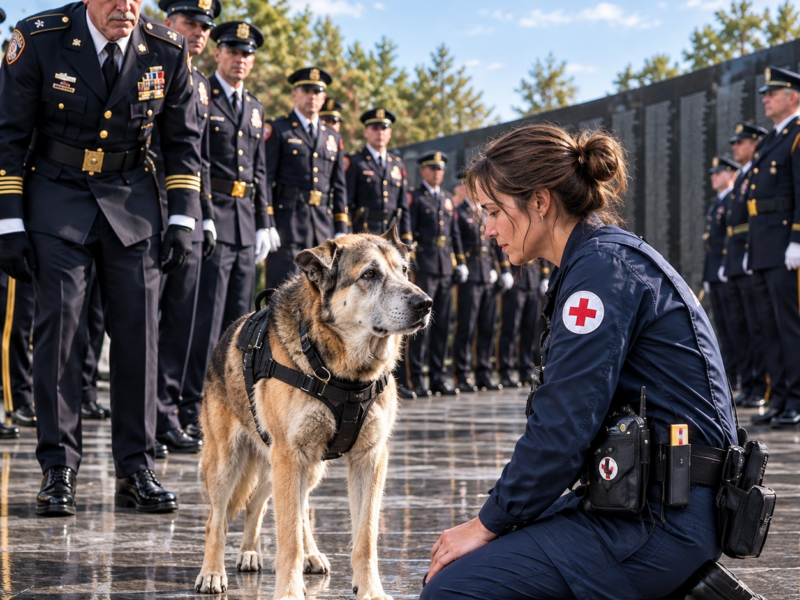
At the Chicago police memorial, one hundred officers stood perfectly still as a blind K9 suddenly broke formation and ran straight toward me, while the police chief shouted for someone to pull him away, because he knew exactly what the dog had recognized before I did
The gray October sky hung low over the Chicago police memorial, thick with the threat of rain. Hundreds of officers stood in disciplined rows, their dark uniforms forming a sea of sharp corners and somber faces. Family members of fallen officers huddled together in the chill, clutching framed photographs and small bouquets of flowers.
I stood near the back, isolated from the grieving families and the stiff uniform lines. My plain blue nurse’s scrubs felt out of place against the formal black suits and dress blues, but I couldn’t bring myself to wear anything else. I was holding a small bundle of white carnations for an officer I had never met in life.
Fourteen years had passed since my father, Detective Daniel Carter, was declared dead following a massive warehouse arson. I was only nine years old when they brought a folded flag to our front porch. Today was the annual memorial service, a place I had avoided for over a decade because the pain always felt too raw, too unfinished.
The keynote speaker was speaking into a microphone, his voice echoing off the cold granite wall that bore hundreds of carved names. I kept my eyes fixed on the lower right panel where my father’s name was etched into the dark stone.
Then, a sudden disturbance rippled through the front row of the honor guard.
A massive German Shepherd, wearing a tactical vest with a reflective handle, abruptly broke his heel command.
His name was Ranger. Everyone in the department knew his story—he was a legendary K9 who had been blinded in a pipe bomb explosion two years prior. Though retired and completely sightless, he was still brought to official ceremonies as a mascot of resilience.
Ranger did not wander aimlessly. He lowered his snout, sniffed the air with frantic intensity, and began moving straight through the tight rows of officers.
Officers scrambled out of his path, startled by the sudden breach of discipline. The dog’s handler reached for the leash, but the leather slipped right through his leather gloves.
Ranger was moving at a fast trot, his nose swinging side to side as if tracking an invisible trail laid down only for him. He was heading straight toward the back perimeter where I stood alone.
The microphone squealed as Police Chief Arthur Vance cut off the speaker and stepped to the edge of the podium.
“Get that dog away from her!” Vance’s voice bellowed across the silent courtyard, laced with an sharp, unmistakable edge of panic.
The handler lunged forward, but Ranger was already upon me.
He came to a sudden halt mere inches from my knees. The crowd had gone entirely silent, every head turning away from the memorial wall to watch the blind dog standing before a nurse in blue scrubs.
Ranger slowly pushed his broad, scarred head directly against my hand.
I froze, my fingers stiff against the cold morning air.
Chief Vance descended the wooden steps of the stage, his boots snapping against the wet concrete as he pointed a gloved finger at the handler.
“Pull him back immediately! He’s off-leash and out of control!” Vance shouted, his face flushed red despite the cold wind.
Ranger turned his head toward the sound of the Chief’s voice and let out a deep, chest-vibrating growl.
It was not a warning directed at me. The dog had positioned his body like a shield between my legs and the approaching chief.
My heart began hammering against my ribs. I had never interacted with this dog in my life, yet as I let my fingers sink into his thick fur, a strange, electric sense of familiarity washed over me.
Ranger lowered himself to his front elbows, trembling violently as his tail gave two slow, tentative wags against the grass.
Then, with sudden determination, he began frantically scratching at the patch of wet earth right at my feet.
A younger officer who had run over to assist paused, his eyes wide with confusion.
“He’s not reacting to a threat,” the young officer muttered quietly. “He’s trying to unearth something.”
Chief Vance reached us, his eyes darting nervously toward the crowd of onlookers who were now craning their necks to see.
“I said take him away, Officer!” Vance barked, his voice tight. “Now!”
Nobody moved. The authority in Vance’s voice was met by a heavy, unyielding silence from the surrounding men and women in uniform.
Ranger scratched harder, his claws tearing up the damp turf and mud, sending wet leaves flying across my shoes.
Finally, the young officer knelt down, ignoring Vance’s glare, and brushed away a thick layer of dead leaves from the soil where Ranger was digging.
Something bright and metallic glinted beneath the dark earth.
The officer picked up a small, silver object, wiping the damp soil away with his thumb before handing it up to me.
It was a custom metal identification tag, tarnished at the edges but unmistakable in its design.
My breath caught sharply in my throat as my thumb traced the deep block letters engraved across the surface.
Daniel Carter. Badge #4412.
My father’s name and badge number.
The warehouse fire that killed him had burned so hot that no personal effects were ever recovered—only fragments of equipment. Yet here was his dog tag, buried under a tree at a memorial built ten years after his supposed death.
I picked up the tag with shaking fingers, the metal biting cold against my skin.
“Where did this come from?” I asked, my voice barely a whisper above the autumn wind.
Chief Vance stared down at me, his eyes wide, his jaw clenched so hard the muscles jumped beneath his skin.
Instead of answering, Ranger let out a low, mournful whine that broke the silence of the courtyard.
He turned toward the granite memorial wall, took the edge of my coat sleeve in his teeth, and pulled me forward.
The crowd parted silently as the blind dog led me by the sleeve toward the high granite wall.
Chief Vance followed closely behind us, his hands clasped tightly behind his back, his breath coming in sharp white clouds.
Ranger stopped directly in front of the middle section of the wall, where hundreds of small bronze plaques were mounted beneath the carved names.
He nudged his snout against a specific panel that held historic photographs of retired and fallen K9 units.
There, nestled among dozens of faded black-and-white prints, was a color photograph I had never seen in my life.
It showed a tall man in a dark trench coat standing on a wet training field, smiling down at a young German Shepherd puppy.
The man was my father. His wide, familiar smile made tears instantly sting the corners of my eyes.
The puppy in the photo had a distinct white star-shaped patch of fur on his chest—the exact same mark Ranger bore today.
I turned slowly to look at Chief Vance, whose face had drained of all color.
“You knew him,” I said, my voice steady despite the tremor in my chest. “You knew he worked with this dog.”
Vance said nothing, his eyes locked on the stone wall as if trying to stare straight through it.
A retired officer with silver hair and a walking cane stepped out from the edge of the crowd, his boots grinding against the gravel path.
“Your father wasn’t killed in that warehouse fire, Clara,” the old man said softly.
My knees weakened instantly, and I had to catch myself against the cold granite edge of the wall.
“What are you talking about?” I whispered, looking from the old officer back to Vance. “Then where is he?”
The silver-haired officer cast a long, cautious glance at the Chief before looking back at me with heavy eyes.
“That’s what the entire brass was told never to tell you,” the old officer replied quietly. “For your safety. And for his.”
Before I could demand an answer, Ranger pulled his head away from my sleeve and bolted toward the far northern end of the wall.
He stopped beside a sealed bronze access panel used by the city maintenance crews to service the memorial’s lighting system.
Ranger reared up on his hind legs and began scratching frantically at the edge of the bronze latch.
Chief Vance’s head snapped toward the dog, and his voice cracked with genuine panic.
“Stop him! Get that animal off the structure!”
Two officers stepped forward, but Ranger hit the latch with his heavy paw before anyone could reach him.
The ancient spring mechanism gave a sharp metallic click, and the heavy bronze panel popped open a few inches.
Inside the dark recess lay a sealed plastic pouch, covered in dust but clearly placed there with intention.
I reached inside before Chief Vance could intercept me, pulling out the sealed pouch with trembling fingers.
Inside was a folded piece of paper and a single photograph.
I opened the note first, the paper stiff and brittle against my skin.
Only six words were written in heavy, familiar black ink.
Tell her I never abandoned her.
The words blurred on the page as tears finally spilled over my eyelashes.
I couldn’t breathe, the air trapped in my chest like a heavy weight.
With hands that would not stop shaking, I turned over the photograph that had been tucked behind the handwritten note.
The image showed a sterile, dimly lit hospital room with monitors glowing in the background.
A little girl was sleeping beneath thick white blankets, an IV taped to her tiny arm, a plush brown bear tucked under her chin.
It was me. I remembered that hospital stay vividly—I was twelve years old, three years after my father’s official funeral, recovering from a severe bout of pneumonia.
Standing right beside the hospital bed, holding my tiny hand while I slept, was my father.
He looked older, tired, with deep lines around his eyes and gray touching his temples, but it was unmistakably Daniel Carter.
And standing directly beside him in the hospital room, wearing a captain’s uniform and placing a supportive hand on my father’s shoulder, was Arthur Vance.
The same man who was currently Chief of Police, standing five feet away from me in the cold wind.
On the back of the photograph, a date was stamped in neat blue ink: October 14, 2015.
Exactly three years after my father’s supposed death in the warehouse fire.
I slowly raised my head and looked Vance dead in the eye, holding the photograph out between us.
“You lied to me,” I whispered, the words carrying across the silent crowd of officers. “My entire life… you let me believe he died alone in the dark.”
Chief Vance closed his eyes for a long moment, the muscles in his jaw working as he swallowed hard.
“Clara… you don’t understand what was happening back then,” Vance said, his voice dropping low, stripped of its official authority. “The department was compromised from the top down. The warehouse fire was an hit, arranged by the syndicate your father was investigating.”
“He survived it,” I said, stepping closer to him. “And you helped him hide.”
“He had to vanish to keep you alive,” Vance replied quietly, his eyes glistening with unshed tears. “They threatened to come after his family if he ever surfaced. He lived in the shadows for years, watching over you from a distance.”
Ranger suddenly lifted his head, his ears spinning toward the perimeter of the crowd, his low growl returning with double the intensity.
The dog didn’t look at Vance. He turned his blind eyes toward a tall man standing near the edge of the stone courtyard, dressed in a long civilian coat.
The man was staring directly at me, his hand resting casually inside his deep coat pocket.
Pinned to his inner lapel, catching the dim afternoon light, was an old silver police badge bearing my father’s original number.
The air in the courtyard seemed to drop ten degrees as the stranger stepped slowly out of the shadows of the maple trees.
Ranger was barking now, a sharp, deafening sound that echoed off the granite wall, his entire body rigid with tension.
The crowd of officers turned as one, their professional instincts kicking in as they sensed the sudden shift in the atmosphere.
“Who is that?” I asked, my blood running cold as the stranger continued to walk toward us with slow, deliberate steps.
Chief Vance shifted his stance, moving slightly in front of me, his hand resting instinctively near his sidearm.
“He wasn’t supposed to be here,” Vance muttered under his breath, his tone laced with a deep, dark dread. “He was supposed to remain in protection.”
The man in the long coat stopped twenty feet away, pulling off his black leather gloves one finger at a time.
He had a sharp scar running from his left temple down to his jawline, his face weathered by years of harsh weather and unspoken burdens.
“You always were too loud, Ranger,” the man said, his voice deep, raspy, and thoroughly worn.
My heart stopped beating for three long seconds.
The sound of that voice unlocked a flood of childhood memories—bedtime stories, laughter in the kitchen, songs sung over breakfast.
“Dad?” the word left my mouth before my brain could fully process the reality of the moment.
The man looked directly at me, his eyes softening as a single tear cut a clean path through the dirt on his cheek.
“Hello, my little bear,” he whispered, using the pet name he hadn’t spoken since I was nine years old.
The officers around us began whispering frantically, several hands moving toward their holsters as confusion swept through the ranks.
“Is that Daniel Carter?” someone shouted from the back of the crowd. “He’s supposed to be dead!”
“Stand down, everyone!” Chief Vance shouted, raising his hand to command the courtyard. “Stand down!”
My father took another step forward, but his eyes suddenly darted toward the tree line behind the memorial wall.
“Arthur,” my father said, his voice suddenly sharp and full of urgency as he addressed Chief Vance. “They tracked me here. They knew about the memorial.”
Before Chief Vance could respond, a dark sedan with tinted windows screeched to a halt along the curb at the perimeter of the park.
The doors flew open, and three men dressed in plain clothes stepped out, their hands concealed within their jackets.
The atmosphere in the park shattered instantly from a somber memorial into an active tactical scenario.
Ranger didn’t hesitate. The blind dog let out a fierce bark and charged directly toward the edge of the stone wall, positioning himself between the strangers and where I stood.
“Clara, get down!” my father roared, sprinting across the wet grass toward me with a speed that defied his age.
He tackled me to the ground just as the sharp sound of a suppressed gunshot cracked through the autumn air, striking the granite wall behind us with a loud spray of stone dust.
Panicked screams erupted from the civilians in the crowd as officers immediately drew their weapons, forming an impromptu defensive perimeter around the memorial wall.
“Take cover!” Chief Vance yelled into his shoulder radio, his voice booming over the chaos. “All units, establish a perimeter on the north side!”
My father pulled me behind the thick bronze base of the central monument, his heavy hands gripping my shoulders as he checked me for injuries.
“Are you hit? Look at me, Clara, are you hit?” he demanded, his hands trembling as he held my face.
“I’m fine… I’m fine,” I stammered, staring into the eyes of the man I had mourned for fourteen years. “Dad… what is happening?”
“The people who burned that warehouse down fourteen years ago… they never stopped looking for the evidence I kept,” he said, breathing heavily. “I had to stay dead to keep you off their radar, but Vance called me last night. He said the case was finally moving.”
“I came because Vance said you’d be here today,” he added, his thumb gently wiping a smudge of dirt from my cheek. “I couldn’t stay away any longer.”
Another shot hit the dirt nearby, spraying wet soil across my blue scrubs.
Ranger was standing right beside us now, leaning his heavy weight against my father’s leg, his ears pinned back as he tracked the movement of the gunmen by sound alone.
“Dad, we need to move,” I said, reaching for his coat sleeve. “The police are here, they can handle them!”
My father looked toward Chief Vance, who was currently behind a stone pillar, returning fire toward the dark sedan.
“Vance isn’t fighting them, Clara,” my father said, his voice dropping into a chilling, calm tone. “He’s covering their retreat.”
My head snapped around to look at Chief Vance, who was standing beside the stone pillar.
He was firing his service weapon into the air above the sedan, making a loud display of force while deliberately missing every single target.
The three men from the sedan weren’t running away—they were moving systematically toward the rear access gate of the memorial, completely ignoring Vance’s position as if they knew he wouldn’t hit them.
“No…” I whispered, the realization hitting me like a physical blow. “He stood right here… he helped you…”
“He helped me hide fourteen years ago because he needed to know where I put the syndicate’s ledger,” my father said, pulling a small black drive from his inner pocket. “He was part of the ring back then, and he’s running it now.”
“He set up this entire memorial meeting today to force me out into the open,” my father continued, his eyes cold and focused. “He knew if he made a scene with Ranger, if he brought up my name, I wouldn’t be able to stay in the shadows.”
Ranger let out a low growl as Chief Vance began walking toward our position, his gun lowered but his face devoid of the panic he had displayed earlier.
The gunfire near the sedan had ceased as the other officers took up positions around the park, completely unaware of what was happening near the monument base.
“Hand over the drive, Dan,” Vance said, his voice flat and empty as he stopped ten feet away from us behind the monument. “It’s over. You’ve been dead fourteen years. Nobody is going to investigate a ghost.”
“You used my daughter as bait,” my father said, stepping out from behind the bronze monument to shield me with his body.
“I used what worked,” Vance replied coldly, raising his weapon slightly. “She’s a nurse, Dan. She has a nice, quiet life. Keep it that way by giving me the drive, and she walks out of this park completely untouched.”
I stood up beside my father, refusing to shrink back into the shadows of the monument.
“She has her mother’s stubbornness,” Vance noted with a cynical half-smile. “Hand it over, Dan.”
Ranger shifted his weight, his nose pointing precisely at Vance’s knee joint.
My father looked down at the blind dog, then met Vance’s cold eyes with a faint smile of his own.
“You forgot one thing, Arthur,” my father said softly.
“And what’s that?” Vance sneered.
“Ranger doesn’t need to see you to know who you are.”
My father uttered a single, sharp word in German—a command I had never heard before, but one Ranger recognized instantly.
The blind German Shepherd lunged forward with explosive power, crossing the ten-foot gap before Vance could even adjust his grip on his sidearm.
Ranger’s jaws clamped down hard around Vance’s wrist, the force of the strike knocking the Chief’s gun loose and sending it skittering across the wet pavement.
Vance let out a sharp cry of pain, tumbling backward onto the grass as he tried desperately to beat the dog off with his free hand.
“Get him off me!” Vance screamed, his composure completely shattering as Ranger held his grip with absolute tenacity.
Dozens of officers, hearing the Chief’s scream, came running around the corners of the granite monument, their weapons drawn and ready.
“Drop your weapons!” the silver-haired retired officer shouted, arriving at the front of the group with two uniformed captains at his side. “What is going on here?”
My father didn’t run. He stood his ground, holding up his hands in plain sight while keeping one foot placed firmly on Chief Vance’s fallen firearm.
“Captain Miller!” my father called out to the silver-haired officer. “Check Arthur Vance’s left pocket! He’s got the master keys to the precinct’s evidence locker and the offshore transfer sheets!”
Captain Miller paused, his eyes widening as he recognized my father’s face clearly in the daylight.
“Dan…?” Miller whispered, his voice trembling. “My God… you’re alive?”
“Search him, Miller!” my father demanded, pointing down at Vance, who was still struggling on the ground under Ranger’s firm restraint. “Search him before his men clear out the precinct!”
Captain Miller nodded to the two younger officers, who immediately rushed forward, pulling Ranger back gently while pinning Chief Vance to the wet grass.
One of the officers reached into Vance’s coat pocket and pulled out a thick leather binder stuffed with encrypted drive keys and bank document printouts.
Miller flipped through the pages quickly, his face darkening with every second that passed.
“Arthur…” Miller said, looking down at the pinned Chief with deep disgust. “You’ve been burning the department from the inside for a decade.”
Vance stopped fighting, his cheek pressed into the mud as the handcuffs clicked tightly around his wrists.
My father turned to me, his shoulders slumping as the heavy weight of fourteen years finally seemed to leave his posture.
“It’s over, Clara,” he whispered, reaching out a hand to me. “It’s finally over.”
The park was flooded with police cruisers within ten minutes, their red and blue lights flashing against the gray stone of the memorial wall.
Chief Vance and the three men from the sedan were loaded into the back of separate transport vans, stripped of their authority and led away in full view of the entire department.
Officers gathered around my father in a quiet, solemn circle, offering silent nods of respect to a man who had sacrificed his entire life to pull down a corrupt system from the shadows.
I sat on the wooden bench near the memorial wall, wrapped in a heavy warm blanket an EMT had placed over my shoulders.
My father sat right beside me, holding a warm paper cup of coffee in his hands, his boots covered in mud.
Ranger lay across both of our feet, his head resting heavy on my father’s shoe, panting softly in the cool afternoon air.
“Where will you go now?” I asked softly, looking at the profile of his face—the grey hair, the scar, the familiar eyes.
My father looked over at the granite wall where his name had been carved fourteen years ago.
“I think I’m done hiding, Clara,” he said, taking my hand in his. “Captain Miller said the state’s attorney will clear my record by the end of the week. I get my life back.”
“You have fourteen years of birthdays to make up for,” I reminded him, a small smile finally breaking through my exhaustion.
He gave a dry, soft laugh, rubbing his face with his free hand. “I know. We can start with breakfast tomorrow.”
Ranger suddenly lifted his head from my father’s shoe and nudged his snout against my fingers, demanding attention.
I reached down, scratching the dog right behind his left ear where the fur was softest.
“He knew you were there the moment he walked into the park, didn’t he?” I asked, looking down at the blind K9.
“He didn’t track me by sight,” my father said softly, leaning down to pat the dog’s side. “He tracked the scent of the cedar wood oil I used to put on my leather jacket every single morning before shift.”
“He remembered,” I said.
“He never forgot,” my father replied. “And neither did I.”
The late afternoon sun finally broke through the heavy blanket of gray clouds, casting long, golden beams of light across the granite wall.
A city worker with a toolkit was already standing near the panel where my father’s name had been carved into the stone so many years ago.
With careful, precise movements, the worker began filling in the carved letters of Daniel Carter with black epoxy, removing him from the list of the dead.
I watched the worker at his task, feeling a strange lightness in my chest that I hadn’t felt since I was a nine-year-old girl waiting on a porch.
My father stood up from the bench, extending a hand down to help me up from the wooden seat.
“Let’s go home, Clara,” he said softly.
Ranger stood up instantly, his tail giving a quick, firm wag as he fell into step right beside us.
We walked together across the wet grass of the park, leaving the shadows of the memorial behind us in the afternoon sun.
As we reached the parking lot, my father’s old truck—a faded red pickup he had kept hidden in a private garage for a decade—chirped as he unlocked the doors.
Ranger hopped into the back cab without needing a single command, settling onto the soft back seat with a heavy sigh of contentment.
I climbed into the passenger seat, pulled the seatbelt across my chest, and looked out the window at the city skyline rising in the distance.
My father started the engine, the familiar rumble filling the quiet space inside the cab.
He looked over at me before putting the truck into gear, his eyes clear and bright in the sunlight.
“Where do we start?” he asked softly.
I looked at the silver identification tag still clutched tightly in my hand, then looked up at him with a grin.
“Start by telling me everything,” I said.
The truck pulled out of the memorial parking lot, joining the steady flow of afternoon traffic along the lakefront drive.
The city of Chicago stretched out before us, vast and vibrant, no longer a place defined by cold granite walls and silent grief.
My father drove with one hand on the wheel, using the other to navigate the winding roads he hadn’t driven openly in fourteen years.
He began talking, his voice steady and quiet as he filled in the long, dark gaps of the past decade—the secret safehouses, the late-night surveillance, the silent visits to my high school graduation where he stood in the back row behind the bleachers.
Every story he told made the cold weight of my past dissolve a little bit more, replaced by the warmth of knowing I had never truly been alone.
In the back seat, Ranger let out a long, quiet snore, resting his broad chin on the center console right between our seats.
I reached back and gently rested my hand against the dog’s scarred forehead, feeling the steady rhythm of his breathing.
The sun was setting behind the city skyscrapers, painting the sky in deep shades of orange and gold.
For fourteen years, I had walked through the world feeling like a ghost of a family that no longer existed.
Now, sitting in the passenger seat of an old red truck with a blind dog behind me and my father beside me, I finally felt grounded in the present.
The road ahead was long, and there were still dozens of legal hurdles and quiet conversations waiting for us in the days to come.
But as the streetlights began to flicker on along the avenue, I knew one thing with absolute certainty.
The mystery was solved, the shadows were gone, and the trail had finally brought us home.









