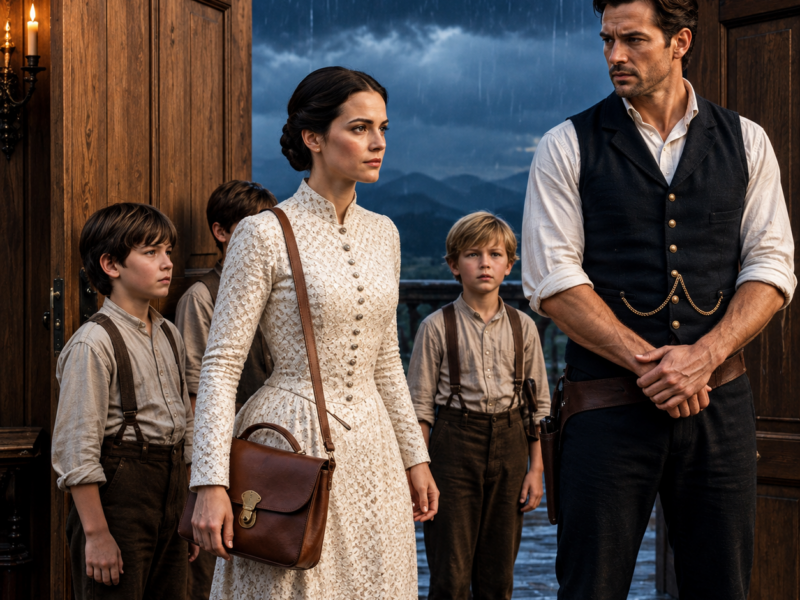
At my wedding in a small Montana chapel, my new husband introduced me to his five children as the woman hired to keep their house in order, then coldly warned me not to interfere with his family, never suspecting that the bride he had chosen from a photograph was a doctor carrying a secret that could save the child he had already begun preparing to lose.
The Montana air was brisk enough to bite through the cheap silk of my wedding dress.
I stood near the altar of the small, weathered chapel, listening to the wind rattle the stained glass windows.
Daniel stood beside me, tall, hard-faced, and as unyielding as the mountains visible through the glass behind him.
He didn’t look at me when he said his vows.
His voice was flat, carrying no heat, no promise of devotion, only the heavy cadence of a business deal being finalized.
When the minister pronounced us husband and wife, Daniel didn’t lean in to kiss me.
He simply turned toward the pews where his five children sat in rigid silence.
He cleared his throat, his tone dripping with a chill that made the small room feel completely devoid of warmth.
“Listen to me, all of you,” Daniel said, his voice carrying clearly to every corner of the chapel.
“This is Maya. She has been hired to keep our house in order and make sure meals are on the table.”
He paused, glancing at me for the briefest fraction of a second with cold, distant eyes.
“She is not your mother. She will never be your mother, and I expect none of you to treat her as anything more than someone here to manage the household.”
Then he turned his sharp glare back to me, lowering his voice just enough for only us to hear.
“Do not interfere with my family, Maya. You signed the agreement, you got your fresh start, but do not cross the line.”
I held my breath, keeping my spine straight and my chin up.
He had chosen me from a agency photograph, picking a woman with a quiet background and no family left of her own.
He wanted a domestic manager, not a partner, and certainly not a wife in any real sense of the word.
What he didn’t know was that the quiet woman standing before him carried a heavy past he hadn’t bothered to investigate.
He didn’t know that under my simple dress beat the heart of a skilled pediatric cardiologist who had walked away from medicine after a tragedy broke her soul.
And he had no idea that the youngest child sitting in the front row was suffering from a subtle, deadly condition Daniel was already resigned to losing him to.
The reception at the local diner was short and devoid of celebration.
Daniel spent the entire time speaking with local ranchers, completely ignoring my presence at the end of the long table.
His children sat clustered together, a fortress of shared grief and deep mistrust.
Sixteen-year-old Lily, the oldest, kept her dark eyes pinned on me like weapons.
When I stepped toward the beverage station to grab a glass of water, she shifted her position to block my path.
“We don’t need another mother,” she muttered under her breath, her voice raw with defensive anger.
“I know,” I answered softly, keeping my tone gentle and completely free of challenge. “I’m not here to replace anyone.”
Daniel stepped up behind us just in time to catch my response, offering a bitter, humorless laugh.
“Don’t make promises you can’t keep, Maya,” he said coldly before walking away to load up his truck.
That night, after we arrived at the sprawling, worn-down ranch house, Daniel handed me a key to a small guest room at the end of the ground floor hall.
“Your room,” he said curtly. “My room is upstairs. The kids are upstairs. Keep to your space.”
I locked the door behind me and sat on the edge of the narrow mattress, listening to the house settle around me.
When I opened the door the next morning at sunrise, five pairs of suspicious eyes were watching me from the shadows of the staircase landing upstairs.
Ten-year-old Ethan, the middle child, quickly ducked back into his room.
The eight-year-old twins, Mason and Caleb, whispered frantically to each other before scampering out of sight.
Little Noah, four years old, stayed at the railing just a second longer, his pale skin looking almost translucent in the dim light.
I noticed the subtle bluish tint around his small lips and the slight effort it took for him to catch his breath after standing up.
My medical instincts flared instantly, a sharp pulse of recognition running through my veins.
I forced myself to smile normally, giving him a small, reassuring nod before turning toward the kitchen to begin my duties.
The kitchen was cluttered and dusty, evidence of a family that had been surviving on frozen meals and pure exhaustion for months.
I rolled up my sleeves and got to work without waiting for instructions.
I learned very quickly how each child operated within their grief.
Ethan was quiet and preferred to be left alone with his sketchbooks.
The twins were full of reckless energy, constantly breaking things around the yard to draw attention from their distant father.
Lily was the gatekeeper, fiercely protective of her brothers and constantly reminding them that I was just a stranger.
Little Noah was the softest, moving slowly through the house like a shadow that didn’t quite belong to the world.
On Tuesday, I noticed Caleb and Mason crying near the porch over a broken chain on their bicycle.
Daniel was out in the pasture, and the boys were terrified to ask him for help.
“Let me take a look,” I said, walking down the wooden steps with a toolbox I had found in the mudroom.
It took ten minutes of greasy work, but I managed to loop the chain back into place and tighten the tension bolt.
The twins looked at me with wide, hesitant eyes, forgetting for a moment that they were supposed to dislike me.
“Thanks,” Mason murmured, wiping his hands on his jeans.
“You’re welcome,” I said, offering a warm smile before heading back inside.
Later that evening, I walked past the living room and saw Lily staring at an old, faded photograph of her mother.
Tears were quietly streaming down her cheeks, but she was trying desperately not to make a sound.
Instead of interrupting or offering empty platitudes, I simply sat on the far end of the couch, keeping her company in the dark.
She didn’t tell me to leave, and for nearly twenty minutes, we just sat together in shared silence.
Daniel saw every interaction, though he pretended not to notice.
He moved through the house like a ghost, burdened by the heavy weight of the ranch’s financial troubles and his late wife’s absence.
Whenever he caught me showing kindness to the children, his expression hardened, as if he suspected I was playing a long game to trick them into trusting me.
“You’re wasting your energy,” he told me one evening as I was cleaning up the dinner dishes.
“They aren’t going to love you, Maya. You don’t need to try so hard.”
“I’m not doing it to be loved, Daniel,” I said calmly, placing a dried plate into the cabinet. “I’m doing it because they deserve care.”
He scoffed, taking his mug of black coffee out onto the porch without another word.
I watched him through the window, noticing how heavy his shoulders slumped when he thought no one was looking.
He was a man running on absolute empty, keeping his heart encased in ice so he wouldn’t break down completely.
My heart ached for him, but my primary concern was growing rapidly toward little Noah.
Every day, I watched the boy closely.
He tired far too easily for a four-year-old, sitting down to rest after running just a few yards across the grass.
His breathing was always slightly shallow, and his fingertips often showed subtle signs of poor oxygenation.
Daniel clearly knew something was wrong with his youngest son, but his behavior suggested he had already accepted an inevitable, terrible outcome.
He held Noah with a tragic lightness, as if the boy were made of fragile glass that was destined to shatter.
I needed to check Noah’s vital signs properly, but I had to wait for the right moment without exposing my past before I was ready.
That moment arrived sooner, and far more terrifyingly, than I could have ever anticipated.
Three weeks after the wedding, the morning routine was interrupted by catastrophe.
We were all sitting around the heavy oak kitchen table, the smell of fresh pancakes filling the warm room.
Noah was picking at his food, sitting quietly in his booster chair beside Lily.
Suddenly, he let out a tiny, gasping sound that made everyone freeze.
His fork clattered onto the floor.
Before anyone could reach out, Noah’s eyes rolled back into his head, and his small body slid sideways off the chair, hitting the hardwood floor.
“Noah!” Lily screamed, jumping up so fast her chair knocked backward onto the rug.
Daniel bolted from the counter, his face turning completely pale as he dropped to his knees beside his son.
The boy was shaking violently, his tiny chest heaving desperately for air that wasn’t reaching his lungs.
His lips were rapidly turning a dark, frightening shade of blue.
“Call nine-one-one!” Daniel yelled at Lily, his voice cracking with sheer, unadulterated terror. “Get the phone now!”
The twins started sobbing hysterically in the corner, and Ethan froze in total shock against the wall.
Daniel reached down to scoop Noah up, but I moved faster than I ever had in my life.
“Don’t move him!” I commanded, my voice dropping into the authoritative, crystal-clear tone I used to use in trauma bays.
Daniel looked up at me, startled by the absolute power in my voice, but I didn’t wait for his permission.
I dropped to my knees beside Noah, my hands moving instantly with practiced, professional precision.
I tilted his head back to open his airway, checking his throat while my fingers pressed against his carotid artery to gauge his racing, erratic pulse.
“Look at me, sweetheart,” I whispered, keeping my tone perfectly level and soothing even as my own heart pounded against my ribs. “Stay with me, Noah. Just breathe.”
“What are you doing?!” Daniel shouted, trying to push my hands away from his son. “You’re going to hurt him!”
“Get back, Daniel!” I snapped, turning a fierce, unyielding gaze on him that made him instantly freeze. “He is in acute cardiac distress. If you lift him wrong right now, you will make it worse!”
I kept Noah on his side, monitoring his chaotic pulse while guiding his airway until the violent tremors began to subside.
His breathing remained horribly shallow, but the blue tint stopped spreading across his face.
Within ten terrifying minutes, the siren of an ambulance echoed down the long dirt driveway.
Paramedics burst through the front door with a stretcher and equipment bags.
I immediately stood up and began delivering a rapid, precise medical handoff.
“Four-year-old male, presenting with sudden syncopal episode followed by brief seizure activity,” I said crisply, speaking directly to the lead paramedic.
“Severe cyanosis observed, irregular pulse over one hundred and sixty, blood pressure dropping. Suspected SVT secondary to undiagnosed structural anomaly.”
The paramedic stared at me in shock for a fraction of a second before nodding vigorously and beginning treatment.
Daniel stood frozen beside the doorway, staring at me as if I had suddenly transformed into a completely different person.
He looked from my face to the precise way I was assisting the medics with the oxygen mask.
“Who are you?” he asked, his voice barely a breath.
I didn’t answer him.
I climbed right into the back of the ambulance alongside Noah, grabbing his tiny, cold hand as the doors slammed shut.
Daniel barely managed to jump into the front seat before the vehicle sped away toward the county hospital.
At the hospital, the emergency room was a chaos of bright fluorescent lights and rushing nurses.
Noah was rolled into a trauma room, where the attending physician was hastily reviewing his vitals.
The doctor looked confused by the erratic monitor readings, hesitating over whether to administer a standard sedative.
I stepped straight into the room, ignoring the nurse who tried to hold me back.
“Look at the rhythm on lead two,” I said firmly, pointing directly at the monitor screen above the bed.
“That’s not a simple seizure disorder. That is a paroxysmal ventricular arrhythmia caused by an accessory pathway. You need to order an immediate pediatric echocardiogram and prepare a low-dose beta-blocker.”
The attending physician snapped his head toward me, glaring with initial annoyance before looking closer at the screen.
He realized instantly that my quick diagnosis was spot on.
“You’re a doctor?” the physician asked, his eyes wide with surprise.
I took a deep breath, feeling the heavy weight of my past crashing back over my shoulders like a tidal wave.
“I was,” I replied softly, my voice trembling slightly for the first time all morning. “Before I lost a patient I couldn’t save.”
Daniel had followed me into the doorway of the room and heard every single word.
The shock on his face turned into a complex storm of anger, confusion, and overwhelming betrayal.
He grabbed my arm gently, pulling me out into the quiet, sterile hallway away from the medical staff.
“You’re a doctor?” he whispered, his eyes searching mine desperately. “A heart specialist?”
“I was the Chief of Pediatric Cardiology at Saint Jude’s in Seattle,” I admitted, looking down at the polished linoleum floor.
“Why didn’t you tell me?” Daniel demanded, his voice shaking with restrained emotion. “Why would you apply for a job as a housekeeper and marry a stranger in Montana if you were a surgeon?!”
“Because I didn’t want you to marry me for what I could do, Daniel,” I answered honestly, looking directly into his eyes.
“And because after I lost a five-year-old girl on my operating table, I couldn’t touch a scalpel without my hands shaking. I needed to run away from medicine just to survive.”
The hallway fell into a heavy, suffocating silence.
Daniel stared at me, his anger melting away into pure, raw exhaustion as the truth settled in his mind.
The attending physician walked out of Noah’s room a few minutes later, holding a clip of test results.
He confirmed what I had already identified: Noah had a rare, complex congenital heart defect that had gone undetected for years.
“He’s stabilized for now,” the doctor explained, looking sympathetically at Daniel. “But his condition is deteriorating rapidly. Without a highly specialized, dangerous surgical procedure, he won’t make it through the winter.”
Daniel slumped against the cold hallway wall, burying his face in his rough, calloused hands.
He began to sob silently, his strong frame shaking with the terrifying reality he had been running from for months.
“I knew he was sick,” Daniel choked out through his tears. “The local clinic told me months ago his heart was weak, but they said there was nothing they could do here. I was just… I was just waiting to lose him.”
I stepped closer to him, laying a warm hand on his trembling shoulder.
“You don’t have to lose him, Daniel,” I said softly but with absolute conviction. “I know the best surgeons in the country. I know how to navigate this system. I will save him.”
For the first time since I had met him, Daniel didn’t push me away.
He reached up and gripped my hand desperately, holding on like a drowning man clutching a lifeline.
Over the next three days, I lived at the hospital, reviewing Noah’s charts, making phone calls to world-renowned colleagues, and adjusting his medication schedules myself.
The children came to visit every afternoon, sitting quietly in the room while I explained Noah’s heart to them using simple, gentle drawings.
Lily watched me closely, the hostility in her eyes slowly giving way to a profound, quiet respect.
Late on the fourth night, Noah was finally resting comfortably in his pediatric step-down room.
The hospital corridors were dim and quiet, smelling of floor wax and antiseptic.
I walked out of the room to get a cup of water and saw Daniel sitting on a plastic bench in the quiet hallway.
He was holding Noah’s tiny, worn-out sneakers in his hands, staring down at them with tears shining in his eyes under the dim overhead lights.
I walked over softly and sat on the cold bench beside him, leaving a small space between us.
“He’s asleep,” I whispered. “His heart rhythm is completely stable tonight.”
Daniel didn’t look up immediately, but he let out a long, ragged breath.
“When my wife, Sarah, passed away two years ago, I thought my life was completely over,” he said softly, his voice echoing in the empty hall.
“I brought you to the ranch because I thought having someone around to cook and clean would fix things, make the house feel less empty.”
He paused, clutching the tiny shoes tighter against his knees.
“I didn’t realize how much I had shut myself off. I didn’t realize how much I’d forgotten how to love anyone without being terrified of losing them.”
“It’s normal to be afraid, Daniel,” I said gently, placing my hand over his on top of the shoes. “Loss makes us want to build walls so high nothing can ever hurt us again.”
He turned his head to look at me, his eyes full of a deep, profound vulnerability I had never seen in him before.
“You don’t have to stop missing your wife to let someone else care about your family,” I added softly.
A tear slipped down his weathered cheek, and he turned his hand over, entwining his fingers with mine.
“I owe you an apology, Maya,” he whispered. “For everything I said at the chapel. For how I treated you.”
Before I could reply, the heavy fire doors at the end of the hallway pushed open with a soft clatter.
It was Lily.
She stood in the corridor, her hair messy from sleep, holding a thick, yellowed envelope in her hand.
She had taken a taxi to the hospital by herself, her eyes red from crying.
“Lily?” Daniel asked, standing up quickly in alarm. “What’s wrong? Is everything okay at home with the boys?”
“Everything is fine with them,” Lily whispered, her voice trembling as she walked down the hall toward us. “Ethan is watching them.”
She stopped in front of us, looking down at the envelope in her hands.
“I was cleaning out Mom’s old desk in the attic tonight looking for Noah’s birth certificate like the doctors asked,” she said, clutching the paper tightly.
“I found this hidden in the back of her wooden jewelry box.”
She handed the envelope to Daniel.
On the front, written in elegant, familiar handwriting, were the words: To Daniel, if Noah ever gets sick.
Daniel opened the envelope with trembling fingers, pulling out a letter written just days before his first wife had passed away.
He began to read the lines silently, his face turning completely pale as his eyes scanned the page.
All the color drained from his skin, and his chest rose and fell in sharp, shocked gasps.
“What is it, Dad?” Lily asked nervously.
Daniel slowly lifted his head, turning his eyes toward me as if he were seeing me for the very first time in his life.
“She knew you,” Daniel whispered, his voice trembling so hard he could barely form the words.
“What do you mean?” I asked, my brow furrowing in complete confusion.
“Sarah… Sarah spent her last weeks searching medical databases across the country when she realized Noah had an early heart murmur,” Daniel read from the paper, his voice breaking.
“She wrote down your name, Maya. She knew you were the top specialist in the region. She wrote down that if anything ever happened to her, you were the only person she trusted to protect our son.”
He held up the letter, showing me a photograph taped to the bottom corner.
It was an old printout from my former hospital’s website, showing my face, my name, and my medical credentials.
It was the exact same photograph Daniel had received from the matching agency weeks ago.
Sarah had arranged for the agency to keep my file on top of their list for Daniel, ensuring that if he ever looked for help, my face would be the first one he saw.
I stood there in utter silence as the realization washed over me like a warm light.
My arrival in Montana had never been a random coincidence, nor had it been an accident of fate.
It was a mother’s final, desperate act of love, reaching out from beyond the grave to save her youngest child and heal the family she was leaving behind.
Daniel reached out, taking my hands in his, his tears falling freely now without any shame or restraint.
“You didn’t just come here to hide, Maya,” he whispered softly, pulling me close against his chest as Lily wrapped her arms around us both. “You were brought here to save us.”