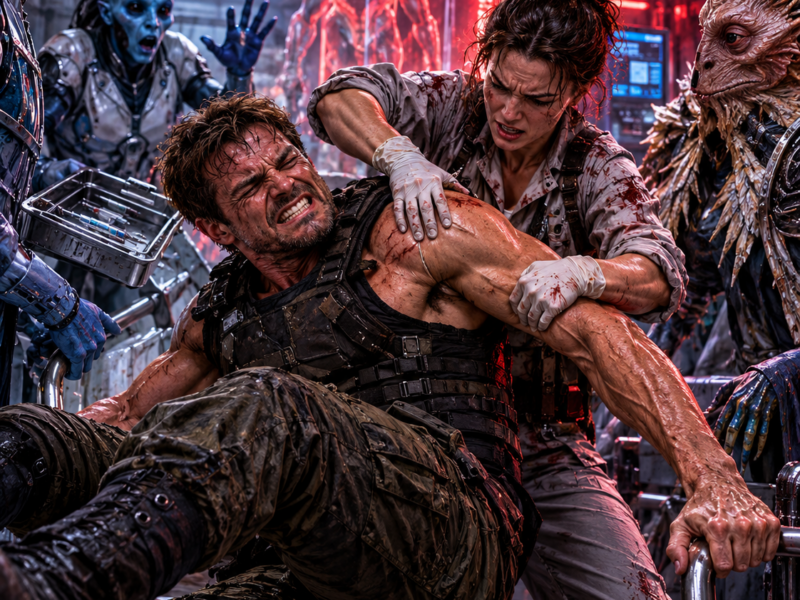
At a crowded emergency room in rural Montana, I watched an alien doctor recoil in horror as a human physician grabbed my dislocated shoulder and violently snapped it back into place, but what terrified the visitors most wasn’t the sound of my bones shifting—it was the fact that I didn’t scream.
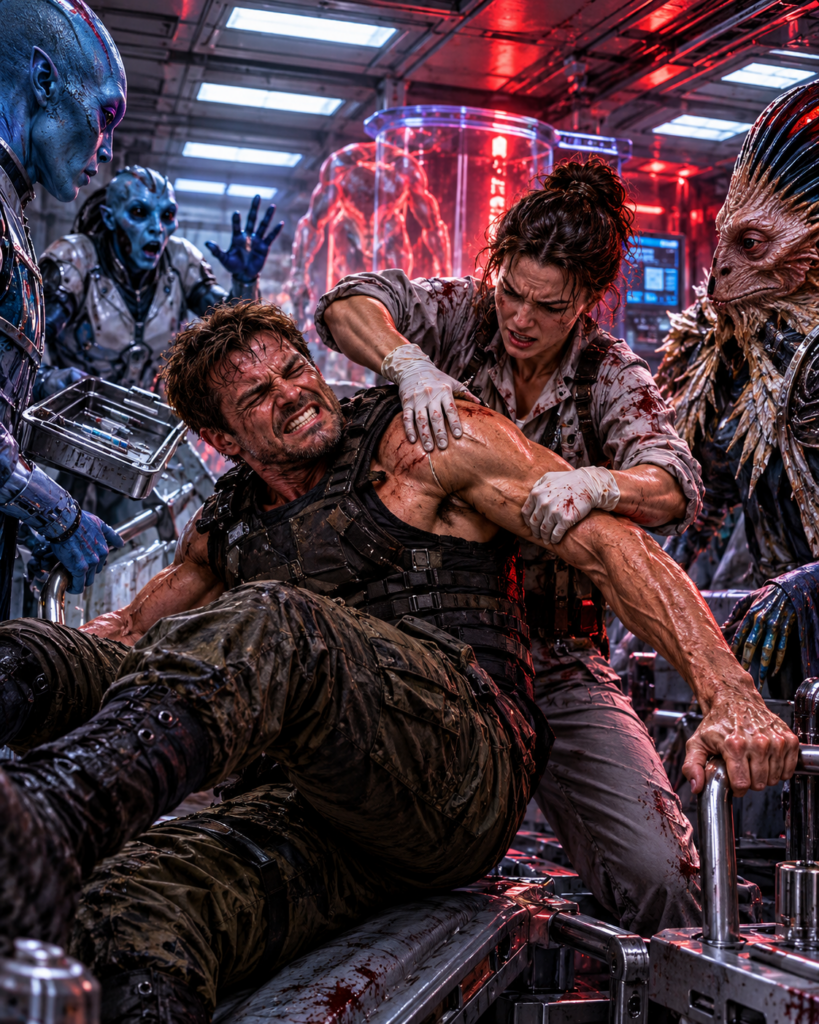
The darkness swallowed the emergency room.
For one terrible second, nobody moved.
Then came the sound of gunfire.
Three shots.
The first shattered a window. The second struck something metallic. The third was followed by a scream from somewhere near the nurses’ station.
“DOWN!” Dr. Collins shouted.
He threw himself over my hospital bed as glass rained across the floor.
I felt his weight press against my injured shoulder, and white-hot pain exploded through my body.
But I still didn’t scream.
Not because I was brave.
Because something much worse was happening.
The emergency lights flickered on, bathing the room in a dim red glow.
The two security officers who had entered with the government officials were no longer standing.
One lay motionless beside the door.
The other was holding his throat, desperately trying to breathe.
The government official who had pointed his weapon at Veyra was staring at his own hands.
Black veins crawled beneath his skin.
“Get away from me!” he screamed.
Veyra raised her wrist.
A blue sphere of light expanded around us, forming a transparent barrier.
The man’s body suddenly lifted several inches above the floor.
His eyes rolled backward.
“Veyra!” one of the other aliens shouted. “Don’t expose yourself!”
She ignored him.
“Daniel, listen carefully. The people who sent us here have already identified you.”
“What people?”
She looked toward the unconscious security officer.
“The people responsible for the medical suppression program.”
I stared at her.
“You’re telling me somebody is deliberately making humans sick?”
“Not just sick,” she replied. “They are preventing your bodies from recovering.”
Dr. Collins slowly stood up.
“What the hell are you talking about?”
Veyra extended her hand.
A holographic display appeared above the hospital bed.
It showed a rotating image of a human cell.
Thousands of tiny particles surrounded it, attaching themselves to its outer membrane.
“Approximately twenty-three years ago, an unidentified extraterrestrial biological signal was discovered beneath the Earth’s surface. It contained instructions for activating dormant regenerative mechanisms within human DNA.”
I blinked.
“Twenty-three years?”
“Your species possesses extraordinary biological capabilities. Your bodies can repair damaged tissue, resist infection, and adapt to environmental threats. However, these capabilities are limited by certain genetic switches.”
She enlarged the hologram.
A series of microscopic structures appeared.
“Someone discovered how to suppress those switches.”
“Who?”
Veyra looked at Dr. Collins.
“Your pharmaceutical and medical research institutions have been distributing a synthetic compound designed to interfere with cellular regeneration.”
Dr. Collins shook his head.
“That’s impossible. There are thousands of independent laboratories. Millions of doctors. You can’t control all of them.”
“No,” Veyra answered. “But you can control the systems they depend upon.”
My stomach tightened.
I thought about the painkillers I had taken for years.
The injections after my motorcycle accident.
The expensive treatments that never seemed to fix anything.
And the strange exhaustion that had become part of my everyday life.
“Why?” I whispered. “Why would anyone do that?”
Veyra lowered her eyes.
“Because a healthy population is difficult to control through medical dependence.”
Before I could respond, a metallic voice emerged from the darkness.
“That’s enough.”
The remaining government official had risen to his feet.
His face was pale, but his eyes had turned an unnatural shade of gold.
He pulled a small black device from his jacket.
Veyra immediately stepped between him and my bed.
“Agent Mercer. You should be dead.”
The man smiled.
“Your intelligence is impressive. Unfortunately, your understanding of human politics is not.”
He pressed the device.
The blue barrier shattered.
Veyra collapsed to one knee.
The other two visitors grabbed her, but their bodies began flickering like images on a broken screen.
“What did you do?” I shouted.
Mercer looked at me.
“Something that should have been done a long time ago.”
He raised his weapon.
And pointed it at my chest.
“Daniel Carter, you’re coming with us.”
Dr. Collins stepped forward.
“He’s a patient!”
Mercer struck him across the face with the weapon.
The doctor fell against the cabinets.
I tried to climb out of bed, but my shoulder refused to cooperate.
Then something strange happened.
The red holographic marks that Veyra had shown me began appearing across my skin.
Not as injuries.
As light.
Thin golden lines spread from my shoulder down my arm.
I felt a warmth unlike anything I had experienced before.
My fingers moved.
My shoulder stopped trembling.
And for the first time in years, the constant ache in my body disappeared.
Mercer took one step backward.
“No.”
Veyra looked up.
Her enormous black eyes widened.
“Impossible.”
The light beneath my skin intensified.
“What is happening to me?”
She stared at my chest.
“Daniel, your regenerative system is activating.”
Mercer raised his weapon again.
“Kill him!”
But before he could pull the trigger, I moved.
I didn’t think.
I simply reached out and grabbed his wrist.
The gun slipped from his hand.
His expression changed from anger to pure terror.
Because I had just crushed the metal weapon between my fingers.
And I hadn’t even felt my injured shoulder move.
I woke up three days later in a room that smelled like disinfectant.
My shoulder was bandaged.
My head hurt.
And a small monitor beside my bed displayed a heart rate that looked perfectly ordinary.
For several seconds, I wondered whether everything had been a dream.
Then I noticed the unfamiliar figure sitting beside the window.
Veyra.
Her silver skin reflected the morning sunlight.
“Welcome back, Daniel.”
I sat up.
“Where am I?”
“An underground medical facility beneath the mountains.”
“Am I a prisoner?”
She considered the question.
“Not yet.”
I looked at my shoulder.
“Did you fix me?”
“Your shoulder was repaired. Your previous injuries are being examined.”
“How long?”
“Eleven hours.”
I stared at her.
“Eleven hours to fix twenty years of damage?”
“Your body did most of the work.”
She projected another hologram.
It showed my skeletal structure, muscles, nerves, and internal organs.
The red marks were almost gone.
But there was something else.
A small golden pattern had appeared near the center of my chest.
“What is that?”
Veyra became unusually quiet.
“Your genetic signature.”
“Meaning?”
“It is the same biological signature we discovered beneath your planet twenty-three years ago.”
I frowned.
“Are you saying I’m an alien?”
“No.”
She leaned closer.
“You’re something far more important.”
She explained that the original signal had not been a weapon or a medical formula.
It was a biological message.
A message intended for a species that had reached a particular stage of evolution.
Humanity had been developing its regenerative abilities for thousands of years, but the process was incomplete.
The signal was supposed to accelerate that development.
However, when the first research team discovered it, they realized something extraordinary.
A small percentage of humans carried a dormant genetic sequence capable of responding to it.
I was one of them.
“How many others?”
“We don’t know. Perhaps thousands. Perhaps millions.”
“Then why haven’t you helped them?”
Veyra looked away.
“Because the signal was stolen before we could understand its purpose.”
A new voice interrupted us.
“Because someone made sure we couldn’t.”
A man entered the room.
He was tall, wore a dark suit, and had a scar running from his left eyebrow to his chin.
Veyra immediately stood.
“Commander Elias.”
He nodded.
“Veyra.”
Then he looked at me.
“Daniel Carter. I’m sorry about what happened at the hospital.”
“Who are you?”
“The person responsible for keeping you alive.”
I laughed bitterly.
“That’s a pretty strange way of showing it.”
He didn’t smile.
“Three people have been killed trying to protect you. The government knows where you are. And whatever happened to your body is being monitored by people who have access to weapons far beyond anything your military possesses.”
He placed a tablet on the table.
A photograph appeared.
It showed a group of men standing in front of a massive underground laboratory.
One of them was Mercer.
Another was a familiar face.
My father’s.
I stopped breathing.
“My father died twenty years ago.”
Elias nodded.
“That’s what you were told.”
I stared at the photograph.
My father, Thomas Carter, had disappeared when I was eleven.
My mother had said he died in a laboratory accident.
There had been no funeral.
No body.
Just a government document and a small wooden box containing his wedding ring.
I had spent years believing that he had abandoned us.
“Where is he?”
Elias hesitated.
“He’s the director of the organization that has been suppressing human regeneration.”
The room seemed to tilt.
“No.”
“I’m afraid so.”
I shook my head.
“My father wouldn’t do that.”
Elias placed the tablet down.
“Then perhaps you should hear his explanation.”
Two hours later, I stood in front of a massive observation window.
Beyond it stretched a cavern containing hundreds of illuminated chambers.
Inside each chamber lay a human being.
Men.
Women.
Children.
Some were unconscious.
Others were connected to machines that pulsed with faint blue light.
“Who are they?” I asked.
“People who carry the same dormant genetic sequence as you.”
I pressed my palm against the glass.
“Are they being experimented on?”
“Some were volunteers. Others were taken from hospitals, military facilities, and research centers.”
“How many?”
“Four thousand, three hundred and twelve.”
My throat tightened.
“Why?”
Elias looked toward the chambers.
“Because your father believes humanity is not ready to evolve.”
I turned.
“That doesn’t give him the right to imprison people.”
“No. But it explains why he did.”
Elias told me that Thomas Carter had once been a brilliant geneticist.
He had led the original research team that discovered the alien signal.
At first, he wanted to make the technology available to everyone.
Then something happened.
A laboratory accident.
An uncontrolled activation.
A young researcher had experienced rapid cellular regeneration.
But the process didn’t stop.
Her cells continued multiplying until her entire body became an unstable mass of living tissue.
The research team had been forced to destroy the laboratory.
Seven people died.
My father survived.
But he changed.
He became convinced that unrestricted regeneration would destroy humanity.
“Instead of helping people control it, he decided to suppress it entirely,” Elias explained.
“And the medical companies?”
“His organization provided them with technology, research, and funding. Most executives believed they were developing ordinary treatments. Only a handful knew the real purpose.”
I stared at the people in the chambers.
“How do we stop him?”
Elias gave me a grim look.
“We don’t.”
He enlarged the map on his tablet.
A massive structure appeared beneath the Rocky Mountains.
“The central suppression network is located here. Your father controls it. Every regenerative signal detected on Earth passes through this facility.”
“And if we destroy it?”
“Your species may finally regain control of its own biology.”
“Then let’s destroy it.”
Elias shook his head.
“There’s a problem.”
He enlarged a diagram.
At the center of the network was a glowing sphere surrounded by thousands of connecting structures.
“Your father’s system has become unstable. If we shut it down incorrectly, the accumulated biological energy could trigger uncontrolled regeneration across the entire planet.”
I looked at him.
“Meaning?”
“Millions of people could die.”
For a moment, nobody spoke.
Then Veyra approached.
“There may be another option.”
She projected an image of my chest.
The golden genetic pattern appeared again.
“Daniel’s body can communicate with the original signal. If he reaches the central network, he may be able to deactivate the suppression system without releasing its accumulated energy.”
Elias stared at her.
“That’s impossible.”
“Perhaps.”
“You’re suggesting we send an untrained human into a facility guarded by an entire military division?”
Veyra looked at me.
“I’m suggesting we give him a choice.”
I thought about the people in the chambers.
The years I had spent working through injuries.
The medical bills.
The people who couldn’t afford treatment.
My mother, who had died after a treatable infection became something much worse because we couldn’t afford the specialist she needed.
I remembered the hospital room.
And the question Veyra had asked.
How many humans live this way?
I turned toward Elias.
“When do we leave?”
We entered the facility shortly before midnight.
There were six of us.
Elias.
Veyra.
Two alien security specialists.
A human engineer named Dr. Lena Brooks.
And me.
The entrance was hidden beneath an abandoned mining complex.
From the outside, it looked like an ordinary industrial building.
Inside, it was a fortress.
Armed guards patrolled every corridor.
Automated turrets tracked movement.
And enormous machines hummed beneath the floors.
Lena led us through a maintenance tunnel.
“According to the original blueprints, the central network is three levels below us.”
“How many guards?” I asked.
“At least two hundred.”
“Great.”
She gave me a nervous smile.
“On the bright side, most of them don’t know we’re here.”
We reached the first security checkpoint without incident.
Then the alarm sounded.
Red lights flashed.
Metal doors slammed shut behind us.
A voice echoed through the corridor.
“Unauthorized biological signatures detected.”
Elias raised his weapon.
“Move!”
The first wave of guards appeared at the far end.
Gunfire erupted.
The alien specialists moved with terrifying speed.
Their weapons fired thin beams of blue energy, disabling the guards without killing them.
But there were too many.
One bullet struck Lena in the side.
She fell.
I rushed toward her.
“Stay with me!”
She pressed a hand against her wound.
“Don’t stop. The control room is ahead.”
“You’re coming with us.”
She grabbed my wrist.
“Daniel, listen.”
Her breathing was shallow.
“I’ve spent twelve years studying cellular regeneration. I watched my brother die from a disease that shouldn’t have killed him.”
She forced a small smile.
“If you can change anything, don’t waste it on revenge.”
I looked at the wound.
Blood soaked through her fingers.
“Veyra!”
The alien doctor knelt beside her.
A small device unfolded from her wrist.
Within seconds, a soft blue light surrounded Lena’s body.
The bleeding stopped.
Her breathing steadied.
I stared.
“You can heal her?”
“Yes,” Veyra answered.
“Then why didn’t you do that at the hospital?”
“Because this technology requires an enormous amount of energy. We have very little left.”
She looked at me.
“And because we cannot save everyone by ourselves.”
A heavy explosion shook the corridor.
Elias shouted.
“We’re out of time!”
I helped Lena stand.
Together, we continued.
The central chamber was enormous.
At its heart floated a sphere of golden light.
Thousands of cables extended from it into the walls.
The entire structure pulsed like a living heart.
And standing beneath it was my father.
Thomas Carter looked almost exactly as I remembered him.
His hair was gray.
His face was older.
But his eyes were the same.
For several seconds, neither of us spoke.
Then he smiled.
“Daniel.”
I felt something break inside me.
“Why?”
He lowered his head.
“I knew this day would come.”
“Why did you leave us?”
“Because I was trying to save you.”
“From what? From getting sick? From being able to heal?”
His expression hardened.
“You have no idea what you’re asking for.”
“I know you imprisoned thousands of people.”
“I protected millions!”
He gestured toward the golden sphere.
“That technology is not a gift. It is an evolutionary mechanism. Once activated, it changes everything. Your body stops recognizing the limits that keep it alive.”
“Veyra says it can be controlled.”
“Veyra is an alien. She doesn’t understand what happens when human ambition gets involved.”
He walked closer.
“Twenty-three years ago, I watched a young woman regenerate so violently that her own body consumed her. I watched seven people die. I spent the rest of my life making sure that would never happen again.”
His voice cracked.
“I couldn’t let that happen to you.”
I stared at him.
“Then you should have taught us how to control it.”
He looked at me.
For the first time, I saw fear in his expression.
“You think people would use it responsibly? Governments would weaponize it. Corporations would sell it. Criminals would exploit it. The rich would become impossible to kill while the poor would be left behind.”
I glanced at the thousands of cables.
“Isn’t that exactly what you’ve created?”
He said nothing.
I stepped closer.
“You didn’t stop people from suffering, Dad. You built a system that made their suffering profitable.”
His face twisted.
“Do you think I wanted this?”
“Then stop it.”
He looked toward the sphere.
“I can’t.”
A mechanical voice interrupted us.
“Suppression network integrity at forty-one percent.”
Veyra froze.
“Thomas, what have you done?”
My father looked at her.
“The system is already failing.”
He explained that the network had been designed to suppress the alien signal gradually.
But over the years, it had accumulated enormous amounts of biological energy.
The original researchers had never understood how much.
Now the system was approaching a critical threshold.
“If it collapses,” he said, “the energy will spread through every connected human cell.”
Elias raised his weapon.
“Then deactivate it.”
“I told you. I can’t.”
Veyra studied the sphere.
Then she looked at me.
“Daniel.”
I knew what she was going to say.
“No.”
“Your genetic sequence is the only one capable of communicating with the original signal.”
“Then show me how.”
She shook her head.
“I cannot guarantee your survival.”
I looked at my father.
He was staring at me with the same expression he had worn when I was a child and had fallen from my bicycle.
Fear.
Love.
Regret.
“Please,” he whispered. “Don’t make the same mistake I did.”
I walked toward the sphere.
And placed my hand against it.
The world disappeared.
I was no longer standing inside the underground facility.
I was floating in a vast darkness filled with millions of golden lights.
Each light represented a living human being.
I could feel their hearts beating.
Their lungs expanding.
Their bodies repairing tiny injuries every second.
I felt the pain of a child with a broken leg.
The exhaustion of an elderly woman fighting an infection.
The silent suffering of a factory worker whose damaged lungs had never received proper treatment.
I felt thousands of lives.
Millions.
Billions.
And beneath them all was something enormous.
A consciousness.
Not a person.
Not a machine.
Something older than humanity itself.
A voice entered my mind.
“BIOLOGICAL CONNECTION ESTABLISHED.”
I tried to speak.
“Who are you?”
“We are the custodians of the original biological architecture.”
“Why did you send the signal?”
“Because your species reached the threshold of self-directed evolution.”
I remembered my father’s warning.
“Can this technology destroy humanity?”
“All power carries risk. Biological evolution without understanding can produce instability.”
“Then why not prevent it?”
“Because evolution cannot be forced. Nor can it be owned.”
Images appeared around me.
Worlds filled with life.
Civilizations that had developed regenerative abilities.
Some had flourished.
Others had destroyed themselves.
I understood then.
The signal was never meant to make humans invincible.
It was meant to give them the ability to repair what could be repaired.
To survive diseases that once seemed impossible.
To recover from injuries that would otherwise end lives.
But it could not eliminate death.
Nor could it erase the consequences of human choices.
I saw another image.
A small golden structure at the center of the suppression network.
It was connected to every medical device on Earth.
The network wasn’t simply blocking regeneration.
It was feeding on it.
Every suppressed biological response was converted into energy.
Energy that could be stored, measured, and controlled.
I understood why my father had built it.
And why Mercer wanted me.
They had discovered something even more valuable than the ability to suppress human regeneration.
They wanted to control who could regenerate.
A voice sounded again.
“THE SUPPRESSION NETWORK IS APPROACHING FAILURE.”
“How do I stop it?”
“YOU MUST RELEASE THE SIGNAL.”
“Will people die?”
“Some may. Your species must learn to regulate its own development.”
I hesitated.
“Can you help me?”
“WE CAN PROVIDE THE KNOWLEDGE. THE CHOICE MUST BE YOURS.”
Then I saw my mother.
Not as she had looked when she died.
But as she had looked when I was six.
She was sitting on the floor beside me, holding a small toy motorcycle.
I remembered her voice.
“Being strong doesn’t mean you never get hurt, Danny. It means you don’t let pain turn you into someone who hurts others.”
The memory faded.
I opened my eyes.
And made my choice.
The golden sphere exploded with light.
Back in the chamber, alarms screamed.
The suppression network began shutting down.
Every cable vibrated.
Machines erupted in showers of sparks.
My father shouted something, but I couldn’t hear him.
The energy was flowing through me.
I felt my body changing.
Not painfully.
Not violently.
It felt as if every cell was remembering something it had forgotten.
I could feel the damage in my muscles repairing.
My bones strengthening.
My nerves reconnecting.
But I could also feel something else.
The biological signal was spreading.
Across continents.
Across oceans.
Into every living human body.
For the first time in human history, people were receiving the instructions their bodies had been waiting for.
Then the sphere cracked.
A blinding flash filled the chamber.
And everything went silent.
When I woke up, I was lying on the floor.
My father was beside me.
His face was covered in dust.
Blood ran down his forehead.
“Daniel?”
I opened my eyes.
“Dad?”
He began crying.
Not loudly.
Not dramatically.
He simply covered his face and wept.
For a moment, I wanted to hate him.
I wanted to tell him that twenty years could never be repaired.
That my mother had died.
That thousands of people had suffered.
That he had stolen something from the entire human race.
But I saw the old man beneath the guilt.
A man who had been so terrified of making another mistake that he had spent his life committing a much larger one.
I reached out and took his hand.
“You’re going to have to answer for what you did.”
He nodded.
“I know.”
“And you’re going to help fix it.”
He looked at me.
“Whatever it takes.”
The chamber doors opened.
Elias entered with several security officers.
He looked at the ruined network.
Then at the golden light slowly fading from the air.
“Is it over?”
Veyra stepped forward.
“No.”
She examined the readings on her wrist.
“It’s beginning.”
The following weeks changed the world.
At first, nobody believed the reports.
Hospitals recorded unexplained recoveries.
Patients with severe infections began improving.
Burn victims healed faster than expected.
People with long-standing injuries reported sudden reductions in pain.
Scientists struggled to explain what was happening.
Governments declared emergencies.
Pharmaceutical companies denied wrongdoing.
Several executives disappeared.
Others attempted to destroy research records before investigators could reach them.
But the evidence was everywhere.
Thousands of patients had been exposed to the suppression compounds.
Their medical histories revealed patterns that could no longer be dismissed as coincidence.
The underground facility was opened to international investigators.
The people held inside were released.
Many had been imprisoned for years.
Some needed months of rehabilitation.
Others needed only time and proper medical care.
The truth about my father became public.
He was arrested.
He did not resist.
Before being taken away, he asked to see me.
We sat across from each other in a small interview room.
“I don’t expect you to forgive me,” he said.
“I don’t know if I can.”
He nodded.
“I understand.”
I looked at the man who had once taught me how to ride a bicycle.
“Why didn’t you tell me?”
“Because I thought keeping you away from the research would protect you.”
“You could have trusted me.”
He lowered his eyes.
“That was the mistake.”
I stood.
“I hope you spend the rest of your life helping the people you hurt.”
He looked up.
“I will.”
I left without hugging him.
Not because I didn’t love him.
But because forgiveness was not something he could demand.
It was something he would have to earn.
Six months later, I returned to the same rural Montana hospital.
The emergency room looked almost exactly as it had before.
The same worn floors.
The same flickering lights.
The same old vending machine that never seemed to work.
Dr. Collins was standing near the nurses’ station.
He spotted me and laughed.
“Well, look who decided to come back.”
I smiled.
“Just checking whether you still charge people for putting their shoulders back.”
“Absolutely. Some traditions are sacred.”
We both laughed.
Then a young woman entered carrying a little boy.
The child was holding his arm against his chest.
“Please,” she said to the receptionist. “He fell off his bicycle. I don’t have insurance, but I can pay something.”
I felt my stomach tighten.
It was the same sentence I had heard myself say countless times.
Dr. Collins immediately approached them.
“Let’s have a look.”
He examined the boy’s arm.
“A small fracture. Nothing we can’t handle.”
The mother looked frightened.
“How much will it cost?”
He glanced at her.
“Let’s worry about getting him better first.”
I watched as he led them toward the examination room.
Veyra stood beside me.
She had remained on Earth as part of a medical cooperation program between humanity and her civilization.
“You seem troubled,” she said.
I looked at the mother and child.
“I thought everything would be different by now.”
“It is different.”
“Not enough.”
She nodded.
“Biological healing can repair tissue. It cannot automatically repair the systems your species has built around suffering.”
I looked at her.
“Then what happens next?”
“That depends on you.”
She was right.
The technology had changed.
But greed hadn’t disappeared.
People still fought over resources.
Governments still sought control.
Corporations still searched for ways to turn discoveries into profits.
Some wealthy individuals were already trying to patent treatments based on the new biological research.
And there were still millions of people without access to basic healthcare.
The alien signal had given humanity an opportunity.
It had not given humanity wisdom.
I glanced at the examination room.
The little boy was laughing now.
His mother was crying with relief.
For a moment, I felt something I hadn’t felt in a long time.
Peace.
Then my wrist device vibrated.
An incoming message appeared.
It was from my father.
He had been transferred to a secure research facility, where he was cooperating with investigators.
The message contained only one sentence.
I finally understand what you were trying to tell me. Healing is not something we should control. It is something we should share.
I read it twice.
Then I put the device away.
One year after the suppression network was destroyed, the first international human-regeneration center opened in Montana.
It wasn’t owned by a corporation.
It wasn’t controlled by a government.
Its funding came from a public international trust, with independent medical oversight and free treatment for anyone who needed it.
Veyra helped train the first generation of human doctors.
Dr. Collins became one of its senior physicians.
Lena Brooks led the research division.
And I became something I had never imagined.
A patient advocate.
I traveled across the country, visiting hospitals and speaking to people whose lives had been affected by the suppression program.
I met a farmer who had spent twenty years living with chronic pain.
A mother whose daughter had lost years of her life to a treatable condition.
A former soldier who had believed his injuries made him useless.
Their stories were different.
But they all contained the same question.
Why had help been kept from them?
I never had an easy answer.
Sometimes, people asked me whether I regretted activating the signal.
I always told them the truth.
There had been risks.
There had been uncertainty.
There were still things we didn’t understand.
But I had learned that fear could be just as dangerous as ignorance.
My father had been afraid of what humanity might become.
So he had decided what humanity was allowed to be.
And in doing so, he had taken away the chance for millions of people to make their own choices.
I understood his fear.
I could even understand how it had begun.
But understanding a mistake did not make it right.
One afternoon, I visited the memorial built outside the research center.
The names of the people who had died during the original experiments were engraved into a long wall of dark stone.
Seven names from the first accident.
Hundreds more from the years of suppression.
I found my mother’s name among them.
She had never been part of the experiments.
But her death had become one of the reasons I refused to accept that suffering was simply something ordinary people had to endure.
I placed a small flower beneath her name.
Then I heard a familiar voice behind me.
“She would have been proud of you.”
My father stood several feet away.
He was wearing a plain gray jacket.
His hair had become almost completely white.
He had been released into supervised service after cooperating with the investigation, though he remained legally responsible for his actions.
I didn’t turn around immediately.
“Maybe.”
He approached slowly.
“I don’t expect you to forgive me.”
“I know.”
“I just wanted you to know that I’ve started writing everything down. Every experiment. Every decision. Every person affected.”
“Good.”
“I want people to understand what happened.”
I looked at him.
“Then don’t leave anything out. Especially the parts that make you look bad.”
He nodded.
“I won’t.”
For a while, we stood together in silence.
It wasn’t reconciliation.
Not yet.
But it was a beginning.
That evening, Veyra and I stood on a hill overlooking the research center.
Lights shone through the windows.
Inside, doctors were treating patients.
Children were playing in the courtyard.
Researchers from two civilizations were working side by side.
The world was far from perfect.
But it was moving.
“Do you miss your home?” I asked.
“Sometimes.”
“Why stay?”
She looked toward the building.
“Because I came here believing your species needed to be studied. I was wrong.”
“About what?”
“Your greatest strength was never your ability to survive pain.”
She turned toward me.
“It was your willingness to care for someone else’s pain, even when you had plenty of your own.”
I looked down at my hands.
A year earlier, I had been a man who considered an untreated injury part of ordinary life.
I had believed strength meant enduring everything quietly.
I had been wrong, too.
There was no honor in suffering unnecessarily.
There was no virtue in allowing people to struggle simply because someone else had decided their suffering was profitable.
And there was no shame in asking for help.
I looked at the stars.
Somewhere beyond them were civilizations that had mastered the secrets of life.
They had come to Earth expecting to discover something extraordinary.
Instead, they had discovered a species that could endure astonishing pain but had not yet learned how to treat one another fairly.
Maybe that was humanity’s real challenge.
Not becoming immortal.
Not becoming invincible.
Not building machines powerful enough to conquer the universe.
But learning that progress meant nothing if its benefits belonged only to those who could afford them.
A year ago, I had refused to scream when a doctor forced my shoulder back into place.
The aliens had mistaken my silence for courage.
Now I understood that it had been something else.
I had simply become accustomed to believing that pain was mine to carry alone.
I didn’t believe that anymore.
And perhaps that was the most important thing the signal had awakened in humanity.
Not stronger bones.
Not faster healing.
Not the ability to survive injuries that once would have been fatal.
It had awakened the possibility of a different world.
One in which nobody had to prove how much pain they could endure before someone decided they deserved help.
I looked at Veyra.
“Do you think we’ll get it right this time?”
She watched the lights of the hospital.
“I think you finally have the chance to try.”
And for the first time in my life, I believed that was enough.
Because the greatest miracle was never learning how to heal ourselves. It was learning that no one should have to suffer alone.