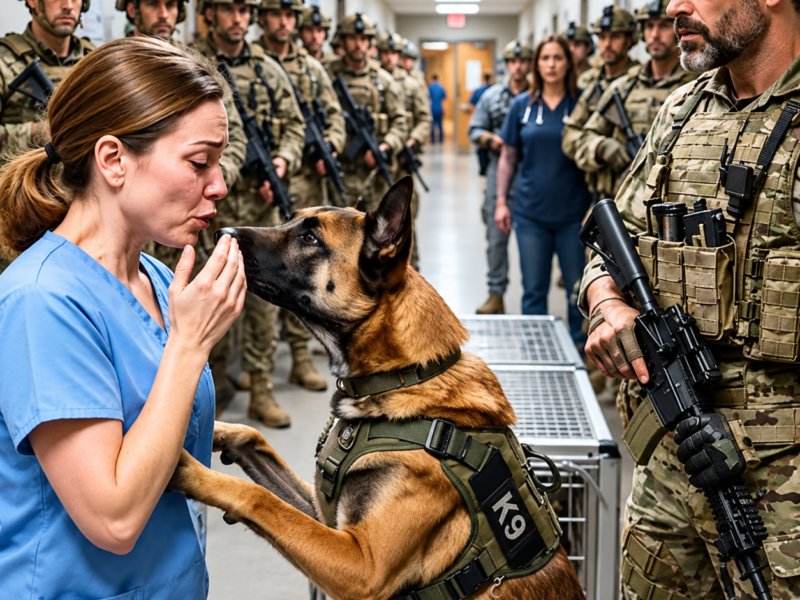
At 2:17 a.m. in a Charleston ER, I was publicly ordered to surrender the wounded K9 I had been treating, and the Navy SEAL beside him called me a liar when I refused—yet the dog’s reaction to my voice revealed a secret buried in my past.
The fluorescent lights of the emergency room hummed with a low, agonizing vibration.
It was 2:17 a.m., the hour when the hospital belonged only to the desperate and the dying.
I adjusted my surgical mask, my hands trembling slightly as I pressed a fresh pad of gauze against the tearing laceration on the dog’s chest.
He wasn’t a standard pet.
He was a Malinois, massive and lean, his dark fur soaked in mud, river water, and thick, crimson blood.
His heavy breathing rattled through his broad chest, each exhale a ragged fight for oxygen.
“Hold the line, big guy,” I whispered under my breath. “Stay with me.”
The bay doors flew open with a sound like thunder, slamming hard against the concrete wall.
Cold rain lashed into the hallway, carrying the sharp scent of ozone, damp dirt, and burning oil.
Three men strode through the entrance, their boots heavy and unyielding against the polished floor.
They wore tactical gear stripped of all patch identification, dark fabrics soaked through and clinging to muscular frames.
The man leading them stood over six feet two, his jaw squared and eyes like chipped flint.
He carried the distinct, quiet gravity of a veteran Navy SEAL who had seen too many dark corners of the world.
“Step away from the animal, Doctor,” he ordered, his voice cutting through the hiss of the oxygen lines.
His command was absolute, carrying no room for debate or hesitation.
I didn’t lift my hands from the dog’s bleeding flank.
“He’s in hemothorax,” I said, keeping my voice steady despite the spike of adrenaline in my vein. “If I step away right now, his lung collapses completely.”
The officer stepped closer, his shadow falling long and heavy across the metallic examination table.
“You don’t understand the clearance level of this asset,” he replied, his tone chillingly flat. “You are ordered to surrender him to us immediately.”
“I don’t care about your clearance,” I said, looking him dead in the eye. “I care about his heart rate.”
The officer’s eyes narrowed into dark slits, taking in my blood-stained scrubs and the faint, pale scar running along my left wrist.
“You’re making a catastrophic mistake, civilian,” he said softly.
“The mistake was leaving him untreated long enough for his pressure to drop to forty,” I countered.
The massive Malinois let out a low, gravelly whine, his golden eyes flickering open beneath heavy eyelids.
He didn’t look at the tactical team standardizing the doorway.
His eye shifted, turning slowly until his dark pupil locked onto mine.
“Easy, Bear,” I muttered without thinking, the name slipping through my lips before my conscious mind could stop it.
The dog’s tail gave a single, distinct thump against the steel table.
The seal officer froze, his hand hovering inches above his side holster.
“What did you just call him?” the soldier demanded, his voice dropping an octave into pure danger.
“It’s just a common name for a big dog,” I lied instantly, though my pulse was hammering against my ribs.
“You’re a liar,” the SEAL said, stepping directly into my personal space. “His name isn’t in any public registry, and his tag is classified black.”
He leaned in closer, his gaze searching my face with surgical precision.
“So tell me, Dr. Miller—how do you know the callsign of a military operative buried three years ago?”
The air in the trauma bay grew thick enough to choke on.
The sound of the heart monitor was the only beat keeping time against the cold silence.
“I read dogs,” I said, forcing my expression into an emotionless mask. “He looks like a Bear.”
“Don’t play games with me,” the officer barked, taking another half-step forward. “I know every handler in Special Operations Command.”
“Then you should know he’s dying while you stand here posturing,” I snapped back.
I reached for the chest tube on the tray, my fingers moving with calculated speed.
The second soldier near the doorway shifted his weight, his hand resting casually on the butt of his sidearm.
“Captain Vance,” the second soldier cautioned quietly. “We have a strict timeline.”
Vance didn’t take his eyes off me.
“She knows the dog, Miller,” Vance said. “Or the dog knows her.”
My fingers tightened around the surgical forceps.
Three years ago, I wasn’t Dr. Elena Miller, chief of emergency veterinary surgery in Charleston.
Three years ago, I was just a ghost with a field kit in the dirt outside Kabul.
A night that was supposed to never exist had wiped my paper trail clean and left me with a broken wrist and a new name.
I thought everyone from that unit was dead or reassigned to forgotten outposts.
“If you don’t let me insert this chest tube in ten seconds,” I said, leaning over the dog, “you’re taking a body back in your truck.”
Bear let out another soft whimpering sigh, his wet nose twitching as he reached toward my sleeve.
He nudged his snout against the crook of my elbow, the precise spot where my old tactical watch used to sit.
Vance saw the movement.
His eyes widened slightly as the realization hit him.
“The handler from Operation Obsidian,” Vance murmured, the suspicion suddenly turning into pure disbelief. “They said she went down in the river crash.”
“I don’t know what you’re talking about,” I replied, pressing the scalpel lightly against the shaved skin of Bear’s ribs.
“You were reported dead, Doc,” Vance said, his voice losing its harsh edge, replaced by something far more dangerous: curiosity.
“People get misidentified in war zones all the time,” I said coldly.
“Not when their DNA tag is burned into the official record,” Vance shot back.
He reached into his tactical vest and pulled out a small, encrypted tablet, tapping the glass rapidly with his thumb.
“If you are who I think you are,” Vance said, “then the people chasing this dog aren’t just military.”
He turned the screen toward me.
On the high-resolution display was a tracking map showing three dark vehicles moving rapidly down Highway 17 toward the hospital.
“They aren’t coming to rescue him, Elena,” Vance said, using my real name for the first time. “They’re coming to make sure he never speaks.”
The light on the overhead monitor flickered twice as a sudden gust of wind rattled the exterior windows.
My hand stayed steady on the blade, but my blood ran cold at the sight of those moving dots on the screen.
“Who are they?” I asked, making the small incision between Bear’s fifth and sixth ribs.
“Private contractors,” Vance answered grimly. “The kind that don’t carry flags on their shoulders.”
“Why do they want a wounded Belgian Malinois?”
“Because he isn’t carrying explosives, Elena,” Vance said, leaning over the table to hold Bear’s shoulders steady. “He’s carrying a hard drive.”
I paused for a fraction of a second, feeling the thick coat beneath my fingertips.
Deep beneath the layers of wet fur and scar tissue, right along his shoulder blade, I felt a hard, unnatural ridge.
It wasn’t a bone fragment or shrapnel.
It was a custom cybernetic capsule, implanted deep near his spine.
“They put a physical drive inside a live K9?” I whispered, disgust rising in my throat.
“It was the only way to get the telemetry out of the compound in Syria,” Vance explained. “He survived three miles of river and two gunfights to get here.”
Bear groaned as I slid the plastic tube into his thoracic cavity.
A steady stream of dark fluid rushed down the line into the canister, and instantly, his shallow panting expanded into a deep, full breath.
The heart monitor’s erratic beep smoothed into a stable rhythm.
“He’s stabilized for now,” I said, rapidly suturing the tube into place. “But he can’t run.”
“He doesn’t have a choice,” Vance said, glancing toward the double doors leading out to the main lobby. “We have about three minutes before those suburban utility vehicles pull into the ambulance bay.”
“We can’t take him out the front,” I said, tearing off my bloody gloves. “They’ll have the perimeter covered.”
“Is there a secondary exit?” Vance asked, his hand dropping to the grip of his weapon.
“The old basement utility tunnel,” I said. “It connects to the drainage system under the bridge.”
“Good,” Vance said. “Move.”
Suddenly, the lights in the trauma room went out completely.
The emergency red backup lights kicked on with a soft buzz, casting long, eerie shadows across the stainless steel equipment.
Through the frosted glass doors of the ER, the silhouette of a tall man appeared.
He wasn’t wearing a military uniform.
He wore a dark raincoat, holding a silenced pistol low at his side.
“Down!” Vance barked, grabbing the back of my scrubs and pulling me behind the stainless steel supply counter.
The glass doors shattered inward with a muffled pop-pop-pop.
Subsonic rounds chewed into the plaster behind where my head had been a second before.
Bear didn’t bark.
True to his high-level spec-ops training, he slid off the table on his own, keeping his body low against the linoleum floor.
He pressed his heavy shoulder against my hip, letting out a breath of air that smelled of copper and rain.
“He remembers the drill,” I whispered, my heart hammering against my chest.
“He never forgot you,” Vance grunted, pulling a suppressed sidearm from his shoulder rig.
Vance leaned around the corner of the counter and fired two quick shots into the darkness of the hallway.
A heavy body thudded to the floor, followed by the sound of boots retreating back toward the lobby.
“There’s more than three,” Vance said, checking his magazine with a quick flick of his wrist. “They cut the hospital grid power.”
“The basement doors are electronic,” I realized with a sink in my stomach. “If the power is out, the magnetic locks freeze in place.”
“Can you bypass them?” Vance asked.
“Not without a physical key from the facility manager’s office,” I said. “Which is on the second floor.”
Vance looked at his remaining squad member, who was kneeling near the shattered entry door, watching the hallway.
“Miller,” Vance said, his eyes locking onto mine with fierce intensity. “Take the dog and head for the maintenance stairs.”
“What about you?”
“I’m going to create a distraction in the lobby,” he said coldly. “If they think the package is moving upstairs, they’ll shift their focus.”
“Vance, that’s a suicide bottleneck,” I said.
“It’s a tactical delay,” he corrected. “Now take Bear and go.”
I grabbed a leash from the hook on the wall and clipped it to Bear’s heavy nylon collar.
The dog stood up slowly, testing his weight on his bandaged leg.
He was weak, his fur matted with dried mud, but the fire in his golden eyes was fully rekindled.
“Come on, boy,” I whispered softly. “Footsteps light.”
Bear pressed his ear back, nodding his massive head once as if he understood every syllable.
We slipped out the side door into the dark service corridor just as a heavy burst of automatic fire echoed through the main lobby.
The service stairwell was pitch black, illuminated only by the faint glow of my cell phone screen held against my chest.
Every step felt like an eternity.
Bear walked close to my left knee, his breathing surprisingly quiet despite the fresh chest tube taped to his side.
We reached the sub-basement landing, where the heavy metal door stood closed, its red digital lock screen dead and dark.
“Damn it,” I muttered, pushing against the heavy steel handle.
It didn’t budge. The magnetic lock was deadlocked without power.
Behind us, at the top of the stairwell, the heavy fire door creaked open.
Slow, deliberate footsteps began descending the concrete steps above us.
They weren’t Vance’s boots.
These were light, tactical boots moving with absolute stealth.
“Search every floor,” a cold voice whispered from two flights up. “The dog doesn’t leave this building alive.”
I grabbed Bear by his tactical harness, pulling him silently into the narrow recess beneath the concrete stairs.
We squeezed into the tight space between the damp concrete wall and an discarded metal utility cart.
I held my hand over Bear’s snout, feeling his warm, damp breath against my skin.
“Quiet, Bear,” I thought, not daring to speak aloud. “Just like the bunker in Jalalabad.”
The footsteps grew closer, pausing on the landing directly above our heads.
I could see the beam of a high-powered tactical flashlight cutting through the dust particles in the air.
The light swept across the floor, illuminating the dead magnetic door, then swung down toward the space under the stairs.
The white beam stopped just inches from my boot.
Bear’s muscles coiled beneath my hand like a compressed steel spring.
I could feel the low rumble of a growl vibrating deep inside his chest, though he kept his mouth shut tight.
“Nothing down here,” a voice called out from above. “The basement door is locked tight from the grid failure.”
“Check the boiler room,” another voice replied from higher up. “They couldn’t have gone far.”
The footsteps shifted, heading back up the concrete stairs.
I let out a breath I hadn’t realized I was holding.
“We need a way out,” I whispered to Bear, looking around the pitch-black basement corridor.
Then, Bear nudged my arm gently with his snout, pushing my hand toward a low metal grate near the floor.
It was an old laundry chute access panel, rusted around the edges and barely wide enough for a person to squeeze through.
I dropped to my knees and examined the latch on the metal chute.
It was held in place by a simple mechanical latch, rusted over from decades of damp hospital air.
I pulled a pair of surgical scissors from my scrub pocket and jammed the blunt tip into the mechanism, leveraging my weight against it.
With a sharp, metallic crack, the latch gave way.
The small door swung open, revealing a dusty, angled shaft leading downward into the foundations of the old building.
“Good eye, Bear,” I whispered.
The dog sniffed the dark opening, then looked up at me, giving a tiny, single tail thump against the concrete floor.
“You go first,” I said, unclipping the leash so it wouldn’t catch on anything inside. “Go on.”
Bear didn’t hesitate.
He slid his front paws into the chute, wriggling his massive body into the narrow metal tube until his back legs disappeared inside.
I heard the soft slide of his body down the rusted metal incline, followed by the quiet landing of his paws on dirt below.
A soft bark echoed back up through the chute—a signal that it was clear.
I turned back to look at the stairwell door.
The sound of shouting and heavy gunfire echoing down from the upper floors meant Vance was running out of time.
I couldn’t help him up there.
My only job was keeping the package—and my old partner—alive.
I wedged my shoulders into the narrow opening, holding my breath as I slid into the dark shaft.
The metal scraped against my arms and hips as gravity pulled me down the steep incline.
I spilled out onto a cold, damp dirt floor, coughing slightly from the cloud of ancient dust.
Bear was instantly at my side, licking my cheek once before turning his nose toward the darkness ahead.
We were in the forgotten foundation tunnels beneath the original 19th-century wing of the hospital.
The air was heavy with the smell of salt marsh, wet bricks, and ocean tide.
A faint light glimmered at the far end of the tunnel, where the old storm drain emptied into the river bayou.
“This is it,” I whispered, pulling myself up to a standing position. “Almost out.”
Before we could take three steps forward, a flash of bright light flooded the end of the tunnel.
A heavy silhouette stepped into the archway, blocking the faint moonlight coming from the river mouth.
“I had a feeling the old blueprints would come in handy,” a voice rasped from the light.
It was a man holding a shotgun, his face illuminated from below by a tactical neck lamp.
He racked the slide with a brutal, metallic sound.
“Hand over the dog, Doctor,” he said. “Or I’ll tear you both to pieces right here.”
The sound of the shotgun rack reverberated off the low brick ceiling of the tunnel.
Bear dropped into a low, predatory stance beside me, a dark, dangerous rumble echoing from deep within his throat.
“You don’t want to do this,” I said, taking half a step forward to cover Bear’s body with my own.
“You have no idea what’s on that drive, lady,” the man snarled, raising the barrel directly at my chest. “It’s worth more than this entire city block.”
“It’s just data,” I said, keeping my tone slow and even, trying to buy every second I could. “He’s a living creature.”
“To you, maybe,” the shooter laughed harshly. “To my employers, he’s just a black box with fur.”
He tightened his finger on the trigger.
In that fraction of a second, I didn’t think about my survival or the secret identity I had built over three quiet years in South Carolina.
I remembered the dusty roads of Helmand, the heat of the burning humvee, and the way this exact dog had dragged my unconscious body out of a line of fire when everyone else had given up.
“Bear!” I yelled, using the tactical command phrase from our old unit. “Redline, strike!”
Bear didn’t jump at the man’s chest.
He had been trained for armored targets.
He launched his two-hundred-pound frame low across the wet dirt, slamming his heavy shoulders directly into the shooter’s knees.
The gun discharged into the concrete ceiling with a deafening explosion of dust and spark.
The shooter screamed as his legs gave way, tumbling backward into the shallow, muddy water of the tunnel floor.
Bear was on him instantly, pinning the man’s right arm to the mud with his massive jaws, holding him down with terrifying precision without breaking skin.
I rushed forward, kicking the dropped shotgun deep into the murky water of the storm drain.
“Hold!” I commanded Bear.
The dog froze immediately, his jaws locked around the man’s sleeve, his eyes fixed on me for the next order.
The shooter lay panting in the mud, his face pale with terror as he looked up at the Malinois towering over him.
“He… he didn’t tear my throat out,” the man gasped in disbelief.
“He’s a professional,” I said cold, picking up the shooter’s fallen tactical light. “Unlike you.”
I grabbed a heavy pair of zip-ties from the man’s tactical vest and bound his hands tightly behind his back, securing him to an exposed iron pipe on the tunnel wall.
“Vance’s team will be down here in five minutes,” I told the captive man. “Pray they find you before the high tide comes in.”
I turned to Bear, whose chest tube was still intact, though his breathing was heavy from the sudden exertion.
“Come on, boy,” I said softly, stroking his wet head. “Let’s go see the river.”
We stepped out of the mouth of the brick archway into the cool, salt-laced night air of the Charleston riverfront.
The storm had passed, leaving behind a sky filled with broken clouds and a sliver of pale moonlight reflecting off the dark water.
A small, unmarked black boat was idling quietly near the wooden pylons of the old dock fifty yards away.
A figure stood at the stern, holding a low-frequency infrared signal light.
It flashed three times in rapid succession.
“That’s Vance’s exit team,” I muttered to myself.
We walked slowly across the slippery mud of the riverbank toward the dock.
Bear moved with a slight limp, but his head was held high, his ears pricked forward toward the sound of the idling engine.
As we reached the edge of the dock, Captain Vance stepped out from the shadow of a large wooden pilings.
His tactical jacket was torn at the shoulder, and a line of dark, dried blood ran down his temple, but his eyes were sharp.
“I see you made it,” Vance said, his voice quiet against the sound of the lapping waves.
“We made it,” I corrected, looking down at Bear. “He did the heavy lifting.”
Vance knelt down on one knee in front of the dog, placing a gentle hand on Bear’s head.
“Good job, buddy,” Vance whispered. “Mission complete.”
Bear nudged Vance’s hand, then turned his head back to look up at me.
“The team in the lobby?” I asked quietly.
“Handled,” Vance replied flatly. “Local authorities are on their way, but the federal black team has already taken control of the scene. The paper trail is being erased as we speak.”
He stood up and looked at me, his eyes searching my face in the moonlight.
“Your name came up as deceased in every DoD database three years ago, Elena,” Vance said. “If I file this report with your real identity, that ghost comes back to life.”
“I don’t want the ghost back,” I said softly, looking back toward the distant lights of the hospital. “Dr. Elena Miller is doing just fine.”
“They’re going to take Bear to the medical facility at Fort Bragg to extract the drive and repair his lung,” Vance said. “He’s going to be retired after this.”
Bear let out a soft whine, stepping closer to my legs and pressing his head against my thigh.
“He doesn’t want to go to Fort Bragg,” Vance observed with a faint, rare smile.
“He’s done enough for the government,” I said, my voice tightening with emotion. “He deserves a quiet life.”
Vance looked at the dog, then looked back at the small boat idling near the dock.
He reached into his pocket and pulled out a small, metallic flash drive that had been wiped clean, along with a set of blank collar tags.
“The drive in his shoulder… we can extract the encrypted chip right here with your surgical kit,” Vance said slowly. “I take the data chip to my superiors. I tell them the K9 succumbed to his chest injuries in the river and his body was lost in the current.”
I looked at Vance, surprised by the offer.
“You’d falsify an official SOCOM incident report?” I asked.
“I’m not falsifying anything,” Vance said, looking me dead in the eye. “The military asset known as Bear dies tonight. What happens to a nameless, retired rescue dog in Charleston isn’t my department.”
My heart did a strange, light flutter in my chest.
“I have my field kit in my vehicle down the road,” I said quickly.
Ten minutes later, beneath the soft yellow glow of a single streetlamp near the tree line, I made a neat, three-millimeter incision over Bear’s shoulder blade.
With careful, precise movements, I extracted the micro-encapsulated drive from beneath the tissue and handed it to Vance.
I closed the tiny wound with two silk sutures and applied a fresh bandage.
Vance took the tiny metal capsule, slipping it into a lead-lined container in his vest.
“The data is secured,” Vance said, stepping toward the waiting boat. “Operation Obsidian is officially closed.”
He paused on the edge of the dock and turned back to look at me one last time.
“Thank you for your service, Doctor,” Vance said, raising his hand in a quiet, crisp salute.
I returned the salute automatically, a habit buried deep in my muscle memory that three years of civilian life hadn’t erased.
“Keep him safe, Elena,” Vance said.
“Always,” I replied.
The boat slipped away from the dock without a sound, its dark hull disappearing into the fog hanging over the river.
I stood on the damp shore for a long time, watching the ripples in the water smooth out under the moonlight.
Bear stood beside me, his shoulder pressing comfortably against my leg, his tail giving a soft, steady rhythm against the wet grass.
The emergency lights of distant police cruisers began flashing across the sky near the hospital, but down here on the riverbank, the air was completely still.
I reached down and unhooked the heavy tactical strap from his collar, dropping it into the muddy water below.
“Come on, Bear,” I said softly, turning back toward the quiet city streets. “Let’s go home.”
The dog let out a clear, healthy bark that echoed across the water, and together, we stepped out of the shadows and into the morning light