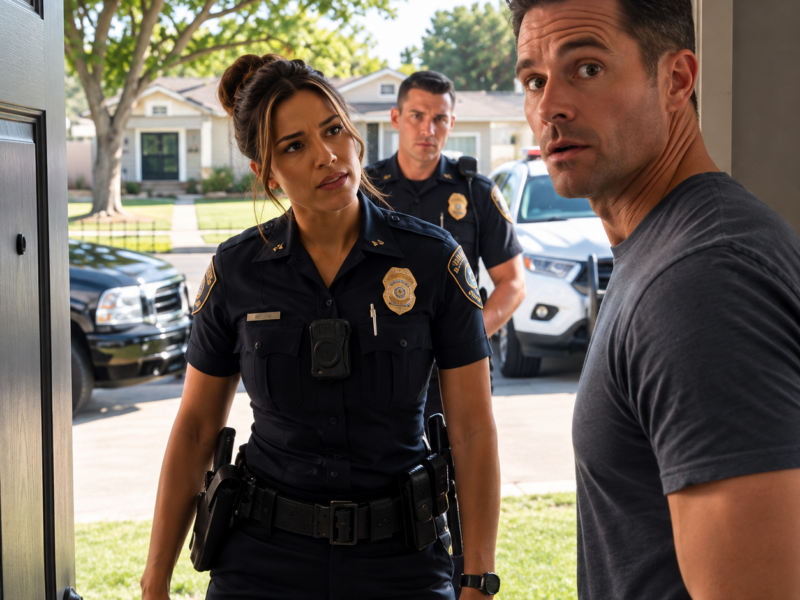
At 11:47 p.m. on a rain-soaked Tuesday, a police officer shoved his flashlight into my face on my own front porch and demanded my ID, while my seven-year-old son watched from behind the door, but the officer had no idea the “suspicious man” he was humiliating was actually a U.S. Attorney investigating a case that would soon reach his own department. I had just carried my son upstairs when someone pounded on the door hard enough to rattle the picture frames. When I opened it, Officer Grant stood beneath the porch light, one hand resting near his holster. “Step outside,” he said. I looked at his badge, then at the cruiser parked across the street. “Can I ask why?” “We received a report about a man matching your description loitering around this house.” I almost laughed, because this was my house. My name was on the deed, my son’s drawings covered the refrigerator, and the mortgage statements sat unopened on the kitchen counter. Instead, I calmly handed him my driver’s license. He studied it longer than necessary, then looked back at me. “You expect me to believe you live here?” Before I could answer, my son appeared behind the glass. “Dad?” The officer glanced toward him, and something in his expression changed. “Get back inside,” I whispered. My son disappeared, but I could hear him crying upstairs. That sound hurt more than the officer’s accusations ever could. Then Grant noticed the folder tucked beneath my arm. “What’s that?” “Work.” He reached for it. I pulled it back. “You don’t have permission to search it.” His jaw tightened. “You lawyers always think rules don’t apply to you.” I stared at him through the rain. “You have no idea who I am.” He smiled coldly. “Then tell me.” I finally opened the folder and removed a federal identification card. His smile vanished. “I’m Daniel Carter,” I said quietly. “United States Attorney.” For several seconds, neither of us spoke. Then his radio crackled. “Unit twelve, stand down immediately.” Grant touched his shoulder mic. “Why?” The dispatcher hesitated. “Because the man at that address is the one from the federal investigation.” Grant slowly looked at me again. I could see fear replacing arrogance in his eyes. But what he didn’t know was that I hadn’t been investigating a stranger. I had been investigating a police officer inside his department. And when I turned the folder around, his own badge number was written across the first page. His face went completely white. Upstairs, my son stopped crying, and from the hallway came a tiny voice. “Dad, are we safe now?” I looked at Grant, then at the evidence in my hand, and realized I still hadn’t told my son the worst part: someone had been watching our house for three weeks.
The porch light buzzed with a low, electrical hum that felt entirely too loud in the stillness of midnight. Outside, the rain came down in relentless, slanted sheets, hammering against the wooden frame of the house and turning the lawn into a swamp of black mud.
I stood in the doorway, feeling the cold draft seep through the fabric of my damp socks and warm flannel shirt. My breath misted slightly in the damp air as I looked down at the soaked welcome mat, trying to steady the frantic beating of my heart.
Just five minutes ago, I had been sitting on the edge of my seven-year-old son’s bed, reading him the final chapter of a story about a brave knight who wasn’t afraid of the dark. Now, the heavy oak door was pulled wide open, exposing us to the cold and the blinding white glare of a police flashlight.
The beam hit my eyes like a physical blow, forcing me to squint and raise a hand to shield my vision. Behind the brilliant light, the outline of a towering man in a dark uniform stood rigid, his shadow stretching long and ominous across my front porch.
His right hand didn’t rest naturally at his side. It hovered just inches above the polished leather of his holster, his fingers twitching with a quiet, practiced tension that sent a wave of cold adrenaline straight to my stomach.
I kept my hands visible, spreading my fingers wide against the cool wooden frame of the door so there would be no mistaking my intentions. In the background, the crimson and blue strobes of a patrol car cast violent, pulsing shadows across the manicured lawns of our quiet suburban cul-de-sac.
“Step out onto the porch,” the officer commanded, his voice dripping with an authority that expected absolute, immediate compliance. “Hands where I can see them.”
I took a slow breath, letting the damp night air fill my lungs, trying to project a calm I didn’t entirely feel. I knew the law better than most men alive, but logic means very little when you are staring down the dark barrel of a high-powered flashlight on your own property.
“Can I ask what this is about, Officer?” I asked, keeping my voice low and steady. “Is there an issue in the neighborhood?”
“We received a call about a suspicious individual,” he growled, stepping closer until I could smell the faint scent of rain and cheap tobacco on his jacket. “A male matching your exact description was reported attempting to breach the premises.”
I couldn’t help the bitter smile that tugged at the corner of my mouth. I looked down at the key ring dangling from my left index finger, then back up at the metallic badge gleaming on his chest.
“I live here,” I said, pointing a finger toward the ground beneath my feet. “This is my home. My name is on the deed, and I was just putting my child to sleep.”
“Everyone’s got a story when the lights come on,” the officer snapped, his voice sharp and unyielding. “I need to see some identification, and I need it right now.”
I reached slowly for my back pocket, making sure every movement was deliberate and exaggerated so there could be no misunderstanding. I pulled out my leather wallet, extracted my state driver’s license, and held it out into the rain.
Officer Grant snatched the card from my fingers, snapping the laminated plastic between his gloved thumb and forefinger with an aggressive, dismissive flick. He brought it close to his eyes, shining his flashlight directly onto the holographic seal, examining it as if it were a poorly crafted counterfeit.
“Daniel Carter,” he read aloud, his tone laced with heavy skepticism. “Address listed matches, but that doesn’t mean a whole lot these days. Anybody can steal a wallet.”
“Check the house,” I replied, maintaining eye contact despite the harsh glare of his light. “Look at the mail on the counter. Look at the framed family photos in the living room.”
“I’m not doing your job for you, Mr. Carter—if that’s even who you really are,” he said, stepping sideways to block my view of the driveway. “You’re acting defensive. That usually means someone’s hiding something.”
“I’m not acting defensive, Officer, I am acting like a father whose quiet evening was interrupted by a battering ram of an entrance,” I said, my patience beginning to fray at the edges.
Before Grant could respond, a soft, high-pitched creak echoed from the dark interior of the hallway behind me. The sound was instantly recognizable to a parent—the footfall of a terrified child stepping onto an old floorboard.
“Dad?”
The voice was tiny, trembling, and thick with sleep and fear. Leo stood near the edge of the stairs, clutching his worn stuffed bear against his chest, his wide eyes reflecting the harsh blue strobes pulsing through the glass panels of the front door.
Grant’s head snapped toward the sound, his stance instantly shifting into a combative posture as his left hand reached instinctively for the heavy flashlight at his belt.
“Sir, tell the individual inside to remain motionless!” Grant barked, taking a aggressive step toward the threshold.
“He’s seven years old!” I yelled, stepping directly into his path and using my body to block the doorway entirely. “Do not speak to my son like that!”
I turned my head slightly, keeping my body locked between the armed officer and my frightened child. Leo was shivering, his small frame shaking under his blue flannel pajamas as he stared at the giant man on our porch.
“Leo, go back upstairs to your bedroom right now,” I said, softening my voice as much as I could while maintaining an absolute tone of command. “Close the door and lock it. Everything is fine.”
“Dad, who is that man?” Leo whimpered, tears spilling over his lower eyelids and trailing down his pale cheeks. “Is he going to hurt you?”
“Nobody is getting hurt, buddy,” I lied, feeling a knot of pure, unadulterated rage twisting deep in my chest. “Go upstairs. Daddy will be right there as soon as we finish talking.”
The boy hesitated for a fraction of a second, his tiny hands tightening on the fabric of his bear, before he turned and scrambled up the carpeted stairs. A moment later, the distant, muffled click of his bedroom door latching echoed down the stairwell.
I turned back to face Officer Grant, my jaw set so hard that my teeth smoked with friction. The lingering sound of my son’s stifled sobs from the second floor burned hotter than any insult the man in front of me could throw.
“You had no right to intimidate a child,” I said, my voice dropping an octave into a cold, lethal register that had silenced rooms full of defense attorneys in federal courtrooms.
“I have every right to secure a scene until I verify who I’m dealing with,” Grant shot back, completely unfazed by my anger. “And right now, you’re a subject of interest in an active call.”
It was then that his eyes drifted lower, dropping from my face down to the thick, weather-resistant leather briefcase I was clutching tightly against my ribs with my left arm. I had brought it from my car less than twenty minutes ago, carrying it like a piece of radioactive material.
“What’s in the bag?” Grant asked, his curiosity instantly spiked as his hand shifted closer to his belt.
“Personal documents,” I replied flatly, tightening my grip on the handle.
“Set the bag down on the porch deck,” he ordered, his eyes narrowing into suspicious slits. “I’m going to inspect the contents to ensure there are no weapons or stolen property.”
“No,” I said, standing my ground. “You don’t have a warrant, you don’t have probable cause, and you certainly don’t have my consent.”
Grant laughed, a short, barking sound devoid of any real humor, as he shook his head in disbelief at my defiance.
“You lawyers always think a few words out of a textbook protect you from the real world,” he sneered, taking another step forward until his chest was nearly touching mine. “Out here on the street, at midnight, I decide what happens.”
“Is that how you operate, Officer Grant?” I asked, taking note of the polished brass nameplate pinned above his left breast pocket. “You decide the law as you go along?”
“I don’t need a lecture from a guy standing in the rain with a briefcase full of God-knows-what,” he spat, reaching out a gloved hand to grab the handle of my case.
I didn’t flinch, nor did I pull away violently. I simply shifted my weight, using my shoulder to block his angle while keeping my fingers locked firmly around the leather.
“Touch this bag again, and you will be committing a federal offense,” I said softly, ensuring every single word carried the distinct, unyielding weight of truth.
Grant paused, his fingers hovering an inch from the dark leather, a momentary flick of uncertainty crossing his features before his expression hardened into pure arrogance once more.
“You’re pushing your luck, pal,” he growled. “I can have you in cuffs and sitting in the back of my cruiser in about ten seconds for obstructing an investigation.”
“You could try,” I replied, stepping back just enough to create space between us. “But before you make a mistake that ends your career, I suggest you take a very close look at what I’m about to show you.”
I reached into the inner breast pocket of my jacket, moving slowly and deliberately so he could watch every millimeter of my movement. I extracted a small, black leather credential wallet, flipped it open, and held it directly under the beam of his flashlight.
The gold-embossed seal of the Department of Justice caught the harsh light, gleaming brilliant and undeniable against the dark background. Next to it, protected behind clear plastic, was my official government identification, bearing my photograph, my title, and the official seal of the United States.
“My name is Daniel Carter,” I said, letting the words fall like heavy stones into the quiet night. “I am the Senior Assistant United States Attorney for the District.”
The silence that followed was absolute, broken only by the steady, rhythmic drumming of the rain hitting the porch roof above us. Grant’s flashlight beam wobbled slightly, dipping an inch as his hand momentarily lost its rigid control.
He stared at the gold badge, then at the photo, and finally raised his eyes back to my face, searching for any sign of a bluff. He found none.
“A… federal prosecutor?” he muttered, his arrogant demeanor instantly faltering as the reality of the situation began to settle into his mind.
“That’s right,” I said, holding the credential steady in front of his face. “So when I tell you that you are attempting an illegal search of official government property without a warrant, I am not giving you an opinion. I am stating a legal fact that will ruin you.”
Grant swallowed hard, his throat moving nervously against the tight collar of his uniform shirt. The aggressive posture he had maintained just moments ago seemed to deflate, his shoulders dropping as he took an involuntary half-step back toward the porch stairs.
Before he could formulate a response, the heavy silence was shattered by the harsh, static-laden chirp of his shoulder microphone. The voice of his precinct dispatcher crackled through the small speaker, sharp and urgent.
“Unit twelve, come in. Officer Grant, acknowledge immediately.”
Grant reached up with a hand that was no longer entirely steady, pressing the button on his shoulder mic while keeping his eyes locked onto mine.
“Unit twelve, go ahead,” he said, his voice lacking the sharp edge it had possessed only moments before.
“Grant, stand down at that location immediately,” the dispatcher ordered, her voice crisp and echoing clearly in the cool night air. “Repeat, do not engage. Discontinue all action at the address.”
Grant frowned, a look of confusion mingling with the growing anxiety on his face as he pressed the button again. “Dispatcher, I am currently on scene with a subject refusing to comply. What is the reason for the stand down?”
There was a brief pause on the line—a heavy, pregnant silence that seemed to stretch out forever while the rain continued to pour around us.
“Because the individual residing at that address is the lead federal prosecutor on Operation Iron Shield,” the dispatcher replied, her tone leaving no room for argument. “And you need to return to the station right now.”
Grant’s hand froze on his shoulder microphone, his knuckles turning white against the plastic housing. The name of the operation seemed to strike him like a physical blow, stripping every last drop of color from his face.
“Operation… Iron Shield?” he whispered, his voice barely audible over the sound of the rain dripping from the eaves.
“Yes, Grant,” I said, lowering my credential wallet and slipping it back into my breast pocket. “You’ve heard of it, haven’t you?”
He didn’t answer. He couldn’t. His eyes were wide, fixed on me as if he were looking at a ghost.
Operation Iron Shield was an ongoing, highly classified federal investigation into systemic corruption, extortion, and evidence tampering within the local police department. It was a massive case that had been quietly building momentum for over eighteen months, shrouded in absolute secrecy to prevent the targets from destroying evidence.
“You thought you were responding to a simple suspicious person call,” I continued, taking a step forward until I was standing at the edge of the porch light. “You thought you were going to intimidate a civilian on his own property.”
Grant took another step back, his foot slipping slightly on the wet wooden deck before he caught his balance against the handrail. “I… I was just following dispatch orders,” he stammered, his confident swagger completely gone. “We got an anonymous call about an intruder.”
“There was no anonymous caller, Grant,” I said quietly, leaning in closer. “We monitored the incoming lines. The call came from an unregistered burner phone located within three blocks of this house.”
He stared at me, his mouth opening slightly as if to offer another excuse, but no sound came out.
“This wasn’t a routine call,” I said, setting my heavy leather briefcase on the small porch table between us and slowly unbuckling the brass latches. “This was a fishing expedition. Someone wanted to see what I had in this bag.”
The metallic click of the latches opening sounded like a gunshot in the quiet night. Grant watched with mounting dread as I flipped the leather top back, exposing neat stacks of color-coded folders and sealed evidentiary bags.
“You see, Grant, when you spend eighteen months investigating a ring of dirty cops, you learn how they operate,” I said softly, reaching into the bag and pulling out a thick, blue folder marked with a bright red CLASSIFIED stamp.
I held the blue folder in my hands, feeling the weight of the paper inside. This wasn’t just a collection of legal briefs; it was a catalog of ruined lives, altered reports, and stolen money.
“You thought this federal investigation was targeting high-ranking officers in the front office, didn’t you?” I asked, looking up from the file to lock eyes with him. “You thought you were safe down here on night patrol.”
Grant’s breathing had become shallow and fast, his chest heaving under his heavy tactical vest. “I don’t know what you’re talking about, Mr. Carter. I just work my shift and go home.”
“Is that so?” I said, opening the folder to reveal the top page.
Printed across the header in bold, black ink was a detailed organization chart of the precinct, complete with red lines connecting key officers to an illegal narcotics redistribution scheme.
And right near the center of that web, circled in thick red marker, was a high-resolution photograph of Officer Grant, accompanied by his full name, badge number, and personal radio call sign.
“Badge number 4108,” I read aloud, my voice clear and precise. “Officer Thomas Grant. Seven years on the force. Assigned to the Third Precinct’s night patrol unit.”
Grant stared down at his own face on the federal document, his entire body trembling violently now. The rain had soaked through his uniform shoulders, but the moisture on his forehead was pure, cold sweat.
“This… this is a mistake,” he whispered, stepping back toward the porch steps as if preparing to run. “Someone set me up. I haven’t done anything illegal.”
“We have three thousand hours of encrypted radio transmissions, Grant,” I said, my tone completely devoid of mercy. “We have the bank records for your offshore account in the Caymans. And we have your signature on twelve altered evidence logs from the warehouse raid last November.”
He closed his eyes tightly, leaning against the wooden porch pillar for support as the crushing weight of reality settled over him. His entire world, his career, his freedom—everything was evaporating right before his eyes on a rain-slicked porch.
“Who sent you here tonight, Thomas?” I asked gently, dropping the formal title. “Who told you I had the final indictment files at my house?”
Grant opened his eyes, looking small, broken, and terrified under the harsh yellow glow of the porch light. The aggressive, arrogant officer who had shoved a flashlight in my face fifteen minutes ago was completely gone, replaced by a desperate man facing a lifetime in federal prison.
“He said… he said you were bringing the final draft home tonight,” Grant stammered, his voice cracking with emotion. “He said if I could get the bag, or just see what was inside, he could make the case go away.”
“Who is ‘he’?” I demanded, taking a final step toward him. “Give me the name, Thomas. Give it to me right now, and maybe—just maybe—I mention to the judge that you cooperated on scene.”
Grant looked toward his patrol car, where the radio was still crackling with frantic calls from his precinct commander demanding his immediate return to base.
“Captain Vance,” Grant gasped out, the words bursting from his lips as if he could no longer hold them back. “It was Vance. He called my personal cell twenty minutes ago. He said you had the master list.”
I nodded slowly, feeling a cold sense of satisfaction. Vance was the missing link, the final high-ranking officer we needed to seal the conspiracy charges against the entire precinct leadership.
“Thank you, Officer Grant,” I said, closing the blue folder and sliding it carefully back into my briefcase. “Now, I suggest you get into your car, drive back to your station, and wait for my team to arrive with the arrest warrants.”
Grant didn’t say another word. He turned, stumbled down the slippery wooden steps, and hurried across the soaked lawn toward his idling cruiser.
I watched as he climbed into the driver’s seat, pulled the door shut, and turned off the flashing red and blue strobes. A moment later, the car accelerated down the dark street, its tires throwing up sprays of water before disappearing around the corner.
The quiet returned to the porch, heavy and absolute, punctuated only by the steady dripping of rain from the roof. I stood there for a long moment, leaning against the doorframe, letting the cold air clear the residual adrenaline from my veins.
I picked up my briefcase, stepped back inside the house, and locked the heavy oak door behind me, sliding every deadbolt into place.
The warm air of the hallway felt incredible against my chilled skin. I kicked off my wet shoes, set the briefcase down on the entry table, and ran a hand through my damp hair, taking a long, shaking breath.
The house was quiet now, but the lingering tension hung in the air like smoke. I walked slowly toward the stairs, my hand sliding along the dark wood of the banister as I made my way up to the second floor.
The corridor upstairs was dim, illuminated only by the faint nightlight shaped like a star that plugged into the wall near the bathroom. I walked down the runner rug, stopping outside the small door at the very end of the hall.
I turned the brass knob silently and pushed the door open an inch, peering into the shadows of Leo’s room.
He wasn’t in bed. He was sitting in the middle of the rug, his small knees pulled up against his chest, clutching his stuffed bear so tightly that his knuckles were white.
“Leo?” I whispered gently, stepping inside and pulling the door shut behind me.
He looked up instantly, his red-rimmed eyes catching the light from the hallway star. “Dad?”
I crossed the room, dropped down to my knees on the soft carpet, and pulled him into a tight, warm hug. He wrapped his small arms around my neck, burying his face into the fabric of my flannel shirt, his body still trembling slightly.
“It’s over, buddy,” I murmured, rubbing his back in slow, steady circles. “The policeman was just confused. Everything is okay now. You’re completely safe.”
“I was scared,” he whispered into my shoulder, his small voice muffled by the fabric. “He was yelling at you. I thought he was going to take you away.”
“Nobody is taking me anywhere,” I said firmly, pulling back just enough to look him in the eyes. “I promise you, Leo. Your dad is right here, and I’m not going anywhere.”
He sniffled, wiping his nose with the sleeve of his pajamas, looking at me with that absolute, uncritical trust that only a child can give to a parent.
“Are you sure?” he asked softly. “Because I saw a car outside earlier today, too. Before you came home.”
My entire body went rigid, every muscle locking up as his words echoed in the small bedroom. I carefully kept my face completely neutral, forcing a gentle smile so I wouldn’t terrify him further.
“What do you mean, buddy?” I asked, keeping my voice light and calm. “What kind of car?”
“A big black one,” Leo said, looking down at his stuffed bear. “It was parked across the street near the big oak tree. It was there when I got off the school bus, and it stayed there all afternoon.”
A cold spike of dread shot straight through my heart, far colder than the rain that had been beating down on my porch moments ago.
“Did you see who was inside it?” I asked quietly.
“No,” Leo shook his head. “The windows were really dark. But I saw a tiny red light shining from the dashboard, like a camera.”
I swallowed hard, keeping my hand steady as I stroked his hair. I had thought Grant’s appearance tonight was an isolated, desperate attempt by a corrupt precinct captain to destroy evidence before an indictment was handed down.
I had assumed we were in control of the timeline. I had assumed that my home was a safe sanctuary, far removed from the legal war I was waging downtown.
“Dad?” Leo asked, noticing the brief pause in my breath. “Did I do something wrong?”
“No, sweetie,” I said, kissing the top of his head. “You did amazing. You are the bravest boy I know.”
I helped him get back into bed, tucking the heavy comforter around his shoulders and placing his stuffed bear right next to his arm. I waited by his side, humming a soft tune until his breathing slowed, his eyelids grew heavy, and he finally drifted off into a deep, exhausted sleep.
I stood up silently, stepped out of his room, and closed the door until only a crack of light remained.
I stood in the dark hallway, looking down at my phone in the palm of my hand. My mind was racing, connecting pieces of a puzzle that had suddenly become far larger and far more dangerous than I had ever anticipated.
I walked down the stairs, every step feeling heavier than the last. I walked past the entry table where my leather briefcase sat, untouched and locked.
I walked into the kitchen, keeping the lights completely off. I moved silently across the linoleum floor until I was standing beside the large bay window that looked out over the front yard and the dark street beyond.
I parted the heavy linen curtains by a single inch, peering through the glass into the pouring rain.
The street was empty now. Officer Grant’s patrol car was long gone, and the quiet suburban neighborhood appeared utterly deserted under the dim glow of the streetlights.
But then I saw it.
Parked beneath the sprawling branches of the massive oak tree across the street—exactly where Leo had said it was—was the dark, unlit silhouette of an unmarked SUV.
Through the rain-streaked glass, I could barely make out the tiny, steady blink of a red recording light mounted on the dashboard.
It wasn’t just Officer Grant. It wasn’t just Captain Vance trying to pull a quick job on a Tuesday night to save his own skin.
They hadn’t just shown up tonight out of nowhere. They had been watching my house, tracking my movements, monitoring my son, and recording our every entry and exit for weeks.
They knew my schedule. They knew when I was alone. They knew my weaknesses.
I let the curtain fall back into place, sealing the room in total darkness once again.
I leaned back against the kitchen counter, my heart pounding a steady, rhythmic cadence against my ribs. I reached into my pocket, pulled out my phone, and dialed a secure, encrypted number I knew by heart.
The line rang twice before a deep, authoritative voice answered on the third ring.
“Director Miller,” I said, my voice steady, cold, and razor-sharp in the dark kitchen. “Execute the federal arrest warrants for the entire Third Precinct immediately.”
“Daniel?” Miller asked, sounding surprised. “We were scheduled to execute at dawn. What happened?”
“They know,” I replied, looking toward the hallway where my son was sleeping upstairs. “And bring a tactical team to my home right now. We have uninvited guests across the street.”









