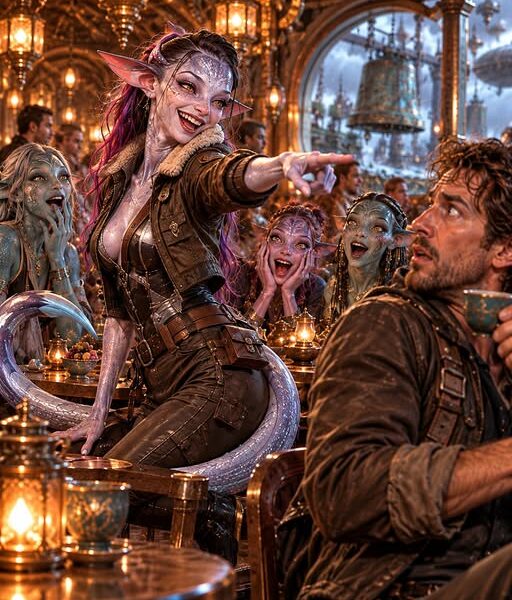
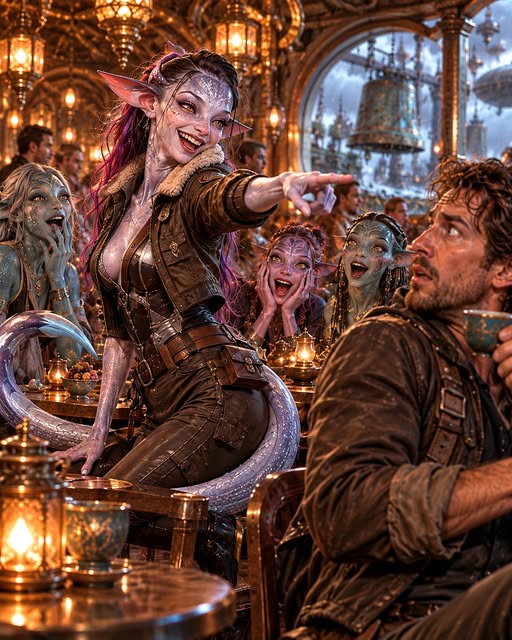
A woman I barely knew pointed at me in a crowded tea house and announced, “This is my husband.” Then she smiled like she’d just shared the happiest news in the galaxy.
The object in my coat was a small brass bell.
Not a Cathari storm bell. Those were made of blue metal, shaped by generations of tradition, and treated with a reverence I was only beginning to understand.
This one was human.
It had belonged to my father.
He’d carried it on his fishing boat for nearly thirty years, claiming it was lucky. It was an ugly little thing, scratched and dented, with a crack running down one side. When I was twelve, I’d asked him why he never replaced it.
He’d laughed.
“Because, Danny, a thing doesn’t have to be perfect to be worth keeping. Sometimes the cracks are where the memories live.”
After he died, I kept it in a drawer. I’d brought it to Kathar without really knowing why.
Now I held it in my palm as the entire temple watched.
Vesra’s golden eyes widened.
“What is that?” she whispered.
“A storm bell,” I said. “Not by your standards, obviously. It can’t warn anyone about anything. It barely makes a sound.”
A few people chuckled nervously.
“But it belonged to my father. He taught me that protecting something doesn’t mean owning it. It means being willing to stand beside it when things get difficult.”
I turned toward Matriarch Asha.
“I was told that a man who repairs a woman’s family bell and drinks her salt tea becomes bound to her. I didn’t understand that when it happened. I know that now.”
I looked back at Vesra.
“And I know that I don’t want to break that bond.”
The temple became completely silent.
“But I also don’t want her to be bound to me because of a misunderstanding. I want her to choose me, knowing exactly who I am. A human engineer who can’t fly a barge, can’t sing in tune, and has absolutely no idea how to operate half the machinery on this planet.”
This time, the laughter was warmer.
I took a breath.
“So I’m not asking the elders to recognize a promise I accidentally made. I’m asking Vesra whether she’d like to make a new one with me.”
I held out the little brass bell.
“Not because I saved her family’s storm bell. Not because I survived a storm. And not because tradition says we belong together.”
My voice faltered.
“Because somewhere between her terrible singing and the endless cups of salt tea, I fell in love with her.”
Vesra stared at me.
For a moment, I thought I’d made everything worse.
Then she walked forward.
“You brought a broken bell to a temple ceremony?” she asked.
“Yes.”
“Humans are strange.”
“I’ve been told.”
She took the bell from my hand, examined its crack, and shook it gently.
A tiny, imperfect sound emerged.
Then she looked at me.
“You should know something, Daniel Mercer.”
“What’s that?”
“I didn’t accept your promise because I thought you were brave.”
Her voice trembled.
“I accepted it because I thought you understood what it meant to stay.”
She stepped closer.
“My parents died in the storm that destroyed the eastern settlements. They were pilots. They knew the risks. But when they didn’t return, everyone told me their deaths were noble. Everyone said I should be proud.”
She swallowed.
“I was tired of being proud. I wanted someone who would come home. Someone who would sit with me after the storms, even when there was nothing heroic left to do.”
She placed one hand against my chest.
“And then you climbed onto my roof in a storm, repaired my bell, and drank my tea. I thought the universe had finally sent me someone who understood.”
“I didn’t understand,” I said quietly. “Not then.”
“I know.”
She smiled sadly.
“But you came back every day afterward. You asked questions. You listened. You stood at the harbor gate when you could have hidden in a shelter.”
Her fingers closed around mine.
“Perhaps understanding is something people build together.”
I felt something loosen in my chest.
“Does that mean…?”
“It means you are still a terrible singer.”
“I know.”
“And your dancing is worse.”
“I haven’t danced yet.”
“Exactly.”
The temple erupted in laughter.
Then Vesra turned toward the matriarch.
“I withdraw my request to end the bond.”
Asha raised one silver eyebrow.
“On what grounds?”
“Because I wish to keep it. But I want the old promise to become a new one.”
The matriarch considered us for a long moment.
Then she nodded.
“Then let the witnesses hear this. A bond begun through ignorance may be questioned. A bond continued through understanding must be chosen.”
She gestured toward the ceremonial bowl.
“Daniel Mercer, do you freely choose Vesra Talin?”
I looked at Vesra.
“I do.”
“Vesra Talin, do you freely choose Daniel Mercer?”
She smiled.
“I do. Even though he drinks salt tea like a dying machine.”
The witnesses laughed again.
Asha lifted the bowl, but instead of asking us to pour salt into the sea, she handed it to Vesra.
“Then let the promise be renewed.”
Vesra dipped two fingers into the salt and touched them to my forehead.
I did the same to hers.
There was no grand explosion of light, no mysterious energy connecting our souls, and no sudden transformation.
Just two people standing in an ancient temple, choosing each other.
Somehow, that felt more extraordinary.
The following morning, I woke to someone pounding on my boarding-house door.
It was Tovak.
He stood outside with his arms crossed, his expression unusually serious.
“Engineer,” he said.
“Pilot.”
“You are coming with me.”
“Where?”
“The south gate.”
I sighed.
“Is it broken again?”
“No. But something is wrong.”
That got my attention.
I followed him to the harbor.
The storm had passed, leaving Sorrows Reach covered in debris. Fishing boats were being repaired, damaged rooftops were being rebuilt, and the harbor crews were still clearing broken equipment from the seawall.
But Tovak wasn’t interested in any of that.
He led me to a section of the storm gate I’d never inspected.
Behind the main hydraulic assembly was a secondary control chamber. Its door had been welded shut.
“What’s inside?” I asked.
“An old emergency system,” he replied. “The elders sealed it twenty years ago.”
“Why?”
Tovak glanced toward the water.
“Because the last time someone used it, three harbor workers died.”
I examined the welds.
They were old, but the metal around them was newer than the rest of the structure.
Someone had deliberately sealed the chamber.
“Who ordered this?”
“The previous harbor master.”
“Is he still alive?”
“No.”
Tovak hesitated.
“But his son is.”
That afternoon, I brought Vesra to the chamber.
She examined the door and frowned.
“Why are you looking at me like that?”
“Because I suspect your family knows something about this.”
Her expression changed.
“My parents worked on the storm gates before they died.”
“Did they ever mention a secondary system?”
She shook her head.
Then she noticed something carved into the metal beside the door.
Three small lines.
A symbol.
Her breath caught.
“My father’s mark.”
We spent the next two hours examining the chamber.
Inside, beneath layers of dust and corrosion, we discovered a set of engineering plans. They showed a secondary flood-control system designed to redirect incoming waves through an abandoned channel on the eastern side of the harbor.
It was brilliant.
It was also dangerous.
If activated incorrectly, it would send a wall of water directly into the lower residential district.
But the plans contained something else.
A handwritten warning from Vesra’s father.
The primary gate is being deliberately weakened. If the eastern bypass remains sealed, the harbor will eventually fail during a major storm.
I read it twice.
Then a third time.
Someone had known the gate was unsafe.
Someone had hidden the evidence.
Vesra looked at the paper.
“My parents knew?”
“I think they discovered it.”
“Then why didn’t they tell anyone?”
Before I could answer, Tovak appeared at the entrance.
His face was pale.
“Because someone made sure they never came back.”
Silence filled the chamber.
He explained that twenty years earlier, a powerful shipping consortium had gained control over much of the harbor’s infrastructure. The consortium wanted to expand the commercial docks and had pushed for a cheaper storm-gate design.
Vesra’s parents had discovered that the design was defective.
They planned to expose it.
But before they could present their findings, they were sent on an emergency rescue mission during a cyclone.
Their barge never returned.
The official report called it an unfortunate accident.
Tovak had been a young pilot at the time. He’d heard rumors, but no one had been willing to investigate.
“And the consortium?” I asked.
“Still controls the harbor contracts,” he said. “Its current director is Marrek Voss.”
The name meant nothing to me.
Apparently, it meant a great deal to Vesra.
“He offered to marry me three years ago,” she said.
I turned toward her.
“He what?”
“Not personally. His family approached my grandmother. He wanted to unite our families and gain access to our ancestral harbor routes.”
“Did you agree?”
She gave me a look.
“Daniel, have you met me?”
Fair enough.
But the timing was too convenient.
Someone had buried the evidence of a dangerous gate system. Someone had sent two pilots to their deaths. And now their daughter was bound to a foreign engineer who had just repaired the very gate that might expose the truth.
We had barely left the chamber when a group of harbor security officers arrived.
Their commander carried an official order.
By authority of the harbor council, all recovered documents were to be surrendered immediately.
I refused.
The commander stepped closer.
“You are a foreign contractor. You have no authority to interfere in Cathari affairs.”
“I’m a structural engineer. I have authority to tell you when a structure is unsafe.”
“You are being ordered to leave.”
Vesra stepped between us.
“He is my bonded partner.”
The commander’s expression hardened.
“Then perhaps you should teach your partner when to stop asking questions.”
That evening, someone broke into my room.
They took my engineering notes, my tools, and the original plans.
But they left one thing behind.
My father’s brass bell.
It was sitting in the center of my desk.
Beside it was a small piece of paper.
Go home, human. Some storms are not yours to survive.
I read it twice.
Then I laughed.
Not because it was funny.
Because I was finally beginning to understand the sort of people we were dealing with.
They had mistaken my attachment to Vesra for weakness.
They thought I would run because I had no family on Kathar, no political influence, and no reason to risk my life for a planet that wasn’t mine.
They didn’t understand something.
I had spent my entire career designing structures that people would never notice unless they failed.
I knew what happened when someone ignored a warning simply because fixing the problem was inconvenient.
And I wasn’t going to let that happen again.
The next morning, I went to the harbor council.
I requested an emergency structural inspection.
Marrek Voss arrived halfway through the meeting.
He was impeccably dressed, with dark scales polished to a mirror shine and a smile that never reached his eyes.
He listened to my findings without interrupting.
Then he folded his hands.
“You are making serious accusations based on incomplete documents.”
“Then let us inspect the eastern bypass.”
“Impossible. The system is unsafe.”
“That’s exactly why it needs inspection.”
He smiled.
“Your bond with Vesra has made you emotional. I suggest you return to your seawall project and leave harbor governance to those who understand it.”
I looked around the chamber.
Nobody spoke.
Then an elderly council member stood.
Her name was Asha Talin.
“I move that an independent inspection be conducted.”
Voss’s smile vanished.
“You cannot be serious.”
“I am entirely serious.”
Several other council members supported her.
The vote was scheduled for the following morning.
That night, Vesra and I sat on the roof beside her storm bell.
She rested her head against my shoulder.
“I am afraid,” she admitted.
“Me too.”
“I thought finding the truth about my parents would make me feel better.”
“Did it?”
“No. It made me angry.”
I nodded.
“That’s understandable.”
She turned toward me.
“Daniel, if this becomes dangerous, I don’t want you to sacrifice yourself for my family.”
I took her hand.
“I’m not trying to become a hero.”
“Then what are you trying to become?”
I thought about my father.
About the brass bell.
About the seawall I had come to Kathar to build.
And about the woman sitting beside me.
“Someone who doesn’t walk away when something important is broken.”
She kissed me.
For a while, the harbor seemed peaceful.
Then the storm bell rang.
Once.
Twice.
A third time.
Vesra stood immediately.
“That isn’t a warning bell.”
“What is it?”
She stared toward the eastern horizon.
“That’s the signal for a pressure surge.”
A moment later, the harbor lights turned red.
The storm gate had failed.
Not the south gate we’d repaired.
The eastern bypass.
Water was pouring into the abandoned channel, and the pressure sensors were showing catastrophic readings.
The lower residential district was directly in its path.
We ran.
By the time we reached the harbor, crews were already evacuating families from the lower streets.
The eastern bypass gates had opened without authorization.
Someone had activated the system.
The water was building behind the old barrier.
If it broke, thousands of tons of seawater would rush into the district.
I examined the pressure display.
There was only one way to stop it.
The bypass needed to be redirected through the northern spill channel, but the manual controls were inside a chamber already filling with water.
Vesra looked at me.
“Don’t even think about it.”
“I haven’t said anything.”
“You have that expression.”
“What expression?”
“The one you had before climbing onto my roof.”
I almost smiled.
Then I handed her the brass bell.
“Keep this safe.”
She grabbed my arm.
“Daniel.”
I leaned forward and pressed my forehead against hers.
“I love you.”
“Then come back.”
“I intend to.”
I climbed into the control chamber with two harbor workers.
The water was already up to our knees.
The main control wheel had jammed.
I inspected the mechanism and realized the problem.
The pressure system was designed to release automatically, but the locking pin had been replaced with a reinforced steel rod.
Someone had deliberately prevented the emergency release.
I took out my cutting tool.
The first attempt failed.
The second nearly broke my wrist when the mechanism shifted.
Above me, the water level continued to rise.
One of the workers shouted that the chamber was beginning to collapse.
I looked at the control wheel.
Then at the steel support beam beside it.
The entire mechanism was under tension.
If I cut the rod without relieving the pressure, the wheel would spin violently and destroy the surrounding assembly.
I needed another support.
I took the spare hydraulic brace from my kit and wedged it between the frame and the floor.
It wasn’t designed for this.
Neither was I.
But it held.
“Now!” I shouted.
The workers pulled the wheel while I cut through the locking rod.
For several seconds, nothing happened.
Then the mechanism released.
A deafening metallic roar shook the chamber.
The northern spill channel opened.
The water changed direction.
Instead of rushing toward the residential district, it surged into the empty flood basin beyond the seawall.
We had done it.
But the chamber was collapsing.
One of the workers was pinned beneath a fallen support.
I tried to lift it, but the water was rising too quickly.
The other worker grabbed my shoulder.
“We have to go!”
“Not without him!”
I braced my feet against the floor and pushed.
The beam shifted an inch.
Then another.
The trapped worker pulled himself free.
We scrambled toward the exit.
A massive section of the ceiling crashed down behind us.
I felt something strike my back.
Then everything went dark.
When I woke, I was lying on the harbor platform.
Vesra was holding my hand.
Her face was streaked with tears.
“You idiot,” she whispered.
“Good morning to you too.”
She laughed, then immediately started crying harder.
I tried to sit up.
Pain shot through my ribs.
“Don’t move,” she ordered.
“Did it work?”
She nodded.
“The district is safe.”
“And the workers?”
“Both survived.”
I closed my eyes.
“Good.”
She leaned down and pressed her forehead against mine.
“I thought I had lost you.”
I wanted to tell her I was fine.
But I wasn’t.
And for the first time since arriving on Kathar, I understood that bravery didn’t mean being unafraid of dying.
It meant understanding what you stood to lose and choosing carefully anyway.
The investigation began the following morning.
This time, there was too much evidence to bury.
The emergency chamber’s control logs showed that the bypass had been activated using a council authorization code assigned to Marrek Voss.
The reinforced locking rod carried markings from his private engineering contractor.
And the recovered plans proved that the harbor’s original safety system had been deliberately disabled years earlier.
Voss was arrested before sunset.
He denied everything.
But the evidence was overwhelming.
During the trial, Tovak testified about the rumors surrounding Vesra’s parents. The two surviving harbor workers described the sabotage. And Asha presented the original documents recovered from the sealed chamber.
The court eventually found Voss guilty of conspiracy, infrastructure sabotage, and causing the deaths of Vesra’s parents.
The harbor consortium was dissolved.
Its assets were used to repair the storm gates, compensate the families affected by the negligence, and rebuild the eastern residential district.
But the most important discovery came several weeks later.
A group of independent engineers examined the old bypass system and found that Vesra’s parents had designed a safer version of it before their deaths.
Their original design was still sound.
The only reason it had been abandoned was greed.
The council restored their names to the harbor memorial.
At the ceremony, Vesra stood before the stone monument and placed her father’s old pilot badge beside her mother’s.
For a long time, she said nothing.
Then she turned toward me.
“I used to think that if I ever discovered the truth, the pain would disappear.”
I took her hand.
“Has it?”
“No.”
She looked at the memorial.
“But now the pain belongs to the truth. Not to a lie.”
She leaned against me.
“And that makes it easier to carry.”
My assignment on Kathar was supposed to last six months.
By the time the new harbor system was completed, I’d been there for almost a year.
The seawall project was finished. The storm gates were rebuilt, and the eastern bypass became the safest flood-control system in the region.
The council offered me a permanent engineering position.
I accepted.
Not because I had forgotten Earth.
Not because I no longer missed Pittsburgh.
But because I’d discovered that home wasn’t always the place where you were born.
Sometimes it was the place where someone waited for you to return.
Vesra and I held our formal wedding beneath her family’s storm bell.
The ceremony was small.
There were no elaborate speeches, no political guests, and no grand displays of wealth.
Just our friends, her grandmother, Tovak, and the harbor workers who had helped us survive the storm.
I wore a human suit that was slightly too tight.
Vesra wore a silver-blue ceremonial dress that shimmered like sunlight beneath the waves.
When the officiant asked whether I would stand beside her through calm seasons and storms, I answered before he had finished the question.
“Yes.”
Vesra smiled.
Then she leaned close enough that only I could hear her.
“You know you still have to learn the songs.”
“I was hoping marriage would exempt me.”
“It does not.”
“That’s unfortunate.”
She kissed me before I could say anything else.
Years passed.
We built a house overlooking Sorrows Reach, close enough to hear the storm bells whenever the weather changed.
Vesra continued flying rescue missions, though she eventually became a flight instructor. Tovak became harbor master, a position he claimed he never wanted and complained about every single day.
I became the chief structural engineer responsible for maintaining the entire coastal defense network.
We had arguments, of course.
Some were about work. Others were about my habit of leaving tools everywhere or her habit of singing while I was trying to concentrate.
She never improved as a singer.
I never learned to dance.
But we became very good at coming back to each other.
One evening, many years after that first storm, I found Vesra sitting beside the old family bell.
She was holding my father’s brass bell.
Its crack had widened over time, and its little handle was worn smooth.
“Do you remember the first time I called you my husband?” she asked.
I laughed.
“Unfortunately, the entire tea house remembers.”
She smiled.
“I was so certain.”
“About what?”
“That you were the person I’d been waiting for.”
I sat beside her.
“And I was so certain we were just friends.”
She rested her head against my shoulder.
“Were we?”
I looked out over the harbor.
The seawall stood firm beneath the evening tide. Lights glimmered across the water, and hundreds of storm bells hung from rooftops throughout the city.
“I think we were becoming something before either of us knew what to call it.”
She lifted the brass bell and shook it.
The familiar, imperfect sound floated into the evening.
Then she placed it in my hand.
“Your father was right,” she said.
“About what?”
“Things don’t have to be perfect to be worth keeping.”
I smiled.
“No. They don’t.”
She curled her tail around mine.
“And promises?”
I looked at her.
“Promises are different.”
“How?”
“Bells can be repaired by one person with the right tools. Promises need two people who are willing to keep showing up.”
For a while, neither of us spoke.
Then Vesra began singing.
It was the same terrible sea shanty she’d sung on her roof all those years ago.
Off-key, overly dramatic, and completely without rhythm.
I joined in.
I was somehow worse.
She laughed so hard that she nearly dropped the bell.
And as the last light disappeared beyond the seawall, I understood something I’d spent most of my life overlooking.
Love wasn’t the dramatic rescue, the dangerous sacrifice, or the moment when two people declared themselves bound together.
Those moments mattered.
But they weren’t what made a relationship last.
It was the quiet work afterward.
The willingness to listen when you didn’t understand.
The courage to admit when you were wrong.
The patience to rebuild what had been damaged.
And, most importantly, the freedom to choose each other again, even after the excitement of the first promise had faded.
I had come to Kathar to build a wall against the sea.
Instead, I had found a reason to stay.
And every time the storm bells rang, I remembered the day a strange woman pointed at me in a crowded tea house and announced that I was her husband.
She had been wrong about one thing.
I wasn’t her husband yet.
But she had been right about something much more important.
We were going to find our way home together.