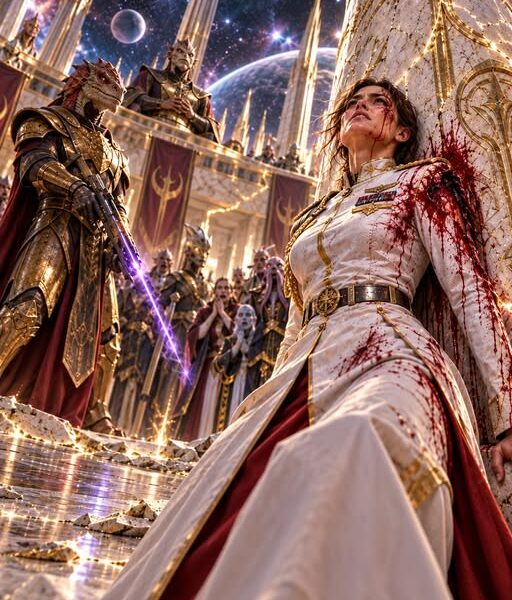
A single shot shattered 900 years of peace. But the most dangerous part wasn’t that someone had tried to kill the human commander. It was that the shot had been fired at exactly the moment someone needed her blood to fall on an ancient stone.
The first warning came from Kelvar.
“Drathi vessels have entered the outer defense perimeter. Estimated time to planetary contact: forty-seven minutes.”
Commander Alina Vasquez listened without moving.
On the tactical display before her, 212 red symbols advanced toward the blue-green world of Kelvar. Between them and the planet stood 38 Terran warships.
Thirty-eight against 212.
It was not a battle anyone would choose.
But Alina had never believed that the purpose of a military fleet was simply to win battles. Sometimes, its purpose was to make sure that innocent people never had to fight one.
“Commander,” Admiral Marcus Hale said through the communication channel, “we need to discuss our position.”
Alina looked at his image.
“Go ahead.”
“Our weapons can destroy perhaps forty Drathi ships before they overwhelm us. If they concentrate their fire, we won’t last twenty minutes.”
“I know.”
“Then we should consider withdrawing to a safer position. We can regroup with reinforcements.”
Alina glanced at the planet behind the Drathi fleet.
Kelvar had no orbital defense network. Its cities were peaceful, its agricultural stations spread across three continents, and its people had never built weapons capable of challenging an interstellar military.
If the Terran ships withdrew, the Drathi would have nothing standing between them and the planet.
“How many people live on Kelvar?” she asked.
“Approximately six billion.”
“And how many of them have ever seen a warship?”
Hale hesitated.
“Most of them have never seen one.”
“Then let’s make sure the first time they see one, it’s protecting them.”
She ended the call.
At the Spire of Accord, the situation was deteriorating just as quickly.
The remaining eight civilizations had gathered in the Grand Chamber. Some delegates were frightened. Others were furious. A few had already begun negotiating with Casorth.
The Drathi envoy stood beneath the enormous ceiling, his golden ceremonial armor reflecting the chamber lights.
“The former Pact has ended,” he announced. “The Drathi Hegemony offers stability, protection, and a new arrangement for all civilized worlds.”
A delegate from the aquatic civilization of Veyr raised a trembling hand.
“And what happens to those who refuse?”
Casorth smiled.
“They will be responsible for their own security.”
“And if the Hegemony attacks them?”
“Then they will have chosen a dangerous path.”
The answer silenced the room.
Casorth continued.
“The Drathi are not interested in unnecessary bloodshed. We simply recognize that the old system has failed. The weak cannot expect the strong to remain restrained forever.”
A low murmur spread among the delegates.
Then the chamber doors opened.
Tenoru entered.
The elderly archivist looked almost insignificant beside the armored Drathi guards. His robes were worn, his walking staff was made of dark wood, and his thin hands trembled slightly.
But he carried something that made Casorth’s expression change.
A small black crystal.
“Before you sign anything,” Tenoru said, “there is a matter of historical importance that must be addressed.”
Casorth’s smile returned.
“Archivist, this is a military and diplomatic emergency. Your records can wait.”
“Unfortunately, history has already waited nine hundred years.”
Tenoru walked toward the center of the chamber.
He placed the crystal on the council platform.
“I have recovered the original recording of the ceremony.”
Casorth’s eyes narrowed.
“What does that have to do with anything?”
“Everything.”
Tenoru activated the crystal.
The image of the ceremony appeared above the platform. Delegates watched as Commander Vasquez approached the Lumen Stone.
The Drathi guard raised his rifle.
Then, just before the shot, a faint voice echoed through the chamber.
“Now.”
The recording stopped.
Nobody spoke.
Tenoru turned toward Casorth.
“That was your voice.”
For the first time since the shooting, the Drathi envoy looked genuinely angry.
“This recording is fabricated.”
“It is an original Spire crystal,” Tenoru replied. “Its frequency signature predates your civilization’s current government.”
“You expect us to believe that a single word proves anything?”
“No,” Tenoru said quietly. “I expect you to explain why you gave an execution order to your own honor guard during a diplomatic ceremony.”
The Veyr delegate slowly rose from his seat.
“Casorth, did you order the attack?”
The Drathi envoy said nothing.
Tenoru continued.
“There is something else you should know. The ancient pact contained a provision that was activated by deliberate betrayal. It was called the Breaker’s Burden.”
A second projection appeared.
The original treaty, written in the languages of nine civilizations, illuminated the chamber.
“According to this provision, if a signatory deliberately destroys the agreement for its own advantage, it becomes the Breaker. The remaining signatories are bound together for one year against that civilization.”
A delegate from the crystalline world of Orath leaned forward.
“But the pact was dissolved when the human blood touched the stone.”
“Yes,” Tenoru answered. “The general protections were dissolved. But the provision governing deliberate destruction was designed precisely for this situation.”
He paused.
“And the authority to invoke it belongs to the individual whose blood was spilled.”
Every eye turned toward the empty chair reserved for humanity.
Casorth laughed.
A cold, unpleasant sound.
“You are telling me that a wounded human commander can command nine civilizations?”
“No,” Tenoru replied. “I am telling you that she can ask them to honor a promise their ancestors made.”
“That is ridiculous.”
“Perhaps. But the ancient words are very clear.”
Casorth stepped toward the projection.
“Even if this absurd interpretation were accepted, the human commander is currently recovering from an assassination attempt. She cannot possibly appear before this council.”
A new voice came from the chamber entrance.
“That’s an interesting assumption.”
The delegates turned.
Commander Alina Vasquez stood in the doorway.
Her left arm was secured in a medical brace. Her uniform had been replaced with a dark Terran field jacket, and her face was pale from blood loss.
Two human security officers followed her.
Casorth stared at her.
“You should be in a medical facility.”
“I was,” Alina replied. “The doctors were wonderful. Unfortunately, they couldn’t convince me to stay.”
She walked toward the center of the chamber.
Tenoru bowed his head.
“Commander.”
“Archivist.”
Alina looked at the delegates.
“I understand that you have all been offered protection by the Drathi Hegemony.”
Nobody answered.
“I also understand why some of you are considering it. You have lived in peace for nine hundred years. Your children have never known what it means to hear an enemy fleet approaching. You don’t want to lose that.”
She glanced at Casorth.
“Neither do I.”
The Drathi envoy folded his arms.
“Then perhaps you should accept our offer.”
Alina shook her head.
“There’s a difference between peace and obedience, Casorth. You seem to have forgotten it.”
She turned back to the delegates.
“I am not asking you to fight for humanity. I’m not asking you to surrender your fleets to us, or to place your governments under Terran command. I’m asking you to stand together long enough to prevent one civilization from enslaving the others.”
She placed her uninjured hand on the ancient treaty projection.
“My blood opened this case. But your choices will determine how it ends.”
The Veyr delegate exchanged a glance with the representatives of Orath and Kelvar.
Then he asked the question everyone was thinking.
“What if we refuse?”
Alina did not threaten him.
She simply answered.
“Then we will defend Kelvar alone. We will fight as long as we can. And whatever happens afterward, humanity will remember that you were given a choice.”
That answer seemed to unsettle the delegates more than any threat could have.
Because Alina was not demanding their loyalty.
She was offering them the freedom to refuse.
Casorth noticed the change in the room.
His hand moved toward the control device attached to his wrist.
“Enough.”
A sharp pulse of energy erupted from the platform.
The projection shattered.
At the same instant, every communication screen in the chamber went dark.
The Drathi guards drew their weapons.
“Seize the human commander!” Casorth shouted.
But he had made one critical mistake.
He had assumed that humanity had brought only diplomats to the Spire.
The two security officers behind Alina moved instantly. One pulled her behind the stone platform while the other fired an electromagnetic disruption round into the nearest guard’s weapon.
The rifle exploded in a shower of sparks.
Delegates screamed and scattered.
Tenoru fell behind the council table, clutching the black crystal.
Casorth ran toward the eastern exit.
“Stop him!” Alina shouted.
But before anyone could move, a deep mechanical sound shook the chamber.
A section of the ceiling opened.
Three small objects descended through the darkness.
Human security drones.
Their lights swept across the room and locked onto Casorth.
“Envoy Casorth,” a metallic voice announced. “You are being detained for attempted murder, conspiracy, and violation of interstellar diplomatic law.”
Casorth froze.
“You have no authority here!”
Alina stepped out from behind the platform.
“Neither do you.”
The drones moved forward.
Casorth raised his wrist.
A hidden signal flashed across the room.
Tenoru’s face went white.
“Commander! The signal! He’s transmitting to the Drathi fleet!”
Alina turned toward the nearest surviving communications panel.
“What’s he sending?”
Tenoru examined the readings.
“An emergency authorization code.”
“For what?”
The archivist looked up.
“An attack.”
FORTY MINUTES EARLIER – KELVAR ORBIT
The first Drathi warship fired without warning.
A beam of violet energy crossed the darkness and struck the Terran destroyer Resolute along its starboard shield.
The ship shuddered.
“Shields down to sixty-three percent!”
“Return fire?” the tactical officer asked.
Admiral Hale stared at the enemy formation.
“Negative. Maintain defensive posture.”
“Sir, they’re firing at us!”
“I can see that.”
A second beam struck the cruiser Horizon. Its shields held, but the impact threw several crew members against their consoles.
Hale clenched his jaw.
“Open a channel to the Drathi flagship.”
The screen flickered.
A massive Drathi commander appeared. His armor was black, his eyes pale gold.
“I am High Admiral Varkesh,” he announced. “Withdraw immediately.”
Hale remained calm.
“We are conducting a defensive operation under the authority of Commander Vasquez.”
“The Pact is dead. Your commander has no authority.”
“Then perhaps you should ask why your fleet has been waiting in our territory for nine days.”
Varkesh’s expression did not change.
“You have five minutes to withdraw.”
Hale looked at the planet behind him.
Six billion people.
He thought of his daughter, who had once asked him why humans traveled so far across the stars.
He had told her that the universe was full of people who needed friends.
Now, looking at the approaching fleet, he wondered whether that had been too simple an answer.
“High Admiral,” he said, “we are not withdrawing.”
The transmission ended.
Varkesh raised his hand.
“Destroy them.”
The Drathi fleet advanced.
And then something unexpected happened.
The Terran ships stopped retreating.
Instead, they spread into a wide formation, placing their strongest shield vessels at the front. Smaller ships moved behind them, creating overlapping defensive barriers.
The formation resembled a wall.
A very small wall.
But a wall nonetheless.
“Admiral,” the tactical officer said, “they’re concentrating fire on the Resolute.”
Hale nodded.
“Transfer power from the rear shields to the forward array.”
“That will leave our engines exposed.”
“Do it.”
The ship’s shields brightened.
Another volley struck.
Then another.
The Resolute held.
Across the Terran formation, the other ships did the same.
The Drathi were used to enemies who fought to destroy them. They had never encountered a fleet willing to absorb punishment simply to keep a planet out of reach.
“Why aren’t they firing back?” one Drathi officer demanded.
Varkesh watched the tactical display.
“They are waiting for something.”
“What?”
“I don’t know.”
Then a new signal appeared.
It came from the surface of Kelvar.
A civilian broadcast.
The image showed a small Kelvari child standing beside a field of golden flowers. Behind her, frightened adults were gathering in shelters.
She looked directly into the camera.
“We can see the ships in the sky,” she said in the Kelvari language. “Our elders told us that the stars were safe because everyone had promised to protect each other.”
She swallowed.
“Are the humans really going to leave?”
The transmission ended.
For a moment, nobody on the Terran bridge spoke.
Then Hale leaned toward the communications officer.
“Send a message to every ship.”
“What should it say, sir?”
The admiral looked at the enemy formation.
“Tell them we’re still here.”
THE SPIRE OF ACCORD
Alina stared at the emergency transmission on the surviving screen.
The Drathi fleet had received Casorth’s authorization.
The attack had begun.
“How many Terran ships are still operational?” she asked.
“Thirty-six,” an officer answered. “Two have lost propulsion.”
“And the Drathi?”
“Two hundred and twelve.”
Alina closed her eyes for a moment.
Then she opened them.
“Tenoru, can the Breaker’s Burden be invoked without the consent of the other signatories?”
The archivist hesitated.
“The provision permits the injured party to issue the call. But the other civilizations must acknowledge it.”
“Can they acknowledge it remotely?”
“Yes. The ancient system was designed to transmit across the original signatory network.”
“Then activate it.”
Tenoru stared at her.
“Commander, if we activate the provision, the Drathi will know exactly what we are doing.”
“They already know.”
“But if the remaining civilizations refuse, the provision will fail.”
Alina looked around the chamber.
“Then let’s give them something worth standing for.”
She turned toward the delegates.
“I will not ask you to send ships you cannot afford to lose. I will not ask you to put your citizens in danger unnecessarily. But I need every civilization to make one decision.”
She pointed toward the projection of Kelvar.
“Will you allow the Drathi to decide who deserves to be protected?”
Silence.
Then the representative of Orath stood.
The crystalline being’s voice resonated through the chamber.
“My people have not forgotten the winter when our atmosphere collapsed. The Kelvari sent oxygen generators when no one else could reach us.”
He placed one crystalline hand against the platform.
“Orath acknowledges the call.”
A green symbol appeared.
Then the Veyr delegate rose.
“Our ancestors built the first medical exchange routes with humanity. We remember that Terran ships protected our hospital stations during the plague of the red moons.”
Another symbol illuminated.
“Veyr acknowledges the call.”
One by one, the others followed.
The insectoid representatives of Namar.
The amphibious delegates of Syth.
The silver-skinned ambassadors of Elar.
Even the representatives of two smaller civilizations who had spent the entire meeting avoiding eye contact.
They all acknowledged.
Only one place remained empty.
Kelvar.
Alina looked toward the screen.
“Can someone contact their planetary council?”
Tenoru shook his head.
“The Drathi have disrupted the communication network.”
“Then use the old emergency beacon.”
The archivist frowned.
“That system has not been activated in centuries.”
“Then today seems like a good day to test it.”
Tenoru moved to the ancient controls.
A low vibration filled the chamber.
Far beneath the Spire, something enormous awakened.
The Lumen Stone began to glow.
Its light spread through the floor, traveled along the walls, and illuminated the nine symbols carved into the ceiling.
Then a tenth symbol appeared.
Humanity.
The chamber filled with a deep, resonant tone.
The old system was responding.
But there was still one problem.
The Breaker’s Burden required the blooded individual to speak the final declaration.
Alina approached the stone.
Her injured shoulder throbbed beneath the bandage.
Tenoru stepped toward her.
“Commander, you have already lost a great deal of blood.”
“I know.”
“You may not survive another exposure to the stone’s energy.”
She looked at him.
“Then let’s make sure the sacrifice means something.”
She placed her uninjured hand against the ancient surface.
The stone was warm.
Not hot.
Warm, like a living thing.
The light intensified.
Alina spoke slowly.
“By the blood taken from me without consent, I invoke the Breaker’s Burden.”
The chamber trembled.
“By the promises made before our civilizations knew each other’s names, I call upon every signatory to stand against the one who deliberately shattered them.”
She took a breath.
“Not for conquest. Not for revenge. Not for the glory of any empire.”
Her voice grew stronger.
“But for the right of every world to live without fear of its neighbor.”
The stone erupted in white light.
Across the galaxy, ancient communication relays awakened.
And the Drathi fleet received a message it had not expected.
THE BREAKER’S BURDEN IS ACTIVE.
THE DRATHI HEGEMONY IS NAMED THE BREAKER.
ALL SIGNATORIES ARE CALLED TO STAND.
THE ONE-YEAR BURDEN HAS BEGUN.
For the first time in nine hundred years, the old alliance had spoken with one voice.
And the Drathi had become its enemy.
THE BATTLE OF KELVAR
High Admiral Varkesh watched the message appear across his command screen.
He read it once.
Then again.
His officers began speaking over one another.
“Orath has activated its orbital defense platforms!”
“Veyr military vessels are approaching from the southern corridor!”
“Unknown ships detected behind our formation!”
Varkesh turned sharply.
“How many?”
The officer swallowed.
“Three hundred and eighty.”
The tactical display filled with new symbols.
The old signatories were coming.
But they were not alone.
Behind the allied fleet came a vast formation of civilian transport ships, medical vessels, and automated construction platforms.
They were not armed for war.
They were carrying supplies, repair equipment, evacuation modules, and medical teams.
A strange sight.
A fleet prepared not merely to defeat an enemy, but to protect everyone caught in the conflict.
“Destroy the Terran ships,” Varkesh ordered.
His weapons officers hesitated.
“Sir, the allied formation is closing.”
“Then destroy them all!”
The Drathi fleet opened fire.
The first allied vessels returned fire.
Space erupted with light.
Orath’s crystalline defense platforms released concentrated energy beams that disabled three Drathi cruisers.
Veyr ships deployed gravity nets, trapping enemy vessels and preventing them from advancing.
Namar fighters moved in tight formations, striking at the Drathi communication relays.
And the Terrans did something that surprised everyone.
They moved forward.
Admiral Hale ordered the Resolute to lead the formation directly toward the Drathi flagship.
“Sir, their heavy cannons are charging!”
“Keep going.”
“We won’t survive a direct hit!”
“Then let’s make sure they have to hit us first.”
The Resolute accelerated.
A massive violet beam tore through its forward shields.
The ship shook violently.
The bridge lights went dark.
“Power failure!”
“Reactor containment at seventy percent!”
Hale grabbed the edge of his console.
“Continue.”
The destroyer pushed through the blast.
Its remaining weapons fired at the Drathi flagship’s propulsion array.
The enemy vessel lurched sideways.
A second Terran ship followed.
Then a third.
They were not trying to destroy the flagship.
They were trying to prevent it from reaching Kelvar.
And it worked.
For the first time, the Drathi formation broke.
But Varkesh had one final weapon.
“Prepare the planetary strike system.”
His tactical officer turned pale.
“Sir, that weapon is prohibited.”
“The Pact is dead.”
“The Breaker’s Burden is active!”
Varkesh slammed his hand against the command console.
“I will not lose this war because of an ancient document!”
The planetary strike system began charging.
A beam capable of destroying an entire continent.
The target was Kelvar’s largest agricultural region.
If fired, billions would face starvation.
“Fire.”
The officer hesitated.
Varkesh drew his sidearm and pointed it at him.
“I said fire!”
The weapon activated.
But before the beam could discharge, a new signal appeared.
A single Drathi cruiser had moved into the firing line.
Its captain opened a channel.
“High Admiral, this is Captain Rethar of the Vigilant.”
Varkesh’s eyes narrowed.
“Move your ship.”
“No.”
“You are ordered to obey!”
“I have obeyed for thirty years,” Rethar replied. “I have watched us turn every neighbor into an enemy. I have watched our leaders call fear strength and obedience peace.”
His ship moved closer to the weapon.
“If this is what the Hegemony has become, then I refuse to be part of it.”
Varkesh’s face twisted.
“Traitor!”
Rethar looked directly into the camera.
“No. Just a Drathi who remembers what we were supposed to be.”
His cruiser struck the weapon’s energy conduit.
The resulting explosion swallowed the forward section of the Drathi flagship in white fire.
The planetary strike system went dark.
Across the battlefield, the Drathi ships began to retreat.
Some surrendered.
Others fled into deep space.
The remaining vessels were surrounded by the allied fleet.
The battle was over.
Kelvar was safe.
But the cost was terrible.
Eleven Terran ships had been destroyed or rendered beyond repair.
Thousands of allied crew members had been killed or wounded.
Captain Rethar and his entire crew were missing.
The Resolute was barely operational.
And Admiral Hale, despite surviving the battle, had suffered severe injuries.
When the news reached the Spire, Alina sat silently for a long time.
She had won the battle.
But she could not bring back the people who had died.
Tenoru approached her.
“Commander, the other delegates are waiting.”
“Give me a moment.”
The archivist nodded.
Then Alina looked up.
“Tenoru, do you know what bothers me most?”
“What?”
“That people will call this a victory.”
He considered her words.
“Was it not?”
She looked at the casualty report.
“We saved Kelvar. That’s what matters. But every name on this list was someone’s entire world.”
Tenoru lowered his head.
For the first time in 112 years, he had no answer.
THE TRIAL OF THE BREAKER
Three weeks later, Casorth stood before the restored council.
His ceremonial armor had been replaced by a plain detention uniform.
The Drathi envoy was no longer smiling.
He had been captured during the fighting, and the recovered communications records had exposed the full conspiracy.
The shooting had been planned months earlier.
The Drathi leadership had identified the treaty’s blood condition and designed the assassination to make humanity appear responsible.
They had also arranged the military buildup near Kelvar, expecting the other civilizations to hesitate once the pact collapsed.
Their plan had almost worked.
Almost.
The council’s judgment was unanimous.
Casorth was found guilty of ordering the assassination, conspiring to destroy the Pact, and attempting to initiate a planetary massacre.
But Alina requested one additional hearing.
She wanted the council to hear from the Drathi themselves.
Not their military leaders.
Not their diplomats.
Their ordinary citizens.
A group of Drathi civilians had traveled to the Spire under the protection of the allied fleet. Among them was a young woman named Sereth.
She stepped forward.
“My people were told that the other civilizations were preparing to destroy us,” she said. “We were told that the Hegemony had to strike first.”
Her voice trembled.
“We believed it because we were afraid.”
She looked at Alina.
“When the truth came out, we learned that our leaders had been planning this war for years. They had hidden the fleet movements. They had silenced anyone who questioned them.”
She lowered her head.
“I am ashamed.”
Alina stood.
“Do you believe every Drathi citizen should be punished for what their leaders did?”
Sereth looked surprised.
“No.”
“Then why should every Drathi world be punished?”
The chamber became silent.
Alina continued.
“The Breaker’s Burden was created to stop aggression, not to create another empire of revenge. We must hold those responsible accountable. But if we treat an entire civilization as guilty, we will become exactly what we fought against.”
The delegates exchanged uneasy glances.
Some wanted the Drathi fleet dismantled completely.
Others wanted the Hegemony broken into smaller territories.
A few argued that no Drathi vessel should ever be allowed near another signatory world again.
Alina listened.
Then she proposed a different solution.
The Drathi military command would be dissolved.
Its senior officers would face independent trials.
All occupied territories would be returned.
The Hegemony’s offensive fleets would be disarmed and placed under international inspection for the duration of the one-year provision.
In exchange, Drathi civilians would retain the right to govern their own worlds and participate in rebuilding the alliance.
It was not forgiveness.
It was accountability without collective punishment.
The proposal passed.
Casorth was sentenced to life imprisonment.
The former Drathi High Admiral Varkesh, who had survived the battle, was also arrested and charged with crimes against multiple civilizations.
As for Captain Rethar, his cruiser was eventually discovered drifting near the edge of the Kelvar system.
The crew had not survived.
But the ship’s final transmission had been recovered.
It contained a message from Rethar to his daughter.
“Tell her that I did not die because I hated my people. I died because I still loved them enough to refuse what they had become.”
The message was played at the memorial.
Even the Drathi delegates wept.
ONE YEAR LATER
The Lumen Stone had been repaired.
Its surface still carried a faint silver mark where Alina’s blood had fallen.
The architects had offered to remove it.
She refused.
“Let it stay,” she said. “People should remember what happened here.”
The nine hundred-year-old Pact had not been restored exactly as it was.
Instead, the surviving civilizations had written a new agreement.
Humanity was now a full signatory.
The Drathi had been permitted to rejoin after completing the required disarmament and political reforms.
A new provision had been added.
No civilization could use the destruction of a treaty as justification for conquest.
And no individual or government could claim the authority to speak for an entire species without accountability to its people.
The new agreement was called the Covenant of Shared Dawn.
On the day of its signing, Alina stood before the Lumen Stone again.
Her shoulder had healed, although a thin scar remained beneath her uniform.
Admiral Hale stood beside her, walking with a slight limp.
Tenoru was there too.
He looked older than ever, but his eyes were bright.
“Do you think it will last?” he asked.
Alina watched the delegates approach.
“Nothing lasts forever.”
“That is not a particularly reassuring answer.”
She smiled.
“Peace isn’t something you sign once and forget. It’s something you choose every day.”
Tenoru considered that.
“Then perhaps the new covenant has a chance.”
The ceremony began.
One by one, the delegates placed their hands on the stone.
When it was humanity’s turn, Alina stepped forward.
But before she could touch it, a small Drathi girl approached.
She was perhaps seven years old.
Her mother stood behind her, looking nervous.
The child held a tiny flower.
She placed it beside the silver stain.
“Is this where the blood fell?” she asked.
Alina knelt.
“Yes.”
“Were you afraid?”
Alina thought about the question.
She remembered the shot.
The pain.
The battle.
The names of the people who had never returned.
“Yes,” she answered. “Very afraid.”
The girl looked at the stone.
“Then why did you help us?”
Alina smiled gently.
“Because being afraid doesn’t mean you stop doing what’s right.”
The girl considered this, then placed her flower beside the mark.
“Thank you.”
Alina watched her return to her mother.
For a moment, the enormous chamber seemed very quiet.
Then Tenoru spoke.
“Commander, I believe that is the first flower ever placed beside the Lumen Stone.”
Alina looked at it.
“Then let’s hope it isn’t the last.”
THE FINAL MESSAGE
That evening, Alina stood alone on the observation balcony of the Spire.
Below her, the city glittered beneath the stars.
Ships from ten civilizations moved peacefully through the orbital lanes.
Some carried diplomats.
Some carried medicine.
Others transported food, technology, and families returning to worlds they had once been afraid to visit.
The galaxy had not become perfect.
There were still disagreements.
There were still borders, political rivalries, and arguments over resources.
But something important had changed.
The civilizations had learned that peace did not mean the absence of conflict.
It meant having the courage to resolve conflict without destroying one another.
Tenoru approached, carrying two cups of warm tea.
“You should be resting.”
Alina accepted one.
“I’ve had enough rest.”
He smiled.
“Your doctors would disagree.”
“They disagree with almost everything I do.”
They stood together in silence.
After a while, Tenoru asked a question that had troubled him since the day of the shooting.
“Commander, when you first arrived at the Spire, you came here to make history. Did you ever imagine it would happen this way?”
Alina looked toward the stars.
“No.”
“Do you regret it?”
She thought for a long moment.
“I regret the lives we lost. I regret that someone believed peace was so weak it could be destroyed by one bullet. But I don’t regret standing here.”
She turned toward him.
“Do you know what I learned?”
“What?”
“That treaties don’t protect people. Ships don’t protect people. Even the strongest armies don’t protect people.”
Tenoru frowned.
“Then what does?”
“People who decide that someone else’s suffering matters.”
The archivist looked down at his cup.
For 112 years, he had believed the Spire was protected by its ancient stone, its laws, and its history.
Now he understood something different.
The stone had never been the source of peace.
It had only been a reminder.
Peace existed because people chose to uphold it.
And it could disappear the moment they stopped caring.
Alina finished her tea.
Far below, the city lights shimmered.
A new generation was growing up without knowing what it meant to live under the shadow of the Drathi fleet.
They would learn about the shooting, the battle, and the Breaker’s Burden in their history classes.
Some would call Alina Vasquez a hero.
Others would remember Admiral Hale, Captain Rethar, and the thousands who had sacrificed their lives.
But Alina hoped they would remember something more important than any name.
She hoped they would remember the choice.
Because the most powerful weapon in the galaxy had never been the Terran fleet.
It had been the decision to protect someone who could offer nothing in return.
And the most dangerous moment in the history of the Pact had not been when the first shot was fired.
It had been the moment when everyone had to decide whether fear would make them abandon one another.
Nine hundred years of peace had been shattered by a single bullet.
But a new peace had been built by millions of choices.
And this time, it would not depend on an ancient stone.
It would depend on the people who stood beside it.
THE END