When a struggling single father was publicly ordered away from my piano in the marble lobby of Mercer Holdings
THE SONG THAT SURVIVED FIFTEEN YEARS
The brass key felt impossibly heavy in my palm.
I stared at Leo, waiting for him to explain what he meant by one last secret.
“Why would my father make you promise anything?” I asked. “He hated you. He spent years trying to keep us apart. What could you possibly owe him?”
Leo pulled out a chair and sat down.
“Because the night you left, your father didn’t just destroy our relationship. He saved my life.”
I felt the air leave my lungs.
“What?”
Leo rubbed his hands together, struggling to find the words.
“After you disappeared, I went back to the apartment. I was angry, devastated, and completely broke. I’d spent almost everything I had on that ring. I thought I’d lost the only person who ever believed in me.”
He glanced at the faded photograph.
“Three nights later, a man came looking for me. He said your father wanted to make a deal.”
“What kind of deal?”
“He offered me fifty thousand dollars to disappear from your life permanently.”
I shook my head.
“That’s not possible.”
“He told me you were engaged. He said you had begged him to make sure I never contacted you again. Then he showed me that forged letter.”
My stomach twisted.
“Why didn’t you take the money?”
Leo gave a sad smile.
“Because I didn’t want your father’s money. I wanted you.”
He paused.
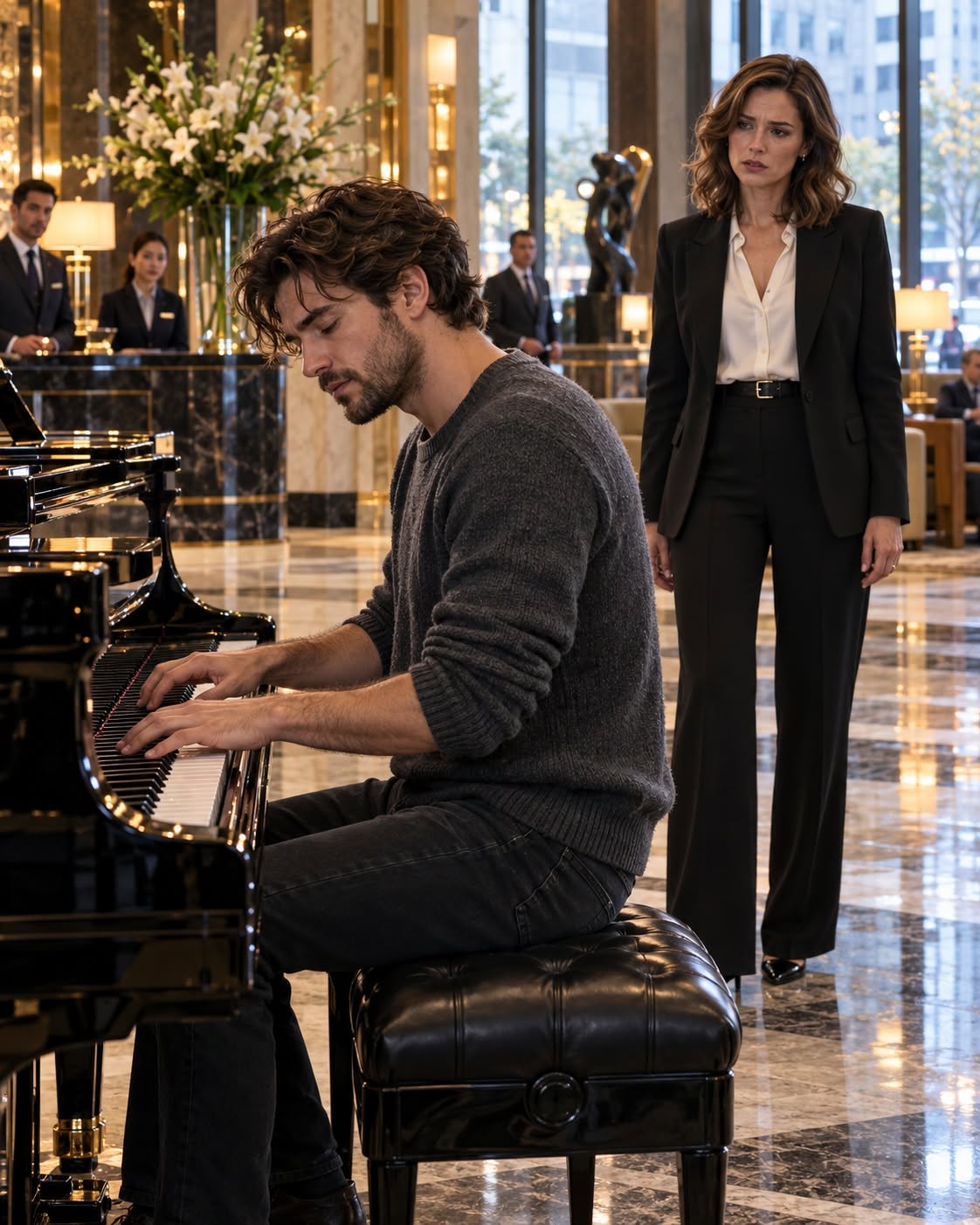
“But I was young. I didn’t understand how powerful your father was. When I refused, the man threatened to have me arrested for stealing confidential documents from Mercer Holdings.”
I stared at him.
“Did you?”
“No. But he had planted evidence in my apartment. Your father had enough influence to make sure nobody believed me.”
Leo leaned forward.
“I was given two choices. Sign a statement saying I had never been in a relationship with you, or spend years fighting a criminal case I couldn’t afford to defend.”
“That is insane.”
“I thought so too.”
His voice dropped.
“So I signed.”
I looked at the brass key.
“And the piano?”
Leo nodded.
“Your father came to see me a week later. He told me he regretted what he’d done. He said he had discovered something about the company, something that could ruin the family name. He wanted me to keep it safe.”
“Why you?”
“Because he knew I had been helping him repair the piano. He also knew I had written music for you. He believed I was the only person who could recognize a particular sequence of notes.”
I frowned.
“That doesn’t make any sense.”
“Your father wasn’t simply trying to keep us apart, Victoria. He was trying to protect something he had hidden.”
Leo reached into a kitchen drawer and took out another folded paper.
It was a photograph of an old music box.
On its lid was a small inscription.
For the daughter who taught me that love cannot be bought.
My throat tightened.
I recognized the handwriting.
It belonged to my father.
The man who had taught me that weakness was expensive.
The man who had told me love was a distraction.
The man who had died without ever apologizing.
And now I was beginning to wonder whether I had ever truly known him.
“Why didn’t you tell me this before?” I asked.
Leo looked at Toby, who was quietly drawing at the other end of the table.
“Because I promised him I wouldn’t reveal the secret unless you came back willingly. He made me swear that I would never use it to bring you back.”
I stared at him.
“My father asked you to protect me?”
“He asked me to give you the truth only when you were ready to hear it.”
I laughed bitterly.
“Fifteen years, Leo. Fifteen years of my life.”
“I know.”
“Do you understand what that cost us?”
“I do.”
His eyes filled with tears.
“But I also know that if I had chased you, if I had tried to force my way back into your life, your father would have made sure neither of us ever had peace.”
I wanted to scream.
Instead, I looked down at the key.
“Then let’s open it.”
Leo hesitated.
“Not tonight.”
“Why?”
“Because whatever is inside that piano could change everything. And Toby needs to sleep. He’s got school tomorrow.”
For the first time, I noticed how late it had become.
Toby was struggling to keep his eyes open, his crayon resting against the paper.
I crouched beside him.
“Good night, Toby.”
He looked up.
“Are you coming back?”
I glanced at Leo.
He didn’t answer for me.
That mattered.
“I’d like to,” I told Toby. “If your dad says it’s okay.”
The little boy smiled.
“Okay. You can hear the whole song next time.”
I almost cried.
Because he had no idea how much those words meant.
The following morning, I arrived at Mercer Holdings before sunrise.
My assistant, Rebecca, nearly dropped her coffee when she saw me walking through the lobby with Leo and Toby.
“Victoria? Your eight-thirty meeting—”
“Cancel it.”
She blinked.
“Again?”
I looked at her.
“Rebecca, have you ever heard the story about the piano in the lobby?”
She glanced toward the instrument.
“Only that your father insisted it remain here after the renovation.”
“Did anyone ever inspect it?”
“Not that I know of.”
I took the brass key from my coat pocket.
“Then we’re about to find out why.”
Leo approached the piano slowly.
His fingertips brushed the polished wood.
For a moment, I saw the young musician I had fallen in love with.
Then he knelt and examined the underside.
“There.”
He pointed to a small brass plate beneath the keyboard.
It was almost invisible against the dark wood.
A narrow keyhole sat in its center.
My hands began to shake.
I handed him the key.
It fit.
There was a soft click.
A hidden panel slid open, revealing a narrow compartment.
Inside lay a leather-bound journal, a small cassette recorder, and a sealed envelope bearing my name.
VICTORIA MERCER.
My father’s handwriting.
I picked up the envelope.
My fingers trembled so violently that I nearly tore it.
“Take your time,” Leo whispered.
But I couldn’t.
I opened it.
My dearest Victoria,
If you are reading this, then Leo has kept his promise, and you have found your way back to the place where the truth was hidden.
I have spent years telling myself that everything I did was for your protection. That was the lie I used to sleep at night.
The truth is much uglier.
I stopped reading.
My vision blurred.
Then I continued.
I did not hate Leo because he was poor. I hated him because he reminded me of the man I once was.
I looked up.
Leo’s expression had changed.
He knew something I didn’t.
I continued.
Before Mercer Holdings became the company you inherited, I was a young man with nothing but a borrowed suit and a dream. Your mother loved me when I had no money, no influence, and no future anyone could see.
I promised her that we would build a life together.
Then my first major investment failed. I was terrified of losing everything. I accepted help from a man who offered me financial security in exchange for control over my business.
I chose power.
Your mother stayed beside me, but something between us died that day.
I swallowed.
My mother had died when I was eleven.
I remembered her as a gentle woman who played piano on Sunday afternoons and always smelled faintly of lavender.
My father rarely spoke about her.
When I met Leo, I saw myself in him. I saw the boy I had been before money taught me to measure every human being by what they could provide.
And I was afraid.
Afraid you would make my mistake.
Afraid you would choose love over security and lose everything.
But instead of teaching you how to be brave, I taught you how to be afraid.
I lowered the letter.
For fifteen years, I had believed my father was a man who understood everything.
Now I was discovering that he had spent his entire life running from one terrible decision.
“There’s more,” Leo said softly.
He opened the leather journal.
Inside were financial records, handwritten notes, and photocopies of contracts.
I recognized several names.
One belonged to Daniel Cross, the former chief financial officer of Mercer Holdings.
He had resigned six years earlier after a dispute with my father.
Another belonged to a private investment firm that had quietly acquired shares in our company over the previous decade.
Leo turned several pages.
Then he stopped.
“Victoria, look at this.”
The records showed that millions of dollars had been transferred from Mercer Holdings into a series of shell companies.
The transfers had begun shortly before my father’s death.
And they had continued under my leadership.
My heart began pounding.
“Who authorized these?”
Leo pointed to a signature.
Mine.
I stared at it.
It was a digital authorization attached to a transaction I had approved without reviewing its underlying documents.
I remembered the day.
A routine restructuring.
A stack of reports.
A meeting I had rushed through because I was preparing for another acquisition.
“Someone has been stealing from us,” I whispered.
“Not just stealing,” Leo said. “Look at the last page.”
A note in my father’s handwriting read:
If Daniel succeeds in completing the final transfer, Mercer Holdings will no longer belong to Victoria. She will inherit the debt, the liability, and the consequences.
My blood ran cold.
The merger I had canceled the previous afternoon suddenly came back to me.
The telecommunications company wasn’t simply an expansion opportunity.
It was the final piece of a plan to hide the missing money inside a massive corporate transaction.
Someone had been counting on my ambition.
Someone had been using my desire to prove myself to finish what my father had refused to allow.
I reached for my phone.
“Call Rebecca. Get the legal team here. Nobody leaves this building until we know exactly what happened.”
Leo touched my arm.
“Be careful.”
I looked at him.
“Why?”
He pointed toward the lobby entrance.
A man in a navy suit had just stepped out of the elevator.
Daniel Cross.
He looked older than I remembered, but his confident smile was exactly the same.
“Victoria,” he called. “I heard you canceled the merger. We need to discuss that.”
I closed the journal.
“Yes, Daniel. We do.”
He approached, his eyes briefly landing on Leo.
“Who is this?”
“Someone who knows more about this company than you expected.”
Daniel laughed.
“That’s an interesting way to introduce a stranger.”
Then he noticed the documents on the piano.
His smile disappeared.
For one brief second, fear crossed his face.
It was all the confirmation I needed.
“Where did you get those?” he demanded.
“From my father’s piano.”
Daniel took a step closer.
“Those records are confidential.”
“So is stealing company money.”
His expression hardened.
“You have no idea what you’re talking about.”
“Then you won’t mind explaining these transfers.”
I opened the journal to the relevant page.
Daniel glanced at the figures.
Then he looked at Leo.
“You.”
His voice was barely audible.
“You were supposed to stay away.”
The words echoed through the lobby.
I stepped between them.
“How do you know him?”
Daniel ignored me.
“Your father should have destroyed those records.”
Leo stood up.
“Your father tried. But he changed his mind.”
Daniel’s face turned red.
“Do you know how much trouble you could cause by bringing this back?”
“Enough to make sure the truth finally comes out,” Leo replied.
Daniel turned toward me.
“Victoria, listen carefully. Your father was not the saint you seem to think he was. He made plenty of mistakes. He knew what was happening, and he allowed it.”
I froze.
“That’s not true.”
Daniel smiled.
“Ask yourself why he kept those records hidden. He was protecting himself, not you.”
For a moment, doubt crept into my mind.
Then I remembered the letter.
My father’s admission.
His shame.
His regret.
Perhaps he hadn’t been innocent.
Perhaps he had been weak.
But there was a difference between admitting wrongdoing and continuing it.
“Maybe he was protecting himself,” I said. “But you were the one who kept stealing after he died.”
Daniel’s jaw tightened.
“You’re making a serious mistake.”
“No. I made one fifteen years ago. I’m not making another.”
I turned to Rebecca, who had just arrived with two members of our legal department.
“Secure the records. Contact independent forensic auditors. Notify the board that the merger is suspended pending an investigation.”
Daniel stepped forward.
“You can’t do this.”
“I can. And I am.”
He looked around the lobby, realizing that the people who had once rushed to obey him were now watching in silence.
Then he pointed at Leo.
“This man is not who you think he is.”
I turned.
“What does that mean?”
Daniel smiled coldly.
“Ask him why your father gave him money.”
I looked at Leo.
He closed his eyes.
And I knew there was another truth waiting to hurt me.
“Leo?”
He took a breath.
“Your father paid for my wife’s medical treatment.”
The words struck me harder than Daniel’s accusation.
“Your wife?”
Leo nodded.
“After I signed the statement, I tried to rebuild my life. Years later, I met Anna. We married, and Toby was born. When Anna became seriously ill, I couldn’t afford the treatment she needed.”
He looked down.
“Your father found out. He arranged for the hospital bills to be paid through a charitable foundation.”
I felt my stomach tighten.
“Why didn’t you tell me?”
“Because he asked me not to.”
Leo’s eyes filled.
“He said he didn’t want you to think he was buying forgiveness. He wanted me to promise that I would never let you believe he had been completely heartless.”
I looked at the letter in my hands.
My father had done terrible things.
He had destroyed a relationship, manipulated two lives, and taught his daughter to fear the very thing that could have made her happy.
But somewhere in the middle of his cruelty, he had tried to do something good.
It didn’t erase anything.
It simply made the truth more complicated.
Daniel seized the moment.
“Touching story. Unfortunately, none of it changes the fact that those documents are worthless without proper authentication.”
Rebecca stepped forward.
“We’ll let the auditors determine that.”
Daniel glanced toward the elevators.
Then he tried to leave.
Two security officers moved into his path.
“Mr. Cross, we’d like you to stay while we contact the authorities.”
His face twisted with anger.
“You’ll regret this, Victoria.”
I held his gaze.
“No. I think I’ve regretted enough.”
By the end of the week, the investigation had uncovered a network of fraudulent transactions stretching back nearly a decade.
The evidence in my father’s journal was supported by bank records, emails, and signed agreements recovered from an overseas account.
Daniel Cross was arrested.
Several executives resigned.
The telecommunications merger was permanently abandoned.
And Mercer Holdings faced a difficult future.
The company survived, but not without consequences.
Its stock fell.
Investors panicked.
Employees worried about their jobs.
For the first time in my career, I had to stand in front of hundreds of people and admit that the company I led had been built partly on decisions I hadn’t questioned.
I didn’t blame my father.
I didn’t blame Daniel.
I didn’t hide behind complicated legal language.
I told the truth.
I announced an independent oversight committee, a full review of our financial practices, and a compensation fund for employees affected by the company’s misconduct.
Then I did something nobody expected.
I stepped down as chief executive.
Rebecca thought I was making a mistake.
“The board will support you,” she said. “You can fix this from the inside.”
“Maybe,” I replied. “But I need to understand who I am when I’m not trying to prove I’m worthy of this building.”
I sold my penthouse.
I moved into a smaller apartment in Queens, not far from Leo and Toby.
I kept enough shares to ensure I could support the company’s recovery, but I no longer needed to control every decision.
For the first time in fifteen years, I allowed myself to wake up without checking the market before opening my eyes.
And slowly, something unexpected happened.
I began seeing Leo again.
Not as a woman demanding a second chance.
Not as a billionaire offering to solve every problem.
Just as Victoria.
The first time we had coffee together, he told me about Anna.
He spoke about her with tenderness, describing how she used to sing badly while cooking and how she always insisted that Toby wear mismatched socks because she thought it made ordinary mornings more interesting.
I listened.
I didn’t interrupt.
I didn’t pretend that her memory was an obstacle to my happiness.
She had been part of his life, and she had given him the greatest gift he had ever received.
Toby gradually grew comfortable around me.
He started bringing his drawings whenever I visited.
One showed a house with three windows, a piano, and a garden full of flowers.
Another showed a little boy holding hands with two adults.
I never asked him what the drawings meant.
I simply kept them.
Months passed.
Leo and I began taking walks along the East River.
Sometimes we talked about the past.
Sometimes we talked about nothing important at all.
He told me about the music he had stopped writing after Anna died.
I told him about the loneliness of living in rooms so expensive that I had never felt at home in them.
There were difficult days.
Days when he remembered the train station and couldn’t look at me.
Days when I wondered whether he was only being kind because he remembered the girl I used to be.
And there were moments when Toby asked questions neither of us knew how to answer.
One evening, while we were eating dinner in Leo’s apartment, he looked at me and asked:
“Are you going to leave again?”
The room went quiet.
I put down my fork.
“I can’t promise that life will never change, Toby. Nobody can.”
His face fell.
“But I can promise that I won’t disappear without telling you the truth. And I won’t make promises just because they’re easy to say.”
He thought about that.
Then he nodded.
“Okay.”
Leo looked at me across the table.
There was something in his eyes I hadn’t seen in fifteen years.
Not forgiveness.
Not yet.
But possibility.
A year after the day I heard the first three notes in the lobby, Leo invited me to a small music hall in Brooklyn.
He told me he had something to show me.
When I arrived, I found a modest upright piano on the stage.
A single spotlight illuminated the keys.
Toby was sitting in the front row, holding a paper program with both hands.
Leo walked onto the stage.
He wore a simple black shirt, and his hair had begun to show more gray.
He looked nervous.
“I’ve been working on something,” he said.
Then he sat down.
His fingers hovered above the keys.
The first three notes drifted through the room.
I recognized them immediately.
But this time, they didn’t sound fragile.
They sounded like a beginning.
Leo continued.
A fourth note.
A fifth.
Then a melody I had never heard before unfolded, rising and falling like rain against an old Brooklyn window.
It carried the sadness of fifteen lost years.
The anger.
The letters.
The choices.
The things we could never recover.
But beneath it all was something warmer.
A quiet hope.
When the final chord faded, the audience remained silent for a moment.
Then Toby stood up and applauded louder than anyone.
Leo smiled at him.
Then he looked at me.
“I promised I’d finish it someday.”
I wiped my tears.
“You did.”
He walked off the stage and stopped in front of me.
“I don’t know what happens next, Victoria.”
I took his hand.
“Neither do I.”
For a moment, we stood together without trying to turn uncertainty into a guarantee.
Then he reached into his pocket and took out a small velvet box.
My breath caught.
Inside was a simple silver ring.
Not the cheap ring he had carried to the train station fifteen years earlier.
Not an attempt to erase what had happened.
Something new.
“I don’t want to pretend we can go back,” he said. “We can’t. But if you’re willing, I’d like to build something honest with you. Slowly. Without secrets. Without anyone deciding what our lives should look like except us.”
I looked at the ring.
Then at the man who had once promised me a home where it never rained inside.
“Are you asking me to marry you?”
“I’m asking whether you’d like to start again. Marriage can wait until we’re both sure.”
I laughed through my tears.
For the first time in years, the sound felt like mine.
“Yes,” I whispered. “I’d like that.”
He slipped the ring onto my finger.
Toby ran onto the stage and wrapped his arms around both of us.
“Does this mean we’re a family?”
Leo looked at me.
I looked at Toby.
And I understood that family wasn’t something a name, a company, or a legal document could guarantee.
It was something people chose to build, one ordinary day at a time.
“Yes, sweetheart,” I said. “If you’ll have me.”
He grinned.
“Then you have to learn how to make pancakes.”
I laughed.
“That’s a very serious responsibility.”
“Dad burns them.”
“Hey,” Leo protested.
For the first time, our laughter filled a room without the past standing between us.
A few months later, I returned to Mercer Holdings.
Not as its CEO.
Not as the daughter of a powerful man.
I had accepted a position overseeing a new foundation established with part of my personal fortune.
Its purpose was to provide music education, scholarships, and emergency support to children from low-income families.
We named it The Open Door Foundation.
The first music room opened in Brooklyn, inside a renovated community center.
There were secondhand pianos, folding chairs, and walls covered with children’s drawings.
Nothing was expensive.
Everything mattered.
On the opening day, Toby sat at the first piano.
He pressed one key, then another.
“Victoria,” he called. “Come here!”
I walked over.
He pointed to the empty bench beside him.
“Play with me.”
I looked at Leo, who was standing near the doorway.
He smiled.
So I sat down.
I had never been particularly good at piano.
My mother had tried to teach me when I was young, but I had abandoned the lessons when my father’s business began consuming our lives.
Still, I placed my fingers on the keys.
Toby played a simple melody.
I followed as best I could.
Leo joined us.
Three people.
Three different histories.
One unfinished song finally becoming something whole.
Later that evening, after everyone had gone home, I stood beside the piano and looked at the small plaque we had placed above it.
It carried a sentence from my father’s letter:
Love cannot be bought, and truth cannot be buried forever.
I thought about the girl I had been fifteen years earlier.
The girl who had stood in the rain, believing she had to choose between love and security.
The woman I had become.
The man who had waited.
The little boy who had taught us that the future could still be gentle.
I had spent half my life believing that success meant never needing anyone.
I had confused control with strength and wealth with safety.
But the greatest loss of my life hadn’t come from choosing the wrong person.
It had come from being too afraid to choose at all.
I couldn’t recover the fifteen years.
I couldn’t give Leo back the nights he had spent waiting at that station.
I couldn’t give Toby the chance to know his mother.
And I couldn’t turn my father into a better man simply because I had finally understood his regrets.
Some things, once broken, remain broken.
But broken things can still become part of something beautiful.
That night, Leo came to stand beside me.
“Are you thinking about the song?”
I smiled.
“Yes.”
“Do you wish things had happened differently?”
I considered the question.
“Every day. But I don’t want to spend the rest of my life wishing away the life I still have.”
He took my hand.
Outside, rain began tapping against the windows.
For years, I had associated rain with abandonment, fear, and the sound of a train carrying someone away.
Now it was simply rain.
A sound against glass.
A reminder that even the longest storm eventually passes.
Leo leaned toward me.
“Come on. Let’s go home.”
I looked around the little music room one last time.
Then I switched off the lights.
As we walked outside, Toby ran ahead of us, laughing beneath the streetlights.
I held Leo’s hand and followed.
For the first time, I understood what my father had spent his entire life trying to learn:
A life without risk may look secure, but it can leave you with nothing worth protecting.
And love, real love, is not a promise that nothing will ever go wrong.
It is the courage to tell the truth, the humility to admit when you’ve been wrong, and the willingness to keep showing up even when forgiveness takes time.
The song had taken fifteen years to finish.
But its final note wasn’t about the past.
It was about everything we still had the courage to begin.