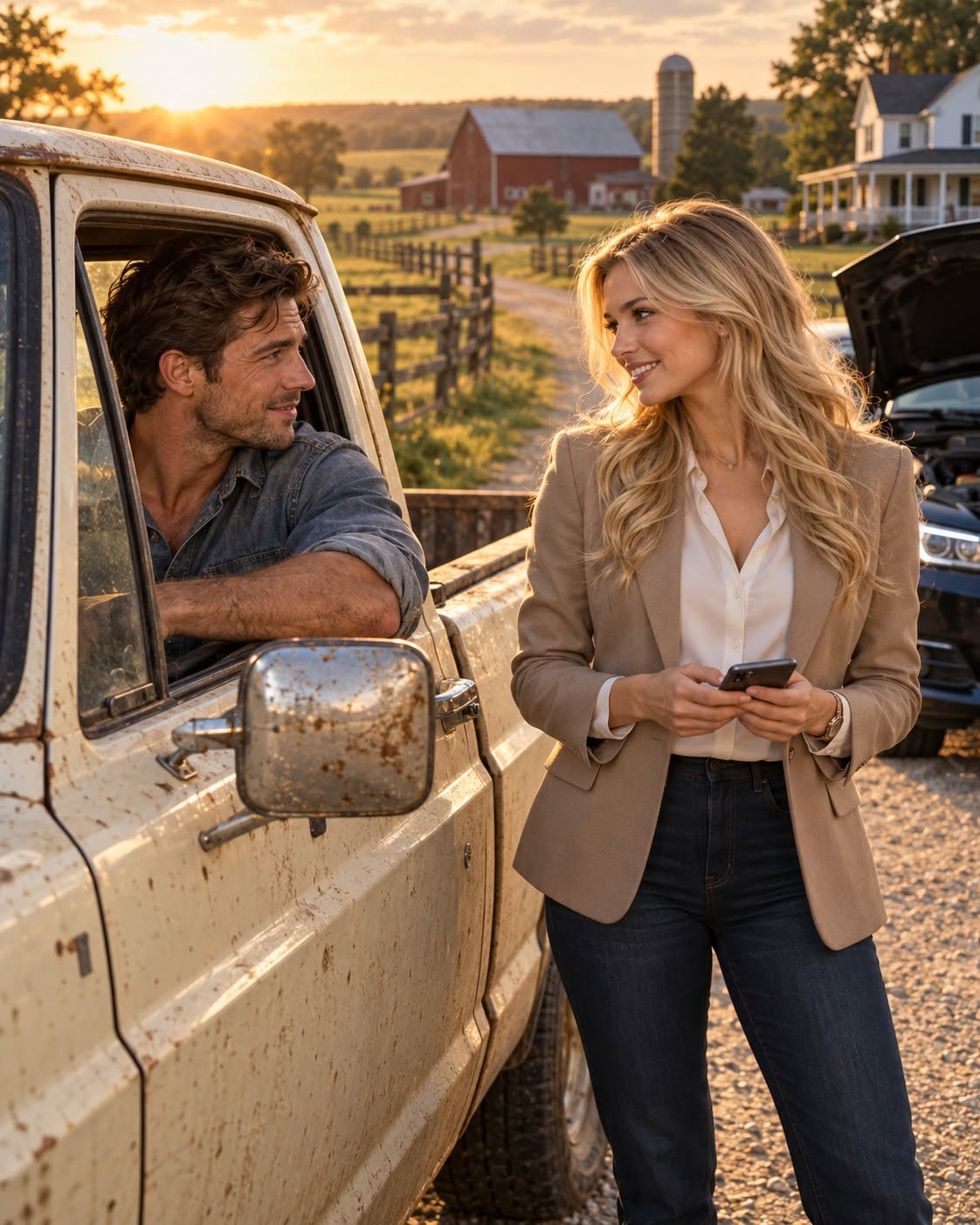
The woman standing beside her broken-down car asked me to take her to 4210 Haydensville Road, and I nearly missed the next turn.
The board wasn’t simply offering me a position anymore. They were planning around my answer.
I looked through the office window toward the fields, where the irrigation lines disappeared beneath the winter grass.
I knew how to calculate water pressure, diagnose a failing valve, and prove that an impossible piece of equipment had never belonged on a working network.
What I couldn’t calculate was how much of my old life I could safely bring back into the new one.
And for the first time, I had to admit that either choice might cost me something I wasn’t ready to lose.
Clara waited patiently across the desk.
“Before you say anything,” she said, “I want you to understand something. The board isn’t asking you to become the man you were five years ago.”
I looked at her.
“Then what are they asking?”
“To help us become the company we should have been all along.”
She opened a folder and slid a document toward me.
It was a proposed employment agreement, but something about it immediately caught my attention.
The position wasn’t quite what I’d expected. It included a reduced schedule for the first six months, authority over engineering decisions across all seventeen properties, and the ability to work remotely whenever on-site supervision wasn’t necessary.
There was also a provision allowing me to bring in additional engineers to handle routine inspections and maintenance.
“Why would the board agree to all this?” I asked.
“Because they know what you found. And because, after everything that’s happened, they understand that hiring another executive who spends most of his time in meetings isn’t going to solve our problems.”
She paused.
“But there’s another reason.”
“What is it?”
“Your daughter.”
I stiffened slightly.
Clara noticed.
“I met Chloe when you brought her to the farm last summer. She was waiting in your truck while you checked something near the loading area. She was doing math homework. I remember because she corrected one of our employees when he made a mistake calculating the weight of a feed pallet.”
Despite myself, I smiled.
“She gets that from her mother.”
“I figured as much.”
Clara leaned forward.
“I don’t want you to accept a job that makes you disappear from her life. And I don’t think the board wants that either. They want your experience, not your sacrifice.”
I looked down at the agreement.
For two years, I had believed the only responsible thing I could do was keep my world small. I had built my entire life around being available whenever Chloe needed me.
But perhaps I had confused being present with refusing to grow.
Still, I wasn’t ready to sign anything.
“I need to talk to my daughter,” I said.
Clara nodded.
“Of course.”
“And I need to know exactly what happened to Arthur. I don’t want to walk into a company where the same people who allowed him to steal millions are still protecting each other.”
Her expression became serious.
“That’s fair. Actually, there’s something else you should know.”
She reached into another folder and removed a printed email.
“Arthur’s attorneys have been contacting the board. He’s claiming the engineering investigation was improperly conducted and that you had a personal motive for interfering with the company.”
I read the email twice.
“He says I was trespassing?”
“Among other things. He’s also questioning your qualifications.”
I almost laughed.
The man had spent years approving invoices for equipment that couldn’t possibly function, and now he was questioning the qualifications of the engineer who designed the actual system.
But Clara wasn’t smiling.
“He’s trying to make the investigation look like a personal dispute rather than a financial crime. His brother-in-law has already resigned from the shell company, and several employees are being interviewed.”
“Do they have enough evidence?”
“We believe so. But the investigators are still working.”
I handed the email back.
“Then I want nothing to do with the legal side unless they need my technical testimony.”
“Understood.”
I stood and picked up my jacket.
“Give me a few days.”
As I walked toward the parking lot, I felt something I hadn’t experienced in years.
Not happiness exactly.
Not confidence.
Something closer to anticipation.
And that frightened me almost as much as the memories.
When I arrived home, Chloe was sitting on the living room floor surrounded by colored pencils and sheets of construction paper.
She was building a model of a small house for a school project.
“Hey, Dad.”
“Hey, sweetheart. How’s the house coming?”
“Terrible.”
I examined the cardboard structure.
“Looks pretty good to me.”
“The roof keeps falling off.”
“Have you tried reinforcing the corners?”
She looked at me.
“With what?”
“Let’s find out.”
We spent the next twenty minutes cutting small cardboard supports and attaching them beneath the roof. By the time we finished, the little house was standing firmly on its own.
Chloe stepped back and admired it.
“See? I knew you’d figure it out.”
I looked at her.
“Actually, you figured it out. I just helped.”
She shrugged, pleased with herself.
Then she asked the question I had been avoiding.
“Dad, are you going to work at the farm?”
I set down the scissors.
“Who told you about that?”
“Nobody. You keep getting calls from Clara, and you look at those old papers when you think I’m not watching.”
Children notice far more than adults give them credit for.
“I haven’t decided yet.”
“Would you have to go away?”
“Not away. But I’d probably spend some days visiting other farms and working in an office.”
“Would you still pick me up from school?”
“Yes.”
“Would you still make pancakes on Saturday?”
I smiled.
“Absolutely.”
She was quiet for a moment.
“Then why don’t you want to do it?”
I considered giving her the simple answer. I could have told her that the job was complicated, that I needed more time, or that I wasn’t sure it was the right decision.
Instead, I decided to tell her the truth.
“Because I used to love engineering. After your mom died, everything connected to that part of my life hurt too much. The farm reminded me of her. My work reminded me of the person I was before she died. And sometimes I was afraid that if I went back, I’d lose the life I’ve built with you.”
Chloe listened without interrupting.
Then she looked down at the little cardboard house.
“Mom used to say you were really good at fixing things.”
My throat tightened.
“She did?”
“Yeah. She said you could look at something broken and see how it was supposed to work.”
I sat beside her.
“She was very kind.”
Chloe picked up a pencil and began coloring the windows.
“Maybe you can fix things and still come home.”
The words were simple.
But they landed somewhere deep inside me.
That night, after Chloe went to bed, I took Laura’s old photograph from the bookshelf.
It was taken at the farm in the summer of 2018.
She stood beneath the white oak, wearing a yellow dress and holding a glass of lemonade. I was beside her, still wearing my engineering shirt, looking exhausted after several weeks of commissioning the irrigation system.
I remembered that day clearly.
The final pressure tests had passed that morning. Every zone was operating within its design parameters. The farmers were happy, the pumps were running smoothly, and I had finally allowed myself to believe the project was finished.
Laura had walked over, taken my hand, and said something I hadn’t thought about in years.
“You know, you don’t have to spend your whole life proving you’re useful.”
At the time, I had laughed.
Now, sitting alone in the quiet house, I wondered whether she had understood something about me that I hadn’t understood myself.
The next morning, I called Clara.
“I’ll consider the position,” I said. “But I have conditions.”
“Go ahead.”
“First, Chloe comes before the company. If there’s a school event, a parent meeting, or something important at home, I need the freedom to be there.”
“Agreed.”
“Second, I want an independent engineering audit of all seventeen properties. Not a superficial inspection. I want every major equipment purchase compared against the actual systems installed.”
“That’s already being discussed.”
“Third, I want the company to establish a scholarship for students studying agricultural engineering or water management. Something permanent. Not a publicity campaign.”
There was a pause.
“That’s an unusual condition.”
“I know.”
“May I ask why?”
I looked at Laura’s photograph.
“Because someone gave me the opportunity to become an engineer. I want someone else to have that opportunity, too.”
Clara was quiet for a moment.
“Put it in writing. I’ll take it to the board.”
I agreed to attend the next meeting.
I didn’t agree to accept the position.
At least, not yet.
Three days later, everything changed.
It began with a phone call from Evelyn.
Her voice sounded different from the meticulous, controlled tone I remembered.
“Are you somewhere you can talk privately?”
I stepped outside the delivery warehouse.
“Yes. What’s happened?”
“They found another company.”
“Another shell company?”
“Yes. And this one is worse.”
She explained that investigators had uncovered a second network of fraudulent invoices connected to Arthur’s brother-in-law.
The original $2.1 million involved questionable irrigation equipment, replacement pumps, valves, and control systems. But the second company had been billing the farm for water treatment components that had never been installed.
Over several years, the company had paid hundreds of thousands of dollars for equipment that existed only on paper.
“How did nobody notice?” I asked.
“Because the invoices were being approved by people who weren’t responsible for inspecting the equipment. And Arthur made sure the maintenance reports looked convincing.”
“Do they have proof?”
“That’s what I’m calling about.”
She lowered her voice.
“When I reviewed the original engineering records, I found something strange. There are maintenance certificates attached to several invoices. They claim that your irrigation system was inspected and upgraded in 2021, 2022, and 2023.”
I frowned.
“I haven’t been on that property since 2022.”
“I know. That’s why I checked the signatures.”
“And?”
“They’re using your name.”
For several seconds, I couldn’t speak.
Evelyn continued.
“The signatures are convincing at first glance, but they’re not yours. Someone copied your name from the original blueprints and attached it to the certificates.”
My stomach tightened.
“Are you sure?”
“I’ve compared them with the originals. I’m certain.”
I closed my eyes.
Arthur hadn’t simply stolen money from the company. He had used my professional reputation to cover his tracks.
“Send everything to the investigators,” I said.
“I already have. But they want you to examine the technical documents. Some of the certificates describe modifications that would have made the system unsafe.”
“How unsafe?”
“One report claims that a high-pressure pump was installed on a line designed for much lower operating pressure.”
I felt a chill.
“That could have caused a pipe failure.”
“Exactly.”
I immediately asked her to send me the documents through the company’s legal team.
That evening, I spent three hours examining them.
The first two certificates described equipment that didn’t match the original design. The third was even more alarming.
It showed a bypass line connecting two pressure zones that were supposed to operate independently.
If someone had actually installed that modification, it could have caused serious damage.
But the strangest detail was the date.
The certificate was dated November 14, 2023.
On that exact day, I had been in a hospital emergency department with Chloe after she fell from a playground climbing frame and fractured her wrist.
I remembered it because she had been terrified of the X-ray machine and had refused to let go of my hand.
I had never been anywhere near the farm.
I called Clara.
“This isn’t just financial fraud anymore,” I told her. “They’re using my name to certify engineering work that could have endangered people.”
Her response was immediate.
“I’m contacting the investigators.”
The following morning, I met with two investigators at the company’s regional office.
I brought my original design documents, my professional registration records, and the calculations showing why the alleged modifications were technically impossible without extensive reconstruction.
One investigator, a woman named Rebecca, examined the documents carefully.
“Could someone have installed this equipment without your knowledge?”
“Someone could install almost anything without my knowledge. But this particular configuration would require replacing several major sections of the distribution network. The original pipes couldn’t handle the pressure described here.”
“Would that be visible?”
“Absolutely. There would be new junctions, larger pump housings, additional control equipment, and a completely different pressure profile.”
Rebecca made a note.
“So the invoices are false?”
“The invoices are inconsistent with the physical system. The maintenance certificates are also false. I can demonstrate that mathematically, and I can inspect the property to confirm it.”
She looked at her colleague.
“That’s what we need.”
Before the meeting ended, Rebecca asked whether I knew anyone who had access to the original blueprints.
I thought for a moment.
“Arthur had access to the company’s engineering records. So did several administrative employees.”
“Anyone else?”
“Evelyn. But she’s the person who discovered the discrepancies.”
Rebecca nodded.
“We’ll verify the document access records.”
When I returned home, I found a message from Clara.
Arthur had requested a meeting with me.
Not through his attorney.
Personally.
I called her.
“Why?”
“He says he wants to explain what happened.”
“Then he can explain it to the investigators.”
“That’s what I told him.”
I thought that would be the end of it.
But the next afternoon, Arthur appeared at the delivery warehouse.
He was wearing an expensive charcoal suit, carrying a leather briefcase, and looking remarkably calm for a man under investigation.
“Well,” he said when he saw me, “the legendary engineer finally comes out of retirement.”
I didn’t respond.
He glanced at the truck behind me.
“Quite a change from designing agricultural infrastructure, isn’t it?”
“What do you want, Arthur?”
He adjusted his cuff.
“I think we’ve both made mistakes. This situation has become unnecessarily complicated.”
“You falsified engineering certificates using my name.”
His expression barely changed.
“That’s an allegation.”
“The documents are dated on days when I was nowhere near the property.”
“Administrative errors happen.”
“Not with forged professional certifications.”
For the first time, his smile disappeared.
He stepped closer.
“You should be careful. You have a daughter, don’t you? A young girl who depends on you.”
I felt something cold settle in my chest.
“Don’t mention my daughter.”
“I’m simply pointing out that investigations can be unpleasant. Your professional history will be examined. Your visits to the property will be questioned. You might find yourself spending a great deal of time defending decisions you made years ago.”
I held his gaze.
“Is that supposed to frighten me?”
“It’s supposed to make you think.”
I took one step toward him.
“I’ve spent two years trying not to think about the person I used to be. But I remember every pipe, every pump, every valve on that farm. And I remember exactly what I designed.”
Arthur’s jaw tightened.
“If I were you, I’d return to delivering feed.”
I looked at him for a long moment.
“That’s where you’re wrong. For the first time in two years, I actually know what I want to do.”
He turned and walked away.
I immediately called Rebecca and reported the conversation.
She asked me not to confront him again and arranged for the incident to be documented.
That evening, I sat at the kitchen table while Chloe worked on another school assignment.
She noticed my expression.
“Something happened?”
“Someone from the farm came to see me.”
“Was he mean?”
I hesitated.
“A little.”
“Did you fix it?”
I smiled faintly.
“Not yet.”
She considered that answer.
Then she reached across the table and took my hand.
“That’s okay, Dad. Some things take longer.”
I squeezed her fingers.
And I realized something.
I had spent so much time worrying that returning to engineering would make me less available to Chloe that I hadn’t noticed how much she needed to see me believe in something again.
The next week, the board held an emergency meeting.
I attended at Clara’s request.
The room was full. Seven board members sat around a long conference table, with legal representatives positioned near the windows.
Evelyn was there, carrying several thick binders.
Clara stood at the front.
The meeting began with an update from the company’s attorneys. They confirmed that the financial investigation had expanded and that investigators were examining both the equipment invoices and the forged engineering certificates.
Then Evelyn presented the accounting records.
She explained how the same shell companies had repeatedly billed the farm for components that didn’t appear in maintenance inventories, delivery records, or physical inspections.
The figures were difficult to ignore.
But the board members still had questions.
One of them asked whether the equipment might have been installed and subsequently removed.
I stood.
“May I explain the engineering side?”
Clara nodded.
I connected my laptop to the screen and displayed the original irrigation design.
Then I showed them the alleged modifications.
I explained the pressure zones, the pump capacities, the pipe specifications, and the hydraulic calculations.
I showed them where the claimed equipment would have needed to connect.
Then I showed them the actual inspection photographs.
The components weren’t there.
More importantly, the existing network was still operating according to the original design.
“These invoices describe a completely different system,” I said. “The equipment listed couldn’t have been installed without major reconstruction. That reconstruction never happened.”
One board member leaned forward.
“Could the maintenance records have been completed incorrectly by an inexperienced employee?”
“One record, perhaps. Seventeen records over several years, all describing equipment that doesn’t exist, with my forged signature attached? No. That’s not an innocent mistake.”
The room fell silent.
Then Evelyn opened another binder.
“There is one more thing.”
She placed a printed document in front of the board.
It was an email exchange between Arthur and his brother-in-law.
The subject line read: November Equipment Reconciliation.
The messages discussed changing the descriptions on invoices before submitting them for approval.
One message included a sentence that made the entire room go still.
Use the old engineer’s certification. Nobody will question a system he designed himself.
Arthur’s name appeared at the bottom.
No one spoke for several seconds.
Finally, the board chair removed his glasses.
“How long have we known about this?”
“Three weeks,” Clara replied. “But the financial records indicate the scheme may have been operating for five years.”
The chair looked at me.
“Mr. Mercer, I believe you have provided information that will be extremely important to the investigation.”
I nodded.
“I just want the truth established. Nothing more.”
He looked around the table.
“Then I think we have our next step.”
By the end of the meeting, the board voted unanimously to suspend the remaining executives who had approved the questionable payments, pending investigation.
Arthur’s employment termination was formally confirmed.
The company also authorized an independent review of every major equipment purchase across all seventeen properties.
As we left the room, Evelyn caught up with me.
“I owe you an apology,” she said.
I looked at her.
“For what?”
“For not realizing sooner that the records were being used to implicate you. I should have checked the signatures before the situation became this serious.”
“You found the problem. That’s what matters.”
She shook her head.
“You know, when I first saw your name on the blueprints, I assumed you were some retired engineer who had become a truck driver because he couldn’t find other work.”
I laughed quietly.
“That’s not entirely inaccurate.”
“No,” she said, smiling. “But I think I understand now.”
“Understand what?”
“That sometimes people leave a profession because life gives them a reason to. It doesn’t mean they stop being good at it.”
I didn’t have an answer.
Outside, Clara was waiting beside her car.
“The board wants to move forward with the offer,” she said. “And they’ve approved your conditions.”
I looked at her.
“All of them?”
“The flexible schedule, the independent audits, and the scholarship program. They even agreed to fund the scholarship for the next ten years.”
I was surprised.
“Ten years?”
“They want it to mean something.”
She handed me the revised contract.
I looked at the signature line.
For a long time, I had imagined that accepting a new job meant leaving the old life behind. I thought I would have to choose between being an engineer and being Chloe’s father.
But standing there, holding that document, I began to understand that perhaps those two things didn’t have to compete.
“There’s one more condition,” I said.
Clara raised an eyebrow.
“Of course there is.”
“I want the farm’s water system to be the first project. Not because it’s the most important property financially, but because I want to make sure it’s safe and operating exactly as designed.”
She smiled.
“I think that’s a good place to start.”
I took the pen.
And signed.
My first official day as Chief Engineer began on a cold Monday morning in January.
I didn’t arrive in a company limousine or wear an expensive new suit.
I drove my old pickup truck, wore my usual work boots, and carried the same engineering notebook I’d kept for years.
The first thing I did was visit Laura’s farm.
The white oak stood exactly where I remembered it.
Its branches were bare, and a thin layer of frost covered the grass beneath it.
I stopped there for a moment before heading toward the control shed.
The irrigation system was running.
The pressure readings were stable. Every zone was operating within its original specifications.
I walked the distribution lines, inspected the junctions, and checked the pump controls.
Everything was functioning properly.
But something else caught my attention.
Near the western field, a small wooden sign had been placed beside the access road.
It read:
LAURA MERCER AGRICULTURAL ENGINEERING SCHOLARSHIP
Beneath the name was a short message:
For those who see possibilities where others see problems.
I stood looking at it for a long time.
Clara approached from behind.
“We thought you’d like to see it.”
I turned toward her.
“You did this already?”
“The board approved the program last week. The first applications open in March.”
I looked back at the sign.
“Thank you.”
Clara nodded.
“There’s something else. Evelyn wants to speak with you.”
“About what?”
“She found a young woman applying for the scholarship. Her family runs a small farm. She’s been accepted into an agricultural engineering program but isn’t sure they can afford it.”
I smiled.
“Then let’s make sure she gets a fair chance.”
Later that afternoon, I drove to Chloe’s school to pick her up.
She climbed into the passenger seat carrying her backpack and a drawing.
“Guess what?”
“What?”
“My teacher said my science project was the best one in the class.”
“That’s wonderful. What was it?”
“A model irrigation system.”
I glanced at her.
“Really?”
She nodded excitedly.
“I used little tubes and a water bottle. I made it so every plant gets the same amount of water.”
I laughed.
“That’s actually a pretty impressive engineering problem.”
She handed me the drawing.
It showed a field with rows of green plants, a small pump, and a network of blue lines connecting everything.
At the top, she’d written:
Water goes where it’s needed.
I stared at the words.
“That’s a good design principle,” I said.
She smiled.
“Mom would have liked it.”
The smile faded slightly.
I reached over and gently touched her shoulder.
“She would have loved it.”
We drove home together.
That evening, after dinner, Chloe asked whether she could visit the farm with me on Saturday.
I hesitated.
“Are you sure?”
“Why wouldn’t I be?”
“I thought you might find it boring.”
She rolled her eyes.
“Dad, I spent three hours making a tiny irrigation system. I think I’ll survive looking at a real one.”
I laughed harder than I had in months.
Saturday morning, we drove through the familiar gates.
Chloe carried her drawing and a small notebook. She wanted to see the pumps, the control shed, and the water lines.
I showed her how pressure changed across different sections of the property. I explained why the pipes were buried at certain depths and why some valves had to be adjusted differently from others.
She asked questions constantly.
Some were simple.
Others were surprisingly difficult.
At one point, she pointed toward a section of the western field.
“Why does that part get less water?”
I checked the readings.
She was right.
A pressure regulator was operating slightly below its intended setting.
I adjusted it and showed her the difference on the gauge.
“See? Now it’s balanced.”
She looked at the numbers.
“How do you know when it’s right?”
I thought about it.
“Because the system tells you. You just have to know how to listen.”
She wrote that down.
After an hour, we walked toward the white oak.
Chloe stopped beneath its branches.
“This is where Mom used to sit?”
“Yes.”
She looked around.
“Can I sit here for a while?”
“Of course.”
We sat together on the grass.
For a few minutes, neither of us spoke.
Then Chloe took a small photograph from her backpack.
It was an old picture of Laura holding her when she was a baby.
“I found this in my room,” she said. “I thought we could leave it here for a little while.”
I looked at the photograph.
Laura’s smile was unmistakable.
“She looks happy,” Chloe whispered.
“She was.”
“Do you miss her every day?”
The question caught me off guard.
I looked across the fields.
“Yes. Every day.”
“Does it ever stop hurting?”
I considered lying.
Telling her that eventually everything becomes easier, that time fixes every wound, that one morning we would wake up and the sadness would simply be gone.
But I knew better.
“Not completely,” I said. “But something changes. At first, remembering someone can feel like losing them all over again. Later, you begin to realize that remembering is also a way of keeping them with you.”
Chloe leaned against my arm.
“I don’t want to forget her.”
“Neither do I.”
“Then we won’t.”
I wrapped my arm around her shoulders.
And for the first time, I didn’t feel the need to escape the silence.
The months that followed were busy.
The engineering audit revealed problems at several properties, including aging pumps, incorrectly sized pipes, and maintenance contracts that had been inflated for years.
We replaced unsafe equipment, redesigned two outdated distribution networks, and introduced a digital maintenance system that required independent verification of major purchases.
The company recovered a portion of the fraudulent payments through insurance claims and legal proceedings.
Arthur eventually faced multiple charges related to financial fraud and falsified records. His brother-in-law was also charged, along with two former employees who had knowingly helped conceal the transactions.
I was asked to testify about the engineering documents.
Standing in that courtroom, I felt no satisfaction at seeing Arthur in trouble.
I simply wanted the record corrected.
When the prosecutor asked whether I had authorized the maintenance certificates bearing my signature, I answered clearly.
“No. I did not.”
She asked whether the alleged modifications could have been installed as described.
“No. The physical system does not support those specifications.”
And when Arthur’s attorney suggested that my return to the farm might have been motivated by a desire for revenge, I looked directly at him.
“I returned because a water system I designed was failing, and I knew how to repair it. I became involved in the investigation because someone used my professional identity to certify work that never happened. My personal feelings about Mr. Vance have nothing to do with the engineering evidence.”
That was all I said.
The case continued for months, but the evidence remained consistent.
Eventually, Arthur accepted a plea agreement on several fraud-related charges. The company pursued financial recovery through civil proceedings, while the remaining criminal matters were handled separately.
I didn’t follow every detail.
I had other things to do.
In March, the Laura Mercer Agricultural Engineering Scholarship received its first applications.
We received forty-three.
One application stood out.
It came from a young woman named Hannah Brooks, whose parents operated a small farm several hours away. She had grown up watching her father struggle with unreliable irrigation equipment and wanted to study water resources engineering so she could develop affordable systems for family farms.
Her grades were excellent.
Her essay was even better.
At the end, she had written:
I want to become the kind of engineer who doesn’t just design systems for people who can afford them. I want to make sure the farms that need help the most aren’t forgotten.
I read the sentence twice.
Then I showed it to Clara.
“She’s the one,” I said.
Hannah received the scholarship.
At the small presentation ceremony, she shook my hand nervously.
“I don’t know how to thank you.”
“You don’t have to.”
“But this changes everything for my family.”
I looked at her.
“Then make something good out of the opportunity. That’s the best thank-you you could give.”
She nodded, her eyes bright.
For a moment, I saw a younger version of myself.
Someone who had been given a chance and hadn’t yet understood how far that chance could take him.
That evening, I told Chloe about Hannah.
She listened carefully.
“Do you think she’ll build something important?”
“I think she already has.”
“How?”
“She decided she wants to help people. The rest is just engineering.”
Chloe considered that.
Then she smiled.
“I think Mom would like her, too.”
“I think so.”
By summer, my new routine had become something I could live with.
I worked four days a week, spent one day handling administrative matters from home, and reserved weekends for Chloe whenever possible.
Some weeks were demanding.
There were emergencies, equipment failures, and difficult meetings.
But I learned to leave work at work.
More importantly, I learned that being a good father didn’t require me to abandon every part of myself that existed before Laura died.
One evening in July, I was reviewing a set of water distribution calculations when Chloe came into my office.
She was holding a school form.
“Dad, can you sign this?”
I looked at the paper.
It was an application for a science summer camp.
“What do they do there?”
“Robotics, environmental science, building things. There’s a whole section about water conservation.”
“Sounds interesting.”
“I want to go.”
I smiled.
“Then we’ll sign you up.”
She hesitated.
“But it’s three weeks.”
I looked at her.
“Yes.”
“Would you be okay if I went?”
I laughed softly.
“Sweetheart, I think I can manage three weeks without you.”
She smiled, then became serious.
“I was thinking maybe I could be an engineer like you.”
For a moment, I didn’t know what to say.
“You can be anything you want.”
“Even an engineer?”
“Especially an engineer, if that’s what you want.”
She looked at the drawings on my desk.
“Would you teach me?”
I pulled out a chair.
“How about we start with something simple?”
I showed her a basic diagram of a small irrigation network.
We spent the next hour discussing water flow, pressure, and why the size of a pipe mattered.
She made mistakes.
So did I.
And every time she got something wrong, we tried again.
At one point, she leaned back and laughed.
“This is harder than it looks.”
I smiled.
“Most worthwhile things are.”
That night, after Chloe went to bed, I walked into the backyard.
The sky was clear, and the evening air was warm.
I thought about the man I had been when Laura was alive.
The ambitious engineer who believed every problem had a solution if he worked hard enough.
Then I thought about the man I had become after she died.
The father who had reduced his world to school pickups, grocery shopping, and making sure his daughter never had to wonder whether he would be there.
Neither man had been wrong.
But neither had been complete.
For a long time, I believed grief required me to preserve the life I had left exactly as it was.
I thought that moving forward meant leaving Laura behind.
Now I understood that love didn’t work that way.
Laura was in the irrigation system I had designed. She was in the white oak where she used to read. She was in Chloe’s questions, her laughter, and the way she carefully measured things before drawing them.
She was also in the parts of me I had tried so hard to bury.
The following Sunday, Chloe and I returned to the farm.
We brought a small wooden plaque to place near the scholarship sign.
It contained a photograph of Laura and a short message.
For Laura, who taught us that the most important things we leave behind are not the things we build, but the lives we help grow.
Chloe helped me secure it beside the oak.
Then she stepped back.
“Do you think Mom can see it?”
I looked up through the branches.
“I don’t know, sweetheart.”
She slipped her hand into mine.
“I think she’d be proud.”
I swallowed.
“I think so, too.”
We sat beneath the tree until the afternoon light began to fade.
For the first time in two years, I didn’t count the minutes before I needed to leave.
I wasn’t trying to outrun a memory.
I was simply sitting with someone I loved, in a place that had once meant everything to someone we both loved.
As we walked back toward the truck, Chloe stopped and looked across the fields.
“Dad?”
“Yes?”
“Are you happy now?”
I thought about the question.
There were still difficult mornings. There were still nights when I reached across the bed out of habit and remembered that Laura wasn’t there.
There were moments when Chloe asked something her mother would have known how to answer, and I felt the old ache return.
My life wasn’t perfect.
It never would be.
But I had meaningful work again. I had a daughter who was growing into a thoughtful, curious young woman. I had colleagues who trusted me, a scholarship that would help others, and a place where I could remember Laura without feeling that I had to run away.
“Yes,” I finally said. “I think I am.”
Chloe smiled.
“Good. You deserve that.”
I looked at her, surprised by the certainty in her voice.
Then I opened the truck door for her.
On the drive home, we passed the old farm gate.
This time, I didn’t look away.
I slowed down just enough to see the white oak in the distance.
The irrigation system beneath the fields was working quietly, carrying water through pipes no one could see, nourishing crops that would eventually feed families.
It reminded me of something I had forgotten.
Not everything important has to be visible.
Some of the strongest things in life work quietly beneath the surface. They support what is growing, survive difficult seasons, and keep giving long after the people who created them are gone.
I used to believe my responsibility was to keep my daughter’s world from changing after her mother died.
I know better now.
Children don’t need parents who never struggle, never grieve, or never pursue anything beyond their responsibilities.
They need parents who show them that life can hurt terribly and still be worth living.
They need to know that loving someone who is gone doesn’t mean refusing to love the life that remains.
And perhaps most importantly, they need to see that starting over isn’t a betrayal of the past.
Sometimes it’s the most honest way to honor it.
I still drive a feed delivery truck on certain weekends, mostly because I enjoy the simplicity of it.
And every time I pass 4210 Haydensville Road, I remember the day Clara climbed into my truck with a dead phone and a broken-down car.
I had thought I was simply giving a stranger a ride.
I had no idea that a single ordinary decision would lead me back to the career I loved, expose a fraud that had cost millions, create opportunities for young engineers, and help me find a way to live with the loss of my wife.
But the greatest change wasn’t the job title.
It wasn’t the money, the board’s approval, or even the successful investigation.
It was the moment my daughter looked at me and said I didn’t seem so tired anymore.
Because she was right.
For two years, I had been surviving.
Now, finally, I was living again.
And I had learned that sometimes the road back to yourself doesn’t begin with a grand decision or a dramatic moment.
Sometimes it begins with a broken-down car, a familiar address, and the courage to stop driving away from the things that still matter.
I can’t bring Laura back.
I can’t give Chloe the childhood she would have had if her mother were still here.
And I can’t undo the years I spent hiding from a part of myself.
But I can choose what happens next.
I can be a father who shows up.
I can be an engineer who uses his knowledge to help others.
I can remember my wife without treating happiness like something I no longer deserve.
And I can teach my daughter that a broken system isn’t necessarily a lost cause.
Sometimes you just have to find where the pressure is failing, understand what went wrong, and have the patience to make the necessary repairs.
Life is a little like that.
You don’t always get to choose what breaks.
But you do get to choose whether you spend the rest of your life standing beside the damage or begin, carefully and courageously, building something new.
And if Laura had taught me anything, it was that there was always more life waiting beyond the things we thought we had lost.