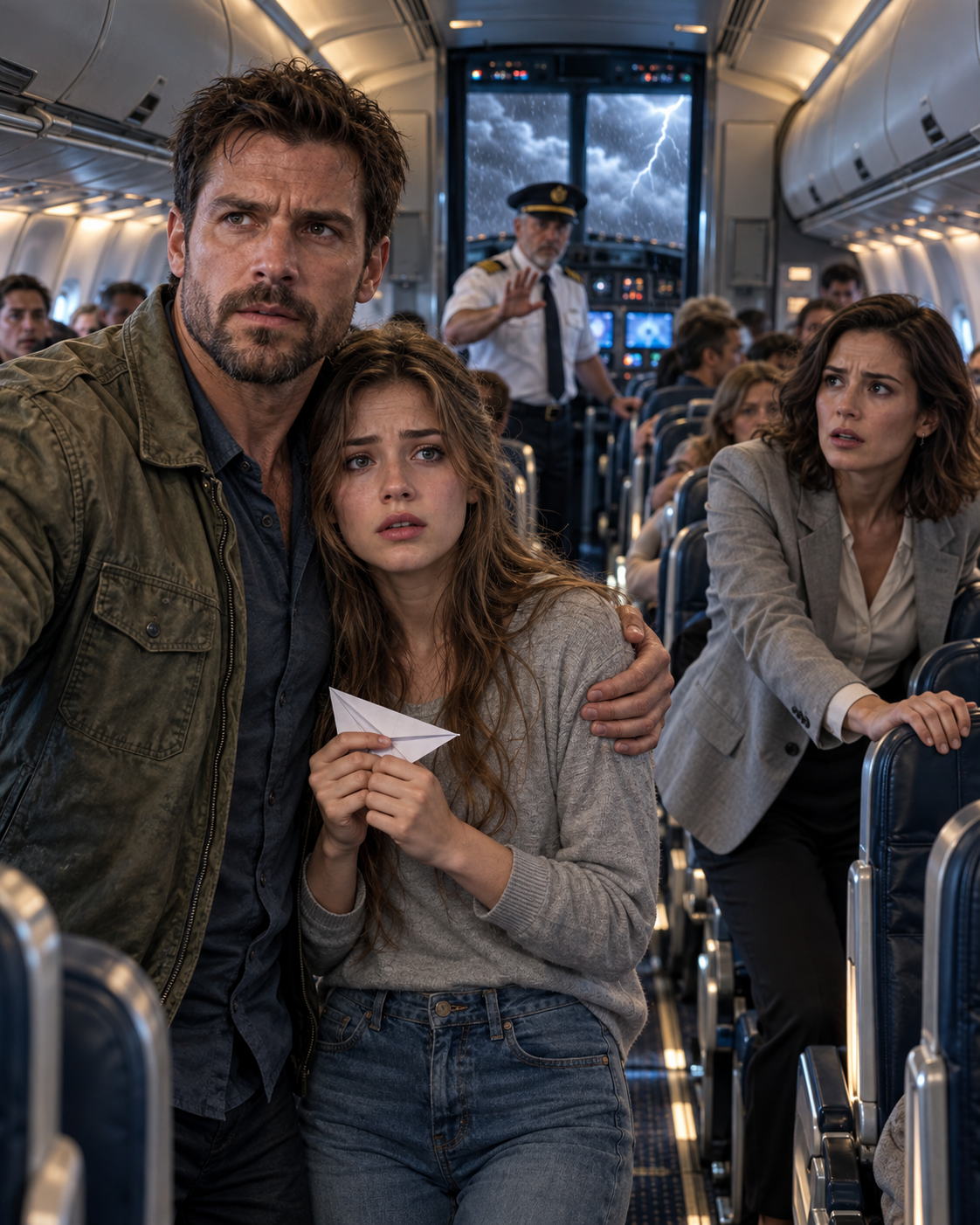
The plane dropped so suddenly that a woman in first class screamed and grabbed both armrests. From seat 23C, I tightened my arm around my seven-year-old daughter
I returned the captain’s salute, but there was no time for old memories.
“Henry, save your strength,” I told him. “Finn, give me the aircraft status.”
Finn quickly briefed me on the situation. The storm had battered the plane, and a serious hydraulic failure had left the crew with limited control. The captain’s medical emergency had come at the worst possible moment.
I moved beside Finn, studying the instruments and listening as he described what the aircraft was doing.
“Keep your attention on the flight path,” I said. “We’ll work through this one decision at a time.”
My voice stayed steady, even when another violent gust threw the aircraft sideways.
I helped Finn assess our remaining control options, manage the uneven thrust, and coordinate with air traffic control to reach the nearest suitable emergency airport. Every adjustment had to account for the storm, the damaged systems, and the aircraft’s changing response.
There was no room for pride. No room for panic. Only the next necessary decision.
Behind us, Henry fought to remain conscious, occasionally offering information that only the captain could provide. Finn listened closely, and I guided him through each new challenge as the cockpit alarms continued to sound.
At last, the airport appeared through the clouds.
“Runway in sight,” Finn announced.
“Good. Stay focused.”
The approach was difficult. Crosswinds pushed against the aircraft, and the damaged systems left little margin for error. Finn followed our coordinated plan, making careful corrections as we descended toward the runway.
For one long moment, the aircraft seemed to hang above the ground.
Then the wheels touched down.
The plane bounced once, settled, and rolled forward as Finn worked to bring it safely to a stop.
We had made it.
Emergency vehicles raced alongside us, their lights flashing across the rain-soaked windows. When the aircraft finally stopped, the cabin erupted in applause, sobs, and relieved prayers.
I barely heard any of it.
I wanted Bonnie.
I left the cockpit with the crew and hurried down the aisle. She was still in her seat, tears running down her cheeks. The moment she saw me, she launched herself into my arms.
“You came back!” she cried.
“I promised I was right here,” I whispered, holding her tightly.
Only after I knew she was safe did I notice Margaret standing several feet away. Her face was pale, and the confidence she had displayed before the storm had vanished.
Later, after the passengers had been evacuated and medical personnel were caring for Henry, Margaret approached me. Cole and Jessica remained behind her, unusually quiet.
“I owe you an apology,” she said. “For the way I treated you earlier. I was cruel, and I had no right to judge you.”
She hesitated before adding, “I hope this doesn’t turn into a media circus. I would hate for all of this to become a public spectacle.”
I looked at her for a moment.
“My daughter has been through enough tonight,” I replied. “I don’t care about headlines, and I don’t need anyone to tell the world who I am. I just want to take her home.”
Margaret lowered her eyes. For once, she had nothing to say.
Before we left, Henry managed to thank me properly. He reminded me of the years when I had trained him at an advanced flight combat school, when discipline and clear thinking mattered more than rank or reputation.
“I learned a great deal from you,” he said quietly.
I squeezed his shoulder. “Tonight, you helped save those people, too.”
Then I took Bonnie’s hand and walked away from the flashing lights.
She looked up at me as we crossed the terminal.
“Mommy, why was that lady so mean to you if you could help everyone?”
I thought about Margaret’s expensive clothes, her cutting remarks, and the way she had measured my worth before knowing a single thing about me.
“Sometimes,” I told Bonnie, “people think they know who someone is just by looking at them. But what matters most is what we do when someone needs us.”
She considered that, then slipped her hand into mine.
And that was enough.
I had no desire to be celebrated or admired. I had done what needed to be done, and I would have done it regardless of who had mocked me or who was watching.
Because wealth cannot guarantee courage, status cannot manufacture kindness, and appearances can never tell the whole story.
When the world began falling apart, the woman they had dismissed was the one who stepped forward.
And the little girl holding her hand learned something far more valuable than any title could teach her: a person’s worth is not measured by what they wear or where they sit, but by what they are willing to do when others need help.
The rain had finally stopped by the time Bonnie and I reached the airport’s emergency reception area, but the night was far from over.
Passengers sat wrapped in silver emergency blankets while paramedics moved between them. Some were crying into their phones. Others stared into space, still trying to understand how an ordinary flight home had turned into something they might remember for the rest of their lives.
Bonnie held my hand so tightly that her fingers began to hurt.
“Mommy, are we going to have to get on another plane?”
“Not tonight, sweetheart.”
“Good.” She paused, looking around at the exhausted passengers. “I think I’ve had enough flying for a while.”
Despite everything, I laughed softly.
It was the first time either of us had laughed since the storm began.
A staff member from the airline approached us with two bottles of water and a blanket. She introduced herself as the station manager and explained that the airline was arranging transportation and accommodation for passengers who needed it.
Then she looked at me with an expression I had begun to recognize.
“You’re the woman who helped in the cockpit, aren’t you?”
“I helped the co-pilot,” I answered.
She nodded, but her eyes told me that the distinction would probably be lost once the story began spreading.
“I can’t imagine what would have happened without you.”
“Neither can I,” I said honestly. “But the co-pilot did an extraordinary job under terrible circumstances. The captain was injured, the aircraft had serious problems, and he never gave up.”
I expected her to thank me again and move on.
Instead, she glanced at Bonnie.
“And you must be very proud of your mother.”
Bonnie looked at me, then back at the woman.
“My mommy was scared, too,” she said.
The manager seemed surprised.
I knelt beside my daughter.
“What makes you say that?”
“Because you squeezed my hand really hard before you left.”
I had no answer ready for that.
Children notice the smallest things. Adults can spend years constructing an image of themselves, but a child can see through it with one frightened question.
I brushed a strand of hair away from Bonnie’s forehead.
“You’re right,” I told her. “I was scared.”
“Then how did you know what to do?”
I looked toward the glass doors, where emergency lights still reflected against the wet pavement.
“Being scared doesn’t always mean you should stop. Sometimes it means you need to pay attention, ask for help, and do the next right thing.”
Bonnie considered that seriously.
Then she leaned against me.
“I think I did the next right thing, too.”
“What was that?”
“I stayed in my seat like you told me.”
“You did exactly the right thing.”
She smiled for the first time that night.
I wanted to preserve that moment. Not the applause, not the salute, not the look on Margaret’s face when she realized she had judged me incorrectly.
Just my daughter, safe in my arms, believing she had done something brave.
Because she had.
We were waiting for transportation when I noticed Henry being wheeled through the reception area.
A paramedic accompanied him, and another medical worker was checking his blood pressure. He looked exhausted, but he was conscious and speaking.
When he spotted me, he raised one hand.
I walked over after making sure Bonnie was comfortable with the airline representative.
“How are you feeling?” I asked.
“Like a man who should have retired ten years ago.”
“You should probably save your energy.”
“I’ve been told that twice already.”
His eyes moved toward Bonnie, who was watching us from a nearby chair.
“Your daughter?”
“Yes. Bonnie.”
Henry smiled at her.
“Your mother is one of the finest pilots I’ve ever known.”
Bonnie’s eyes widened.
“She is?”
Henry looked at me before answering.
“She certainly was when I knew her.”
I gave him a warning look.
“Henry.”
“What? I’m not telling her anything you haven’t earned.”
“That’s precisely the problem.”
He chuckled, then winced slightly as the paramedic adjusted his position.
I softened.
“Don’t push yourself.”
His expression changed.
For a moment, the noise of the reception area seemed to recede, leaving only the two of us and everything we had never discussed.
“I owe you an apology,” he said.
I frowned.
“For what?”
“For not recognizing how much you sacrificed when you left.”
I looked down at the floor.
Years ago, I had been one of the most promising pilots in an elite military aviation program. I had trained in difficult conditions, learned to make decisions under pressure, and developed the kind of discipline that could not be acquired through a few hours of instruction.
Henry had been younger then, ambitious and eager to prove himself.
I had been his instructor.
He was talented, but he sometimes confused confidence with control. He wanted to move quickly, make difficult maneuvers look effortless, and impress everyone watching.
One afternoon during a training exercise, he had made a mistake because he was too focused on completing the mission exactly as he had imagined it.
I had pulled him aside afterward.
“You don’t get points for looking fearless,” I told him. “You get points for bringing everyone home.”
He had never forgotten that lesson.
Neither had I.
But years later, when my own life changed, the lesson took on a meaning I hadn’t anticipated.
I left military aviation after a family tragedy forced me to reconsider what I wanted from the years ahead. I had spent too long measuring my life by missions completed, risks managed, and expectations met.
When I became a mother, my priorities changed.
I wanted to be present for school mornings, scraped knees, bedtime stories, and the ordinary moments that disappear while you’re busy preparing for the next extraordinary thing.
I wanted Bonnie to know me as her mother, not as a story someone told about a person I used to be.
I never regretted that decision.
But leaving a world that had shaped your identity doesn’t mean you stop carrying it inside you.
“You don’t owe me an apology,” I told Henry.
“Perhaps not. But I owe you my thanks.”
He looked directly at me.
“When I realized who you were, I knew we had a chance. Not because you could perform miracles, but because you never lost your head when everyone else did.”
I shook my head.
“Finn deserves the credit for keeping the aircraft under control. We worked together.”
“And that,” Henry replied, “is exactly what you taught me.”
A medical worker interrupted us to explain that Henry needed further examination. Before they wheeled him away, he reached for my hand.
“I hope you know you haven’t lost what made you who you are.”
I watched him disappear through the doors.
Then I returned to Bonnie.
She immediately asked, “What did he mean when he said you used to be a pilot?”
I sat beside her.
“I used to fly aircraft as part of my work.”
“Big ones?”
“Not passenger planes like the one we were on.”
“Were you in the military?”
I nodded.
She stared at me as if I had just told her I used to live on the moon.
“Why didn’t you tell me?”
I smiled faintly.
“Because I wanted you to have time to be a kid without worrying about the things I used to do.”
“But you could have told me.”
“You’re right.”
That answer seemed to surprise her more than anything else.
I took her hand.
“I think I was so busy being your mom that I forgot you might want to know the other parts of my life, too.”
She rested her head against my shoulder.
“I like being your kid.”
My throat tightened.
“I like being your mom.”
For the first time that night, I felt something inside me settle.
Not the fear. Not the exhaustion.
Something deeper.
The feeling that I had brought my daughter through a terrible experience without letting it take away the one thing she needed most: the certainty that she was loved.
By the time we reached the hotel arranged by the airline, it was nearly dawn.
Bonnie fell asleep before I had finished pulling the blanket over her.
I sat beside the bed, listening to her breathing and watching the first pale light creep across the curtains.
My phone had been vibrating for almost an hour.
I finally picked it up.
There were messages from people I hadn’t spoken to in years, missed calls from former colleagues, and several notifications from numbers I didn’t recognize.
One message came from a former instructor.
I heard what happened. Are you all right?
Another came from someone who had once served beside me.
You always did know how to show up when it mattered.
I stared at the screen for a long time.
The world had a way of finding you when you least expected it.
I had spent years building a quiet life. I had accepted work that allowed me to be available for Bonnie, rented a modest home, and learned to appreciate the comfort of routines.
I knew which grocery store marked down bread on Thursday evenings. I knew the best place to buy secondhand children’s books. I knew how to stretch a tight budget without making Bonnie feel as though we were missing out.
Those things mattered to me.
I didn’t want a spotlight.
I didn’t want strangers deciding they understood my life because they had heard a story about a storm.
And I certainly didn’t want Bonnie growing up believing that her mother had to be extraordinary to deserve respect.
I put the phone facedown.
For a little while, I simply watched the morning arrive.
Then Bonnie stirred.
“Mommy?”
“I’m here.”
“Did we really land?”
I moved closer to her bed.
“We really did.”
She opened her eyes.
“Can we go home now?”
“Yes, sweetheart. As soon as we can arrange it.”
She nodded and closed her eyes again.
A few seconds later, she whispered, “I’m glad you were my mommy on that plane.”
I pressed my lips together.
There are moments when the world can praise you a thousand times and still fail to give you what a single sentence from your child can provide.
That was one of them.
By midmorning, the story had begun circulating online.
At first, it was a short report about a commercial flight diverted during a severe storm after the captain experienced a medical emergency. The airline confirmed that the passengers had landed safely and that the captain was receiving treatment.
Then someone posted a photograph of emergency vehicles surrounding the aircraft.
Another passenger uploaded a picture of the cabin after landing.
Soon, people were sharing fragments of what they claimed had happened.
Some described a former military pilot helping the co-pilot. Others praised the captain for surviving the emergency. Several passengers mentioned the calm woman who had walked toward the cockpit while everyone else was frightened.
The details varied, and some were wrong.
I made no attempt to correct them.
I had no interest in becoming a public figure because of one terrible night.
But the story eventually reached Margaret.
I learned this because she contacted the airline and asked whether she could speak with me privately.
At first, I considered declining.
I had no desire to revisit her insults or spend my limited energy reassuring someone who had humiliated me in front of my child.
Then I remembered the expression on her face after we landed.
It had not been merely embarrassment. Beneath it, I had seen something unfamiliar to her: the realization that she had been wrong about someone, and that the consequences of her judgment had become impossible to ignore.
I agreed to meet her briefly in the hotel lobby before our transportation arrived.
She was already waiting when I came downstairs.
Without the designer coat and the entourage that had surrounded her during boarding, she looked less imposing. Cole and Jessica were nowhere to be seen.
When I approached, she stood.
“Thank you for agreeing to speak with me.”
I nodded and took a seat across from her.
For a moment, neither of us spoke.
Then she said, “I’ve been thinking about what happened before the flight.”
“So have I.”
“I treated you terribly.”
She didn’t dress it up as a misunderstanding. She didn’t blame the stress of travel or suggest that Bonnie had somehow provoked her.
“I looked at your clothes and your backpack, and I decided I knew what kind of person you were. I treated you as though you were beneath me.”
She swallowed.
“And then, when everyone was frightened, I mocked you for offering to help.”
I listened without interrupting.
“I keep thinking about what my daughter would have learned if she had been there,” Margaret continued. “Or what your daughter learned by watching me.”
I hadn’t expected that.
“Bonnie doesn’t need to carry the burden of what you did,” I said. “She’s seven. She needs to know that adults can make mistakes, take responsibility, and do better.”
Margaret nodded.
“I understand.”
I wasn’t sure she did. Understanding is easy to claim when you are ashamed. Changing is harder.
Then she surprised me.
“I want to apologize to your daughter, too. If you’ll allow it.”
I considered the request.
“Not today. She needs time to recover from what happened, and she doesn’t owe anyone a conversation.”
“Of course.”
Margaret looked down at her hands.
“I also want to make something clear. I wasn’t asking to speak to you because I’m afraid of bad publicity.”
I waited.
“I am afraid of what this says about me. Publicity would be the easy part. I could issue a statement, say the right things, and move on. But I know I can’t undo how I treated you.”
For the first time, her apology sounded less like an attempt to manage consequences and more like an admission.
I didn’t tell her everything was forgiven.
Forgiveness is not a service someone is entitled to receive simply because they have apologized.
Instead, I said, “Then don’t focus on what people might say about you. Focus on how you treat the next person you meet when you think they can’t do anything for you.”
Margaret looked up.
I continued.
“Anyone can be polite to someone they admire. The real test is how you behave toward someone you believe has nothing to offer you.”
She sat very still.
Then she nodded.
“I’ll remember that.”
“I hope you do.”
When I stood to leave, she did not ask for a photograph or a promise that I would keep our conversation private. She simply thanked me and let me walk away.
It was the first decent thing she had done for me.
And I decided it was enough for that morning.
Our journey home took another day to arrange.
The airline offered to book us on a later flight, but after everything we had experienced, I chose to take a train for part of the journey and arrange the remaining transportation on the ground.
Bonnie was delighted.
“A train has windows I can actually look out of,” she announced as we boarded.
I smiled.
“And no turbulence.”
“Exactly.”
We settled into our seats, and for the first time since the storm, I let myself relax.
The landscape moved slowly beyond the window. Towns passed, followed by stretches of countryside and long rows of trees.
Bonnie watched everything.
She asked about the stations, the conductors, and why some people traveled with enormous suitcases while others carried only a small bag.
Eventually, she turned to me.
“Mommy, are you going to fly planes again?”
The question caught me off guard.
“I don’t know.”
“Would you want to?”
I looked out the window.
For years, I had treated that part of my life like a room I had closed and locked. I didn’t hate what was inside it. I simply believed I had moved on.
But the previous night had reminded me that some skills remain part of you, even when your life takes a different direction.
“I think I might want to help people learn to fly,” I said slowly.
Bonnie brightened.
“Like a teacher?”
“Something like that.”
“Would you be good at it?”
I laughed.
“I hope so.”
She returned to her window, apparently satisfied.
But I kept thinking about her question.
I had assumed that moving forward meant leaving everything behind. Perhaps it meant something else.
Perhaps I could honor the life I had lived without returning to the life I had left.
I could teach. I could mentor. I could help people develop the judgment and discipline that mattered when things went wrong.
And I could still be there when Bonnie lost a tooth, needed help with homework, or wanted me to sit beside her while she read a book.
The two parts of my life did not have to compete.
For the first time in years, the thought felt possible.
Three weeks later, I received a letter from Henry.
It arrived in a plain envelope, without an official seal or a return address that would have made it look important.
Inside was a handwritten note.
He told me that he was recovering well and had been instructed by his doctors to take his rehabilitation seriously. He also wrote that Finn had visited him and that the airline was reviewing the emergency response to understand what had gone well and what needed improvement.
Then he wrote about the salute.
I hope you didn’t think I was trying to turn you into a hero. I was thanking the person who taught me that competence means nothing without responsibility.
I read that sentence twice.
He continued.
You left aviation because you wanted to build a different life. I respected that then, even if I didn’t fully understand it. After what happened, I’ve realized that leaving a profession doesn’t erase the good you brought to it.
At the bottom, he included a telephone number and a simple invitation.
If I ever wanted to discuss teaching or mentoring, he knew people who could help me explore the possibilities.
I placed the letter on the kitchen table.
Bonnie found it when she came home from school.
“Is that from the captain?”
“Yes.”
“Is he okay?”
“He’s getting better.”
She nodded, relieved.
Then she pointed at the letter.
“Does he want you to fly again?”
“He wants me to think about teaching.”
She considered that.
“I think you’d be a good teacher.”
“Why?”
“Because when I don’t understand my homework, you don’t get mad at me.”
I laughed.
“That is a very low standard.”
“No, it isn’t,” she insisted. “Some people get mad when you don’t know things.”
I looked at her, recognizing the lesson she had drawn from the experience in her own way.
“Then perhaps I’ll try.”
That evening, after she went to bed, I called Henry.
We spoke for nearly an hour.
He told me about opportunities to mentor young pilots and help with training programs. There were no grand promises, no dramatic offers to return me to my former position. Just practical conversations about work I could do, hours I could manage, and responsibilities I would need to consider.
I asked questions.
I took notes.
And when we hung up, I felt something I hadn’t felt in a very long time.
Possibility.
The following months were not transformed by a single miraculous event.
Life continued to demand ordinary things.
Bonnie still forgot her lunch occasionally. The washing machine still made an unpleasant noise during the spin cycle. Bills arrived, groceries cost money, and there were evenings when I was so tired that cooking dinner felt like a major undertaking.
But I began exploring the opportunity Henry had mentioned.
I met with instructors, reviewed training materials, and discussed how my experience might be useful in a teaching role. I was careful not to rush into anything. I had learned that the best decisions were rarely the ones made to satisfy someone else’s expectations.
Eventually, I accepted a part-time position assisting with advanced aviation training.
The schedule allowed me to take Bonnie to school, attend her activities, and keep my evenings mostly free.
On my first day, I stood outside the training facility for several minutes before going in.
I had not worn a uniform in years.
I had not expected to return to that world in any form.
Yet there I was, carrying a notebook and a cup of coffee, preparing to teach people who were younger than some of the memories I carried.
The first student I worked with was an intelligent young pilot who spoke quickly and seemed determined to prove that he could handle every challenge.
During a practice scenario, he made a mistake, then immediately tried to explain why it wasn’t really his fault.
I recognized the expression.
I had seen it on Henry years earlier.
I waited until he finished.
Then I asked, “What do you think happened?”
He hesitated.
“I misjudged the situation.”
“What would you do differently?”
“Slow down. Check the information again. Ask for another assessment if I need one.”
“Good.”
He looked relieved.
I continued, “You don’t have to pretend you know everything. You have to recognize what you know, what you don’t know, and what you need to do next.”
He wrote that down.
I watched him leave the room later that afternoon, and I thought about the woman I had been when I first entered aviation.
I had believed strength meant being able to handle everything alone.
Experience had taught me something more useful.
Strength meant knowing when to act, when to listen, and when to trust another person.
It meant preparing carefully enough that you didn’t need to rely on luck.
And sometimes, it meant stepping away from the cockpit because the person waiting for you at home mattered more than any achievement.
I was not returning to my old life.
I was building something new from the parts of it that still mattered.
Several months after the storm, I received an unexpected email from Margaret.
The subject line was simple: Thank you for telling me the truth.
I nearly deleted it without reading.
Then curiosity got the better of me.
She wrote that she had spent the months since our flight thinking about the way she treated people. She had spoken to Cole and Jessica about what happened, and the conversations had not been comfortable.
Both had initially dismissed the incident as a bad moment during a stressful trip.
Margaret had realized that this was precisely the problem.
They had all been so accustomed to treating certain people as less important that they barely noticed when they did it.
She explained that she had begun changing some of the ways she managed her business, including how her staff interacted with clients, contractors, and service workers.
She didn’t ask me to praise her.
She didn’t claim she had become a different person overnight.
Instead, she wrote that she was trying to pay attention to the moments when she felt entitled to someone’s time, patience, or respect without offering the same in return.
At the end, she mentioned that she had made a donation to a program that helped young people explore aviation careers, particularly those who might never have considered the field accessible to them.
She made it clear that the donation was not an attempt to purchase my forgiveness.
I sat quietly after reading the message.
I couldn’t know whether every change would last. People are complicated, and one frightening experience does not automatically erase a lifetime of habits.
But I could recognize a sincere effort when I saw one.
I replied with a short message.
Thank you for taking the lesson seriously. What matters now is what you do next.
I didn’t mention the donation.
I didn’t ask her to contact me again.
And I didn’t feel the need to.
Some people enter your life only long enough to show you something about yourself. Others reveal something about themselves that you cannot unsee.
Margaret had done both.
I hoped she would become kinder.
But her journey was hers to make.
One Saturday afternoon, Bonnie and I visited a small aviation museum near our home.
She had been asking questions about my former career for weeks, and I decided it was time to let her see some of the things I had spent so long keeping separate from our life together.
We walked through exhibits featuring old aircraft, flight instruments, and photographs of pilots from different generations.
Bonnie stopped in front of a display showing a cockpit filled with switches and gauges.
“Did your plane look like that?”
“Some of the instruments were similar.”
“Did you have to remember what every button did?”
“I had to know how the systems worked, yes.”
She stared at the display.
“I would forget everything.”
“You’d learn.”
She looked skeptical.
We continued walking until we reached a photograph of a group of military pilots standing beside an aircraft. I recognized several faces. Some belonged to people I had not seen in years.
Bonnie noticed me looking.
“Are those your friends?”
“Some were colleagues. Some became friends.”
“Are you in the picture?”
I pointed to myself.
She gasped.
“That’s you?”
I smiled.
“That’s me.”
She studied the photograph carefully.
“You look different.”
“I was younger.”
“No.” She shook her head. “You look like you’re thinking really hard.”
I laughed.
“I probably was.”
She took my hand.
“Were you happy?”
The question caught me more deeply than I expected.
I looked at the photograph for a long time.
“Yes,” I said at last. “I was happy in many ways. I loved flying. I loved the people I worked with. I was proud of what we did.”
“Then why did you stop?”
I crouched so that we were looking at each other.
“Because being happy in one part of your life doesn’t mean you have to stay there forever. Sometimes the things you love change, and sometimes what you need most changes, too.”
She thought about that.
“Like when I stopped liking broccoli?”
“Not exactly.”
She giggled.
I continued, “I wanted to spend more time raising you. I wanted a life where I didn’t have to be away so often. That didn’t mean my old life was bad. It meant I had something new that mattered even more to me.”
Bonnie looked back at the photograph.
“I’m glad you chose me.”
My chest tightened.
I brushed my thumb across her cheek.
“I didn’t choose you instead of something important, sweetheart. You became something important that I hadn’t known how to measure before.”
She wrapped her arms around my neck.
We stayed that way for a while, kneeling beside the display while visitors passed around us.
I thought about the storm, the cockpit, the salute, and the moment I had stepped away from my daughter to help strangers I might never see again.
I had once believed those events belonged to separate worlds.
Now I understood that they were connected by the same responsibility.
I wanted to be someone who could help when help was needed.
I also wanted to be someone my daughter could depend on when the world felt frightening.
Neither desire made the other less meaningful.
A year after the emergency landing, Henry invited Bonnie and me to a small gathering with several people who had been involved in the flight.
Finn attended, looking healthier and more relaxed than he had that night. Henry had recovered well enough to resume some of his professional activities, although he was taking fewer demanding assignments.
A few crew members came, along with several passengers who had stayed in touch.
The gathering was deliberately private.
There were no reporters, no cameras, and no speeches about heroes.
We ate dinner, shared memories, and talked about how much had changed since the night of the storm.
Finn approached me while Bonnie was showing Henry a drawing she had made.
“I wanted to thank you again,” he said.
“You don’t have to keep thanking me.”
“I know. But I want to explain something.”
I waited.
“Before you entered the cockpit, I thought my job was to prove I could handle the situation. Once you arrived, I realized my job was to keep making the best decisions possible, even when I didn’t have every answer.”
He shook his head.
“I had trained for emergencies, but I hadn’t understood how different it would feel when one was actually happening.”
“That’s normal,” I said. “Training gives you a framework. It doesn’t remove the pressure. It helps you work through it.”
He nodded.
“I’ve thought about that every day since.”
We talked for a while about training and judgment. Then he glanced toward Bonnie.
“She told Henry that she wants to be a pilot.”
I smiled.
“She changes her mind every other week.”
“Last week, she wanted to be a veterinarian,” Finn said.
“And the week before that, a detective.”
He laughed.
“Then she’s keeping her options open.”
Bonnie came running toward us.
“Mommy, Henry says I can sit in a simulator someday!”
“If you’re old enough and the instructor agrees.”
“I will be responsible.”
Finn raised an eyebrow.
“That’s what every future pilot says.”
She put her hands on her hips.
“I mean it.”
We all laughed.
And for a moment, the night of the emergency seemed very far away.
Not forgotten.
Never forgotten.
But no longer the only thing that defined our connection.
The passengers who had been strangers had become people who understood something about one another that ordinary introductions could never reveal. We had shared a frightening experience, but we were not obligated to spend the rest of our lives reliving it.
We could simply be grateful that we had another day.
Later that evening, while Bonnie was occupied with a dessert that was almost entirely chocolate, Margaret approached me.
I had not seen her since our conversation at the hotel.
She looked different, although I could not have explained exactly how. Her clothes were still elegant, and she carried herself with the same confidence, but there was less urgency in the way she moved through the room.
She asked whether we could talk for a moment.
I agreed.
“I wanted to thank you for answering my email,” she said.
“You didn’t need my permission to change.”
“No, but I think I needed someone to tell me that an apology wasn’t the end of the work.”
She glanced at the others.
“I used to think being successful meant making sure people knew I was successful. I wanted the right clothes, the right seats, the right introductions. I thought those things proved I had earned my place.”
She looked down at her hands.
“But the night of the storm, none of that mattered. I was frightened, and the person I had treated as though she were insignificant was the person I needed to trust.”
I listened quietly.
Margaret continued, “I can’t undo the way I treated you. And I can’t ask you to forget it. But I can make sure I don’t keep behaving that way.”
“That is a good place to start.”
She smiled faintly.
“I also wanted to ask about Bonnie. If she’s comfortable with it, I’d be happy to help support her interest in aviation. Not because I think money can solve everything, but because I know some opportunities are difficult to access.”
I considered the offer.
My first instinct was to decline. I had worked hard to build a life in which I did not have to depend on people who measured others by wealth or status.
But there was a difference between accepting a gift for myself and allowing a child to benefit from an opportunity offered in good faith.
“I’ll speak with Bonnie,” I said. “If she’s interested, we can look at appropriate programs. But there won’t be any obligation attached.”
“Of course.”
“And I don’t want her to feel she owes you gratitude for being kind.”
Margaret nodded.
“I understand.”
This time, I believed she understood at least part of what I meant.
We returned to the gathering.
Bonnie eventually joined us, and Margaret introduced herself without mentioning the argument during boarding or the emergency landing.
She asked Bonnie about school, her favorite books, and the drawing she had shown Henry.
Bonnie answered politely, then returned to her dessert.
There was no dramatic embrace.
No declaration that everything had been forgiven.
No instant friendship.
Just a quiet conversation between two people who had met under terrible circumstances and were trying, in their own ways, to do better.
Sometimes that is what progress looks like.
On the drive home, Bonnie fell asleep in the back seat.
I watched the streetlights pass across the windshield and thought about the strange path that had brought us there.
I had not set out to prove anything to Margaret.
I had not stepped into the cockpit to reclaim a title, restore my reputation, or demonstrate that I was better than someone who had insulted me.
I had done it because people were in danger, and I had the experience to help.
That was all.
If Margaret had been kind to me during boarding, I would still have helped.
If she had never learned my name, I would still have helped.
If no one had witnessed what happened, I would still have helped.
The value of a decision does not depend on who applauds it afterward.
I had learned that lesson long before the storm.
But that night had given me another opportunity to understand it more deeply.
A person’s worth is not something that increases when someone important recognizes it. It is not something that disappears when someone wealthy looks down on them.
Worth is not a seat assignment.
It is not a bank balance.
It is not a uniform, a title, or a photograph hanging on a wall.
It is reflected in the choices we make when the consequences matter and no one can guarantee that we will be praised for making them.
I glanced into the rearview mirror.
Bonnie was asleep with one hand tucked beneath her cheek, her favorite stuffed rabbit resting against her chest.
I smiled.
For years, I had thought the most important thing I could give her was a safe, quiet life.
I still wanted that for her.
But I was beginning to understand that I could not protect her from every frightening experience, every unkind person, or every disappointment.
What I could do was teach her how to respond.
I could show her that kindness did not require weakness, that confidence did not require arrogance, and that admitting fear did not make someone a coward.
I could teach her that helping another person was not an invitation to become a hero. It was simply one way of being human.
And I could remind her, through the way I lived, that she never had to earn the right to be treated with dignity.
Not by wearing better clothes.
Not by sitting in a more expensive seat.
Not by becoming important enough for other people to notice.
She already deserved it.
We all did.
The following spring, Bonnie and I returned to the airport where our flight had landed during the storm.
We were there for an aviation education event organized by a local training group. Henry had helped arrange it, and I had agreed to speak briefly about decision-making under pressure.
I had been nervous when I accepted the invitation.
Not because I was afraid of speaking to a room full of people, but because I didn’t want the event to become a celebration of one person.
There had been an entire crew on that aircraft. Finn had worked under extraordinary pressure. Henry had provided critical information despite his medical condition. Adelaide had helped manage frightened passengers, and Xavier had helped verify my credentials and escort me into the cockpit.
Everyone had contributed.
So when I stood before the audience, I made sure they understood that.
I spoke about preparation, teamwork, communication, and the importance of remaining willing to learn.
I spoke about how easy it was to mistake confidence for competence, and how dangerous it could be to assume that the loudest person in a room was necessarily the most capable.
I also spoke about judgment.
“Before that flight,” I said, “someone decided what kind of person I was based on my clothes and the seat I occupied. That judgment was wrong, but the more important point is that it should never have been necessary to prove it wrong.”
The room grew quiet.
“People deserve basic respect before they demonstrate what they can do. They deserve it when they are successful, and they deserve it when they are struggling. If you only treat people well when you believe they can help you, then you haven’t learned much about character.”
I paused.
“Emergency situations reveal how people respond under pressure. Ordinary situations reveal what they believe they are entitled to do when they think there are no consequences.”
I looked toward the back of the room, where Bonnie sat beside Henry.
She was listening carefully.
I continued.
“The goal isn’t to become the person everyone admires after a crisis. The goal is to become the person who does the right thing when a crisis comes, whether anyone ever knows about it or not.”
When I finished, the applause was warm but brief.
That was exactly how I wanted it.
Afterward, a young woman approached me. She wore a simple jacket and carried a folder filled with training documents.
“I’ve been interested in aviation for years,” she said. “But my family doesn’t have much money, and I wasn’t sure people like me belonged in this field.”
I thought about my faded backpack and worn-out clothes.
I thought about Margaret’s expression when I had stood in the aisle.
Then I looked at the young woman.
“You don’t have to look like someone who belongs here before you begin,” I told her. “You need to be willing to learn, work hard, and take responsibility for what you do. The rest is something you build over time.”
She smiled, and I offered to help her find information about training opportunities.
It was a small conversation.
No dramatic music.
No cameras.
No one standing to applaud.
But as I watched her walk away with her folder held a little more confidently, I felt the quiet satisfaction of knowing that something useful had come from a night I would never have chosen.
On the way out, Bonnie slipped her hand into mine.
“Mommy, can I ask you something?”
“Always.”
“Do you wish the storm had never happened?”
I thought carefully before answering.
“Yes,” I said. “I wish nobody had been frightened or hurt. I wish the captain hadn’t become ill, and I wish all those people hadn’t spent the night wondering whether they would make it home.”
She nodded.
“But I’m glad I got to see what you did.”
I looked down at her.
“Why?”
“Because I knew you were my mommy, but I didn’t know about the other things you could do.”
I smiled sadly.
“I’m still the same person.”
“I know.” She squeezed my hand. “But now I know more about you.”
We walked toward the parking lot.
After a few steps, she asked, “Do you think that lady is nicer now?”
I knew she meant Margaret.
“I think she’s trying.”
“Will she always be nice?”
“Probably not. Nobody gets everything right all the time.”
Bonnie seemed disappointed by that answer.
“So how do you know if someone has changed?”
I slowed my steps.
“You watch what they do. Not just what they say. If they make a mistake, you see whether they take responsibility. If they hurt someone, you see whether they try to make things right. And you give people a chance to do better, as long as they are not asking you to accept being hurt again and again.”
Bonnie nodded thoughtfully.
“That sounds hard.”
“It can be.”
“Are you good at it?”
I laughed.
“I’m still learning.”
She seemed pleased by that.
Perhaps she had expected her mother to have every answer. Perhaps she was beginning to understand that growing up meant learning alongside the people who raised you.
We reached the car.
Before climbing in, she turned toward me.
“Mommy?”
“Yes?”
“I’m glad you helped everyone.”
I knelt and hugged her.
“So am I.”
She wrapped her arms around my neck.
“But I’m more glad you came back.”
I held her a little tighter.
“So am I, sweetheart.”
Sometimes, when people heard about the flight, they wanted to know what happened to Margaret.
They wanted to know whether she had been publicly embarrassed, whether she had lost her position, whether she had been forced to apologize in front of everyone she had insulted.
They wanted a satisfying punishment to match the cruelty she had shown.
I understood that impulse.
There is something comforting about imagining a world where every act of arrogance is immediately exposed and every unkind person receives a consequence that makes everything feel balanced again.
But real life rarely offers such neat endings.
Margaret continued with her career. Cole and Jessica went on with theirs. None of them became perfect people because of one frightening night.
What mattered was whether they allowed the experience to change their choices.
I could not control that.
I could only control my own.
I chose to keep teaching.
I chose to make time for Bonnie.
I chose not to turn a painful experience into a permanent identity.
And I chose not to measure my success by whether the people who had underestimated me eventually admitted they were wrong.
Their opinions had never determined my worth.
They had simply revealed their own assumptions.
That distinction freed me more than any apology could have.
Because the truth was that I had not needed Margaret to recognize me.
I had needed to recognize myself.
I had needed to understand that leaving my former career had not made me less capable, that choosing motherhood had not erased the years I had spent learning my craft, and that living quietly did not mean living without purpose.
The person I had been was still part of me.
So was the person I had become.
I could honor both without sacrificing either.
And when Bonnie was old enough to understand the entire story, I hoped she would remember more than the storm, the emergency landing, or the woman who had mocked her mother.
I hoped she would remember the lesson that came before all of those things.
That we do not know the whole story of a person by looking at them.
That fear can reveal both our weaknesses and our strengths.
That an apology matters most when it leads to changed behavior.
And that doing the right thing is not a transaction in which we earn admiration in exchange for our courage.
Sometimes, doing the right thing simply means helping because help is needed.
Years from now, Bonnie may forget the exact words spoken in the cabin.
She may forget the names of the airports, the sound of the alarms, and the color of the emergency lights flashing through the rain.
She may even forget the details of the apology Margaret offered.
But I hope she remembers the feeling of my hand holding hers.
I hope she remembers that she was frightened and still did what she had been asked to do. That she was small, but her fear did not make her unimportant. That the adults around her were not invincible, and that being brave never meant pretending otherwise.
Most of all, I hope she remembers that the world is full of people whose stories we have not yet heard.
Some will wear expensive suits. Some will carry worn-out backpacks. Some will occupy first-class seats, and others will sit quietly in the back of the plane.
Some will be confident and loud.
Others will be reserved, tired, or uncertain.
None of those things tells us whether a person will be kind, whether they will be capable in a crisis, or whether they will stand beside us when life becomes difficult.
We discover those things through actions.
And sometimes, when we are fortunate, we discover them before it is too late.
The night our aircraft descended through the storm, I did not think about proving Margaret wrong. I did not think about the story people might tell afterward. I did not imagine a salute or a standing ovation.
I thought about the people in that aircraft.
I thought about the co-pilot who needed another person to help him think clearly.
I thought about the captain who was fighting to remain conscious.
And I thought about my little girl, waiting for me to return.
Those were the things that mattered.
They still are.
Because a life is not defined by the moments when everyone finally sees your value.
It is defined by the choices you make when someone needs you, by the people you protect, by the mistakes you are willing to admit, and by the kindness you offer when you have no reason to expect anything in return.
I had spent years believing that the most important part of my story was behind me.
The storm reminded me that it wasn’t.
But the greatest lesson I carried away from that aircraft had nothing to do with flying.
It was that no one should have to survive a crisis before they deserve respect.
And no one should have to prove they are extraordinary before they are treated as human.
I hope Margaret remembers that.
I hope Cole and Jessica remember it, too.
And I hope Bonnie grows up knowing it so deeply that she never needs a storm to teach her.
As for me, I will keep teaching, keep learning, and keep being the mother who waits outside the classroom when school lets out.
I will celebrate the small things.
I will make mistakes and apologize when I need to.
I will try to judge people by what they do rather than what they own.
And if another difficult moment comes, I will do my best to meet it with the same calm I found that night.
Not because I am fearless.
Not because I am better than anyone else.
But because I know what matters when everything else falls away.
A title can be lost. Money can disappear. Appearances can mislead us. Reputation can change in a single afternoon.
Character is built more quietly.
It grows in the choices nobody applauds, the help nobody sees, and the moments when we decide that another person’s safety or dignity matters more than our pride.
That is the lesson I want my daughter to carry into the world.
And if she remembers nothing else about the night the storm nearly brought our plane down, I hope she remembers this:
When everything was falling apart, the most important thing was never who sat in first class.
It was who was willing to help.
And when I walked away from that aircraft with my daughter’s hand in mine, I knew I had brought home something more valuable than recognition.
I had brought home the chance to keep showing her what kind of person I wanted to be.
One ordinary day at a time.