The moment I ordered my squadron to retreat, three pilots lost faith in me. By sunrise, they would call me a coward.
Colonel Briggs didn’t repeat his question.
He simply sat behind his desk, waiting for my answer.
The silence in the room was almost unbearable. Kyle stood to my right, his hands clasped behind his back. Jessica was beside him, staring straight ahead. None of us had slept properly since the mission, and the exhaustion showed on all three faces.
I looked down at the reports.
One documented the unauthorized flight. Another detailed the damage to my A-10. The third contained statements from the pilots who had witnessed the rescue operation.
My career was sitting on that desk in three separate folders.
“Sir,” I finally said, “if you’re asking whether I would fly into that valley again knowing what I know now, I can’t give you a simple yes or no.”
Briggs leaned back.
“Explain.”
“During the first mission, I ordered the squadron to retreat because I believed another attack would cost us more lives. I still believe that was the right decision. We had incomplete intelligence, multiple anti-aircraft positions, and no safe route into the valley. Sending everyone back would have been irresponsible.”
I paused.
“But when I discovered Major Callahan was alive, I made a different decision. I let the urgency of saving him override the procedures designed to protect the rest of the team. I took an aircraft without authorization, ignored a suspension, and entered an active combat zone without adequate support.”
Briggs watched me carefully.
“So you admit you were wrong?”
“I admit I was wrong to believe that being right about saving someone gave me the authority to ignore every rule.”
Kyle shifted beside me.
I continued.
“But I also believe we were wrong to treat the situation as though there were only two choices: abandon Major Callahan or sacrifice everyone trying to reach him. We should have pushed harder for an authorized rescue operation. We should have brought the evidence forward, demanded a faster response, and explored every available option.”
“And if the answer had still been no?” Briggs asked.
I looked him directly in the eyes.
“Then I would have had to live with that decision. That’s what leadership means, sir. Not getting the answer you want. Accepting responsibility for the consequences of the answer you choose.”
For several seconds, nobody spoke.
Then Briggs closed the folder in front of him.
“Thank you, Captain.”
His expression gave away nothing.
“All three of you will remain on suspension until the investigation is complete. You’re dismissed.”
We turned toward the door.
“Vance.”
I stopped.
“One more thing.”
“Sir?”
He looked at me with an expression I couldn’t quite read.
“Don’t confuse courage with the willingness to disobey. Sometimes the bravest thing a person can do is follow an order they hate.”
I nodded.
“Yes, sir.”
“And sometimes,” he added quietly, “the hardest thing a commander has to do is explain why he didn’t give a different one.”
I walked out without answering.
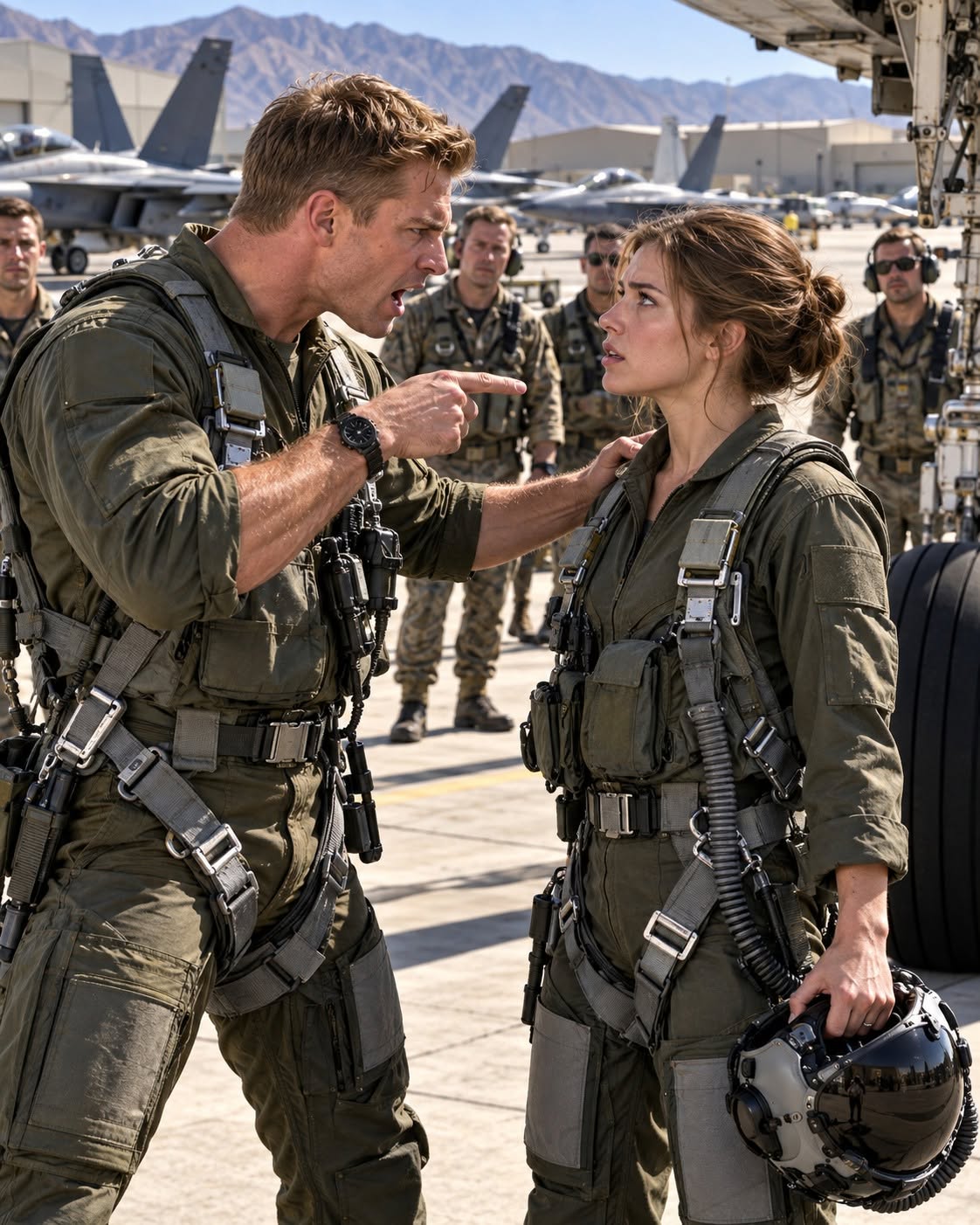
For the next two weeks, our lives became a collection of interviews, statements, medical evaluations, and endless waiting.
The investigation examined everything.
The original intelligence briefing. The enemy positions. The damaged aircraft. The infrared recording. The unauthorized rescue flight.
They even reviewed the communication logs from the moment I ordered the squadron to disengage.
Every word was examined.
Every decision was questioned.
And the most difficult part wasn’t defending myself against the accusations.
It was watching the people I had once flown beside describe me as someone they no longer trusted.
One statement came from a young pilot named Daniel Mercer.
He had been flying behind Kyle during the original engagement.
“I followed Captain Vance’s order,” he wrote. “But I believe we should have tried to recover Major Callahan. I don’t know if I could trust her to make that choice again.”
I read the sentence several times.
I couldn’t blame him.
He had lost someone he respected that day. From his perspective, my order had meant leaving a fellow pilot behind.
What he didn’t know was how close we had come to losing everyone.
I wondered whether he would ever understand.
Then, on the fifteenth day, I received a message from Colonel Briggs.
Report to headquarters. 0900 hours.
I arrived early.
Kyle and Jessica were already waiting outside the conference room.
Neither looked particularly happy to see me.
“Morning,” I said.
Kyle nodded.
Jessica offered a tired smile.
We stood there for a moment before she finally spoke.
“I owe you an apology.”
I turned toward her.
“For what?”
“For the way I treated you after we got back. I said you abandoned him. I said you weren’t fit to lead us.”
She looked down at her hands.
“I didn’t know about the recording. I didn’t know you had spent the entire night trying to find a way to save him.”
I shook my head.
“You were scared.”
“That doesn’t excuse it.”
“No,” I admitted. “But it explains it.”
Kyle exhaled.
“I was angry because I couldn’t do anything. Callahan was the first commander who ever made me believe I could become a good pilot. When I saw his aircraft disappear, I felt useless.”
He looked at me.
“And when you ordered us out, I needed someone to blame.”
“Why me?”
“Because you were the one who made the decision. And because it was easier than admitting I was terrified.”
I understood that feeling more than I wanted to.
For days, I had replayed the moment I gave that order. I had wondered whether I had been too cautious, whether another approach might have worked, whether I had let fear disguise itself as judgment.
But I had never considered that Kyle and Jessica were doing something similar.
They had turned their fear into anger.
I had turned mine into silence.
Neither had helped us.
“I should have told you what I was thinking,” I said. “I should have explained why I made that call when we got back.”
Kyle shook his head.
“You gave us an order. You shouldn’t have needed to defend it to us in the middle of an emergency.”
“Maybe not. But once we were safe, I owed you an explanation.”
Jessica looked between us.
“Are we going to be able to fly together again?”
I didn’t answer immediately.
“I hope so.”
The conference room door opened.
“All three of you,” an officer called. “Come inside.”
Colonel Briggs was seated at the head of the table. Two investigators sat opposite him, and a representative from the command’s legal department had joined them.
There was another person in the room.
Major Thomas Callahan.
He was sitting in a wheelchair, one leg in a brace, with a bandage still visible beneath his uniform sleeve.
For a moment, I couldn’t move.
He looked thinner than I remembered. His face carried the exhaustion of someone who had spent too many days fighting pain.
But he was smiling.
“Morning, Finch.”
I swallowed.
“Sir.”
“Sit down. Apparently, I’ve become the reason everyone is having a very unpleasant month.”
Nobody laughed.
Callahan glanced at Briggs.
“I asked to be present because I have something to say before this investigation reaches its conclusion.”
Briggs nodded.
“Go ahead, Major.”
Callahan placed a document on the table.
“I’ve reviewed the mission recordings, the intelligence reports, and the statements from everyone involved. I also remember what happened before my aircraft went down.”
He looked at me.
“When I lost control of the aircraft, I was already taking fire from three separate positions. My instruments were failing, and I couldn’t maintain formation. I attempted to eject, but the impact threw me against the side of the cockpit.”
He stopped briefly, adjusting his injured leg.
“When I came around, I was on the ground. My radio was destroyed. I had a broken leg, a damaged shoulder, and enemy troops moving through the area.”
Kyle leaned forward.
“How did you send the signal?”
Callahan nodded toward the investigators.
“Emergency survival beacon. The impact had damaged it, but I managed to activate its infrared distress mode manually. It wasn’t designed to transmit continuously. I had to trigger it in short bursts.”
I remembered the three flashes.
“How long were you able to keep it working?” I asked.
“About six hours. After that, the battery started failing.”
Six hours.
That was how much time we had.
Callahan turned back toward Briggs.
“I want the record to reflect something. Captain Vance’s initial withdrawal order was correct. I was in no condition to provide useful support, and the valley was far more heavily defended than our briefing indicated.”
He paused.
“If she had sent the squadron back into that valley, we might have lost four aircraft instead of one.”
Kyle looked down.
Jessica’s face tightened.
Callahan continued.
“But when she discovered I was alive, she tried to organize a rescue. I know she was suspended. I know she broke regulations. I’m not asking this board to ignore that.”
He looked directly at me.
“I’m asking them to understand why she did it.”
Briggs folded his hands.
“Major, you’re not here to determine disciplinary action.”
“I understand, sir. But I am here to explain that the person accused of abandoning me was the only person who actually found me.”
His voice became quieter.
“And she didn’t find me because she was reckless. She found me because she refused to stop looking.”
I felt something tighten in my throat.
I had spent so many nights wondering whether anyone understood what that first retreat had cost me.
Now the man I thought I had failed was sitting across from me, telling the room that he knew.
But Callahan wasn’t finished.
“There’s another issue,” he said.
The investigators exchanged glances.
“What issue?” Briggs asked.
Callahan reached for another document.
“The original intelligence assessment.”
He slid it across the table.
“Someone had classified the valley’s anti-aircraft activity as low probability. That assessment was wrong. Not slightly wrong. Completely wrong.”
One of the investigators nodded.
“We’ve identified discrepancies between the intelligence summary and the raw surveillance data.”
Callahan looked at Briggs.
“Three enemy batteries were visible in the original satellite imagery. They weren’t included in the briefing package.”
The room went silent.
I stared at the document.
Three batteries.
The exact number I had encountered during the first engagement.
“Why weren’t they included?” I asked.
The investigator cleared his throat.
“We’re still determining that. At this stage, we know the final briefing was compiled using an outdated intelligence file. A subsequent update was received but wasn’t incorporated before the mission.”
“Who received it?” Jessica asked.
The investigator hesitated.
“That information is part of a separate review.”
I glanced at Briggs.
His jaw had tightened.
For the first time, I realized the investigation wasn’t only about our decisions.
There were failures much higher up the chain.
And those failures had nearly killed us.
The meeting lasted another hour.
When it ended, Briggs asked us to remain.
The investigators left with Callahan.
Briggs waited until the door closed.
“I’ve spent twenty-five years in command,” he said. “I’ve seen pilots make mistakes because they were afraid. I’ve seen others make mistakes because they wanted to prove they weren’t afraid.”
He looked at each of us.
“And I’ve seen good officers confuse personal loyalty with operational judgment.”
He picked up my report.
“Captain Vance, your initial decision was sound. Your unauthorized flight was not. You exposed yourself and two other pilots to unnecessary danger, even if the mission ultimately succeeded.”
“I understand, sir.”
“Brody. Stanton. You disobeyed direct orders, commandeered aircraft, and entered a hostile area without clearance.”
“Yes, sir,” Kyle answered.
“Do you have anything to say?”
Kyle glanced at me.
“No, sir. I knew what I was doing.”
Jessica nodded.
“Same, sir.”
Briggs closed the report.
“The command has reached a decision.”
My heart began beating faster.
“Captain Vance, your suspension is lifted. You will receive a formal reprimand for the unauthorized flight, and you will be removed from operational command for thirty days while completing additional mission-planning and risk-management training.”
I nodded.
“Understood.”
“Lieutenant Brody and Lieutenant Stanton, both of you will receive formal reprimands and temporary flight restrictions. You will also undergo additional training before returning to combat operations.”
Kyle swallowed.
“Yes, sir.”
Briggs stood.
“None of you are being dismissed. None of you are being promoted. This isn’t a reward for a successful rescue. It is an acknowledgment that good intentions do not erase dangerous decisions.”
He looked at me one final time.
“Do you understand?”
“Yes, sir.”
“Then don’t make me have this conversation again.”
We left his office together.
Outside, Callahan was waiting.
He had been listening to the decision through the partially open door.
“So,” he said, “how does it feel?”
Kyle shrugged.
“Like I got grounded.”
Jessica laughed for the first time in days.
I smiled.
“At least we’re still here.”
Callahan nodded.
“That’s the important part.”
But the story didn’t end with the investigation.
In fact, the most important lesson came several weeks later.
By then, Callahan had begun walking with assistance. My flight restrictions were still in place, and Kyle and Jessica were completing their training.
The squadron had slowly returned to something resembling normal.
People talked to me again.
Some apologized.
Others simply acted as though nothing had happened.
I didn’t expect everyone to trust me immediately.
Trust, I was learning, wasn’t something a commander could demand. It was something earned through repeated decisions, especially the difficult ones.
One afternoon, I was summoned to the briefing room.
A new operational exercise had been scheduled.
The mission involved a simulated downed-aircraft recovery in hostile terrain. Our task was to coordinate surveillance, suppression, and extraction while operating under strict time constraints.
Colonel Briggs would be observing.
I was assigned to lead the planning team.
When I entered, Kyle was already seated near the front. Jessica was beside him. Callahan had joined the briefing as an observer.
The room quieted when I approached the screen.
“All right,” I began. “Before we discuss the route, I want to establish one thing.”
I turned toward the squadron.
“No rescue operation begins with the assumption that someone has to die.”
A few pilots exchanged glances.
“We will identify the threat environment, establish communication procedures, and define our abort conditions before anyone enters the target area. If intelligence changes, the mission changes. If the risk becomes unacceptable, we reassess.”
Kyle raised his hand.
“What if the downed pilot is still alive and time is running out?”
I looked at him.
“Then we move faster. We don’t stop thinking.”
He nodded.
“And if command refuses authorization?”
“Then we present the evidence, request alternatives, and continue pushing through the proper channels. We don’t gamble with other people’s lives because we’re desperate to prove we care.”
Jessica leaned forward.
“What if we still can’t reach them?”
I took a breath.
“Then we make the hardest decision a pilot may ever have to make. We accept that we cannot save everyone by sacrificing everyone.”
Nobody spoke.
I looked around the room.
“But we also don’t stop looking for a better answer.”
The exercise began.
For three hours, the team worked through changing weather, unreliable communications, and unexpected enemy activity.
Twice, I ordered the simulated rescue team to withdraw.
Both times, we regrouped, revised our approach, and returned with a better plan.
At the end, the evaluators gave us the highest score in the unit.
But that wasn’t what stayed with me.
After the briefing, Daniel Mercer approached my desk.
He was the young pilot whose statement had questioned whether he could trust me again.
“Captain?”
“Yes, Daniel?”
He hesitated.
“I read the final investigation report.”
I waited.
“I think I understand your first decision now.”
I nodded.
“Good.”
He looked uncomfortable.
“I still don’t know what I would have done.”
“Neither do I,” I said honestly. “Not until the moment comes.”
He gave a small smile.
“Fair enough.”
As he walked away, I realized something.
Leadership wasn’t about making everyone agree with you.
It was about creating a team capable of questioning decisions without losing faith in one another.
A few days later, Callahan visited me at the flight line.
He was still using a cane, but his recovery was progressing.
He stopped beside my A-10 and looked at the damaged panel that had been replaced after the rescue.
“She’s looking better,” he said.
“She’s flying better, too.”
He smiled.
“Good. I owe that aircraft a thank-you.”
I laughed.
We stood quietly for a moment, watching ground crews move between the hangars.
Then he turned toward me.
“Can I ask you something, Finch?”
“Of course, sir.”
“Back in the valley, when you first received the signal, what made you decide to go?”
I thought about the question.
“I knew you were alive.”
“That isn’t what I asked.”
I looked at him.
He continued.
“Was it guilt? Loyalty? Anger? Or did you simply believe you had to be the one to bring me home?”
I considered each possibility.
“Maybe all of them.”
He nodded.
“That’s what worries me.”
I frowned.
“Sir?”
“You’re a good pilot, Samantha. And you have the instincts of a leader. But I saw what happened when you convinced yourself that nobody else could carry the responsibility.”
He tapped his cane lightly against the concrete.
“You flew into that valley alone because you thought you had to fix everything yourself.”
I didn’t argue.
“That’s not leadership,” he said. “That’s a burden.”
I looked toward the aircraft.
“I couldn’t leave you there.”
“I know. And I’m grateful. But what if the next time you make that decision, the person waiting for you isn’t rescued? What if the next person who follows you never comes home?”
His words settled heavily between us.
“You’re allowed to care about your people,” he continued. “You’re supposed to care. But you cannot make yourself the only person responsible for saving them.”
I looked down.
For weeks, I had believed my greatest failure was retreating from the valley.
Then I believed my greatest failure was flying back without authorization.
Now I was beginning to understand that the real danger had been something else.
I had allowed the need to save someone to become more important than the responsibility to protect everyone.
And those were not always the same thing.
“Thank you, sir,” I said.
Callahan nodded.
“Don’t thank me. Just remember it.”
A month after the rescue, the squadron held a small gathering to welcome Callahan back to active administrative duty.
He wasn’t cleared to fly yet, but the doctors believed he would eventually return to the cockpit.
There were no speeches at first.
Just food, a few drinks, and the familiar noise of pilots pretending they hadn’t missed one another.
At some point, Kyle approached me.
He held two cups of coffee.
“Thought you might need one.”
I accepted it.
“Thanks.”
He stood beside me, looking toward the others.
“Can I ask you something?”
“Go ahead.”
“Did you ever resent us for coming after you?”
I shook my head.
“No.”
“Even after everything?”
“Especially after everything.”
He looked confused.
I smiled faintly.
“Because you didn’t come after me to prove I was wrong. You came because you finally understood what I was trying to do.”
Kyle considered that.
“I think I owe you another apology.”
“You’ve already apologized.”
“Not for the argument. For making you think you had to carry everything alone.”
I looked at him.
“That one might take longer to forgive.”
He laughed.
“Fair.”
Jessica joined us a moment later.
She raised her cup.
“To the worst unauthorized rescue operation in squadron history.”
Kyle shook his head.
“Don’t say that too loudly. Someone might give us an award.”
I laughed.
For the first time since Zarash Valley, it felt as though the squadron was whole again.
Not because we had forgotten what happened.
Because we had finally learned how to talk about it.
Later that evening, Colonel Briggs approached me.
He handed me a sealed envelope.
“Your new assignment.”
I opened it.
The document stated that I had been selected to lead a specialized aircrew training program focused on combat decision-making, rescue coordination, and operational leadership.
I looked up.
“Sir, I thought I was still under review.”
“Your disciplinary action is complete. Your performance during the subsequent exercises was noted.”
He paused.
“Your experience in Zarash Valley also made you uniquely qualified for this position.”
I glanced down at the letter again.
“Thank you, sir.”
“Don’t thank me yet. It’s a difficult assignment.”
“I understand.”
Briggs studied me for a moment.
“One more thing, Captain.”
“Sir?”
“I read the statement you submitted after the rescue. The part about leadership being the responsibility to accept consequences.”
I waited.
“I think you should keep that sentence.”
He turned to leave, then stopped.
“But add something.”
“What would that be?”
He looked back.
“Leadership is also the responsibility to make sure your people never have to guess whether you value their lives.”
I thought about Kyle and Jessica.
About Callahan.
About the three pilots who had once believed I had abandoned their commander.
“Yes, sir,” I said.
“I’ll remember that.”
Six months later, I stood in front of a new group of pilots.
They were young, confident, and convinced that courage meant never backing away from a fight.
I recognized the look in their eyes.
I had worn it myself once.
The final lesson of the training program was called The Decision to Return.
I showed them the footage from the first mission.
The moment Callahan’s aircraft disappeared.
The enemy positions.
The order to disengage.
Then I showed them the infrared signal.
Three flashes.
A pause.
Three more.
I stopped the recording.
“This,” I said, pointing toward the screen, “is where most people think the story begins.”
I turned toward them.
“But it doesn’t.”
I explained the first retreat. The arguments. The suspension. The unauthorized flight. The rescue. The investigation.
I didn’t leave out my mistakes.
I told them how close I had come to losing my aircraft and how Kyle and Jessica had risked their lives to help me.
I told them about the intelligence failures and the importance of questioning incomplete information.
Then I gave them the question that had haunted me for months.
“What does it mean to be a good leader when every available choice has a cost?”
One pilot raised his hand.
“Doesn’t it mean choosing the option that saves the most lives?”
“Usually,” I answered. “But real situations aren’t always that simple. You have to consider the mission, the people involved, the information available, and the consequences of acting or refusing to act.”
Another pilot asked, “So how do you know when you’re making the right decision?”
I looked at the room.
“You don’t always know.”
The young pilot frowned.
“Then what’s the point of being in command?”
I smiled slightly.
“The point is to make the best decision you can with the information you have, to explain your reasoning when there’s time, and to accept responsibility when the outcome isn’t what you hoped.”
I paused.
“And never confuse a willingness to die with the ability to lead.”
Nobody moved.
I continued.
“Sometimes courage means flying into the storm. Sometimes it means turning away because the people behind you are counting on you to bring them home. And sometimes it means admitting you were wrong before your mistake costs someone else their life.”
I looked toward the back of the room.
Callahan was standing there, watching.
He gave me a small nod.
I turned back to the pilots.
“Your job isn’t to be fearless. Your job is to think clearly when fear is trying to make your decisions for you.”
After the class ended, one of the youngest pilots approached me.
“Captain, can I ask something?”
“Sure.”
“If Major Callahan had died before you found him, would you still believe your first decision was right?”
The question caught me off guard.
I considered it for a long moment.
“Yes,” I finally said. “Because a decision isn’t automatically wrong just because the outcome hurts. And it isn’t automatically right just because everything works out.”
He nodded slowly.
I continued.
“I would have mourned him. I would have questioned myself. I probably would have replayed that mission for the rest of my life. But I would still have known that I made the first decision to protect the people entrusted to me.”
“And the second decision?”
I smiled faintly.
“That one would always remind me that doing the right thing and doing it the right way are not necessarily the same.”
He thanked me and walked away.
I remained in the room for a few minutes after everyone had left.
The screen was still displaying the final image of the infrared recording.
Three flashes.
A pause.
Three more.
I had watched that signal hundreds of times.
At first, it had represented a desperate plea from a man trapped behind enemy lines.
Later, it had become the reason I risked everything to bring him home.
Now it meant something different.
It reminded me that people could be lost without being forgotten.
That fear could turn teammates against one another.
That good intentions could lead to terrible mistakes.
And that leadership was never about being the person who made the fewest mistakes.
It was about being the person willing to learn from them, take responsibility for them, and make better decisions the next time someone depended on you.
That evening, I walked out to the flight line.
My A-10 was parked beneath the fading sunlight, its freshly repaired wings catching the last orange light of the day.
I climbed the ladder and rested one hand against the cockpit.
For a moment, I remembered the sandstorm.
The missile warning.
The damaged engine.
Kyle’s voice cutting through the static.
Jessica calling out the enemy positions.
And Callahan being lifted from the ground.
I remembered how certain I had been that morning that I might never return.
Then I remembered something even more important.
We had all come home.
Not because one person had been fearless.
Not because every decision had been perfect.
But because, eventually, we had learned to trust one another again.
Kyle and Jessica were back on flight status. Callahan was preparing for his medical clearance. And I had found a new way to serve the people I once believed I could only protect from inside a cockpit.
Before leaving, I looked toward the distant horizon.
The sky was clear.
For the first time in a long while, I didn’t feel the need to prove anything to it.
My call sign was Finch.
I had once believed that being a good pilot meant never turning away from a fight.
I had been wrong.
Then I believed being a good leader meant carrying every burden alone.
I had been wrong about that, too.
Now I understood something I wished someone had taught me before Zarash Valley.
A leader is not measured by how many times they are willing to risk their life.
A leader is measured by how carefully they protect the lives placed in their hands, how honestly they own their mistakes, and how much they are willing to learn when the world proves them wrong.
There will always be people who mistake restraint for weakness.
There will always be moments when the right decision looks like the wrong one to everyone watching.
And there will always be choices that leave scars, no matter which direction you turn.
But courage isn’t simply the willingness to fly into danger.
Sometimes, courage is knowing when to pull your people back.
Sometimes, it’s finding a way to return for someone who hasn’t given up.
And sometimes, it’s standing before the people who once doubted you and admitting that you still have more to learn.
I climbed down from the aircraft and headed toward the hangar.
Behind me, the evening wind moved gently across the runway.
Tomorrow, another mission would come.
Another decision would have to be made.
And if there was one thing I knew for certain, it was this:
I would never again mistake being willing to sacrifice everything for my squadron with being worthy of leading it.
Because bringing your people home was never about proving how brave you could be.
It was about remembering why they trusted you with their lives in the first place.
And sometimes, the greatest victory a pilot can bring home isn’t an enemy destroyed or a mission completed.
It’s the sound of every voice answering roll call when the aircraft land.
Every single one.
THE END