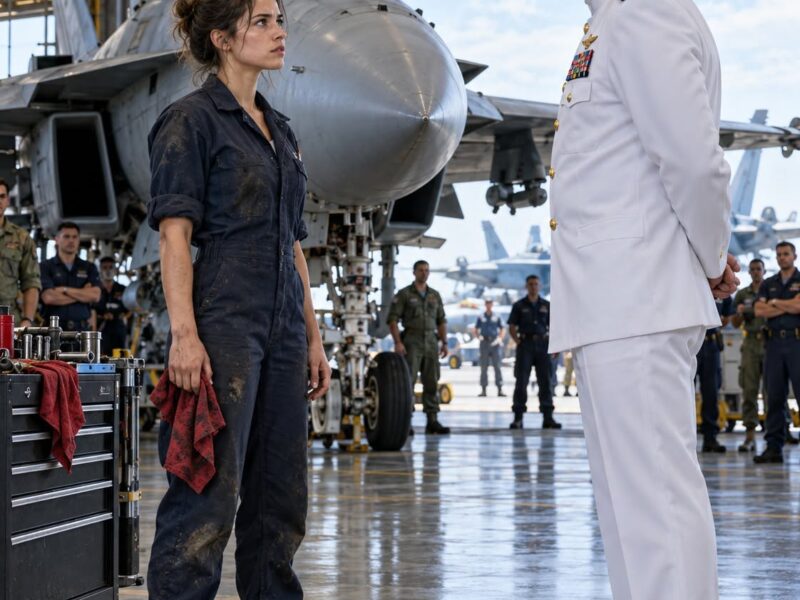
The moment Ensign Eli Park’s voice cracked over the radio, every person in the operations room at Naval Air Station Oceana knew something was terribly wrong.
The hangar was so quiet I could hear the rain beginning to tap against the metal roof.
I looked at Rear Admiral Whitfield, then at the officers standing behind him.
For years, I had learned to keep my head down, do my job, and let other people take credit for decisions that kept aircraft and their crews safe. I had convinced myself that staying out of the spotlight was easier than constantly explaining why I belonged in rooms where people had already decided I didn’t.
But Ensign Park’s voice was still somewhere in my memory.
I’m losing my horizon.
I knew there would be another pilot someday. Another night when the weather changed faster than expected. Another officer who believed admitting uncertainty was a sign of weakness.
And I knew that if I walked away now, I might spend the rest of my life wondering whether I could have prevented it.
“Yes, Admiral,” I finally answered. “I’ll accept the assignment.”
Whitfield nodded slowly.
“Good. Because I wasn’t asking you to come here and make friends. I was asking you to help us make sure this never happens again.”
He turned toward Callahan.
“Lieutenant Commander, my office. Ten minutes.”
Callahan’s jaw tightened.
“Yes, Admiral.”
As the admiral walked away, the officers began to disperse. Some looked at me with curiosity. Others looked uncomfortable. A few offered small nods, the kind people give when they aren’t yet sure whether they should respect you.
I didn’t mind.
Respect that comes from a single dramatic moment rarely lasts. I wanted something more substantial.
I wanted a system where the next person who noticed a dangerous weather pattern wouldn’t have to fight for permission to be heard.
That afternoon, I received my new assignment.
My official title was Senior Flight Safety and Training Officer, attached directly to the air station’s operations command. I would review weather-related flight authorizations, evaluate risk assessments, assist with pilot training, and report safety concerns directly to the admiral’s office when necessary.
It was a position with considerable responsibility.
It was also a position that immediately made me unpopular.
By the end of my first week, I understood why Whitfield had warned me.
Some pilots regarded me as an outsider. Others believed my appointment was a political reaction to the incident. A few were convinced I had been given the job because the admiral wanted someone to blame if anything else went wrong.
The most difficult reaction came from the officers who had previously ignored me.
They were polite now.
Painfully polite.
They called me ma’am in meetings, waited for me to finish speaking, and then quietly questioned my recommendations after I left the room.
One afternoon, I found a handwritten note tucked beneath my office door.
STAY IN YOUR LANE.
There was no signature.
I read it twice, folded it, and placed it in my desk drawer.
Then I returned to reviewing the flight schedule.
I had no interest in discovering who wrote it.
I had more important things to do.
My first major initiative was a complete review of the squadron’s weather-related flight procedures.
The review uncovered problems that went far beyond the night Park nearly lost his aircraft.
Weather observations were not always updated before launch decisions. Some pilots relied on forecasts that were several hours old. In a few cases, changes in visibility had been recorded but never communicated to the officers responsible for authorizing departures.
The system had become comfortable with assumptions.
And assumptions, I had learned, were among the most dangerous things in aviation.
I proposed three changes.
First, every flight authorization involving marginal weather would require a documented review of current conditions, not simply the original forecast.
Second, any crew member or operations specialist could request an immediate safety review without fear of professional retaliation.
Third, every pilot would receive additional training on spatial disorientation, instrument interpretation, and the psychological effects of flying without a visible horizon.
The third recommendation generated the most resistance.
During a briefing, Lieutenant Commander Callahan finally spoke.
He had returned to regular duties following the initial investigation, although his authority over flight clearances had been temporarily restricted.
“With respect, ma’am, these pilots are already trained professionals. We don’t need to turn every weather briefing into a classroom exercise.”
I looked at him.
“Professional pilots are precisely the people who should understand how quickly conditions can overwhelm experience.”
He shifted in his chair.
“Are you suggesting our training has been inadequate?”
“I’m suggesting that training is only useful if we keep improving it.”
A few officers exchanged glances.
Callahan leaned back.
“Some of us have spent our entire careers in the cockpit. We understand what these situations look like.”
I nodded.
“Then you should have no difficulty recognizing the value of preparing for them.”
The room went quiet.
I continued through the presentation.
I didn’t raise my voice. I didn’t mention his earlier comments about leaving the flying to the pilots.
I didn’t need to.
The documents on the screen contained the evidence.
Over the next several weeks, I worked with instructors to develop practical training scenarios. We used controlled simulators to recreate the conditions that had nearly caused Park’s aircraft to crash.
The goal wasn’t to frighten pilots.
It was to teach them how easily their senses could deceive them and how important it was to trust reliable instruments when their bodies were telling them something different.
Ensign Park volunteered for the first training session.
When I saw his name on the roster, I wasn’t surprised.
He arrived early, carrying a notebook.
“Ma’am, I wanted to thank you again.”
“You already did that.”
“I know. But I don’t think I ever explained what happened after I landed.”
I set down the folder I was holding.
“Go ahead.”
He hesitated.
“When the wheels touched the runway, I realized my hands were shaking. I couldn’t even release the controls properly. The ground crew had to help me out.”
He looked down at his notebook.
“I kept thinking about how close I came to making the wrong correction. I thought I was pulling the aircraft out of danger. In reality, I was making everything worse.”
I listened without interrupting.
“That night, I thought I was going to die,” he continued. “And the worst part was that I couldn’t trust my own body.”
“That’s what makes spatial disorientation so dangerous,” I said. “It doesn’t feel like confusion. It feels like certainty.”
He looked up.
“Exactly.”
I pulled a chair toward him.
“Then let’s make sure the next pilot recognizes that feeling before it’s too late.”
He nodded.
From that day forward, Park became one of the most committed participants in the training program.
He wasn’t the most experienced pilot in the squadron, but he had something valuable that many experienced officers lacked.
He remembered what it felt like to be vulnerable.
And he wasn’t embarrassed to talk about it.
Meanwhile, the investigation into the original flight continued.
Rear Admiral Whitfield had ordered an independent review of the launch authorization, the weather reports, and the chain of communication leading up to the departure.
I was interviewed twice.
Both times, I provided the same information.
I had observed the deteriorating conditions.
I had submitted my recommendations.
I had documented the updated readings.
And I had been overruled.
The investigators asked whether I believed Lieutenant Commander Callahan had intentionally disregarded the warnings.
I considered the question carefully.
“I believe he made a decision based on confidence that wasn’t supported by the available information,” I answered. “Whether that was intentional or careless is something your investigation should determine.”
One investigator looked at me.
“You’re being very careful with your words.”
“I am. Because this isn’t about whether I dislike Lieutenant Commander Callahan. It’s about why the decision-making process failed.”
The investigator made a note.
A week later, I was called into the admiral’s office.
Whitfield stood beside his desk, holding a thick folder.
“Have a seat.”
I sat down.
He opened the folder and slid several pages toward me.
“The investigation is complete.”
I glanced at the first page.
The findings were worse than I expected.
The weather deterioration had been documented accurately. My warnings had been received. The updated visibility readings had been available before launch.
The decision to proceed had been made despite those warnings.
More importantly, the investigation found that Callahan had previously dismissed two other weather-related concerns raised by junior personnel.
Neither had resulted in an emergency, but both had demonstrated the same pattern.
He had treated disagreement as a challenge to his authority.
“What’s going to happen to him?” I asked.
“He’s being removed from flight authorization responsibilities. He’ll face formal administrative action and additional leadership evaluation before any consideration of returning to command duties.”
I nodded.
Whitfield closed the folder.
“There’s something else.”
I waited.
“Callahan requested a private meeting with you.”
I wasn’t expecting that.
“Why?”
“He didn’t explain. But I think you should hear him out.”
I looked through the office window toward the runway.
“All right.”
The meeting took place the following morning in my office.
Callahan entered without the confident expression I had grown accustomed to seeing.
He looked tired.
For several seconds, neither of us spoke.
Finally, he pulled out the chair opposite my desk.
“I owe you an apology.”
I remained silent.
He looked down at his hands.
“I’ve spent a lot of time reviewing that night. At first, I told myself the forecast was wrong. Then I told myself Park had panicked. I even convinced myself that the situation could have happened to anyone.”
He took a breath.
“But the reports were clear. You warned me. Twice.”
I folded my hands on the desk.
“Yes, sir.”
His eyes lifted.
“I dismissed you because I thought I knew more than you did.”
“That wasn’t the only problem.”
He frowned slightly.
“No?”
“You dismissed the information because you didn’t respect the person delivering it. If another officer with gold wings had brought you the same report, would you have listened?”
He didn’t answer immediately.
Then he shook his head.
“Probably not.”
That honesty surprised me.
“I’ve spent my entire career believing leadership meant being decisive,” he said. “I thought hesitation made people lose confidence in me.”
“Leadership isn’t about never being wrong, Commander. It’s about recognizing when you might be wrong before someone pays for it.”
He looked toward the window.
“Park could have died.”
“Yes.”
“And you saved him.”
“I gave him information he needed. He was the one who flew the aircraft home.”
Callahan slowly nodded.
“I don’t expect you to forgive me.”
“I didn’t say I wouldn’t.”
He looked at me.
“But forgiveness doesn’t mean there shouldn’t be consequences,” I continued. “You have to accept what happened, and you have to make sure you never put another pilot in that position.”
For the first time since I had known him, he didn’t have an immediate response.
He stood.
“Understood.”
At the door, he paused.
“One more thing. The admiral told me about your record.”
I waited.
“Why didn’t you tell anyone?”
I looked at the photograph on my desk.
It was an old picture of an aircraft carrier flight deck, taken years earlier. The edges had faded, but the people standing beside the aircraft were still recognizable.
“Because I thought my assignment here was about the work I was doing now. I didn’t believe my past should give me special treatment.”
Callahan considered that.
“Maybe I should have asked before making assumptions.”
“Maybe you should have.”
He left without another word.
I didn’t feel triumphant.
I felt relieved that, for once, a difficult conversation had ended with someone willing to listen.
But the most unexpected part of the story came three weeks later.
I received a call from the admiral’s office.
Whitfield wanted me to attend a meeting with a visiting delegation from Naval Aviation headquarters.
I assumed they were coming to inspect the new safety procedures.
Instead, I walked into a conference room and found an older captain waiting beside the window.
For a moment, I couldn’t move.
Captain Daniel Mercer.
He had been my commanding officer during the most defining years of my flying career.
He looked almost exactly as I remembered him, although his hair had turned completely white.
He smiled when he saw me.
“Well, I’ll be damned.”
I laughed softly.
“Captain.”
He walked over and shook my hand.
“I heard what happened at Oceana.”
“News travels.”
“Especially when someone with your call sign suddenly appears on an emergency frequency.”
I looked at Whitfield.
The admiral smiled.
“I thought you two might have something to discuss.”
Mercer pulled out a chair.
“Sit down. We have a lot of catching up to do.”
I sat.
He studied my face for a moment.
“I’ve been trying to get you back into aviation leadership for years.”
I blinked.
“What?”
“After your last operational assignment, I recommended you for several positions. But every time I heard your name, you seemed to be moving into something quieter.”
I looked away.
There was a reason for that.
Years earlier, I had been an operational naval aviator. I had earned my wings, flown difficult missions, and served alongside some of the finest people I had ever known.
My call sign had been earned during a particularly demanding deployment.
They called me NORTHSTAR.
Not because I never made mistakes, but because I had a habit of keeping my head when everyone else was struggling to find direction.
During one night operation, our flight encountered unexpected weather and communications problems. A fellow pilot became disoriented while attempting to return to the carrier.
I had helped coordinate the recovery and guided the aircraft back using its instruments and the available navigation information.
The incident became part of my operational record.
But the years that followed were not simple.
A serious training accident involving another aircraft had left me questioning whether I could continue flying without carrying the weight of every risk on my shoulders.
I eventually stepped away from operational flying and moved into flight operations and safety work.
I had never considered that decision a failure.
It was simply a different way to serve.
Mercer leaned forward.
“Do you remember what I told you after that night operation?”
I smiled faintly.
“You said that the best pilots aren’t the ones who never get scared.”
He nodded.
“They’re the ones who can think clearly while they’re scared.”
He paused.
“And you were one of those pilots. You still are.”
I looked at him.
“What does this have to do with the delegation?”
Whitfield answered.
“Naval Aviation is considering expanding the flight safety initiative across several installations. They want an officer to help develop the program and oversee its implementation.”
I stared at him.
“You want me to lead it?”
“We do.”
For the first time in a long while, I didn’t know what to say.
Mercer smiled.
“You spent years making yourself smaller because you thought that was the most useful way to serve. Maybe it’s time you stopped.”
I looked down at my hands.
I thought about the night Park had called for help.
I thought about the warnings I had submitted, the meetings where people ignored me, and the years I had spent believing that remaining invisible was a reasonable price for doing meaningful work.
Then I thought about the pilots who would eventually benefit from a better system.
“Give me a week,” I said.
Whitfield nodded.
“Take the time you need.”
That week became one of the most important of my life.
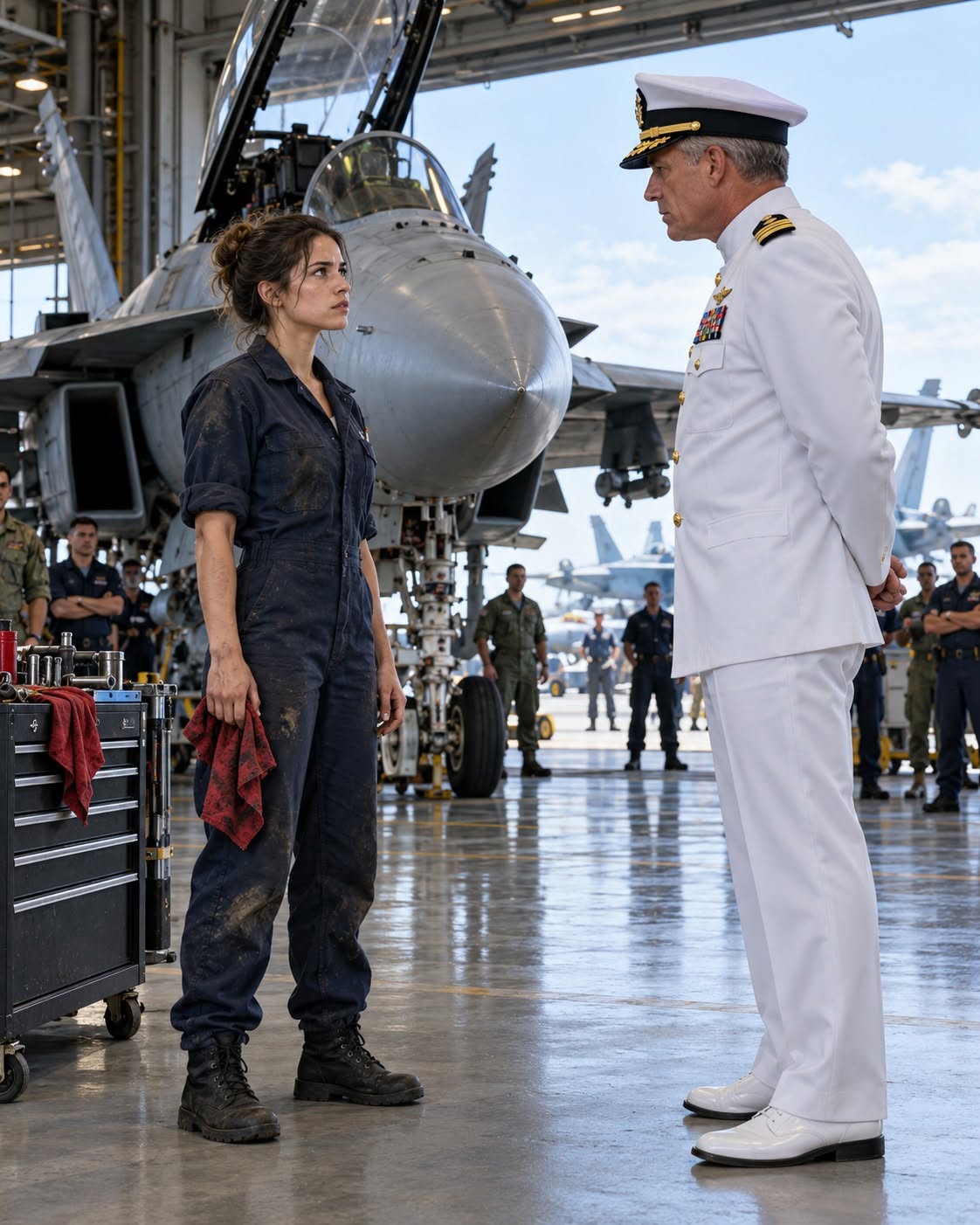
I walked through the hangar early one morning, before the day’s operations began.
Aircraft stood in their designated spaces, their surfaces catching the pale light coming through the open doors.
Ground crews moved between them, checking equipment and preparing for another day.
I stopped beside one aircraft and placed my hand against its cool fuselage.
I remembered the first time I had worn my flight suit.
I remembered the excitement of earning my wings.
I remembered the people who had trusted me with their lives.
And I remembered the moment I had decided that leaving the cockpit meant leaving an important part of myself behind.
For years, I had treated my past like something that belonged in a locked drawer.
Now I understood that experience didn’t lose its value simply because the uniform changed.
I accepted the position.
The transition wasn’t easy.
The new program required months of coordination, budget approvals, instructor training, and cooperation between installations.
There were setbacks.
There were arguments.
There were officers who questioned whether a woman with a non-flying operations assignment should be directing changes to aviation training.
But there were also people who surprised me.
Junior pilots began submitting safety observations without waiting for someone senior to ask.
Operations specialists started speaking up when weather data changed.
Instructors shared mistakes they had once been afraid to discuss.
Slowly, the culture began to change.
And Lieutenant Commander Callahan did something I hadn’t expected.
He volunteered to assist with the leadership training program.
His first presentation was uncomfortable.
He stood in front of a group of junior officers and explained how his decision had nearly cost a pilot his life.
He didn’t blame the forecast.
He didn’t blame the equipment.
He didn’t blame Park.
He described the warnings he had ignored and the assumptions that had influenced his judgment.
At the end, one young lieutenant raised her hand.
“Sir, what should we do if our commanding officer refuses to listen to a safety concern?”
Callahan paused.
Then he answered.
“You document it. You elevate it through the proper channels. And if the situation requires immediate action, you keep speaking up.”
The lieutenant nodded.
Callahan looked around the room.
“And if you’re the commanding officer, you remember that rank doesn’t make you immune to being wrong.”
I watched from the back.
It wasn’t a perfect apology.
It didn’t erase what had happened.
But it was a beginning.
Several months passed.
The new training program expanded to additional units, and our procedures became part of a broader flight safety initiative.
Ensign Park completed his advanced training and returned to regular flight duties.
On the day he received his next qualification, he came to my office carrying a small framed photograph.
It showed his aircraft parked safely on the runway after the emergency landing at Norfolk.
Someone had written a message along the bottom.
TRUST THE INSTRUMENTS. TRUST YOUR TRAINING. NEVER STOP LISTENING.
He placed it on my desk.
“I thought you should have this.”
I smiled.
“That’s a good photograph.”
“I wanted to add something.”
He turned the frame around.
On the back, he had written a few lines.
TO NORTHSTAR,
THANK YOU FOR REMINDING ME THAT SURVIVING A BAD NIGHT IS ONLY THE BEGINNING. WHAT MATTERS IS WHAT YOU DO WITH THE NEXT MORNING.
I read it twice.
Then I looked at him.
“Who told you that call sign?”
He smiled.
“The admiral. And I asked Captain Mercer about it.”
“Of course you did.”
Park laughed.
Then his expression became serious.
“Ma’am, can I ask you something?”
“Certainly.”
“Do you ever miss flying?”
I looked toward the runway.
An aircraft was beginning its takeoff roll, its engines growing louder as it accelerated down the pavement.
“Every day,” I answered.
He nodded.
“Then why don’t you go back?”
I thought about that question.
“Because flying isn’t the only way to protect the people who fly.”
He considered my answer.
“Do you regret leaving?”
I took a moment before responding.
“No. But I regret believing that I had to leave my experience behind when I changed assignments.”
Park smiled.
“I think that’s something people should hear.”
“Then remember it when you’re the one responsible for making decisions.”
He gave a respectful nod and left.
A few days later, I received an invitation to attend a ceremony recognizing the new flight safety program.
The ceremony was held inside the same hangar where Admiral Whitfield had first asked for my name and call sign.
This time, the room was filled with pilots, maintenance personnel, operations specialists, and senior officers from several installations.
Whitfield stood at the podium.
He spoke about the importance of preparation, accountability, and the responsibility leaders carried when they authorized a flight.
Then he called me forward.
I walked to the front.
The admiral handed me a small presentation case.
Inside was a set of gold naval aviation wings.
For a moment, I couldn’t speak.
I looked at him.
“Admiral, I already earned these.”
He smiled.
“I know. These aren’t being awarded to you for earning your wings. They’re being presented in recognition of the years you’ve spent protecting the people who wear them.”
The room began to applaud.
I accepted the case.
But before Whitfield stepped away, I turned toward the audience.
“May I say something?”
He nodded.
I moved closer to the microphone.
“I’ve been called a lot of things during my career. Pilot. Officer. Instructor. Operations specialist. Some of those titles came with respect. Others came with assumptions.”
I glanced toward the back of the room.
Callahan was standing beside Park.
“Last year, I sat in an operations room and watched a young pilot fight to keep his aircraft in the sky. I had information that could help him, but the people around me didn’t know my history. They saw my uniform and decided what I was capable of.”
I paused.
“That night reminded me of something important. Experience isn’t always visible. The person who notices the danger might not be the person with the highest rank. The person who has the right answer might not be the person everyone expects to speak.”
The room was completely silent.
“Every member of an aviation team has a responsibility to protect the people who trust us. That responsibility doesn’t disappear because someone is junior, because someone works behind a desk, or because their uniform looks different from ours.”
I looked directly at the young officers in the audience.
“Never confuse authority with infallibility. Never confuse confidence with competence. And never ignore a warning simply because it comes from someone you haven’t bothered to understand.”
I closed the presentation case.
“Most importantly, when someone tells you something is wrong, listen before you decide they don’t belong in the conversation.”
The applause that followed was louder than I expected.
But I wasn’t listening to the applause.
I was looking at Park.
He was standing straight, his expression serious, his eyes fixed on me.
And beside him, Callahan was applauding too.
Not because the admiral was watching.
Not because anyone had instructed him to.
He was simply acknowledging a lesson he had learned the hard way.
After the ceremony, people gathered around me.
Some wanted to discuss the training program. Others asked about my flying career. A few apologized for having underestimated me during my early days at Oceana.
I accepted their words without making a ceremony out of them.
Then, just as the crowd began to thin, Whitfield approached.
“There’s something I never told you,” he said.
I raised an eyebrow.
“What is it?”
He glanced toward the hangar doors.
“Before I arrived at Oceana, I reviewed your service record. I knew who you were. I knew about Northstar.”
I stared at him.
“Then why didn’t you say anything?”
“Because I wanted to see whether you would step forward without being reminded of your reputation.”
I considered that.
“That seems like a dangerous test.”
He laughed quietly.
“It was. But I also wanted to understand something. You had been doing excellent work for years without anyone giving you the recognition you deserved.”
He looked at the wings in my hand.
“I hope this makes up for some of that.”
I shook my head.
“Recognition is appreciated, Admiral. But I’d rather make sure the next person doesn’t have to wait until an emergency to be heard.”
Whitfield nodded.
“That’s exactly why we need you.”
As he walked away, I remained in the hangar for a few more minutes.
The afternoon sun stretched across the concrete floor.
Somewhere outside, an aircraft engine started.
I thought about the woman I had been before that night.
The woman who had believed silence was the easiest way to avoid being judged.
The woman who had convinced herself that being underestimated was simply part of the job.
I wished I could go back and tell her something.
You don’t have to announce your worth to everyone.
You don’t have to turn every insult into an argument.
You don’t have to prove your history every time someone questions your ability.
But when the moment comes, don’t let someone else’s assumptions silence you.
Because sometimes the difference between a safe landing and a tragedy is a person willing to speak when everyone else is waiting for permission.
A few months later, I received a letter from Ensign Park.
He had been assigned to a new unit and was preparing for his next operational deployment.
The letter was short.
He wrote that he still remembered the darkness of that night. He remembered the feeling of losing his horizon, the overwhelming certainty that his body was right, and the fear that he would never make it home.
But he also remembered the voice that cut through the confusion.
Calm.
Precise.
Certain.
He said that during a recent training exercise, another pilot had become disoriented in the simulator. Park had recognized the signs and helped him recover.
The instructor later told him that his intervention had made the difference between a failed exercise and a successful recovery.
At the bottom of the letter, he had written:
“I finally understand what you meant when you said that we don’t just fly for ourselves. We fly for the people who trust us to bring each other home.”
I folded the letter carefully and placed it inside the same drawer where I had kept the anonymous note telling me to stay in my lane.
I looked at the two pieces of paper together.
One represented everything people had assumed about me.
The other represented what could happen when someone chose to listen.
I closed the drawer.
The next morning, I arrived at the operations building before sunrise.
A new group of pilots was preparing for training.
One of the junior officers stood beside the weather board, studying an updated report.
He noticed me approaching and straightened.
“Good morning, ma’am.”
“Morning. How are the conditions?”
He looked at the screen.
“There’s a possibility of deteriorating visibility later this afternoon. The current forecast is acceptable, but the latest observations suggest it could change.”
“Have you raised the concern?”
“Yes, ma’am. I sent an updated assessment to the flight commander.”
“Good.”
He hesitated.
“Do you think they’ll delay the exercise?”
I studied the readings.
“I don’t know. That’s a decision for the responsible officers. But you’ve done the right thing by making sure they have the information.”
He nodded.
Then he asked something I hadn’t expected.
“Ma’am, do you think people will actually listen?”
I looked at him.
“Some will. Some won’t. But you have to make sure the information reaches them. And if the risk becomes unacceptable, you keep speaking through the proper channels.”
He smiled slightly.
“Understood.”
I continued toward my office.
Behind me, the junior officer returned to the weather board.
For a moment, I stopped and looked back.
He was no longer standing there wondering whether he was important enough to raise a concern.
He was doing his job.
And that was the real victory.
Not the ceremony.
Not the gold wings.
Not the admiral’s recognition or the change in Callahan’s attitude.
It was the fact that a young officer at a naval air station could now speak about a dangerous condition without first wondering whether his rank gave him permission to care.
I had spent much of my career believing that leadership meant being the person everyone looked to when things went wrong.
Now I understood something more important.
Real leadership means building a place where fewer things go wrong in the first place.
It means creating an environment where people can admit uncertainty, question assumptions, and speak up before a mistake becomes irreversible.
And it means remembering that the most important voice in the room isn’t always the loudest, the highest-ranking, or the one wearing the most impressive uniform.
Sometimes, it’s the quiet voice at the back of the room.
The one that has been watching carefully.
The one that noticed the clouds changing.
The one that knows when something isn’t right.
And the one that finally decides to speak.
Because courage isn’t always climbing into a cockpit and flying into the darkness.
Sometimes, courage is standing in a room full of people who have already dismissed you and saying, calmly and clearly, “Stop. Something is wrong.”
That morning, as the first aircraft lifted into the pale Virginia sky, I stood beside the operations window and watched it disappear into the clouds.
For the first time in years, I didn’t feel like I was standing outside the life I had once known.
I understood that I had never really left it.
I had simply found another way to serve.
And somewhere above the coastline, a pilot was flying with better training, better information, and a team that understood the importance of listening.
I smiled.
My call sign had always been Northstar.
But I had finally learned that being a guiding light doesn’t mean you have to be the one in the sky.
Sometimes, it means making sure everyone else can find their way home.