The last time my parents spoke to me, they called me selfish because I refused to give my lottery winnings to my younger brother.
I looked at Grace for a long moment.
“Honestly? I don’t know.”
She squeezed my hand.
“Then don’t make a decision because you feel guilty. Make one because it’s what you want.”
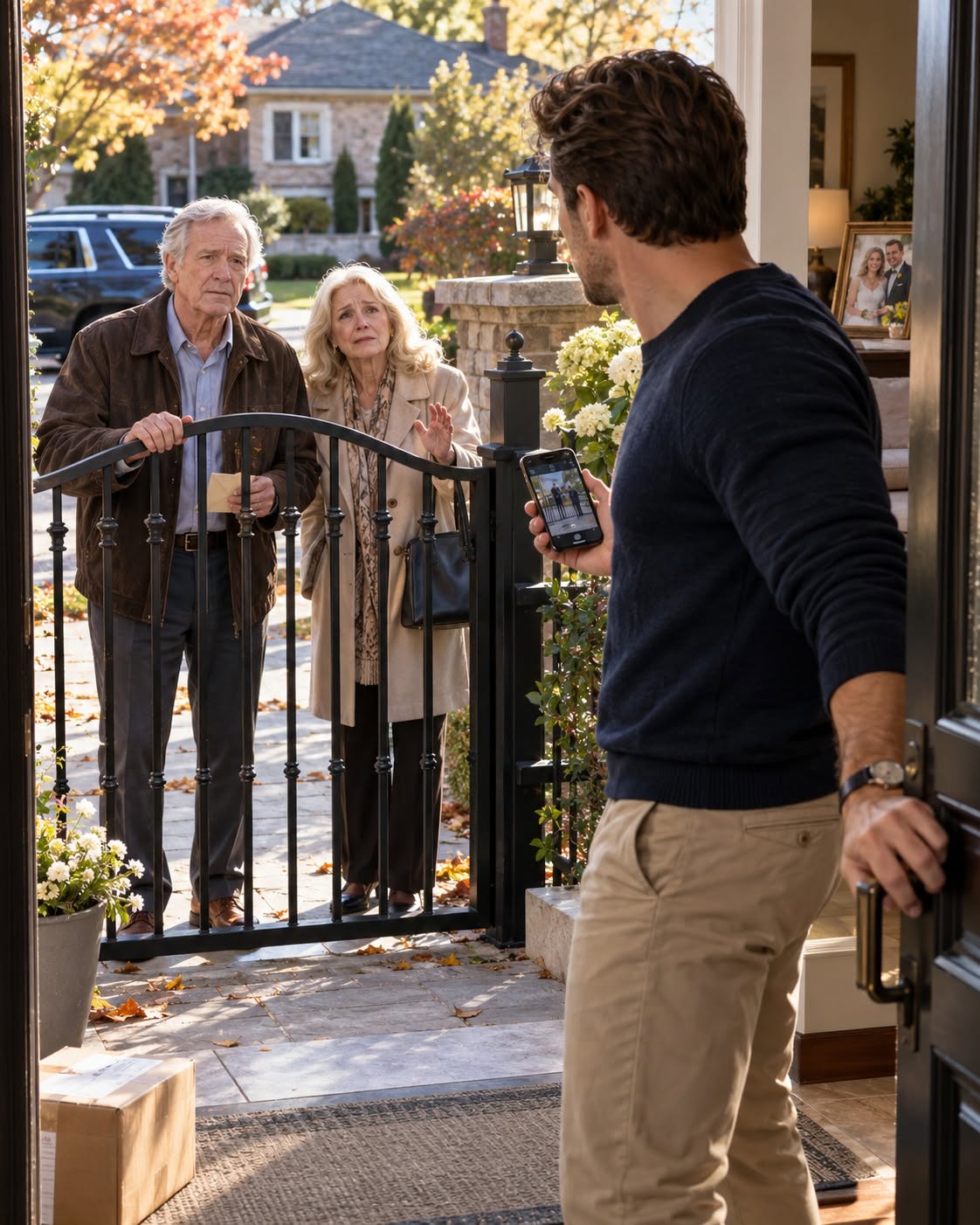
I looked back at the security monitor. My parents were still standing outside the gate, waiting. Five years ago, I would have rushed to open it. I would have worried about disappointing them, upsetting them, or being called selfish again.
But I wasn’t that person anymore.
“Let them in,” I finally said. “But we’re having this conversation in the garden. I’m not inviting them into our home.”
Grace nodded.
I pressed the gate release.
My parents walked up the driveway slowly, as if they weren’t entirely sure they were welcome. My mother kept looking at the house, then at the garden, then at the expensive-looking security system near the front entrance.
My father tried to smile.
“Lucas. It’s good to see you.”
I stood with my arms folded.
“You’ve seen me. Now tell me why you’re here.”
My mother looked hurt by my tone.
“Is that how you’re going to greet your parents after all these years?”
I almost laughed.
“Five years ago, you told me I was selfish because I wouldn’t give Caleb my lottery winnings. You didn’t call once to ask how I was doing afterward. So yes, I’m going to ask why you’re here.”
My father’s expression tightened.
“We didn’t come here to argue about the past.”
“Then you should have thought about that before bringing it up.”
Grace stood beside me, calm and composed. She offered them water, which my mother accepted with a quiet thank-you.
For a moment, nobody spoke.
Then my father leaned forward.
“Caleb is in serious trouble.”
There it was.
Not hello. Not we’ve missed you. Not we’re sorry.
Caleb.
I looked at him.
“What kind of trouble?”
My father rubbed his forehead.
“His latest business collapsed. He borrowed money from several people to keep it running. Some of those people are now demanding repayment.”
“How much?”
My mother answered instead.
“About two hundred and eighty thousand dollars.”
I stared at her.
“Two hundred and eighty thousand?”
She nodded, wiping her eyes.
“He’s made some bad decisions. But he’s your brother, Lucas. He’s frightened. He’s barely sleeping.”
I leaned back in my chair.
“And what exactly do you expect me to do about that?”
My father shifted uncomfortably.
“We were hoping you might be able to help him get back on his feet.”
I let out a slow breath.
“Help him how?”
My mother looked at me with an expression I remembered all too well.
“You have a successful career now. Your wife has a good job. You’ve built a beautiful home. Surely you could lend him something to get through this.”
I looked at Grace.
She didn’t react. She simply waited for me to decide how to respond.
I turned back to my parents.
“Let me make sure I understand. You haven’t spoken to me in five years. You didn’t attend my wedding. You didn’t ask whether I was alive or well. And now that Caleb owes nearly three hundred thousand dollars, you’ve suddenly remembered you have another son?”
My mother’s face crumpled.
“That’s not fair.”
“Isn’t it?”
My father raised his voice.
“He’s your brother!”
“And I’m your son.”
The words came out more sharply than I intended.
For the first time since they arrived, my father had nothing to say.
My mother reached for my hand, but I moved it away.
“Lucas, please. We know we made mistakes. We know we weren’t always fair to you.”
“Not always?”
She looked down.
My father finally spoke.
“We’ve been thinking about what happened. Your mother and I aren’t proud of everything. But families make mistakes. Sometimes people say things they don’t mean.”
I looked directly at him.
“You didn’t just say something you didn’t mean. You spent my entire childhood teaching me that Caleb mattered more.”
My mother’s eyes filled again.
“We loved you both.”
“I believe you loved me in the way you knew how. But love that never makes room for one child isn’t enough.”
That silenced them.
I thought the conversation would end there. I expected another argument about family loyalty, followed by another request for money.
Instead, my mother reached into her handbag and pulled out a thick envelope.
“We brought something.”
She placed it on the table.
I didn’t touch it.
“What is it?”
“Documents,” my father said.
“About Caleb?”
He shook his head.
“About the house.”
I frowned.
“What house?”
My mother looked at my father before answering.
“The house we live in.”
I felt a strange knot form in my stomach.
They explained that several years earlier, they had taken out a second mortgage on their property to help Caleb finance one of his businesses. When that venture failed, they refinanced the debt. Then they borrowed again to cover the payments.
Now the bank was threatening foreclosure.
Their house was worth considerably more than what they owed, but the outstanding loans, penalties, and other debts had consumed most of its equity.
My father stared at his hands.
“We may lose it within the next few months.”
I studied their faces.
For the first time, I could see something beyond desperation. They looked genuinely frightened.
But I also knew that fear didn’t automatically make someone else’s problems my responsibility.
“How much do you owe?”
My father gave me a figure.
It was nearly three hundred and forty thousand dollars.
I sat back.
“So Caleb owes two hundred and eighty thousand, and you’ve borrowed another three hundred and forty thousand?”
My mother nodded.
“We never expected things to get this bad.”
I almost asked how they could possibly have expected anything else. Instead, I took a sip of water.
“Why didn’t you sell the house when the first business failed?”
My father looked irritated.
“Because we believed Caleb could turn things around.”
“Of course you did.”
My mother started crying.
“Lucas, please don’t make this harder than it already is.”
I felt something inside me go still.
“You’re asking me to solve a financial disaster that took years to create. And somehow I’m the one making things difficult?”
My father stood up.
“Forget it. I knew this was a mistake.”
Grace finally spoke.
“Nobody is forcing you to stay. But perhaps you should let Lucas finish.”
My father looked at her, clearly surprised.
He had never been used to someone challenging him politely.
He sat down again.
I opened the envelope.
Inside were mortgage statements, loan agreements, overdue notices, and several letters from creditors.
I read through them carefully.
My accounting background made it almost impossible not to examine the details. Some of the numbers didn’t make sense.
There were loans from different lenders. There were late fees, interest charges, and several transfers between accounts.
Then I noticed a document dated eighteen months earlier.
It was a personal guarantee.
My father’s signature appeared at the bottom.
But there was something else.
A second signature.
My mother’s.
I looked up.
“Did both of you sign this?”
My mother nodded.
“We had to. The bank needed additional security.”
I continued reading.
The agreement involved a business loan taken out by Caleb’s company. My parents had guaranteed it using their property.
But a few pages later, I found another document.
A transfer of funds from their home equity account to a private investment company.
The amount was $95,000.
I turned the page.
Then I turned another.
Finally, I looked at my father.
“What is this payment?”
He went pale.
My mother stopped crying.
“What payment?”
I pointed to the transaction.
“Your home equity account transferred ninety-five thousand dollars to a company called Northbridge Capital. What was that for?”
My father shifted in his chair.
“That was part of Caleb’s business expenses.”
“Which business?”
He didn’t answer.
I looked at my mother.
She lowered her eyes.
Something was wrong.
“Mom?”
She began twisting her wedding ring.
“Your father thought it was an investment opportunity.”
I stared at him.
“What kind of investment?”
My father swallowed.
“Caleb had a partner who promised excellent returns.”
“Did you receive any returns?”
Silence.
“How much money did you lose?”
My mother whispered, “All of it.”
I put the papers down.
This wasn’t simply a family business that had failed. My parents had been making financial decisions they didn’t understand, using their home as collateral and trusting people they had no business trusting.
And now they were sitting in my garden hoping I would rescue them.
I stood up.
“I need time to review these documents. I’m not promising you anything.”
My father looked offended.
“You can’t even give us an answer?”
“I just did.”
My mother reached for my sleeve.
“Lucas, we came all this way. Please don’t send us away without helping.”
I gently moved her hand.
“I’ll look at the paperwork. That’s all I can promise.”
They left shortly afterward.
My father didn’t say goodbye.
My mother turned around twice while walking toward the gate, as if waiting for me to change my mind.
I didn’t.
That evening, Grace found me sitting in my office with the documents spread across the desk.
“You’re thinking about helping them,” she said.
I looked up.
“I’m thinking about whether there’s a way to help without destroying what we’ve built.”
She pulled a chair beside mine.
“Those are two different things.”
“I know.”
She rested her head against my shoulder.
“Lucas, I want you to remember something. You can have compassion for people without giving them control over your life.”
I nodded.
But I couldn’t sleep that night.
Part of me was angry. Another part remembered my childhood bedroom, the birthday parties where Caleb received expensive gifts while I got a card, and the countless times my parents had told me to be understanding because my brother needed more attention.
I had spent years trying to earn something they gave him freely.
And now they were back.
Not because they had finally realized what they had lost.
Because they needed something.
The next morning, I called an attorney I trusted.
I explained the situation and asked him to review the documents. He agreed to help me understand the legal risks, but he made one thing very clear.
“Do not sign anything. Do not transfer money. And don’t let anyone convince you that an emergency gives them the right to your assets.”
I promised I wouldn’t.
Then I called my parents.
I told them I would meet them again, but only if Caleb attended.
My father immediately objected.
“Why does he need to be there?”
“Because most of these debts involve him. I want to hear his explanation directly.”
There was a long pause.
Finally, my mother said she would arrange it.
Three days later, we met at a small restaurant halfway between our homes.
Caleb arrived twenty minutes late.
He looked different. His expensive haircut was gone, his clothes were wrinkled, and there were dark circles beneath his eyes.
For a brief moment, I felt sorry for him.
Then he sat down and said, “So, are you finally going to help us?”
I almost smiled.
Five years had passed, and apparently nothing had changed.
“Good to see you too, Caleb.”
He rolled his eyes.
“Look, I know things got complicated. But this isn’t the time to discuss old family drama.”
I folded my hands.
“Then let’s discuss the numbers.”
I showed him the documents.
“Where did the two hundred and eighty thousand dollars go?”
He glanced at the statements.
“Business expenses. Equipment. Marketing. Payroll. You know how these things work.”
“I know how businesses work. That’s why I’m asking.”
He looked uncomfortable.
“Things didn’t go according to plan.”
“That’s not an answer.”
My father intervened.
“Lucas, he’s under enough pressure already.”
I turned toward him.
“Then he should have prepared to explain where the money went before asking me to pay his debts.”
Caleb leaned forward.
“You think you’re better than everyone because you have a fancy job?”
“No. I think I’m responsible for the money I earn.”
His expression hardened.
“Easy for you to say. You’ve always been lucky.”
I stared at him.
“Lucky?”
“You won the lottery. You got everything handed to you.”
I actually laughed.
“Everything handed to me? I worked nights through college. I paid my own tuition. I built my career without a single dollar from our parents. And the lottery money went toward debts I had already spent years paying.”
Caleb shrugged.
“Whatever.”
Then he said something that changed the entire conversation.
“I never even wanted the first business my parents gave me money for.”
My mother looked up sharply.
“What?”
Caleb rubbed his face.
“I told you I didn’t want to do it. You insisted it was a great opportunity.”
My father frowned.
“That’s not how it happened.”
“Yes, it is. You kept telling me I was destined to be successful. You said I needed to take risks.”
I sat back.
For years, I had believed my parents simply preferred Caleb.
Now I was beginning to understand something else.
They hadn’t only protected him from failure. They had taught him that failure was something other people were supposed to clean up.
But Caleb wasn’t a child anymore.
He had made his own decisions.
And he was still trying to avoid responsibility.
I asked him about Northbridge Capital.
His face changed immediately.
“Where did you hear about that?”
“Your parents’ financial statements.”
He glanced at our parents.
My mother looked frightened.
Caleb sighed.
“That was a private investment.”
“Who introduced you to them?”
He hesitated.
Then he said, “A guy I knew.”
“What’s his name?”
Caleb stared at the table.
“Marcus.”
I asked for the company’s full legal name.
He gave it to me.
It wasn’t the same company listed on the documents.
I felt my stomach tighten.
“Caleb, I need you to tell me exactly what happened.”
For several seconds, he said nothing.
Then he finally admitted that Marcus had approached him with an investment opportunity promising unusually high returns. Caleb had convinced our parents to put money into it.
But the company had never delivered the promised investment.
Instead, the money had been transferred through several accounts, and Marcus had disappeared.
My father looked at him in disbelief.
“You told us the investment was still active.”
Caleb rubbed his forehead.
“I thought I could recover the money.”
“When?” my mother whispered.
Caleb didn’t answer.
I looked at him.
“How long have you known?”
He finally raised his eyes.
“Almost a year.”
My mother covered her mouth.
My father looked as if someone had punched him.
“You let us believe the money was safe?”
“I was trying to fix it!”
“You were lying to us,” my father shouted.
Caleb slammed his hand against the table.
“Because you wouldn’t stop telling everyone I was going to be successful! You kept giving me money! You kept saying I couldn’t fail!”
The restaurant went quiet around us.
I watched my family unravel in front of me.
And for the first time, I understood that the golden child had been trapped by the same expectations that had made him the favorite.
But understanding that didn’t excuse what he had done.
I leaned forward.
“Did you know the investment company wasn’t legitimate when you introduced our parents to it?”
He looked away.
“At first, no.”
“And later?”
He swallowed.
“I started having doubts.”
“How much later?”
“Several months.”
I felt my jaw tighten.
“Then you knew they might lose their house, and you still said nothing?”
He didn’t respond.
My father pushed his chair back.
“How could you do this to us?”
Caleb started crying.
For once, nobody rushed to comfort him.
I sat quietly for a moment.
Then I said, “I’m not giving you money.”
Caleb looked up.
“I didn’t say you had to.”
“You came here expecting me to.”
My father shook his head.
“So that’s it? You’re going to let your own family lose everything?”
I looked at him.
“No. I’m refusing to become another person who protects Caleb from the consequences of his decisions.”
My mother began sobbing.
I felt the old guilt rising, but I didn’t let it make the decision for me.
I slid the documents back across the table.
“I will pay for an independent legal and financial review. I’ll help you understand your options. If there’s evidence of fraud, I’ll help you organize the paperwork for the authorities. I’ll also help you find a reputable debt counselor.”
My father frowned.
“And the money?”
“There won’t be a personal loan. I won’t pay Caleb’s creditors. I won’t put my name on your mortgage. And I won’t guarantee anything.”
Caleb shook his head.
“You’re really going to walk away?”
“No. I’m offering help that doesn’t involve pretending none of this happened.”
He stared at me.
Then he said something I hadn’t expected.
“You think I wanted to be the favorite?”
I didn’t answer.
He looked down.
“Every time I failed, Dad told me I just needed another chance. Mom told me I was special. I started believing I couldn’t be ordinary. I couldn’t admit I was scared or that I didn’t know what I was doing.”
He wiped his eyes.
“Then you won the lottery, and they started talking about your money. I was angry because I thought you had everything I never had.”
I looked at him.
“You had parents who showed up for you. I had to learn how to show up for myself.”
He nodded slowly.
For the first time, I saw something resembling shame in his expression.
“I’m sorry,” he whispered.
It wasn’t enough to erase the past.
But it was the first apology I had ever heard from him that didn’t come with an excuse.
I didn’t forgive him that day.
I simply nodded.
“Then start by telling the truth to everyone involved.”
The following weeks were difficult.
My attorney connected my parents with a specialist who reviewed the property loans and the investment documents. We discovered that Northbridge Capital was part of a fraudulent operation that had targeted several small business owners.
Caleb had lost money, but he had also helped persuade other people to invest.
Some of those people had lost their savings.
The investigation revealed that Marcus had used false company information and fabricated financial reports to convince investors that their money was growing.
The authorities eventually began investigating the operation.
Caleb cooperated, provided his records, and admitted what he had told our parents.
It didn’t erase his responsibility, but it mattered.
Meanwhile, my parents had to confront the financial reality they had avoided for years.
They couldn’t keep their house.
The property was sold before foreclosure, and after the remaining debts were settled, they had enough to move into a smaller rental.
My father struggled with the loss.
For years, that house had been the symbol of everything he believed he had achieved.
My mother took it harder.
She called me several times during the moving process, sometimes to ask practical questions and sometimes simply to cry.
I listened when I could.
But I never offered money.
Grace supported me through all of it.
She reminded me that setting boundaries didn’t mean I had to become cruel.
And she reminded me that compassion didn’t require me to sacrifice my marriage, my security, or my peace.
Months passed.
Caleb eventually found a job working for a local logistics company. It wasn’t glamorous, and it didn’t make him rich.
But he showed up every day.
He began repaying some of the people he had misled, even though the process would take years.
My parents adjusted to their smaller apartment.
My father became quieter.
My mother began volunteering at a community center.
They weren’t suddenly transformed into perfect people.
But for the first time, they were living within the limits of what they could actually afford.
Then, almost a year after they first appeared at my gate, my mother sent me a letter.
Not a text.
Not a request for money.
A letter.
I opened it one Sunday morning while Grace was making coffee.
The first line made me stop.
“Dear Lucas, I have spent most of my life believing that loving a child meant giving them whatever they needed to succeed. I never stopped to ask whether I was teaching your brother to stand on his own or teaching you that you didn’t deserve help.”
I continued reading.
She wrote about my childhood.
About the times I had come home from school with good grades and received little more than a distracted smile.
About the nights I had worked while Caleb was given money to pursue another dream.
About the dinner when I refused to hand over my lottery winnings.
She admitted that she had called me selfish because it was easier than admitting she had been unfair.
Then she wrote:
“I thought you were strong enough not to need us. I didn’t understand that you had become strong because you learned we wouldn’t be there.”
I had to put the letter down.
Grace sat beside me.
“Are you okay?”
I nodded, although my eyes were wet.
My mother wasn’t asking for money.
She wasn’t asking me to rescue anyone.
She was finally acknowledging what I had spent my childhood trying to explain.
At the bottom of the letter, she wrote that she didn’t expect forgiveness.
She only hoped that someday I might allow her to know me again.
I read it twice.
Then I put it in my desk drawer.
I didn’t respond immediately.
For several weeks, I thought about what I wanted.
I realized I didn’t want to punish my parents forever.
But I also didn’t want to return to the relationship we had before.
I wanted something different.
Something honest.
So I wrote back.
I told my mother that I appreciated her letter, but rebuilding trust would take time. I told her I was willing to have occasional conversations, provided they didn’t revolve around money, Caleb’s problems, or expectations about what I owed the family.
I made it clear that Grace and I would decide how much contact felt healthy for us.
My mother accepted.
Our first phone call lasted eleven minutes.
It was awkward.
She asked about my work, and I told her about a project at the company.
She asked about Grace.
Then, surprisingly, she asked what books I liked reading.
It was such a simple question that I almost didn’t know how to answer.
Nobody in my family had ever seemed particularly interested in the things I enjoyed.
We spoke again a few weeks later.
Then once a month.
Sometimes the conversations were uncomfortable. Sometimes my mother slipped into old habits, and I had to remind her that I wasn’t responsible for fixing every problem.
But gradually, things became less tense.
My father took longer.
He sent a short message on my birthday.
“Happy birthday, Lucas. I hope you’re doing well.”
No demands.
No lecture.
Just a message.
I replied, “Thank you.”
It wasn’t much, but it was a beginning.
Caleb’s apology came later.
He asked if I would meet him for coffee.
I almost declined.
But eventually, I agreed.
He arrived early and looked nervous.
For a while, we talked about ordinary things.
His job.
My work.
The weather.
Then he looked at me.
“I know I can’t undo what happened,” he said. “But I want you to know I’m trying to become someone who doesn’t need other people to keep rescuing him.”
I nodded.
“That’s a good place to start.”
He looked down at his coffee.
“I used to think you hated me.”
“I didn’t hate you, Caleb. I hated how everyone treated me like I mattered less.”
He absorbed that quietly.
Then he said, “I think I understand now.”
I didn’t know whether he truly did.
But for once, I didn’t feel the need to convince him.
We finished our coffee and went our separate ways.
Over the following year, we gradually developed a cautious relationship. We weren’t suddenly best friends. We didn’t pretend our childhood had been fair.
But we could talk.
Sometimes we even laughed.
And that was enough.
My parents eventually visited our home again, this time after asking permission.
When my mother stepped through the front gate, she looked around the garden.
“It’s beautiful,” she said.
“Thank you.”
She glanced at Grace.
“Thank you for making him happy.”
Grace smiled.
“He’s made me happy too.”
My father stood awkwardly near the entrance.
Then he looked at me.
“I owe you an apology.”
I waited.
He took a breath.
“I spent years believing that because you were responsible, you didn’t need anything from me. I used that as an excuse to give your brother everything and ask you to understand.”
His voice faltered.
“I was wrong. You were my son too. I should have been there for you.”
I felt something loosen in my chest.
Not because everything was suddenly fixed.
But because, after all these years, he had finally said the words I had needed to hear.
“Thank you for saying that,” I replied.
We didn’t hug.
We didn’t pretend that one apology could erase decades of hurt.
But we sat together that afternoon and talked.
And for the first time, my father asked about my life without turning the conversation toward Caleb.
Later that evening, after they had left, Grace found me standing by the front gate.
“How do you feel?” she asked.
I looked at the camera mounted above us.
The same camera that had captured my parents standing outside almost a year earlier.
“Strange,” I admitted.
“Good strange or bad strange?”
I thought about it.
“Both.”
She slipped her hand into mine.
“That’s okay.”
I looked toward our house.
The lights were on. Dinner was waiting. Our home was quiet.
And I realized something important.
Five years earlier, I had believed cutting off my family meant I had lost something.
But what I had actually lost was the constant pressure to prove I deserved to be loved.
I had spent so much of my life trying to earn a place in a family that should have given me one automatically.
I had thought the lottery winnings were the turning point in my story.
They weren’t.
The real turning point was the moment I said no.
Not because I wanted revenge.
Not because I wanted to see my brother fail.
But because I finally understood that my future was not a family resource to be divided among people who had never helped me build it.
I had every right to protect what I worked for.
And I had every right to decide what forgiveness would look like.
A few months later, Grace and I hosted a small family dinner.
Her parents came. My parents came. Caleb came too.
There was no grand speech.
No dramatic announcement.
Just food, conversation, and people making an effort to listen to one another.
At one point, Grace’s father asked Caleb about his new job.
Caleb answered honestly.
“It’s not what I imagined I’d be doing at this age,” he said. “But it’s mine. I earned it.”
I looked across the table.
For the first time, he didn’t seem ashamed of having an ordinary life.
My father raised his glass.
“To new beginnings.”
I lifted mine, but I didn’t make any promises about the future.
Because I had learned that rebuilding a family wasn’t about pretending the past never happened.
It was about creating something better, one honest choice at a time.
And if there was one thing I wanted anyone reading my story to understand, it was this:
You can forgive someone without giving them access to everything you’ve worked so hard to protect.
You can love your family without financing their mistakes.
You can offer a second chance without surrendering your boundaries.
And sometimes, the most important door you ever open is the one that allows you to leave guilt behind.
That night, after everyone had gone home, Grace and I stood together in the kitchen, washing the last few dishes.
She looked at me and smiled.
“Are you happy?”
I glanced around our home.
At the photographs on the wall.
At the life we had built.
At the woman who had stood beside me without ever asking me to become someone else.
“Yes,” I said. “I really am.”
And for the first time, I understood that happiness wasn’t about finally convincing the people who had overlooked me to see my worth.
It was about building a life where I no longer needed them to.