The first time Major Rex “Goliath” Sterling saw me climb out of an F-16 at Nellis Air Force Base, he looked at my clean service record
I looked at the folder on the table, then at the man who had spent three months trying to convince everyone I didn’t belong in his squadron.
“Before I make my decision, General, I have one question.”
General Kane Foster folded his hands. “Go ahead.”
“If I stay, will I be allowed to do my job without having to prove I deserve to breathe every time I walk into the ready room?”
The room became painfully quiet.
Colonel Vance Reed shifted in his chair. Major Rex Sterling, the man everyone called Goliath, lowered his eyes.
For the first time since I had arrived at Nellis, nobody interrupted me.
General Foster leaned back and studied me carefully. “That is a fair question. But I can’t promise you that every pilot will trust you immediately.”
“I didn’t ask for trust, sir. I asked for the chance to earn it without someone deliberately putting lives at risk to test me.”
That landed harder than I expected.
Goliath’s jaw tightened, but he didn’t argue.
Instead, he stood, straightened his flight suit, and looked directly at me.
“Then I’ll make you a promise,” he said. “If you stay, I won’t ask you to trust me. I’ll give you a reason to.”
I had heard plenty of promises from officers who believed rank could repair anything.
I wasn’t ready to believe his.
But I had learned something in the darkness over the Mediterranean: a person could be wrong about you and still have the capacity to change.
Whether Goliath possessed that capacity remained to be seen.
“I’ll stay,” I said.
General Foster nodded once.
“Good. Because the next mission may be more difficult than the last.”
He opened the folder.
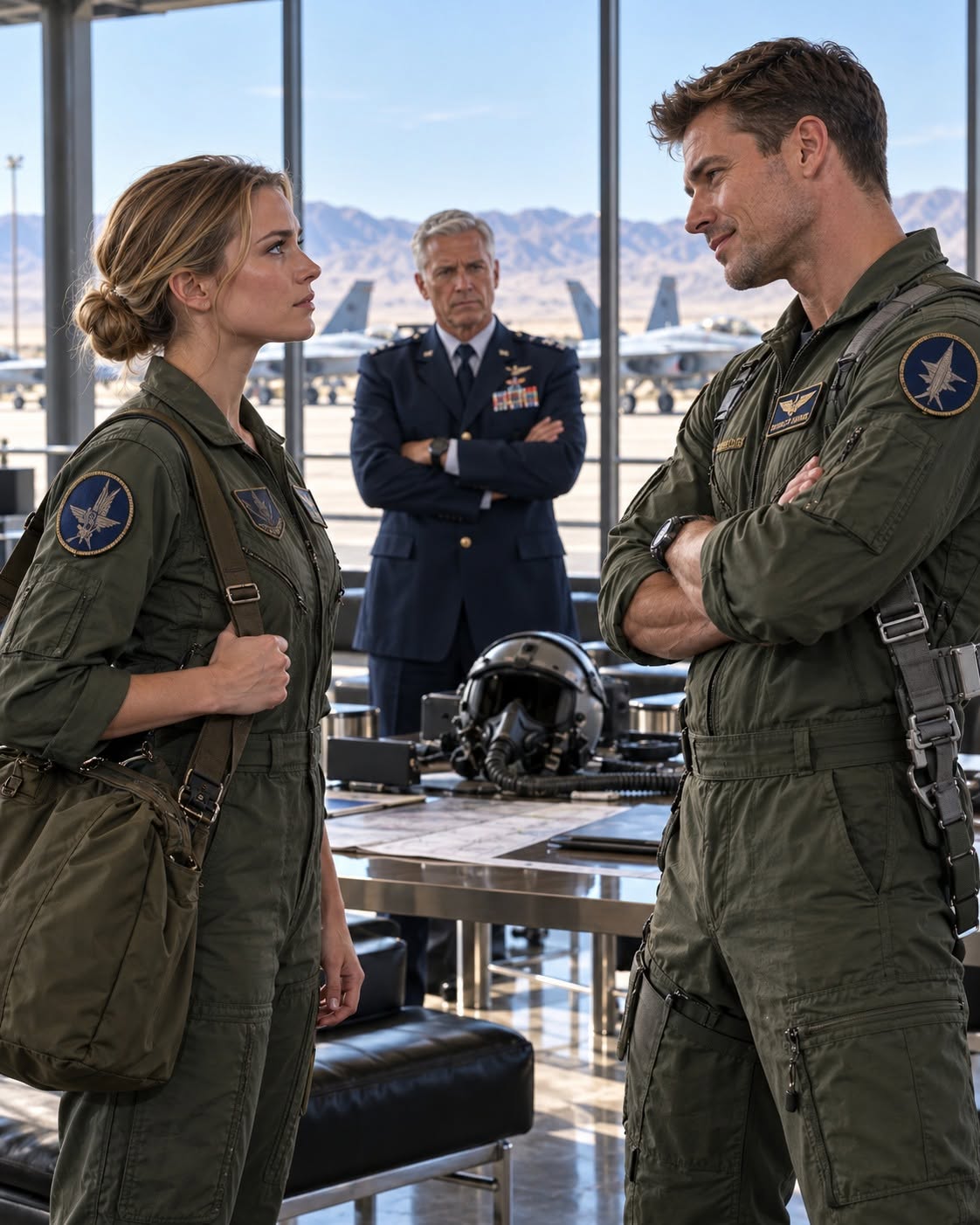
And when I saw the photograph inside, I realized our fight was nowhere near over.
The photograph showed an airfield on the coast of North Africa, its runways illuminated by scattered fires. Several aircraft sat beneath camouflage netting, surrounded by armored vehicles. A red circle marked a long, narrow building near the northern edge of the base.
“What am I looking at?” I asked.
“A forward operating location used by the mercenary organization responsible for the attacks on allied shipping,” Foster replied. “Our intelligence suggests they’re preparing to move a new weapons system into the region. If it becomes operational, they’ll be able to threaten every aircraft and vessel within hundreds of miles.”
Colonel Reed pointed to the photograph.
“Satellite imagery indicates they’ve acquired an advanced electronic warfare platform. We believe it’s the same technology that disrupted our radar picture during the engagement over the Mediterranean.”
“And you want us to destroy it.”
“We want to know what it is, where it’s going, and how it’s being protected,” Foster corrected. “An attack is only one possibility. We won’t commit aircraft until we understand the threat.”
I studied the photograph again.
There was something wrong with the arrangement of the vehicles. They were too neatly distributed, almost as though someone had placed them there to suggest the location was more heavily defended than it really was.
I leaned forward.
“Sir, when was this image taken?”
“Four hours ago.”
“Do we have infrared imagery?”
“Not yet.”
“Then we shouldn’t assume the equipment is inside that building.”
Reed frowned. “Explain.”
“The vehicles are arranged to draw attention to the northern side. The eastern service road is almost completely empty, and there are no visible security positions around the southern perimeter. Either this facility is badly defended, or someone wants us looking at the wrong place.”
Foster’s expression changed.
“Can you determine what they’re hiding?”
“Not from this image alone. But I can tell you where I’d look first.”
He pushed another photograph across the table.
“That’s why you’re here.”
For the next six days, I worked with intelligence officers, electronic warfare specialists, and the pilots of the 77th. I helped build a picture of the enemy’s capabilities, explaining how an adversary could exploit the assumptions a fighter pilot made about radar, altitude, and the position of a threat.
I didn’t give away every detail of my previous assignments. Some information remained classified, and some experiences weren’t mine to share.
But I gave them enough to understand that modern air combat wasn’t simply a contest of speed or courage.
It was a contest of perception.
The aircraft you couldn’t see could be more dangerous than the one directly in front of you. The radio call you dismissed could be the only warning you received. And the person you considered least important might be the one who understood the battlefield best.
At first, the Gamblers listened because General Foster had ordered them to.
Then they began asking questions.
Lieutenant Daniel Price, a talented young pilot who had laughed at me on my first day, stayed after one briefing.
“Ma’am, can I ask you something?”
“You just did.”
He gave an embarrassed smile. “Fair enough. During the engagement over the Mediterranean, how did you know where the second fighter would turn?”
“I didn’t know.”
“But you went after him anyway.”
“I understood what he wanted me to do. He expected me to chase him, so he could lead me into a position where his wingman could engage me.”
Daniel crossed his arms. “So what did you do?”
“I stopped trying to win the fight he wanted to have.”
He considered that.
“That’s annoyingly simple.”
“Most useful lessons are.”
He laughed, but this time there was no cruelty in it.
Across the room, Goliath had been listening.
He didn’t approach me afterward, and I didn’t seek him out.
Our relationship had become a strange kind of silence, one filled with things neither of us knew how to say.
Then, on the seventh morning, Hank Baker found me beside my aircraft.
He carried two cups of coffee and wore the expression of a man who had discovered something he had suspected for a long time.
“Thought you might need this.”
I accepted the cup.
“Thank you.”
He looked toward the hangar, where Goliath was speaking with the maintenance crew.
“You know, that man has spent three nights reading every report about your previous assignments.”
“I hope he enjoys the paperwork.”
“Apparently, he doesn’t.” Hank took a sip. “He asked me yesterday why you inspect your aircraft like you’re expecting it to betray you.”
My fingers tightened around the cup.
“What did you tell him?”
“The truth. That you check things because you know what happens when someone assumes everything is fine.”
For a moment, the hangar seemed to grow quieter.
Hank didn’t know all of my history. He knew enough.
Years before I arrived at Nellis, I had flown with an operational unit on a mission that officially never happened. A routine reconnaissance flight had turned into a desperate fight when an electronic warfare system corrupted our tactical picture.
My wingman, Captain Elias Ward, had warned me that something was wrong.
The flight leader dismissed him.
The warning was repeated.
Again, it was ignored.
Then the formation split, and Ward’s aircraft disappeared from our screens.
I had heard his final transmission, a broken sentence swallowed by static. I had searched until my fuel forced me to turn back.
His aircraft was never recovered.
The official report described the loss as an unavoidable consequence of enemy action. It did not mention the ignored warnings, the contradictory instructions, or the fact that the flight leader had continued with the original plan despite evidence that the situation had changed.
I had survived.
Ward hadn’t.
And somewhere along the way, I had decided that if I ever saw another pilot walking toward the same mistake, I would do everything in my power to stop it.
Even if the pilot hated me.
Especially if the pilot hated me.
Hank watched my face.
“You don’t have to tell me anything,” he said quietly. “But you should know that being careful isn’t the same as being afraid.”
I looked down at the coffee.
“I know.”
“Do you?”
I didn’t answer.
Before he could say anything else, the base alarm sounded.
A red warning light flashed above the hangar doors.
Every conversation stopped.
The loudspeaker crackled.
“All available aircrew report to the operations center immediately. This is not a drill.”
Within minutes, the squadron was assembled around the main display.
An allied surveillance aircraft had detected unusual activity near a commercial shipping corridor south of Crete. Two merchant vessels had lost communications, and an allied patrol aircraft had reported multiple unidentified contacts operating without standard transponder signals.
The enemy had moved sooner than expected.
General Foster appeared on the secure video feed.
“We have reason to believe the mercenary force is preparing an attack on a humanitarian convoy carrying medical supplies and emergency equipment to a besieged coastal region. The convoy is expected to enter the threat area in less than two hours.”
The room went still.
“Rules of engagement remain in effect,” Foster continued. “Your mission is to protect the convoy, identify hostile aircraft, and prevent an attack. You will not engage a target solely because it is unidentified.”
Goliath stepped forward.
“Understood, sir.”
The general’s eyes shifted toward him.
“Major Sterling, you will lead the mission. Captain—” He glanced at the roster. “Your callsign remains classified in this briefing. You will serve as tactical support.”
I nodded.
The briefing continued, detailing the available intelligence and the limitations of our sensors. The enemy’s electronic warfare system could create false targets, conceal real aircraft, and overwhelm inexperienced operators with contradictory information.
We would be flying into a picture designed to confuse us.
Exactly the kind of situation that had killed Elias Ward.
When the briefing ended, Goliath approached me.
“I want your honest assessment.”
I studied him, searching for the familiar impatience.
It wasn’t there.
“The enemy will probably try to separate the flight before attacking the convoy,” I said. “They’ll create enough confusion to make us chase false contacts. If we lose coordination, they’ll pick us off one at a time.”
“Then we stay together.”
“Not necessarily. If they know we’re staying together, they’ll exploit that too.”
He nodded slowly.
“What would you do?”
“Establish clear decision points. If our tactical picture becomes unreliable, we stop treating every contact as a target and start relying on verified information from multiple sources. And nobody ignores a threat call just because it comes from someone who doesn’t fit their expectations.”
His eyes dropped for a moment.
“I understand.”
I wanted to believe him.
But understanding a lesson in a briefing room was one thing.
Remembering it when missiles were in the air was another.
An hour later, we were airborne.
The Mediterranean stretched beneath us like a sheet of black glass, broken by scattered lights along distant coastlines. Our flight moved toward the convoy while AWACS monitored the surrounding airspace.
For the first twenty minutes, everything appeared normal.
Then the first false contact appeared on our tactical display.
A second followed.
Then four more.
“Multiple unknowns, bearing east,” Daniel reported.
“Confirming,” another pilot replied. “I’m seeing six.”
“I have nine,” someone else said.
The AWACS controller interrupted.
“Gamblers, be advised, our radar picture is degraded. We cannot independently confirm all reported contacts.”
Goliath remained calm.
“Maintain formation. No weapons release without positive identification.”
For a moment, I felt a cautious flicker of relief.
He had listened.
Then the convoy’s escort aircraft reported a missile warning.
“Gamblers, this is Sentinel Two! We’re under attack! Multiple hostile contacts approaching the convoy!”
A burst of static swallowed the next transmission.
I looked at my display.
The contacts were moving in ways that made no sense. Some appeared to accelerate impossibly, while others vanished and reappeared in different positions.
It was a manufactured picture, designed to provoke a reaction.
“Goliath, I believe the enemy is manipulating our tactical feeds,” I said. “The contacts near the convoy may not all be real.”
“Can you identify the genuine threats?”
“Not with certainty yet.”
“Then we need another source.”
I switched to the alternate communications channel and requested a direct status report from the escort aircraft.
A pilot answered through heavy interference.
“Sentinel Two, we have visual confirmation of at least two hostile aircraft. They’re approaching from the south. Our radar is unreliable.”
I checked the flight’s position.
The southern contacts were real.
The northern group was almost certainly a deception.
“Goliath, recommend we redirect our attention south and leave the northern contacts unengaged until verified.”
“Agreed,” he replied.
We turned toward the actual threat.
And then the enemy did something none of us expected.
A voice came over the emergency frequency, speaking in clear English.
“Gamblers flight, this is allied control. Your current heading will take you directly into a restricted airspace. Turn north immediately. Repeat, turn north immediately.”
Daniel hesitated.
“Sir, that’s a control transmission.”
“No,” I said. “It isn’t.”
“How can you tell?”
“Because they’re using a call sign that was retired two years ago.”
The voice repeated the instruction.
For half a second, the entire flight seemed to hold its breath.
Goliath cut in.
“Gamblers, disregard the transmission. Maintain current heading. AWACS, verify our routing.”
The controller responded immediately.
“Gamblers, your assigned route is correct. The transmission did not originate from an authorized allied station.”
Goliath looked toward my aircraft, though he could not see me through the darkness.
“Good catch.”
Those two words carried more weight than he probably realized.
We reached the convoy as the first hostile fighter swept across its path.
The escort aircraft engaged, forcing the attacker away from the lead vessel. A second enemy fighter approached from a different direction, using the confusion to get behind the escort.
Daniel called the contact.
“I have a hostile on Sentinel Two’s tail!”
The enemy was closing fast.
I turned toward the engagement, but Goliath’s voice stopped me.
“Gambler Two, maintain your assigned sector. I’m moving to support Sentinel.”
For one terrible moment, I saw the past repeating itself.
A flight leader dividing his attention.
A pilot assuming the situation was under control.
A warning arriving just before everything went wrong.
“Goliath, negative,” I said. “Your current position puts you between two unverified contacts. You’re about to lose your tactical support.”
“I can handle it.”
The words struck me like a physical blow.
Then the second hostile aircraft emerged from the darkness.
Its position confirmed my warning.
Goliath had seconds to react.
“Break right!” I shouted. “Immediate break right!”
This time, he didn’t ask me to explain.
He obeyed.
The enemy’s attack passed behind him, and the hostile fighter was forced to reposition. Daniel and another pilot moved to cover the escort aircraft while I tracked the second threat.
Our flight had finally begun working as a team.
But the enemy still had one advantage.
Their electronic warfare platform was transmitting from somewhere near the coast, feeding false information into our sensors. As long as it remained active, we could not trust our tactical picture.
“AWACS, can you locate the source of the interference?” I asked.
“Negative. We have several possible locations.”
I studied the pattern of the false contacts.
They were not random. Their positions shifted in a repeated sequence, each false target appearing just before a genuine aircraft changed direction.
The system was reacting to our movements.
That meant someone on the other side was watching us, learning our responses, and adjusting the deception.
I remembered the photograph on Foster’s table.
The carefully arranged vehicles.
The empty service road.
The building that had been intended to draw our attention.
“Goliath, I think the electronic warfare platform is operating from a mobile unit. The airfield may be a decoy. The transmitter could be somewhere else entirely.”
“Can you narrow it down?”
“I’m working on it.”
I compared the false contacts with the reports from the convoy escorts. Every time a real enemy aircraft changed course, the interference pattern shifted several seconds later.
The source was receiving information from the aircraft themselves.
It was not merely hiding the enemy.
It was coordinating the attack.
I relayed my analysis to AWACS.
The controller paused.
“Gamblers, we have an intermittent signal originating from a vessel approximately twenty miles east of the convoy. It wasn’t on the original threat assessment.”
I looked toward the horizon.
A cargo ship was moving without navigation lights, maintaining a course parallel to the convoy.
Its identity signal was absent.
“That’s our source,” I said.
Goliath responded immediately.
“Can we confirm hostile intent?”
“Not from the signal alone. We need the ship identified.”
The AWACS controller requested additional surveillance support.
Meanwhile, the hostile fighters continued to pressure the escort aircraft. One of the merchant vessels reported damage, and the convoy began to slow.
We were running out of time.
Then the unidentified ship transmitted a burst of encrypted data.
The enemy fighters changed course simultaneously.
I watched the movement and felt a chill settle over me.
“They’re receiving targeting updates from that vessel,” I said. “If it continues transmitting, they’ll keep adapting to our movements.”
“Can we disable it?” Goliath asked.
“We can stop the immediate threat by forcing the aircraft away from the convoy, but the ship is still unidentified. We cannot simply attack it.”
He didn’t argue.
“Then we’ll keep the convoy protected while AWACS confirms its identity.”
We continued the engagement, keeping the hostile fighters away from the merchant vessels without firing on uncertain targets. It was exhausting work. Every maneuver demanded a decision, and every decision had to account for information that might be false.
Then the ship made its mistake.
A short-range missile rose from its deck and streaked toward one of the allied escort aircraft.
The missile missed, passing beneath the aircraft before disappearing into the sea.
But there was no longer any ambiguity.
“Hostile launch confirmed,” AWACS announced. “The vessel is now classified as an active threat. Engagement authorization granted under current rules.”
Goliath’s voice hardened.
“Gamblers, neutralize the hostile aircraft threatening the convoy. Do not pursue contacts beyond the assigned area.”
The flight moved as one.
The remaining hostile fighters, deprived of the element of surprise, began to withdraw. One attempted a final pass toward the damaged merchant vessel, but Daniel intercepted its approach and forced it away.
I remained focused on the unidentified ship.
The electronic interference was still active.
If the vessel escaped, it could threaten another convoy tomorrow.
“AWACS, request authorization to engage the hostile platform.”
“Negative at this time. We need confirmation of the vessel’s identity and the threat it poses beyond this attack.”
I understood the caution.
I also understood that the enemy knew exactly how long our authorization process would take.
The ship turned toward the coast.
Then I noticed something on the sensor display: a brief interruption in the interference, followed by a strong transmission from the vessel’s stern.
The system was repositioning its antenna.
For a few seconds, the signal was stronger than before.
I relayed the observation.
AWACS confirmed the location, and a surveillance aircraft identified the ship as one previously associated with the mercenary network.
General Foster authorized a coordinated response.
But by the time the instruction reached us, the vessel was already approaching territorial waters where our engagement options would be severely limited.
Goliath looked at the display.
“We’re not going to reach it in time.”
I studied the remaining flight positions.
There was one possibility, but it required coordination between aircraft that had spent most of the night fighting a shifting tactical picture.
“Major, I have a proposal.”
“I’m listening.”
“We don’t chase the ship. We make it believe we’ve stopped chasing it.”
I explained the plan.
Goliath listened without interrupting. Then he looked at the flight display and began assigning roles.
“Daniel, protect the convoy. Gambler Three, remain with him. Gambler Two, coordinate with AWACS and prepare to redirect if the platform changes course. I’ll take the western approach.”
No bravado.
No attempt to prove that he was the smartest pilot in the room.
Just a commander making use of the information his people had given him.
The plan worked.
The hostile vessel changed course to avoid what it believed was an approaching interception. Its movement exposed the equipment it had been using to transmit targeting data, allowing allied surveillance to confirm the platform’s identity and coordinate a response with authorized forces.
The electronic interference stopped.
Across our displays, the false contacts disappeared.
For the first time that night, the sky became readable again.
“Gamblers, the tactical picture is stabilizing,” AWACS announced. “The convoy is clear of immediate air threats. All hostile aircraft are withdrawing.”
Goliath exhaled.
“Copy. All aircraft, regroup and prepare for recovery.”
Nobody cheered.
We were too tired, too aware of how close the night had come to becoming a disaster.
But as we turned toward base, I heard Daniel’s voice over the radio.
“Gambler Two, I owe you an apology.”
I glanced at the display.
“For what?”
“For laughing when you arrived. For assuming I knew what kind of pilot you were before I’d ever seen you fly.”
I took a slow breath.
“Just remember it the next time someone new joins the squadron.”
“I will.”
Another voice joined the channel.
Then another.
Some apologized directly. Others simply acknowledged the work we’d done together.
Goliath waited until the others had finished.
“Gambler Two,” he said.
“Go ahead.”
“When we land, I’d like to speak with you.”
“About the mission?”
“About everything.”
I watched the distant lights of the airfield grow brighter.
“We’ll see, Major.”
It wasn’t forgiveness.
But it wasn’t a refusal, either.
The sun had begun to rise by the time we returned to base.
Our aircraft were inspected, the mission data was secured, and the pilots were sent to debrief. The convoy had survived, though one merchant vessel required emergency repairs. The allied escort aircraft had made it home with minor damage, and no members of our flight had been lost.
General Foster attended the debrief personally.
He listened as each pilot described what had happened, asking detailed questions about the false contacts, the unauthorized transmission, and the enemy’s use of coordinated electronic warfare.
When my turn came, I explained the pattern I had observed and how it had led us to the mobile platform.
The general nodded.
“Your analysis was sound. More importantly, you kept your assessment within the limits of what the evidence supported. You didn’t confuse suspicion with confirmation.”
He turned to Goliath.
“Major, what did you learn?”
Goliath sat with his hands clasped on the table.
“That I was fortunate to have a pilot who recognized the threat before I did.”
Foster waited.
Goliath continued.
“And that I almost made the same mistake twice. I treated confidence as proof of competence, and rank as proof that I understood the situation better than the people around me.”
Nobody moved.
“I also spent months undermining a member of my own squadron because her record didn’t match my expectations. When she warned me during training, I dismissed her. When she saved my aircraft over the Mediterranean, I finally had to confront what I’d refused to see.”
He looked directly at me.
“That was my failure, not hers.”
The room remained silent.
For once, I didn’t feel the need to defend myself.
Goliath had finally said the truth without being forced to hide behind excuses.
After the debrief, he asked me to join him outside.
We stood beside the hangar as the morning light spread across the Nevada desert. The air smelled of jet fuel and warm metal, and maintenance crews were already preparing the aircraft for their next sortie.
“I owe you an apology,” he said.
“You’ve said that before.”
“I know. And the first time, I thought admitting I was wrong would be enough.”
He looked toward the flight line.
“It wasn’t. I humiliated you in front of the squadron. I gave you assignments designed to make you fail. I ignored your warnings because listening to you would have meant admitting that I didn’t understand something. Then I used my authority to make my mistakes look like yours.”
He paused.
“I can’t undo any of that.”
“No, you can’t.”
“I won’t ask you to forgive me.”
That surprised me more than the apology.
He continued, “General Foster has recommended a formal review of my command conduct. I support it. Whatever happens, I won’t use my position to avoid the consequences.”
I studied him.
The old Goliath would have filled the silence with explanations about pressure, standards, or the need to toughen up inexperienced pilots.
This man offered none.
“Why now?” I asked.
“Because you saved my life, and I realized I had been treating your existence in my squadron like a personal insult.” He swallowed. “But that’s not the real reason I should change. If you’d never saved me, what I did to you would still have been wrong.”
For the first time, I believed he understood the difference.
I looked out at the aircraft.
“I’m not going to tell you that we’re even, Major.”
“I wouldn’t expect you to.”
“And I won’t pretend the things you did don’t matter just because you’ve apologized.”
“I understand.”
“But I will work with you, as long as you treat every pilot in this squadron with the same professional respect you should have shown me from the beginning.”
He nodded.
“That’s fair.”
“It’s not a favor I’m doing for you. It’s the standard.”
He accepted that without argument.
In the weeks that followed, the Gamblers began to change.
Goliath remained their commander while the review proceeded, but his leadership became noticeably different. He asked questions during briefings instead of treating every disagreement as a challenge. He demanded that pilots explain their reasoning, and he made sure junior officers could raise concerns without being ridiculed.
When someone made a mistake, he corrected it.
When he made a mistake, he admitted it.
The change wasn’t perfect. Old habits surfaced under pressure, and there were moments when his impatience returned. But he no longer treated accountability as something that applied only to the people beneath him.
I noticed the difference most clearly during a training exercise several weeks later.
A young pilot reported a possible equipment fault shortly before takeoff. The problem turned out to be a faulty sensor indication, not an actual failure, and the delay cost the squadron valuable training time.
The pilot braced himself for the inevitable public humiliation.
Instead, Goliath asked the maintenance crew to explain the indication and had the squadron review the procedure.
Then he said, “I’d rather lose an hour confirming a problem than lose a pilot because somebody was afraid to report one.”
I watched from the back of the ready room.
Hank, standing beside me, gave a small nod.
“Looks like the big man is learning.”
“Let’s not get carried away,” I said.
Hank chuckled.
“Fair enough.”
The formal review concluded a month later. Goliath received an official reprimand and was required to complete additional leadership training. His command authority remained subject to oversight, and the findings became part of his service record.
He accepted the decision without protest.
Colonel Reed also faced scrutiny for endorsing the original debrief without adequately reviewing the mission data. The incident forced the squadron to examine how easily a confident officer could shape a narrative before the evidence had been properly considered.
I was offered a promotion and the opportunity to return to my former restricted assignment.
General Foster met with me privately to discuss the options.
“You’ve done exceptional work here,” he said. “You could return to specialized operations, where your experience would be put to immediate use. Or you could remain with the Gamblers and help develop the training program we’re building around contested airspace and electronic warfare.”
I considered the choices.
The restricted assignment had been my life for years. It was familiar, demanding, and important. The Gamblers, on the other hand, were a unit that had nearly broken my patience before learning to listen.
Yet the work we had begun mattered.
There would always be new pilots, new technologies, and new commanders who believed their confidence made them infallible. If I could help build a squadron where a warning was heard before a crisis became a tragedy, perhaps Elias Ward’s loss would not remain only a painful memory.
“I’d like to stay,” I said. “At least long enough to help build the program.”
Foster smiled.
“I was hoping you’d say that.”
The next morning, the squadron gathered in the ready room.
The room looked exactly as it had on my first day: flight suits, coffee cups, mission boards, and the faint smell of aircraft fuel drifting in from the hangar.
But when I walked through the door, nobody laughed.
Goliath stood beside the briefing screen.
“Before we begin,” he said, “I want to make something clear. Captain, your operational experience is going to be central to this program. Every pilot in this room will learn from it, including me.”
He looked around the room.
“And if anyone here thinks asking a question makes them look weak, I’d suggest they remember that the most dangerous words a pilot can say are, ‘I already know.’”
A few people smiled.
I set my notebook on the table.
“Then let’s start with the first rule,” I said.
Goliath stepped aside.
I faced the squadron.
“Your aircraft doesn’t care about your rank. The enemy doesn’t care how many medals you have. And physics will not change its mind because you’re confident.”
The room became quiet.
“Your job isn’t to look fearless. Your job is to recognize danger, make sound decisions, and bring your people home. Sometimes that means taking the lead. Sometimes it means following someone whose experience exceeds your own. And sometimes it means admitting that the person you underestimated is the only one who sees the problem clearly.”
I looked around at the pilots.
“Never let pride become the reason someone doesn’t make it back.”
For the next several months, we worked to turn those principles into practice. The training program became one of the squadron’s most important initiatives, and our pilots learned to challenge assumptions, verify uncertain information, and communicate clearly when conditions deteriorated.
Not every lesson came easily.
But gradually, the ready room became a place where people could disagree without being humiliated, where junior pilots could question a plan without fearing retaliation, and where experience was measured by judgment rather than volume.
Goliath and I never became close friends.
Trust, once damaged, doesn’t return simply because someone has finally learned the right words. It returns through repeated choices, made quietly, especially when nobody is watching.
He earned some of mine.
Not all of it.
And I learned that forgiveness did not require pretending the past had never happened. I could acknowledge his growth without surrendering my memory of what he had done.
One evening, long after the rest of the squadron had gone home, I found Goliath standing beside my aircraft.
He was studying the name stenciled beneath the cockpit.
“Captain,” he said, “may I ask you something?”
“Depends on the question.”
He hesitated.
“Do you ever think about the people you couldn’t save?”
The question settled between us.
I looked at the darkened hangar, remembering a voice fading into static and the years I had spent wondering whether one different decision might have changed the outcome.
“Every day,” I said.
He lowered his head.
“I used to think leadership meant having the answer before anyone else asked the question.”
“And now?”
“Now I think it means making sure the right question gets asked before it’s too late.”
I considered that, then nodded.
“That’s a better place to start.”
He glanced toward the runway, where the last light of sunset was fading beyond the desert.
“I’m sorry I made you fight so hard to be heard.”
“I know.”
It was all I could offer him that night.
And, for once, it was enough.
The following spring, the Gamblers completed their final evaluation under the new training program. Their performance was exceptional, not because they had become invincible, but because they had learned to recognize uncertainty and respond to it together.
General Foster attended the closing ceremony.
He praised the squadron’s discipline, its adaptability, and its willingness to question assumptions. Then he asked me to address the pilots.
I stood before them and looked at the faces that had once watched me enter the ready room as an outsider.
Some had laughed.
Some had remained silent.
Some had eventually apologized.
All of them had learned something about the cost of judging a person before understanding them.
“I want you to remember something,” I said. “You will meet people whose records don’t tell the whole story. People who are quiet when everyone else is boasting. People who question a plan when everyone else is eager to execute it. People whose experience you cannot see and whose reasons you may never fully understand.”
I paused.
“Don’t assume they’re weak because they don’t advertise their strength. Don’t assume they’re wrong because their rank is lower than yours. And never confuse respect with obedience. Respect is what allows people to tell you the truth, especially when the truth is inconvenient.”
I saw Goliath standing at the back of the formation.
He gave a small nod.
I continued.
“On the day you fly into real danger, you won’t have time to decide whether the person beside you deserves to be listened to. You’ll have to trust the training, trust the evidence, and trust that your team has been built on something stronger than pride.”
The ceremony ended, and the pilots began to disperse.
As I walked toward the hangar, Daniel caught up with me.
“Ma’am, do you think Major Sterling will ever be the same commander he was before?”
I thought about the man who had laughed when I arrived, the pilot who had dismissed my warning over the Mediterranean, and the officer who had finally admitted that his mistakes belonged to him.
“No,” I said. “I hope not.”
Daniel looked surprised.
“Because the point isn’t to become the person you were before you made a mistake,” I explained. “It’s to become someone who knows what the mistake cost.”
He nodded slowly.
Then he returned to his friends, leaving me alone beneath the wide Nevada sky.
I climbed the ladder to my cockpit and rested one hand against the aircraft’s canopy. The metal was warm from the afternoon sun.
For a long time, I had believed that surviving meant carrying every failure, every loss, and every unanswered question by myself. I had mistaken silence for strength and distance for protection.
But the Gamblers had taught me something I hadn’t expected to learn.
Being heard mattered.
Being accountable mattered.
And no pilot, no commander, no matter how talented, could afford to believe that their perspective was the only one worth trusting.
I thought of Elias Ward, of the warning that had gone unheeded, and of the promise I had made to myself after his disappearance.
I couldn’t bring him home.
I couldn’t rewrite the past.
But I could help make sure that the next warning was heard.
That was enough to give the work meaning.
As I climbed into the cockpit, my radio crackled with the familiar voices of the squadron preparing for another training sortie.
Goliath’s voice came through, steady and clear.
“Gamblers, final checks. If you see something, say something. If something doesn’t make sense, question it. And if someone gives you a warning, listen before you decide whether you like the person giving it.”
A brief pause followed.
Then Daniel laughed softly.
“Copy that, Major.”
I smiled behind my oxygen mask.
The engines came alive, and the desert runway stretched out before me.
I had arrived at Nellis with a clean record that concealed a complicated past, a commander who mistook arrogance for strength, and a squadron that had already decided who I was.
I was leaving that first chapter behind with something more valuable than their approval.
I had earned a place where my voice could matter.
And Goliath had learned that the measure of a commander was never how loudly he could make others obey, but how willingly he could listen when they had something important to say.
Because the sky has no patience for pride.
The enemy has no obligation to respect your rank.
And the truth doesn’t become less important simply because it comes from someone you underestimated.
In the end, the most dangerous mistake a leader can make isn’t choosing the wrong maneuver or misreading a radar screen.
It’s deciding that the person standing beside them has nothing worth hearing.
Sometimes, that person is the only reason they make it home.