The first time I walked into the F-35 squadron briefing room at Aliya Air Base, the men inside stopped talking.
The first thing I noticed after the rescue was not the applause, the congratulations, or the sudden respect in the eyes of the men who had once laughed at me. It was the silence.
For months, the briefing room at Aliya Air Base had been filled with jokes whenever I spoke. Now, the same men sat waiting for my opinion, their notebooks open and their attention fixed on me. It was a strange feeling, realizing that the people who had ignored my voice were finally listening to it.
I should have felt victorious.
Instead, I felt the quiet exhaustion of someone who had spent too long proving something that should never have been in question.
That evening, I returned to my quarters and found a package resting outside my door. It was wrapped in brown paper and tied with a thin piece of rope. There was no name on the outside, only a small note written in careful handwriting.
For the pilot who knows how to listen.
Inside was a weathered leather compass.
I recognized it immediately.
It belonged to my father.
For a moment, I simply stared at it, unable to understand how it had arrived at the base. Beneath the compass lay a short letter.
Your father asked me to deliver this if you ever found yourself in a place where people mistook silence for weakness. He said you would understand when the time came.
The letter was signed by an old desert guide who had known my father for decades.
I held the compass in my palm, remembering the countless mornings when Kahlil had taken me beyond our village and taught me to read the desert as if it were a living thing. He had never promised that the compass would show me every danger. He had taught me something more important: a direction was only useful when a person understood the ground beneath their feet.
I called him that night.
He answered on the second ring.
“You received it,” he said.
“You arranged this?”
“I thought you might need a reminder.”
I laughed softly. “A reminder of what? That I should have become a desert guide instead of a fighter pilot?”
“No,” he replied. “A reminder that bringing people home is more important than being admired for knowing the way.”
His words stayed with me long after the call ended.
I did not yet know how urgently I would need them.
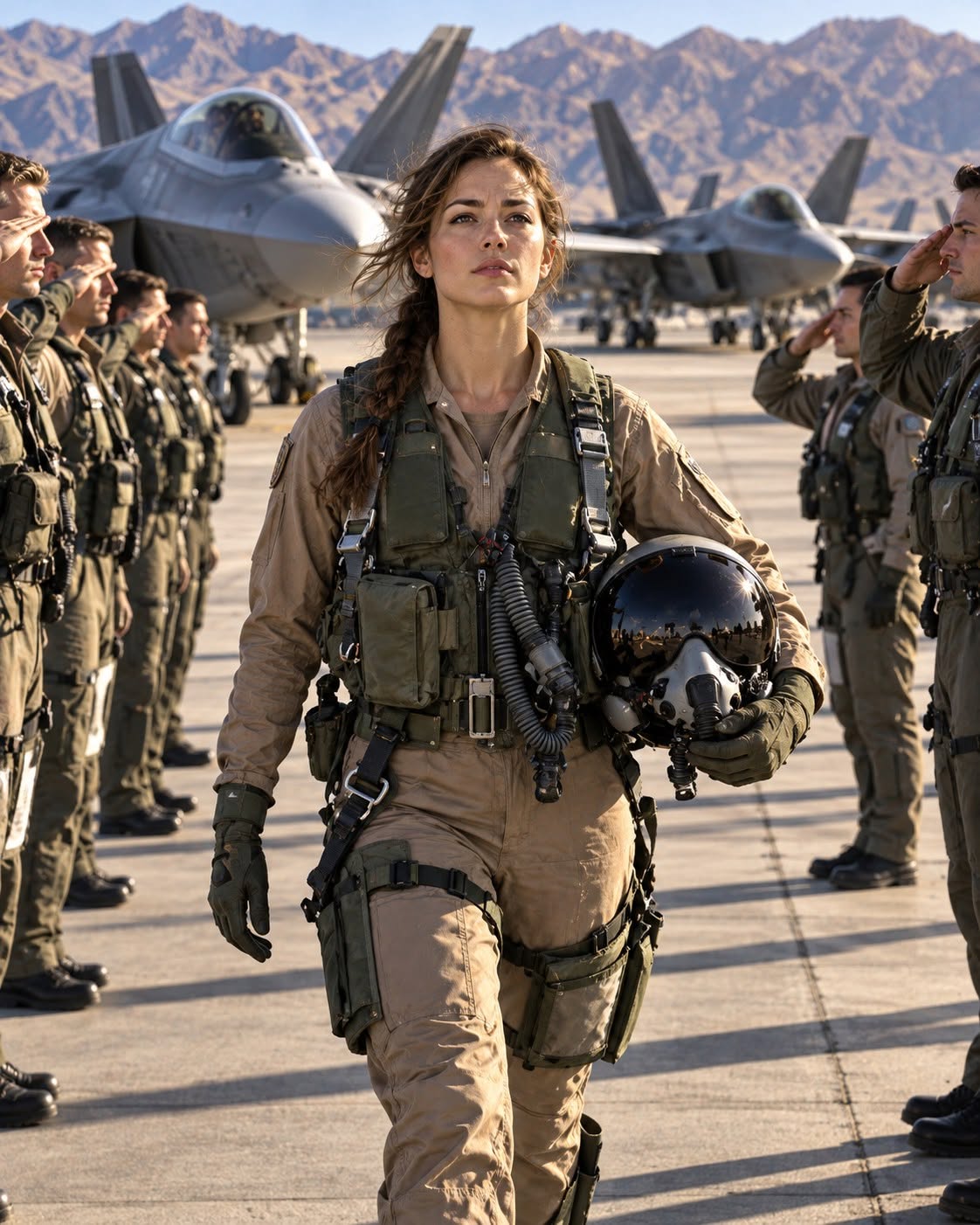
Three weeks after the international exercise, Aliya Air Base received orders to prepare for a high-priority joint readiness evaluation. Senior officers from several allied nations would arrive to assess our squadron’s ability to operate under extreme conditions. The evaluation would determine whether our base could be trusted with a larger regional defense responsibility.
For Colonel Zayd, it was an opportunity to prove that his squadron was among the best.
For the pilots, it meant days of preparation, simulated emergencies, and demanding formation exercises.
For me, it meant something unexpected.
I was appointed deputy lead for the navigation and recovery team.
Tariq heard the announcement while we were reviewing the evaluation schedule. His expression tightened, though he quickly covered it with a nod.
“Congratulations,” he said.
“Thank you.”
He hesitated. “I suppose you have more experience with disappearing horizons than the rest of us.”
It was meant to be a joke, but there was no cruelty in his voice this time.
“I have experience with making mistakes when I think I know too much,” I answered.
He looked at me for a moment, then smiled.
“That’s probably more useful.”
Our relationship had changed since the rescue, but it had not transformed overnight. Respect was not a switch that could simply be turned on. Tariq still challenged my decisions, and I still challenged his. The difference was that we had begun to argue about the mission instead of each other’s right to participate in it.
I considered that progress.
The readiness evaluation began on a clear morning. Aircraft launched in coordinated waves while ground teams monitored simulated communications failures, fuel emergencies, and changing weather patterns. The first several hours went smoothly.
Then an unexpected message arrived from the operations center.
A transport aircraft carrying six technical specialists had diverted from its planned route after reporting a serious engine vibration. The crew intended to land at a secondary airstrip on the far side of the desert, where emergency equipment was available.
Before reaching it, the aircraft encountered a rapidly developing weather front.
The transport’s last transmission reported heavy dust, worsening turbulence, and a navigation display that had begun giving conflicting information.
Then communications stopped.
The transport was not an F-35. It was slower, less agile, and far more vulnerable in severe weather. Its crew could not simply climb above the storm and wait for conditions to improve indefinitely.
Six people were now somewhere in the desert, with limited fuel and an uncertain landing site.
The operations center immediately initiated the missing-aircraft procedure.
Colonel Zayd summoned the senior pilots.
“We have a narrow search window,” he said. “The storm is moving east. We will use the available surveillance data to establish the most likely corridor, then deploy the recovery team.”
An officer projected the transport’s last known position onto the display.
Several possible routes appeared.
Tariq studied them carefully. “The most direct route would take them toward the secondary strip.”
“Assuming their navigation system was accurate,” I said.
He glanced at me. “You think they may have drifted south?”
“I think we should account for it.”
I examined the wind data, the reported engine vibration, and the transport’s estimated fuel consumption. The pilot might have turned away from the strongest turbulence. If the crew had done so, they could have entered a shallow depression that stretched between two rocky ridges.
It was a route that would look unlikely on a conventional flight-planning display.
But I knew the terrain.
My father had taken me through that region when I was sixteen. We had traveled for hours beside a ridge that seemed to go nowhere, only to discover a narrow passage leading toward an old service road.
The passage was difficult to see from the ground. From the air, it could easily be mistaken for an unbroken stretch of dunes.
“If they were trying to avoid the worst of the storm,” I said, pointing to the map, “they may have followed this corridor.”
A senior evaluator shook his head.
“That area is unsuitable for a landing.”
“I agree,” I said. “But it may not have been their intended destination. It could be where they ended up while trying to regain orientation.”
Colonel Zayd studied the display.
“How confident are you?”
“Not confident enough to call it a confirmed position. Confident enough to include it in the search.”
He looked at the other officers, then ordered the surveillance team to examine the corridor.
Ten minutes later, a faint radar return appeared near the southern ridge.
It was intermittent, but its movement was consistent with a slow aircraft.
The room fell quiet.
“Possible contact,” the surveillance operator announced. “We need confirmation.”
Colonel Zayd turned toward me.
“Shadow Fox, prepare to launch. Tariq, you will accompany her.”
Tariq immediately moved toward the equipment station.
I felt a familiar pressure settle over my shoulders. This time, however, it was not the weight of being doubted. It was the weight of knowing that six people were waiting for someone to find them.
Before leaving the room, I looked at the projected map one final time.
The storm had already begun to erase the route.
We launched into a sky that was turning the color of old bronze.
Tariq flew on my wing, maintaining enough distance to preserve visibility while our sensors searched for the transport. The radio crackled with updates from the operations center, but none of them provided a precise location.
Then Tariq spoke.
“Shadow Fox, I have something on my display. It could be terrain interference.”
“Describe it.”
“A weak return, moving slowly. It appears and disappears.”
“Does the movement match a transport aircraft?”
“Possibly.”
I adjusted our search heading toward the corridor.
For several minutes, nothing changed. Then a faint transmission emerged through the static.
“Mayday… transport… engine vibration worsening…”
The voice was barely intelligible.
I keyed the microphone.
“Unidentified transport, this is Shadow Fox. If you can hear me, transmit your last known heading.”
Static answered.
Then came three clipped words.
“Heading… uncertain… fuel…”
The transmission vanished.
Tariq’s voice became sharper. “We need to narrow the search. The weather is deteriorating faster than forecast.”
“I know.”
Our instruments were functioning, but the radar picture was becoming increasingly cluttered. The ridges created false returns, while the dust reduced our ability to confirm anything visually.
I studied the pattern of the echoes.
There was a gap between two stronger returns, a narrow opening that seemed inconsistent with the surrounding terrain.
I remembered my father’s explanation of wind corridors. Where two ridges formed the right angle, the strongest gusts could sweep sand away from a narrow section, leaving a darker strip of exposed rock.
The gap on our display might be nothing.
Or it might mark the passage I remembered.
“Tariq, hold your current position while I request updated terrain data.”
He acknowledged.
I contacted the operations center and asked for the most recent survey information for the southern ridge. The response came back with a warning: the area contained irregular terrain, and no low-altitude flight was recommended.
I already knew that.
What I needed was not permission to pretend the danger did not exist. I needed enough information to determine whether there was a safer way to reach the possible contact.
The transport pilot transmitted again.
“Cabin… passengers… we cannot maintain…”
His voice broke off.
Tariq came back over the radio. “We have a decision to make. If they continue south, they’ll reach the ridge. If they turn north, they may miss the only clear corridor.”
“Then we have to help them identify the corridor.”
I contacted the transport once more.
“Transport aircraft, this is Shadow Fox. Do not attempt a sharp turn toward the ridge. If your controls permit, maintain a steady heading while we establish your position.”
A burst of static followed.
Then a weak voice answered, “Copy… trying.”
I turned to Tariq.
“I need you to maintain contact with the operations center and relay every update. I’m going to use the terrain return to refine our position estimate.”
He paused.
“Understood. But don’t assume the gap is the passage just because you remember it.”
The words surprised me.
They were almost exactly what I would have told him.
“I won’t,” I replied.
Together, we worked through the conflicting information. The transport’s last reported heading, its estimated speed, the wind direction, and the faint radar returns gradually narrowed the possibilities.
At last, we had a likely position.
The aircraft was not inside the corridor.
It was approaching the ridge from the wrong side, with very little room to correct its course.
If the crew continued on their present heading, they could strike rising terrain before seeing it through the dust.
I called them immediately.
“Transport, your current route is taking you toward high ground. I need you to make a gradual correction to the west, but only when your instruments confirm you can do so safely. Do not descend to search for visual landmarks.”
There was a long pause.
“Shadow Fox, we have a problem. The engine vibration is getting worse.”
My hands tightened around the controls.
“How much thrust can you maintain?”
“Enough to stay airborne. I can’t promise much more.”
The transport was losing options by the minute.
I relayed the information to the operations center. The nearest suitable runway was still beyond the storm, and the crew could not be expected to reach it without reliable guidance.
Then Tariq noticed something.
“Look at the terrain return,” he said. “The western opening is narrower than we thought. But the service road beyond it runs almost parallel to the ridge.”
I checked the display.
He was right.
The old road marked a gradual route around the highest section of the terrain. It did not provide a runway, but it led toward a broad, hard-packed area used by maintenance vehicles years earlier.
That area might offer the transport a place to make an emergency landing, provided the crew could reach it and confirm that the surface was suitable.
Might.
It was a dangerous word, but the alternative was allowing the aircraft to continue toward a ridge it could no longer see.
I asked the operations center to verify the old maintenance area’s location and surface conditions using available survey records. The response was cautious: the area was not an approved landing site, and its present condition could not be guaranteed.
I relayed that warning to Colonel Zayd.
For several seconds, he said nothing.
Then his voice came over the command channel.
“Shadow Fox, you are not authorized to direct an aircraft into an unverified landing area. Continue assisting the crew toward an established recovery option. We are working on alternatives.”
The order was clear.
I could not ignore it simply because I wanted to save the day. A failed landing could turn one emergency into seven casualties.
I looked at the transport’s projected track.
The aircraft was drifting closer to the ridge.
“Understood, Colonel,” I replied.
I continued guiding the crew away from the immediate terrain hazard while the operations center searched for another solution. Tariq maintained communications and passed updates as quickly as they arrived.
For a few minutes, we made progress.
Then the transport’s engine warning escalated.
Its pilot reported a sudden loss of power and an inability to maintain the previous altitude.
The storm had not given us time to wait.
“Shadow Fox,” the transport pilot said, his voice strained but controlled, “we may have to put it down wherever we can.”
I closed my eyes for half a second.
I remembered my father standing on a dune when a sudden wall of sand swallowed the tracks ahead of us. I had been frightened, certain we would become lost.
He had not told me to ignore the storm.
He had shown me how to stop, observe, and distinguish what I knew from what I merely hoped.
I opened my eyes and looked again at the available data.
The maintenance area was not a guaranteed safe landing site. But its location, the terrain profile, and the transport’s remaining flight capability offered a possibility worth investigating with every available source.
I contacted Colonel Zayd.
“Sir, the transport is losing power. The established recovery runway may be beyond its range. We have an unverified emergency landing area near the old service road. I recommend immediate surface verification and a controlled decision based on the best information we can obtain.”
The colonel did not answer immediately.
I could imagine him weighing the risks, the regulations, and the lives involved.
Then he spoke.
“Approved for assessment. Do not treat the area as safe until the available data supports that conclusion. Keep the transport crew informed, and coordinate with ground rescue.”
It was not a promise.
It was an opening.
The operations center began checking archived surveys and contacting a nearby ground team familiar with the service road. Their report came back several tense minutes later.
The area was broad enough to be considered a possible emergency landing zone, but its surface had not been inspected recently. The crew would have to make the final assessment from the aircraft, and the decision remained theirs.
We relayed the information carefully.
The transport pilot listened, then answered with a steadiness that surprised me.
“Understood. We have six people on board. We will make the safest decision we can.”
For the first time, I heard no panic in his voice.
Only responsibility.
I guided the aircraft toward the general corridor while Tariq monitored the projected track and relayed updated information. We did not promise a safe landing. We did not tell the crew that everything would be fine.
We gave them the best information we had, corrected our estimates whenever new data arrived, and kept the communications clear.
At last, a faint outline appeared on the transport crew’s forward display.
The pilot confirmed that he could see the open area.
“Shadow Fox, visual contact with the landing zone. Surface looks uneven. We are assessing.”
“Take your time,” I replied. “Use your judgment. We will remain available as long as conditions permit.”
The next few moments stretched unbearably.
The transport began its approach.
A burst of static filled our headsets. Tariq leaned forward, eyes fixed on his instruments.
Then the pilot’s voice returned.
“We’re down. Hard landing, but we’re down.”
For a second, I could not speak.
Then he added, “All six passengers accounted for. We have no immediate injuries reported.”
Tariq exhaled so loudly that I heard it over the radio.
“That’s six more people going home,” he said.
I watched the transport’s signal stabilize on the display and felt the tension leave my shoulders.
We had not conquered the storm. We had not made the desert harmless.
We had listened, questioned our assumptions, and given six people a chance to survive.
The rescue teams were already moving toward the landing area when Colonel Zayd ordered us back to base.
The return flight was quieter than the journey out.
For the first time, Tariq did not fill the silence with a joke or a technical observation. He flew beside me, maintaining formation with the kind of care that needed no explanation.
When we landed, the ground crew confirmed that the transport’s occupants had been evacuated safely. One specialist had a minor injury, but everyone was alive.
The evaluation officers gathered for an emergency debriefing.
I expected questions about the unverified landing area, the delays, and the decisions made under pressure. Those questions came, and they were necessary. We examined every estimate, every transmission, and every point at which a different choice might have produced a different outcome.
Colonel Zayd made it clear that the successful rescue did not make every decision automatically correct.
“We will learn from what worked,” he said, “and we will identify what must improve. Good outcomes do not excuse careless reasoning. They remind us why disciplined reasoning matters.”
Then he turned toward Tariq.
“You identified the service road and helped refine the route. Explain your reasoning.”
Tariq stood.
He described the terrain return, the archived survey information, and the way the road changed our assessment of the possible landing zone. He did not exaggerate his contribution, and he did not pretend he had discovered the solution alone.
When he finished, he looked at me.
“Shadow Fox was right to question the initial search corridor. I was wrong to treat the first estimate as the only reasonable one.”
The room remained silent.
Then he added, “And she was right not to treat her memory as proof. We checked it against the available data before acting.”
That mattered more to me than any compliment he could have offered.
Because the lesson was not that I had been right and everyone else had been wrong.
The lesson was that knowledge became dangerous when pride prevented people from questioning it.
After the debriefing, Tariq found me outside the hangar. The sun was sinking beyond the runway, turning the distant dunes gold.
“I owe you another apology,” he said.
I raised an eyebrow. “For what this time?”
“For thinking that because I had more experience in one kind of flying, I understood every kind of situation better than you did.”
He glanced toward the aircraft parked along the apron.
“I used to think confidence meant having an answer before anyone else. Today, I realized it sometimes means being willing to say you don’t know yet.”
I studied him for a moment.
“That’s a useful thing to learn.”
“Expensive, though.”
I laughed.
He smiled, then grew serious again.
“When I made those jokes about your father and the desert, I thought I was proving that I belonged here. I didn’t realize I was making the squadron weaker.”
I could have reminded him of every insult, every dismissed recommendation, and every lunch I had eaten alone.
Part of me wanted to.
Instead, I said, “You can’t change what you did. But you can decide what kind of pilot you become next.”
He nodded slowly.
“I intend to.”
Over the following months, the change at Aliya Air Base became visible in small, practical ways. Briefings grew more collaborative. Pilots began challenging assumptions without turning every disagreement into a contest. Junior officers were encouraged to speak when they noticed something unusual, even if they could not immediately explain it.
Colonel Zayd introduced a new training module that combined instrument-based navigation, terrain awareness, and decision-making under uncertainty. He asked me to help develop it.
I agreed, but only on one condition.
“We teach people how to question my recommendations, too,” I told him. “If someone sees a flaw in my reasoning, I want them to say so.”
He smiled.
“Good. A squadron that cannot question its best pilot will eventually make that pilot’s mistakes.”
The module became one of the most demanding parts of our training program. It required pilots to work with incomplete information, changing conditions, and conflicting reports. They had to explain not only what they believed, but why they believed it—and what evidence would cause them to change their minds.
Tariq became one of its strongest instructors.
He was still competitive, still demanding, and occasionally far too pleased with his own jokes. But he had learned to recognize the difference between humor that brought people together and humor that pushed someone out of the room.
One afternoon, I watched him listening to a young trainee who had questioned his planned route. Instead of interrupting, he asked the trainee to explain the concern.
The trainee pointed to a possible change in wind direction.
Tariq studied the chart.
“You may be right,” he said. “Let’s check.”
I looked away before he noticed me smiling.
Not every day was easy. Some pilots still doubted my judgment, and there were moments when I doubted it myself. A rescue could earn respect, but it could not eliminate uncertainty. Every mission brought its own variables, and every decision carried consequences that no amount of praise could erase.
I learned to live with that truth.
A year after my arrival at Aliya Air Base, I received an invitation to attend an international aviation safety conference. The organizers wanted me to speak about navigation under extreme conditions and the importance of cultural knowledge in modern aviation.
I nearly declined.
I was a pilot, not a public speaker. I preferred a cockpit to a stage, and I had no desire to turn a difficult rescue into a story about personal glory.
But Colonel Zayd placed the invitation on my desk.
“People need to hear what you learned,” he said. “Not just what you did.”
So I accepted.
Before leaving, I visited my father.
He was sitting outside our family home, repairing a strap on an old travel bag. The years had added silver to his hair, but his hands remained steady.
When I told him about the conference, he listened with the same patient attention he had given me as a child.
“Will you tell them about the compass?” he asked.
“I might.”
“And the storm?”
“Yes.”
He tightened the strap, then looked up.
“Will you tell them that you were afraid?”
I hesitated.
“I don’t know if that matters.”
He gave me a look that made me feel sixteen again.
“Of course it matters. If you tell them only about courage, they may believe courage means feeling no fear. Then they will hide their fear from the people who need to know about it.”
I sat beside him.
“I was afraid of making the wrong decision.”
“Good.”
I frowned. “Good?”
“Fear can remind you that a decision matters. The danger begins when you allow fear to make the decision for you—or when pride convinces you that you have nothing to fear.”
He handed me the compass.
“Take it with you.”
I turned the worn instrument over in my palm.
“What if they don’t understand?”
My father shrugged.
“Then you will have spoken honestly. Understanding belongs to the listener as much as the speaker.”
At the conference, the auditorium was filled with pilots, engineers, instructors, and senior officers from different countries. Some had spent their careers flying advanced combat aircraft. Others had worked in remote rescue operations or designed the navigation systems used by modern fleets.
I stood behind the lectern and looked out at the audience.
For a moment, I remembered my first day in the briefing room at Aliya Air Base. I remembered Tariq’s laughter, the empty seat at the end of the table, and the feeling that I had to prove my existence before anyone would consider my ideas.
Then I placed my father’s compass on the lectern.
I began with a simple question.
“What happens when the instruments you trust begin to disagree with the world you see?”
The room grew quiet.
I told them about the sandstorm, the two allied pilots, and the difficult decision to turn back when my fuel was running low. I explained that the rescue had not depended on instinct alone. It had required training, instrument cross-checks, communication, preparation, and the willingness to revise an assessment when the evidence changed.
Then I told them about the transport aircraft and the six people who had nearly disappeared into the storm.
I spoke about the limits of experience, the importance of verifying assumptions, and the danger of treating confidence as a substitute for evidence.
Finally, I told them about my father.
“He taught me to read the desert,” I said. “But he never taught me that the desert was easy to understand. He taught me to pay attention, to recognize what I didn’t know, and to respect the difference between a possibility and a fact.”
I lifted the compass.
“This instrument can point north. It cannot tell me whether the ground ahead is safe, whether a storm will change direction, or whether the person beside me has noticed something I missed. Those questions require observation, judgment, and the humility to listen.”
I paused and looked across the audience.
“The greatest mistake we can make is assuming that knowledge must come from someone who looks like us, speaks like us, or has followed the same path we have. Sometimes the person who sees the danger first is the person we have been least willing to hear.”
For several seconds, no one moved.
Then the applause began.
It grew until the entire auditorium was standing.
I felt no triumph over the men who had once mocked me. I felt gratitude for every person who had helped turn those painful beginnings into something useful.
Among the audience, I saw Tariq standing beside Samir and Clara. Colonel Zayd stood a few rows behind them.
They were applauding, but it was not the applause that mattered.
It was the fact that they had come to listen.
After the conference, a young officer approached me. She wore the uniform of a fighter squadron and carried a notebook pressed against her chest.
“Ma’am,” she said, “I wanted to thank you for your presentation.”
“I’m glad it was useful.”
She hesitated, then looked down at her notebook.
“I’ve just joined a squadron where I’m the only woman. The other pilots don’t insult me directly, but they rarely take my suggestions seriously. I’ve started wondering whether I should stop speaking up.”
I recognized the expression on her face.
I had seen it in the mirror many times.
“Do you trust your training?” I asked.
“Yes.”
“Do you check your assumptions?”
“I try to.”
“Are you willing to listen when someone corrects you?”
She nodded.
“Then keep doing those things. Ask questions. Prepare carefully. When you make a mistake, own it and learn from it. When you have evidence, speak clearly.”
She looked up.
“But what if they still don’t respect me?”
I thought of the years I had spent waiting for respect as if it were a permission slip someone else had the right to issue.
“Some people may take longer than others,” I said. “You cannot control how quickly they change. But you can refuse to let their prejudice determine the quality of your work. And remember, you don’t have to face it alone. Find the people who will hold you to high standards while treating you fairly, and help create that environment for others.”
Her shoulders relaxed.
“Thank you.”
As she walked away, I realized that the most meaningful part of my journey had not been the moment I landed safely after the sandstorm.
It was the possibility that someone else might not have to endure the same loneliness I had known.
That evening, I called my father from the hotel balcony. The city lights spread beneath me, bright and orderly, a world away from the shifting dunes of my childhood.
“How did it go?” he asked.
“I think they listened.”
“Did you listen to them?”
I smiled.
“Yes, Father. I did.”
“Then it was a good day.”
I told him about the young officer and the questions she had asked. He listened quietly before answering.
“Remember something,” he said. “A path is not made safe merely because one person has traveled it. It becomes safer when that person leaves signs for the next traveler.”
I wrote those words in my notebook.
Years later, I would remember them whenever I trained a new pilot, reviewed a mission plan, or stood in a briefing room where someone hesitated to speak.
Aliya Air Base eventually changed in ways that went far beyond one rescue. Our navigation program expanded. Joint training exercises placed greater emphasis on uncertainty and communication. Pilots learned to question one another without turning every disagreement into a battle for status.
Tariq became a squadron commander. Before every major exercise, he made a point of asking the newest pilot in the room to identify the weakest assumption in the plan.
Sometimes the answer was wrong.
Sometimes it revealed a problem no one else had noticed.
Either way, he listened.
Samir went on to become an instructor, teaching young pilots how to maintain composure when their instruments and instincts seemed to contradict each other. Clara returned to her home unit and helped develop new procedures for allied crews operating in severe weather.
We remained in contact, not because we needed to relive the rescues, but because we had learned how much could be gained by sharing what had gone wrong as well as what had gone right.
As for me, I continued flying.
There were difficult missions, exhausting training cycles, and days when the sky seemed determined to test every lesson I had ever learned. I made mistakes, corrected them, and kept learning. I never became immune to fear, and I never mistook a successful outcome for proof that every decision had been perfect.
My father’s compass remained beside my desk whenever I was on the ground.
Its metal casing grew duller with time, and its glass acquired another small scratch. It was not a magical object. It could not rescue anyone or guarantee that I would always find the right answer.
But it reminded me of the person I wanted to be when the world became uncertain.
Years after my first arrival at Aliya Air Base, I returned to the briefing room where Tariq had once asked whether I had learned to fly by following camels across the desert.
The room had been renovated. The old table was gone, replaced by a larger one with seats arranged so that every pilot could see the mission display. A new group of trainees had gathered for their first operational briefing.
One young pilot stood near the doorway, holding a flight bag. He looked around the room with the anxious expression of someone trying to decide where he was permitted to belong.
I recognized it immediately.
“There’s a seat here,” I said, gesturing toward the table.
He sat down.
As the briefing began, he noticed a discrepancy between two pieces of information on the display. He raised his hand, then hesitated when a senior pilot continued speaking.
I waited.
Finally, he spoke.
“Sir, I may be mistaken, but I think we should verify that heading.”
The senior pilot stopped and turned toward him.
“Explain.”
The young man did.
Together, they checked the figures and discovered that one of the entries had not been updated.
No one laughed.
No one dismissed him.
The briefing continued, stronger for the question he had asked.
I sat quietly at the end of the table and felt something inside me settle.
My journey had begun in a room where people believed respect belonged only to those who already possessed it. It had brought me through storms, difficult choices, and moments when a single uncertain voice could make the difference between life and death.
Now, the room had become a place where a question could be heard before its speaker had to prove their worth.
That was the victory I had wanted without knowing how to name it.
After the briefing, I walked outside toward the flight line. The desert stretched beyond the airbase, vast and patient beneath the afternoon sun. Above it, the sky was clear, but I knew better than to believe that clear skies meant an easy flight.
I took my father’s compass from my pocket and opened its worn lid.
The needle settled.
North.
For years, I had believed that proving myself meant showing everyone that I could survive the storm. I had thought the final reward would be the moment when the people who doubted me finally admitted they had been wrong.
I understood now that their recognition had never been the destination.
The destination was the pilot who could be trusted with another person’s life. The leader who listened before deciding. The colleague who made room for a quieter voice. The person who learned from the past without allowing it to harden into bitterness.
My father had taught me to read the desert, but the greatest lesson he gave me had never been about sand, stars, or direction.
It was about humility.
The desert did not care who was proud, who was popular, or who believed they deserved to lead. It rewarded attention and punished arrogance without asking anyone’s permission.
The sky was no different.
And people, I had learned, were often no different either.
They could be wrong about you. They could underestimate you. They could mistake your silence for weakness and your patience for fear. You might spend years waiting for them to see what you already knew about yourself.
But you did not have to let their judgment decide what you became.
You had to keep learning. Keep listening. Keep preparing for the moment when your knowledge might matter to someone who had never questioned whether you belonged.
I closed the compass and looked toward the runway, where the next generation of pilots was preparing for departure.
Somewhere beyond the horizon, the desert was already changing. The wind was moving sand across the old tracks, covering yesterday’s footprints and creating new ones.
I knew I would never be able to control every storm.
I could only learn to recognize its warning signs, make the best decisions I could, and help others find their way through it.
Then I walked toward the aircraft, carrying my father’s lesson with me.
The desert and the sky would always tell their truth.
The challenge was never forcing them to speak louder.
It was learning to listen—and having the courage to act when the truth finally became clear.