The first thing they gave Captain Elena Vasquez at Blackhawk Air Base wasn’t a welcome speech, a handshake
The moment Elena crossed the southern boundary, the warning lights inside her cockpit began flashing.
A red indicator appeared on the left side of her instrument panel. Then another.
“Blackhawk Command, this is Widowmaker. I’m entering the recovery zone. Confirm partner helicopter’s estimated arrival.”
Colonel Marcus Webb leaned closer to the communications console.
“Partner helicopter is twelve minutes out. Enemy ground movement has been detected approximately six miles from the crash site. Your job is to keep them away until recovery is complete.”
“Understood.”
“Captain Vasquez, I want you to understand something. This is not a routine exercise. You are entering contested airspace. If anything goes wrong, we may not be able to get you out.”
Elena glanced at the small photograph tucked beside her instrument panel. It showed an elderly woman standing beside a young girl in front of a modest house in New Mexico.
Her mother.
The woman who had taught her that courage wasn’t about being unafraid. It was about doing what needed to be done even when fear was sitting beside you.
“I understand, Colonel.”
She pushed the throttle forward.
Tail number 77-014 responded with a familiar vibration.
The same aircraft that had once been called the coffin was now carrying the only pilot willing to enter the danger zone.
Back at Blackhawk, the command center had gone unusually quiet.
Jason Holt stood near the rear console, arms folded, pretending not to care.
Major Denton was studying the tactical display.
“Why are we sending Vasquez?” Holt finally asked. “There are more experienced pilots available.”
Webb didn’t turn around.
“Then why aren’t they volunteering?”
Holt opened his mouth, but nothing came out.
“That’s what I thought,” Webb replied.
On the radar screen, Elena’s aircraft appeared as a small moving symbol approaching the recovery zone.
The drone wreckage was located in a narrow valley surrounded by rocky hills. Its data core contained intelligence that could expose several enemy supply routes and potentially prevent attacks against allied positions.
The approaching ground vehicles were moving quickly.
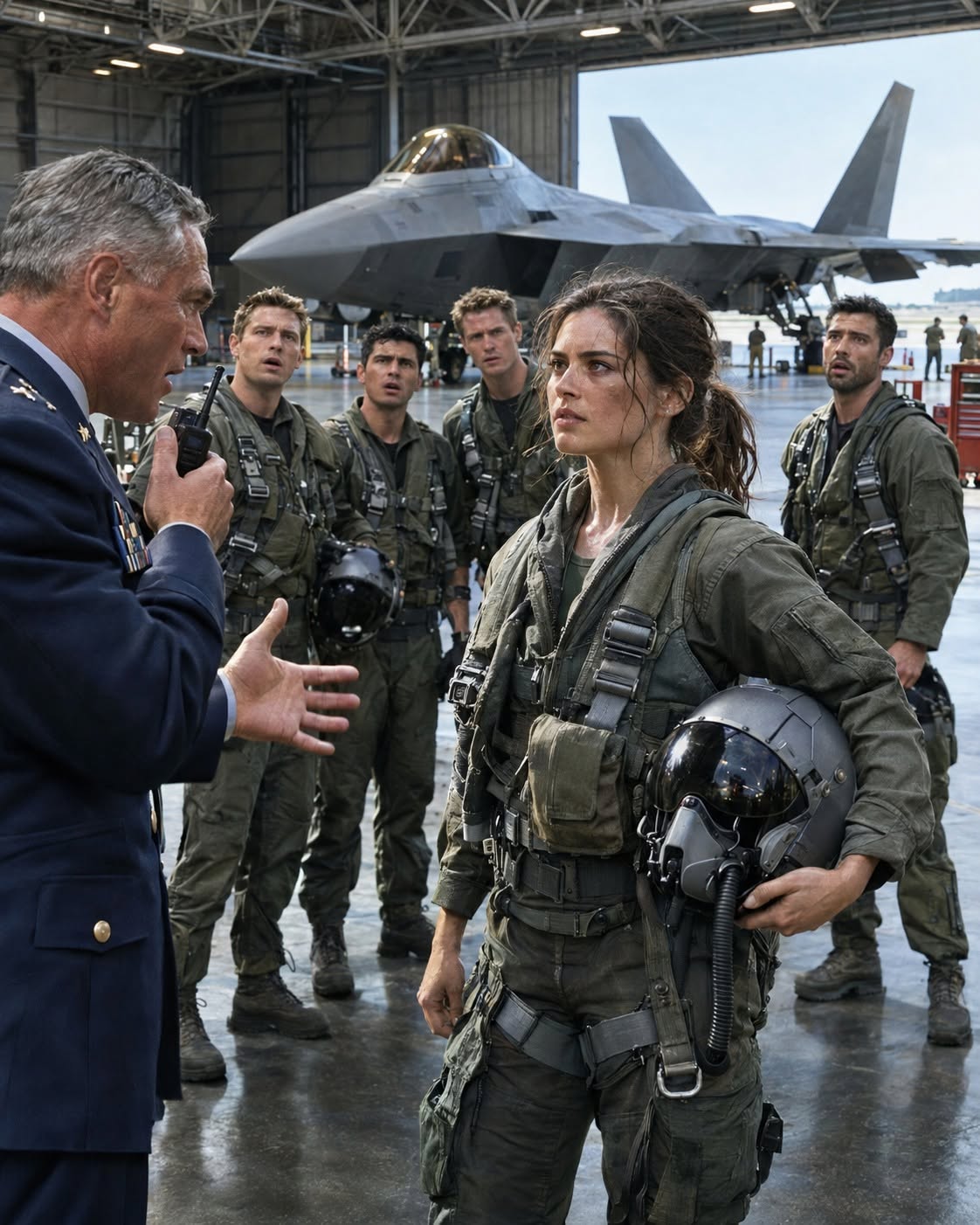
If they reached the wreckage first, the mission would be compromised.
“Captain Vasquez,” Webb said over the radio, “we have three vehicles approaching from the eastern access road. They are approximately four minutes from the crash site.”
“Visual confirmed.”
Elena saw the dust rising behind the hills.
Three dark vehicles.
Possibly more behind them.
She took a breath and assessed the terrain.
Her aircraft was not in perfect condition. Despite the countless hours she and Daniel had spent repairing it, the old F-16 still carried the scars of years of neglect. She knew every vibration, every unusual sound, every little hesitation in its systems.
She also knew its limits.
And she knew how to work within them.
“Command, I’m establishing a defensive presence over the wreckage.”
“Copy. Maintain your position and avoid unnecessary engagement.”
“Understood.”
Elena descended slightly, positioning herself where the approaching vehicles could see the aircraft.
She activated her warning systems.
The first vehicle stopped.
Then the second.
For several seconds, nobody moved.
“Captain, enemy vehicles are changing direction,” the radar operator announced.
Webb watched the display.
“They’re testing her.”
And they were.
The vehicles split into two groups, attempting to approach the valley from different directions.
Elena followed their movement, keeping herself between the approaching threat and the wreckage.
Then the radio crackled.
“Blackhawk, this is Widowmaker. I’m detecting additional movement near the northern ridge.”
Webb checked the display.
“Confirmed. Two more vehicles.”
“Copy.”
Holt shook his head.
“She’s going to get surrounded.”
Daniel Okapor, who had been standing quietly near the back of the command center, looked at him.
“She’s been surrounded since the day she arrived here.”
Holt turned.
“What does that mean?”
“It means she learned how to work with people who wanted her to fail. A few vehicles aren’t going to change that.”
Nobody answered.
Back in the valley, Elena noticed something unusual.
The vehicles weren’t simply trying to reach the drone. One of them had stopped near a narrow road, and several figures were moving toward a ridge with equipment.
They appeared to be preparing to establish a position overlooking the wreckage.
If they succeeded, the recovery helicopter would be exposed.
“Command, the ground forces are repositioning toward the northern ridge. Their movement suggests they’re preparing to control the recovery area.”
Webb frowned.
“Can you maintain visual contact?”
“Affirmative.”
“Do not pursue them beyond the recovery perimeter.”
Elena looked at the terrain.
She could see the helicopter’s projected approach corridor on her display. The northern ridge was becoming the greatest threat to the mission.
She needed time.
Not glory.
Not another impressive maneuver for the squadron to discuss over dinner.
Just enough time for the recovery team to get in and out.
“Command, request permission to use the western approach as a visual diversion.”
Webb looked toward the operations officer.
The proposed route was narrow, and the aircraft’s condition made unnecessary maneuvering a concern.
“Negative for aggressive engagement,” Webb replied. “Keep your aircraft safe.”
Elena didn’t argue.
“Understood.”
She studied the ridge again.
Then she noticed the enemy vehicles had stopped moving.
Something was happening.
A faint signal appeared on her warning display.
Her aircraft had detected a tracking attempt.
Someone on the ground was trying to lock onto her position.
“Command, possible hostile tracking. I have an indication of a threat.”
The room erupted into activity.
“Confirm type!”
“Unable to identify.”
Webb stepped toward the console.
“Captain, break off if you believe you’re in immediate danger.”
Elena’s eyes moved across the instruments.
The old F-16 gave a small shudder.
She knew that sensation.
It was the same irregular vibration she and Daniel had spent three nights investigating. A hydraulic component was responding differently under sustained load.
Not a failure yet.
But a warning.
She could return to base.
Nobody would blame her.
The recovery mission would probably be abandoned, and the data core might be lost.
But she had made a promise to herself long before she became a fighter pilot.
Never let someone else pay the price for a problem you still have the power to face.
“Command, I can maintain the perimeter. Request the recovery helicopter proceed with caution.”
Webb hesitated.
“Captain, that’s an order to disengage if the threat becomes unmanageable.”
“Copy, Colonel.”
Then the helicopter’s voice came through the radio.
“Blackhawk Command, this is Falcon Two. We are five minutes from the recovery zone.”
Elena looked toward the southern horizon.
Five minutes.
She could give them five minutes.
The first hostile vehicle began moving again.
Then another.
Elena adjusted her position, maintaining a visible presence over the valley.
Suddenly, the warning indicator flashed again.
This time, the hydraulic pressure dropped.
“Come on,” she whispered.
The aircraft shuddered.
For a brief moment, the control response felt heavier than it should have.
Elena immediately reduced the demands on the aircraft and reassessed her options.
She wasn’t going to pretend the problem didn’t exist.
She had spent too many nights repairing this machine to make that mistake.
“Daniel,” she said quietly, forgetting for a moment that he wasn’t on the aircraft. “You’d better have fixed what you said you fixed.”
At Blackhawk, Daniel was listening to the communications feed.
He recognized the change in her voice.
“Colonel, something’s wrong with 77-014.”
Webb turned.
“How do you know?”
“She’s compensating for something. Listen to the way she’s describing her aircraft’s response.”
Daniel hurried toward the maintenance console.
“Get me the latest maintenance history.”
An airman pulled up the records.
Daniel scanned the information, his finger moving down the list.
Then he stopped.
“There’s the problem.”
“What?”
“That pressure sensor. It was replaced twice, but the wiring harness wasn’t. We repaired the connector, but the original fault may still be intermittent.”
Denton stepped forward.
“Are you saying the aircraft is unsafe?”
Daniel looked directly at him.
“I’m saying we’ve been treating symptoms instead of fixing the cause for years.”
The words hung in the room.
Daniel leaned toward the microphone.
“Captain Vasquez, this is Okapor. I’m looking at your maintenance history. Your hydraulic pressure indication may be unreliable. Do you copy?”
“Copy, Daniel.”
“Don’t push the aircraft harder than necessary. We are checking the system from here.”
“Understood. Thanks for the warning.”
Webb looked at the radar.
The helicopter was getting closer.
Three minutes.
Then the unexpected happened.
The approaching ground vehicles began moving toward the western side of the valley, apparently attempting to bypass Elena’s position.
The helicopter’s planned approach was now exposed.
Elena saw it immediately.
“Falcon Two, hold your current position. Do not enter the valley yet.”
The helicopter pilot responded.
“What’s the problem?”
“Ground movement near your approach corridor. Wait for my confirmation.”
Webb studied the tactical display.
“Captain, can you identify their destination?”
“Affirmative. They’re moving toward the western entrance.”
“Can you maintain observation?”
“Yes, Colonel.”
Elena shifted her attention between the aircraft instruments and the ground.
Her hydraulic warning was still present.
The fighter was becoming more difficult to control.
But she wasn’t going to let the recovery team fly blindly into danger.
She contacted the helicopter again.
“Falcon Two, use the alternate southern approach. The northern ridge is no longer clear.”
The helicopter pilot paused.
“That route is longer.”
“I know. But it’s clear.”
“Copy. Changing approach.”
Webb looked at his operations officer.
“How did she see that?”
“She has a better view of the entire valley than we do.”
“No,” Webb said. “She understood what the enemy was trying to do.”
For the next two minutes, Elena remained above the recovery zone, carefully managing the aircraft.
The hostile vehicles had reached the valley entrance.
Then the helicopter appeared.
A small shape against the distant mountains.
“Falcon Two, this is Widowmaker. Recovery zone is clear on the southern approach. You have approximately two minutes.”
“Copy. Beginning descent.”
The helicopter landed near the wreckage.
Two recovery specialists jumped out and ran toward the damaged drone.
One carried a reinforced equipment case.
The other carried a small extraction tool.
Elena watched them move.
“Falcon Two, status?”
“Data core located.”
“Copy.”
One of the specialists opened the drone’s damaged compartment.
A moment later, he lifted out a small metallic case.
“Core secured!”
Elena felt her shoulders relax.
Then the radio erupted.
“Contact! Vehicles approaching from the eastern side!”
The helicopter crew hurried back.
One of the recovery specialists stumbled near the landing gear.
The data case slipped from his hand and struck the ground.
For one terrible second, nobody moved.
Then the second specialist grabbed it and pulled him toward the helicopter.
“Falcon Two, we have the core. Preparing departure!”
Elena watched the enemy vehicles close the distance.
“Move now,” she said.
The helicopter lifted.
A loud crackling sound interrupted the radio.
Then silence.
“Falcon Two, confirm status.”
Nothing.
“Falcon Two, this is Widowmaker. Do you copy?”
A few seconds passed.
Then a voice returned.
“Copy, Widowmaker. We have a communications issue. Aircraft is operational. Data core secure.”
Elena exhaled.
“Good. Get out of there.”
The helicopter disappeared behind the southern ridge.
The recovery was complete.
But Elena was not yet safe.
Her aircraft’s warning system flashed again.
This time, the hydraulic pressure indication dropped further.
“Command, I have a serious aircraft systems warning. I’m discontinuing the patrol and returning to base.”
Webb answered immediately.
“Approved. We have your position. Emergency crews are standing by.”
“Copy.”
Elena turned toward home.
The old F-16 seemed to resist her every movement.
The cockpit was filled with warnings.
She could hear the engine, the rushing air, and her own breathing.
For the first time that night, she allowed herself to think about what might happen if she didn’t make it back.
Not the medals.
Not the reports.
Not even the squadron’s opinion.
She thought about Daniel waiting in the hangar.
She thought about the mechanics who had worked beside her.
And she thought about the fourteen pilots who had once looked at her as though she were an inconvenience.
She wanted them to understand something.
Not that she was better than them.
That they had all been wrong about what made a pilot worthy of respect.
A pilot wasn’t defined by the aircraft assigned to them.
A pilot was defined by the decisions they made when everything stopped going according to plan.
“Blackhawk Command, this is Widowmaker. Approximately eight minutes from base. Aircraft handling is degraded, but manageable.”
Webb leaned toward the radio.
“Understood, Captain. Take your time.”
Eight minutes became ten.
Then twelve.
When the aircraft finally appeared over Blackhawk, every person in the command center stood.
The runway lights were on.
Emergency vehicles lined the edges.
Daniel stood near the hangar entrance, staring at the approaching aircraft.
He knew that sound.
He also knew it wasn’t healthy.
The F-16 touched down harder than usual, bounced slightly, then settled onto the runway.
It rolled toward the designated stopping area.
When the engine finally shut down, the silence felt almost unreal.
For several seconds, Elena remained in the cockpit.
Her hands were still gripping the controls.
Then she removed her helmet.
The canopy opened.
Daniel was the first person to reach her.
“You stubborn woman,” he said, his voice shaking with relief.
Elena managed a tired smile.
“Nice to see you too.”
He helped her climb down.
“How bad?”
“Bad enough that I owe you another maintenance night.”
Daniel laughed, but his eyes were wet.
“You owe me about fifty.”
The other pilots had gathered near the aircraft.
Holt stood at the front.
He looked at the old F-16, then at Elena.
For once, he had nothing sarcastic to say.
Major Denton approached a few seconds later.
“Captain Vasquez.”
“Sir.”
“Colonel Webb wants you in the command center.”
Elena nodded.
She was exhausted.
But she straightened her uniform and followed him.
Inside, the atmosphere had changed.
The recovered data core had already been transferred to intelligence personnel. The initial assessment suggested that the information could help identify several previously unknown supply routes.
The partner nation’s helicopter crew had confirmed that everyone was safe.
Webb stood at the center of the room.
When Elena entered, he didn’t ask her to explain herself.
He simply looked at the operational display.
“Captain, your mission report will include the full timeline, including the aircraft malfunction, the enemy movements, and your coordination with the recovery team.”
“Yes, sir.”
“And your contribution will not be diluted into a convenient story about squadron-wide cooperation.”
Elena remained silent.
Webb continued.
“I’ve spent enough years in uniform to recognize when someone is being underestimated. But tonight, I saw something more concerning. I saw a command structure that almost overlooked the one pilot who understood the mission better than anyone else.”
Denton shifted uncomfortably.
“Colonel, I believe the squadron was operating within its established procedures.”
Webb turned toward him.
“Established procedures are supposed to protect people and accomplish missions, Major. They are not supposed to protect someone’s ego.”
Nobody spoke.
Webb looked back at Elena.
“You have my respect, Captain. And I intend to make sure the official record reflects what actually happened.”
Elena nodded.
“Thank you, sir.”
Then she added something nobody expected.
“With respect, Colonel, I’d also like the maintenance investigation to be included.”
Daniel looked up.
Webb raised an eyebrow.
“Explain.”
“The hydraulic issue wasn’t a surprise. The aircraft had been carrying a recurring fault for years. Daniel and I identified the pattern, but we didn’t have enough authority to investigate every related component before tonight.”
She paused.
“If that aircraft had failed over populated territory, the consequences could have been much worse. I don’t want the investigation to stop at the fact that I brought it home.”
Webb studied her for a long moment.
“You’re more interested in fixing the problem than receiving credit for surviving it.”
“Yes, sir.”
“Very well. We’ll investigate the maintenance history across the entire wing.”
Daniel looked down.
He had spent twenty years maintaining aircraft.
He had written reports, submitted requests, and watched problems get passed from one maintenance shift to another because there was never enough time, money, or authority to fix them properly.
For the first time, someone with real influence was listening.
The following morning, Blackhawk Air Base woke to a very different atmosphere.
The mission had already become the subject of discussion across the wing.
The recovered intelligence had confirmed a threat to several allied supply routes.
The partner nation had publicly acknowledged the successful recovery operation.
And the official report identified Captain Elena Vasquez as the sole fighter pilot who maintained the recovery perimeter.
Her call sign, Widowmaker, appeared in the report for the first time.
But something else happened that morning.
At 0700, Colonel Webb called an emergency leadership meeting.
Every pilot, crew chief, and senior maintenance officer was ordered to attend.
Elena arrived wearing her flight suit.
Daniel stood near the back.
Holt was already there, looking unusually uncomfortable.
Webb entered carrying a thick folder.
“I’ve reviewed the maintenance records for tail number 77-014,” he began.
“The aircraft was repeatedly assigned low priority because of its history. Several unresolved problems were documented. Some were repaired temporarily. Others were passed along without adequate investigation.”
He placed the folder on the table.
“That aircraft wasn’t simply unreliable. It was neglected.”
His eyes moved toward Denton.
“Who authorized its continued operation without a complete review?”
Denton’s face tightened.
“Several maintenance decisions were made before my current assignment.”
“Then we will investigate those decisions too.”
Webb turned toward the pilots.
“Some of you called it the coffin. Some of you laughed when Captain Vasquez was assigned to it. You treated an aircraft with a troubled history as though it were an appropriate punishment for a pilot you didn’t believe belonged here.”
He paused.
“That attitude ends today.”
Holt shifted in his chair.
Webb continued.
“An aircraft is not a toy. A maintenance crew is not an inconvenience. And a pilot’s value is not determined by gender, popularity, or the number of people willing to laugh at their jokes.”
His voice grew firmer.
“Every person on this base is responsible for the safety and success of the people beside them. If you cannot respect the people who keep you alive, you have no business leading them into the air.”
Elena sat quietly.
She hadn’t expected an apology.
She certainly hadn’t expected the colonel to address the entire squadron.
But Webb wasn’t finished.
“Captain Vasquez will be formally recognized for her actions during Operation Copper Shield, the northern patrol, and last night’s recovery mission. Her reports will be included in the operational review.”
He looked toward Daniel.
“Senior Crew Chief Okapor will lead a technical review of the 77-014 maintenance program and recommend changes to prevent similar problems across the wing.”
Daniel blinked.
“Sir?”
“You heard me.”
For the first time in years, the crew chief looked as surprised as a new recruit.
After the meeting, the pilots began leaving in small groups.
Holt remained seated.
Elena was walking toward the door when he called her name.
“Captain Vasquez.”
She turned.
He stood, looking as though the words were physically difficult to produce.
“Can I talk to you?”
“Of course.”
Holt glanced at the others.
“I owe you an apology.”
Elena said nothing.
He continued.
“I thought you were going to arrive here expecting everyone to make room for you. I thought you’d use every opportunity to prove something. When they gave you 77-014, I figured you’d either fail or ask to be transferred.”
He looked down.
“Instead, you made that aircraft better than half the planes we fly.”
Elena folded her arms.
“That’s not why you owe me an apology.”
Holt looked up.
She continued.
“You owe me an apology because you decided who I was before you ever watched me work. And you didn’t just disrespect me. You ignored the people who were trying to keep all of us safe.”
Holt swallowed.
“You’re right.”
For a moment, neither spoke.
Then Elena nodded.
“Learn from it. That’s all I can ask.”
She turned to leave.
“One more thing,” Holt said.
She stopped.
“If you ever need a wingman…”
Elena gave him a small smile.
“Then make sure you’re the kind of wingman someone can trust.”
It wasn’t forgiveness.
Not yet.
But it was a beginning.
Over the next several weeks, Blackhawk began changing in ways that couldn’t be captured in a single official report.
The maintenance department received new authority to ground aircraft with unresolved safety issues.
Crew chiefs were included in operational planning meetings.
Pilots were required to review maintenance discrepancies with the people responsible for fixing them.
And tail number 77-014 received the most comprehensive inspection it had undergone in years.
Daniel personally supervised the process.
Elena visited the hangar almost every evening.
One night, while they were reviewing the final inspection report, Daniel looked up from his clipboard.
“You know, I used to think you were trying to prove something to those pilots.”
Elena tightened a bolt on a maintenance panel before answering.
“I was.”
Daniel smiled.
“And now?”
She looked at the aircraft.
“Now I think I was trying to prove something to myself.”
“What was that?”
“That I hadn’t made a mistake choosing this life.”
Daniel put down his clipboard.
“You didn’t.”
Elena looked at him.
He continued.
“People see the aircraft. They see the uniforms, the ranks, the medals. But they don’t always see the people who make all of it work. You saw us.”
He gestured toward the aircraft.
“That’s why this machine is still flying.”
Elena smiled.
“No, Daniel. It’s flying because you never stopped caring.”
For a while, they worked in comfortable silence.
Then Daniel pointed toward the side of the hangar.
A new sign had been installed above the maintenance office.
It read:
EVERY AIRCRAFT HAS A STORY. EVERY PERSON DESERVES TO BE HEARD.
Elena stared at it.
“Who came up with that?”
Daniel pretended to examine his clipboard.
“Some old crew chief who has been around too long.”
She laughed.
But the biggest change came three months later.
Colonel Webb announced that Blackhawk would establish a new maintenance-and-flight evaluation program. Pilots and crew chiefs would work together to identify recurring aircraft problems before they became emergencies.
Elena was asked to help lead the program.
She initially declined.
“Sir, I’m a fighter pilot. There are more qualified people for a management position.”
Webb smiled.
“That’s precisely why I want you involved. You understand both sides.”
She considered it.
Then she accepted.
Her work wasn’t limited to repairing the reputation of one old F-16. She helped change how the entire wing approached maintenance, communication, and accountability.
And tail number 77-014?
It became the symbol of the program.
The aircraft was repainted, but Elena insisted that its original tail number remain.
She also requested that the maintenance crew’s names be included on a small plaque inside the hangar.
When the ceremony was announced, several pilots expected a grand speech.
Instead, Elena stood beside the aircraft and spoke for less than five minutes.
“I was given this aircraft because people believed it was the worst one in the squadron. They thought it represented my place here.”
She rested one hand on its fuselage.
“But an aircraft is more than its reputation. It is the result of every decision made by the people responsible for it. Some decisions were good. Some were careless. And some were made because nobody wanted to spend the time understanding the real problem.”
She looked toward Daniel and the maintenance team.
“These people never gave up on this aircraft. They deserved better long before I arrived.”
Then she turned toward the pilots.
“If you want to be a good fighter pilot, learn to respect the people who stand behind you. You may be the one in the cockpit, but you are never flying alone.”
The applause began with Daniel.
Then Webb.
Then the rest of the room.
Even Holt joined in.
Months passed.
The name Widowmaker became familiar throughout the wing, but Elena never allowed it to become the most important part of her identity.
She still arrived early.
She still studied mission reports.
She still visited the maintenance hangar.
And she still flew 77-014 whenever its mission requirements allowed.
One afternoon, a young lieutenant named Sarah Mitchell arrived at Blackhawk.
She was the second woman assigned to the 77th Fighter Wing.
When she stepped off the transport aircraft, several pilots turned to look.
Sarah adjusted her duffel bag.
She had heard stories about Blackhawk.
She had also heard about the famous captain who had supposedly turned an abandoned aircraft into one of the wing’s most dependable fighters.
But she wasn’t sure what kind of reception to expect.
She walked toward the hangar alone.
Before she reached the entrance, a familiar voice called out.
“Need a hand with that bag?”
Sarah turned.
Captain Elena Vasquez stood beside a maintenance cart.
Behind her was Daniel Okapor, smiling.
Sarah looked surprised.
“Captain, I can manage.”
“I know,” Elena replied. “That doesn’t mean you have to.”
She took one side of the bag.
Daniel took the other.
As they walked toward the hangar, Sarah glanced at the F-16 parked inside.
“Is that 77-014?”
Elena nodded.
“I’ve heard about that aircraft.”
“Most people have.”
“Is it really as bad as they say?”
Elena looked toward the old fighter.
Then she smiled.
“Not anymore.”
Sarah hesitated before asking the question that had been bothering her since she received her assignment.
“Captain, can I ask you something?”
“Go ahead.”
“Was it difficult being the only woman here?”
Elena stopped walking.
She considered giving the young lieutenant an encouraging answer. Something simple about confidence, hard work, and ignoring the critics.
But Sarah deserved something more honest.
“Yes,” Elena said. “Some days were harder than others. There were moments when I wondered whether I would ever be judged by the same standards as everyone else.”
Sarah nodded.
“How did you handle it?”
“I stopped trying to convince people who had already decided not to listen. I focused on becoming someone others could depend on.”
She paused.
“But remember something. You don’t have to repair an entire institution just to earn the right to be in it. That’s not your responsibility. The people who come after you deserve a better environment than the one you inherited.”
Sarah absorbed the words.
Then she asked quietly, “Do you think things will be different for me?”
Elena looked around the hangar.
At the pilots working beside the crew chiefs.
At the maintenance officers reviewing inspection reports.
At Daniel, who was now training a new generation of technicians.
And at Holt, who had recently volunteered to help mentor incoming pilots.
“Yes,” Elena said. “Because we’ve already started changing them.”
That evening, Colonel Webb requested Elena’s presence in his office.
A new assignment had arrived.
A special evaluation unit was being established to investigate recurring aircraft failures and improve operational readiness across several bases. Webb had recommended Elena to help lead its flight operations.
The assignment would take her away from Blackhawk for several months.
She read the document twice.
“Sir, why me?”
Webb leaned back.
“Because I’ve watched you do something very few officers understand.”
“What is that?”
“You don’t confuse authority with leadership.”
He continued.
“You could have spent the last three months collecting praise, demanding promotions, and making sure everyone knew how badly you had been treated. Instead, you made the entire wing better.”
Elena looked at the assignment.
It was a significant opportunity.
But leaving Blackhawk felt strange.
This was the place where she had been rejected, underestimated, and handed an aircraft nobody wanted.
It was also the place where she had found people who believed in her.
“How long do I have to decide?”
“Forty-eight hours.”
“Thank you, Colonel.”
As she left the office, she passed the squadron’s main corridor.
A framed photograph had recently been installed there.
It showed Elena standing beside Daniel in front of tail number 77-014.
Neither was wearing a medal.
Neither was posing like a hero.
They were simply looking at the aircraft.
Underneath, a small plaque read:
OPERATION COPPER SHIELD AND SOUTHERN RECOVERY MISSION
COURAGE IS NOT MEASURED BY THE AIRCRAFT YOU ARE GIVEN, BUT BY THE RESPONSIBILITY YOU ACCEPT.
Elena stood there for a moment.
Then she continued toward the hangar.
Daniel was waiting beside 77-014.
“Word is you’re leaving us,” he said.
“Word travels quickly.”
“Twenty years in maintenance teaches you two things. Aircraft make strange noises, and people gossip.”
She laughed.
He handed her a small envelope.
“What’s this?”
“Something I found while organizing the old maintenance records.”
Inside was a photograph of 77-014 taken years earlier.
The aircraft looked almost unrecognizable. Its paint was faded, its panels worn, and its landing gear covered in dust.
On the back, someone had written:
UNFIT FOR FUTURE SERVICE.
Elena stared at the words.
“Who wrote this?”
Daniel shrugged.
“Someone who stopped looking.”
She turned the photograph over again.
Then she looked at the aircraft standing in front of her.
“Maybe they were right at the time.”
Daniel raised an eyebrow.
“Are you serious?”
“Maybe it really wasn’t fit for service. Maybe it needed more work than anyone wanted to give it.”
She folded the photograph carefully.
“But that doesn’t mean it was worthless.”
Daniel nodded slowly.
“There’s a difference between something being broken and something being beyond repair.”
Elena smiled.
“Exactly.”
The next morning, she submitted her acceptance of the new assignment.
Before leaving, she made one final flight in 77-014.
The sky above Blackhawk was clear.
The old fighter climbed smoothly, its familiar engine sound filling the cockpit.
Elena looked down at the airbase.
The runways.
The hangars.
The people who had once doubted her.
And the people who had eventually stood beside her.
She opened the radio.
“Blackhawk Tower, Widowmaker. Requesting final departure clearance.”
The controller responded.
“Clearance granted, Captain. Safe travels.”
She smiled.
Then another voice came through.
“Captain Vasquez, this is Okapor. You still owe me fifty maintenance nights.”
Elena laughed.
“Put them on my tab, Daniel.”
A second voice interrupted.
“Captain, this is Lieutenant Holt. When you come back, I expect a proper rematch in the simulator.”
Elena glanced at the instruments.
“Only if you promise to follow formation this time, Lieutenant.”
There was laughter over the radio.
Even Holt laughed.
Then Colonel Webb’s voice came through.
“Blackhawk will always have a place for you, Widowmaker.”
Elena looked at the horizon.
“Thank you, Colonel.”
She pushed the throttle forward.
Tail number 77-014 accelerated down the runway and lifted into the morning sky.
For a brief moment, the aircraft that had once been considered a coffin seemed to disappear into the sunlight.
But its story was far from over.
Years later, when new pilots arrived at Blackhawk, they would hear about the captain who had been given the squadron’s worst aircraft and refused to accept the limits others had placed on it.
They would hear about Operation Copper Shield, the midnight interception, and the dangerous recovery mission that had changed the wing forever.
Some would remember her call sign.
Others would remember the missions.
But Daniel Okapor always told the story differently.
He would point toward the old maintenance photographs and say:
“People think Elena Vasquez saved that aircraft. And in a way, she did. But what she really saved was the idea that every problem deserves to be understood before someone decides it’s hopeless.”
And that was the lesson Blackhawk eventually learned.
A person’s worth is not determined by the worst thing someone says about them.
A machine’s value is not determined by the moment it stops working.
And leadership is not about making sure everyone knows your name.
It is about making sure the people around you have a better chance of succeeding because you were there.
Elena had arrived at Blackhawk with one duffel bag, no welcome, and an aircraft nobody wanted.
She left with something far more valuable than recognition.
She left behind a standard.
A standard that demanded respect before judgment, responsibility before excuses, and courage before comfort.
The squadron had once believed that giving her the coffin would end her career.
Instead, it became the beginning of a legacy.
And somewhere above the clouds, the woman they had once underestimated continued flying toward the horizon, carrying a lesson that no official report could ever rewrite:
Never mistake what someone has been given for what they are capable of becoming.