The first explosion ripped through the cabin at 40,000 feet. Seconds later, the engines began failing, the oxygen masks dropped
PILOT’S LAST CALL — THE MAN WHO TRIED TO FORGET THE SKY
Chapter 2: The Past Never Stays Buried
The first thing I noticed after the aircraft stopped moving was the silence.
Not the peaceful kind of silence you experience after a long day. This was different. It was the kind of silence that comes after something terrible has almost happened, when your mind is still waiting for the next explosion.
Rain hammered against the damaged fuselage. Somewhere behind me, an alarm continued to beep. The smell of burning rubber, hydraulic fluid, and saltwater filled the cockpit.
I kept my hands on the controls for several seconds, even though the aircraft was no longer moving.
I didn’t trust the silence.
“Sir?”
The voice came from the cockpit doorway.
A young flight attendant stood there, blood running down one side of his forehead. His uniform was torn, and his hands were shaking.
“Are they alive?” I asked.
He nodded.
“All of them. The medical team is checking everyone. Some people are injured, but they’re alive.”
I closed my eyes.
For the first time since the explosion, I allowed myself to breathe.
Then the young man asked a question I wasn’t prepared to answer.
“Who are you?”
I looked down at my hands.
They were trembling now.
“I used to fly.”
He stared at me.
“Used to?”
Before I could explain, the radio crackled.
“Reach 824, this is Raptor Two. Do you read?”
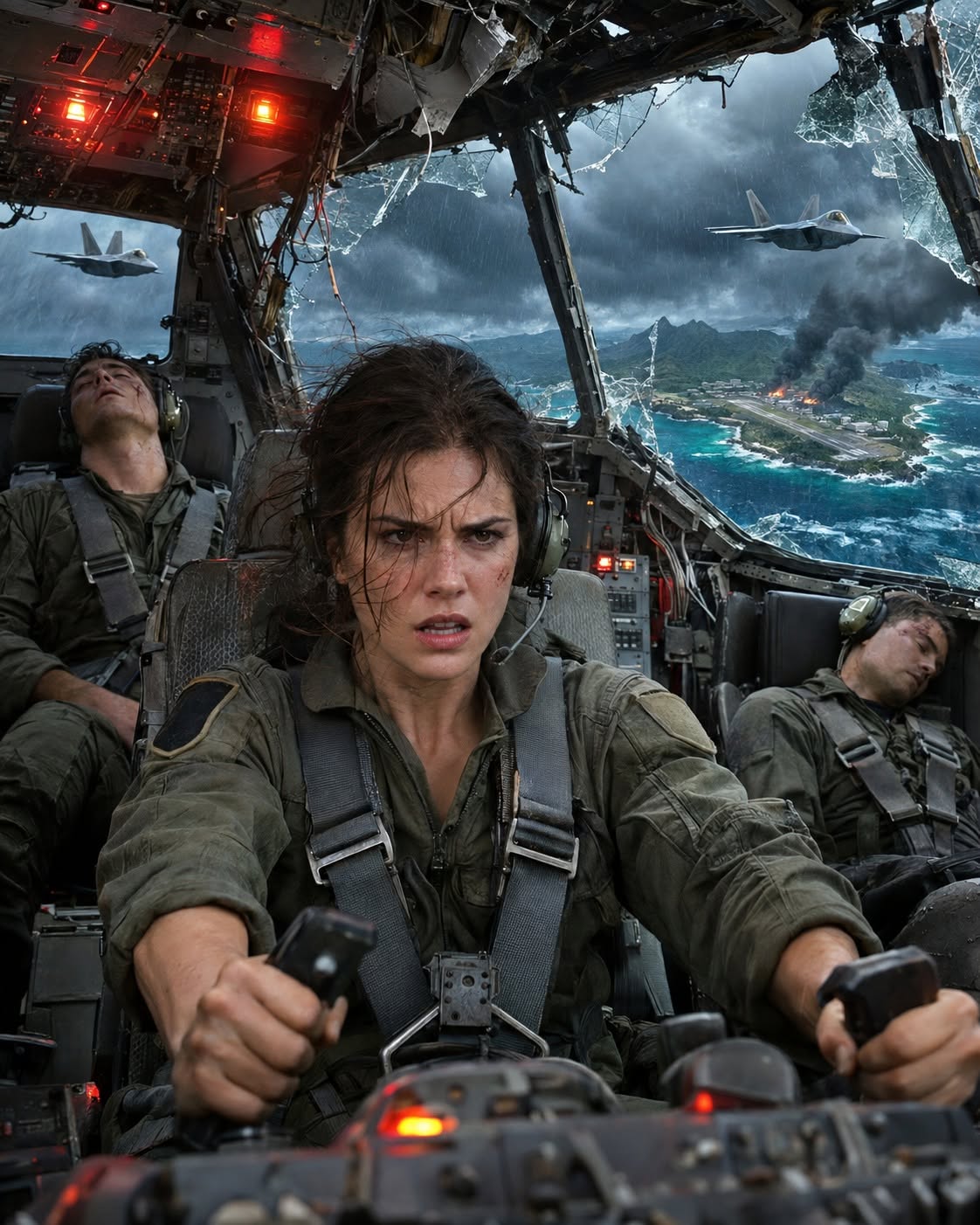
I reached for the microphone.
“Raptor Two, Reach 824. We read you.”
“Thank God. We have rescue aircraft inbound. Stay where you are. Do not attempt to move the aircraft.”
A second voice broke through.
It was David.
“Hey, old friend. You still have a habit of making impossible situations look personal.”
Despite everything, I almost smiled.
“You’re getting sentimental, Collins.”
“Only because I thought I was about to watch you disappear into the Pacific.”
I looked through the shattered cockpit window. One of the F-22s was circling above the coastline, its silhouette barely visible through the storm.
“How long until rescue?”
“Twenty minutes, maybe thirty. Weather’s making it difficult.”
“Tell them to prioritize the medical teams. We’ve got eighty wounded soldiers in the back.”
“Already done.”
There was a pause.
Then David spoke again.
“Listen. Don’t go anywhere. There’s going to be a lot of questions when we get there.”
I knew exactly what he meant.
“Figured as much.”
“And this time, don’t disappear before I get to talk to you.”
The radio went quiet.
I sat back and stared at the instruments.
My old life had found me.
And I had a feeling it wasn’t going to let me walk away so easily.
The Questions Begin
By the time the rescue teams arrived, the storm had weakened enough for helicopters to reach the atoll.
Military medics moved through the wreckage with remarkable speed. They checked the soldiers, stabilized those with serious injuries, and began transferring patients to evacuation aircraft.
I helped where I could.
I carried medical supplies, assisted a soldier whose leg was trapped beneath a fallen equipment case, and held pressure against a wound until a medic took over.
Nobody asked me to do those things.
I simply couldn’t stand there watching.
One soldier, a young man with a bandage wrapped around his chest, grabbed my sleeve as I passed.
“Hey, pilot.”
I stopped.
“Yeah?”
He looked at me for a moment.
“I don’t know who you are, but I heard what happened up front.”
I didn’t answer.
He tightened his grip.
“My little brother is six. I promised him I’d come home.”
His voice cracked.
“Thanks for helping me keep that promise.”
I felt something tighten in my throat.
“You’re going to see him,” I said. “Just focus on getting better.”
He nodded.
Then he released my sleeve.
It was the first time that day I understood what the flight had really been about.
It hadn’t been about the aircraft, the controls, or the impossible landing.
It had been about promises.
Eighty of them.
Eighty people who had someone waiting for them somewhere.
And I had been given one chance to help them get there.
An hour later, a military transport helicopter carried me to a naval medical facility.
A doctor examined my injuries, cleaned a cut above my eyebrow, and insisted I remain under observation.
I barely listened.
Two uniformed officers were waiting outside the examination room.
One was a colonel with silver hair and a face that seemed permanently carved into a frown. The other was a woman carrying a tablet.
“Are you the civilian who took control of Reach 824?” the colonel asked.
“Yes, sir.”
“Former military?”
“Former Air Force.”
“Name?”
I gave it to him.
He glanced at the tablet.
His expression changed.
“That’s interesting.”
I knew that look.
It was the look people got when they discovered something they weren’t expecting to find.
“You were an F-15E pilot,” he said.
“Yes.”
“Combat deployments?”
“Several.”
“Then why were you listed as a civilian passenger on a military evacuation flight?”
“Because that’s what I was.”
The colonel studied me.
“That’s not an answer.”
“It’s the only one I have right now.”
The woman beside him looked up from her tablet.
“Sir, his flight records show he was medically grounded after an incident seven years ago.”
The room suddenly felt smaller.
The colonel folded his arms.
“Is that true?”
I looked toward the window.
“Yes.”
“What happened?”
I didn’t answer immediately.
Because that was the question I had spent seven years trying not to hear.
Seven Years Earlier
My last combat deployment had been in the Middle East.
I was flying as part of a two-aircraft formation when our mission changed unexpectedly. Intelligence reported that an American reconnaissance team had been compromised near a hostile position.
We were ordered to provide cover while a rescue helicopter moved in.
The situation deteriorated quickly.
Dust reduced visibility. Communications became unreliable. Enemy fire forced the helicopter to change its approach.
Then my wingman, Captain Michael Hayes, reported an engine warning.
I told him to break away.
He refused.
He had a rescue team below him, and he wasn’t leaving until they were safe.
A moment later, his aircraft was hit.
I watched his F-15E disappear behind a ridge.
I remember the radio call.
I remember the smoke.
I remember the silence afterward.
I also remember the investigation.
The official report found that the mission had been compromised by several factors, including weather, communication failures, and enemy action.
But I blamed myself.
I had been flight lead.
I had made the decisions.
And Michael had never come home.
For months, I couldn’t sleep without hearing his voice.
Eventually, I requested reassignment.
Then I left the Air Force.
The doctors called it post-traumatic stress and recommended treatment.
I called it something else.
Failure.
The colonel listened without interrupting.
When I finished, he lowered his eyes.
“Hayes,” he said quietly. “I knew him.”
I looked at him.
“He was a good pilot.”
“He was more than that.”
The colonel nodded.
“Yes. He was.”
For a moment, neither of us spoke.
Then the woman with the tablet broke the silence.
“There’s another issue.”
I turned toward her.
“The aircraft’s flight recorder captured several minutes of the emergency. Your actions are already being reviewed by the Air Force.”
“Reviewed for what?”
“Unauthorized access to a military aircraft. Assuming command without authorization. Potentially interfering with the crew.”
I stared at her.
“Those pilots were unconscious.”
“We understand that.”
“Then what exactly are we discussing?”
The colonel raised a hand.
“Easy. Nobody is accusing you of trying to steal an aircraft. But procedures exist for a reason. We need to understand what happened.”
I leaned back.
“Then ask the flight recorder.”
“We intend to.”
He paused.
“But there’s something else you should know.”
He looked directly at me.
“Major Collins has requested to see you.”
The Man in the F-22
David arrived the following morning.
He walked into the medical room wearing a flight suit, his hair still damp from a shower and exhaustion visible beneath his eyes.
For several seconds, he simply looked at me.
Then he shook his head.
“Seven years.”
I shrugged.
“Time passes.”
“Not like that.”
He pulled a chair beside my bed.
“I heard about Hayes.”
I looked down.
“I figured you had.”
“Michael was my instructor before he became your wingman.”
I hadn’t known that.
David leaned forward.
“Do you know what he told me once?”
I shook my head.
“He said you were the best pilot he’d ever flown with. Not because you could fly circles around everyone else. Because you never stopped thinking about the people who depended on you.”
I swallowed.
“Didn’t save him.”
“No,” David said. “It didn’t.”
His honesty caught me off guard.
He continued.
“But you can’t spend the rest of your life treating every person you fail to save as proof that you shouldn’t have survived.”
I looked away.
“Easy for you to say.”
“Maybe.”
He rested his hands on his knees.
“But I watched that C-17 come out of a dive yesterday. I watched you bring eighty people down through a storm in an aircraft you had never flown before. And I heard you stay on the radio afterward, making sure everyone was accounted for.”
He shook his head.
“Michael would have been proud.”
I felt the familiar pressure behind my eyes.
I didn’t want to cry.
Not in front of David.
Not about Michael.
But grief doesn’t always ask permission.
A tear slipped down my cheek.
David pretended not to notice.
For that, I was grateful.
After a while, he stood.
“There’s one more thing.”
“What?”
“The military wants you to attend a formal debriefing. But that’s not why I’m here.”
He reached into a pocket and placed a small envelope on the table.
Inside was a photograph.
Michael and me, standing beside our aircraft after a training exercise. Both of us were smiling.
On the back, in Michael’s handwriting, were four words.
Never stop bringing people home.
I stared at the photograph for a long time.
Then I closed the envelope.
“Where did you get this?”
“His wife sent it to me years ago. She asked me to give it to you if I ever found you.”
I couldn’t speak.
David waited.
Finally, I asked, “How is she?”
“She’s doing well. Their daughter just started college.”
I nodded.
For years, I had convinced myself that remembering Michael meant remembering the day he died.
I had forgotten that he had lived.
He had loved people.
He had laughed.
He had left behind a family.
And perhaps the best way to honor him wasn’t to keep punishing myself for losing him.
Perhaps it was to remember the man he had been.
The Investigation
Three days later, I sat in a military conference room facing a panel of senior officers.
The flight recorder footage played on a large screen.
The explosion.
The decompression.
The failed engines.
The pilots losing consciousness.
Then the cockpit door opening.
Me entering.
The footage showed me checking the pilots, taking control, and attempting to stabilize the aircraft.
An officer paused the recording.
“At this point, you recognized the aircraft was not responding normally?”
“Yes.”
“What did you believe had failed?”
“Hydraulic systems. Possibly flight control assistance.”
“Had you ever received formal C-17 training?”
“No.”
“Then how did you know what to do?”
I considered the question.
“I didn’t know exactly what to do. I recognized what the aircraft was telling me, and I used the training I had.”
The officer frowned.
“That’s a rather broad explanation.”
“It’s the truth.”
Another officer leaned forward.
“Your decisions were unconventional. Particularly the landing maneuver.”
I nodded.
“I understand.”
“You deliberately forced the aircraft into a ground loop.”
“Yes.”
“That maneuver could have destroyed the aircraft.”
“It could have.”
“And you believed that was preferable?”
I looked around the room.
“An aircraft can be replaced. Eighty people cannot.”
Nobody spoke.
The chairman of the panel, a general with decades of experience, closed the file in front of him.
“Captain, we’ve reviewed the data. We’ve also interviewed the surviving crew and several passengers.”
He paused.
“Your actions were extraordinary. But we need to be careful about what this event represents.”
I waited.
“We cannot encourage untrained individuals to take control of military aircraft. Nor can we pretend that experience in one aircraft automatically qualifies someone to operate another.”
“I agree.”
The general seemed surprised.
I continued.
“I made decisions under extreme pressure. Some were calculated. Some were desperate. I don’t expect anyone to copy them. I only know that when I reached the cockpit, there was nobody else capable of keeping that aircraft in the air.”
The general studied me.
“Would you make the same decision again?”
I thought about the soldiers.
About Michael.
About the Pacific rushing toward us.
“Yes.”
The room remained silent.
Then the general nodded.
“That’s what I expected.”
He closed the folder.
“Your actions will be formally recognized. However, we have another matter to discuss.”
He slid a document across the table.
It was an offer.
The Air Force wanted me to help develop emergency response training for military transport crews, particularly scenarios involving sudden crew incapacitation, communication failures, and unusual aircraft emergencies.
I stared at the document.
“You’re asking me to come back?”
“Not as a fighter pilot,” the general replied. “As an instructor. Someone who understands what happens when the manual doesn’t seem to cover the situation.”
I didn’t pick up the document.
“Why me?”
The general looked at me for a long moment.
“Because you know what it costs to lose someone. And because you understand that courage without discipline is dangerous, but discipline without courage can be just as costly.”
I left the room without giving him an answer.
The Soldier Who Remembered
Two weeks after the crash, I received a package at my apartment.
There was no return address.
Inside was a collection of handwritten letters.
The first was from the young soldier who had grabbed my sleeve during the rescue.
His name was Sergeant Daniel Miller.
He wrote that he had made it to a military hospital in California and was recovering well.
His younger brother had visited him.
Apparently, the boy had refused to let go of his hand for nearly an hour.
Daniel included a photograph.
He was sitting in a hospital bed, smiling weakly, with a small boy beside him.
The boy held a piece of paper.
On it were three crooked words.
My brother’s hero.
I read the letter twice.
Then I opened the second.
It was from a woman whose husband had been aboard Reach 824.
She wrote that he had survived the crash and was expected to walk again.
The third came from a young corporal who had lost part of his leg in combat.
He said the crash had frightened him more than anything he had experienced overseas.
But he also wrote something that stayed with me.
For a few minutes, I thought my story was going to end on a plane. Then somebody decided it wasn’t over.
I sat at my kitchen table until the sun went down.
There were eighty people on that aircraft.
Eighty lives.
Eighty families.
Eighty futures that had almost disappeared over the Pacific.
I had spent seven years believing my greatest failure defined me.
Now strangers were reminding me that one terrible day did not have to define the rest of my life.
A Decision at Sunrise
I called David the next morning.
“I’ve been thinking about the offer.”
“That’s dangerous,” he replied.
I laughed.
It was the first time I’d laughed without forcing it in years.
“I’ll take it.”
There was a pause.
“Seriously?”
“Yes. But I have conditions.”
“Let’s hear them.”
“I don’t want to spend my time teaching people how to become heroes. I want to teach them how to prevent disasters, how to recognize problems early, and how to protect the people sitting behind them.”
David was quiet.
Then he said, “Michael would have liked that.”
“I know.”
“And one more thing.”
“What?”
“You’re going to need a call sign.”
I looked toward the window.
For years, I had refused to use the old one.
It belonged to a life I thought I had lost.
But perhaps I had been looking at it the wrong way.
“Keep the old one,” I said.
David laughed.
“Thought you’d never ask.”
I hung up and looked at the photograph of Michael.
For the first time, I didn’t feel the need to turn it face down.
I placed it beside the document I’d signed.
Then I made another call.
I called Michael’s wife.
We hadn’t spoken in seven years.
When she answered, I almost lost my nerve.
“It’s me,” I said.
There was a long silence.
Then she whispered my name.
We talked for nearly an hour.
I told her about Reach 824, about the eighty soldiers, and about the photograph David had given me.
I also told her something I had never said aloud.
“I’m sorry I survived when Michael didn’t.”
She took a slow breath.
Then she answered with words I will never forget.
“Don’t ever apologize for coming home. Michael spent his life trying to bring people home. If he could have chosen what happened next, he would have wanted you to do the same.”
I closed my eyes.
For seven years, I had waited for someone to give me permission to stop feeling guilty.
I realized that permission had never been mine to ask for.
It was mine to accept.
The Return
Six months later, I stood inside a military training facility watching a group of transport pilots prepare for a simulated emergency.
The room was filled with young men and women who had never experienced a real aircraft disaster.
Some were confident.
Some were nervous.
All of them were listening.
I stood beside the instructor’s station.
“Today’s scenario is simple,” I said. “Your aircraft experiences sudden decompression. Your flight crew is incapacitated. You have passengers who cannot evacuate themselves. What do you do?”
A young pilot raised his hand.
“Follow emergency procedures, sir.”
“Good. And if the procedures aren’t enough?”
He hesitated.
“Request assistance?”
“Absolutely. Use every resource available. Your crew, your controllers, your checklists, and the people around you. Nobody gets extra points for trying to solve an emergency alone.”
I paused.
“Your job isn’t to look fearless. Your job is to keep thinking when everyone else is frightened.”
The simulation began.
Within minutes, alarms sounded. The cockpit filled with warning lights. The aircraft began descending.
The trainees worked together, calling out information and checking procedures.
One made a mistake.
Another caught it.
They corrected their actions and stabilized the aircraft.
When the exercise ended, I looked around the room.
“That’s what success looks like,” I said. “Not one person doing something impossible. A team preventing something terrible.”
After the session, the young pilot who had raised his hand approached me.
“Sir, can I ask you something?”
“Sure.”
“Is it true you saved eighty soldiers in a C-17?”
I looked at him.
“That’s what people say.”
“How did you stay calm?”
I thought about the explosion, the falling aircraft, the storm, and the moment the runway disappeared beneath us.
“I wasn’t calm,” I told him. “I was terrified.”
He looked confused.
“Then how did you do it?”
“Because being afraid doesn’t mean you stop moving. It means you understand what is at stake. You acknowledge it, and then you do the next right thing.”
He nodded slowly.
I hoped he would remember that.
Not because I wanted him to become a hero.
Because I hoped he would never need to be one.
The Last Flight
One year after Reach 824, I returned to Johnston Atoll.
The military had arranged a small ceremony to recognize the people involved in the rescue. Several of the soldiers had traveled from their rehabilitation centers.
Daniel Miller was there.
He was walking with a cane.
His younger brother stood beside him, holding the same photograph I’d seen in the letter.
When Daniel spotted me, he smiled.
“Pilot!”
I walked over.
“How’s the leg?”
“Still attached. Still complaining.”
We laughed.
Then he introduced me to his brother.
“This is the guy I told you about.”
The boy looked up at me.
“You’re the pilot who saved everybody?”
I crouched to his level.
“I was one person on a very big team.”
“But you flew the plane.”
“I helped. A lot of people helped.”
He considered that.
Then he held out a folded piece of paper.
It was a drawing of a giant airplane with eighty little figures inside.
At the bottom, he’d written:
Thank you for bringing my brother home.
I accepted it carefully.
“That’s a pretty good drawing.”
He smiled.
Across the ceremony area, David was talking with several officers. When he noticed me, he raised two fingers in a familiar salute.
I returned it.
Later, after the ceremony ended, I walked alone toward the old runway.
The damaged aircraft had long since been removed. The military had repaired sections of the concrete, but the scars remained.
I stood there for a while, listening to the wind move across the island.
I remembered the moment the tires touched the runway.
The explosion.
The falling aircraft.
The radio call.
The silence afterward.
And Michael.
For years, I had believed that returning to the sky meant returning to the pain.
Now I understood that the sky had never been the thing I needed to escape.
It was the guilt I’d carried into every room, every conversation, every quiet night.
I took the photograph from my jacket.
Michael was smiling in it, standing beside our old F-15E.
I looked at his handwriting on the back.
Never stop bringing people home.
Then I finally understood what he had meant.
Bringing people home wasn’t always about flying an aircraft.
Sometimes it meant giving someone a reason to keep fighting through rehabilitation.
Sometimes it meant teaching a young pilot to recognize danger before it became a disaster.
Sometimes it meant answering a phone call you had been avoiding for seven years.
And sometimes, it meant allowing yourself to come home, too.
My phone vibrated.
A message from David appeared on the screen.
“Got a new training assignment. Somewhere cold. Long runway. You’re going to hate it.”
I smiled and typed back.
“Send the coordinates.”
A moment later, another message arrived.
“Welcome back, old friend.”
I put the phone away and looked toward the ocean.
The sun was beginning to set, painting the water in shades of gold and red.
Somewhere above the clouds, aircraft were crossing the Pacific, carrying soldiers, families, supplies, and people who were simply trying to get somewhere safe.
I knew that most of those flights would end quietly.
No explosions.
No emergency landings.
No dramatic radio calls.
And that was exactly how it should be.
Because the greatest measure of a pilot wasn’t how many people applauded after a dangerous flight.
It was how many people reached their destinations without ever knowing how close they had come to disaster.
I had once thought my story ended when I left the cockpit.
Then I thought it ended when Reach 824 touched the runway.
I was wrong both times.
A life isn’t defined by the worst moment in its past, nor by the most extraordinary thing someone does in an emergency.
It’s defined by what that person chooses to do afterward.
I folded Michael’s photograph carefully and slipped it back into my jacket.
Then I turned toward the waiting aircraft.
For the first time in seven years, I wasn’t walking away from the sky.
I was walking toward it.
And this time, I wasn’t trying to prove that I could save everyone.
I was going to make sure that more people knew how to save one another.
Because heroes aren’t the people who never fall.
They’re the people who find a way to help others stand again.
And sometimes, the bravest thing a pilot can do is not take off.
It’s finally allow himself to come home.