The distress call came through at 02:17, thin and broken by static. Somewhere beneath our C-17, a fighter pilot
The investigation began before I had finished my first cup of coffee.
At 08:12, a black government sedan stopped outside the operations building at Elmendorf. Two officers stepped out, followed by a woman in a dark blue uniform carrying a thick folder beneath her arm. She was older than the others, perhaps in her late fifties, with silver beginning to show at her temples and the kind of expression that made people reconsider their answers before speaking.
“Captain,” she said when she reached me. “Brigadier General Eleanor Hayes. We need to talk about your flight last night.”
I nodded.
“I expected as much, ma’am.”
She studied me for a moment, then glanced toward the C-17 sitting on the flight line.
“Did you?”
“Yes, ma’am.”
“Good. Then perhaps we can save ourselves some time. You knowingly departed from your assigned altitude, disregarded two warnings from your navigation system, and used a military transport aircraft to assist a disabled fighter over open water in conditions that would have made a conventional rescue operation extremely difficult.”
“That is correct.”
“And you understand that the aircraft you commanded carried a crew, not to mention several tons of cargo, all of whom were exposed to unnecessary risk?”
“I do.”
“Then tell me why you believed you had the authority to make that decision.”
I looked through the window behind her. The C-17’s enormous wings reflected the pale Alaskan sunlight, and for a moment I could almost hear the engines humming beneath them.
“I didn’t believe I had the authority, ma’am.”
Her expression hardened.
“Then why did you do it?”
“Because the pilot was dying.”
Silence settled over the room.
General Hayes closed the folder.
“That answer may be honest, Captain. It may even be understandable. But it doesn’t settle the matter.”
“I know.”
“Good. Because this investigation will not be decided by how moving your story sounds. We will examine your judgment, the risks you accepted on behalf of your crew, the information available to you, and the alternatives you considered.”
“That is fair, ma’am.”
She seemed almost disappointed that I hadn’t argued.
Then she leaned forward.
“There’s one more issue. The call sign you used over the radio.”
For the first time that morning, I felt something tighten in my chest.
“Hawk,” she continued. “I thought that name had disappeared from active operations.”
“It did.”
“Not entirely, apparently.”
She opened the folder and slid a photograph across the table.
It showed a formation of F-16s above a stretch of desert. Three aircraft were visible, their wings catching the sunlight. Standing beside one of them was a much younger version of me, wearing a flight suit and smiling in a way I hadn’t seen on my own face in years.
I remembered the day.
I remembered the mission.
And I remembered the man who had stood beside me in that photograph.
Colonel Daniel Mercer.
My former commanding officer.
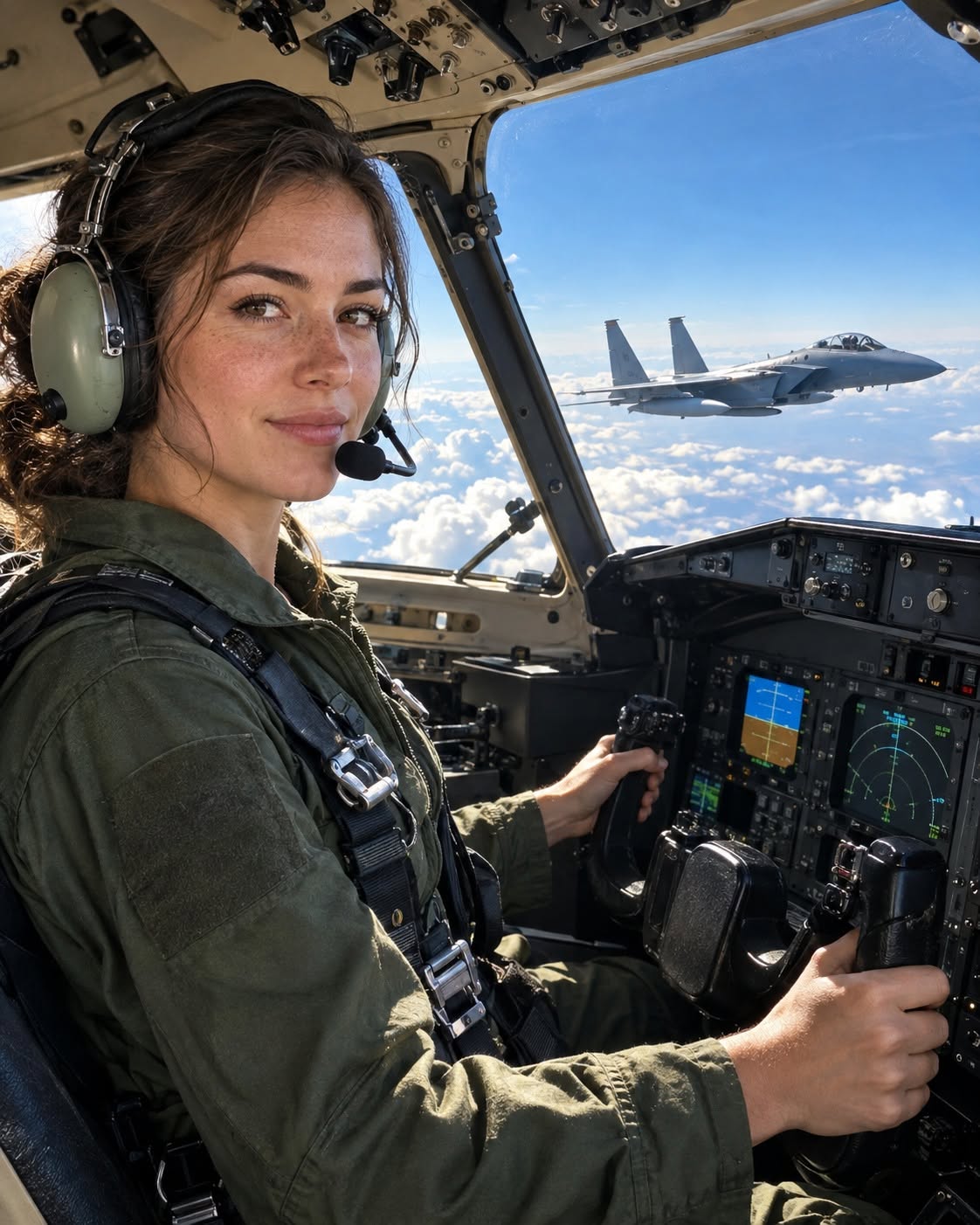
The man whose orders I had refused three years earlier.
“Do you recognize him?” General Hayes asked.
“Yes, ma’am.”
“Colonel Mercer is now directing the review of your former squadron’s operational decisions. He has also submitted a request to participate in this investigation.”
I stared at her.
“Why?”
“That is what I intend to find out.”
She gathered the folder, stood, and walked toward the door. Before leaving, she paused.
“One final question, Captain. If you could return to 02:17 this morning, knowing what you know now, would you make the same decision?”
I thought of the pilot’s voice fading into static.
I thought of the ocean beneath us.
I thought of Logan, watching the instruments as I brought a massive cargo aircraft into an environment for which it had never been designed.
“Yes, ma’am,” I said. “But I would spend more time finding a way to do it without putting my crew at unnecessary risk.”
For the first time, she gave me something that almost resembled a smile.
“That’s the first answer you’ve given me today that sounds like a captain.”
Then she left.
I didn’t know whether that was a good sign.
By noon, the story had spread throughout the base.
Some people called me reckless. Others called me brave. A few seemed to believe that an unauthorized descent was acceptable simply because the pilot survived.
I disagreed with all three groups.
I hadn’t acted because I wanted to be a hero. I hadn’t wanted anyone to know my old call sign. And I certainly hadn’t forgotten what it meant to be responsible for the people sitting behind me.
I had acted because a man had been running out of time.
That distinction mattered to me, even if it wouldn’t matter to the officers reviewing the flight.
Logan found me sitting alone in the crew lounge.
He carried two cups of coffee and handed me one.
“Sir, can I ask you something?”
“You’ve been asking me questions with your eyebrows all morning. You might as well use words.”
He laughed nervously, then sat opposite me.
“Who were you before you started flying cargo?”
I looked down at the coffee.
“I was a fighter pilot.”
“I know that much. But the F-22 pilots knew you. General Hayes knew your call sign. Even some of the ground crew seemed to recognize you when we landed.”
I took a slow breath.
“Three years ago, my squadron received orders to strike a suspected weapons facility. Intelligence said the building was being used to coordinate attacks against our forces. We were told the surrounding area had been evacuated.”
“And it hadn’t?”
“No.”
I could still see the aerial photographs in my mind. The target building. The narrow streets. The people moving between the rooftops.
“During the mission, I identified civilians inside the designated strike area. Families. Children. They were being moved into the facility by people who had no intention of protecting them. The intelligence picture had changed, and I requested authorization to abort.”
“What happened?”
“My request was denied.”
Logan stopped drinking his coffee.
“The mission commander insisted that the target had to be destroyed before an enemy convoy arrived. I was ordered to release my weapons.”
“And you refused.”
“I refused.”
I remembered the radio exchange with painful clarity.
The clipped voice ordering me to comply.
My wingman asking whether I had received the instruction.
The target passing beneath my aircraft as the seconds disappeared.
“I broke formation, forced the mission to pause, and reported what I was seeing. Other pilots confirmed the presence of civilians. The strike was eventually canceled.”
“So you saved them.”
“Some of them, perhaps. I don’t know what happened to everyone afterward.”
“Then why were you punished?”
I watched the steam rising from my cup.
“Because I had disobeyed a lawful order as it was understood by the people giving it. Because I had disrupted an operation. Because command believed my judgment had undermined discipline. And because I had made a decision that could not be neatly explained in a mission report.”
“Were the civilians really there?”
“Yes.”
“Did anyone admit the intelligence was wrong?”
“Eventually.”
He leaned back, his expression changing.
“So you were right.”
“I may have been right about the danger to those civilians. That doesn’t mean every decision I made afterward was right. There were channels I could have used, procedures I should have documented more carefully, and people I should have forced to confront the evidence before the situation reached that point.”
I met his eyes.
“Never confuse being certain you’re doing the right thing with being incapable of making a mistake. That belief has destroyed more pilots than bad weather ever will.”
Logan was quiet for a long time.
Then he asked the question I had been dreading.
“Do you regret it?”
I remembered the children in the photographs.
“No.”
The answer came without hesitation.
“I regret that I couldn’t protect my career and those people at the same time. But I don’t regret refusing to fire.”
Logan nodded slowly.
“I think I understand now.”
“No,” I told him gently. “You understand part of it. The rest is what you’ll learn when the decision belongs to you.”
That afternoon, I received a call from Colonel Mercer.
He wanted to meet at the old operations building, a short walk from the flight line.
I arrived ten minutes early and found him standing beside a window overlooking the runway. His hair had turned almost entirely gray, and the years had added weight to his face, but his posture remained unmistakable.
He turned when I entered.
“Hawk.”
“Colonel.”
For several seconds, neither of us moved.
Then he gestured toward a chair.
“Sit down.”
I remained standing.
“Is this an official interview?”
“Partly.”
“Then I’d prefer to wait for the investigators.”
He studied me, and something flickered behind his eyes.
“Still stubborn.”
“Still careful about who gets to ask the questions.”
To my surprise, he laughed.
“Fair enough.”
He sat down.
“I watched the recording of your radio exchange last night. I recognized your voice before you said your call sign.”
“Then you know why I used it.”
“I know why you thought you had to.”
The distinction irritated me more than it should have.
“Do you?”
He looked out at the runway.
“Three years ago, I signed the order that removed you from fighter operations.”
“You signed the recommendation. Other people made the decision.”
“I recommended it.”
“And would you make the same recommendation today?”
He didn’t answer immediately.
Instead, he opened a thin folder and removed several pages.
“The investigation into the strike you refused to execute was reopened six months ago. Additional intelligence records were recovered. They confirmed that your identification of civilians was correct and that the original evacuation assessment was dangerously inaccurate.”
I felt no satisfaction.
Only a tired, hollow kind of recognition.
“What happened to the people responsible?”
“Several were disciplined. Others retired before the review concluded. The report acknowledged failures in intelligence verification and command communication.”
“And my record?”
He slid the pages across the table.
“Your objection was formally recognized as having been supported by credible evidence. Your refusal was no longer described as an unjustified departure from mission orders.”
I read the document once.
Then again.
Three years of carefully constructed explanations seemed to collapse into a few paragraphs of official language.
There was no apology.
No mention of the nights I’d spent wondering whether I had destroyed my own life for nothing.
Just a correction.
A statement that the truth had finally been established.
“Why are you showing me this now?” I asked.
“Because I owe you something.”
I looked up.
“An apology?”
He accepted the question without flinching.
“Yes.”
The room seemed to grow smaller.
“I was responsible for ensuring that the information reaching our pilots was reliable. When you reported civilians in the target area, I should have demanded independent confirmation before ordering you to proceed. Instead, I treated your objection as a threat to operational discipline.”
His voice lowered.
“I believed that if I allowed a pilot to question an order in the middle of a mission, the entire formation might become unreliable. I was so concerned about preserving control that I failed to recognize when control was becoming more important than judgment.”
I had imagined this conversation a hundred times.
In some versions, I shouted at him. In others, I walked away without listening.
Now that the apology had finally arrived, I discovered that it couldn’t give me back the years.
“Why did you change your mind?” I asked.
“Because last night, two young fighter pilots escorted a cargo aircraft home without knowing whether they would be criticized for it. They followed your lead because they trusted the judgment you had demonstrated years earlier.”
He paused.
“And because when I reviewed your flight data, I saw something else. You descended aggressively, but you continued to monitor your aircraft’s limitations. You kept your speed within the safe operating envelope, coordinated with your co-pilot, and maintained communication. Your decision was dangerous. It was not careless.”
“Those are different things.”
“They are. And I should have understood that three years ago.”
For the first time since entering the room, I sat down.
Mercer folded his hands.
“The board will decide what happens next. I won’t interfere with that process. But I wanted you to hear the truth from me before you heard it from a document.”
I studied him.
“I appreciate the apology, Colonel. But I can’t promise it changes anything.”
“It doesn’t have to.”
He stood, then hesitated.
“One more thing. The rescued pilot has requested to speak with you. He’s at the medical facility. His name is Lieutenant Commander Ethan Cole.”
I remembered the voice through the static.
The words telling us he was alive.
“Is he all right?”
“Hypothermia, bruising, a possible shoulder injury. He’s expected to recover.”
I rose.
“Then I’d better go see him.”
The medical facility smelled of disinfectant and stale coffee. I found Cole in a hospital bed with a blanket pulled over his shoulders, his left arm supported in a sling.
He looked younger than I had imagined.
Perhaps thirty. Dark hair. Tired eyes. A faint cut across his cheek.
When I entered, he tried to sit upright.
“Captain.”
“Don’t get up.”
He smiled.
“I was beginning to think I’d have to track you down myself.”
“You should concentrate on getting better.”
“I’ve had several hours to do that. Unfortunately, the doctors aren’t very interested in discussing the man who decided to illuminate half the Pacific for me.”
I pulled a chair beside his bed.
“How much do you remember?”
“Enough to know I was in trouble.”
He looked toward the window.
“The engine failed faster than I expected. I lost most of my instruments, and the cloud layer was too thick to establish a reliable visual reference. I couldn’t tell whether I was descending toward water or still above the clouds.”
He swallowed.
“When your lights appeared, I thought they were another instrument malfunction. Then I realized they were moving with me.”
“You followed them.”
“I tried. By the time I reached the surface, I had very little control left. I managed to eject, but I hit the water hard. For a while, I couldn’t get my bearings.”
He turned back to me.
“If the raft hadn’t deployed properly, I wouldn’t be here.”
I said nothing.
“I heard the F-22s on the radio later,” he continued. “They told me they’d located my emergency beacon. I asked who was flying the transport.”
“And?”
“They told me his call sign was Hawk.”
He studied my face.
“Do you know how many times I heard that name when I was training?”
I frowned.
“Probably too many.”
“Your old training footage was used in our advanced flight program. There was a mission where you abandoned a clean attack profile because the conditions around the target changed. The instructor paused the recording and asked us what mattered more: completing the original plan or responding correctly to the situation in front of us.”
I looked away.
“I don’t remember that footage.”
“I do. The instructor said a good pilot must understand the difference between following a plan and serving its purpose.”
Cole shifted painfully in the bed.
“Last night, I thought I was going to die. When I heard you telling me to follow your lights, I did it because I had nothing else left to trust.”
He held out his right hand.
“I know the investigation may not go your way. I know what you did wasn’t a standard rescue procedure. But I wanted to thank you before anyone else turned this into an argument about paperwork.”
I shook his hand carefully.
“I’m glad you’re alive, Lieutenant Commander.”
He didn’t let go immediately.
“Then promise me something.”
“What?”
“Don’t disappear again.”
The words struck harder than I expected.
I had spent three years making myself invisible. I had convinced myself that anonymity was peace, that silence was maturity, and that the easiest way to avoid another painful decision was to stop believing I had anything worth saying.
Cole seemed to recognize the change in my expression.
“You don’t have to return to a fighter cockpit,” he added. “You don’t have to become some legend. Just don’t let the people who misunderstood you decide what kind of man you’re allowed to be.”
I left the hospital without answering.
Because I didn’t know how.
Three days later, the review board convened.
The room was filled with officers, legal advisers, and representatives from the air operations command. Logan sat behind me as a witness. General Hayes presided, with Mercer present as an adviser.
The proceedings lasted six hours.
They examined every detail of the flight: the radio calls, the descent profile, the weather, the landing lights, the aircraft’s fuel state, and the possibility that a safer alternative might have existed.
One officer argued that I had exposed a transport aircraft and its crew to an unacceptable hazard.
Another questioned whether the rescue had depended too heavily on luck.
Both arguments were valid.
I answered every question honestly.
When they asked whether I had considered the possibility of losing control of the C-17, I said yes.
When they asked whether I had considered the consequences for Logan and the rest of the crew, I said I had, but not for long enough.
When they asked whether I believed saving Cole justified the risk, I explained that I had made the decision with the information available to me, while acknowledging that a different set of circumstances might have led to a different choice.
Finally, General Hayes leaned forward.
“Captain, you have described the moral urgency of the situation. You have explained why you believed immediate action was necessary. But military aviation depends on more than individual conviction. It depends on procedures designed to protect entire crews. What prevents a pilot from using your example to justify any dangerous action he personally believes is right?”
I took a breath.
“Nothing prevents a foolish person from misusing my example, ma’am. That’s why I wouldn’t teach this flight as a model rescue procedure.”
Several heads lifted.
“I would teach it as a case study in decision-making under pressure. The conditions were exceptional. The risks were real. And the outcome does not prove that every choice I made was correct.”
I looked directly at the board.
“A pilot who believes that good intentions excuse poor judgment is dangerous. But a pilot who believes that following a procedure removes all personal responsibility is dangerous, too. Regulations exist to help us make sound decisions. They cannot see everything that changes in front of us. When reality changes, we must be able to recognize it, communicate it, and respond within the limits of our training and authority whenever possible.”
I paused.
“I accept responsibility for the risk I created. I also believe that refusing to consider the pilot’s immediate danger would have been a failure of responsibility in its own right.”
No one spoke.
General Hayes closed her notes.
“The board will deliberate.”
We waited outside for nearly two hours.
Logan paced the corridor. Mercer stood near the window. I sat with my hands clasped, wondering whether I would soon be searching for another career.
At last, the door opened.
General Hayes emerged with a document.
“Captain, the board has reached a decision.”
I stood.
“Your deviation from the assigned flight profile is considered a serious breach of operational procedure. Your decision placed your aircraft and crew in a situation that could have resulted in additional casualties. The board will not dismiss those concerns simply because the rescue succeeded.”
I nodded.
“However, the evidence establishes that you maintained aircraft control, attempted to assess the changing conditions, and acted in response to a credible emergency. The board also recognizes that your actions contributed directly to the survival of Lieutenant Commander Cole.”
She glanced at the document.
“You will receive a formal reprimand for the unauthorized descent. You will undergo additional review and decision-making training before returning to unrestricted flight duty. Your command assessment will be updated to reflect both the procedural violation and the positive outcome.”
I let out a slow breath.
“Understood, ma’am.”
She continued.
“There will be no suspension of your flying privileges beyond the review period already completed. Your position as a transport captain remains intact.”
For a moment, I couldn’t find words.
I had prepared myself for dismissal. I had prepared myself for another official judgment that would follow me for the rest of my life.
Instead, the board had done something more difficult than declaring me innocent or condemning me outright.
It had acknowledged both sides of the truth.
“Thank you, ma’am.”
General Hayes held my gaze.
“Don’t thank me. Learn from it.”
Then she offered me a second document.
“This is a separate recommendation. The command is establishing a review program for emergency decision-making in unusual flight situations. Colonel Mercer proposed that you assist with the training after you complete your review.”
I stared at her.
“You want me to teach?”
“We want you to explain what happened without turning it into a legend. We want our pilots to understand the human consequences of decisions made in seconds, and the operational consequences of decisions made without enough thought.”
She paused.
“Can you do that?”
I thought of the three years I’d spent avoiding questions about my past.
“Yes, ma’am.”
“Good. Then perhaps something useful can come from this.”
The first training session took place six weeks later.
I stood before a room of young pilots, looking at a screen displaying the radar picture from the night of the rescue.
Some leaned forward with interest. Others looked skeptical. One appeared to have already decided that the entire episode was an example of unnecessary risk.
I didn’t blame him.
I began by showing them the descent profile.
I explained the visibility limitations, the aircraft’s handling characteristics, the communication problems, and the uncertainty surrounding Cole’s final moments in the air.
Then I showed them the parts of the flight that had troubled me most.
The warning I had dismissed too quickly.
The moment I had stopped considering alternatives.
The seconds when I had focused so completely on the pilot in distress that I had nearly forgotten the people depending on me to bring our aircraft home.
“This was not a perfect flight,” I told them. “And if you leave this room believing that courage means ignoring every rule, then I’ve failed to teach you anything.”
I let the words settle.
“Your responsibility is not to become a hero. It is to become the kind of professional who can recognize danger, question assumptions, communicate clearly, and make the best decision possible when every available option carries a cost.”
A young pilot near the front raised his hand.
“Sir, if you had to do it again, would you still descend?”
I considered the question.
“I would still try to save the pilot. But I would begin by exhausting every available option that could get him help without creating another emergency. I would involve my crew in the decision earlier, coordinate with any available support, and make sure we were not confusing urgency with permission to ignore consequences.”
“And if none of that worked?”
I looked at him.
“Then I would have to decide with the information I had. But I would never pretend the decision was easy simply because I believed my reasons were good.”
The young pilot nodded.
For the first time, I saw that he wasn’t looking for permission to be reckless. He was trying to understand how a person could live with a decision that might save one life while endangering others.
That was a question worth teaching.
Months passed.
Cole recovered and returned to limited flying duties. He sent me occasional messages, usually brief updates about his rehabilitation, his family, or the endless administrative paperwork that followed an emergency landing.
Logan completed his training and earned his qualification as a captain.
On his final day flying with me, he stood beside the C-17 with his flight bag over one shoulder.
“Sir, I have a question.”
“Of course you do.”
He grinned.
“Do you think you’ll ever fly fighters again?”
I looked toward the distant hangars, where sleek aircraft rested beneath the Alaskan sky.
For years, I had believed that returning to a fighter cockpit was the only way to recover the person I had lost.
Now the idea no longer carried the same weight.
“Maybe,” I said. “But I don’t need to.”
Logan seemed surprised.
“Really?”
“Really. I spent too long believing that the aircraft made the pilot. It doesn’t. The aircraft gives you a job. Your decisions determine what kind of person performs it.”
He nodded, considering that.
Then he held out his hand.
“Thank you for teaching me, Captain.”
I shook it.
“Just remember what you learned. And when it’s your turn to make the hard decision, don’t assume the loudest voice in the room is always the wisest.”
He smiled.
“I’ll remember.”
After he left, I climbed into the cockpit and sat in the left seat.
The familiar instruments glowed softly in the early morning light. Beyond the windshield, ground crews moved around the aircraft, preparing another routine flight across the northern Pacific.
There would be no dramatic interception today. No emergency call. No fighter pilot falling through darkness.
Just cargo, weather reports, checklists, and the ordinary responsibility of bringing everyone home.
I had once considered that kind of flying a lesser existence.
I no longer did.
My next mission was scheduled for 02:00, nearly a year after the night that had changed everything. As we climbed through the clouds, the sky gradually opened above us, revealing a field of stars scattered across the darkness.
I checked our instruments, listened to Logan’s replacement read the checklist, and adjusted our course by a fraction.
Everything was routine.
Everything was exactly as it should be.
Then my copilot looked over at me.
“Captain, do you ever miss being Hawk?”
I watched the horizon for a moment.
“I used to think Hawk was the man who flew fighters,” I said. “The man who made difficult decisions and never hesitated.”
“And now?”
“Now I think Hawk was the man who understood that being a pilot meant accepting responsibility for what happened after the decision, too.”
The copilot nodded.
I turned back to the instruments.
Somewhere beneath us lay the same black Pacific that had nearly swallowed Cole. Its surface remained hidden by clouds, vast and indifferent to the lives moving above it.
I could not control the ocean.
I could not guarantee that every decision I made would be right.
And I could not promise that doing what I believed was necessary would protect me from criticism, consequences, or regret.
But I had learned something I wished I had understood years earlier.
Integrity was not the absence of fear. It was not blind obedience, and it was not the satisfaction of proving everyone else wrong.
Integrity was the willingness to face the facts, accept the cost of your decisions, and keep asking whether your actions served the people you were responsible for protecting.
Sometimes that meant following the rules.
Sometimes it meant questioning them.
And sometimes it meant admitting that you had been wrong, even when your intentions had been good.
I rested my hands on the controls and listened to the steady rhythm of the engines.
For three years, I had believed that my old identity was buried beneath a failed career and a decision that no one wanted to remember.
But identity was never a uniform, a rank, or a call sign painted beneath a cockpit canopy.
It was the choices you made when no one could guarantee that you would be forgiven.
The choices you made when the outcome was uncertain.
The choices you made when the easiest path was to look away.
I had once called myself Hawk because I believed it represented the pilot I wanted to become.
Now I understood that the name had never belonged to the aircraft I flew.
It belonged to the responsibility I carried.
And as our C-17 moved steadily through the night, with its crew depending on me and the world stretching silently beneath our wings, I finally stopped wondering whether I had lost the man I used to be.
I had not lost him.
I had simply spent too many years believing that he could only exist in the past.
The radio crackled with a routine transmission from air traffic control.
I answered, confirmed our position, and returned my attention to the flight.
There were no witnesses to the moment. No photographs. No officers waiting on the runway. No dramatic words that would one day become part of a story told to young pilots.
There was only the work.
The responsibility.
And the quiet understanding that the truest measure of a person is not whether he never makes a mistake, but whether he has the courage to learn from it without abandoning the values that made him worth trusting in the first place.
I smiled faintly and looked toward the horizon.
“Everything looks good,” I told my copilot.
He checked the instruments and nodded.
“Agreed, Captain.”
I adjusted our heading and guided the aircraft onward.
My name was still on the flight manifest.
My rank was still captain.
My aircraft was still a transport.
But somewhere in the darkness beyond the windshield, beneath the stars and above the endless Pacific, I could finally hear the old call sign without feeling the weight of everything I had lost.
Hawk was no longer a ghost.
He was simply the pilot at the controls, doing his best to bring everyone home.