The billionaire stood beside her Aston Martin, watching me crawl out from under a rusty sedan with grease on my forehead.
I still hadn’t signed it.
That night, after Maisie had gone to bed, I sat alone at the kitchen table with Genevieve’s proposal spread in front of me. The house was quiet except for the refrigerator humming in the corner and the occasional truck passing on the road outside.
The numbers were impressive. More space. Better equipment. Salaries for experienced mechanics. Enough money to turn my little cinder-block garage into a business that could serve customers for decades.
But there were other pages, too.
Ownership percentages. Management responsibilities. Expansion targets. Projections showing how many vehicles we would need to service every month to make the investment worthwhile.
None of it looked unreasonable. Genevieve hadn’t tried to cheat me. If anything, her proposal was more generous than I expected.
Still, I kept returning to one sentence buried near the bottom of the fourth page.
The business shall prioritize high-value specialty vehicles to maximize profitability and support future growth.
I read it three times.
Then I looked toward the hallway, where Maisie’s bedroom door stood slightly open.
I could already imagine what would happen. My ordinary customers would be told their cars no longer fit our schedule. The retired teacher who had trusted me with her old Honda would have to find another mechanic. The landscaper who paid me in installments when business was slow would be turned away.
The garage would grow, but something inside it would shrink.
I folded the proposal and went to bed without making a decision.
The following morning, I found Maisie at the kitchen table, eating cereal and drawing little cars in the margins of her math notebook.
“Can I ask you something?” I said.
She looked up. “Is this about the big garage lady?”
I smiled despite myself. “Maybe.”
“Would you be happier if we had a bigger shop?”
She considered the question seriously, which was one of the things I loved most about her. Maisie was only eight, but she had a habit of thinking before she spoke.
“Would you come home later?”
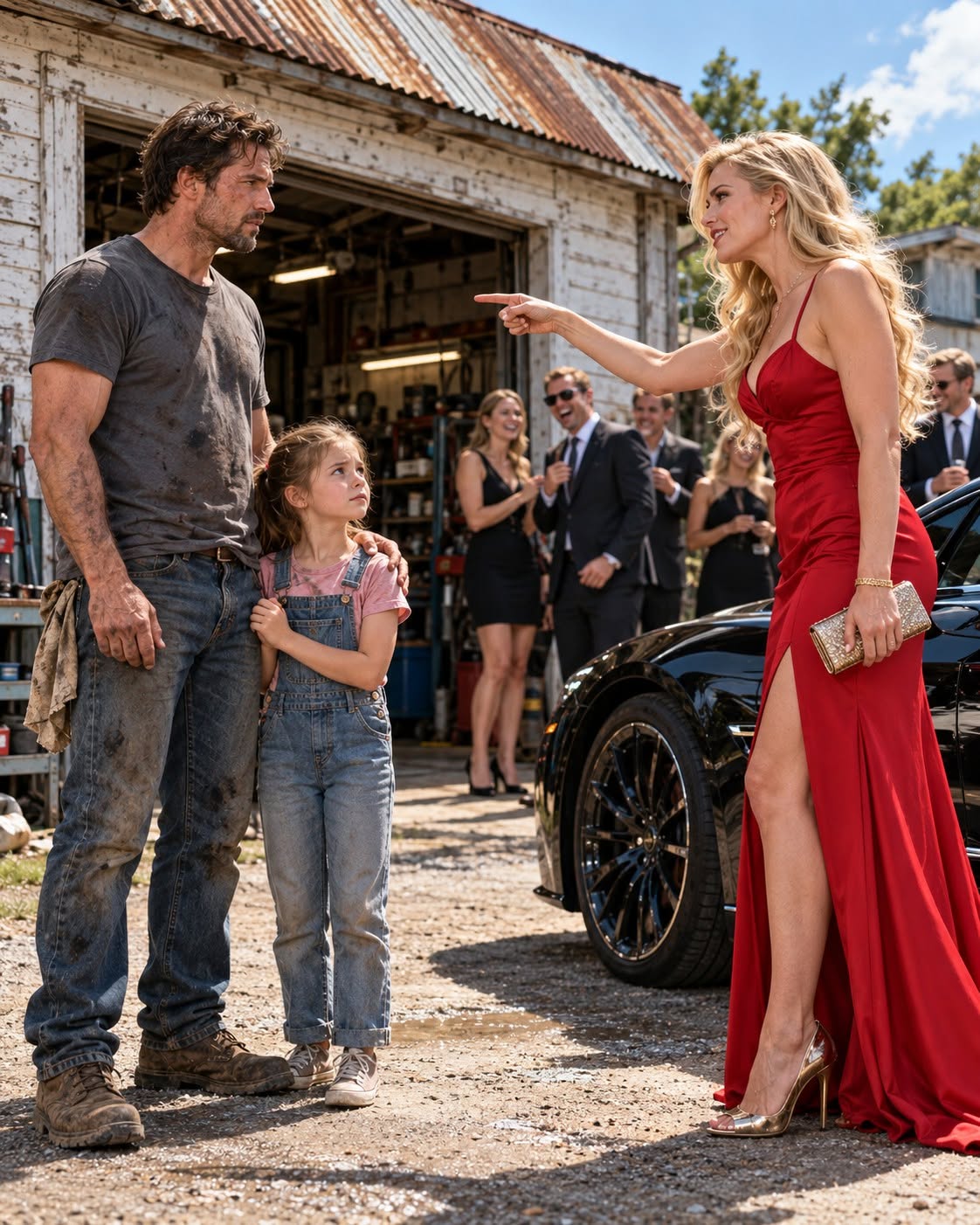
“Probably some days.”
“Would you still be there when I get scared during thunderstorms?”
The question caught me off guard.
“Of course.”
She lowered her spoon. “You said that last time you got really busy, too.”
I felt the words settle somewhere beneath my ribs.
Three months earlier, a customer had needed an emergency transmission repair. I’d worked late for several nights, missing bedtime stories and once forgetting that Maisie had a school project due the next morning. She hadn’t complained much. She’d simply learned to entertain herself.
Children are remarkably good at making sacrifices they don’t understand.
I reached across the table and squeezed her hand.
“You’re right,” I said. “I need to do better.”
She nodded, satisfied that I’d taken her seriously, then returned to her cereal.
That afternoon, I called Genevieve.
“Could we meet tomorrow?” I asked. “There’s something I’d like to discuss before I sign anything.”
“Of course,” she said. “I’ll bring coffee.”
“Bring the proposal, too.”
There was a brief pause.
“Daniel,” she said carefully, “you don’t have to accept. I hope you know that.”
“I know. That’s why I want to talk.”
We agreed to meet at the garage the next morning.
When she arrived, she found me standing beside my workbench, holding the proposal in one hand and a greasy old shop rag in the other.
“I’ve read everything,” I told her. “And I think your offer could help us build something remarkable.”
She smiled. “Then let’s discuss the next steps.”
“But I won’t sign this version.”
Her smile faded, though not with anger. “Tell me why.”
I laid the proposal on the workbench and pointed to the sentence about prioritizing high-value vehicles.
“I didn’t start this garage because I wanted to work on expensive cars. I started it because people need their cars to get to work, take their kids to school, and get home safely. I won’t build a business that forgets that.”
Genevieve looked down at the page.
“And I can’t let the business consume every evening I have with my daughter,” I continued. “If we expand, it has to make our lives better, not just make the numbers bigger.”
For several seconds, she said nothing.
Then she asked, “What would you change?”
I had spent half the night writing my own terms on the back of an old parts invoice.
We would hire two additional mechanics and keep a dedicated portion of the schedule for ordinary customers. Repair prices would remain transparent, with written estimates and no unnecessary replacements. We would set aside a limited number of appointments each week for people who couldn’t afford dealership prices.
We would also close at a reasonable hour, with one evening reserved for emergencies only.
Most importantly, I would retain control over the garage’s repair standards and customer policies. Genevieve would be an investor and strategic partner, not someone who could decide which people deserved my time.
I handed her the invoice.
She read it slowly.
“You’ve put a great deal of thought into this,” she said.
“I’ve had a long night.”
She glanced at me. “You know most people would have asked for more money.”
“Most people probably don’t have an eight-year-old waiting for them to come home.”
Genevieve looked away for a moment.
Then she folded the invoice and slipped it into her handbag.
“I’ll have my attorney revise the agreement.”
I blinked. “Just like that?”
“No,” she replied. “Not just like that. We’ll need to work through the details, and I may disagree with some of your terms.”
“Fair enough.”
“But I agree with the principle.”
She extended her hand.
I shook it.
For the first time since the Aston Martin had pulled into my driveway, I felt as though I was moving forward instead of being carried along by events I couldn’t control.
I thought that was the hardest part.
I was wrong.
Three days later, the first sign of trouble arrived in the form of a black Mercedes with tinted windows.
The driver was a man named Richard Vale, a prominent collector who owned several rare sports cars and apparently considered patience an inconvenience reserved for people with smaller bank accounts.
He stepped into the garage wearing a charcoal suit and an expression that suggested the building itself had personally disappointed him.
“You’re Daniel?” he asked.
“That’s me.”
“Good. I’ve heard you’re the mechanic everyone’s talking about.”
“I work on cars. People talk.”
He didn’t laugh.
Richard wanted me to inspect a rare vintage Aston Martin he had purchased at auction. The car had developed an intermittent loss of power, and two specialist workshops had failed to identify the cause.
He offered me $15,000 to diagnose and repair it within forty-eight hours.
I explained that I already had appointments scheduled.
He raised the offer to $25,000.
I told him money wouldn’t change the order.
His expression hardened.
“Do you understand what you’re turning down?”
“An expensive repair.”
“You’re turning down the opportunity to establish yourself among the most influential collectors in the country.”
I wiped my hands on the rag.
“I’ve got a delivery driver coming at three. His van needs to be running by tomorrow morning so he can make his route. If you want me to look at your car, I’ll give you an appointment after the vehicles already booked.”
Richard stared at me as if I’d spoken in a language he had never encountered.
Then he left.
I thought that would be the end of it.
The next morning, I discovered that he had posted about me in a private collector’s group. By lunchtime, a local business reporter had called to ask whether I was refusing wealthy customers. By three o’clock, someone had uploaded a photograph of my garage with the caption: The mechanic who thinks he’s too good for a quarter-million-dollar car.
I wasn’t too good for it.
I simply wasn’t available.
But the internet rarely rewards careful explanations when a dramatic accusation will do.
The story spread beyond Connecticut. Some people praised my principles. Others called me arrogant, ungrateful, or foolish for rejecting money that could transform my life.
Then the phone calls started.
A few customers canceled appointments because they didn’t want their names associated with the controversy. Others called just to tell me they hoped I wouldn’t change.
I tried to ignore it and focus on work.
That became difficult when a familiar gray-haired woman walked into the garage on Thursday afternoon, holding a folded newspaper.
It was Mrs. Patterson, the retired schoolteacher whose old Honda I’d repaired for years.
“Daniel,” she said, “is it true you’re turning away ordinary people now?”
I put down my wrench.
“No, ma’am. Who told you that?”
She showed me the article.
The headline read: Small-Town Mechanic Risks Losing His Humble Roots After Luxury-Car Windfall.
The article suggested that my sudden success had made me selective about the people I served.
I felt a flash of anger, followed by something worse: the realization that people who had trusted me might believe it.
“Mrs. Patterson, look around,” I said. “Your car is in bay two. I’m waiting for the replacement part you approved yesterday. Nothing has changed.”
She studied my face.
“Then why are people saying it has?”
“Because a man with a lot of money wanted to skip the line, and I wouldn’t let him.”
She nodded slowly.
“Good,” she said. “My husband used to say that the quickest way to learn a person’s character was to watch how they treated someone who couldn’t do anything for them.”
She patted my arm and walked back outside.
Her words stayed with me for the rest of the day.
That evening, Genevieve called.
“I’ve seen the article,” she said. “My communications team can issue a statement.”
“I don’t need a publicity campaign.”
“I wasn’t suggesting one. I was suggesting that we correct the record.”
I leaned against the workbench.
“Would it change anything?”
“It might.”
“Then let’s correct it with facts. No grand speeches. No photographs of me looking heroic beside an expensive car.”
She laughed softly.
“You’re remarkably difficult to market, Daniel.”
“That’s probably why my garage never had a waiting room.”
We agreed to release a short statement explaining our appointment policy. Every customer would be served according to the same scheduling rules, regardless of the value of their vehicle or the size of their bank account.
The controversy gradually faded.
But Richard Vale wasn’t finished.
Two weeks later, a transporter delivered his vintage Aston Martin to my shop.
The driver handed me a note.
I understand you have an appointment available now. Diagnose the fault. No deadline. Charge your usual rate.
I stared at the message for a long moment.
Then I called Richard.
“Why the change of heart?”
He sighed.
“Because I spoke to three mechanics after you turned me down. They all told me what I wanted to hear. One promised to have the car fixed in two days without even inspecting it.”
“And?”
“And the car broke down on the way to his workshop.”
I couldn’t help smiling.
“Bring it inside. I’ll take a look.”
The fault turned out to be a failing fuel-pressure regulator combined with a damaged section of wiring that had been repaired incorrectly years earlier. Nothing magical. Just patient testing and a willingness to follow the evidence instead of replacing whatever part seemed most convenient.
When I called Richard with the diagnosis, he was quiet.
“How much?”
I gave him the estimate.
“That’s all?”
“That’s what the work costs.”
He approved it without negotiation.
A few days later, when he collected the car, he stood beside me for a while, watching Maisie draw with colored pencils at a small desk I’d built near the office.
“I owe you an apology,” he said.
I waited.
“I assumed your refusal meant you didn’t understand how business works.”
“And now?”
“Now I think you understand something I forgot.”
He took out his checkbook.
I shook my head. “The invoice is on the seat.”
“This isn’t for the repair.”
He wrote a second check.
“Then I can’t accept it.”
“It’s a donation,” he said. “For whatever you decide to do with that expansion you’re planning.”
I looked at the check, then back at him.
“Richard, if you want to help, I have a better idea. There’s a vocational program in town that needs funding for tools. They train young people who want to work with their hands. Some of them can’t afford the equipment required to get started.”
He stared at me.
“You want me to fund a school program instead of your garage?”
“I want you to decide what kind of help you actually want to give.”
He tucked the checkbook away.
“Send me the details.”
I did.
Three weeks later, the program received enough funding to purchase diagnostic equipment, safety gear, and a set of training engines. Richard never asked for his name to be put on a plaque.
That was the first time I began to suspect that people could change when they were given a chance to do something worthwhile rather than merely being told they were wrong.
Meanwhile, the negotiations with Genevieve continued.
Her attorney revised the agreement. My accountant reviewed it. We argued over budgets, staffing levels, and the amount of money that should be reserved for unexpected expenses.
There were frustrating days when I wondered whether I was making a mistake.
But Genevieve listened whenever I explained why a decision mattered to the people who depended on us.
Eventually, we reached an agreement.
The new business would be called Sterling & Daniel Automotive, though I insisted that the original garage sign remain above the entrance to the old workshop.
Genevieve invested in a larger property on the edge of town. The new building had heated floors, modern lifts, advanced diagnostic equipment, and enough space to work on several vehicles without turning every job into a puzzle of moving bumpers and toolboxes.
We hired two experienced mechanics: a patient technician named Luis, who had spent years working at a dealership, and a young woman named Hannah, who had recently completed her automotive training.
I was particularly pleased when Hannah arrived for her first interview wearing work boots and carrying a notebook full of questions.
She reminded me of myself when I was younger, except she was better organized.
Our agreement included paid training for apprentices, fair wages, transparent estimates, and a community repair fund. A portion of the shop’s profits would cover essential repairs for people facing genuine financial hardship.
We didn’t promise to fix every car for free. We weren’t a charity, and pretending otherwise would eventually hurt everyone who worked there.
Instead, we made sure that a sudden brake failure or an unreliable work vehicle wouldn’t automatically become a financial disaster for a family already struggling to make ends meet.
The new shop opened in early spring.
On opening day, Genevieve arrived in her Aston Martin Vanquish, the same car that had started everything.
She parked it outside the entrance and walked over to where I stood with Maisie.
“Well?” she asked. “What do you think?”
I looked at the building, the equipment, and the mechanics preparing their first work orders.
“It’s bigger than I imagined.”
“Too big?”
I watched Luis help an elderly customer understand his repair estimate while Hannah carefully checked a vehicle’s inspection sheet.
“No,” I said. “Not if we remember why we built it.”
Genevieve smiled.
Then she looked at Maisie.
“And what do you think?”
Maisie considered the building.
“Does Dad still get to come home for dinner?”
Genevieve crouched slightly so they were eye to eye.
“That’s one of the rules.”
“Every night?”
“Most nights,” I said. “And every night when you have a school project due.”
Maisie seemed satisfied.
She took my hand and led me toward the ribbon stretched across the entrance.
The local newspaper was there. So were several customers who had followed me from the old garage, a few collectors, and representatives from the vocational program Richard had helped fund.
When the ribbon was cut, the applause was warm but brief.
I preferred it that way.
There was work to do.
For the first few months, everything ran smoothly. We learned to manage the appointments, hired another technician, and developed a reputation for solving difficult problems without inventing expensive ones.
Our luxury-car business grew, but ordinary vehicles continued to fill the schedule.
Some mornings, a rare sports car occupied one lift while an old pickup truck waited on the next. Nobody received preferential treatment because of the badge on the hood.
Then, on a rainy Tuesday in November, everything changed again.
A woman arrived carrying a small boy who looked about six years old. His jacket was wet, his shoes were muddy, and he clutched a plastic dinosaur in one hand.
Behind her was a battered minivan with a cracked taillight and a hood that rattled when the engine ran.
“I’m sorry,” she said as she entered the office. “I know you probably can’t help me today.”
I looked at the appointment board. Every bay was occupied, and three cars were waiting outside.
“What’s happening?”
“The van keeps stalling. I need it for work, and my son has appointments across town. The other shop said the repair would cost almost two thousand dollars.”
She looked embarrassed as she spoke.
“I can’t pay that. I thought maybe you could tell me whether it’s safe to drive.”
I asked Luis to bring the van into the inspection bay.
We found a loose electrical connection, a failing sensor, and a cracked hose. The repairs were manageable. The larger estimate she’d received included several parts that weren’t actually necessary.
When I told her the cost, she covered her mouth with one hand.
“That’s less than a third of what they quoted me.”
“Because you don’t need everything they listed.”
She stared at me for a moment.
Then her eyes filled with tears.
“I can pay half today. I get paid Friday.”
“That’s fine. We’ll work out the rest.”
She thanked us so many times that I finally had to interrupt her and tell her to get her son something warm to drink.
After they left, Hannah came into my office.
“Can I ask you something?”
“Sure.”
“How do we know when we’re helping people and when we’re putting the business at risk?”
It was a fair question.
I pulled a chair beside her.
“We start by being honest about the numbers. We don’t promise what we can’t deliver. We don’t make people feel ashamed for needing help. And we don’t confuse being generous with being careless.”
She thought about that.
“That sounds harder than fixing cars.”
“Sometimes it is.”
A few months later, the woman returned with her minivan running smoothly. She paid the remaining balance and brought a box of homemade cookies for the staff.
Her son had drawn a picture of our garage. In the picture, the building was enormous, with cars of every color parked outside and a yellow sun hanging above the roof.
At the bottom, he’d written in crooked letters: THE PLACE THAT FIXED MOM’S CAR.
We hung it in the break room.
I saw it every morning for years.
As the business grew, other opportunities appeared. A manufacturer invited me to consult on diagnostic procedures. A national magazine offered to feature the shop. Investors approached us with proposals to open branches in major cities.
Some offers were tempting.
But each time, Genevieve and I returned to the same questions.
Would the expansion preserve our standards? Could we train people properly? Would the people who trusted us still receive honest work? And could I continue to be a father rather than merely a man who paid for his daughter’s life from a distance?
We turned down more opportunities than we accepted.
We eventually opened a second workshop, but only after finding a manager who shared our principles and giving him the authority to protect them.
Genevieve never tried to push us into becoming a chain of luxury garages.
Over time, our partnership became a friendship built on the sort of trust that doesn’t require either person to pretend to be someone else.
One evening, several years after she first arrived, I found her standing in the old cinder-block garage. We’d kept it as a small training space for apprentices, preserving the stained concrete floor and the battered workbench.
She ran her fingers over the edge of the bench.
“Do you ever regret it?” she asked.
“Regret what?”
“Letting me into your life. The investment. The attention. All the changes.”
I considered the question.
There had been difficult days. Arguments over schedules. Nights when I had worried about payroll. Moments when I missed the simplicity of being responsible for only one small garage.
But there had also been new opportunities for young mechanics, families who could keep their vehicles, and a business that no longer depended on one exhausted man doing everything himself.
“No,” I said. “But I might have regretted it if I’d agreed to everything just because the money was there.”
She nodded.
“I think that’s why I trusted you in the first place.”
I looked at her.
“Because I charged you $450?”
“Because you charged me $450 when you could have charged me five thousand and watched me thank you for it.”
She laughed quietly.
“I’d spent years surrounded by people who assumed the price of something was the same as its value. Your garage reminded me that the two aren’t always connected.”
For a moment, neither of us spoke.
Then she glanced toward the office, where Maisie was finishing her homework.
“She’s grown up,” Genevieve said.
I smiled. “Too quickly.”
Maisie was thirteen by then, tall enough to reach the shelves that had once required a step stool. She spent some afternoons helping with paperwork and asking the mechanics questions that made it clear she understood more about engines than most adults understood about their own cars.
She had also developed a talent for noticing when people were pretending everything was fine.
That evening, she came into the old garage carrying a folded sheet of paper.
“Dad, I need you to read something.”
It was an essay she’d written for school about the person who had influenced her most.
I expected to find a story about a teacher or perhaps Genevieve.
Instead, the first line read:
My dad taught me that being successful doesn’t mean becoming the person everyone wants you to be.
I continued reading.
She wrote about the old pickup truck, the cold coffee, and the days she’d done homework beside the parts washer. She wrote about the Aston Martin and the strange rush of expensive cars that followed. But most of all, she wrote about the proposal on our kitchen table.
She remembered asking whether we’d have to move.
She remembered asking whether I’d still fix people’s cars.
And she remembered that I hadn’t known the answer.
Near the end, she wrote:
I used to think my dad was brave because he could fix things other people couldn’t. Now I think he is brave because he knows some things should never be traded away, even when someone offers a lot of money.
I had to stop reading.
Maisie watched me, looking slightly worried.
“Is it bad?”
I shook my head and pulled her into a hug.
“No, sweetheart. It’s pretty wonderful.”
“Can I use it for the school assembly?”
“Of course.”
She smiled, then hurried back toward the office because she had forgotten her backpack.
Genevieve watched her go.
“You know,” she said, “when I first came here, I thought you were simply an unusually talented mechanic.”
“And now?”
“Now I think you were building something long before I arrived. You just hadn’t realized how many people might need it.”
I looked around the old garage.
For years, I’d thought of it as a place where I repaired broken machines. But perhaps it had always been something more. A place where people could come with a problem, receive an honest answer, and leave knowing that someone had taken their concerns seriously.
That mattered whether the car cost five thousand dollars or five hundred thousand.
It mattered whether the person behind the wheel was a billionaire or someone counting the days until payday.
And it mattered to Maisie, who had watched every decision I made, even the ones I thought she was too young to understand.
The following Saturday, we held a community event at the new workshop. The vocational students demonstrated their projects, our mechanics offered free safety checks, and local families came by to learn how to recognize basic vehicle problems before they became dangerous.
Richard Vale arrived carrying a box of tools for the training program.
Mrs. Patterson came with her daughter, who had recently purchased her first car.
Genevieve brought coffee for everyone, though I noticed she’d finally learned not to buy the expensive kind that tasted like burnt wood.
At the end of the afternoon, I stood outside the workshop while the last visitors drove away.
The sky was turning orange above the Connecticut hills. Through the open garage doors, I could hear Hannah explaining a diagnostic procedure to a group of students. Luis was laughing at something one of the apprentices had said.
Maisie came to stand beside me.
“Do you miss the old days?” she asked.
I watched a young mechanic carefully guide a customer’s aging sedan out of the bay.
“Sometimes,” I admitted. “I miss how simple everything seemed.”
“Was it really simpler?”
I thought about the long hours, the broken equipment, the bills that sometimes arrived faster than the money to pay them, and the fear of what would happen if I got sick and couldn’t work.
“No,” I said. “I suppose it only looked that way because I hadn’t imagined anything else.”
She slipped her hand into mine.
“Are you happy now?”
I looked at the building we’d created, at the people who worked there, and at the little drawing of the garage that hung in the break room.
Then I looked at my daughter.
“Yes,” I said. “But not because we got bigger.”
“Why, then?”
“Because we got bigger without forgetting who we were.”
She seemed to consider that answer carefully.
Then she leaned against my arm.
For the first time in years, I didn’t feel the urge to check my phone, review tomorrow’s appointments, or calculate how much work remained unfinished.
There would always be another engine that wouldn’t start, another customer who needed help, another opportunity that looked irresistible on paper.
I couldn’t fix every problem in the world.
But I could decide what kind of place we would build, what kind of father I would be, and what kind of example I wanted my daughter to remember.
I had learned that success wasn’t measured by the number of expensive cars parked outside my garage, the size of my building, or the amount of money sitting in a bank account.
It was measured by whether people could trust us when they were frightened, whether our employees could build good lives through honest work, and whether Maisie could grow up believing that kindness and ambition belonged in the same sentence.
The next Monday morning, I arrived early and unlocked the original garage.
The concrete floor still carried its familiar oil stains. The workbench still had scratches from years of repairs. My chipped mug sat beside the toolbox, holding coffee that was already beginning to cool.
I heard footsteps behind me.
Genevieve stood in the doorway, holding a folder.
“Another investment proposal?” I asked.
She smiled. “Actually, a request.”
“That sounds dangerous.”
She handed me the folder.
Inside was a plan for a scholarship fund for students entering automotive trades, supported by the profits from our workshops and contributions from several of the collectors who had become regular customers.
The fund would cover tuition, tools, safety equipment, and paid apprenticeships for students who otherwise couldn’t afford to enter the profession.
At the bottom of the proposal was a blank space for my signature.
I looked up at Genevieve.
“You didn’t need my permission to put this together.”
“No,” she said. “But I wanted your name on it only if you believed in it.”
I read every page.
Then I thought of the young people who would one day stand where I had stood, uncertain whether their skills would ever be enough to build a decent life.
I signed.
Not because the project would make us famous. Not because it would increase the company’s value. And certainly not because anyone had promised that it would be easy.
I signed because I knew what it meant to have talent but limited resources, to work hard without knowing whether the next opportunity would ever arrive, and to hope that someone would judge you by the quality of your work rather than the condition of your clothes.
When Genevieve left, I stayed in the garage for another few minutes.
Then I heard a familiar voice from outside.
“Dad? The school bus is coming!”
Maisie stood beside my old pickup truck, her backpack hanging from one shoulder.
I grabbed my keys, put on my jacket, and followed her out.
The garage could wait.
For all the cars I’d repaired, all the opportunities I’d accepted, and all the money that had passed through my hands, the most important thing I’d learned was surprisingly simple.
You don’t have to reject success to protect your values.
You have to decide what success is allowed to change—and what it never will.
Sometimes the greatest opportunity in life isn’t the one that makes you richer.
It’s the one that gives you the chance to help more people without losing sight of the people who mattered before the world started watching.
And if you ever find yourself standing before a life-changing offer, remember this:
Don’t ask only what it will give you. Ask what it will ask you to become.