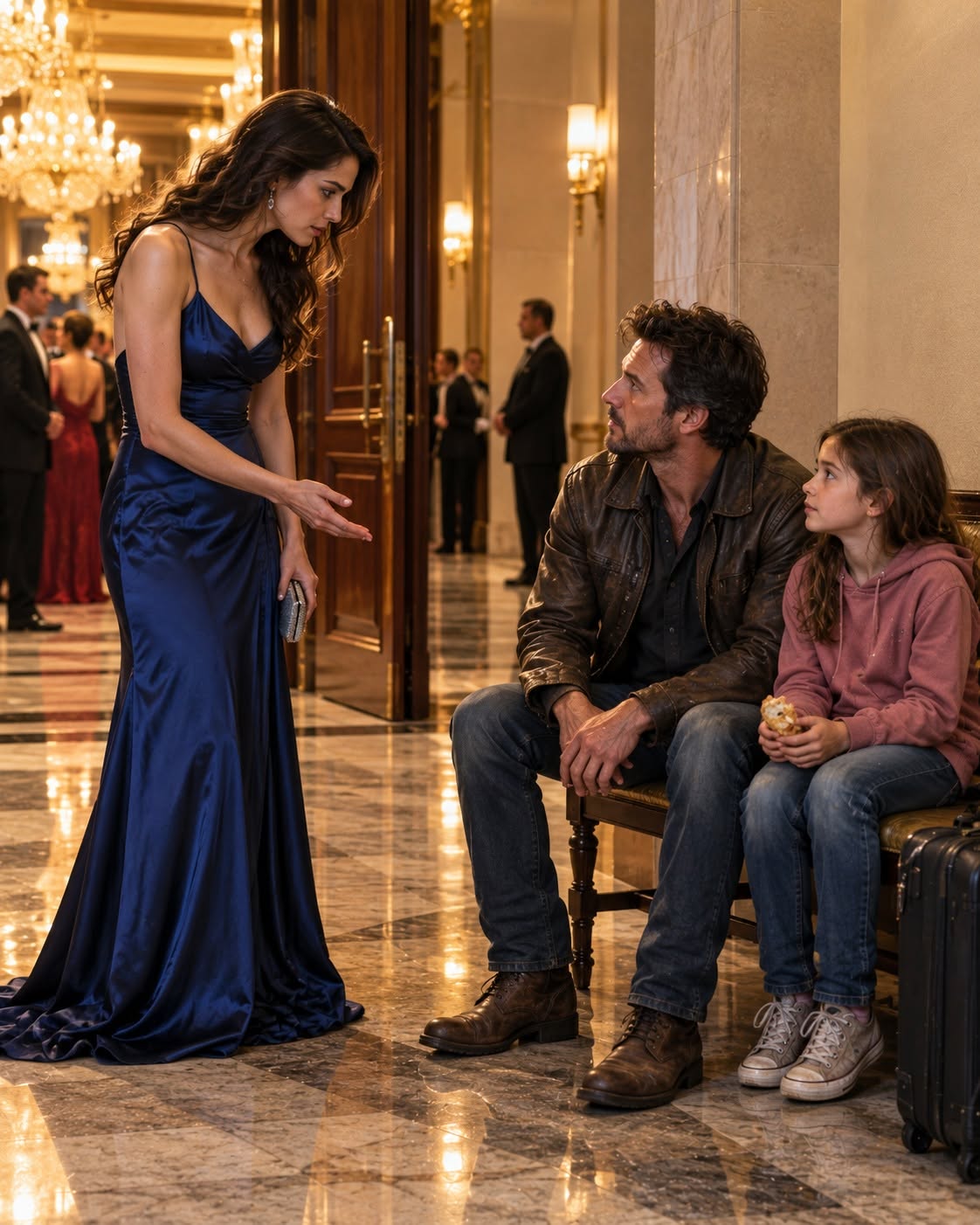
The billionaire left her own charity gala because she couldn’t stand another minute of applause. But in a quiet hospital corridor
I looked at Chloe standing in the kitchen doorway, her notebook tucked beneath one arm and a hopeful expression on her face.
“Are you coming back for pizza?”
For a moment, I couldn’t speak.
Eight years ago, I had been lying in a hospital bed, wondering whether I would live long enough to see my company succeed. A stranger had quietly helped me when I had nothing left. Now, his daughter was asking me a question that had nothing to do with money, business, or gratitude.
“Yes,” I finally said. “But only if I get to choose the toppings.”
Chloe grinned.
“Then you should know that Dad always chooses mushrooms, and mushrooms are terrible.”
Nathan laughed.
“That’s because some of us have developed excellent taste.”
I stayed for pizza that evening. We argued about pineapple, listened to Chloe explain a complicated friendship problem at school, and watched Nathan burn the first batch of garlic bread because he was too busy making sure I had enough to eat.
When I left, Nathan walked me to my car.
“Same time next Sunday?” he asked.
I smiled.
“I’d like that.”
But as I drove home, the warmth of that kitchen slowly gave way to the reality waiting for me.
The restructuring proposal was scheduled for a board vote in six days.
And my company was about to make a decision that could destroy the very place where Nathan had spent years helping people.
I knew what I had to do.
I just wasn’t sure I was brave enough to do it.
The meeting that changed everything
The following Monday, I arrived at headquarters before sunrise.
My office occupied the top floor of a glass tower overlooking downtown Chicago. From there, the city looked like a perfectly organized machine. Traffic moved along familiar routes. Buildings reflected the morning light. Thousands of people hurried toward jobs, appointments, and responsibilities I would never fully understand.
I used to believe that being successful meant seeing the bigger picture.
That morning, I realized how often I had mistaken distance for perspective.
Julian was already waiting outside my office with a tablet.
“The board members are expecting your approval on the restructuring proposal,” he said. “They want the final authorization before Thursday.”
“Have you reviewed the clinic closures?”
“Yes. St. Agnes is among the facilities scheduled to lose its independent operating status.”
I stopped walking.
“What does that mean in practical terms?”
“Reduced community services. The emergency assistance program would be discontinued, and several positions would be eliminated. The clinic would technically remain open, but under a centralized operating model.”
“Technically open,” I repeated.
Julian nodded.
“The numbers look better that way.”
I turned toward him.
“Do the numbers include the people who won’t be able to afford treatment after the changes?”
He hesitated.
“That’s not how the financial model measures performance.”
I looked through the glass wall of my office.
“Then perhaps the financial model is measuring the wrong thing.”
Julian had worked for me for eleven years. He had seen me negotiate acquisitions, dismiss executives, and survive a medical crisis that nearly ended my career. He rarely questioned my decisions.
But that morning, he looked genuinely concerned.
“Are you planning to oppose the proposal?”
“I’m planning to understand exactly what we’re about to do.”
“Some board members won’t appreciate that.”
“I’m beginning to think their appreciation isn’t particularly important.”
I spent the next two days reviewing documents I should have examined months earlier.
The proposal was more aggressive than I had realized. It wasn’t simply about reducing administrative costs. It involved selling several community clinic properties to a private healthcare operator, consolidating departments, and eliminating programs considered financially inefficient.
St. Agnes was particularly vulnerable.
Its patient assistance fund, the same fund Nathan had once used to help me, was classified as a nonessential expense.
I read that phrase repeatedly.
Nonessential.
I wondered how many people had heard those words before losing access to the treatment they needed.
On Wednesday evening, I called Nathan.
“Would you have time to talk tomorrow?”
“Of course. Is everything okay?”
I looked at the restructuring documents spread across my desk.
“There’s something I should have told you.”
He was quiet for a moment.
“Is this about the folder?”
“Not exactly.”
“Then come over for dinner. Chloe has been asking when you’re coming back.”
I almost told him everything over the phone.
Instead, I said I would be there.
I knew he deserved more than a rushed explanation.
The truth at the dinner table
Nathan’s house smelled like roasted chicken and cinnamon when I arrived.
Chloe opened the door wearing mismatched socks.
“You’re late,” she announced.
“I’m seven minutes early.”
“Dad says being on time means being ready before someone arrives.”
From the kitchen, Nathan called out, “I did not say that.”
Chloe shrugged.
“He says a lot of things.”
I laughed and followed her inside.
For the first half hour, dinner was ordinary. Chloe told me about a science project involving a volcano. Nathan complained about a faulty heating system at the hospital. I listened, occasionally asking questions, while trying to gather the courage to change the subject.
Finally, when Chloe went upstairs to finish her project, I placed my fork down.
“Nathan, I need to tell you something about my company.”
He leaned back slightly.
“All right.”
“Eight years ago, when I was receiving treatment, St. Agnes helped coordinate the donations that kept me alive. You know that now.”
He nodded.
“My company has grown considerably since then. We own several healthcare facilities, and we’re currently considering restructuring some of them.”
Nathan’s expression remained neutral.
“Which facilities?”
I took a breath.
“St. Agnes is one of them.”
He stopped moving.
“What kind of restructuring?”
I explained the proposal. I told him about the planned closures of community programs, the private operator, and the positions that would disappear.
I didn’t soften anything.
When I finished, he pushed his plate away.
“You knew this was happening when you came here last week?”
“I knew the proposal was being prepared. I hadn’t examined all the details.”
“But you knew.”
“Yes.”
He stood and carried his glass to the sink.
“Why didn’t you tell me?”
“Because I was afraid.”
He turned around.
“Afraid of what?”
“Losing your trust.”
Nathan looked at me for a long moment.
“You’re asking me to believe that you came into my home, ate at my table, and listened to my daughter talk about her school project while knowing your company might take away something this neighborhood depends on?”
His voice wasn’t loud.
Somehow, that made it worse.
“I came here because I wanted to be honest with you. I just took too long.”
“Too long can change everything.”
“I know.”
He rubbed his forehead.
“Do you understand why I helped you?”
I nodded.
“Because you and Sarah believed people should help when they could.”
“No. That’s part of it. But there’s something else.”
He walked to the living room and picked up a photograph from the shelf.
Sarah was standing in a hospital garden, her hair covered by a colorful scarf. She was smiling at the camera, one hand resting on Nathan’s shoulder.
“When Sarah was sick, we spent months moving between hospitals. There were doctors who were wonderful, nurses who worked miracles, and strangers who brought us food when we couldn’t think straight. But there were also bills we couldn’t pay and offices where nobody seemed to know what to do with us.”
He paused.
“After she died, I kept thinking about the people who had to leave those places because they couldn’t afford another appointment. I couldn’t save Sarah. But I could make sure someone else got another chance.”
I looked at the photograph.
“I’m sorry.”
“So am I. But you can’t honor what I did eight years ago by pretending what your company is doing today doesn’t matter.”
His words landed harder than any accusation.
“I won’t sign the proposal,” I said.
Nathan studied my face.
“Is that enough?”
“No.”
“Then what are you going to do?”
I looked down at my hands.
“I’m going to change it.”
He nodded slowly.
“Then do that. Don’t make promises just because you’re sitting at my kitchen table.”
I left that evening without the usual goodbye hug.
Nathan opened the door for me, but neither of us knew what to say.
As I drove away, I understood something I had never learned in a boardroom.
Trust wasn’t restored by making the right promise.
It was restored by doing the difficult thing when nobody was watching.
The price of doing the right thing
The emergency board meeting began at nine on Friday morning.
Nine executives sat around a polished conference table. Several had flown in from other states. Two had already made it clear that they considered my concerns an unnecessary distraction.
Our chief financial officer, Richard Coleman, presented the proposal.
He spoke about efficiency, margins, shareholder expectations, and operational discipline. Every sentence was supported by a chart.
When he finished, the room applauded politely.
I didn’t.
“Before we vote,” I said, “I want to discuss the community impact.”
Richard folded his hands.
“We’ve already addressed that in the supporting documentation.”
“No. You’ve addressed the financial implications. That’s not the same thing.”
He gave me a patient smile.
“We can’t preserve every underperforming facility simply because people have emotional attachments to it.”
I opened a folder.
“St. Agnes treated more than twenty thousand patients last year. Its assistance program helped hundreds of families obtain medication and follow-up care. Your proposal would eliminate that program.”
“Those patients can be redirected to other providers.”
“Which providers?”
Richard glanced at his notes.
“We haven’t finalized those arrangements.”
“Then what exactly are we asking the board to approve?”
A few people shifted in their seats.
I continued.
“I want to show you something.”
I placed a document on the screen. It was a photograph of an old handwritten donation receipt from St. Agnes.
Eight years earlier, Nathan had made a series of small contributions to the clinic. Some were barely more than a few hundred dollars. Others were larger, made during months when he had worked extra shifts.
I had included the records because I wanted the board to understand what the assistance program actually meant.
But I had not included Nathan’s name.
“This clinic once helped me when I couldn’t afford my treatment. A person I had never met made sacrifices to ensure I received another chance. That person didn’t ask for recognition or repayment.”
Richard interrupted.
“With respect, your personal experience shouldn’t determine corporate policy.”
I looked directly at him.
“Agreed. Which is why I’m not asking you to preserve this clinic because it once helped me. I’m asking you to consider whether our company should profit from removing access to care from people who need it.”
Silence settled over the room.
I presented an alternative plan.
We would suspend the sale of the community clinic properties, establish an independent review of each facility, and create a protected fund for patient assistance. We would also redirect a portion of executive bonuses toward maintaining essential services during the transition.
It would cost money.
A considerable amount.
Richard was furious.
“You’re proposing to sacrifice shareholder value for programs that may never become profitable.”
“I’m proposing that a healthcare company should be accountable for more than its quarterly earnings.”
One board member asked whether I understood the effect on the stock price.
Another questioned whether I was making the decision because of my personal history.
I answered every question.
Then Richard said something I hadn’t expected.
“If we abandon this restructuring, I will recommend that the board reconsider your position as chief executive.”
I looked around the table.
For years, I had believed that the greatest threat to my company was failure. I had fought to survive, convinced that losing control would mean losing everything.
Now I understood that there were things worse than losing a title.
I closed my folder.
“Then perhaps you should.”
The vote was delayed.
The board requested an independent financial assessment, and several members openly challenged my proposal. I knew I had not won.
But for the first time in months, I had stopped pretending that silence was the same as leadership.
An unexpected visitor
Three days later, I received a message from Nathan.
Chloe has a school project about people who make a difference in their community. She wants to interview you. Apparently, being a billionaire is an acceptable qualification.
I smiled when I read it.
Then another message arrived.
She also says you owe her pizza.
I replied that I would be there Saturday.
When I arrived, Chloe had prepared a list of questions on a sheet of notebook paper.
She sat across from me at the kitchen table, holding a pencil.
“Question one. How much money do you have?”
Nathan, who was washing dishes, nearly dropped a plate.
“Chloe.”
“What? It’s an interview.”
I laughed.
“That’s a difficult question. More than I need, certainly.”
She wrote something down.
“Question two. Does having a lot of money make you happy?”
I thought about the gold chandeliers, the endless applause, and the years I had spent wondering whether anyone genuinely liked me.
“Not by itself.”
“Then why do people want it so much?”
“Because money can solve certain problems. It can give people choices. But it can’t guarantee that they’ll have someone to share those choices with.”
Chloe considered that.
“Like Dad?”
I looked toward Nathan.
“Yes. Like your dad.”
She wrote furiously.
“Question three. If you could change one thing about the world, what would it be?”
I didn’t answer immediately.
“I would make sure that nobody had to choose between getting medical care and keeping food on the table.”
Chloe looked pleased.
“That’s a good answer.”
Then she asked, “Are you actually going to do it?”
I smiled.
“I’m trying.”
“Okay. You can have a cupcake.”
Nathan laughed from the sink.
“That’s apparently how she measures whether people are trustworthy.”
For the rest of the afternoon, we worked on her project. I helped her organize the questions, and Nathan made coffee.
When I was leaving, he walked me to the front steps.
“I heard about the board meeting,” he said.
I looked at him.
“How?”
“Someone at the hospital mentioned it. Apparently, your name was all over the local news.”
“I haven’t won anything yet.”
“I know.”
He hesitated.
“I’m sorry I was hard on you.”
“You weren’t hard on me. You were honest.”
Nathan looked toward the street.
“Sarah used to say that honesty is sometimes the kindest thing you can give someone, even when it hurts.”
I smiled faintly.
“She sounds like someone I would have liked to know.”
“You would have.”
For the first time since our argument, he reached for my hand.
It was a small gesture, but it meant more than I could explain.
The night everything almost fell apart
The following Thursday, I received a call from Julian at 11:47 p.m.
His voice was unusually tense.
“You need to come in.”
“What happened?”
“Someone leaked the original restructuring documents.”
I sat upright in bed.
“Where?”
“Several financial news outlets. They’re reporting that we’re planning to sell the community clinics and eliminate patient assistance programs.”
“That’s not the final plan.”
“They don’t know that. They’re also questioning whether you’ve been pressured into changing the proposal because of a personal relationship with an employee at St. Agnes.”
My stomach tightened.
“Who?”
“They haven’t named Nathan, but they have enough information for someone to identify him.”
I was out of bed before Julian finished speaking.
By morning, the story had spread.
A billionaire healthcare executive was accused of changing corporate strategy because of an emotional attachment to a maintenance worker who had once helped her financially.
Some articles described Nathan as a mysterious benefactor. Others implied that he had deliberately approached me to gain influence over my company.
One particularly cruel headline called him a maintenance worker who had found a shortcut to the billionaire’s fortune.
I read it twice.
Then I threw my phone onto the desk.
“Who leaked the documents?”
Julian looked uncomfortable.
“We’re investigating.”
I knew what he wasn’t saying.
Richard had opposed my plan from the beginning.
But I couldn’t prove anything.
Later that afternoon, Nathan called.
“Have you seen the news?”
“Yes.”
“Chloe’s teacher asked her about it today.”
I closed my eyes.
“I’m sorry.”
“She came home upset. Some children said her father was trying to get rich.”
My throat tightened.
“Nathan, I never wanted this to happen.”
“I know.”
“I can issue a statement. I can make sure the articles are corrected.”
“That’s not what I’m worried about.”
“What is?”
He was quiet.
“Chloe asked me if I helped you because I expected something in return.”
I couldn’t speak.
“She wanted to know if her mother would have been disappointed in me.”
I felt tears gathering behind my eyes.
“What did you tell her?”
“I told her that her mother would have been proud that we helped someone. And that she would have been even prouder if we kept doing the right thing when it became difficult.”
I covered my mouth.
“Nathan, I can protect you. I can arrange—”
“Please don’t.”
His voice was gentle but firm.
“I don’t want your lawyers calling her school. I don’t want a statement explaining that I’m a good person. I want my daughter to grow up knowing that helping somebody isn’t shameful, even when the world misunderstands it.”
I sat down.
“What do you need from me?”
“Tell the truth. All of it. Even if it costs you something.”
The call ended.
I stayed at my desk for a long time.
Then I called Julian.
“Prepare a public statement. And arrange a press conference for tomorrow.”
“Are you sure?”
“Yes.”
“Richard will fight this.”
“Let him.”
The confession
The press conference was held in the main auditorium at our headquarters.
By ten o’clock, every seat was occupied. Cameras lined the back wall. Reporters held microphones toward the stage as I approached the podium.
I had spent years preparing speeches designed to reassure investors.
This time, I had no intention of reassuring anyone.
I began by confirming that the restructuring proposal had been under review and that the leaked documents reflected an earlier version of the plan.
Then I acknowledged what mattered.
“Our company has made decisions that placed financial efficiency above the needs of the communities we serve. That is a failure of leadership, and I take responsibility for it.”
The room became still.
I explained that I had personally benefited from a community assistance program eight years earlier. I said that someone had helped me anonymously during the most difficult period of my life.
I did not reveal Nathan’s name.
“I have since learned that the person who helped me was a hospital maintenance electrician. He did not know my wealth, my position, or what I might become. He simply saw someone in need and chose to help.”
A reporter raised his hand.
“Are you suggesting that this individual influenced your decision about the clinics?”
“No. I’m suggesting that his actions reminded me of something our company should never have forgotten.”
I looked directly into the cameras.
“Healthcare is not merely a market. It is the place people turn when their lives are falling apart. If we measure success only by how much money we can extract from that moment, then we have misunderstood our responsibility.”
Another reporter asked whether I was prepared to lose my position over the new plan.
I took a breath.
“If the price of keeping my position is abandoning the people our company was built to serve, then I am prepared to pay that price.”
For several seconds, nobody spoke.
Then the questions began again.
I answered them until the conference ended.
That evening, the board held an emergency vote.
The restructuring proposal was suspended. The sale of the community clinics was halted pending independent review. The patient assistance programs would remain operational.
Richard resigned two days later.
I didn’t celebrate.
I knew that one vote couldn’t solve every problem, and I knew that the company still had a great deal of work to do.
But something important had changed.
For the first time, the people who depended on our services were being considered before the next quarterly report.
A different kind of promise
Three weeks passed.
The independent review confirmed that several clinics were financially strained but could remain operational through a combination of administrative changes, community partnerships, and revised funding.
St. Agnes was among them.
I visited the hospital one afternoon without an entourage.
Nathan was repairing a damaged electrical panel near the service corridor.
When he saw me, he raised an eyebrow.
“Lost again?”
“Apparently.”
He put down his tools.
“I heard the board approved the new plan.”
“They did.”
“Congratulations.”
“Thank you.”
I stood beside him, looking at the corridor where we had first met.
The wooden bench was still there.
Someone had replaced the old light fixture above it, and a small sign had been attached to the wall reminding visitors that the area was reserved for staff breaks.
I smiled.
“Do you remember sharing that sandwich with me?”
Nathan laughed.
“Chloe still thinks you owe her half a sandwich.”
“I believe I owe her considerably more than that.”
He leaned against the wall.
“You did something difficult.”
“So did you.”
He shook his head.
“I just shared lunch.”
“No. You helped someone when you had every reason to keep what little you had.”
Nathan looked down at his hands.
“Sarah would have liked what you said at the press conference.”
I smiled.
“I wish I could have met her.”
For a moment, neither of us spoke.
Then I reached into my bag and took out a small envelope.
Nathan looked at it suspiciously.
“What is that?”
“An invitation.”
He opened it.
Inside was a letter from the hospital’s community advisory committee. I had arranged for the hospital to create an independent patient assistance council, with representatives from patients, medical staff, and local residents.
Nathan had been invited to serve as a volunteer advisor.
There was no salary, no special treatment, and no obligation to accept.
I watched him read the letter.
“You want me to do this?”
“I think you understand what people need better than most executives ever will.”
He looked uncomfortable.
“I don’t know anything about running a hospital.”
“Neither did I, once.”
“That isn’t exactly reassuring.”
I laughed.
“You don’t need to run anything. You just need to make sure the people making decisions remember who those decisions affect.”
Nathan folded the letter.
“I’ll think about it.”
“That’s all I ask.”
Then I added, “And this time, I’m not going to offer you money.”
He smiled.
“Good. I was beginning to think you couldn’t have a conversation without trying to write a check.”
I laughed harder than I had in weeks.
Eight years after the first gift
The following spring, St. Agnes opened a renovated community care center.
The building wasn’t extravagant. There were no marble floors or enormous chandeliers. Instead, it had bright waiting rooms, additional treatment spaces, a small pharmacy, and a dedicated office where patients could receive help navigating medical expenses.
At the opening ceremony, I was asked to give a speech.
I declined the large stage and stood beside the entrance instead.
Nathan arrived with Chloe.
She was eleven now, taller than I remembered, and carrying a small bouquet of flowers.
“Those are for you,” she said.
“Thank you. They’re beautiful.”
“Dad says you shouldn’t buy flowers for yourself.”
“Your dad seems to have a lot of rules.”
“He does.”
Nathan shook his head.
“I’m surrounded.”
We laughed.
Inside, the new care center was already busy. A mother sat with her young son near the reception desk. An elderly man spoke quietly with a financial counselor. A nurse helped a patient understand the instructions on a prescription.
Nobody was applauding.
Nobody was asking for photographs.
People were simply receiving the help they needed.
And somehow, that felt like the greatest celebration I had ever attended.
Later, Chloe found me sitting near the entrance.
“Can I ask you something?”
“Of course.”
“Did Dad really save your life?”
I looked toward Nathan, who was speaking with one of the hospital administrators.
“Yes,” I said. “He did.”
She thought about that.
“Then why didn’t you give him lots of money?”
I smiled.
“I offered. He refused.”
“Why?”
“Because he didn’t want his kindness to become something I could buy.”
Chloe frowned.
“That’s confusing.”
“It took me a long time to understand it, too.”
She sat beside me.
“Dad says helping people doesn’t mean they have to owe you.”
I looked at her.
“Your dad is a very wise man.”
She nodded proudly.
“Mom used to say that.”
I glanced at the photograph of Sarah displayed in the care center’s small remembrance room. Nathan had donated it, along with a handwritten note about the woman who had taught him that compassion was a responsibility, not a performance.
I felt a familiar ache in my chest.
“Chloe, can I tell you something?”
She nodded.
“Your father gave me something much bigger than money. He reminded me that I could spend my entire life building something impressive and still forget what it was supposed to be for.”
She looked at the people moving through the waiting room.
“Maybe that’s why you built this place.”
“Maybe.”
She leaned against my arm.
“I’m glad you met Dad.”
I smiled.
“So am I.”
The last piece of the story
A year later, on a cold Sunday evening, I returned to Nathan’s house.
There was no gala, no board meeting, and no important announcement.
Just dinner.
Chloe had grown into a confident young girl who had developed strong opinions about almost everything. Nathan still worked at the hospital, although he had reduced his overtime hours to spend more time with his daughter.
The old woven bracelet was still on his wrist.
I had once asked whether he wanted a new one.
He had refused.
“Sarah gave it to me,” he had explained. “It doesn’t need to look new.”
That evening, after dinner, Chloe went upstairs to finish a book report.
Nathan and I sat at the kitchen table with coffee.
He looked tired.
“Long week?”
“Long year,” I replied.
He smiled.
“Still running the company?”
“Trying to run it without letting it run me.”
We sat quietly for a while.
Then I reached across the table and placed something beside his coffee.
It was a small photograph.
The two of us, sitting on that hospital bench the night we met. Someone had taken it during the gala, before either of us realized what the moment would become.
I had only recently discovered it in the hospital’s archived event photographs.
Nathan picked it up.
“I don’t remember anyone taking this.”
“Neither do I.”
He studied the picture.
“You look exhausted.”
“I was.”
“And Chloe looks like she’s about to give you her entire sandwich.”
“She was a very generous child.”
“She still is.”
I smiled.
“I’ve been thinking about something.”
Nathan raised an eyebrow.
“That usually means trouble.”
“I spent years searching for the person who helped me. I thought that when I found him, I’d finally know how to repay what he had done.”
“And now?”
“Now I think I understand that some gifts aren’t meant to be repaid. They’re meant to be carried forward.”
Nathan looked at the photograph again.
“Sarah would have liked that.”
I reached for my coffee.
“I hope so.”
He was quiet for a moment.
Then he said, “You know, when I first saw you in that corridor, I thought you were just another exhausted person who needed somewhere to sit.”
I laughed.
“That was exactly what I was.”
“I didn’t know your name. I didn’t know your company. I didn’t know anything about you.”
“And you still shared your lunch.”
He shrugged.
“Sarah would have done the same.”
I looked at the faded bracelet on his wrist.
For eight years, I had believed that a stranger had saved my life through a series of anonymous donations.
I had finally learned that the money was only one part of the story.
The greater gift was the lesson behind it.
Kindness had brought Nathan and me together long before either of us knew what the other could offer. It had survived grief, misunderstanding, public criticism, and the temptation to turn gratitude into a transaction.
And it had taught me that generosity was not measured by the size of a check, the number of people applauding, or the name engraved above a hospital entrance.
It was measured by what remained when nobody was watching.
From upstairs, Chloe called down.
“Are you two talking about something serious again?”
Nathan laughed.
“Just life.”
“Well, stop. Dad promised we’d watch a movie.”
I stood and carried my coffee to the sink.
“I’m coming.”
Nathan smiled.
“Make yourself at home.”
I paused at the doorway and looked back at him.
Eight years ago, I had thought my life was saved by an anonymous donor.
Now I knew it had been saved by a man who had lost someone he loved, carried that grief quietly, and still found room in his heart to help a stranger.
I had once believed that the greatest thing I could do with my fortune was build an empire.
Now I understood that an empire was only worth building if it made life a little less frightening for the people who had nowhere else to turn.
And perhaps the most important lesson Nathan had ever taught me was this:
You don’t have to be rich to change someone’s life. You only have to notice when someone needs help—and be willing to give what you can.
That night, there were no speeches, no applause, and no cameras.
There was only a small living room, a bowl of popcorn, a father and daughter laughing at a terrible movie, and an empty seat beside them that they had saved for me.
For the first time in many years, I didn’t feel like a billionaire trying to escape her own life.
I felt like I was finally living it.