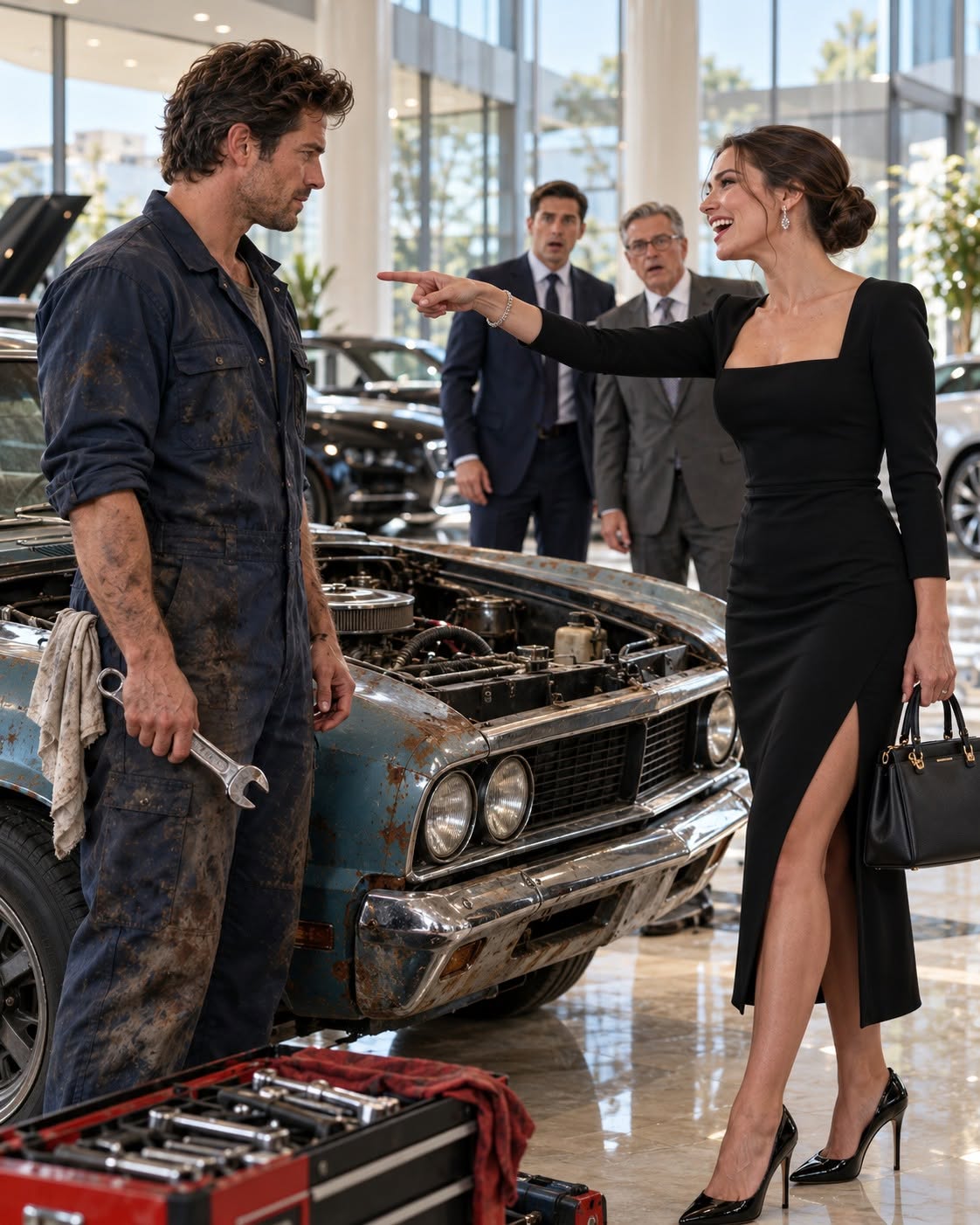
The billionaire CEO told me she was going to have my car towed and my job taken away. Then I turned the key
What I told Jocelyn that morning was not what she expected to hear.
“I want you to promise me that if this technology works, you won’t use it to make people like me disposable.”
She stared at me across the kitchen counter.
I continued before she could interrupt. “I want the people who build this engine to share in what it creates. I want the janitors, the technicians, the cafeteria workers, and the people who keep your buildings running to be treated like human beings, not obstacles. And I want a written agreement that my daughter will never have to watch me destroy myself just to prove that I’m worth something.”
Jocelyn’s eyes moved toward Wren, who was now holding up a drawing of a purple dinosaur wearing a crown.
“That’s a lot to ask,” she said quietly.
“No,” I replied. “It’s just a lot more than you’re used to giving.”
For a moment, the old Jocelyn appeared. Her chin lifted. Her shoulders straightened. I could almost hear the argument forming in her mind about budgets, corporate policy, and how the world actually worked.
Then something unexpected happened.
She pulled out the chair across from me and sat down.
“Tell me exactly what you want.”
So I did.
I wanted ownership of my original intellectual property, with the company receiving a negotiated license to develop and commercialize it. I wanted an independent engineering team with authority to challenge my decisions and the freedom to publish safety findings. I wanted a fair share of future revenue to support the people who made the breakthrough possible.
And I wanted Jocelyn to change the way her company treated the people who worked beneath its glass ceilings.
“Not a charity fund with your name on it,” I told her. “Actual wages. Real benefits. A childcare program. A way for employees to report abuse without risking their jobs.”
She listened without checking her phone once.
When I finished, she closed the folder.
“I can’t promise you that every board member will agree.”
“Then you have your answer.”
I started clearing the breakfast dishes.
“Wait,” she said.
She looked at me with an expression I couldn’t quite read.
“I’ll put it before the board. And I’ll make the case myself.”
“Why?”
It was a simple question, but she seemed to find it harder than the rest.
“Because last night, I saw what happens when a person becomes invisible to everyone around him,” she said. “And this morning, I realized I might have been looking at people that way for years.”
I wanted to believe her.
But I had learned that promises were easy when someone needed something from you.
“Tomorrow morning,” I said. “Nine o’clock. The laboratory. No cameras, no press, and no announcement about a miracle engine. We test it properly, and we let the results speak.”
Jocelyn nodded.
Then she turned toward Wren.
“Would it be all right if I looked at your dinosaur?”
Wren studied her with the grave suspicion only a seven-year-old could manage.
“Are you still mad at our car?”
“No,” Jocelyn answered. “I think I owe your car an apology.”
Wren considered this for several seconds.
“Cars can’t hear apologies.”
“People can,” Jocelyn said.
My daughter looked at her drawing again.
“Then you should apologize to my dad.”
Jocelyn lowered her eyes.
“You’re right. I’m sorry, Daniel.”
It wasn’t enough to erase what had happened, but it was the first apology she’d offered without attaching a price to it.
And for that morning, it was enough.
By nine the next day, I was standing inside the laboratory where I had spent countless nights emptying trash cans and mopping floors.
Only this time, nobody handed me a bucket.
The room was crowded with senior engineers, physicists, technicians, and executives. Several of them looked at my worn jacket with barely concealed skepticism. One man in a charcoal suit whispered something to his colleague, who responded with a smirk.
Jocelyn heard them.
“Before we begin,” she announced, “Daniel will lead today’s technical review. His findings will be evaluated on their merits, not his job title, his education, or his appearance. Anyone who has a substantive objection is welcome to present it. Anyone who has come here to humiliate him can leave.”
The room fell silent.
I walked to the central console.
The company’s prototype fusion system occupied nearly half the laboratory. It was an enormous arrangement of superconducting magnets, cooling lines, plasma chambers, and sensors. It had consumed years of work and hundreds of millions of dollars.
My engine, by comparison, could almost have fit inside a large toolbox.
The difference wasn’t that their engineers lacked intelligence. They were brilliant people. Their problem was that they had been trained to trust a design philosophy that no longer served them.
They had made their magnetic fields symmetrical because symmetry simplified their equations and reduced certain predictable disturbances. But under the extreme conditions they were trying to achieve, their system was amplifying a different class of instability.
They kept increasing power to compensate for a problem that greater power only made worse.
“Show me the instability data from your last three failed runs,” I said.
A young engineer named Priya Shah brought up the records.
I studied them for several minutes.
Then I pointed at a graph.
“Here. This is where you lose containment.”
Priya leaned closer.
“We thought that was a sensor artifact.”
“It isn’t. Your field is responding too uniformly to disturbances that aren’t uniform. You’re forcing the plasma into a pattern it doesn’t want to maintain.”
A senior physicist named Dr. Malcolm Reeves folded his arms.
“And your alternative is what, exactly? A collection of improvised coils and salvaged automotive parts?”
A few people chuckled.
I looked at him.
“My alternative is to stop confusing an expensive solution with a correct one.”
The laughter died.
I spent the next hour explaining how my system used deliberately asymmetric control responses to compensate for shifting plasma conditions. The principle wasn’t magic, and it wasn’t a complete solution to every fusion problem. It was a different approach to a specific instability their existing configuration had failed to address.
Priya began running calculations.
Her expression changed first.
Then she checked them again.
“Dr. Reeves,” she said slowly, “if these control parameters hold, we may be able to stabilize the disturbance before it grows.”
He stepped toward the display.
“That isn’t possible at this operating range.”
“According to our current model,” I said, “it isn’t.”
He stared at me.
“And according to yours?”
“We’re about to find out.”
For the first time since I entered the room, nobody laughed.
We spent the rest of the morning preparing a controlled test. I refused to let anyone bypass a safety interlock or rush the procedure. If the engine in my Mustang had taught me anything, it was that a breakthrough was worthless if you couldn’t reproduce it safely.
The first test failed.
A pressure reading drifted outside the acceptable range, and the system shut itself down.
Dr. Reeves gave a tight smile.
“Interesting theory.”
I ignored him and studied the data.
The second test failed too.
This time, a feedback loop reacted too slowly to a change in plasma density.
I asked Priya to pull the control logs. We found the problem in a delay buried inside a subsystem that had been designed by a contractor several years earlier.
The fix required rewriting part of the control sequence and recalibrating the response thresholds.
It took another three hours.
By then, my back ached, my stomach was empty, and my phone had buzzed six times with messages from the woman watching Wren.
I stepped into the corridor to call home.
“Daddy?” Wren answered.
“Hey, little bird. How are you doing?”
“I made three dinosaurs. One is a scientist.”
“That’s a very important dinosaur.”
“He says you need lunch.”
I laughed, and for the first time that day, some of the tension left my shoulders.
“I think your dinosaur might be right.”
“Are you going to be home for bedtime?”
The question struck harder than any criticism Dr. Reeves had offered.
I looked through the glass wall at the laboratory, where a dozen people were waiting for me to return.
“Yes,” I told her. “I’ll do everything I can.”
I didn’t make the mistake of promising something I couldn’t guarantee.
When I returned, Jocelyn was standing beside the console with two sandwiches and a bottle of water.
“I heard you talking,” she said. “I won’t ask you to stay if you need to go home.”
I studied her face.
“Is the company going to collapse if I leave for an hour?”
“No.”
“Then I’m taking an hour.”
She nodded immediately.
“Of course.”
It was a small thing, perhaps. But three days earlier, I would have expected a lecture about commitment and deadlines.
Instead, she adjusted the schedule.
I went home, ate dinner with my daughter, listened to her explain why the purple dinosaur needed a laboratory coat, and tucked her into bed.
When I returned to the company, Jocelyn was still there.
So was Priya.
And so was Dr. Reeves.
Nobody complained about the interruption.
At eleven forty-seven that night, we began the third test.
The laboratory lights dimmed as the containment system came online. Cooling systems hummed. Sensors flickered across the displays. The plasma ignited inside the chamber, glowing like a miniature sun trapped behind layers of carefully engineered protection.
For a few seconds, the readings looked promising.
Then the first disturbance appeared.
The containment field shifted.
One sensor flashed amber.
Another followed.
Dr. Reeves stepped forward.
“Shut it down.”
“Not yet,” I said, studying the response curve. “The correction is arriving. Give it two seconds.”
“Two seconds could destroy the chamber!”
“The automatic shutdown is armed. If we cross the safety limit, it will trip.”
Jocelyn stood behind the observation line, her hands clenched at her sides.
The instability grew.
Then the asymmetric controls responded.
The field adjusted—not violently, but with a precise, almost elegant shift. The disturbance weakened. The next sensor stayed green.
Then the next.
The plasma settled into a stable operating pattern.
Nobody spoke.
On the main display, the containment trace flattened.
Priya whispered, “It’s holding.”
We waited through the verification interval.
The system maintained stability.
Then the test sequence ended, and the chamber entered its controlled shutdown.
For several seconds, the only sound in the laboratory was the ventilation system.
Then Priya began to laugh. It was the disbelieving laugh of someone who had spent years watching the same failure happen and had finally seen something different.
A technician clapped.
Someone else joined in.
Soon, the entire room was applauding.
Even Dr. Reeves stood motionless for a moment before he approached the display.
He studied the final readings, then turned toward me.
“I was wrong,” he said.
I nodded.
“Yes.”
He blinked, perhaps expecting me to soften the answer.
I didn’t.
After a moment, he extended his hand.
“I’d like to understand how you developed this approach.”
I shook it.
“Then let’s start with the data.”
That was how I knew the breakthrough might actually survive.
Not because a billionaire was impressed, or because a room full of executives had witnessed a spectacular test, but because the people who understood the science were ready to challenge it, examine it, and build upon it.
We hadn’t solved every problem in fusion energy. We had demonstrated a reliable solution to a critical containment instability under controlled conditions. There would be months of testing, independent replication, and engineering work before anyone could claim more.
But for the first time in years, the company had a path forward.
At six in the morning, I finally walked out of the laboratory.
Jocelyn followed me into the empty corridor.
“Daniel, the board will want to announce this immediately.”
“They can announce the successful test when the data has been reviewed.”
“They’ll want to know who made it possible.”
“Then tell them the truth.”
She hesitated.
“The truth is that you were working here as a cleaner while we spent millions trying to solve the problem.”
I looked at her.
“Yes.”
“And I never noticed.”
“No.”
The word hung between us.
“I don’t expect you to forgive me,” she said. “But I want you to know that I understand what you asked for. I’ll put your proposal before the board this morning.”
“Your proposal?”
She gave a tired, rueful smile.
“Our proposal. I have some learning to do.”
For the first time, I believed she understood that leadership wasn’t simply the ability to make people follow orders.
It was the responsibility to recognize what people needed in order to do their best work.
The board meeting began at ten.
I wasn’t invited to sit in.
At first, I assumed that was because the executives wanted to discuss the financial details privately. Then, at eleven fifteen, Priya called me.
“Daniel, you need to come upstairs.”
Her voice was tense.
“What’s happened?”
“The board has a problem with the agreement.”
My stomach tightened.
I took the elevator to the executive floor and entered the conference room. Jocelyn sat at the far end of a long polished table. Around her were twelve directors, several lawyers, and the company’s chief financial officer.
A document lay open on the screen.
The proposed acquisition agreement.
Except it wasn’t the agreement we had discussed.
The company had rewritten the terms overnight. The new version transferred ownership of my existing engine designs and related patents to the corporation in exchange for a large payment and an executive position. The safeguards we had discussed were missing. So were the provisions protecting the research team and ensuring independent safety oversight.
One director, a silver-haired man named Warren Pike, gestured toward an empty chair.
“Mr. Daniel, please sit. We recognize your contribution, and we’d like to resolve this matter efficiently.”
I remained standing.
“Where are the terms we discussed?”
Warren folded his hands.
“The company has invested substantially in fusion research. It cannot move forward with fragmented ownership or restrictions on commercialization.”
“You mean you want the engine.”
“We want the rights necessary to develop it.”
“Then why remove the protections?”
He exchanged a glance with the other directors.
“Those provisions introduce unnecessary complexity.”
I looked at Jocelyn.
She wasn’t looking at me.
Something cold settled in my chest.
Had I mistaken her apology for a change of heart? Had she simply needed me to believe her until the company could get what it wanted?
“Did you approve this version?” I asked.
Jocelyn raised her eyes.
“I didn’t authorize the final language.”
“That wasn’t my question.”
Her face tightened.
“Yes,” she said. “I approved the general acquisition framework. I didn’t review every revision before it came to the board.”
Warren leaned back.
“Ms. Jocelyn has been under extraordinary pressure. This is a multibillion-dollar opportunity, Mr. Daniel. We cannot structure a global business around personal preferences.”
I looked at the document once more.
Then I closed it.
“I’m withdrawing from the negotiations.”
The room erupted in overlapping voices.
Warren stood.
“You can’t simply walk away after demonstrating technology on company equipment.”
“My engine was developed independently. My original designs and records predate these tests. Your lawyers can examine the documentation.”
“We’ll need to review that claim.”
“Please do.”
Jocelyn rose from her chair.
“Daniel, wait.”
I turned toward her.
“You asked me what I wanted. I told you. You said you understood.”
“I do understand.”
“Then why am I standing in a room where everything we agreed on has disappeared?”
She had no answer.
I walked out.
I expected the company to send lawyers after me. I expected threats, accusations, and perhaps an attempt to claim that my employment gave it ownership over my work.
Instead, the first blow came from the news.
By that afternoon, a business publication was reporting that a breakthrough fusion system had been demonstrated at the company. The article praised the corporation’s years of investment and leadership while describing the technology as an internal achievement.
My name appeared nowhere.
Neither did the names of Priya, the technicians, or the people who had helped run the test.
The story spread quickly.
My phone filled with messages from former colleagues who had recognized the work. Some congratulated me. Others warned me that the company was preparing to secure its intellectual property claims.
Then I received an email from Jocelyn.
It contained only one sentence.
I am sorry. I should have stopped it.
I read it twice.
Then I put the phone away and went to pick up my daughter.
That evening, Wren sat cross-legged on the living-room floor, arranging her dinosaurs in a circle.
“Did you fix the machine, Daddy?”
“We helped it work better.”
“Did the lady say thank you?”
I sat beside her.
“Some people did.”
“Did she?”
I looked at my daughter and thought about all the things I wanted to protect her from: poverty, grief, disappointment, and the knowledge that doing the right thing did not always mean being treated fairly.
“She made a mistake,” I said.
“Can she fix it?”
“I don’t know.”
Wren placed the purple dinosaur in the center of the circle.
“Then she should try.”
Children have a way of making complicated problems sound painfully simple.
The next morning, I received a call from an attorney I had hired years earlier to help wind down my company. I explained what had happened and sent him my original engineering notebooks, dated design files, component receipts, and the records showing that my prototype had been developed in my own garage.
He listened carefully.
“Your documentation is unusually thorough,” he said. “The company may have legitimate questions about the work performed on its premises, but that doesn’t automatically give it ownership of everything you’ve developed independently.”
“What do you recommend?”
“Don’t sign anything. Preserve every record. Let us establish exactly what belongs to you and what belongs to the company.”
For the first time since the board meeting, I felt the ground beneath my feet again.
I had spent years believing that the loss of my company meant the loss of my ability to build something meaningful.
But the work was still mine.
And so was my choice.
Over the next week, the legal dispute grew more complicated. The company issued a statement crediting its research team with the breakthrough. Its lawyers requested technical records. My attorney responded with a carefully documented account of my independent development work and the conditions under which the laboratory test had occurred.
I refused every offer that required me to surrender control without meaningful safeguards.
Meanwhile, Jocelyn’s position inside the company began to weaken.
Warren Pike and several directors argued that her handling of the breakthrough had exposed the corporation to unnecessary risk. Others blamed her for allowing an outside inventor to dictate commercial terms.
One evening, she called me again.
I almost let it go to voicemail.
Then I remembered the way she’d sat at my kitchen table, asking what I wanted. I remembered the first apology she’d offered to Wren.
I answered.
“The board is preparing to remove me as CEO,” she said.
I was quiet for a moment.
“I’m sorry.”
“You don’t have to be. I helped create this situation.”
“Why are you calling me?”
“Because I finally understand something I should have understood years ago. If I let the board take control of this technology without the protections you asked for, they’ll probably make the same mistake I did. They’ll see the engine as an asset, not as a responsibility.”
I leaned against the kitchen counter.
“What do you want me to do?”
“Nothing. I won’t ask you to come back or negotiate for my sake. I just wanted you to know that I’m going to oppose the revised agreement, even if it costs me my position.”
For once, she wasn’t asking me to rescue her.
She was telling me what she intended to do.
The next day, Jocelyn called an emergency board meeting and presented the original proposal alongside the revised agreement. She documented the changes, acknowledged her failure to review them properly, and argued that the company’s future depended on a structure that rewarded innovation without destroying the people responsible for it.
Warren accused her of putting personal guilt ahead of shareholder interests.
Jocelyn answered without raising her voice.
“Protecting the people who create value is not the opposite of protecting the company. It’s how you ensure that the next breakthrough happens here instead of somewhere else.”
The board voted.
She lost her position as CEO.
The news reached me that afternoon.
I felt no triumph. A woman had finally begun to understand the consequences of her decisions, and the cost of that understanding was greater than she had expected.
Two days later, she appeared at my apartment again.
No folder this time. No assistants. No prepared speech.
Just Jocelyn, standing in the hallway with a paper bag in her hand.
“I brought dinner,” she said. “I wasn’t sure what seven-year-olds eat.”
“Mostly things they can negotiate over.”
A faint smile crossed her face.
“I brought pizza.”
Wren appeared behind me.
“Is it for us?”
“If your father says it’s all right.”
Wren looked at me.
I stepped aside.
We ate at the same small kitchen table where our negotiations had begun. Jocelyn told us about her first job, how she had spent years believing that the only way to survive in business was to become the hardest person in the room.
“I thought if I showed weakness, people would take advantage of me,” she said.
Wren took a bite of pizza.
“Were you mean because you were scared?”
Jocelyn stopped chewing.
I looked at my daughter, amazed at how easily she could ask the question adults spent years avoiding.
“Yes,” Jocelyn finally said. “Sometimes.”
“That’s silly,” Wren replied. “You can be scared and still be nice.”
Jocelyn looked down at her plate.
“I think you’re right.”
After dinner, she placed a small envelope on the table. Inside was a signed letter publicly correcting the company’s earlier announcement. It credited me with developing the original containment approach, acknowledged the contributions of the laboratory team, and confirmed that the company would not claim ownership of my independent designs without a negotiated agreement.
“I can’t undo what happened,” she said. “But I can stop pretending it didn’t.”
I read the letter carefully.
It wasn’t a settlement. It didn’t resolve every legal issue, and it didn’t restore the job I had lost or the nights I’d spent hiding my exhaustion behind a mop bucket.
But it was a start.
Over the following month, the negotiations resumed under a different structure. Jocelyn no longer represented the company as its CEO, but she agreed to serve as an independent adviser while the board reviewed its options. Several directors who had opposed her proposal changed their positions after independent technical experts confirmed that the containment approach was promising and deserved further development.
My attorney negotiated a licensing agreement rather than an outright acquisition. I retained ownership of my preexisting intellectual property. The company received the right to develop the technology under clear terms, with royalties tied to commercial success and provisions requiring independent safety review.
The agreement also created a research fellowship for young engineers and established a worker-support program funded by a portion of the project’s future revenue. It wasn’t everything I wanted. Corporate policy doesn’t transform overnight, and promises need enforcement.
But the changes were written down, funded, and subject to oversight.
Most importantly, I was free to walk away if the company violated the agreement.
I accepted the position of chief systems engineer on the project, not because I needed Jocelyn’s approval or wanted to sit at the head of a conference table, but because the work mattered.
My salary paid off the debts that had followed me since my wife’s death. Wren got her own room, a sturdy desk, and a window that looked out toward a small patch of trees. I hired a reliable after-school caregiver, so she no longer had to sleep in a supply closet or the back seat of a rusty car.
The first night in our new apartment, she ran from room to room, opening every cupboard as if she expected to discover another bedroom hidden inside.
“Daddy, this place has so much space!”
I laughed.
“Don’t get too comfortable. You still have to clean your own room.”
She gave me the look that told me I had clearly misunderstood the purpose of being a father.
Then she wrapped her arms around my waist.
“Mom would like it here.”
The smile left my face, but I held her close.
“I think she would, little bird.”
For the first time in years, the thought of my wife didn’t feel like a door slamming shut. It felt like a light left on in a room I could finally bear to enter.
Six months later, the project reached another milestone. The containment system completed a series of longer, independently monitored tests, and the engineering team began preparing a larger experimental unit. There was still a long road ahead before fusion could deliver practical, economical power at scale. We had learned enough to know that success would require more than one clever invention.
But the work was moving forward.
And the team was different now.
Technicians could raise concerns without being dismissed. Junior engineers were encouraged to challenge senior researchers. Safety reviews were no longer treated as obstacles to a deadline. The company still had shareholders, budgets, and disagreements, but it had begun to understand that progress did not require people to surrender their dignity.
One afternoon, I returned to the basement garage where everything had started.
My Mustang was parked in the same spot, its rusted fenders still showing the scars of years on the road. I had repaired the worst of the damage, but I refused to restore it until every mark of its history had been documented.
I wanted to remember what it had carried us through.
Wren climbed into the passenger seat and buckled herself in.
“Are we going to turn on the blue light?”
“Not today. The engine’s undergoing a safety inspection.”
She sighed.
“Scientists have to wait for everything.”
“Good scientists do.”
I turned the key, and the familiar hum filled the garage. The engine was running in a restricted test mode, its blue glow faint beneath the hood.
Then I noticed someone standing beside the concrete pillar.
Jocelyn.
She wore no expensive coat and carried no folder. She simply stood with her hands in her pockets, watching the car.
“May I?” she asked.
I nodded toward the engine.
She crouched beside the hood, careful not to touch anything.
“I’ve been thinking about that night,” she said. “About what I would have done if the car had been an ordinary old Mustang.”
I waited.
“I probably would have called security and had it towed. I would have gone upstairs, forgotten your name, and never thought about you again.”
The honesty hurt more than an excuse would have.
“Probably,” I said.
She nodded.
“That’s the part I can’t stop thinking about. The blue light didn’t make you a worthwhile person. It only made me notice what was already there.”
Wren leaned forward from the passenger seat.
“Dad was worthwhile before the blue light.”
Jocelyn’s eyes glistened.
“Yes,” she said. “He was.”
I shut down the engine and stepped away from the car.
“Jocelyn, do you know what changed my mind about working with you?”
She shook her head.
“It wasn’t the apology. It wasn’t the contract. It wasn’t even the way you stood up to the board.”
“What was it?”
“The moment you stopped asking me to save your company and started taking responsibility for what you’d done.”
She absorbed that quietly.
“I still have a long way to go.”
“So do I.”
We stood together for a moment, listening to the garage settle into silence.
Then Jocelyn looked at Wren.
“Would your dad mind if I asked you something?”
Wren thought about it.
“Depends.”
“Would you teach me how to draw a dinosaur?”
My daughter burst into delighted laughter.
“Only if you make it purple.”
Jocelyn smiled.
“I wouldn’t dare make it any other color.”
As they walked toward the elevator, I glanced back at the Mustang.
For years, I had believed that my engine was proof I hadn’t failed—that somewhere beneath the wreckage of my old life, I was still the man who could build something extraordinary.
But I finally understood that I had been measuring myself by the wrong thing.
My wife’s death hadn’t made me worthless. Losing my company hadn’t erased my knowledge. Working as a cleaner hadn’t diminished the years I’d spent learning how the world worked.
I had been a father through grief, a builder through poverty, and a man trying to preserve his dignity when the world offered him very little reason to believe anyone cared.
The engine was extraordinary.
But it was never the reason I deserved respect.
A year after that first night, the company held a small ceremony to recognize the team behind the containment breakthrough. There were no extravagant promises about limitless energy and no claims that humanity’s problems had been solved. Instead, the engineers presented their verified results, described the remaining challenges, and thanked the technicians who had helped make the work possible.
I stood beside Priya and the rest of the team, looking out at a room full of people whose contributions would once have gone unnoticed.
Jocelyn sat in the second row.
She was no longer the company’s CEO. After leaving the position, she had started working with several organizations focused on responsible engineering and fair employment. She had made mistakes in her new work, too. Change, I learned, wasn’t a transformation that happened once. It was a choice a person had to make repeatedly.
After the ceremony, she approached me.
“I used to think power meant having the final word,” she said.
“And now?”
“Now I think it means being responsible for what happens after you speak.”
I smiled.
“That sounds like something a purple dinosaur would say.”
She laughed.
Across the room, Wren was showing Priya a drawing of a blue engine surrounded by tiny stars. At the bottom, in her uneven handwriting, she had written a sentence that made me stop walking.
Everyone is important, even when nobody knows what they can do.
I asked her where she’d learned that.
She shrugged.
“I just thought it was true.”
I folded the drawing carefully and placed it in my pocket.
Later that evening, I drove us home in the Mustang. The city lights passed across the windshield, and the engine hummed beneath us, steady and quiet.
Wren fell asleep before we reached our street, her head resting against the window, her stuffed rabbit tucked beneath her arm.
At a red light, I looked at her reflection in the glass.
I thought about the years I had lost, the people who had abandoned me, and the future that had nearly slipped beyond my reach. I thought about Jocelyn, who had needed a flash of impossible blue light to see a man she should have respected from the beginning.
And I thought about the lesson I hoped my daughter would carry into a world that would sometimes judge her by her clothes, her job, her bank account, or the people who stood beside her.
Never confuse someone’s circumstances with their worth.
Never assume that the quiet person in the room has nothing to teach you.
And never wait for a miracle to treat another human being with dignity.
The blue light beneath my hood had changed my life, but not because it had made me extraordinary.
It had forced someone powerful to confront the ordinary cruelty she had stopped noticing.
That was the real breakthrough.
Not the engine.
Not the money.
Not the company that had finally learned my name.
It was the moment we understood that respect should never be a reward for proving your value.
It should be the starting point from which every human being is given the chance to show it.