On the sixty-first morning of my punishment, I stood behind a coffee counter in a white apron while my squadron
General Whitaker didn’t raise his voice, but the question landed harder than any reprimand I’d received in twenty-three years of service.
Colonel Vance stared at the folder on the floor as if the papers inside it had suddenly become dangerous.
“General, I’m afraid there’s been some confusion,” he said. “Captain Morgan’s disciplinary action was handled through the appropriate channels. Her conduct during the winter incident was reviewed, and the decision was made to impose a temporary administrative assignment.”
Whitaker accepted the cup of coffee I’d prepared, but he didn’t drink it.
“I didn’t ask about her punishment, Colonel. I asked why the official report says she abandoned her wingman when the recording I reviewed last night suggests she was the only person who tried to bring him home.”
Behind Vance, one of the senior supervisors shifted his weight.
The dining hall remained so quiet I could hear the coffee urn cycling on its heating element.
I stood with both hands resting on the steel counter, suddenly conscious of the white apron tied around my waist and the silver wings above my nameplate.
For sixty-one days, that apron had been the most visible thing about me.
Now, for the first time since the storm, someone with enough authority to demand an answer was looking directly at the truth I’d been ordered to bury.
“General,” Vance replied, “the recording may lack context.”
“Then provide the context.”
“Certainly, sir. Perhaps we should move to my office, where I can brief you privately.”
Whitaker finally lifted his coffee, took a small sip, and set the cup back on the counter.
“No. You prepared an official account of an incident involving an aircraft, a pilot, and a direct order. The people who maintained those aircraft and supported that operation are standing in this room. If the account is accurate, it should survive being examined in front of them.”
His gaze moved to me.
“Captain Morgan, are you willing to explain what happened?”
I had imagined this moment more times than I wanted to admit.
In some versions, I spoke with perfect precision, presenting every fact in the right order and watching Vance struggle to explain himself.
In others, I finally told someone how angry I was, how humiliating those sixty-one mornings had been, how many nights I’d spent wondering whether one decision had destroyed everything I’d worked for.
But standing there, with hundreds of people watching, I found that neither version fit.
I thought about Caleb Reed sitting in the cockpit of a failing aircraft.
I remembered the static in my headset, the worsening weather, and the desperate way his voice had broken through the radio.
“General, I’d be happy to explain. But I believe Lieutenant Reed should be allowed to speak for himself, too.”
Whitaker studied me for a moment.
“Agreed. Where is he?”
“Here, sir.”
The voice came from the back of the dining hall.
Caleb stepped away from the line, his shoulders rigid beneath his uniform. He looked older than he had two months earlier, though he was still only twenty-six.
He walked forward until he stood beside me.
Vance’s expression changed.
“Lieutenant Reed,” he said sharply, “you were not scheduled to participate in this inspection.”
Caleb stopped.
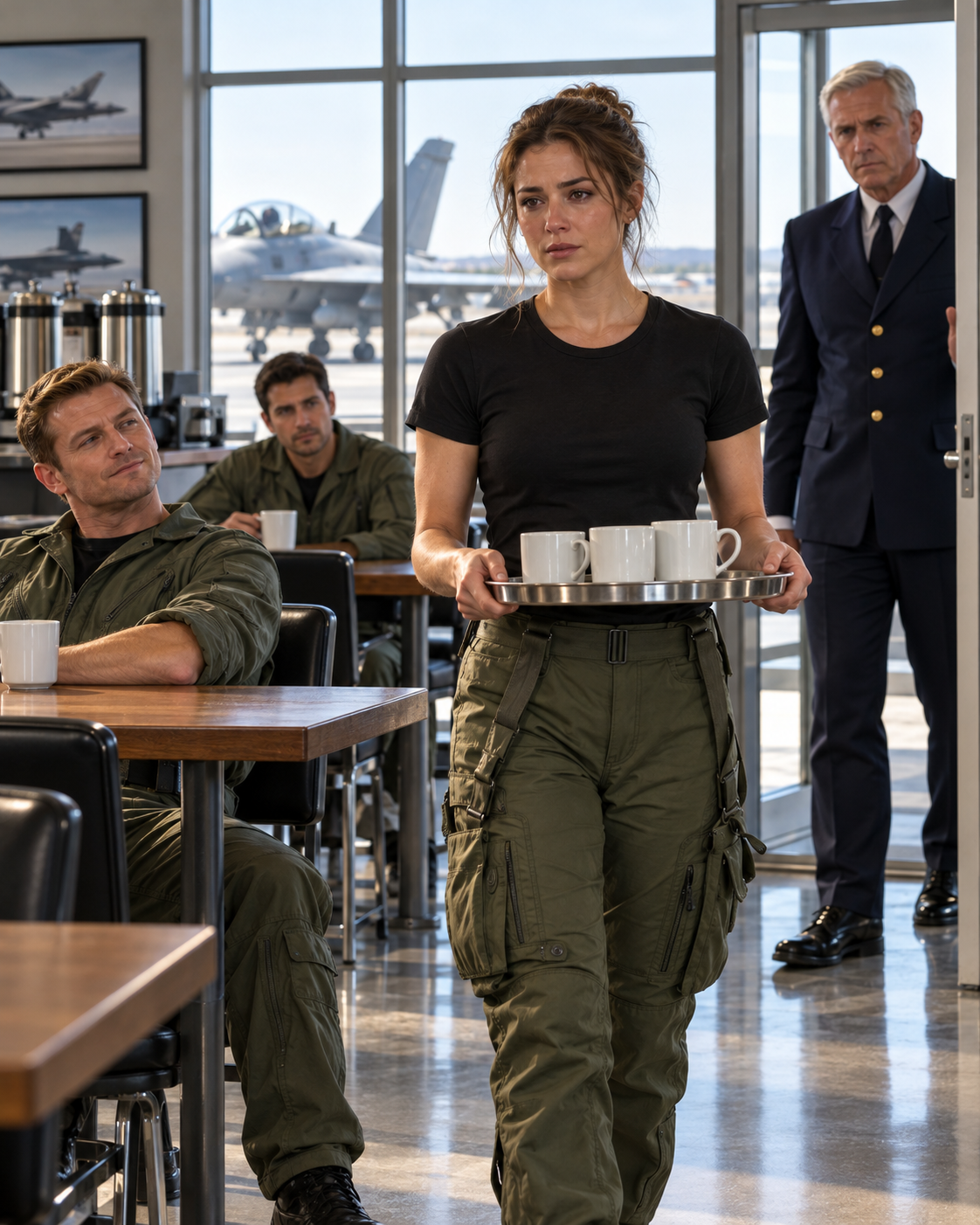
“No, sir. I wasn’t.”
“Then return to your assigned duties.”
The young pilot glanced at General Whitaker.
“With respect, sir, I think I need to stay.”
Whitaker gave a small nod.
“You’re welcome to stay, Lieutenant.”
Caleb reached into the inside pocket of his uniform and withdrew a sealed evidence envelope.
“I kept the original recording from my aircraft’s emergency system,” he said. “I was told it had been corrupted during the recovery process, but I had already downloaded a copy to the squadron’s approved flight-data archive.”
He handed the envelope to the general’s aide.
“I also kept the radio transcript from the night of the incident.”
Vance’s face tightened.
“That material was already reviewed.”
Caleb turned toward him.
“No, sir. The edited transcript was reviewed. The original wasn’t included in the final package.”
A murmur moved through the dining hall.
General Whitaker raised his hand, and the room settled.
“Explain the difference.”
Caleb swallowed.
“My aircraft lost engine power during the storm. I followed the emergency checklist, but I couldn’t restore thrust. I requested assistance and reported my position. Colonel Vance ordered Captain Morgan to maintain her assigned route and prohibited her from diverting.”
He paused, his eyes briefly meeting mine.
“Captain Morgan acknowledged the order. Then she asked me for my altitude, airspeed, and remaining electrical power.”
Vance interrupted.
“Because she was attempting to assess a situation she had no authorization to enter.”
“Yes, sir,” Caleb said. “She was trying to figure out whether I could survive long enough for the approved recovery team to reach me.”
“And she was wrong to assume that she could make that determination alone.”
Caleb’s hands tightened at his sides.
“Sir, I had less than a minute of usable control before my aircraft entered an unrecoverable descent. The weather had pushed me away from the designated recovery corridor. Nobody was coming to my position in time.”
He took a breath.
“Captain Morgan turned toward me anyway.”
I could still see the instruments in my mind, the warning lights, and the ice forming along the canopy.
I’d made the decision in seconds. I hadn’t had time to think about my career, my record, or what the commander might do afterward.
I had thought about a young pilot dying alone in a freezing storm while I continued toward a safe landing because an order had told me to.
Caleb continued.
“She located me, talked me through the emergency, and stayed close enough to guide me toward a landing area. Her own aircraft sustained damage during the maneuver. She lost her operational qualification because she brought me home.”
His voice faltered on the final words.
“I survived because she came.”
No one in the dining hall moved.
General Whitaker turned toward the aide, who had opened a secure tablet and begun reviewing the material.
“Can we authenticate this recording?”
“Yes, sir. The original file has a verifiable timestamp and matching aircraft data. We’ll need a full technical review before making a final determination, but it appears consistent with the emergency telemetry.”
Whitaker looked back at Vance.
“Colonel, why does the final report omit the distress call that preceded Captain Morgan’s diversion?”
Vance straightened his shoulders.
“The report focused on the command decision and the consequences of violating it. The communications record was considered supplemental.”
“Supplemental?” Whitaker repeated.
“Yes, sir.”
“An aircraft loses engine power during a severe winter storm, a pilot requests assistance, and the only other aircraft in the area diverts to help him. You consider the distress call supplemental?”
Vance’s jaw tightened.
“Captain Morgan was under my direct command. If every pilot disregarded an order whenever they personally believed circumstances justified it, we would have no reliable operational structure.”
“That is a legitimate concern,” Whitaker said. “It is not an answer to my question.”
The colonel said nothing.
For the first time, I saw something other than confidence in his expression.
It wasn’t yet guilt.
It was the realization that he could no longer control which facts were allowed into the room.
Whitaker turned to me again.
“Captain, did you knowingly disobey a direct order?”
“Yes, sir.”
A few heads turned.
I could have qualified the answer. I could have described the weather, the rapidly deteriorating conditions, the conflicting information, and the seconds I’d spent weighing the risk.
But I had disobeyed the order.
Pretending otherwise would have made the rest of my account weaker.
“Why?”
“Because I believed Lieutenant Reed was about to die, sir, and the time required to obtain further authorization would have removed any realistic chance of reaching him.”
“Did you understand the risk to your own aircraft?”
“Yes, sir.”
“Did you understand that you might lose your qualification?”
“Not in those exact terms. But I understood there could be consequences.”
Whitaker held my gaze.
“And if you could return to that night, knowing what followed, would you make the same decision?”
I looked down at the cup I’d prepared for him.
The black coffee had begun to cool.
“I would make the decision based on the conditions and the information available at the time, sir. If those conditions were the same, I would go after him again.”
Vance gave a short, incredulous laugh.
“General, this is precisely the attitude that led to the incident.”
Whitaker turned his head.
“No, Colonel. That is the attitude we are here to examine. There is a difference between reckless disregard for an order and a reasoned emergency decision. We are going to establish which one occurred.”
He addressed his aide.
“Secure the original data. Preserve the squadron’s communications logs, the weather records, the maintenance reports, and every version of the incident review. No files are to be altered or deleted. Notify the appropriate investigative office that we require an independent examination.”
Then he looked at Vance.
“You will provide a written account of your actions and the basis for the report. Until the preliminary review is complete, you will not direct the handling of evidence related to this incident.”
The colonel’s face flushed.
“General, with respect, I cannot accept the implication that I—”
“You are not being asked to accept an implication. You are being given an instruction.”
Vance fell silent.
Whitaker picked up his coffee again.
Then, to my surprise, he turned toward the room.
“I’d like to know how many of you have information relevant to this incident.”
No one immediately moved.
I understood why.
These were people with families, mortgages, enlistment contracts, and careers that depended on evaluations written by officers like Vance. Asking them to speak openly was easy for a general.
Living with the consequences was something else.
Master Sergeant Evelyn Price stepped forward.
“I have a statement regarding the handling of the emergency leave request for Airman Brooks, sir.”
Daniel, who stood near the entrance, looked at her in alarm.
Whitaker nodded.
“That’s a separate matter, Master Sergeant. You may submit it through the appropriate channel.”
“Yes, sir. I also have observations concerning the command climate in this unit.”
The general studied her.
“Put those in writing as well.”
Then another voice spoke from the line.
“I have something to add.”
It was Luis Ortega.
He stepped forward, holding his coffee with both hands.
“I maintain the maintenance records for the aircraft involved in Captain Morgan’s rescue. There are discrepancies between the original inspection notes and the summary attached to the disciplinary review.”
Vance turned on him.
“Sergeant, you are a maintenance specialist. You are not qualified to interpret operational decisions.”
Luis lowered his cup.
“I’m not interpreting the operational decision, sir. I’m reporting what the records say.”
The words were simple.
They were also the first time I’d heard someone challenge Vance in public without immediately retreating.
One by one, others came forward.
A communications technician had retained an unedited transmission log. A weather officer could explain how quickly conditions had deteriorated. Two ground crew members had recorded damage to my aircraft that hadn’t been fully described in the summary.
Nobody shouted.
Nobody made grand accusations.
They simply described what they had seen, what they had documented, and what they had been instructed to leave out of their reports.
And with each statement, the official version of that night became harder to defend.
I looked at the faces in the dining hall.
These were the same people I’d served coffee to every morning, the same people whose names I’d written into my notebook because I wanted to remember more about them than their ranks.
They weren’t protecting me because I was an accomplished pilot.
They were protecting the possibility that their own words might finally matter.
When the last witness had spoken, General Whitaker set down his cup.
“Thank you. Nobody here is being asked to reach a conclusion today. We will establish the facts through the review process, and anyone who provides evidence must be protected from retaliation.”
He glanced toward the entrance.
“That includes people whose statements may be inconvenient to senior leadership.”
Then he looked at me.
“Captain Morgan, I would like you to remain available to the investigation. For now, you will continue your assigned duties unless you receive a lawful change in orders.”
I nodded.
“Understood, sir.”
He picked up the cup one last time, drank the remaining coffee, and handed it back to his aide.
“By the way, Captain, that’s a good cup of coffee.”
It was such an ordinary remark that I nearly laughed.
“Thank you, General.”
He turned to leave, then stopped beside Master Sergeant Price.
“Master Sergeant, make sure I receive that statement.”
“Yes, sir.”
The general departed with his staff.
The dining hall remained quiet for several seconds after the doors closed.
Then the coffee urn rattled again.
Somebody at the back of the line cleared his throat.
“Captain? Could I still get a refill?”
I looked at him.
He was a young security airman whose name I had written in my notebook the previous week because he’d mentioned that his wife was expecting their first child.
I smiled.
“Of course.”
I reached for the pot.
My hands were shaking.
Not because I was afraid of Vance anymore, but because the first real crack had appeared in a wall I’d spent two months believing was solid.
And I had no idea how much would come down when the rest of it fell.
The investigation lasted twenty-three days.
Those twenty-three days were harder in some ways than the sixty-one mornings I’d spent behind the counter.
When I was serving coffee, the rules were simple. Pour the drink. Learn the person’s name. Listen when someone needed to talk. Show up again the next morning.
An investigation was different.
It required patience, documentation, and the willingness to watch people you respected struggle with the truth.
The investigators interviewed me twice, then asked me to submit a written account of the rescue. They examined my aircraft’s maintenance records and compared the radio transmissions against the weather data.
They also interviewed Caleb, Luis, Master Sergeant Price, and the personnel who had spoken during the inspection.
Vance was temporarily removed from direct oversight of the review.
He remained the squadron commander while the administrative process proceeded, but his authority over witnesses and evidence was restricted.
He didn’t speak to me for the first week.
Then, on the eighth day, he appeared at the coffee counter shortly after sunrise.
The line had thinned. I was wiping down the steel surface when his shoes stopped in front of me.
“Coffee,” he said.
I reached for a cup.
“Black, sir?”
He stared at me for a moment.
“Yes.”
I poured it and set it on the counter.
He didn’t take it immediately.
“Do you enjoy this?” he asked.
I glanced at him.
“Serving coffee, sir?”
“Watching me go through this.”
I put the pot down carefully.
“No, sir.”
“Then perhaps you could explain why you’ve encouraged half the base to turn against me.”
“I haven’t encouraged anyone to do anything. People gave statements because they had information.”
“You made yourself the center of a spectacle.”
“General Whitaker asked questions. I answered them.”
His fingers tightened around the cup.
“You could have shown some discretion.”
I looked at him, trying to find the man who had once briefed us before difficult missions, the man who had seemed capable of carrying the weight of command.
“I spent sixty-one days showing discretion, Colonel. I kept my head down, served the coffee, and did the assignment you gave me. I didn’t ask anyone to defend me.”
“Yet they did.”
“Yes, sir.”
“Why do you think that is?”
The question surprised me.
For a moment, I wondered whether he was genuinely asking.
“Because they were there,” I said. “They know what happened, and they know what they saw.”
He finally lifted the cup.
“People see what they want to see, Morgan.”
“Sometimes, sir. That’s why records matter.”
He stared at me, then walked away without drinking.
I watched him leave.
I didn’t feel triumphant.
I felt tired.
That afternoon, I found Daniel Brooks sitting alone near the far end of the mess hall.
His grandmother’s funeral had taken place three weeks earlier, and he had returned from Georgia with a small framed photograph tucked into his locker.
“Everything all right?” I asked.
He nodded, then looked down at his hands.
“I heard what happened during the inspection. I wanted to thank you again.”
“You already did.”
“I know.”
He hesitated.
“Master Sergeant Price told me you never mentioned the leave request to anyone except the people who could help. You didn’t use it to make yourself look good.”
I pulled out the chair across from him.
“Daniel, your grandmother deserved to have her grandson at her funeral. It wasn’t a favor to me.”
He rubbed his eyes.
“That’s what I mean. You acted like it was normal to care.”
For a while, neither of us spoke.
Then he reached into his pocket and took out a folded photograph.
It showed an older woman sitting on a porch, smiling at the camera with a dish towel over one shoulder.
“She used to tell me that the world would give you enough reasons to become hard,” he said. “She said the real challenge was not letting those reasons make the decision for you.”
I looked at the photograph.
“Sounds like she knew what she was talking about.”
“She did.”
He slipped the picture back into his pocket.
“Captain, I don’t know what happens with your career. But I hope you know you changed how I think about being in uniform.”
I felt my throat tighten.
“Just remember it when someone junior to you needs help.”
He nodded.
“I will.”
That evening, I opened my notebook in my quarters.
Between Luis’s daughter’s birthday and the security airman’s upcoming wedding anniversary, I found the page where I’d written Daniel’s grandmother’s name.
Margaret Brooks.
I’d written it down after he told me about her, even though I’d never met her.
I traced the name with my thumb.
For the first time since my mother’s death, I understood something I’d struggled to put into words.
Kindness didn’t erase grief.
It didn’t repair a broken aircraft or reverse a disciplinary decision.
It didn’t guarantee that good people would be treated fairly.
Sometimes, it simply ensured that when a person faced something terrible, they wouldn’t have to face it entirely alone.
The investigators finished their preliminary findings on the twenty-third day.
I was summoned to a conference room in the administration building, where two investigators and a legal adviser sat behind a table covered in documents.
Caleb was there, too.
So was Master Sergeant Price.
General Whitaker joined by secure video from another installation.
The lead investigator, a lieutenant colonel from outside our command, opened a folder.
“Captain Morgan, the review has confirmed that Lieutenant Reed’s aircraft experienced a severe engine malfunction during rapidly deteriorating weather conditions. The available telemetry supports his account of a rapidly declining ability to maintain controlled flight.”
She turned a page.
“The original radio recording also confirms that you requested updated information about his aircraft before diverting to his position. Your actions were not impulsive in the sense suggested by the disciplinary summary. They were preceded by a rapid assessment of the emergency.”
I sat still.
The investigator continued.
“The review also found that your commander issued an instruction to maintain your assigned route after receiving information indicating that Lieutenant Reed was experiencing a potentially catastrophic emergency.”
General Whitaker’s face remained composed on the screen.
“Did the commander have a legitimate operational reason for issuing that instruction?” he asked.
“Some concerns were legitimate, sir. Weather conditions posed a serious risk to both aircraft, and the squadron commander was responsible for coordinating the broader operation. However, the evidence indicates that the decision was based on incomplete information and that the commander did not adequately reassess the situation after receiving the updated distress transmission.”
She paused.
“More significantly, the final disciplinary report omitted material communications that were relevant to determining whether Captain Morgan’s actions were justified under the circumstances.”
I felt my fingers press into my knees.
There it was.
Not a rumor. Not an accusation made in a crowded dining hall.
A finding, supported by records.
The investigator closed the folder.
“The review does not conclude that every aspect of Captain Morgan’s decision was without risk. It concludes that the existing disciplinary determination cannot be sustained in its current form because material evidence was omitted and the decision-making process was inadequate.”
She looked directly at me.
“Your disciplinary action will be rescinded pending final administrative approval. Your flight status will be evaluated separately, based on your qualifications and the technical condition of your aircraft.”
I exhaled slowly.
Caleb looked at me, and for a second his expression reminded me of the young pilot who had called for help in the storm.
He didn’t smile.
Neither did I.
We had both learned that the truth could arrive without repairing everything it touched.
General Whitaker spoke.
“Captain Morgan, I want to be clear about something. This finding is not a declaration that orders are optional. Military operations depend on discipline, coordination, and trust. But those things are not served when a report is shaped to protect a commander’s reputation.”
“Understood, sir.”
“Your actions will be reviewed for what they were, not for the embarrassment they caused your commander.”
He paused.
“Your willingness to accept responsibility for disobeying the order also matters. You did not deny what you did, and you did not try to make yourself the hero of this incident. That gave the investigation a clearer starting point.”
I looked at Caleb.
“I wasn’t the only person involved, sir.”
“No,” Whitaker said. “You weren’t.”
He turned toward the investigator.
“Please proceed with the remaining administrative actions. I also want a separate review of the command climate concerns raised by the personnel at the installation.”
The meeting ended shortly afterward.
Outside the conference room, Caleb walked beside me toward the stairwell.
“So,” he said, “does this mean you’re flying again?”
“Not yet.”
“But it’s a start.”
“Yes.”
He stopped beside a window overlooking the flight line.
“I’ve replayed that night in my head more times than I can count.”
I waited.
“I keep thinking I should have done something differently. Maybe I should have declared the emergency sooner. Maybe I should have tried another restart. Maybe if I hadn’t drifted so far off the corridor, you wouldn’t have had to—”
“Caleb.”
He stopped talking.
“You were in a failing aircraft in a winter storm. You followed the emergency procedures, communicated what you could, and fought to keep control. You don’t have to invent a perfect decision after the fact just because you survived.”
He looked out the window.
“I know that when you say it.”
“Then believe it when you’re alone, too.”
He gave a small, unsteady laugh.
“You’re better at this coffee-counter thing than you think.”
“Don’t tell Master Sergeant Price. She’ll try to keep me there permanently.”
For the first time in weeks, Caleb laughed properly.
The final administrative decision arrived five days later.
My disciplinary penalty was formally rescinded, and the finding of misconduct was removed from my record. The command-climate investigation continued separately, and Vance was ordered to relinquish squadron command while the remaining findings were reviewed.
He wasn’t marched out in handcuffs.
There was no public announcement declaring him a villain.
He was simply removed from the position he’d used to control the story, and the authority to determine what happened next was placed in other hands.
That mattered more than any dramatic punishment could have.
The base still had to operate.
Aircraft still needed maintenance. Security personnel still had to work through the night. Young pilots still had to learn how to make decisions under pressure.
And every one of those people deserved a command structure that treated accountability as more than a weapon used against the powerless.
A week after the decision, General Whitaker returned to the installation.
This time, his visit was announced.
The dining hall staff had been told to prepare for a formal reception, and I was instructed to report to the personnel office that morning to discuss my reinstatement and the next stage of my flight evaluation.
I arrived in my service uniform.
For the first time in nearly three months, I wasn’t wearing the white apron.
Master Sergeant Price was waiting outside the office.
She looked me up and down.
“Well,” she said, “you clean up all right, Captain.”
I glanced at my sleeves.
“I was beginning to forget what these looked like.”
“Don’t get sentimental. You’ll be back in a flight suit soon enough.”
I smiled.
“I hope so.”
She studied me for a moment.
“How are you feeling?”
I considered giving her the answer officers were supposed to give.
Ready. Confident. Focused.
Instead, I told the truth.
“I’m relieved. I’m angry about what happened. And I’m afraid that if I get back into a cockpit, I’ll discover I’m not the same pilot I was before.”
Price nodded as if I’d told her the weather forecast.
“That’s reasonable.”
“Is it?”
“Captain, if you came through all this without a single doubt, I’d worry about you.”
She straightened the edge of my collar.
“Your job now is to find out what you can still do. You don’t have to pretend nothing happened.”
I carried that sentence into my meeting with the flight evaluation board.
The board reviewed my service record, the technical damage to my aircraft, and the circumstances of the rescue. They also examined whether the injuries I’d sustained during the emergency maneuver affected my ability to return to operational duty.
My qualification wasn’t restored automatically.
I had to complete medical clearance, simulator assessments, emergency-response evaluations, and a series of supervised flights.
The first simulator session was humbling.
I made a small correction too late during a high-workload exercise, and the instructor paused the scenario.
“Captain, you’re anticipating the failure instead of flying the aircraft.”
I removed my hands from the controls.
“Yes, sir.”
“Why?”
I stared at the simulated instruments.
Because I’d spent months imagining everything that could go wrong.
Because I’d learned how quickly a good decision could be turned into evidence against you.
Because the moment I heard a warning tone, part of me wanted to look over my shoulder for the person who would blame me if I acted.
I couldn’t explain all that in a simulator debrief.
So I said, “I need another run, sir.”
He nodded.
“Then let’s do another run.”
I did.
And another.
The next morning, I returned.
Over the following weeks, my confidence came back in pieces, not all at once.
I relearned how to trust my judgment without assuming it was infallible. I relearned how to accept correction without interpreting every criticism as a threat. Most importantly, I learned that courage in the cockpit wasn’t the absence of fear. It was the ability to evaluate that fear without allowing it to make the decision for you.
Caleb completed his own return-to-flight program, too.
His recovery was slower, and he never pretended otherwise.
Sometimes, when we crossed paths near the hangars, he asked me questions about the rescue. We discussed the parts that had gone well and the parts that needed improvement. We examined the choices we had made and the information we had possessed at the time.
We didn’t turn the incident into a legend.
We treated it as something we had survived, something from which we still had things to learn.
Three months after the inspection, the command-climate review reached its conclusion.
The report identified failures in the handling of disciplinary evidence, inappropriate pressure on personnel, and weaknesses in the process for raising operational concerns. It recommended formal leadership training, revised reporting procedures, and independent oversight for serious safety-related disciplinary cases.
Vance received formal administrative consequences for his handling of the incident and was reassigned from the squadron command position.
I saw him only once after the decision.
He was standing outside the administration building with a folder tucked beneath his arm. His uniform was immaculate, but his shoulders seemed to have lost some of their rigid certainty.
I was walking toward the flight line when he called my name.
“Morgan.”
I stopped.
“Sir.”
He looked toward the runway, where a maintenance crew was guiding a tow vehicle toward a parked aircraft.
“I’ve read the final report.”
I waited.
“They were harder on me than I expected.”
I wasn’t sure how to respond.
After a moment, he continued.
“I still believe that command authority matters. I believe that pilots who ignore orders can put other people at risk.”
“I agree, sir.”
He seemed surprised.
“You do?”
“Yes. I’ve seen what happens when someone mistakes confidence for competence. I’ve also seen what happens when people stop questioning a decision because they’re afraid of the person who made it.”
He looked down at the folder.
“I thought you were undermining me.”
“I was trying to bring Caleb home.”
“I know that now.”
The words came out quietly.
For a moment, I saw something like regret in his expression, though I couldn’t tell whether he regretted the decision itself or simply the consequences.
He shifted the folder under his arm.
“I should have reviewed the full communications record before finalizing the report.”
“Yes, sir.”
“I should have listened to the people who were there.”
“Yes, sir.”
He looked at me, perhaps expecting me to soften the answer.
I didn’t.
Not because I wanted to punish him, but because pretending the harm had been smaller than it was would have served no one.
He nodded once.
“I don’t expect you to forgive me.”
“I haven’t decided what forgiveness means in this situation, sir.”
He seemed to consider that.
Then he said, “Fair enough.”
He walked away.
I watched him cross the parking lot until he disappeared around the building.
I didn’t feel the satisfaction I’d once imagined I would feel if he were finally held accountable.
I felt the weight of a difficult truth: even when a person admitted a mistake, the damage did not disappear simply because the admission had arrived.
I could acknowledge his regret without pretending the consequences hadn’t mattered.
I could move forward without giving him the power to define what the incident meant to me.
And I could let the institution deal with his conduct without making my life revolve around his punishment.
The following month, I passed my final flight evaluation.
The medical officer signed the clearance. The board approved my return to operational duty. My qualification was restored, subject to the normal requirements and a period of supervised flying.
When I received the paperwork, I sat alone in my quarters and read the final line three times.
I had expected to cry.
Instead, I laughed once, quietly, and pressed the page flat against the desk.
Then I took out my notebook.
The pages were crowded with names, reminders, and small details I’d gathered during my ninety-day sentence. Some entries had been crossed out because people had transferred to other bases. Others were marked with notes about promotions, weddings, or family milestones.
I found the page with my mother’s name at the top.
Years earlier, I’d written down one of her favorite sayings so I wouldn’t forget it.
Never confuse being important with being worth listening to.
I ran my finger over the words.
Then I closed the notebook and went to the flight line.
My first operational flight back was scheduled for a clear, cold morning.
The sky was pale blue, and the snow had receded from the concrete in long gray streaks. Ground crews moved around the aircraft with the familiar efficiency that had always steadied me.
Luis Ortega was there, supervising the final maintenance checks.
He looked up when I approached.
“Morning, Captain.”
“Morning, Luis. How’s your daughter?”
“Started school last week. Already telling me I’m embarrassing.”
“That’s how you know she’s doing well.”
He grinned.
“Aircraft checks are complete. All the required documentation is signed.”
I studied the jet.
For months, I’d wondered whether climbing into another aircraft would feel like returning home or walking back into a place where I’d been hurt.
Now, standing beside the fuselage, I felt both things at once.
I was still afraid.
I was also ready.
Caleb appeared from the next hangar, carrying his helmet.
He had been assigned to a different training flight that morning, but he’d come to see me off.
“Captain,” he said, “I owe you a coffee.”
“You owe me several. You were a regular customer.”
“I was a regular customer because your coffee was better than the stuff in the officers’ lounge.”
“That’s the nicest thing anyone’s said to me all year.”
He smiled, then became serious.
“I know I can’t repay what you did.”
“You don’t owe me repayment.”
“I know you say that.”
He looked toward the aircraft.
“But if I’m ever the one making the decision, I hope I’ll remember what happened that night. Not just that you came for me. That you made the decision with the information you had, and then accepted responsibility for it.”
I nodded.
“That’s all any of us can do.”
He held out his hand.
I shook it.
Then I climbed into the cockpit.
As the ground crew completed the final checks, I looked through the canopy at the people standing beside the aircraft. Luis raised one hand. Caleb stepped back behind the safety line. A young crew member gave me a thumbs-up.
I checked the instruments.
I reviewed the departure procedure.
I listened to the radio.
Everything was ordinary, and that was the greatest gift of all.
When clearance came, I taxied to the runway.
The aircraft accelerated beneath me, and the concrete markings began to blur. The nose lifted, the ground fell away, and the base spread out beneath the wings.
For the first time in months, I was where I had worked so hard to be.
But the most important change wasn’t that I’d returned to flying.
It was that I no longer believed my worth depended on whether I was permitted to do it.
I had spent years measuring myself by performance reports, flight hours, qualifications, and the trust of people whose opinions could alter my future.
Those things mattered. I wasn’t going to pretend otherwise.
But they weren’t the whole of a life.
A few weeks later, on the morning my ninety-day sentence would officially have ended, I returned to the mess hall before sunrise.
I wasn’t ordered to be there.
I didn’t have to wear an apron.
I came because I wanted a cup of coffee before my briefing, and because I had promised Master Sergeant Price I would bring her the notebook so she could see the names I’d collected.
The dining hall was already filling.
Daniel Brooks stood near the counter, laughing with Luis about something on his phone. His grandmother’s photograph was tucked into the clear sleeve of his identification holder.
When he saw me, he straightened.
“Captain Morgan.”
“At ease, Daniel.”
He grinned.
“Sorry, ma’am. Habit.”
I ordered my coffee and turned toward the tables.
A new airman approached the counter carrying a tray. He looked exhausted, with dark circles under his eyes and a uniform that seemed a size too large.
He hesitated when he noticed my rank.
“Excuse me, ma’am. Do you know where I can find someone about emergency family leave?”
The question brought back the first morning Daniel had stood in front of me with his folded paperwork.
I set down my cup.
“Tell me what’s going on.”
He glanced toward the door, as though worried he was already taking too much time.
“My dad’s in the hospital. I got a call overnight, and I don’t know how to start the request.”
I pulled out a chair.
“Sit down for a minute. We’ll find the right office and figure out what documentation you need.”
He sat.
Across the room, Master Sergeant Price watched us with a small smile.
I opened my notebook to a fresh page and wrote down the airman’s name.
Then I listened.
Outside, the first aircraft of the morning began to rumble along the runway.
The coffee in my cup was cooling, my briefing was approaching, and the young airman had a long day ahead of him.
None of us could fix everything that was waiting beyond the dining hall doors.
But we could start with the person sitting across from us.
And sometimes, that was how a base learned to become a little more worthy of the people who served it.