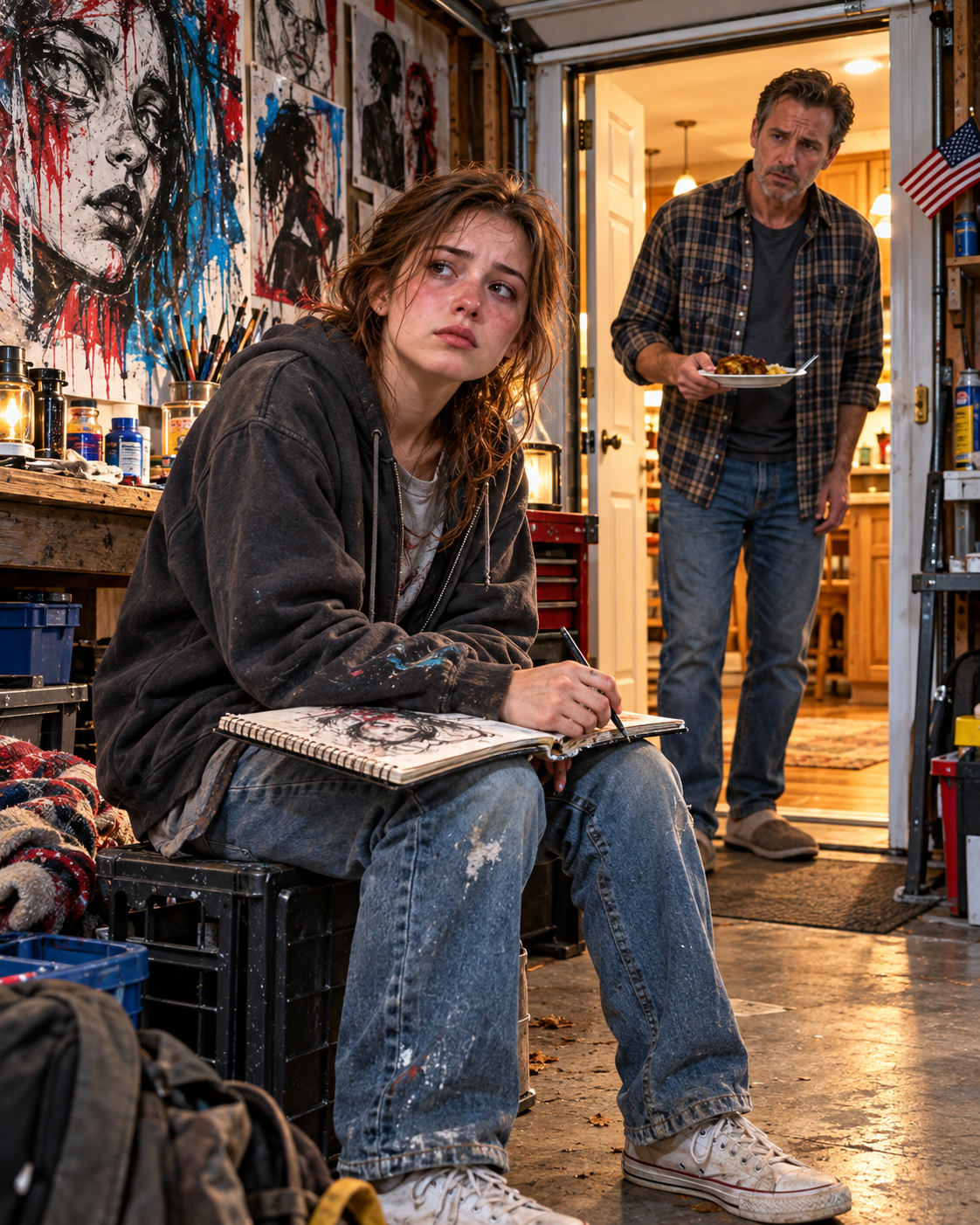
My mother ordered me to sleep in the freezing garage because I had painted over the mirrors in my sister’s dance studio
The envelope contained an invitation to interview for a youth mural fellowship sponsored by a local arts organization. They had seen my online work and wanted to fund a public mural project, provide mentorship, and help me build a professional portfolio.
It wasn’t a magic ticket out of my family’s house. The fellowship required an interview, a proposal, and months of work. But it was the first real opportunity I had ever received because of my art, and it came with a modest stipend that could help me save for independence.
My mother read the letter twice.
“They want to pay you for this?” she asked, looking past me at the painted garage walls.
“Yes.”
“After everything you’ve done to this family?”
I looked at the envelope in her hand. “You mean after everything you’ve done to me?”
Her expression hardened. She said the magazine had twisted the story, that my paintings made her look cruel, and that I had no right to embarrass her professionally. She insisted I turn down the fellowship until I could prove I was capable of making responsible decisions.
For years, I would have obeyed just to stop the argument.
This time, I took the envelope back.
“I’ll go to the interview.”
She threatened to take my paint, shut down my internet access, and make sure I never sold another print. But the situation was no longer as simple as her issuing an order and everyone falling into line.
Olivia had heard enough. She told our mother that she had saved photographs of the torn sketchbook, pictures of the garage, and messages documenting what had happened. If our mother tried to hurt me again or prevent me from getting help, Olivia was prepared to contact the appropriate child welfare authorities.
My father finally stood up from the couch.
He didn’t suddenly become brave enough to defend me the way he should have years earlier. He simply admitted that he had known the garage was too cold and that telling me to endure it had been easier than confronting his wife.
“I’m sorry,” he said.
I believed he regretted it. I also understood that regret didn’t erase the nights I had spent shivering beside cans of paint while he stayed warm inside.
I went to the fellowship interview with my portfolio tucked under my arm. The panel asked me about the figures in my murals, the recurring images of windows and locked doors, and why so much of my work seemed to be about finding a way out.
I told them the truth without giving them every painful detail.
“I paint what I can’t say out loud,” I explained. “And I want to make things other people can recognize themselves in.”
A few weeks later, I received confirmation that I had been selected for the project.
The stipend wasn’t enough to solve every problem, but combined with my print sales, it gave me a practical start. With Olivia’s help, I began researching safe housing options, budgeting for expenses, and making plans with trusted adults who could help me navigate the next steps. I would not leave recklessly or pretend that a teenager could solve every legal and financial problem overnight.
Meanwhile, my mother stopped speaking about my art as though it were a childish phase. She began asking whether I could remove certain photographs from my page and whether the next magazine might mention her school again.
I told her I would not publish private family details simply to punish her. But I would not erase my work to protect her reputation, either.
The garage stayed cold for a while longer. My family didn’t transform overnight, and my father’s apology didn’t repair everything. Some evenings, the silence inside the house was still unbearable.
Yet the walls around me had changed.
They were covered with paintings I had created, not because someone had approved them, but because I needed to make them. Each finished mural reminded me that the place where my mother had tried to diminish me had become the place where I discovered what I could do.
Months earlier, she had sent me to the garage believing that isolation would teach me obedience.
Instead, strangers had found my work, an arts organization had offered me a chance, and I had begun building a future that belonged to me.
I didn’t become successful because my mother punished me. I became stronger because, even in the middle of that punishment, I found a way to keep creating.
And the first time I painted a public wall under my own name, I realized I no longer needed my family to approve of the person I was becoming.
The garage had never been the future.
It had only been the place where I learned how to begin.
The first time I signed my name on a public mural, I did it with a shaking hand.
The wall stood beside a neighborhood community center in a small American town, facing a parking lot where parents dropped off their children for after-school programs and older residents gathered on folding chairs when the weather was warm. It wasn’t a famous building or a place tourists came to photograph. The brick was chipped in places, the pavement cracked, and someone had drawn a smiley face on the dumpster behind the center.
But the wall was mine to paint.
Not because I owned the building. Not because my family had given me permission. The local arts organization had approved my design, arranged the necessary permissions, and given me a chance to turn something private into something other people could see.
For the first time, I didn’t have to wait until everyone in my house was asleep before I could make art.
I stood on the pavement with a paint marker in my hand, looking at the mural I had spent three weeks planning. A series of figures stood beneath a dark blue sky, each one separated by a narrow black doorway. At the far end, one figure was stepping through an open door toward a field of gold.
It wasn’t a picture of a perfect life.
It was a picture of a life that could belong to you.
I signed my name in the bottom corner.
Then I stepped back.
“Looks good,” said Daniel, the fellowship coordinator, standing beside me with two paper cups of coffee.
I laughed nervously. “You don’t have to say that.”
“I’m not saying it because I have to.” He nodded toward the wall. “You made something people are going to stop and look at. That’s the job.”
I glanced at the signature again.
For years, my mother had treated my name as something she could attach to a list of mistakes. Missing assignments. Paint on my clothes. Sketches in the margins of notebooks. Another argument she had to manage before dinner.
Now it was written on a wall that strangers would walk past every day.
I wondered how she would react if she saw it.
Then I realized I didn’t have to wonder.
She already knew.
My mother attended the mural’s unveiling two days later.
She arrived wearing a navy blazer and the same carefully arranged expression she used at school meetings. Her hair was perfect, her shoes were clean, and she carried a small handbag that looked as though it had never touched the floor.
She had told me she was coming because she wanted to show her support.
I wasn’t sure whether to believe her.
Olivia came with her, although she had made it clear that she was there for me, not for our mother. My father arrived separately and stood near the back of the crowd with his hands in his jacket pockets. Mia stayed home, saying she had dance practice.
I couldn’t blame her.
The past few months had made our family feel like a house after a storm. The walls were still standing, but everyone knew something had cracked underneath them.
Daniel introduced me to the people who had come to see the mural. A local reporter asked about my process, and a woman from the community center told me her son had started drawing again after seeing my work online.
I answered their questions as best I could.
Then the reporter asked what had inspired the images of locked doors.
I looked at the mural.
“I used to feel like there were parts of me I had to hide to keep everyone else comfortable,” I said. “I think a lot of people understand that feeling, even if their situation is different from mine.”
The reporter nodded and wrote something down.
My mother stood a few feet away.
I didn’t look at her again until the crowd began to disperse.
She approached me with her handbag held tightly against her side.
“You didn’t mention the family,” she said.
“I was talking about the painting.”
“People know who you are. They read that magazine article. They see your posts. You know what they’re going to assume.”
I wiped a small streak of paint from my thumb.
“I can’t control what people assume.”
“You could be more careful.”
“I am careful.”
She lowered her voice.
“Do you have any idea what this has done to my reputation?”
There it was.
Not a question about the fellowship. Not a question about the work. Not even a question about how I was doing.
Her reputation.
I looked at her for a long moment.
“I know what it did to mine when you decided I was the family disappointment.”
She went still.
For once, I hadn’t shouted. I hadn’t insulted her. I hadn’t done anything she could easily point to as proof that I was disrespectful.
I had simply answered her.
She glanced toward the people still standing nearby, then leaned closer.
“We’ll discuss this at home.”
“No,” I said quietly. “We won’t discuss it the way we used to.”
Her eyes narrowed.
I felt my heartbeat in my throat, but I didn’t take the words back.
“I’ll talk to you when we can have a conversation without threats or yelling. Until then, I’m going to keep working.”
I turned toward Daniel, who was packing his supplies into a plastic storage bin.
My mother remained behind me.
For the first time, I walked away from an argument without waiting to find out whether she considered it finished.
That evening, Olivia called me.
“How are you holding up?”
I was sitting in the garage, sorting receipts from my print sales into an old shoebox. I had started tracking every dollar I earned because the fellowship coordinator had explained something my parents never had: independence wasn’t just a feeling. It required planning.
“I’m okay,” I told her.
“That’s not an answer.”
I smiled despite myself.
“I’m tired. But I’m okay.”
She was quiet for a moment.
Then she said, “I need to tell you something about Mia.”
I stopped sorting the receipts.
“What happened?”
“She came into my room yesterday. She was crying.”
I leaned back against the workbench.
Mia had always been the child my mother protected most fiercely. She was younger than Olivia and me, and our mother had built so much of her identity around Mia’s dancing that even small setbacks became household emergencies.
When Mia forgot a routine, our mother blamed her instructor.
When she lost a competition, our mother blamed the judges.
When she was tired, our mother canceled family plans so Mia could rest.
I had spent years resenting her for it.
But I knew that being the favorite wasn’t the same as being free.
“What did she say?” I asked.
“She said she feels like she has to be perfect all the time. She said Mom keeps telling her that everyone is watching her and that she can’t afford to disappoint people.”
I looked at the garage door.
For months, I had thought Mia was happy to have the basement studio and all the attention that came with it. I had assumed she knew how much our mother favored her.
Maybe she did.
Maybe she had simply never understood what that favoritism cost.
“Did she say anything else?” I asked.
Olivia hesitated.
“She asked if you hate her.”
The question hurt more than I expected.
I remembered standing in the basement with paint on my hands, staring at the mirrors my mother had installed for Mia. I remembered how satisfying it had felt to cover those perfect reflections with the feelings I had been forced to hide.
I also remembered Mia’s face when she first saw what I had done.
She had looked devastated.
I had told myself that the damage was my mother’s fault, that the mirrors represented everything wrong with our family. But Mia had danced in front of those mirrors every day. They were part of her world, too.
“I don’t hate her,” I said.
“Then tell her.”
I swallowed.
“I don’t know how.”
“Start there.”
After we hung up, I sat with my phone in my hand for nearly twenty minutes.
Then I opened a message to Mia.
I typed three different versions before finally sending the simplest one.
I don’t hate you. I’m sorry I damaged your studio. I was angry, and I wanted Mom to understand how I felt. I know that hurt you, too. If you ever want to talk, I’m here.
She didn’t respond that night.
Or the next morning.
For a while, I wondered whether I had waited too long.
Then, three days later, I found a message from her.
Can I come see the garage?
I stared at the screen.
My first instinct was to say no.
This garage had become my sanctuary. It was the place where I could paint without hearing my mother’s criticism or worrying about Mia’s rehearsals. Letting someone from the house into it felt like opening a door I had spent months learning to close.
But Mia wasn’t my mother.
And she wasn’t responsible for everything that had happened between us.
I replied, Yes. Just let me know when.
Mia arrived on Saturday afternoon wearing leggings, an oversized sweatshirt, and the worn sneakers she used for practice.
She stood at the entrance for a few seconds, looking around.
The garage wasn’t beautiful. The floor was still concrete, the shelves were crowded with paint cans, and the old cardboard boxes hadn’t disappeared. A small electric heater sat near my workbench, and I had hung thick curtains over the worst gaps around the windows.
But the walls were covered in art.
Some pieces were rough sketches. Others were large, layered paintings made with whatever supplies I could afford. I had arranged photographs of the murals in a row above the workbench, with dates and notes written beneath them.
Mia walked slowly from one wall to the next.
“I didn’t know you could do this,” she said.
I almost laughed.
“That’s kind of the problem.”
She looked down.
“I know.”
We stood in silence for a moment.
Then she stopped in front of a painting I had never posted online. It showed a girl standing in a bright room full of mirrors, each reflection wearing a different expression. The girl herself was looking toward a small open window.
“Is that supposed to be me?” Mia asked.
I considered lying.
Instead, I said, “Partly.”
She studied it.
“I always thought you hated my dancing.”
“I hated how Mom treated your dancing like it mattered more than everything else.”
“Sometimes I hate it, too.”
I turned toward her.
Mia rubbed the edge of her sleeve between her fingers.
“Don’t tell Mom I said that.”
“I won’t.”
“She gets so upset if I say I’m tired. She says I’m lucky to have opportunities other kids would do anything for. And I know she’s right, but sometimes I just want to dance because I like it. I don’t want every competition to decide whether I’m good enough.”
Her voice cracked on the last few words.
I had imagined this conversation many times, but never from her side.
I had spent years looking at Mia as the symbol of everything I wasn’t allowed to have. I hadn’t considered that our mother might have turned her into a symbol, too.
“I don’t think Mom knows how to love something without trying to control it,” I said.
Mia wiped her cheek.
“Do you think she’ll ever change?”
I looked around the garage.
“I don’t know.”
It was the most honest answer I had.
She moved toward the workbench and picked up a pencil from a cup.
“Can you teach me how to draw?”
I blinked.
“You want me to teach you?”
“Not dancing. Just drawing.”
For a moment, I couldn’t find the right words.
Then I pulled a clean sheet of paper from a drawer and set it in front of her.
“Start with something you can see.”
She looked around the garage, considering her options. Finally, she began sketching the old metal toolbox beside the workbench.
Her first lines were hesitant. She erased them, tried again, and frowned at the result.
I showed her how to look at the shapes instead of the object, how to notice the angle of the lid and the shadows beneath the handle.
She tried again.
This time, the drawing began to resemble the toolbox.
She smiled.
It was a small smile, but it wasn’t the polished expression she wore in photographs from dance competitions. It was the face of a girl who had discovered she could do something imperfectly and still enjoy it.
We spent the rest of the afternoon drawing.
Before she left, Mia stood near the garage door and looked back at the walls.
“I wish I hadn’t been so angry about the mirrors,” she said.
“You had every right to be angry. I damaged something that mattered to you.”
She nodded.
“But I think I understand why you did it now.”
I didn’t tell her that understanding didn’t erase the damage. I didn’t need to. We both knew that.
Instead, I said, “Next time, I’ll find a different way to make my point.”
She smiled faintly.
“Good. Because those mirrors were expensive.”
I laughed.
For the first time in months, we laughed together without checking whether our mother could hear us.
The following weeks were not easy.
My mother continued to insist that the family needed to move forward, but she defined moving forward as returning to the way things had been before anyone questioned her.
She wanted the garage cleaned, the paintings removed, and the magazine article forgotten. She wanted Olivia to stop threatening to involve child welfare authorities. She wanted Mia to concentrate on dance again and my father to stop avoiding conversations.
Most of all, she wanted me to come back inside and act as though the punishment had been a misunderstanding.
I couldn’t do that.
The fellowship required regular meetings, and I began spending more time at the community arts center. Daniel introduced me to other young artists, some of whom had grown up in families that didn’t understand their work.
One painted elaborate landscapes on discarded cabinet doors. Another made sculptures from scrap metal collected at construction sites. A girl a few years older than me created portraits of strangers using nothing but charcoal and recycled paper.
None of them treated art as something embarrassing.
They asked questions about my work. They offered suggestions. Sometimes they disagreed with my choices, but they explained why instead of tearing up my drawings.
I began to understand that criticism didn’t have to be cruel to be useful.
I also learned that talent alone wasn’t enough.
I had to meet deadlines, communicate with the organization, keep track of expenses, and revise designs when the community center requested changes. I had to learn how to price my prints without underestimating the time I spent making them.
Some days, the practical work was more exhausting than painting.
But when I made a mistake, nobody called me a disappointment.
They helped me correct it.
My online audience continued to grow. People ordered prints of the garage murals, and a small independent shop agreed to display a few of my pieces. I started setting aside part of every payment for supplies and part for future housing expenses.
I didn’t spend the money on expensive clothes or new equipment I didn’t need.
I wanted something more important.
A place where I could close the door and know that the person on the other side wouldn’t use my belongings to punish me.
One afternoon, Daniel helped me connect with a youth support program that offered guidance to teenagers dealing with unsafe or unstable home situations. They explained the options available to me and helped me understand what I could realistically afford.
I didn’t move out that week.
I didn’t suddenly become an adult because strangers liked my paintings.
I was still young, and I still needed support. I still had to navigate school, family conflict, and the practical limits of my situation.
But I had begun making decisions based on what I needed instead of what would keep my mother calm.
That difference changed everything.
My father was the last person I expected to see standing in the garage with a toolbox in his hand.
It was a Sunday morning. I was painting a new piece when he knocked on the open doorframe.
He looked uncomfortable.
“I thought you might need these,” he said, setting the toolbox on the workbench. Inside were a set of screwdrivers, pliers, a measuring tape, and several small tools I could use to repair the shelves.
I stared at them.
“Why?”
He rubbed his jaw.
“Because I should have helped you make this space livable a long time ago.”
I put down my brush.
He looked around at the walls, then at the heater near the workbench.
“I keep thinking about the night I brought you dinner.”
I said nothing.
“I knew it was cold in here. I knew you were hurt. And I told you to endure it because I didn’t want another fight with your mother.”
His voice grew quieter.
“I made it sound like the situation was temporary, as if that made it acceptable.”
I watched him carefully.
He had said sorry before, but usually in the form of vague comments about how everyone had made mistakes. This was different. He was naming what he had done.
“I’m not asking you to forgive me,” he continued. “I just want you to know I understand that I failed you.”
For a long time, I had wanted him to say those exact words.
Now that he had, I wasn’t sure what to do with them.
“Why didn’t you help me then?” I asked.
He looked down at the toolbox.
“Because I was afraid of what would happen if I stood up to her.”
I waited.
He swallowed.
“And because I told myself that keeping the peace was the same as protecting you. It wasn’t.”
The garage was quiet except for the heater.
I wanted to tell him that I understood. I wanted to tell him that he had been caught between two people he loved, that confronting my mother must have been difficult, that perhaps he had done the best he could.
But those explanations had always come too easily to me.
They were the reasons I had spent years making excuses for the people who hurt me.
“You could have done something,” I said.
“I know.”
“You could have told her the garage wasn’t safe. You could have stopped her from tearing up my sketchbook. You could have stood between us when she slapped me.”
His eyes filled, but he didn’t interrupt.
“You didn’t have to fix everything,” I continued. “You just had to stop acting like nothing could be done.”
He nodded slowly.
“I know.”
I looked away, blinking hard.
Part of me wanted to reach for him. Another part wanted to ask why he had waited until strangers started praising my work before he decided I deserved to be defended.
I didn’t ask that question.
Not because it didn’t matter, but because I wasn’t ready to hear the answer.
“I’m glad you’re trying now,” I said. “But I need you to keep trying when Mom gets angry, too. Not just when things are quiet.”
He nodded again.
“I will.”
I couldn’t promise to trust him immediately.
So I didn’t.
I let him help me repair a loose shelf, and we spent the next hour measuring, drilling, and tightening screws. He made coffee in the old machine near the garage door, and I showed him how I had organized the prints I was preparing to ship.
It wasn’t reconciliation in the way movies portrayed it.
There was no dramatic embrace. No instant forgiveness.
It was a beginning, and for now, that was enough.
My mother’s behavior changed most noticeably after the school year ended.
She had worked for years to cultivate an image of competence and kindness among her colleagues. She was the parent who volunteered for events, remembered birthdays, and spoke confidently about the importance of discipline.
The magazine feature had unsettled that image.
People had begun asking questions, and she hated not being able to control the answers.
At first, she blamed me for everything.
Then she tried to convince me to remove my work from the internet.
She said the photographs made our home look worse than it was. She said the garage was only a temporary arrangement. She said the family deserved privacy.
I told her I wasn’t going to publish additional private details about our arguments, but I wouldn’t pretend the garage hadn’t happened.
That distinction made her furious.
“You could ruin my career,” she said one evening.
We were standing in the kitchen. Olivia was at the table, and Mia was putting dishes away.
“I haven’t contacted your school,” I replied. “I haven’t tried to get you fired. I’m making art.”
“Art that tells everyone I’m a terrible mother.”
I took a breath.
“I didn’t make you tear up my sketchbook. I didn’t make you send me to the garage. I didn’t make you hit me.”
Mia stopped stacking plates.
My mother looked toward her, then back at me.
“You’re twisting everything.”
Olivia pushed her chair back.
“No, Mom. She’s describing what happened.”
My mother turned on her.
“You have always been jealous of the attention Mia received, and now you’re encouraging this.”
Olivia’s expression hardened.
“This has nothing to do with jealousy. I saw what happened. We all did.”
My mother opened her mouth, then closed it again.
For the first time, the rest of us weren’t rushing to fill the silence.
She walked out of the kitchen.
I stood there, my hands trembling slightly.
Olivia touched my shoulder.
“You okay?”
I nodded, although I wasn’t entirely sure.
Mia put the last plate in the cabinet.
Then she said something none of us expected.
“I’m tired of pretending everything is fine.”
Olivia and I looked at her.
Mia’s eyes were wet, but she didn’t look away.
“I love Mom,” she said. “But I don’t want to feel like I’m failing her every time I have a bad day.”
I reached for her hand.
“You don’t have to be perfect.”
She squeezed my fingers.
“Neither do you.”
For a moment, the three of us stood together in the kitchen, all carrying different versions of the same family.
We weren’t suddenly united against our mother. We still disagreed about things. We still had our own memories and resentments.
But we had stopped treating her approval as the only measure of whether our feelings were valid.
That was new.
And it mattered.
By the time the fellowship project ended, I had completed three public murals and sold enough prints to build a modest savings fund.
The organization invited me to a small reception at the community center. There were folding tables, paper plates, grocery-store cookies, and a display of photographs showing the artists at work.
Nothing about the event was glamorous.
I loved it.
People stood around talking about the projects, and a little boy asked whether I could paint a dragon on the wall outside his school. An older man told me the gold doorway in my mural reminded him of the first apartment he had rented after leaving home.
I listened to him for nearly twenty minutes.
When he finally walked away, Daniel handed me a bottle of water.
“That’s the part nobody tells you about public art,” he said. “You think you’re making something for people to look at. Sometimes you’re making something they can use to explain their own lives.”
I glanced at the mural.
For years, I had thought my paintings were proof that I was different from my family.
Now I understood they were also a way to connect with people beyond it.
After the reception, I received an email from the organization offering to recommend me for another project the following year. They couldn’t promise me a career or solve every practical problem, but they wanted me to keep going.
I read the message three times.
Then I printed it and placed it in a folder with my fellowship agreement, receipts, and the first invoice I had ever sent for a commissioned piece.
I had begun with a sketchbook my mother destroyed.
Now I had a portfolio.
I had begun by painting a basement mirror in anger.
Now I had a public mural with my name on it.
And I had begun believing that my only choices were to obey my mother or fight her.
Now I knew there were other possibilities.
I could make plans.
I could ask for help.
I could set boundaries.
I could build a life that wasn’t organized around proving someone else wrong.
The hardest decision came several weeks later.
A youth housing counselor helped me review my options and work through a realistic plan for leaving home when it was safe and feasible. We discussed school, transportation, budgeting, and the support I would need to avoid trading one unstable situation for another.
It wasn’t as simple as packing a bag and walking out.
I needed a stable place to stay, reliable adults I could contact, and a plan for continuing my education. The counselor helped me identify resources and explained how to get additional assistance if the situation at home escalated.
I also had to decide what kind of relationship I wanted with my family.
I couldn’t make that decision all at once.
I still loved my father, even though he had failed me. I still loved Olivia, who had defended me when it mattered. And I still loved Mia, who had been both the beneficiary of my mother’s favoritism and another person struggling under her expectations.
My feelings about my mother were more complicated.
I wanted her to understand what she had done. I wanted her to apologize without adding a list of excuses. I wanted her to look at my art and see something other than a threat to her reputation.
But I couldn’t make her do any of those things.
The only decision I could make was what I would accept going forward.
I told her I was preparing to live independently when the arrangements were ready.
She reacted exactly as I expected.
“You can’t manage on your own,” she said. “You have no idea what the world is like.”
I thought about the hours I had spent tracking print orders, calculating expenses, negotiating project details, and learning how to communicate with people who didn’t owe me anything.
“I know I still have a lot to learn,” I said. “That’s why I’m making a plan.”
“You think those strangers care about you?”
“No. I think some of them care about my work. And I’ve met people who are willing to help me learn.”
She shook her head.
“You’ve let this attention go to your head.”
Maybe I had changed.
I no longer lowered my eyes when she spoke. I no longer apologized automatically whenever she became upset. I no longer believed that making her angry meant I had done something wrong.
If that was what she meant, then yes.
I had changed.
“I’m not trying to punish you,” I told her. “I’m trying to grow up without being afraid of you.”
For a moment, her expression shifted.
I thought she might say something honest.
Instead, she turned away.
“Do whatever you want.”
I returned to the garage.
The old concrete floor was still cold beneath my shoes, and the motor-oil smell still clung to the shelves. The space hadn’t become beautiful just because I had filled it with paintings.
But it was no longer the only place where I felt I could exist without permission.
I had friends who knew me beyond my family role. I had mentors who took my work seriously. I had an opportunity to keep learning, and I had a plan for the next stage of my life.
The future wasn’t guaranteed.
It was mine to work toward.
The day I finally left the house, I didn’t make a dramatic announcement.
I packed my clothes, my sketchbooks, my essential supplies, and the folder containing my important documents. Olivia helped me check that I hadn’t forgotten anything, and my father carried the heavier boxes.
Mia stood near the garage door, holding a small package wrapped in brown paper.
“I made you something,” she said.
Inside was a drawing of the old toolbox.
She had added the cracks in the concrete, the paint cans, and the narrow window near the ceiling. In the corner, she had drawn a small figure standing in front of a wall covered with color.
It wasn’t technically perfect.
The perspective was uneven, and the shadows didn’t quite line up.
It was wonderful.
On the back, she had written, For the place where you started.
I held it carefully.
“Thank you.”
She looked down at her shoes.
“I’m going to keep drawing.”
“I hope you do.”
“Not because Mom says I should. Just because I want to.”
I smiled.
“That’s the best reason.”
She hugged me, and I held on a little longer than I expected.
When I stepped away, she wiped her face with her sleeve and laughed at herself.
“Don’t make it weird.”
“I wouldn’t dream of it.”
Olivia drove me to the place I had arranged to stay with help from the support program. It wasn’t a dream apartment with huge windows and white walls. It was a modest room in a shared living arrangement, with a desk, a bed, and enough space for my art supplies.
The first thing I did was set my sketchbooks on the desk.
The second was open the window.
Outside, traffic moved along the street, someone was mowing a lawn, and a dog barked at a delivery truck. Ordinary sounds. Ordinary life.
I sat on the edge of the bed and waited for the familiar feeling of guilt to arrive.
It came, but not as strongly as I expected.
I wondered whether my mother would be angry. I wondered whether my father would finally stand up to her consistently, or whether he would retreat into silence again. I wondered how long it would take before Mia felt free enough to make choices without worrying about disappointing anyone.
I didn’t have answers.
For the first time, I understood that I didn’t need all of them before I could take the next step.
That evening, I unpacked my paints and started a new canvas.
I didn’t paint my mother as a villain. I didn’t paint myself as a hero. I painted a room with a window, a chair beside it, and a door standing open.
Then I added a small figure in the doorway.
The figure wasn’t running.
It was simply choosing where to go.
A year later, I returned to the community center to work on another mural.
The garage paintings had become part of my portfolio, and I had continued selling prints while balancing school and my new responsibilities. I still had difficult days. Some projects fell through, some customers complained, and some paintings took weeks longer than I expected.
There were moments when I missed the familiarity of home, even the parts of it that had hurt me.
Healing, I learned, wasn’t a clean break between a painful past and a perfect future.
It was a series of decisions.
Sometimes I answered my father’s calls. Sometimes I didn’t have the energy. Olivia and I remained close, and Mia sent me photographs of her drawings, occasionally asking for advice.
My mother and I spoke less often.
When we did speak, I tried to keep our conversations honest and brief. I didn’t argue about whether the past had happened. I didn’t accept blame for her reactions. And I didn’t treat every small improvement as proof that everything had been repaired.
She had apologized once, in a conversation that began with her saying she hadn’t realized how badly the cold had affected me.
I told her I appreciated the apology but needed her to understand that the cold had only been one part of it.
She hadn’t known how to respond.
We were still working through what a relationship could look like when it no longer depended on her having the final word.
I didn’t know whether we would ever reach the place I once wanted us to reach.
But I no longer measured my future by that possibility.
On the day I finished the new mural, a group of children gathered near the wall while I cleaned my brushes. One of them pointed at the figure in the open doorway.
“Why is that person standing there?” he asked.
I considered the question.
“Because they’re deciding what comes next.”
The boy nodded as though that made perfect sense.
Then he ran back to his friends.
I looked at the wall for a long time after everyone had gone.
I thought about the sketchbook in the trash, the mirrors in the basement, the freezing nights in the garage, and the plate of cold meatloaf my father had set beside the toolbox.
I thought about the girl who had once believed she needed to become someone extraordinary before she deserved to be treated with kindness.
I wished I could tell her that she didn’t have to earn it.
She didn’t have to become famous. She didn’t have to sell a single print. She didn’t have to prove that her art was worth money or that her pain could be turned into something beautiful.
She deserved safety and respect before anyone outside the family knew her name.
The paintings had helped me find a way forward, but they hadn’t made the punishment right. They hadn’t made my mother’s choices acceptable. And they hadn’t erased the years I spent believing there was something fundamentally wrong with me.
What they gave me was a language for understanding what had happened and a way to build something beyond it.
That was enough to begin.
Before leaving the community center, I took out my phone and photographed the finished mural.
I posted the picture to the same account where I had once uploaded photographs of the garage walls.
The caption was simple.
I used to paint because I had nowhere else to put what I was feeling. Now I paint because I have somewhere to go.
Within minutes, the first comments appeared.
Some people asked about the colors. Others wanted to know whether prints would be available. One person wrote that they were going through something similar and had been afraid to imagine a future outside their family.
I sat on the curb and wrote back.
You don’t have to figure out everything today. Start with one safe step. Find someone you can trust. Give yourself time to make a plan.
Then I put my phone away.
The sun was lowering behind the buildings, turning the windows across the street gold. I gathered my supplies and walked toward the bus stop, thinking about the painting I wanted to start next.
For years, I had believed my mother had the power to decide who I would become.
She had been wrong.
But the most important thing I learned wasn’t that I could succeed despite her disapproval.
It was that my life had value before I succeeded at anything.
The garage had been the place where I learned to paint without permission. The fellowship had taught me to take my work seriously. The people I met had shown me that support could exist without control.
And leaving home had taught me that love, when it was healthy, didn’t require me to disappear.
I still carried some of the hurt with me. I probably always would.
But it no longer occupied every room in my life.
I had work to do, people to meet, places to see, and paintings I hadn’t imagined yet.
For the first time, the future didn’t look like another room where I had to prove I deserved to stay.
It looked like an open door.
And this time, I was the one deciding whether to walk through it.