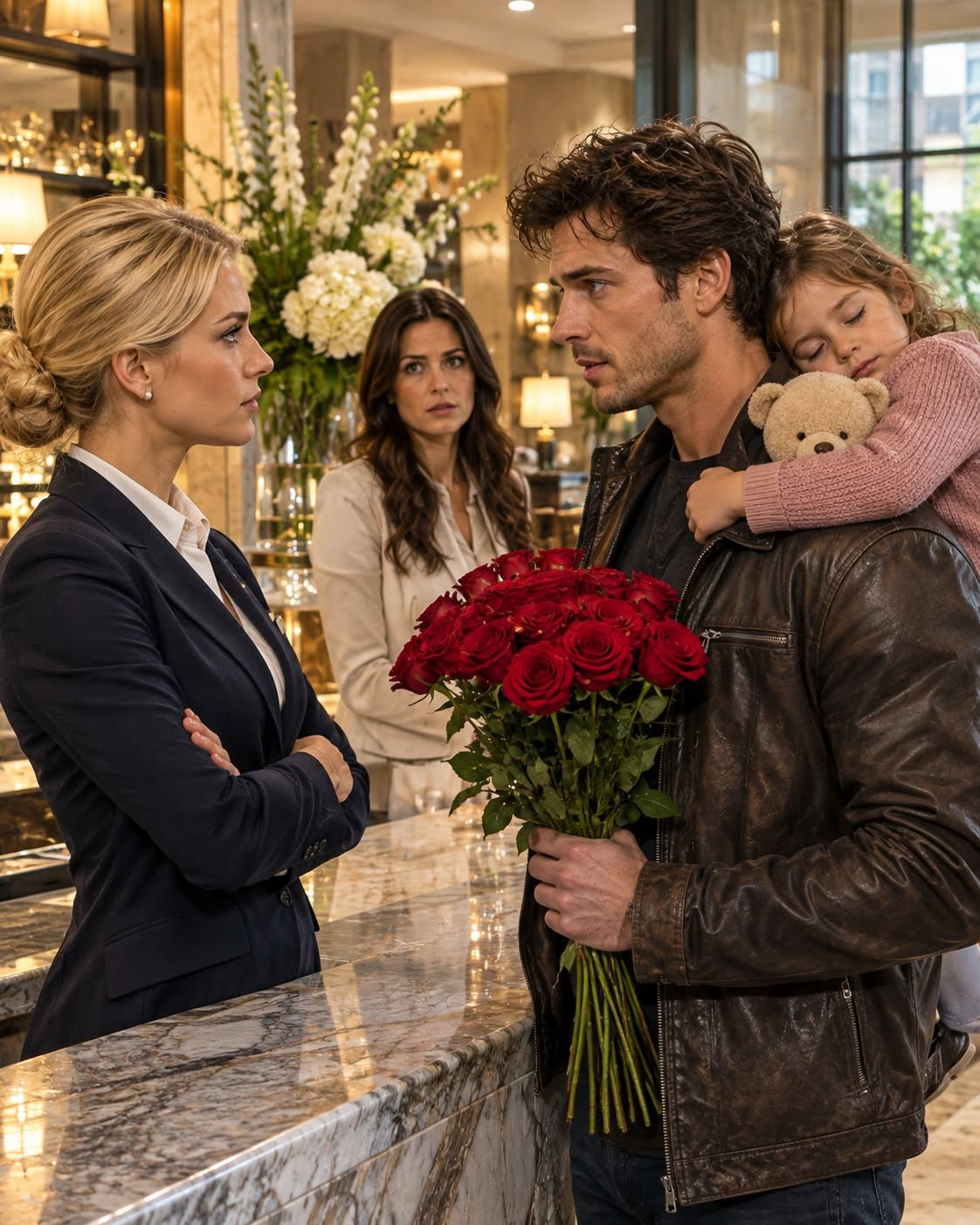
I was standing in the lobby of my own family’s luxury hotel, holding a bouquet of red roses and carrying my sleeping daughter, when the manager told me we had to leave.
“Mommy told us this was where Daddy would remember how to smile again.”
I froze.
For a moment, I couldn’t speak. My little girl was looking at me with those big, innocent eyes, waiting for an answer that I wasn’t sure I had the strength to give.
I knelt beside her and gently brushed a strand of hair away from her forehead.
“Yes, sweetheart,” I whispered. “This is the place Mommy wanted us to visit. And I think she wanted us to discover something here.”
“What is it, Daddy?”
I looked at the roses resting beside the window.
“Hope,” I answered. “She wanted us to remember that even when someone we love is no longer beside us, the love they gave us never really leaves.”
My daughter nodded as if she understood every word.
Then she reached into her little backpack and pulled out a folded envelope.
“Mommy said I should give you this when we got here.”
My heart skipped.
I recognized the handwriting immediately.
It was my wife’s.
And suddenly, the beautiful penthouse suite felt like the only place in the world where time had stopped.
I took the envelope with trembling fingers.
On the front, in her familiar handwriting, were five simple words:
“For the day you come home.”
I sat down on the edge of the bed.
My daughter climbed beside me, resting her little hand on my arm.
“Can we read it together, Daddy?”
I nodded.
But before I opened it, I need to tell you something about my family and this hotel, because what happened next would change far more than just one evening.
My grandfather, Arthur Bennett, had built the Bennett Grand Hotel nearly fifty years earlier.
It stood on a hill overlooking the ocean, with tall glass windows, marble floors, and gardens that seemed to stretch forever.
But when he first opened it, the hotel had been nothing like the luxury destination it was today.
It had been a modest building with twenty rooms, a small restaurant, and a handful of employees who knew every guest by name.
My grandfather believed a hotel wasn’t truly successful because of its expensive furniture or impressive architecture.
It was successful because of how people felt when they walked through its doors.
He used to tell me, “A person should never have to prove they deserve kindness, son. Especially when they’re tired, frightened, or carrying a heavy heart.”
I grew up hearing those words.
Unfortunately, after he died, the family business became something different.
My father took control of the hotel group and expanded it into a chain of luxury properties.
The business grew, but the family grew apart.
My father and I eventually disagreed about almost everything.
He believed success meant protecting the family name and increasing the value of the company.
I believed the hotel had forgotten the very people who made it successful.
Our arguments became so bitter that I eventually walked away.
I didn’t want to spend my life fighting over money, titles, and boardroom decisions.
I moved to another state, started a small construction business, and built a quiet life with my wife, Emily.
We had our daughter, Lily, three years later.
For the first time in my life, I understood what happiness really looked like.
It wasn’t a penthouse suite.
It wasn’t a family fortune.
It was Emily laughing in the kitchen while Lily tried to steal chocolate chips from a mixing bowl.
It was Saturday mornings, bedtime stories, and holding my wife’s hand while we watched the sunset.
Then Emily became ill.
The doctors tried everything, but the disease progressed faster than anyone expected.
During her final weeks, she spent a lot of time talking about the places she wanted Lily to see.
There was one place she mentioned more than any other.
The Bennett Grand.
She had visited it with me shortly after we married.
She remembered the gardens, the ocean view, and the little fountain near the entrance.
But most importantly, she remembered my grandfather.
He had welcomed her like a member of the family, even though she had never come from a wealthy background.
One afternoon, while we were sitting beside her hospital bed, Emily took my hand.
“Promise me you’ll take Lily there someday.”
I tried to smile.
“Of course. We’ll go together when you get better.”
She shook her head gently.
“Daniel, listen to me.”
Her voice was weak, but her eyes were clear.
“Don’t let our daughter grow up believing that losing someone means losing all the beautiful things they left behind.”
I couldn’t answer.
She continued.
“Take her to the hotel. Show her the roses in the penthouse. Tell her about your grandfather. And promise me you’ll let yourself be happy again.”
I lowered my head and kissed her hand.
“I promise.”
Two weeks later, Emily passed away.
And for a long time, I couldn’t bring myself to fulfill that promise.
Every time I looked at the hotel website, I closed it.
Every time I thought about booking the trip, I remembered that Emily wouldn’t be there to see it.
But eventually, I realized something.
I was keeping Lily away from a place that meant so much to her mother because I was afraid of feeling the pain myself.
So I booked the penthouse, packed our bags, bought twelve red roses, and drove for hours.
And now I was sitting in the very room Emily had asked us to visit.
I unfolded the letter.
“My dearest Daniel,
If you’re reading this, then you’ve finally brought our little girl to the Bennett Grand.
I hope the drive wasn’t too exhausting, and I hope Lily has enjoyed looking out the windows along the way.
There are a few things I want you to know.
First, I am proud of you.
Not because of your family name, your business, or anything you have accomplished.
I’m proud of the man you became when life gave you every reason to become bitter.
You chose kindness.
You chose to be a good father.
And you chose to love me even when loving me meant watching me slowly slip away.
I know you’ve been afraid of the future.
I know you sometimes wonder how you’re going to raise Lily without me.
But she doesn’t need a perfect father.
She needs the father who makes funny pancakes, sings the wrong words to lullabies, and lets her stay up five minutes longer to finish a story.
Please don’t spend the rest of your life mourning the fact that I won’t be there.
Instead, let Lily grow up surrounded by stories about the woman I was, not just the illness that took me away.
And Daniel, there’s something else.
Your grandfather once told me that he had left something in the hotel for you.
He said you would understand its purpose when you returned.
Ask Rodrigo.
He knows where to find it.
I hope you discover what he wanted you to see.
I love you both.
Always,
Emily.”
I read the letter twice.
Then I pressed it against my chest.
My daughter wrapped her arms around me.
“Mommy loves us, doesn’t she?”
I kissed the top of her head.
“More than anything in the world.”
That evening, I found Rodrigo waiting outside the suite.
He was holding a small silver key attached to a faded leather tag.
“Mr. Bennett,” he said, “I believe it’s time you saw something.”
I followed him down a private staircase to an older section of the hotel.
The walls here were different.
The modern decorations disappeared, replaced by framed photographs, wooden panels, and paintings from the hotel’s earliest days.
At the end of the hallway stood a narrow door.
Rodrigo inserted the key.
Inside was a small office.
It smelled of old books, polished wood, and something faintly familiar.
My grandfather’s cologne.
I stood completely still.
His desk was still there.
His old leather chair sat beside the window, and a photograph of my grandmother rested on a shelf.
On the desk was a wooden box with my name engraved on it.
“Your grandfather asked me to keep this safe,” Rodrigo explained.
“He told me that one day you would come back. He said not to give it to anyone else.”
I ran my fingers across the engraving.
“How long have you had this?”
“Almost twelve years.”
“Twelve years?”
Rodrigo nodded.
“He believed you would return when you were ready.”
I opened the box.
Inside were several documents, an old photograph, and a handwritten journal.
The first document was a letter from my grandfather.
“Daniel,
If you have found this box, then you have finally returned to the place where our family began.
I know you left because you were disappointed in what this business had become.
I cannot blame you.
In my later years, I watched the hotel slowly become a monument to wealth instead of a home for travelers.
I tried to change things, but I was no longer strong enough to fight every battle.
So I made a decision.
I placed a portion of my shares in a trust, to be transferred to you when you returned and agreed to take responsibility for the values on which this hotel was built.
The hotel was never meant to be a kingdom.
It was meant to be a place where people could find comfort when the world had become difficult.
If you choose to accept this responsibility, remember that you are not inheriting a building.
You are inheriting the trust of thousands of people who have walked through its doors.”
I stared at the papers.
The next document was even more surprising.
My grandfather had left me controlling voting rights in a family trust, along with the authority to appoint a new board chair.
I had never known.
“Why didn’t my father tell me?” I asked.
Rodrigo hesitated.
“Your father knew about the trust. He disagreed with your grandfather’s decision.”
I looked up.
“Did he try to change it?”
Rodrigo lowered his eyes.
“He tried. But the documents were legally protected.”
Before I could ask another question, the office door opened.
A man stood there.
My father.
He looked older than I remembered.
His hair had turned almost completely gray, and the confident expression he once wore had disappeared.
“Daniel,” he said.
I hadn’t seen him in nearly six years.
For several seconds, neither of us moved.
Then he looked at the documents in my hands.
“So you’ve found it.”
I stood up.
“You knew?”
He nodded.
“Your grandfather told me what he intended to do.”
“And you never thought to tell me?”
My father walked toward the desk.
“I thought you would never come back.”
“That wasn’t your decision to make.”
“No,” he admitted quietly. “It wasn’t.”
There was something in his voice that I had never heard before.
Regret.
He glanced toward the hallway, where Lily was sitting with a housekeeper, drawing pictures.
“Is that your daughter?”
“Yes. Her name is Lily.”
“She looks like Emily.”
My father’s expression softened.
“I heard about what happened. I wanted to call, but I didn’t know whether you would answer.”
I felt anger rise inside me.
“You didn’t know whether I would answer, so you did nothing?”
He looked down.
“I was ashamed.”
That answer caught me off guard.
My father had always been a man who believed apologies were signs of weakness.
Seeing him admit shame was almost more unsettling than hearing him defend himself.
He pulled out a chair.
“Can we talk?”
I didn’t sit down.
“About what?”
“About the hotel. And about what happened tonight.”
I folded my grandfather’s letter.
“What happened tonight is exactly why this place needs to change.”
My father nodded.
“The manager has already been suspended pending an investigation.”
“Why?”
“Because she treated a guest without basic respect.”
I looked at him.
“Was that the only reason?”
He paused.
“No.”
He walked to the window.
“The hotel’s occupancy numbers are excellent. Our revenue is growing. But over the past three years, employee turnover has increased, guest complaints have doubled, and several long-serving employees have resigned.”
I remembered Rodrigo’s face when he recognized me.
“Why?”
My father sighed.
“Because we became obsessed with appearances. We hired people who looked impressive on paper and promoted those who brought in the highest numbers. We stopped listening to the people who actually worked here.”
For a moment, neither of us spoke.
Then he said something I never expected.
“Your grandfather would have hated what I did.”
I looked at him.
“He wouldn’t have hated you. He would have wanted you to fix it.”
My father slowly nodded.
“Perhaps that’s why he chose you.”
I didn’t answer.
Because I was beginning to understand that inheriting the hotel wasn’t going to be a simple matter of signing papers and taking a title.
It meant confronting everything that had gone wrong.
And I wasn’t sure I wanted that responsibility.
The following morning, I went downstairs with Lily.
She was wearing a yellow dress Emily had bought before she became ill.
As we entered the restaurant, Rodrigo approached with two cups of hot chocolate.
“Good morning, Princess,” he said to Lily.
She giggled.
“I’m not a princess.”
Rodrigo smiled.
“Then perhaps you’re the queen of breakfast.”
Lily considered that seriously before nodding.
“I like that.”
We sat near the window.
I noticed several employees watching us.
Some smiled.
Others seemed nervous.
Then a young housekeeper approached our table.
“Mr. Bennett?”
“Yes?”
She looked around before speaking.
“May I tell you something?”
“Of course.”
“My name is Sofia. I’ve worked here for four years.”
She glanced at Lily, then lowered her voice.
“I was the one who checked your reservation yesterday.”
I remembered the receptionist.
“You were working at the front desk?”
She nodded.
“I was covering the evening shift. The manager told me not to process your reservation because she thought you were using someone else’s booking.”
I frowned.
“But why?”
“She said the hotel had received complaints about people trying to enter the penthouse without authorization. She told me to stop anyone who didn’t look like the kind of guest we normally served.”
I felt my stomach tighten.
“Did you see my reservation?”
“Yes, sir. It was right there.”
“Then why didn’t you say anything?”
Her eyes filled with tears.
“Because I was afraid of losing my job.”
I looked at her for a long moment.
She wasn’t the same receptionist who had apologized the night before.
She was someone who had been trapped in a workplace where fear had become normal.
“What’s your position now?” I asked.
“Housekeeping. I was moved here three months ago.”
“Why?”
She hesitated.
“Because I questioned a charge the manager added to a guest’s bill. The guest was an elderly woman traveling alone. She couldn’t afford it, and I thought it was unfair.”
I leaned back.
“Did anyone investigate?”
“No, sir.”
I glanced at Rodrigo.
He wasn’t surprised.
And that was perhaps the most disturbing part.
The problem wasn’t one manager.
It was a culture that had taught decent people to stay silent.
I finished breakfast and asked my father to arrange a meeting with every department head.
He looked surprised.
“Today?”
“Today.”
“What are you planning to do?”
“Listen.”
By noon, the hotel’s main conference room was filled with employees.
Housekeepers, receptionists, maintenance workers, cooks, security guards, and department managers sat together.
Some looked uncomfortable.
Others seemed suspicious.
I stood at the front of the room.
“My name is Daniel Bennett. Some of you know me. Some of you don’t. I haven’t worked here in years, and I’m not going to pretend I understand everything that happens inside this building.”
I paused.
“But yesterday, I was treated like someone who didn’t belong here. And what concerns me most is that I suspect this wasn’t an isolated incident.”
I looked around the room.
“I want to hear the truth. Not the version prepared for investors. Not the version written in a monthly report. The truth.”
At first, nobody spoke.
Then an older maintenance worker raised his hand.
He had worked at the hotel for twenty-seven years.
“Sir, we used to have a staff meal every evening,” he said. “Your grandfather insisted on it. He said nobody should serve a guest while going hungry themselves.”
A woman from housekeeping nodded.
“That stopped five years ago.”
Another employee spoke.
“Overtime payments have been delayed.”
Someone else mentioned unfair scheduling.
Then a receptionist explained that employees were often instructed to ignore guests who didn’t appear wealthy enough.
The room slowly filled with stories.
Some were small.
Some were heartbreaking.
One employee had been forced to work while recovering from an injury because she feared being replaced.
A young waiter had been publicly humiliated for accidentally spilling water on a wealthy guest.
A security guard had been instructed to remove a homeless veteran who had only entered the lobby to escape a storm.
Every story pointed toward the same problem.
The hotel had forgotten that dignity was not a luxury reserved for paying guests.
When the meeting ended, I asked everyone to write down what they believed needed to change.
Then I made an announcement.
“No employee will be punished for speaking honestly today. And anyone who has been treated unfairly will have the opportunity to have their situation reviewed.”
For the first time that morning, people began to smile.
But the biggest surprise was waiting in my grandfather’s journal.
That evening, after Lily had fallen asleep, I returned to his office.
I opened the journal and turned through the handwritten pages.
Near the back, I found a note dated six months before his death.
“Today, I met a young woman named Emily. Daniel brought her to dinner.
She has a kind heart.
She spoke to the kitchen staff by their first names and thanked the gardener for the flowers outside the restaurant.
I hope my grandson understands how fortunate he is.
If he ever becomes lost, he should remember that the right person can remind him who he truly is.”
I smiled through my tears.
My grandfather had loved Emily.
He had recognized something in her that I sometimes forgot to recognize in myself.
But there was another envelope tucked inside the journal.
It was addressed to my father.
I hesitated before opening it.
Then I read.
“My son,
I know we have disagreed about the future of this hotel.
I know you believe I have been unfair to you.
Perhaps I have.
But I need you to understand something.
A business can survive losing money.
It can survive losing customers.
What it cannot survive forever is losing its soul.
You have spent your life trying to prove that you are capable of protecting what I built.
I wish you had spent more time understanding why I built it.
Your son may one day return.
If he does, do not see him as your competitor.
See him as an opportunity to repair what we broke.
And if you cannot bring yourself to say you’re sorry, then at least let your actions speak for you.”
I folded the letter carefully.
My father was standing in the doorway.
He had apparently come looking for me.
I handed him the envelope.
He read it in silence.
When he finished, his shoulders dropped.
“I thought I was making the hotel stronger,” he whispered.
“You were trying to make it bigger.”
He nodded.
“And I confused the two.”
He looked at the photograph of my grandfather.
“I never told you this, Daniel, but when you left, I felt as if I had failed him. You were the one person he believed would carry on his values. I thought if I could make the company successful enough, he would eventually be proud of me.”
I looked at my father.
“He was already proud of you.”
My father shook his head.
“I wish I had understood that earlier.”
Then he looked toward the hallway.
“Can I see Lily tomorrow?”
I considered the question.
She barely knew him.
I didn’t want to force a relationship just because we shared a family name.
“Let her decide,” I said. “Start by getting to know her.”
He nodded.
“I can do that.”
The next morning, something unexpected happened.
The woman who had been dismissed as service manager returned to the hotel.
Her name was Margaret Collins.
She had worked there for eleven years.
She asked to speak with me privately.
I agreed.
She sat across from me in my grandfather’s office, holding a folder tightly in her hands.
“I know I was wrong,” she began.
I said nothing.
“I judged you by your clothes. I assumed you couldn’t afford the room. I treated you as if you were an inconvenience.”
She opened the folder.
“I also want you to know that I didn’t act alone.”
Inside were copies of internal instructions, guest complaints, and several reports documenting discriminatory treatment.
She explained that senior management had pressured her to keep the lobby looking exclusive.
Employees had been told to redirect certain guests to other properties, even when rooms were available.
She had followed those instructions because she wanted to protect her position.
“I thought I was doing what the company expected,” she said.
I studied her face.
“Did you ever consider what it was doing to the people you turned away?”
She lowered her eyes.
“No.”
“Then why bring me these documents?”
She took a shaky breath.
“Because yesterday, when I saw your daughter sleeping on your shoulder, I remembered my own father.”
She explained that her father had once been a construction worker.
He had saved for years to take her on a special vacation.
One evening, they had entered a beautiful restaurant, only to be told they weren’t dressed appropriately.
He had smiled, apologized, and taken her somewhere else.
For years, Margaret had remembered the embarrassment.
“I promised myself I’d never make anyone feel that way,” she said. “And somehow, I became the person who did.”
I looked at the documents again.
“I can’t simply give you your old position back.”
“I understand.”
“But I can make sure your information is investigated fairly. If you’re willing to cooperate, the board will hear your testimony.”
She nodded.
“Thank you.”
As she stood to leave, I stopped her.
“Margaret.”
She turned.
“An apology matters. But what you do after it matters more.”
“I know, sir.”
And for the first time since I had arrived, I believed her.
Over the next several weeks, the hotel underwent a thorough review.
The investigation revealed that the problem had been much deeper than anyone expected.
The former service manager had not been acting alone.
Several senior employees had been involved in policies that rewarded appearance over fairness.
Some were removed.
Others were required to undergo retraining and accept new accountability standards.
A few resigned before the investigation was completed.
But I also made sure the hotel didn’t become a place where people were afraid of making mistakes.
We created a confidential reporting system.
We introduced fair scheduling and paid overtime.
We restored staff meals.
We established clear guest-service standards that applied to everyone, regardless of appearance or wealth.
And we created a small emergency fund to help guests facing unexpected difficulties.
My father agreed to step down as chief executive and remain as an adviser during the transition.
He wasn’t happy about giving up control.
But for the first time, he seemed more interested in repairing relationships than defending his authority.
As for Rodrigo, I offered him a position as director of guest experience.
He laughed when I told him.
“Sir, I’m a bellman. I don’t know anything about being a director.”
I smiled.
“That’s exactly why I think you’d be good at it.”
He looked at me for a long moment.
Then his eyes became wet.
“Your grandfather once told me that one day this hotel would need someone who remembered what it was supposed to be.”
He shook my hand.
“I suppose that day has arrived.”
Three months later, the Bennett Grand reopened its original garden entrance.
We removed the velvet ropes that had made the lobby feel like a private club.
We restored the old fountain.
We brought back the wooden welcome desk my grandfather had designed.
And above it, we placed a simple inscription:
“Everyone arrives carrying a story. Make room for them.”
The hotel also introduced a tradition called the Rose Welcome.
Every Sunday evening, twelve red roses were placed beside the penthouse window.
Not for wealthy guests.
Not for celebrities.
They were offered to families who had experienced a difficult loss and needed a place to spend time together.
The first family who received them was a mother and her two young sons.
Their father had passed away unexpectedly.
They had traveled from several states away because he had once promised to take them to the ocean.
When the mother saw the roses, she began to cry.
I didn’t know what to say.
So I simply sat beside her and listened.
Sometimes, that is the greatest kindness we can offer.
On the first Sunday after the hotel’s reopening, my father came to visit Lily.
He brought a small wooden music box.
It had belonged to my grandmother.
Lily opened it carefully.
A soft melody began to play.
“What’s the song?” she asked.
My father smiled.
“Your great-grandmother used to sing it to your daddy when he was little.”
Lily looked at me.
“Daddy, did you have a mommy too?”
I laughed softly.
“Yes, sweetheart. And she loved me very much.”
My father watched us from across the room.
For the first time in years, I saw him smile without looking worried about anything.
Later that afternoon, he asked whether he could take Lily to the garden.
I agreed.
From the penthouse window, I watched them walk beside the fountain.
My father held her hand carefully, as if he were afraid of breaking something precious.
Lily pointed at the flowers.
He bent down to listen.
And I realized that my grandfather’s greatest inheritance had never been the hotel.
It was the possibility of bringing a family back together.
That evening, Lily and I stood beside the roses.
She held one flower in her little hand.
“Daddy?”
“Yes, sweetheart?”
“Do you think Mommy can see us?”
I looked toward the sunset.
“I don’t know exactly how it works, sweetheart. But I know she would be happy to see you smiling.”
Lily thought about that.
Then she placed the rose beside the others.
“I’m going to tell Mommy everything when I see her again someday.”
I hugged her.
“That’s a wonderful idea.”
She looked up at me.
“Are we going to stay here forever?”
I smiled.
“No, sweetheart. We have a home waiting for us. But this place will always be special.”
“Because it’s where Mommy came?”
“Because it’s where Mommy reminded us that love doesn’t disappear.”
She wrapped her arms around my waist.
Then she whispered something that made me close my eyes.
“I think Mommy would like the hotel now.”
I kissed her forehead.
“I think so too.”
A year passed.
The Bennett Grand became known for something very different from the reputation it had once built.
Guests began sharing stories about employees who had helped them during difficult moments.
A young couple wrote about how the staff had quietly arranged a small anniversary dinner after learning that they had lost their home in a fire.
An elderly man wrote about how Rodrigo had remembered his name after a five-year absence.
A single mother wrote about a receptionist who had helped her find affordable transportation when her car broke down.
The hotel still had luxurious rooms, beautiful restaurants, and breathtaking ocean views.
But now, it also had something more important.
People felt welcome.
One Sunday evening, I was walking through the lobby when I noticed a little boy standing near the entrance.
He was holding his mother’s hand.
His clothes were wrinkled, and his shoes were covered in dust.
His mother approached the front desk nervously.
“I’m sorry,” she said. “We may have made a mistake with our booking. My husband was supposed to meet us here, but he hasn’t arrived. We don’t have much money, and I don’t want to cause any trouble.”
The receptionist smiled warmly.
“There’s no trouble at all, ma’am. Let’s see what we can do.”
The boy looked around the lobby.
Then he noticed the fountain.
“Mom, can we look at it?”
His mother hesitated.
“Not right now, sweetheart.”
I walked toward them.
“Actually,” I said, “I think the fountain is waiting for someone to make a wish.”
The boy looked up at me.
“Can I?”
“Of course.”
His mother looked embarrassed.
“I apologize. We really don’t want to take up your time.”
I shook my head.
“Please don’t apologize for being here.”
I asked the receptionist to help arrange a comfortable room while we sorted out their booking.
Then I took the boy to the fountain.
He closed his eyes and tossed a small coin into the water.
“What did you wish for?” I asked.
He smiled.
“That my daddy comes home soon.”
I felt something tighten in my chest.
I remembered the night I had stood in the lobby carrying Lily, holding roses, and wondering whether anyone would help us.
I crouched beside him.
“I hope your wish comes true.”
When I returned to the desk, I saw Rodrigo watching from a distance.
He gave me a small nod.
No words were needed.
That night, I went upstairs to the penthouse.
Lily was already asleep.
On the table beside the window sat a photograph of Emily, smiling in the garden.
I placed twelve fresh red roses beside it.
Then I opened the old letter again.
There was one sentence I had never fully understood until that moment.
“Please don’t spend the rest of your life mourning the fact that I won’t be there.”
I had spent months believing that moving forward meant leaving Emily behind.
Now I understood that it meant carrying her love into everything I did.
I couldn’t bring her back.
I couldn’t give Lily the childhood we had once imagined.
But I could make sure our daughter grew up knowing that kindness was not weakness, that people deserved respect regardless of what they wore, and that a person’s worth could never be measured by the size of their bank account.
I could also make sure that every person who entered our hotel was treated as someone whose story mattered.
The next morning, I found a small drawing on my desk.
Lily had drawn three people standing beside a building.
One was a little girl.
One was a tall man holding flowers.
The third was a woman wearing a yellow dress.
Above them, she had written in uneven letters:
“OUR FAMILY IS STILL TOGETHER.”
I sat there for a long time, looking at the picture.
Then I placed it inside my grandfather’s wooden box, beside his letter and Emily’s final message.
Years earlier, I had thought returning to the Bennett Grand would be about reclaiming something my family had lost.
I was wrong.
It was about discovering what we should never have lost in the first place.
And every time I walked through the lobby, I remembered the lesson my grandfather had tried to teach me:
A luxury hotel can offer the finest sheets, the most expensive meals, and the most breathtaking views.
But none of those things can make a person feel truly welcome.
That comes from the way we treat someone when we have absolutely nothing to gain from them.
Because the man wearing an old leather jacket might be the owner.
The woman carrying a tired child might be having the hardest day of her life.
And the person standing quietly at your front desk might be carrying a story you know nothing about.
Never judge someone by what they wear, what they own, or how much money you think they have.
You may never know what they’ve survived to reach your door.
And sometimes, the smallest act of kindness can become the reason someone believes in people again.
As for the twelve red roses, they still sit beside the penthouse window every Sunday.
Not because the man who owns the hotel wants to remember his wealth.
But because a little girl once made her father promise to bring her somewhere special.
And because her mother taught them both that love is not measured by how long someone stays.
It is measured by what they leave behind in the hearts of the people who remain.