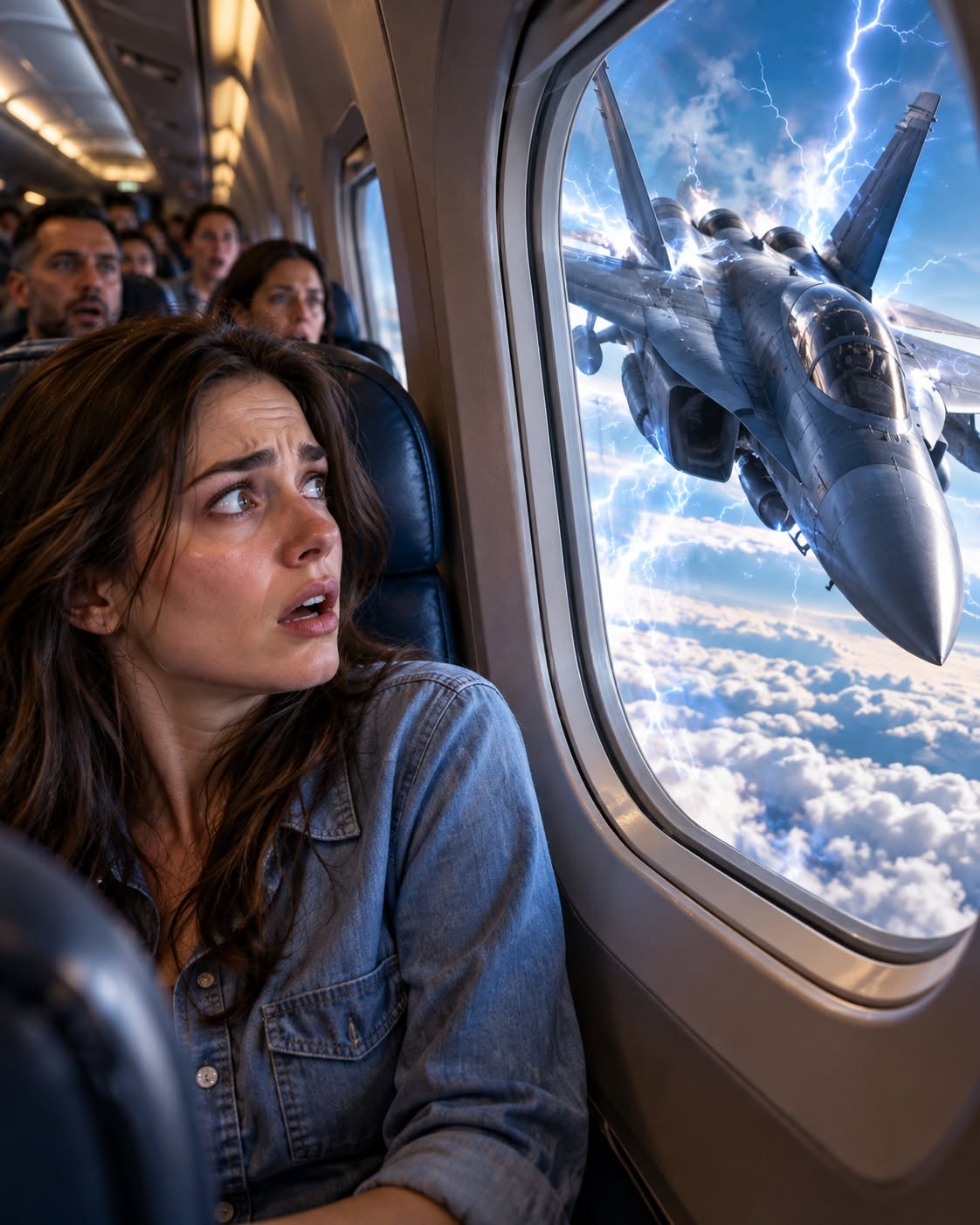
I was sitting quietly in seat 12C when the captain announced that an unidentified aircraft was approaching our Boeing 777
The first knock came before I had finished my coffee.
I was sitting in a small interview room at Denver International Airport, staring at a paper cup that had gone cold, when two federal agents entered. The taller one carried a black folder. The other kept glancing at me as though he were trying to reconcile the woman in front of him with someone described in a classified report.
“Major Vance,” the taller agent said, “we need to talk about what happened aboard Flight 447.”
I looked at him over the rim of my cup.
“I assumed that was why you were here.”
“My name is Agent Thomas Reed. This is Agent Melissa Grant. We work with a joint federal task force investigating the attempted hijacking.”
“Attempted hijacking?” I asked. “An armed fighter threatened a civilian aircraft and launched a missile at it. You can call it whatever you want, but that sounds a little more serious.”
Reed didn’t smile.
“We agree. That’s why we’re here.”
He opened the folder and placed a photograph on the table.
It showed the unmarked F-16 banking away from Flight 447, its silhouette captured by a camera aboard one of the American interceptors.
“Do you recognize the aircraft?”
“The type, yes. The markings, no.”
“What about the pilot?”
I studied the image carefully.
“No clear view of the canopy. I can’t identify someone from this photograph.”
Reed nodded, as if that answer had been expected.
“Three years ago, you were involved in an operation that resulted in the disappearance of several classified intelligence files. Shortly afterward, you resigned from active duty and withdrew from public life. Now, on a commercial flight, you identify a foreign nuclear scientist and recognize the tactics of an unidentified fighter.”
He leaned forward.
“Do you understand why that raises questions?”
I looked at the photograph again.
“I understand why you’re asking. But if you want to know whether I planned any of this, the answer is no.”
“Then perhaps you can explain why you recognized the attack pattern so quickly.”
For a moment, I considered telling him everything.
Then I remembered the promise I had made to myself three years earlier: I would never again let the institution that had taken everything from me decide what my life was worth.
“I recognized the behavior,” I said. “Not the pilot. The fighter was trying to isolate the airliner, force it away from monitored airspace, and create an opportunity to recover one specific passenger. Once I saw Dr. Morozov’s name, the threat made sense.”
“Why did you leave the military, Major?”
There it was.
The question I had spent three years avoiding.
I put the coffee down.
“Because I learned that sometimes the people you’re ordered to trust are the people you need to question.”
Neither agent spoke.
Outside the interview room, airport announcements drifted through the corridor. Families reunited near the baggage claim. Travelers hurried toward connecting flights. Somewhere beyond the walls, Flight 447 was being examined by investigators, its passengers still trying to understand how an ordinary afternoon had turned into a fight for survival.
I looked back at Reed.
“If you want to know what happened three years ago, I’ll tell you. But not in a room where half the information is classified and the other half has already been decided before I speak.”
For the first time, he seemed genuinely interested.
“What are you asking for?”
“Access to the evidence. And Dr. Morozov’s account of why someone was willing to kill 284 people to get him.”
Reed closed the folder.
“I’ll see what I can arrange.”
He stood, but before he reached the door, his phone vibrated.
He read the message.
Then his expression changed.
“Major, I need you to stay here.”
“What happened?”
He hesitated.
“The convoy transporting Dr. Morozov has been diverted. One of the escort vehicles has lost contact with the others.”
I rose so quickly that my chair scraped against the floor.
“Where?”
“That’s what we’re trying to determine.”
I looked at the photograph on the table, then at the closed door.
The fighter had abandoned Flight 447, but the people behind the attack had not necessarily abandoned their objective.
And if they had already reached the ground operation, we might have been looking at the beginning of something far more dangerous.
“Agent Reed,” I said, “you need to find that convoy before they disappear.”
He was already reaching for his phone.
“Stay here, Major.”
I watched him leave.
For three years, I had believed that my past was something I could lock away. Now it was unfolding around me, one unanswered question at a time.
I had saved the passengers on Flight 447.
But I was beginning to suspect that the real mission had only just started.
The Missing Convoy
Twenty minutes later, Agent Grant returned with a map displayed on a tablet.
The convoy had been transporting Morozov to a secure federal facility outside Denver when its lead vehicle reported a possible mechanical problem. The escort had pulled off the main highway, and communications had become intermittent.
Then the tracking signal vanished.
“Could be a communications failure,” Grant said. “Could be a deliberate diversion. We don’t know yet.”
“Were the route details restricted?”
“Of course.”
“Who had access?”
She gave me a sharp look.
“That’s precisely what we’re investigating.”
I studied the map. The last recorded position lay near an industrial access road, several miles from the intended route. The surrounding area contained warehouses, rail sidings, and a network of service roads that could conceal a vehicle from ordinary traffic.
“Was the convoy carrying any independent tracking equipment?”
“Yes.”
“Then why do you have only one last known position?”
Grant paused.
“Both systems stopped reporting within seconds of each other.”
That was not proof of an attack, but it was enough to make my stomach tighten.
“Agent Grant, I need you to consider the possibility that someone knew the route before the convoy left the airport.”
“We are considering it.”
“Then stop treating the flight and the convoy as separate incidents.”
She studied me for a long moment.
“You think the fighter was a distraction?”
“I think it was one part of a coordinated operation. They tried to force the aircraft carrying Morozov into isolated airspace. When that failed, the ground team may have become their next option.”
Grant looked down at the map.
“That’s a serious allegation.”
“It’s a serious situation.”
Before she could answer, Reed entered the room again.
“We found one of the escort vehicles.”
“Where?”
“Abandoned near a warehouse complex. No sign of Morozov or the remaining agents.”
“Casualties?”
“One agent is injured but alive. He’s been taken to a hospital.”
I closed my eyes for a second.
“Then there’s still time.”
Reed frowned.
“Time for what?”
“To find Morozov before whoever took him realizes the first plan failed.”
He looked at Grant.
She nodded slowly.
“We’ve requested additional personnel. The area is being secured.”
I pointed to the map.
“There’s a rail corridor here. If they wanted to move someone quickly without attracting attention, it gives them several options. Check the access roads and the loading areas. Don’t send anyone into an unsecured location without backup.”
Reed’s eyes narrowed.
“You seem remarkably comfortable giving instructions to federal agents.”
“I spent years planning operations under pressure. You asked me to explain what happened. I’m explaining.”
For a moment, the room was silent.
Then Reed turned to Grant.
“Pass the location to the field team. Tell them to check the rail corridor and adjacent properties.”
He looked back at me.
“You’re not going out there.”
“I didn’t ask to.”
“Good. Because if this turns into a criminal investigation, your role is as a witness.”
I almost smiled.
“Then let’s hope your witnesses get there before the people holding the doctor.”
He left again.
I sat down, but my mind continued moving through possibilities.
There was something about the timing that bothered me. The fighter’s arrival, the demand for Morozov, the communications failure, and the missing convoy all pointed toward a plan that had been designed with multiple contingencies.
Someone had expected resistance.
Someone had prepared for failure.
And someone had known enough about American security procedures to exploit the gaps between them.
My phone vibrated.
An unknown number.
The message contained only a few words.
You should have stayed invisible, Major.
I read it twice.
Then I handed the phone to Agent Grant, who had returned to collect the map.
Her face lost its color.
“Where did this come from?”
“I don’t know.”
“Don’t touch anything else on the device.”
She called Reed immediately and arranged for the message to be preserved as evidence.
I stared at the screen.
Whoever had sent it knew my name, my former rank, and enough about my life to understand what disappearing had meant to me.
The threat was not simply about Morozov anymore.
It was about me.
The File That Never Existed
By evening, the federal investigation had expanded to include counterintelligence specialists and military representatives. The airport was still operating, but Flight 447 remained under examination. Passengers had been contacted for statements, and the surviving evidence from the interception was being collected.
I was moved to a secure office in a federal building near the airport.
Reed returned carrying a sealed document pouch.
“We found something in Morozov’s belongings.”
Inside was a small data-storage device, recovered from a concealed compartment in his carry-on luggage. It had been encrypted, and the initial examination had revealed only fragments of information.
But one file name was visible.
NORTHSTAR—ARCHIVE 17.
My hands went cold.
I had seen that name before.
Three years earlier, I had been assigned to a classified intelligence unit investigating the movement of sensitive weapons technology through a network of intermediaries. The operation was called Northstar. Its purpose was to identify the people supplying technical information to a foreign weapons program and determine whether any of that information had been stolen from American facilities.
I had been the intelligence officer responsible for reviewing intercepted communications.
During the investigation, I discovered that several reports had been altered before reaching senior command. Dates had been changed. Sources had been misidentified. Evidence pointing toward a suspected insider had disappeared from the official record.
I reported the discrepancies.
Within forty-eight hours, my access was suspended.
The following week, I was informed that the investigation had been closed because the evidence was unreliable.
I was ordered to sign a statement acknowledging that the discrepancies had resulted from an administrative error.
I refused.
Soon afterward, the unit’s leadership changed, and I was quietly reassigned. I requested a formal review, but the process stalled. The more questions I asked, the more I was treated as a problem rather than an officer trying to protect the integrity of an investigation.
Eventually, I resigned.
I did not leave because I had lost faith in the people who served beside me. I left because I could no longer trust the system to distinguish between a mistake and a deliberate lie.
Now Northstar had returned.
“Where did you get this?” I asked.
“Morozov had it when he boarded Flight 447,” Reed said. “Our analysts believe the archive contains information connected to an illicit technology-transfer network.”
“Does it contain the original reports?”
“We don’t know yet.”
“Then you need to preserve every copy and every access log. If someone altered the original intelligence, the metadata might tell you who handled it.”
Reed studied me.
“You think this connects to what happened three years ago.”
“I think it’s a reason to find out.”
He set the pouch on the table.
“Morozov requested to speak with you once he was recovered.”
“Recovered?”
Reed’s jaw tightened.
“The convoy team found him.”
“Alive?”
“Yes. He was being held in a maintenance building near the rail corridor. The response team reached him before his captors could move him again. Two suspects were arrested. The others escaped.”
Relief washed through me, but it was followed by another question.
“Did he say who ordered the operation?”
“Not yet. He’s being examined by medical staff and interviewed by the counterintelligence team.”
“Then I want to speak to him as soon as possible.”
Reed hesitated.
“Major, this isn’t your investigation.”
“No. But I may understand part of the evidence.”
He watched me for a moment before nodding.
“I’ll make the request.”
When he left, I sat alone with the name Northstar burning in my mind.
Three years ago, I had believed that walking away would protect me from the damage caused by the investigation.
Now I wondered whether my departure had given the people responsible exactly what they wanted.
The Scientist’s Warning
I met Dr. Nikolai Morozov the following morning.
He looked older than he had aboard the aircraft. His face was pale, and a bruise darkened one side of his jaw. Despite his exhaustion, his eyes were alert.
“You saved my life twice,” he said as I entered the interview room.
“I helped the captain get everyone down safely. The rescue team found you.”
“You recognized my name before I explained anything. That was not luck.”
I sat opposite him.
“Tell me about Northstar.”
He glanced at the agents observing through the glass.
“I can tell you what I know, but not everything belongs in this room.”
Reed, seated beside me, nodded.
“We’ll coordinate with the appropriate security officials.”
Morozov turned back to me.
“Three years ago, I was part of a scientific group examining the security implications of a weapons research program. I discovered that technical documents were being passed through an intermediary network. Some concerned nuclear material management. Others described methods for concealing illicit transfers from routine inspections.”
“Who was receiving them?”
“We identified several companies, but the people directing the network were protected by layers of intermediaries. The evidence suggested that someone inside a Western intelligence organization had been altering reports to keep investigators away from the real recipients.”
My pulse quickened.
“Did you identify the insider?”
“Not conclusively. But I found a link between the altered reports and a private security contractor that had been involved in Northstar.”
Reed leaned forward.
“Which contractor?”
Morozov gave him a name.
The room seemed to grow smaller.
Three years earlier, that same company had provided technical support to my unit. Its analysts had been responsible for managing several of the systems through which intelligence reports were processed.
I had raised concerns about its access.
My concerns had disappeared into the review process.
“Why didn’t you provide this information when you first defected?” I asked.
“I did. But I did not have the original archive. I had only portions of the records and the identities of several intermediaries. I was told the information would be investigated.”
“And was it?”
Morozov looked at me.
“I do not believe it was.”
Reed’s expression hardened.
“Why did the attackers target Flight 447?”
“Because I had finally recovered the original records. I was taking them to an American team that had agreed to examine the evidence independently.”
“Who knew you were traveling?”
“Only a small number of officials. My security arrangements were supposed to be compartmentalized.”
“Someone compromised them,” I said.
Morozov nodded.
“The fighter was intended to force the aircraft away from its planned route. If the plane had landed at a different location, the people waiting there could have taken me before American authorities secured the airport.”
“And when that failed,” Reed said, “they targeted the convoy.”
Morozov looked down at his hands.
“They were afraid of what the archive would reveal.”
I thought of the anonymous message.
You should have stayed invisible, Major.
“There’s another question,” I said. “Why contact me?”
Morozov hesitated.
“Because your name appeared in the archive.”
The words landed harder than I expected.
“What?”
“Not as a suspect. As the officer who identified the original discrepancies. Your reports were included in a series of internal communications discussing how to neutralize the investigation.”
For a moment, I could not speak.
Three years of silence. Three years of wondering whether I had made a mistake by refusing to sign that statement. Three years of telling myself that leaving was the only way to reclaim my life.
Now there was evidence that my work had mattered.
And evidence that someone had deliberately tried to erase it.
“Do you know who wrote those communications?” I asked.
“Not yet. But one name appears repeatedly in the approval chain.”
He slid a piece of paper across the table.
I read it.
Then I read it again.
General Adrian Mercer.
He had been the senior officer who oversaw the final review of Northstar. He had also been the person who told me, three years ago, that the discrepancies were an administrative issue and that I should stop pursuing them.
I had respected him.
I had trusted him.
And he had been the last person to speak to me before my resignation became inevitable.
Reed took the paper and placed it inside an evidence sleeve.
“We’ll verify this through the archive,” he said.
Morozov looked at me.
“Major, I am sorry. I did not know what happened to you.”
I shook my head slowly.
“You don’t need to apologize for telling the truth.”
But inside, something that had remained unresolved for three years had finally shifted.
The past had not returned because I had failed to escape it.
It had returned because the truth had never been allowed to finish its journey.
The Man Behind the Silence
By noon, the archive had been transferred to a secure analytical team. Investigators confirmed that several documents contained original timestamps inconsistent with the official Northstar report. Some had been modified after review. Others had been removed from the final record entirely.
The evidence was serious, but it was not yet enough to prove who had authorized the changes.
Then the task force received a new lead.
One of the arrested suspects had agreed to cooperate.
He was a former contractor who had worked with the company named by Morozov. During questioning, he admitted that he had helped arrange the interception of Flight 447 and the attempted seizure of the scientist.
He claimed that the operation had been authorized by people who believed the archive would expose their role in the illicit network.
He also provided an encrypted communication containing a reference to General Mercer.
The task force moved quickly.
Mercer was located at a private conference facility outside Washington, where he had been attending a closed security meeting. He was not arrested immediately. Investigators first needed to establish whether the communications were authentic and whether he had direct knowledge of the operation.
I was asked to review selected records because of my familiarity with the original Northstar investigation.
I accepted, but only under formal oversight and with the appropriate security clearances.
For the first time in three years, I returned to a classified work environment.
The walls were familiar. The security procedures were familiar. The quiet concentration of analysts examining evidence was familiar.
But I was not the same officer who had walked away.
I no longer believed that rank automatically deserved trust.
I believed that evidence did.
Over several hours, we compared the original reports with the altered versions. The discrepancies formed a pattern. Each change redirected attention away from the contractor’s activities. Each missing attachment weakened the case against the intermediary network. Each approval had passed through a small group of senior officials.
And each time my original concerns had been raised, the record showed that someone had intervened to close the matter.
One of the analysts looked up from her screen.
“Major, we found a message attached to the final review.”
She turned the monitor toward me.
The message had been written shortly after my request for an independent investigation.
It read: Vance is persistent. Remove her from the process before she creates a record that cannot be contained.
I stared at the sentence.
There was no dramatic revelation, no confession, no sudden explanation for every decision that had followed. Just a line of text that made the past painfully clear.
I had not been removed because my work was worthless.
I had been removed because it was dangerous to someone.
The analyst watched me carefully.
“Are you all right?”
I took a breath.
“Yes.”
It was not entirely true, but it was true enough to continue.
That evening, Agent Reed called me into a separate room.
“We have enough to bring Mercer in for questioning,” he said. “The evidence also links the contractor’s network to the people who organized the attack on Flight 447.”
“Will you be able to establish who ordered the fighter to fire?”
“We have communications that suggest the order came through an intermediary. We’re working to authenticate them.”
“And Mercer?”
“We believe he authorized the broader effort to recover the archive. Whether he personally approved the attack is still under investigation.”
I nodded.
“Then don’t let the evidence become a convenient story. Follow it wherever it leads.”
Reed gave me a tired smile.
“You sound like someone who’s said that before.”
“I have.”
He became serious again.
“There is one more thing. Mercer has requested to speak with you.”
I looked at him.
“Why?”
“He says he wants to explain what happened three years ago.”
For a moment, I considered refusing.
I had spent years imagining what I might say if I ever saw him again. In those imagined conversations, I had been furious, eloquent, and certain of every word.
Now that the moment had arrived, I felt none of those things.
I felt tired.
But I also knew that if I walked away without hearing him, the unanswered questions might follow me for the rest of my life.
“Arrange the meeting,” I said.
The Final Conversation
General Mercer entered the interview room without his uniform.
He wore a dark suit and carried himself with the same controlled confidence I remembered. His hair had turned almost entirely gray, but his expression was unchanged.
For several seconds, we simply looked at each other.
Then he sat down.
“You look well, Hannah.”
I did not answer the familiarity in his voice.
“You asked to speak with me.”
He nodded.
“I did.”
“Then explain why my reports were altered.”
He looked at the table.
“The investigation was becoming complicated. There were sensitive relationships involved, sources we could not expose, and risks that extended beyond the scope of the original inquiry.”
“So you changed the evidence?”
“I authorized changes to the reporting process.”
“That isn’t an answer.”
His jaw tightened.
“I believed I was protecting a larger operation.”
“By destroying the credibility of the people who discovered the problem?”
He said nothing.
I leaned forward.
“You told me the discrepancies were administrative errors. You told me I should sign a statement accepting that explanation. When I refused, you allowed my career to collapse.”
“I didn’t want you to leave the service.”
“Then you should have told the truth.”
For the first time, his composure faltered.
“You don’t understand the pressures involved at that level.”
“Perhaps not. But I understood the reports I was reading. I understood that evidence had been changed. And I understood that someone was trying to make an investigation disappear.”
Mercer looked older suddenly.
“The situation became more difficult than I anticipated. The contractor had relationships with people who believed its work was essential to national security. I convinced myself that keeping the network intact was safer than exposing it.”
“And now?”
He looked up.
“Now I see that I was wrong.”
The words did not satisfy me.
They did not repair the years I had spent questioning myself. They did not erase the attack on Flight 447 or return the trust I had once placed in him.
But they were the first honest words I had heard from him.
“Did you authorize the attack?” I asked.
“No,” he said immediately. “I authorized an effort to recover the archive. I did not authorize the use of an armed aircraft against a civilian flight.”
“Did you know that was a possibility?”
He hesitated.
That hesitation was enough to tell me how much remained unresolved.
“I knew there were people willing to take extreme measures,” he admitted. “I did not know the operation had progressed to that point.”
“Then you built a system in which people could act in your name while you avoided asking what they were actually doing.”
He closed his eyes briefly.
“I suppose I did.”
The room fell silent.
I had wanted him to offer a single explanation that would make the past understandable. Instead, I found a man who had made one compromise, then another, until he could no longer distinguish protecting his institution from protecting himself.
“Do you know what the worst part was?” I asked.
He looked at me.
“It wasn’t losing my position. It wasn’t leaving the service. It was spending three years wondering whether I had been wrong to trust my own judgment.”
Mercer lowered his gaze.
“I am sorry.”
I believed he regretted what had happened.
I did not know whether he fully understood it.
“Your apology is yours to give,” I said. “What happens next belongs to the investigation.”
I stood.
As I reached the door, he spoke again.
“Hannah, you were one of the best officers I ever worked with.”
I turned back.
“Then you should have listened when I told you something was wrong.”
I left him sitting alone.
For the first time since my resignation, I did not feel the need to prove that I had been right.
The evidence was doing that for me.
The Choice to Return
The investigation continued for months.
The contractor’s senior executives were questioned, several officials were suspended, and the network responsible for the illicit transfers began to unravel. Investigators traced the operation that targeted Flight 447 through intermediaries, falsified records, and communications designed to conceal who had given the orders.
Not every question was answered. Some participants remained unidentified, and the full extent of the conspiracy would take years to establish.
But the evidence was no longer disappearing.
Dr. Morozov entered a protected witness program and began working with investigators to explain the technical records he had preserved. The surviving passengers from Flight 447 were gradually released from the uncertainty that had followed them home.
I received calls from some of them.
Clara, the flight attendant, sent me a handwritten note.
I used to think courage meant never being frightened. Now I think it means doing what needs to be done while you’re frightened anyway. Thank you for reminding me.
Captain Miller called a week later.
He told me that the airline had reviewed its emergency procedures and that he and David had been asked to help train crews on how to respond when unexpected security threats developed during a flight.
“David keeps saying he wants to buy you dinner,” James said. “He thinks he owes you one.”
“He doesn’t owe me anything.”
“Try telling him that.”
I laughed.
It felt strange to laugh without immediately wondering what I was supposed to do next.
For three years, I had believed that peace meant keeping the world at a distance. I had built a life around ordinary routines and anonymous places, convinced that if I stopped looking backward, the past would eventually stop following me.
But the attack had taught me something I had not expected.
I did not have to return to the life I had left behind to accept what it had taught me.
I could choose what came next.
I could help investigators understand the evidence without becoming a soldier again. I could teach younger analysts how to recognize manipulated records and protect the integrity of their work. I could speak about leadership, accountability, and the danger of confusing obedience with judgment.
Most importantly, I could stop treating my past as a wound I had to hide.
One afternoon, Reed met me outside the federal building.
“The task force would like you to consider a position as a civilian intelligence adviser,” he said. “You’d work with analysts on evidence review and operational risk assessment. No uniform, no flight schedule, and no requirement to return to active duty.”
I looked at him.
“Is this an official offer?”
“It’s an invitation to discuss one.”
“And if I say no?”
“Then you say no.”
I studied his face, searching for the hidden condition I had once expected to find in every official request.
There was none that I could see.
“I’ll think about it,” I said.
He nodded.
“That’s all we’re asking.”
That evening, I walked through a park near my apartment and watched the sun settle behind the buildings. People passed carrying groceries, walking dogs, and talking about ordinary problems. Somewhere nearby, a child was learning to ride a bicycle while a parent ran alongside, ready to catch him if he fell.
The world was full of quiet moments that rarely appeared in reports.
I wanted to protect those moments.
Not because I believed I could prevent every tragedy, but because I understood how much they mattered.
The next morning, I called Reed.
“I’ll meet with the team.”
He sounded pleased.
“Good. I’ll send the details.”
“But I have one condition.”
“What’s that?”
“I want the work to include training people to challenge bad information, even when it comes from someone with a higher rank.”
There was a pause.
Then Reed said, “I think we can arrange that.”
I ended the call and stood by the window.
For the first time in three years, the future did not feel like a place I had to escape.
It felt like somewhere I could choose to go.
Seat 12C
Six months after Flight 447, I returned to Denver International Airport.
I was not there for an investigation or an interview. I was there to take another commercial flight, this time to Washington, where I would begin my new role as a civilian adviser.
I arrived early, passed through security, and found a quiet seat near the windows.
Aircraft moved across the distant runways. Their engines rose and faded beneath the airport announcements.
I watched one Boeing 777 turn toward the taxiway.
For a moment, I remembered the cabin tilting, the captain’s strained voice, and the missile streaking past the wing. I remembered the faces of the passengers who had trusted the crew to bring them home.
Then I remembered what happened afterward: the investigation, the recovered archive, and the evidence that finally gave a name to the doubts I had carried for years.
My phone vibrated.
A message from Clara appeared on the screen.
Hope your next flight is wonderfully boring.
I smiled and typed back.
That’s the plan.
When boarding began, I joined the line with everyone else. No one recognized me. No one asked about my service record. No one knew that a few months earlier, I had stood in a cockpit while an armed fighter threatened an airliner carrying 284 people.
I found my seat, fastened my belt, and looked out the window.
The engines started.
The aircraft began to move.
And I realized that I was no longer afraid of the sky.
I was not eager for danger. I did not miss the pressure of combat or the terrible clarity of moments when one decision could determine whether someone lived or died.
What I had missed, without understanding it, was the sense that my experience could still be useful.
For years, I had confused leaving the military with leaving behind everything I had learned. I had thought that if I wanted peace, I had to become someone who had never been a pilot, never been an intelligence officer, and never carried the responsibility of other people’s lives.
Flight 447 had shown me otherwise.
The past did not have to dictate my future, but neither did I have to erase it.
I could keep the lessons without carrying every wound. I could acknowledge what had happened without allowing it to decide who I became. And I could serve people in ways that did not require me to return to the cockpit of a fighter.
As the aircraft lifted from the runway, Denver spread beneath us in a patchwork of roads, buildings, and sunlit fields.
I watched until the city disappeared behind the clouds.
Then I closed my eyes.
For the first time in years, I felt no need to disappear.
I had learned that courage was not always charging toward danger, and it was not always walking away from it. Sometimes courage meant speaking when silence would be easier. Sometimes it meant admitting that an institution you loved had failed you. Sometimes it meant allowing yourself to begin again without pretending the past had never happened.
And sometimes, it meant sitting quietly in seat 12C, surrounded by strangers, knowing that you had finally made peace with the person you used to be.
I was Hannah Vance.
I had once been a fighter pilot. I had been a military intelligence officer. I had been betrayed, dismissed, and forced to rebuild a life I had never planned to live.
But none of those things was the whole of me.
I was also a woman who had chosen to act when 284 people needed help. A woman who had learned that loyalty without honesty could become complicity, and that authority without accountability could endanger the very people it claimed to protect.
I could not change the three years I had spent in silence.
I could not undo the fear aboard Flight 447 or guarantee that every person responsible for the conspiracy would face justice.
But I could decide what those experiences meant.
And I could use them to help ensure that the next person who noticed something wrong would not be told to look away.
Outside the window, sunlight spread across the clouds, turning their edges gold.
I rested my head against the seat and allowed myself to breathe.
The world would always contain people willing to misuse power, conceal the truth, or sacrifice innocent lives to protect their own interests. There would always be moments when the safest choice seemed to be silence.
But silence was not the same as peace.
And disappearing was not the same as healing.
I had spent three years trying to become invisible because I believed that was the only way to reclaim my life. In the end, I discovered that I did not need to become invisible to be free.
I only needed to stop letting someone else’s decisions define my worth.
The aircraft continued toward Washington, carrying me into a future that was uncertain but finally my own.
For once, I was not waiting for the past to catch up with me.
I was ready to meet whatever came next.