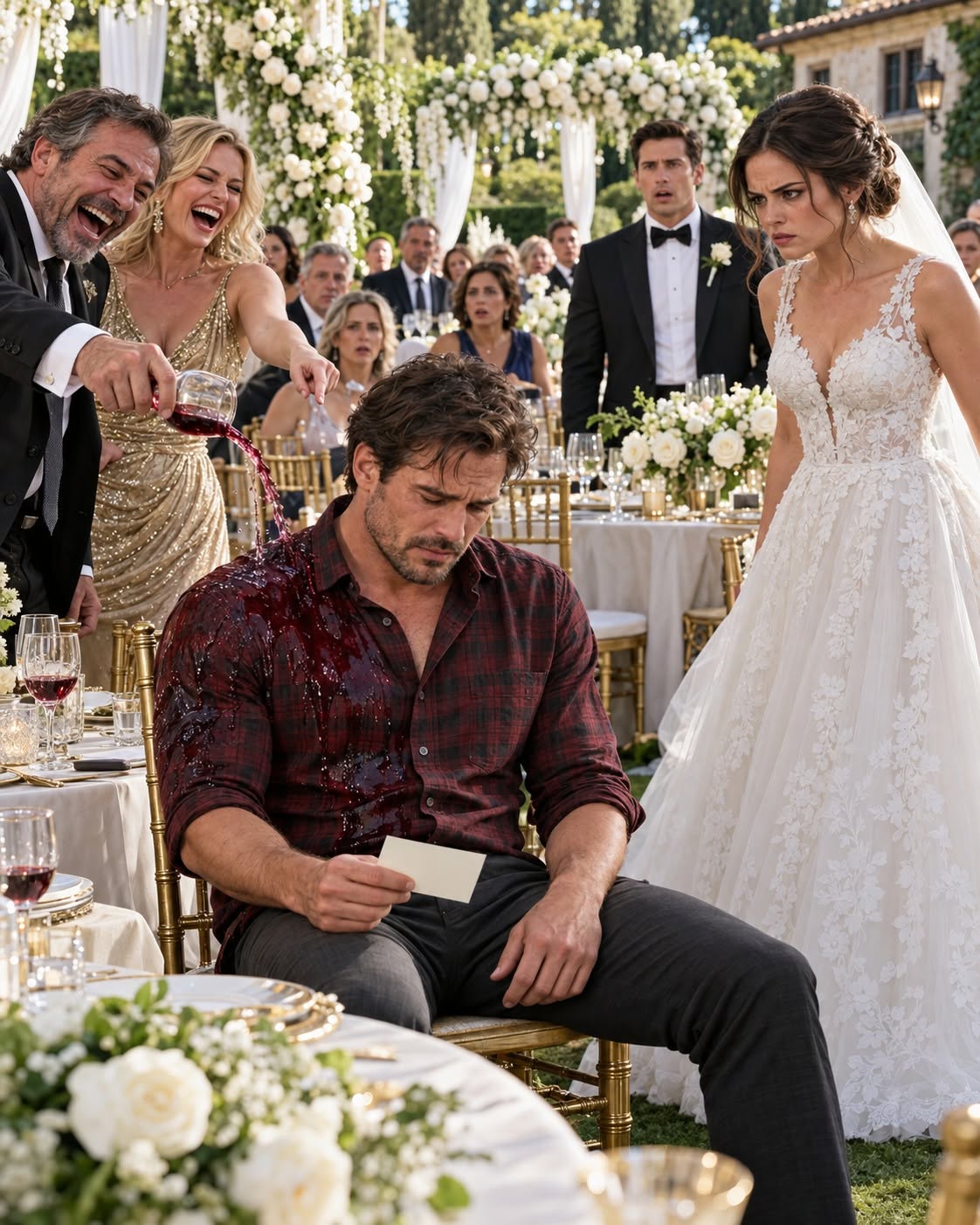
I was on my knees, picking up shattered champagne glass with my bare hands while a billionaire’s groom laughed at me.
The rest of the story
For the next three days, I tried to convince myself that the wedding was behind me.
I returned to my usual routine at Kensington Global, organizing contracts, updating records, and answering requests from departments that rarely remembered my name. My fingers were healing, although the cuts still stung whenever I handled paper.
But something about the company had changed.
People who had barely acknowledged me before suddenly stopped by my desk. Some asked whether I was feeling better. Others wanted to know what had really happened at the wedding.
A few simply stared at me as if I had become someone important overnight.
I hated that part.
I hadn’t become a different person. I was still Daniel, the single father who worried about prescription costs and whether his daughter’s inhaler had enough medication to last until payday.
On Wednesday morning, I found a message from Human Resources waiting in my inbox.
Mandatory meeting. Executive conference room. 9:00 a.m.
My stomach tightened.
For a moment, I wondered whether Preston had somehow managed to cause trouble even after being escorted out of the wedding.
I walked into the conference room carrying a notebook and sat near the end of the table.
Audrey Kensington was already there.
She wore a dark navy suit, her hair tied back, and a serious expression. Beside her sat the company’s chief financial officer, the head of Human Resources, and two attorneys.
“Good morning, Daniel,” she said.
“Good morning, Ms. Kensington.”
She gestured toward an empty chair.
“Please sit. We need your help.”
I looked around the room.
“My help?”
Audrey nodded.
“Something happened at that wedding that I should have recognized long before you were forced to experience it.”
She opened a folder.
“Preston Reed wasn’t simply dishonest about his personal finances. He had been using his relationship with me to gain access to confidential information about Kensington Global.”
I felt a chill run down my back.
“What kind of information?”
“Financial projections, acquisition plans, private investor communications, and documents related to our upcoming public offering.”
The CFO leaned forward.
“We discovered unusual access requests over the past several months. Some came through departments Preston had no legitimate reason to contact.”
Audrey continued.
“At first, we thought it was a security issue. Then we found evidence that someone had been sharing information with an outside investment group.”
I remembered the wedding.
Preston’s expensive watch. His tailored tuxedo. The way he had looked at me as if my entire existence were beneath him.
“Was he doing this himself?” I asked.
“We believe he was working with several people,” Audrey replied. “And there’s something else.”
She turned another page.
“Three weeks before the wedding, someone requested access to archived corporate agreements from 2019 through 2022. The request was unusual because those records had already been digitized.”
I looked down at the folder.
“What agreements?”
“Acquisition agreements. Several of them involve companies that Preston’s investment partners have recently approached.”
My mind immediately went to the archive department.
I had processed hundreds of those documents.
“Do you know who approved the request?” I asked.
The CFO exchanged a glance with Audrey.
“Your supervisor, Martin.”
I stopped breathing for a second.
Martin had been my supervisor for almost four years. He was the man who approved my vacation requests, assigned my workload, and occasionally reminded me that employees should be grateful for stable positions.
I had never thought of him as dishonest.
“Are you sure?”
“We’re investigating,” Audrey said. “But we need someone who understands how the archive system works.”
I looked at the folder again.
“Why me?”
“Because you know those records better than anyone in this building. And because I believe you will tell us what you find, even if the answer is uncomfortable.”
I hesitated.
I wasn’t an investigator. I wasn’t a lawyer. I was an archivist trying to make sure his daughter had affordable medical care.
But I also remembered the champagne glass breaking against the marble floor.
I remembered everyone watching.
And I remembered how easily Preston had assumed that nobody would defend me.
“All right,” I said. “I’ll help.”
Audrey gave a small nod.
“Thank you. And Daniel, this investigation will not put your job or your benefits at risk. I want that understood from the beginning.”
For the first time, I believed her.
That afternoon, I returned to the archive department and began reviewing the access logs.
The first few hours revealed nothing unusual.
Then I found something.
A request had been submitted under Martin’s credentials at 11:47 p.m. on a Saturday. It involved a collection of acquisition contracts stored in a restricted archive.
The request had been approved using a temporary administrator account.
I checked the access history.
The documents had been downloaded to an external device.
But the most disturbing detail was the name attached to the device.
P. Reed Consulting.
I stared at the screen.
Preston hadn’t simply been interested in our business. He had been taking confidential information directly from the company.
I printed the access report and took it to Audrey’s office.
She read it in silence.
“Can you establish whether anything else was accessed?”
“Not without reviewing the backup logs. But I think there may be more.”
She closed the folder.
“Then keep going.”
For the next week, I worked alongside the company’s internal security team.
We uncovered a pattern that became increasingly difficult to ignore.
Several employees had been asked to retrieve documents outside their normal responsibilities. Some had received unusually generous gifts. Others had been told that Preston was helping Audrey prepare for the IPO.
And one person had been paid to delete records after each transfer.
That person was Martin.
I discovered the final piece of evidence on a Thursday afternoon.
It was an old memorandum from a corporate acquisition that had never been completed. The document contained a handwritten note explaining why the transaction had been abandoned.
The note was important because it revealed that a company Preston’s partners were trying to acquire had serious undisclosed liabilities.
Someone had deliberately removed that memorandum from the digital index.
But the original paper copy was still there.
I found it inside a box marked for routine disposal.
My hands went cold.
If that document had disappeared, Kensington Global could have made a disastrous investment decision based on incomplete information.
I took photographs, recorded the document’s location, and immediately notified the legal department.
An hour later, Audrey called me into her office.
She was standing beside the window, looking out over the city.
“Daniel, we’ve found something significant.”
I handed her the memorandum.
She read it carefully.
Then she looked up.
“This is the document we’ve been missing.”
I nodded.
“It was almost destroyed.”
“Do you know who placed it in the disposal box?”
I shook my head.
“Not yet.”
Audrey walked back to her desk.
“Martin has been suspended. Our attorneys are preparing to contact the authorities.”
I thought that would be the end of it.
I was wrong.
The following morning, I received a call from my daughter’s school.
Maddie was having difficulty breathing.
They had used her emergency inhaler, but she was still struggling.
I left the office without waiting for permission and drove straight to the school.
By the time I arrived, an ambulance had already been called.
My little girl was sitting in the nurse’s office, frightened and pale, with one hand clutching her favorite stuffed rabbit.
“Daddy!”
I rushed over and held her hand.
“I’m here, sweetheart. You’re okay. I’ve got you.”
The paramedics took her to the hospital.
The doctors treated her asthma attack and monitored her breathing for several hours.
Thankfully, she responded well to treatment.
But as I sat beside her hospital bed that evening, I felt the weight of everything pressing down on me.
The wedding. The investigation. The company. The fear that one unexpected expense could undo months of careful planning.
Maddie opened her eyes.
“Daddy?”
“Yes, princess?”
“Are you sad?”
I forced a smile.
“No. I’m just tired.”
She looked at my bandaged fingers.
“Did the mean man hurt you?”
I swallowed.
“A little. But I’m okay.”
She thought about that for a moment.
“Did you tell him to stop?”
I looked at her.
“No, sweetheart. I didn’t.”
“Why not?”
I brushed a strand of hair away from her forehead.
“Because sometimes grown-ups get scared too.”
She considered that answer.
Then she reached for my hand.
“You can be brave next time.”
I turned away so she wouldn’t see my eyes filling with tears.
Children have a way of asking questions that adults spend years avoiding.
The next Monday, Audrey personally called the hospital to check on Maddie.
She also arranged for Human Resources to explain the company’s medical benefits and make sure I understood every option available to me.
I thanked her, but she seemed uncomfortable.
“You shouldn’t have to thank me for making sure an employee can take care of his child,” she said.
Then she paused.
“Daniel, I need to ask you something. Would you consider joining a new team we’re creating?”
I wasn’t sure what she meant.
“We’re establishing an independent corporate records and compliance office. It will report directly to the audit committee rather than to individual department supervisors.”
She slid a document across the desk.
“We need someone who understands how information moves through this company. Someone who knows that a missing document can be more dangerous than a thousand suspicious transactions.”
I looked at the proposed job description.
The position was called Senior Records Integrity Specialist.
It came with better pay, greater responsibility, and the same health benefits.
I read it twice.
“Why are you offering this to me?”
“Because you found evidence that several highly paid executives overlooked. Because you protected the company without knowing whether anyone would protect you.”
I was silent for a moment.
“I don’t have a background in corporate investigations.”
“Neither did I when I started making decisions that affected thousands of employees,” she replied. “You can learn the technical side. Integrity is harder to teach.”
I accepted the position.
But the investigation was far from over.
Two weeks later, the company’s attorneys discovered that Preston had been working with a private investment firm called Northbridge Capital.
The firm had been using confidential Kensington information to position itself ahead of the IPO.
Preston had promised his partners that, after marrying Audrey, he would have influence over major financial decisions.
In return, they had helped him cover mounting debts and maintain the appearance of wealth.
The marriage wasn’t just about love or status.
It was supposed to be the final piece of a financial scheme.
Worse, Martin had helped Preston obtain confidential information in exchange for a promised executive position at a company Northbridge planned to establish.
The police began investigating the financial misconduct, and several employees were interviewed.
Then came the day I never expected.
I was summoned to a special meeting of the board’s audit committee.
I entered the room carrying the original memorandum and a detailed timeline of the missing records.
Around the table sat people whose names appeared on buildings, charitable foundations, and financial magazines.
Audrey sat at the far end.
“Daniel,” she said, “please walk everyone through what you found.”
I connected my laptop to the screen.
My presentation began with a simple timeline.
I explained when the records had been requested, which accounts had accessed them, where the files had been transferred, and how the original memorandum had nearly been destroyed.
One board member interrupted me.
“Are you suggesting that a senior manager deliberately compromised our IPO?”
“I’m not suggesting anything,” I answered. “I’m showing you the records.”
He looked irritated.
“These are technical details. Surely our legal department can interpret them.”
I felt my old instinct returning.
Keep quiet. Don’t challenge powerful people. Don’t risk your position.
Then I remembered Maddie in the hospital bed.
And the words she had spoken.
You can be brave next time.
I continued.
“The problem isn’t just that someone accessed confidential documents. The problem is that our system allowed one supervisor to request, approve, transfer, and conceal those records without independent review.”
I displayed the final page.
“If we don’t change that process, replacing one dishonest employee won’t solve anything.”
The room became silent.
Audrey leaned forward.
“He’s right.”
She turned to the board.
“This company has spent years discussing culture, accountability, and employee engagement. Yet one of our own employees was treated like disposable labor at my wedding because someone believed his position made him less worthy of respect.”
Nobody spoke.
Audrey continued.
“We cannot claim to value people while building systems that allow powerful individuals to abuse them.”
The audit committee approved an independent investigation, suspended several pending transactions, and delayed the IPO until the financial controls could be properly reviewed.
It cost the company millions.
Some investors complained.
A few board members argued that Audrey was being too cautious.
But she refused to change course.
For the first time in years, Kensington Global was willing to lose money rather than hide a problem.
Three months later, the investigation reached its conclusion.
Martin was dismissed and later faced legal proceedings related to his role in the information transfers.
Northbridge Capital became the subject of a broader financial investigation.
Preston was charged in connection with the fraudulent scheme and several related financial offenses.
The man who had once laughed while I knelt on a marble floor was now answering questions from investigators about transactions he could no longer explain away with an expensive watch or a charming smile.
I never saw him again.
And strangely, I didn’t feel the satisfaction I had imagined I might feel.
I didn’t want revenge.
I wanted him to understand that the people he considered insignificant had lives, responsibilities, and families of their own.
But perhaps some lessons can only be learned when the privilege that protected you disappears.
Six months after the wedding, Kensington Global held an employee town hall.
Audrey stood on the stage in the main auditorium.
She spoke about the investigation, the IPO delay, and the changes being made throughout the company.
Then she announced a new employee protection policy.
It included an independent reporting system, stronger controls over management decisions, transparent promotion procedures, and guaranteed protection against retaliation for employees who reported misconduct.
She also introduced a new emergency assistance fund for employees facing unexpected medical or family expenses.
The room applauded.
Then she did something that surprised me.
She invited me onto the stage.
I immediately shook my head.
I wasn’t comfortable being in front of hundreds of people.
But Audrey smiled.
“Daniel, I think they should hear from someone who understands why these changes matter.”
I walked onto the stage, my heart pounding.
She handed me the microphone.
I looked out at the audience.
There were executives in expensive suits, administrative assistants, security guards, cleaners, receptionists, and people from departments I had never even visited.
I thought about the wedding.
The broken glass.
The laughter.
The silence.
“I want to tell you something,” I began.
“That night, I was on my knees because I was afraid of losing my job. I was afraid of losing the health insurance that helped me take care of my daughter. I knew that if I spoke up, the consequences might affect someone who depended on me.”
The room was completely still.
“I don’t blame anyone for being afraid. Sometimes people stay silent because they have families to feed, bills to pay, and responsibilities that are bigger than their pride.”
I paused.
“But I hope we build a workplace where nobody has to choose between keeping their dignity and keeping their livelihood.”
A woman in the front row began applauding.
Then another person joined her.
Within seconds, the entire auditorium was on its feet.
I handed the microphone back to Audrey.
For the first time, I didn’t feel invisible.
But the greatest change didn’t happen at work.
It happened at home.
A few weeks later, Maddie and I were sitting at the kitchen table when she noticed a photograph on my phone.
It was from the employee town hall.
I was standing beside Audrey, holding a microphone.
“That’s you, Daddy!”
I laughed.
“Yes, that’s me.”
“Why are all those people clapping?”
I thought about how to explain it to a six-year-old.
“Because I told them something important.”
“What?”
I leaned closer.
“That everyone deserves to be treated nicely, even if they don’t have lots of money.”
Maddie nodded as if that were the most obvious thing in the world.
“Like me and my friends?”
“Exactly.”
She smiled and went back to coloring.
Then, after a moment, she asked:
“Daddy, are you still scared of the mean man?”
I looked at her.
“No, sweetheart.”
“Why?”
“Because I learned something.”
“What?”
I took her little hand in mine.
“Being brave doesn’t mean you’re never afraid. It means you don’t let fear decide what kind of person you become.”
She smiled.
“That’s good.”
And then she returned to her drawing.
A month later, Audrey invited me to her office for another conversation.
This time, there were no lawyers, no board members, and no folders filled with evidence.
Just two cups of coffee and a quiet afternoon.
She told me she had begun working with a counselor after the wedding.
“I spent so much time convincing myself that Preston was the person I wanted him to be,” she said. “I ignored things that didn’t fit the picture.”
I listened.
“Do you regret the wedding?” I asked.
She considered the question.
“I regret trusting the wrong person. But I don’t regret what happened afterward.”
She looked out the window.
“I thought becoming CEO meant making the biggest decisions in the room. Now I think it means making sure the people who aren’t in the room still matter.”
I nodded.
“That’s probably the hardest part.”
She smiled faintly.
“Yes. It is.”
Before I left, she handed me a small envelope.
Inside was an invitation to the company’s annual scholarship and community awards ceremony.
Kensington Global had established a scholarship program for children of employees who wanted to pursue education in science, technology, and the arts.
Maddie was too young to apply, but Audrey had written a personal note encouraging her to keep drawing and learning.
I thanked her.
Then I returned to my desk and placed the note inside my notebook.
Life slowly settled into something resembling normal.
My new position was demanding, but I enjoyed the work. I helped redesign the archive system, trained employees, and worked with compliance teams to make sure important records could never again disappear through a single person’s decision.
My salary increased enough that I no longer had to calculate every grocery purchase.
Maddie’s asthma treatment remained affordable, and we started putting a little money aside each month.
Nothing extravagant.
Just a savings account, a few extra groceries, and the occasional trip to the park without worrying about the cost of the bus ride home.
One Saturday, I took Maddie to a small restaurant for breakfast.
She ordered pancakes with strawberries and asked for extra syrup.
As I watched her laugh, I remembered the night I had knelt on the ballroom floor.
At the time, I thought my greatest fear was losing my job.
But I realized something else.
My greatest fear had been that the world would teach my daughter that people with less money deserved less respect.
I didn’t want her growing up believing that.
I wanted her to understand that kindness wasn’t something reserved for people who could afford to be generous.
It was a responsibility we all shared.
Several months after the wedding, I received a letter from an employee who worked in the company’s cleaning department.
She wrote that she had once been afraid to report a manager who regularly spoke to her disrespectfully.
After the new reporting system was introduced, she finally felt safe enough to speak up.
The complaint was investigated, and the manager was disciplined.
At the end of the letter, she wrote:
“I used to think nobody would care what happened to someone like me. Now I know I was wrong.”
I read those words several times.
Then I placed the letter in the new employee protection archive.
Not because it was legally important.
Because it mattered.
A year after that unforgettable wedding, Kensington Global finally completed its public offering.
The ceremony was held in a modest conference hall rather than an extravagant ballroom.
There were no enormous ice sculptures, no champagne fountains, and no expensive performances.
Audrey stood beside the company’s employees and thanked everyone who had helped rebuild trust.
Before the event ended, she approached me.
“Daniel, do you remember what you said at the town hall?”
I smiled.
“About nobody having to choose between dignity and a paycheck?”
She nodded.
“I think we’re getting closer.”
I looked around the room.
The cleaners were sitting beside the executives. Receptionists were talking with department directors. People who had once worked silently behind closed doors were now being recognized for their contributions.
It wasn’t a perfect company.
No company is.
But it was becoming a better one.
Audrey raised her glass.
“To everyone whose work happens behind the scenes,” she said. “You are not invisible. You never were.”
Everyone applauded.
I raised my glass too.
And for the first time, I understood that the most important thing that had happened at that wedding wasn’t that a billionaire’s fiancé had been exposed.
It wasn’t that a powerful man had been forced to clean up his own mess.
It wasn’t even that a company had avoided a financial disaster.
It was that one ordinary employee, a father who had been too afraid to speak, had helped expose a system that allowed people to believe they were untouchable.
I had spent years preserving documents because I believed the past mattered.
That night taught me something more important.
The way we treat people today becomes part of the history we leave behind.
And no amount of money, influence, or expensive clothing can make cruelty respectable.
As for Maddie, she still has asthma. She still needs her medication. And I still worry about her whenever she coughs in the middle of the night.
Life didn’t magically become perfect.
But we are safer now. More secure. And, most importantly, I no longer feel that I must accept humiliation simply to survive.
Sometimes I think about that broken champagne glass.
I remember the sound it made when it struck the marble floor.
I remember Preston laughing.
And I remember the moment Audrey walked down those stairs and asked why one of her employees was on his knees.
For a long time, I thought she had saved me that night.
And she had.
But eventually, I understood that the real change began when I stopped believing that my dignity depended on someone powerful deciding to defend it.
I deserved respect before Audrey ever noticed me.
I deserved it when I was organizing dusty contracts in a basement office.
I deserved it when I was struggling to pay for my daughter’s medication.
And I deserved it even when I was kneeling on that ballroom floor.
Because a person’s worth has never been measured by the size of their paycheck, the title on their business card, or the price of their clothes.
It is measured by something much harder to fake.
Character.
And if there’s one thing I hope Maddie remembers when she grows up, it’s this:
Never mistake someone’s silence for permission to mistreat them.
Sometimes the person you think is powerless is simply someone who has too much to lose.
And sometimes, when that person finally finds the courage to stand up, an entire room has to reconsider what it means to be powerful.
I went to that wedding believing I had to stay invisible to protect my daughter’s future. I left understanding that no child should have to grow up watching their parent surrender their dignity just to survive.
That was the greatest gift I could ever bring home to Maddie.