I was asleep in seat 8B when the flight attendant’s voice suddenly crackled over the intercom, sharp enough to wake half the cabin.
The questions began before the emergency vehicles had even cleared the runway.
Aviation officials, airport police, medical personnel, and airline representatives crowded around the aircraft. Everyone seemed to want an explanation, but I was still trying to understand how a routine flight had turned into something I would remember for the rest of my life.
A paramedic approached me.
“Sir, are you injured?”
I shook my head.
“I’m fine. How are the captain and first officer?”
He hesitated for a moment.
“They’re being treated. The captain has a serious head injury, but he’s alive. The first officer is stable. They’re taking both to the hospital.”
I closed my eyes.
Alive.
That single word meant more to me than anything else I had heard that night.
Then another voice called from behind me.
“Lieutenant Commander?”
I turned around.
A man in a dark suit was standing beside two airport officials. He introduced himself as Daniel Reeves, an investigator assigned to the incident.
“We need to ask you some questions about what happened in the cockpit.”
I nodded, although my legs suddenly felt heavier than they had during the entire flight.
“Of course.”
But before I could take another step, a little girl appeared beside him.
She couldn’t have been more than seven years old. Her dark hair was tangled, her cheeks were wet with tears, and she was holding a small stuffed rabbit against her chest.
“Are you the man who landed our airplane?”
I looked down at her.
“Yes, sweetheart. I was helping.”
She studied my face for a moment.
Then she stepped forward and wrapped her arms around my waist.
“My mommy said we were going to die.”
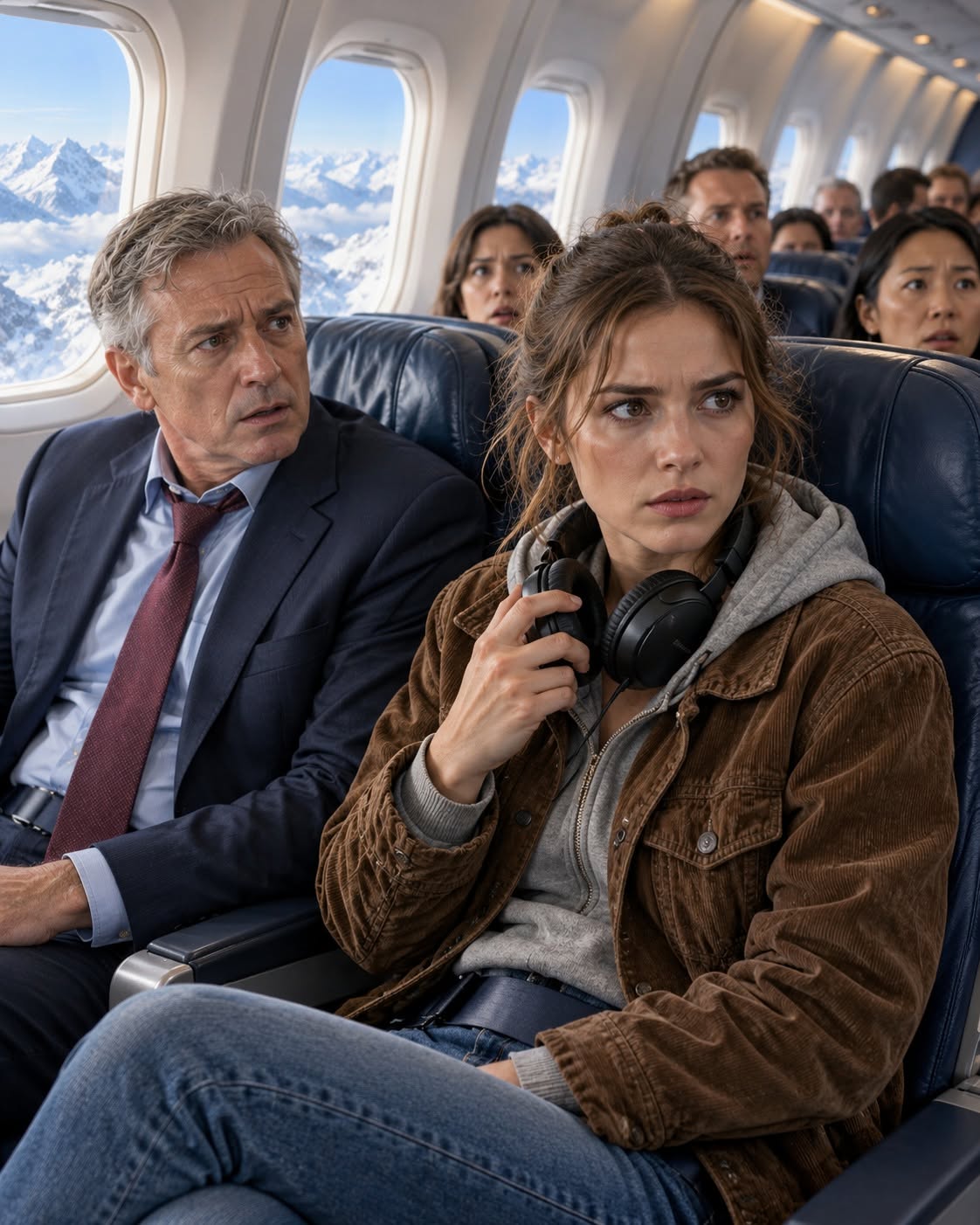
Her words struck harder than any turbulence.
I slowly knelt so that we were at eye level.
“Well, you’re here now. And you’re going to see your mommy again.”
She nodded, but she didn’t let go.
Her mother hurried toward us a few seconds later, crying as she pulled the little girl into her arms.
“I don’t know how to thank you,” she whispered.
I wanted to tell her that she didn’t owe me anything. I wanted to explain that I had simply done what anyone with the necessary training would have tried to do.
Instead, I said the only thing that felt honest.
“I’m just glad you both made it.”
That was when I realized something.
During the flight, I had thought about the 210 people behind me as a responsibility. I had imagined them as passengers, numbers, and lives depending on a series of decisions.
Now they had faces.
A little girl with a stuffed rabbit.
An elderly man who had been traveling to see his grandchildren.
A young couple celebrating their anniversary.
A father who had been trying to get home before his son’s birthday.
They weren’t simply 210 people on a passenger manifest anymore.
They were 210 separate stories that had almost ended in the sky.
And every one of them had just been given another chapter.
THE FIRST THING I DID AFTER LANDING
The investigators eventually escorted me to a quiet room inside the airport.
There was a cup of coffee on the table, but I didn’t touch it. My hands were still trembling, and I could feel the exhaustion settling into every muscle.
Daniel Reeves sat across from me with a notebook.
“Let’s start from the beginning,” he said. “Tell me exactly what happened when you entered the cockpit.”
I described the captain’s injury, Nate’s condition, the warning lights, and the difficulty maintaining control of the aircraft.
I explained that I had never flown a Boeing 767 before that night.
He stopped writing.
“You’re telling me you had never operated this aircraft, not even in a simulator?”
“That’s correct.”
“And you still agreed to take control?”
I looked at him.
“I didn’t think I had much of a choice.”
He leaned back.
“Most people would have panicked.”
“Most people weren’t sitting in front of 210 people who needed someone to do something.”
For several seconds, neither of us spoke.
Then he asked about Gene Sutter.
I told him how Gene had guided me through the unfamiliar cockpit, how he had broken complicated instructions into manageable steps, and how his calm voice had prevented the situation from becoming even more chaotic.
“Do you know where he was calling from?”
“I never asked.”
Daniel made a note.
“We’ll locate him.”
I looked toward the window.
“Please do.”
There was something I needed to tell Gene that I hadn’t managed to say over the radio.
Thank you.
Not the ordinary kind of thank you people offered after someone held a door open or helped carry a suitcase.
I meant the kind that comes when another person’s knowledge becomes the difference between life and death.
THE MAN BEHIND THE VOICE
At approximately three in the morning, an airport representative returned with an update.
The captain was undergoing surgery. Nate had regained consciousness and was receiving treatment for his injured arm.
Both were expected to survive, although the captain’s recovery would take time.
I finally allowed myself to breathe.
Then the representative handed me a phone.
“There’s someone who wants to speak with you.”
A familiar voice came through the speaker.
“Is this the Navy pilot who stole my airplane?”
I almost laughed.
“Gene?”
“The one and only.”
I leaned back in my chair.
“Sir, I owe you more than I can say.”
“Don’t start with that.”
“I mean it. Without you, I don’t think we would have made it.”
There was a short silence.
Then Gene spoke again.
“You did the hard part. I was sitting somewhere safe, looking at information and talking into a microphone. You were the one making decisions with a storm shaking that aircraft.”
“I didn’t know half the things you were telling me to look for.”
“That’s why you listened.”
His answer caught me off guard.
He continued.
“Do you know what I heard in your voice during the approach?”
“What?”
“Fear.”
I looked down at my hands.
“I was terrified.”
“Good.”
I frowned.
“Good?”
“Fear means you understood what was at stake. The dangerous people are the ones who think they’re invincible. You didn’t pretend to know everything. You asked questions, followed instructions, and stayed focused.”
I didn’t answer.
Then Gene said something I would remember for years.
“Flying isn’t about proving you’re the best person in the cockpit. It’s about making sure everybody gets out of the aircraft alive.”
I closed my eyes.
For the first time that night, I felt the pressure beginning to lift.
Before we ended the call, I asked him one question.
“Gene, how did you know I could do it?”
He laughed quietly.
“I didn’t.”
“What?”
“I knew you had experience. I knew you could listen. But I had no guarantee you’d get that aircraft down. Neither did you.”
He paused.
“But when you took the controls, you stopped trying to be a fighter pilot and started trying to be a student. That’s when I knew we had a chance.”
After the call ended, I sat there for a long time.
I had spent twelve years believing that experience meant having answers.
That night taught me something different.
Sometimes experience means knowing exactly when you need someone else’s answers.
THE INVESTIGATION
Two days later, the story was everywhere.
News channels were showing pictures of the aircraft sitting on the runway. Headlines described a Navy fighter pilot who had saved a commercial flight after its captain became incapacitated.
Some called me a hero.
Others called the landing a miracle.
One television station even described me as a man who had single-handedly saved 210 lives.
That headline bothered me.
Because it wasn’t true.
I hadn’t done it alone.
Gene had guided me.
Marcus had kept the cockpit functioning.
Nate had fought through his injuries long enough to help us initially.
And the cabin crew had kept frightened passengers as calm as possible.
There were dozens of small decisions made by different people that contributed to the outcome.
But the headlines didn’t have room for all of that.
They wanted one face.
One name.
One hero.
I wasn’t comfortable being that person.
Meanwhile, the official investigation continued.
The investigators examined the aircraft’s flight data, cockpit voice recordings, weather conditions, and maintenance history.
They wanted to understand why the captain had lost consciousness, why the first officer had been injured, and what had caused the repeated autopilot disconnects.
They also needed to establish how the aircraft had been brought safely to the ground despite the damaged autoland system.
One afternoon, Daniel Reeves called me.
“We’ve finished reviewing the initial cockpit recording,” he said.
“Is there a problem?”
“Not exactly. There’s something we think you should hear.”
He arranged a meeting.
When I arrived, he played a section of the recording from the cockpit.
At first, I heard nothing unusual. The sounds of warning systems, the wind, and Gene’s instructions filled the room.
Then came my own voice.
“Gene, I need you to tell me if I’m making a mistake.”
Gene answered immediately.
“Everybody makes mistakes. What matters is recognizing them before they become dangerous. Tell me what you’re seeing.”
I remembered that moment.
I had been struggling to understand an unfamiliar instrument display while trying to maintain the aircraft’s stability.
Then my recorded voice came again.
“I don’t want to guess.”
Gene’s response was almost gentle.
“Then don’t guess. Ask.”
Daniel stopped the recording.
He looked at me.
“That exchange stood out to our team.”
“Why?”
“Because you were under extraordinary pressure, but you didn’t let urgency convince you that guessing was acceptable.”
He closed the file.
“That may have been one of the most important decisions you made.”
I thought about the number of times in my military career when I had felt pressure to appear confident.
To give an answer.
To make a decision quickly.
To avoid looking inexperienced.
That night, I had learned that confidence and competence were not always the same thing.
Sometimes the most professional sentence a person could say was, I don’t know.
THE VISIT TO THE HOSPITAL
Three days after the incident, I went to see the captain and Nate.
The hospital was quiet, and the smell of disinfectant brought back memories of the medical facilities I had visited during my years in uniform.
Nate was awake when I entered his room.
His right arm was supported in a sling, and there was a bruise along his forehead.
He looked at me for a few seconds before smiling.
“You’re the guy who took my seat.”
I pulled a chair closer.
“I hope you don’t mind.”
“Not particularly. I was having a pretty terrible day.”
We both laughed.
Then his expression changed.
“I remember pieces of it,” he said. “I remember the captain falling. I remember trying to keep the aircraft steady. And I remember hearing someone say he was a Navy pilot.”
He looked down at his injured arm.
“I thought we were finished.”
I didn’t know what to say.
Nate continued.
“I wanted to stay conscious. I really did. But everything was getting dark.”
“You did enough,” I told him.
He shook his head.
“I should have been able to do more.”
“You were injured. You were dealing with an emergency. Don’t turn surviving into something you have to apologize for.”
He stared at me for a moment.
Then he nodded.
Before I left, he reached out with his good hand.
“Thank you for not giving up on us.”
I shook it.
“Thank you for getting us through the first few minutes.”
The captain was in another room.
His name was Robert Hayes, and he had been flying commercial aircraft for nearly three decades.
His injuries had been serious, but he was recovering.
When I entered, he tried to sit up.
“Don’t,” I said. “You’ve had enough trouble already.”
He smiled weakly.
“I heard you landed my airplane.”
“I borrowed it for a few minutes.”
He laughed, then winced.
For a while, we talked about the flight. He remembered preparing for the descent, then a sudden impact and a flash of pain.
He also remembered hearing someone speaking in the cockpit, although he couldn’t recall the details.
Finally, he looked at me.
“I keep thinking about the fact that you had never flown a 767.”
“Neither do I. It’s been on my mind.”
“How did you do it?”
I considered the question.
“Honestly? I had help from someone who knew the aircraft better than I did.”
Robert nodded slowly.
“That’s the part people forget. They think the person holding the controls is the only one responsible.”
He looked toward the ceiling.
“I’ve spent thirty years flying. I know how much depends on the crew around you.”
Then his eyes became serious.
“I also know what it means to lose control of a situation. I’m sorry you had to experience that.”
I shook my head.
“You don’t owe me an apology.”
“Maybe not. But I want you to know something.”
He reached for my hand.
“When I recover, I want to meet Gene Sutter. And I want to thank Marcus properly. That flight belonged to all of us.”
I promised him I would help arrange it.
THE SECRET MARCUS HAD KEPT
A week later, I received an unexpected message from Marcus, the flight attendant who had stayed in the cockpit throughout the emergency.
He asked if we could meet.
We arranged to have lunch near the airport.
When I arrived, he was already sitting at a small table by the window.
He looked different without the uniform. Younger, somehow. But the exhaustion in his eyes was still familiar.
“It’s good to see you,” I said.
“You too.”
We ordered coffee and sat quietly for a few minutes.
Then Marcus took a folded piece of paper from his jacket.
“I wanted to give you something.”
I opened it.
It was a handwritten note.
The writing was uneven, and several words had been crossed out and rewritten.
It read:
To the man who walked toward the cockpit when everyone else was hoping someone would.
You didn’t know what you would find. You didn’t know whether you could help. But you went anyway.
I was scared. I was trying not to show it because the passengers were watching me.
When you walked through that cockpit door, I finally felt that someone was taking responsibility.
Thank you for giving us a chance.
I read it twice.
“Marcus, you don’t have to thank me for this.”
“I know.”
He looked down at his coffee.
“But there’s something else.”
He told me that after the captain had collapsed, he had been ordered to return to the cabin and prepare the passengers for an emergency landing.
He had been terrified.
Not just of dying, but of having to look frightened passengers in the eyes and tell them something he didn’t know how to explain.
Then he had heard the announcement asking whether there was a military pilot aboard.
“When you stood up, I thought you were going to tell them you were a pilot and take over everything.”
“I almost did.”
He raised his eyebrows.
“You did?”
“I wanted to sound confident. But when I entered the cockpit, I realized I needed help.”
Marcus smiled.
“That’s what I remember most. You didn’t pretend.”
He leaned closer.
“Do you know what happened in the cabin after you took the controls?”
I shook my head.
“People started praying. Some were crying. One man was holding his wife’s hand so tightly that I thought he might hurt her.”
Marcus paused.
“But I kept telling them the same thing. We had people working to get them home.”
He looked at me.
“And for the first time, I believed it.”
I folded the note carefully and put it in my pocket.
There are medals for bravery.
There are official commendations.
There are photographs and headlines.
But sometimes a handwritten note from someone who was afraid beside you means more than all of them.
THE MEETING THAT CHANGED EVERYTHING
About a month after the incident, the airline organized a private gathering for the crew and several passengers.
The purpose was to thank everyone involved and provide an opportunity for those who had been on the flight to meet again.
I almost didn’t attend.
I wasn’t interested in standing in front of a room while strangers applauded.
But Robert, the captain, called me personally.
“You’re coming,” he said.
“Is that an order?”
“It’s a request from the captain whose seat you borrowed.”
I couldn’t argue with that.
The gathering took place in a conference room overlooking the airport.
There were photographs of the aircraft, a few news clippings, and a small display recognizing the crew.
Gene Sutter was there.
When I finally met him in person, I discovered that he was a gray-haired man with kind eyes and a habit of speaking as though every situation could be solved with patience.
He shook my hand.
“So, you’re the famous fighter pilot.”
“And you’re the voice that kept me from making a mess of that cockpit.”
He laughed.
“Sounds like we’re both exaggerating.”
We sat together while passengers arrived.
Some brought flowers. Others brought letters.
The little girl with the stuffed rabbit was there too.
Her name was Emily.
When she saw me, she ran across the room.
“You’re the airplane man!”
I smiled.
“I suppose that’s what I am now.”
She held up her stuffed rabbit.
“His name is Captain Floppy. He was scared too.”
I crouched down.
“Was he?”
“He didn’t say anything, but I could tell.”
I looked at her mother, who was smiling through tears.
“Then I’m glad Captain Floppy made it safely.”
Emily nodded seriously.
Then she handed me a small drawing.
It showed a large airplane with several rows of windows. There was a blue sky above it, and a yellow sun in one corner.
At the bottom, in uneven handwriting, were the words:
THANK YOU FOR BRINGING US HOME.
I stared at the picture longer than I intended.
Then Emily asked a question that silenced me.
“Were you scared too?”
I looked at her.
“Yes.”
“Even though you’re a Navy pilot?”
“Especially because I knew how serious it was.”
She thought about that.
“Then how did you do it?”
I smiled.
“I listened to people who knew what to do, and I kept going one step at a time.”
She seemed satisfied with that answer.
But I wasn’t.
Because her question deserved something more than a simple explanation.
I looked around the room.
At Robert, who was recovering.
At Nate, whose arm was still healing.
At Marcus, who had quietly carried responsibility for an entire cabin.
At Gene, whose knowledge had guided us through the storm.
And at the passengers who had trusted us when they had every reason to be afraid.
Then I understood what I wanted to say.
I stood up.
The room became quiet.
“I’ve been called a hero a lot over the past few weeks,” I began. “I appreciate the kindness behind that word, but I don’t think it tells the whole story.”
I looked at Gene.
“If someone had asked me to land that aircraft without his guidance, I would have been facing a situation I wasn’t qualified to handle alone.”
I looked at Marcus.
“If he hadn’t kept the cockpit functioning and helped communicate with the cabin, the situation could have become much worse.”
Then I turned toward Robert and Nate.
“And the crew members who were injured that night had already been doing everything they could before I arrived.”
I took a breath.
“I spent twelve years learning how to fly fighter jets. I thought I understood what it meant to stay calm under pressure. But that night taught me that courage isn’t about pretending you have every answer.”
I paused.
“It’s about recognizing what you don’t know, trusting people who do, and being willing to take responsibility when the moment demands it.”
Nobody spoke.
Then Robert began to applaud.
Gene joined him.
Marcus followed.
Within seconds, the entire room was standing.
I felt my face grow warm.
I wasn’t used to receiving applause for something that had been so frightening.
But this time, I didn’t try to stop it.
I let it happen.
Because I understood that the applause wasn’t really for me.
It was for everyone who had made it possible for those passengers to walk out of that airplane alive.
THE CALL I NEVER EXPECTED
I thought the story would end there.
The investigation would conclude, the passengers would return to their ordinary lives, and the world would eventually find another headline.
But several months later, I received a phone call from a number I didn’t recognize.
It was Emily’s mother.
She told me that Emily had been having trouble sleeping since the incident.
For weeks, she had refused to board another airplane.
Her mother had tried everything, but every time they approached an airport, Emily became frightened.
“She keeps asking whether the pilot might get hurt again,” her mother explained. “And she asks whether there will be someone else to help if that happens.”
I listened quietly.
Then she told me that Emily had started drawing airplanes again.
Only now, every drawing included several people standing together in the cockpit.
“Would you be willing to talk to her?”
I looked at the photograph on my desk.
It was Emily’s drawing from the gathering.
I remembered the words at the bottom.
THANK YOU FOR BRINGING US HOME.
“Of course,” I said.
We arranged a meeting at a small aviation museum.
Emily arrived holding Captain Floppy.
She looked nervous, but she didn’t hide behind her mother this time.
I showed her a few aircraft displays and explained how pilots, mechanics, controllers, and flight attendants all worked together to make flying safe.
She listened carefully.
Then she asked whether fighter pilots were allowed to make mistakes.
I smiled.
“Absolutely.”
“Even big ones?”
“That’s why we train so much. And that’s why we have people around us who can help us recognize problems.”
She looked at the aircraft hanging from the ceiling.
“So pilots aren’t supposed to know everything?”
“No one knows everything.”
She considered that for a moment.
“Then it’s okay to ask for help?”
I nodded.
“It’s one of the smartest things you can do.”
Her mother smiled.
For the first time since the accident, Emily looked genuinely excited about flying again.
Before leaving, she gave me another drawing.
This one showed a large passenger airplane flying above a storm.
There were three people inside the cockpit, and one of them had a small speech bubble.
It said:
WE CAN DO THIS TOGETHER.
I put it beside the first drawing.
I would keep both.
WHAT HAPPENED AFTERWARD
The official investigation eventually concluded.
The findings documented the aircraft damage, the emergency circumstances, and the actions taken by the flight crew and those who assisted during the crisis.
The airline also reviewed its emergency procedures and crew coordination practices.
Robert eventually returned to flying after completing his recovery and the necessary medical clearances.
Nate returned to the cockpit later as well, although he admitted that the first few flights had made him more nervous than he expected.
Marcus continued working as a flight attendant.
Gene returned to his normal routine, although he occasionally reminded me that I still owed him a proper dinner.
As for me, I returned to my Navy duties.
My colleagues had heard about the incident before I even walked through the door.
Some joked that I should ask for a Boeing qualification.
Others wanted to know whether commercial aircraft were easier to fly than fighter jets.
I told them the truth.
They were different.
Very different.
And I had learned more about aviation from those few terrifying minutes than I could have imagined.
But the biggest change wasn’t professional.
It was personal.
Before that night, I had always measured myself by how well I could perform under pressure.
I believed that being prepared meant having enough training, enough discipline, and enough confidence to handle whatever came my way.
After the flight, I began paying closer attention to the people around me.
I listened more.
I asked questions sooner.
I became less concerned with appearing capable and more concerned with actually being useful.
One afternoon, a younger pilot approached me after a training session.
He had made a mistake during an exercise and was clearly embarrassed.
He kept explaining why it had happened, as though he expected me to criticize him.
I let him finish.
Then I asked him a simple question.
“What did you learn?”
He looked surprised.
“I should have recognized the problem earlier.”
“Good. What else?”
“I should have asked for help instead of trying to correct everything myself.”
I nodded.
“Remember that.”
He hesitated.
“Sir, did you ever make a mistake like that?”
I thought about the Boeing 767.
I thought about the storm, the warning lights, the injured first officer, and Gene’s voice telling me not to guess.
Then I smiled.
“Let me tell you about a flight I once took to Anchorage.”
And I told him the story.
Not the version from the news.
Not the version that began with a hero and ended with applause.
I told him about the fear.
About admitting I didn’t know how to operate an unfamiliar aircraft.
About trusting a man I had never met.
About a flight attendant who refused to abandon his responsibility.
And about 210 people who had been given another chance to go home.
When I finished, the young pilot was quiet.
Then he asked, “So what’s the most important lesson?”
I looked at him.
“Never confuse confidence with competence. And never let your pride prevent you from asking for help.”
He nodded.
I hoped he would remember it.
THE LAST MESSAGE
Almost a year after the incident, I received one final message from Gene.
It was short.
He had attached a photograph of the airport runway where we had landed.
The sky was clear, and sunlight reflected off the wet pavement.
Below the photograph, he had written:
Funny how a runway can look so ordinary after it has saved 210 lives.
I stared at the message for a long time.
Then I called him.
We talked about ordinary things. Weather, flying, family, and the ridiculous price of airport coffee.
Before hanging up, he said something that brought the entire experience back.
“Do you remember what I told you when you asked whether you were making mistakes?”
I smiled.
“Everybody makes mistakes. What matters is recognizing them before they become dangerous.”
“Exactly.”
He paused.
“There’s something else I want you to remember.”
“What’s that?”
“You didn’t save those people because you were fearless. You saved them because, even while you were afraid, you kept listening.”
I looked out the window.
For a moment, I could almost hear the warning alarms again.
The rain.
The shaking cockpit.
The desperate announcement.
And then Gene’s voice.
Calm.
Patient.
Certain of the next step, even when none of us knew how the story would end.
I thanked him again.
This time, he didn’t tell me to stop.
He simply said, “Take care of yourself, Lieutenant Commander.”
Then the call ended.
THE MEANING OF THAT NIGHT
People still ask me whether I would do it again.
Whether I would leave my seat, walk toward an unfamiliar cockpit, and take responsibility for an aircraft carrying hundreds of strangers.
My answer is yes.
But I would also tell them something important.
I would never pretend that the outcome was guaranteed.
I would never claim that my military training made me capable of everything.
And I would never forget that the people who helped me were just as important as the person holding the controls.
That night, I learned that courage is often misunderstood.
We imagine courage as a person who never shakes, never doubts, and never feels afraid.
But that isn’t what I saw in the cockpit.
I saw a first officer fighting to remain conscious.
I saw a flight attendant trying to keep his fear from spreading to an entire cabin.
I heard a retired airline captain using his knowledge to guide someone through a situation that could have ended terribly.
And I saw 210 people trusting strangers with their lives.
None of us knew exactly how the night would end.
We simply did what we could with what we had.
And somehow, step by step, we made it.
I still have Emily’s two drawings.
They sit in a frame beside my desk.
The first shows an airplane flying beneath a yellow sun.
The second shows three people in a cockpit, working together above a storm.
Sometimes, when a young pilot asks me what those pictures mean, I tell them the story.
I tell them that one night, 210 people boarded an airplane expecting to arrive at their destination.
They didn’t know their captain would be injured.
They didn’t know their first officer would be unable to continue.
They didn’t know a stranger in seat 8B would be asked to do something he had never done before.
And they certainly didn’t know that a voice coming through a radio would help bring them home.
But they survived.
Not because one person knew everything.
Not because one person was fearless.
And not because everything went according to plan.
They survived because, when everything began to fall apart, people chose to trust one another.
That’s what I remember most.
Not the applause.
Not the headlines.
Not even the moment the wheels touched the runway.
I remember the silence in the cockpit when Gene said, “You’ve got them on the ground.”
I remember Marcus finally breathing.
I remember the little girl holding her stuffed rabbit.
And I remember realizing that every person on that aircraft had someone waiting for them somewhere.
Someone who expected them to come home.
The next time you find yourself in a situation you don’t understand, remember this:
You don’t have to be the smartest person in the room.
You don’t have to have every answer.
And you certainly don’t have to pretend that you’re not afraid.
But you do have to be willing to listen, to learn, and to act when someone needs you.
Because sometimes, the difference between disaster and survival isn’t one extraordinary person.
It’s a group of ordinary people who refuse to give up on one another.
And sometimes, the person who helps bring everyone home is simply the one who was willing to stand up when the announcement came.
I boarded that airplane expecting to be a passenger.
I left it understanding something I would carry for the rest of my life.
Being brave doesn’t mean knowing you can do everything. It means being willing to do what you can, asking for help when you need it, and never forgetting the lives depending on the choices you make.
And if I ever hear that announcement again, I know exactly what I will do.
I will stand up.
Not because I believe I can save everyone by myself.
But because nobody should have to face the impossible alone.