I arrived at the industrial plant auction in an old pickup truck, wearing a faded work shirt with my sleeves rolled up and machine oil still embedded beneath my fingernails.
THE MAN WHO BOUGHT THE FACTORY
The first Monday after the acquisition, I arrived at the plant before sunrise.
My old pickup rattled through the security gate at 5:42 a.m. The sky was still dark, and a cold November wind swept across the enormous parking lot. I parked beside a row of company vehicles, switched off the engine, and sat quietly for a moment.
Two hundred million dollars.
That was the price I’d agreed to pay for a factory that most investors believed was worth less than half that amount.
But as I looked through the windshield at the massive industrial buildings, I wasn’t thinking about the money.
I was thinking about the people.
Nearly four hundred employees depended on that place. Four hundred mortgages, grocery bills, college tuition payments, and families who needed their paychecks every Friday.
I knew what it felt like to have someone depending on you when the future looked uncertain.
I’d lived through that after Amanda died.
I wasn’t about to let those workers experience the same helplessness because a handful of executives had decided their financial interests mattered more than everyone else’s.
I stepped out of my truck, grabbed my toolbox, and headed toward the main entrance.
The receptionist looked surprised to see me.
“Mr. Harlow? You’re here early.”
“Daniel is fine,” I replied. “Is the production team already inside?”
She nodded cautiously.
“Most of them. But Mr. Mercer is holding a management meeting at nine.”
I smiled faintly.
“Then I suppose I’ll have plenty of time to look around.”
What I didn’t know was that Jason Mercer had already begun preparing his next move.
At 8:55 a.m., I entered the executive conference room.
The atmosphere was tense.
Jason sat at the head of the table, surrounded by department managers. He wore an expensive charcoal suit and had a thick folder in front of him.
When he saw me, his expression hardened.
“I wasn’t aware this meeting included outside contractors.”
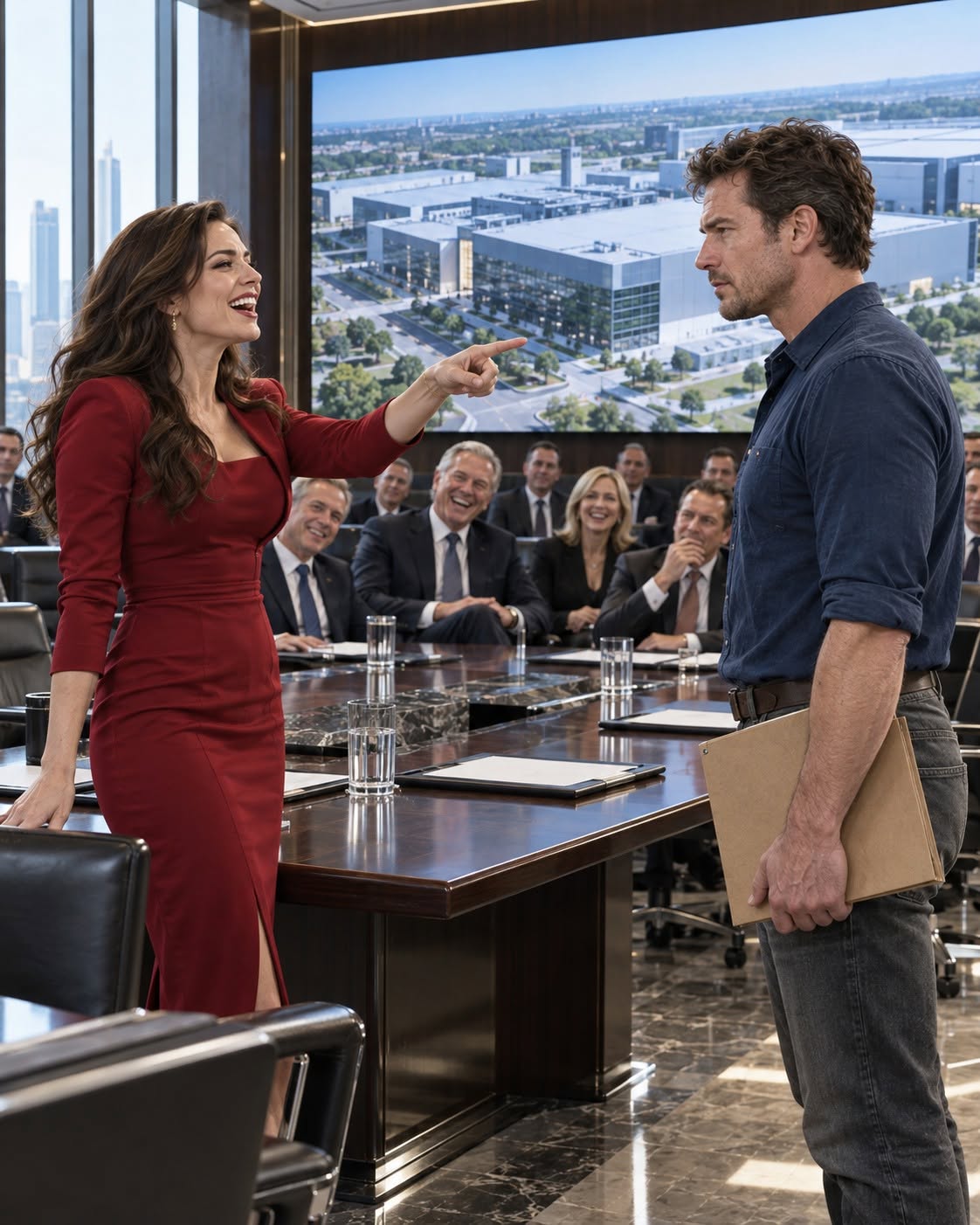
I pulled out a chair.
“Good morning, Jason. I’m not a contractor. I own the place.”
A few managers exchanged glances.
Jason leaned back.
“Ownership doesn’t automatically make you qualified to run an operation of this size.”
“You’re right,” I answered. “That’s why I’m here to listen to the people who actually know how this factory works.”
He seemed disappointed that I hadn’t taken the bait.
I turned toward the production director, an older man named Walter Brooks.
“How long have you worked here?”
“Thirty-one years.”
“And what do you think needs fixing?”
Walter looked at Jason before answering.
“Honestly? A lot of things. But most of them aren’t nearly as expensive as management has been claiming.”
I opened my notebook.
“Tell me more.”
For the next forty minutes, Walter explained how maintenance budgets had been reduced, experienced technicians had been dismissed, and perfectly repairable machinery had been labeled obsolete.
Then a young woman sitting near the end of the table spoke up.
“Some of us submitted reports about these problems months ago. They were never addressed.”
Her name was Emily Carter, and she worked in quality control.
“Do you still have copies?” I asked.
She nodded.
“Yes. I kept everything.”
“Good. Don’t delete a thing.”
Jason suddenly closed his folder.
“This discussion is becoming unproductive. We have contractual obligations, pending deliveries, and operational concerns that require experienced leadership.”
I looked directly at him.
“Then let’s talk about those obligations. Starting with the ones you signed.”
His face changed.
For the first time, I saw something behind his anger.
Fear.
The meeting ended shortly afterward, but I didn’t leave the building.
Instead, I spent the rest of the morning walking through the production floor with Walter.
He showed me machines that had been shut down unnecessarily, spare parts sitting untouched in storage, and maintenance requests that had been marked completed without anyone actually repairing the equipment.
At one point, we stopped beside a massive industrial press.
“That machine was supposed to be replaced last year,” Walter explained. “Management said the repair would cost almost three million dollars.”
I examined the hydraulic assembly and listened to the motor.
“Who inspected it?”
“An outside engineering firm.”
“Did anyone here examine it?”
Walter shook his head.
I crouched beside the machine, removed a protective panel, and studied the damaged component.
Ten minutes later, I looked up.
“Three million dollars?”
Walter laughed bitterly.
“That’s what they told us.”
I wiped my hands with a rag.
“This needs a replacement valve assembly and a proper hydraulic flush. We can probably get it running for less than forty thousand.”
Walter stared at me.
“You can tell that just by looking at it?”
“Not just by looking. By knowing what I’m looking at.”
For the first time that morning, Walter smiled.
And I realized something important.
The factory didn’t need a miracle.
It needed someone willing to pay attention.
Over the next two weeks, Grace Holloway worked with an independent forensic accounting team to investigate the suspicious transactions.
The findings were worse than we’d expected.
Meridian Asset Solutions wasn’t simply a company that had appeared in a few questionable invoices.
It was connected to a network of shell businesses that had received payments for maintenance services never performed.
Several contracts had been terminated under false justifications. Equipment had been deliberately undervalued. Replacement parts had been purchased through intermediaries at inflated prices.
And the money hadn’t simply disappeared.
It had been transferred into accounts connected to executives who had played key roles in making the factory appear financially unsustainable.
Jason Mercer was at the center of the investigation.
But there was another name.
Isabella Vance.
When Grace showed me the documents, I stared at the page for several seconds.
“Are you certain?”
“Not yet,” she replied. “Her company approved several transactions that benefited Meridian. But we haven’t established whether she personally knew about the scheme.”
I leaned back.
“Then we don’t accuse her until we have evidence.”
Grace nodded.
“That’s exactly why I wanted you to see this.”
Meanwhile, the factory began showing signs of life.
We repaired three production lines, renegotiated two supplier agreements, and brought several experienced technicians back to work.
I also made one decision that surprised almost everyone.
I refused to lay off a single employee during the first ninety days.
Owen Blake thought I was taking an unnecessary financial risk.
“Daniel, you’re paying people while trying to stabilize an operation that hasn’t generated meaningful profits in months.”
“I know.”
“And if the numbers don’t improve?”
“Then we’ll make difficult decisions based on actual performance, not on assumptions created by people who wanted this place to fail.”
Owen rubbed his forehead.
“You realize you can’t save everybody.”
I looked through the office window toward the production floor.
“I know. But I can at least make sure I don’t abandon them before giving them a fair chance.”
He was quiet for a moment.
Then he nodded.
“All right. Let’s see what we can do.”
For the first time since the auction, I felt we were beginning to move in the right direction.
Then Isabella Vance called.
Her assistant contacted me on a Thursday afternoon and requested a private meeting at Vance Tower.
I almost declined.
But something told me I needed to hear what she had to say.
The following morning, I arrived at her office.
It was on the forty-second floor, surrounded by glass walls overlooking the city.
Isabella stood beside the windows, wearing a dark blue suit.
She turned when I entered.
“Mr. Harlow.”
“Isabella.”
She gestured toward a chair.
“Coffee?”
“No, thank you.”
She studied me for a moment.
“You’ve caused quite a disruption.”
“I’ve been told that before.”
She didn’t smile.
“My board is concerned about the allegations involving Meridian. Our legal department has been reviewing the transactions.”
“Good.”
“Jason Mercer insists the documents are misleading.”
“Then he should welcome an independent investigation.”
She walked back toward her desk.
“There’s something you should understand. I inherited a complicated company. Thousands of employees, hundreds of contracts, and decisions made by people I trusted.”
I folded my hands.
“Trust isn’t a substitute for accountability.”
Her expression tightened.
“I didn’t come here to be lectured.”
“Then why did you invite me?”
For several seconds, she said nothing.
Finally, she opened a drawer and removed a thick envelope.
“I found something.”
She placed it on the desk.
Inside were copies of internal emails between Jason Mercer and several senior executives.
One message, dated eight months earlier, caught my attention.
Jason had written that the plant’s true operating value needed to be reduced before the auction. He had also discussed a possible acquisition through Meridian.
Another message referred to a meeting with a member of Isabella’s executive team.
I looked up.
“Why are you showing me this?”
“Because I found out that someone used my authorization to approve a transaction I never personally reviewed.”
“That’s a serious claim.”
“I know.”
She sat down.
“And because I remember what I said to you at the auction.”
I waited.
She looked uncomfortable.
“I judged you before I knew anything about you. I assumed that because you weren’t dressed like the other investors, you didn’t belong in that room.”
I said nothing.
“I was wrong.”
“Yes,” I replied.
She seemed surprised by my bluntness.
I continued.
“But the bigger problem isn’t what you thought of me. It’s what happened to the people working in that factory while your executives were playing games with its value.”
She lowered her eyes.
“I understand.”
“Do you?”
She looked back up.
“I intend to find out.”
Before leaving, I told her one thing.
“If you genuinely want to help, cooperate fully with Grace and the investigators. Don’t protect anyone simply because their name appears on an executive directory.”
She nodded.
“I will.”
I left Vance Tower without knowing whether I believed her.
Three days later, everything changed.
At 6:15 on Monday morning, Walter called me.
“Daniel, you need to get here. Now.”
His voice was unusually strained.
I drove to the factory as quickly as I could.
When I arrived, several employees were gathered outside the main production building.
A section of the automated assembly line had stopped working overnight. A critical control unit had failed, and the replacement components we’d ordered were missing.
Walter handed me a printed delivery notice.
“According to the supplier, the order was canceled last Friday.”
“By whom?”
He pointed to the authorization code.
Jason Mercer.
I felt my jaw tighten.
“Where is he?”
“Not here.”
I called Grace immediately.
Within twenty minutes, she had discovered something even more troubling.
Jason had used an old executive authorization to cancel several outstanding equipment orders and transfer the remaining inventory to a warehouse operated by a Meridian affiliate.
It looked like an attempt to cripple production before the ownership transition could be fully completed.
But there was another problem.
A major customer was expecting a shipment within forty-eight hours.
If we missed the deadline, the contract allowed them to terminate the agreement and demand substantial compensation.
Losing that customer could destroy the recovery plan.
Owen arrived shortly afterward.
He looked at the production figures and shook his head.
“We need those components. Without them, we’re finished.”
I examined the control cabinet.
“Not necessarily.”
Walter looked at me.
“What are you thinking?”
I pulled out my phone and called an old supplier I’d worked with for nearly fifteen years.
His name was Frank Delaney.
“Frank, I need a favor.”
“Daniel? Haven’t heard from you in months. What’s going on?”
“I need an industrial control unit. Older series, compatible with a Siemens drive system. I need it today.”
He whistled.
“That’s a difficult one.”
“I know.”
“Give me two hours.”
I spent the next several hours working with the maintenance crew.
We isolated the failed section, tested the remaining components, and built a temporary control arrangement that would allow the unaffected production stations to operate safely.
By noon, Frank called back.
He had found the replacement unit in a warehouse outside the city.
I sent one of our technicians to collect it.
At 4:30 p.m., the assembly line restarted.
When the machinery began moving again, the entire production floor erupted in applause.
Walter shook my hand.
“Thirty-one years here, Daniel. I’ve never seen anything like this.”
I looked around at the workers.
“Neither have I.”
But the victory came with a price.
The next morning, Jason Mercer appeared at the factory with two attorneys and a security team.
He demanded access to the executive offices and accused me of interfering with ongoing business operations.
I met him in the lobby.
“You canceled critical equipment orders and transferred company inventory without authorization.”
“I acted within my authority.”
“Your authority ended when the acquisition closed.”
He stepped closer.
“You think buying a factory makes you untouchable?”
“No. I think stealing from one makes you accountable.”
His attorney interrupted.
“We advise you to refrain from making defamatory statements.”
Grace appeared behind me carrying a folder.
“Excellent advice. Perhaps you should also advise your client to explain these transfer records to the investigators.”
Jason went pale.
For a moment, he looked toward the exit.
Then two uniformed officers entered the building.
They had come to serve a formal notice requiring him to preserve company records and attend an interview concerning the suspected financial misconduct.
Jason looked at me with pure hatred.
“This isn’t over.”
I watched him leave.
“No,” I said quietly. “It isn’t.”
The investigation continued for several weeks.
Grace and her team uncovered additional transactions involving fake consulting agreements, inflated equipment valuations, and unauthorized transfers.
Several senior managers resigned.
Others cooperated with investigators.
Eventually, Jason was formally charged in connection with the alleged financial scheme. The legal process would take months, but the evidence was substantial enough that his position in the company was finished.
And then came the news I hadn’t expected.
Isabella Vance was stepping down as CEO.
Her company announced that she would take temporary leave while an independent review examined the decisions made under her leadership.
The announcement made headlines.
Some investors called her resignation an admission of guilt.
Others believed she was taking responsibility for a system she hadn’t properly supervised.
I didn’t know which interpretation was correct.
All I knew was that I had another problem to solve.
The factory was running again, but its future remained uncertain.
One evening, I stayed late in my office reviewing payroll reports.
My phone rang.
It was my daughter’s school.
My stomach tightened immediately.
“Mr. Harlow? Your daughter is fine, but she’s been asking for you. She seems upset.”
I looked at the clock.
It was almost seven.
I’d promised to pick her up early that afternoon.
I had forgotten.
I drove across town without even changing out of my work clothes.
When I arrived, my daughter was sitting on a small chair beside her teacher.
Her little backpack rested on her knees.
She looked up when she saw me.
“Daddy!”
I knelt and hugged her.
“I’m sorry, sweetheart.”
She wrapped her arms around my neck.
“You’re late.”
“I know.”
“Are you fixing another big machine?”
I swallowed.
“Something like that.”
She studied my face.
“Mommy used to say you always come back.”
Those words hit harder than anything Jason had said.
I held her close.
“I’ll always come back to you.”
That night, after putting her to bed, I sat alone at the kitchen table.
Amanda’s photograph stood on the shelf.
She was smiling in it, holding our daughter when she was barely a year old.
I remembered the years when Amanda’s illness had consumed nearly every part of our lives.
The hospital visits.
The long nights.
The promises I made when I knew I couldn’t guarantee anything.
After she passed away, I’d convinced myself that providing for our daughter was the most important thing I could do.
But I was beginning to understand that providing wasn’t the same as being present.
The next morning, I called Owen.
“I need to change something.”
“What’s wrong?”
“I’ve been treating this factory like it’s the only thing that matters.”
He was silent.
“I need to hire an experienced operations director. Someone capable of managing the daily business without me standing over every machine.”
Owen chuckled.
“That’s what I’ve been telling you for weeks.”
“I know. I was stubborn.”
“That must have been difficult to admit.”
I laughed.
“Don’t get used to it.”
We began searching for someone who could lead the operation properly.
Walter recommended a former plant manager named Margaret Ellis.
She had spent twenty-five years running manufacturing facilities and had a reputation for being demanding but fair.
When I interviewed her, she asked only one question that mattered.
“What happens when the numbers get worse before they get better?”
I answered honestly.
“We protect the workers as long as the business can support it. We communicate the truth, even when it’s uncomfortable, and we don’t hide problems to make ourselves look successful.”
Margaret nodded.
“Then perhaps we can work together.”
She accepted the position.
Within a month, the factory had a clear operating structure, transparent maintenance schedules, and a proper financial reporting system.
Employees were invited to submit improvement proposals.
We created an apprenticeship program for younger workers and brought back several retired technicians as paid mentors.
For the first time in years, people were being encouraged to speak rather than instructed to stay quiet.
But the biggest change came from an unexpected source.
One afternoon, Isabella arrived at the factory.
She wasn’t wearing the expensive suit I’d seen at the auction.
Instead, she wore a simple coat and carried a leather folder.
She asked to speak with me privately.
We sat in the small office overlooking the production floor.
“I wanted to see what you’ve done with the place,” she said.
“We’re still working on it.”
She looked through the window.
“I’ve spent most of my career believing that success meant being the person in the room with the most authority.”
“And now?”
“Now I’m not sure I understood what authority was supposed to mean.”
I leaned back.
She opened her folder.
Inside was a proposal.
Her company wanted to establish an independent industrial recovery fund to support struggling manufacturing businesses, with strict financial oversight and employee representation.
She wanted our factory to become the first participant.
I read through the document carefully.
“Why are you bringing this to me?”
“Because you understand something I didn’t.”
“What’s that?”
“That a factory isn’t just an asset on a balance sheet. It’s a community of people.”
I closed the folder.
“It’s a good idea. But there’s something you need to understand before we discuss it.”
She waited.
“I won’t participate in a public relations exercise designed to repair your company’s reputation.”
“I wouldn’t ask you to.”
“And I won’t let anyone use the workers as a convenient photograph for an advertising campaign.”
She nodded.
“Fair enough.”
I studied her face.
“Then build the fund properly. Put independent people in charge. Publish the results. And make sure the employees have a voice.”
For the first time since I’d met her, Isabella smiled without any trace of arrogance.
“That’s exactly what I intend to do.”
Over the following months, the recovery fund became a genuine partnership between several industrial companies, independent auditors, and workforce representatives.
Isabella remained involved, but she no longer tried to control every decision.
She attended public hearings, answered difficult questions, and helped provide documents to the investigators.
Her reputation suffered, and she lost several influential allies.
But she didn’t run away.
Eventually, the independent investigation concluded that while she had failed to exercise proper oversight, there was insufficient evidence that she had personally participated in Jason’s fraudulent scheme.
She issued a public statement accepting responsibility for the failures in corporate governance under her leadership.
I read it in my office one afternoon.
Then I put the newspaper down and returned to work.
I didn’t need her to become my friend.
I needed her to understand that leadership carried consequences.
Six months after the auction, the factory reached its first major milestone.
Production was operating at eighty-five percent of capacity.
We had restored several customer contracts, reduced unnecessary expenses, and brought the maintenance department back to full strength.
More importantly, not a single employee had lost their job because of the financial crisis during those first six months.
On a Friday afternoon, Margaret called an all-staff meeting.
I stood near the front of the production floor, surrounded by hundreds of employees.
Walter stepped forward with a sheet of paper.
“We’ve been here through layoffs, canceled contracts, broken machines, and promises that never came true,” he said.
He paused.
“But today, I have something different to announce.”
The room became quiet.
“The factory has recorded its first operating profit since the crisis began.”
For a second, nobody reacted.
Then the entire building erupted in applause.
Some people cheered.
Others hugged their coworkers.
Walter shook my hand with tears in his eyes.
I looked around and felt something I hadn’t experienced in years.
Pride.
Not because I’d spent two hundred million dollars.
Not because I’d defeated a powerful executive.
But because people who had almost lost everything were beginning to believe in their future again.
That evening, I drove home in my old pickup.
My daughter was waiting at the kitchen table with a drawing.
“Daddy! Look!”
It showed a huge factory with smoke-free chimneys, little people standing outside, and a blue truck parked beside the entrance.
Above it, she’d written three words in crooked letters.
“DADDY’S BIG FACTORY.”
I smiled.
“That’s beautiful, sweetheart.”
She pointed toward the truck.
“That’s yours.”
Then she pointed toward a small figure standing beside it.
“That’s me.”
I hugged her.
“You’re the most important part.”
She giggled and returned to her crayons.
I placed the drawing on the refrigerator, right beside a photograph of Amanda.
For the first time in a long while, the two things that mattered most to me seemed to belong in the same picture.
A few weeks later, we held a small ceremony at the factory.
There were no expensive decorations, no celebrity guests, and no speeches about billion-dollar valuations.
Just employees, their families, suppliers, and the people who had helped rebuild the operation.
I stood at the microphone and looked across the crowd.
“When I first came here, I was told I didn’t belong in a room full of investors because I repaired junk for a living.”
A few people laughed.
I smiled.
“Maybe I did look out of place. I arrived in an old truck, wearing a work shirt, with grease under my fingernails.”
I paused.
“But I want you to understand something. There’s no shame in repairing broken things. Sometimes the most valuable skill isn’t knowing how to build something new. It’s knowing how to recognize what can still be saved.”
The crowd became quiet.
“This factory was called worthless. Its workers were treated like expenses. Its machines were written off before anyone bothered to understand them. And the people who depended on it were nearly forgotten.”
I looked toward Walter, Margaret, and the maintenance crew.
“They didn’t need someone to rescue them. They needed someone to give them a fair opportunity to prove what they could do.”
I took a breath.
“That’s what we’re going to keep doing here.”
The applause lasted longer than I expected.
Afterward, Isabella approached me.
She had attended as a guest, not as a CEO.
“That was a good speech,” she said.
“Thank you.”
She glanced at my daughter, who was standing beside me holding a cupcake.
“She’s adorable.”
“She’s the reason I keep going.”
Isabella nodded.
Then she extended her hand.
“Daniel, I owe you another apology.”
I looked at her.
“For what?”
“For the way I treated you at the auction. I thought your clothes told me everything I needed to know about you.”
I shook her hand.
“Don’t worry about what I was wearing.”
She frowned slightly.
“What do you mean?”
I looked around at the employees celebrating behind us.
“Just remember the next time someone walks into your office with oil on their hands. They might understand your business better than the person wearing the most expensive suit.”
She smiled.
“I won’t forget that.”
A year after the auction, the factory was no longer struggling.
We had expanded production, secured long-term supply agreements, and created a training program that gave local young people a path into skilled manufacturing careers.
The independent investigation had also produced lasting consequences.
Jason Mercer and several associates eventually faced convictions related to the financial fraud. The court ordered restitution where possible, and the recovered funds were directed toward affected creditors and other legally recognized claims.
Meridian Asset Solutions was dissolved.
The company that had once seemed untouchable was forced to answer for its actions.
As for Isabella, she rebuilt her career slowly.
She never returned to her old position with the same authority, but she became an active advocate for transparent corporate governance and responsible industrial investment.
We occasionally spoke about business.
We never became particularly close.
And that was fine.
Not every person who enters your life needs to become a friend. Sometimes the most important thing they can do is learn from a mistake and make sure it doesn’t happen again.
One Saturday morning, I brought my daughter to the factory.
She had been asking to see where I worked, and Margaret had arranged a special tour.
Walter showed her the assembly line.
He explained how the machines moved, how the sensors worked, and why every worker had an important job.
My daughter listened with wide eyes.
Then she looked up at me.
“Daddy, is this where you fixed everything?”
I knelt beside her.
“Not everything.”
“Why not?”
I smiled.
“Because some things can’t be fixed by one person.”
She considered that answer for a moment.
Then she reached for my hand.
“But you tried.”
I squeezed her little fingers.
“Yes, sweetheart. I tried.”
As we walked toward the old pickup, I thought about the man who had arrived at that auction in an oil-stained shirt, carrying years of grief and a determination nobody in that room could understand.
I remembered Isabella’s laughter.
I remembered the investors who had dismissed me.
I remembered Jason’s threats.
But more than anything, I remembered Amanda.
She had once told me that the measure of a person wasn’t how much they could accumulate, but how much good they could leave behind.
At the time, I hadn’t fully understood what she meant.
Now I did.
The factory was worth far more than the two hundred million dollars I’d paid for it. But its greatest value wasn’t in its buildings, its equipment, or its production contracts.
It was in the families who could now plan their futures without wondering whether their paychecks would disappear.
It was in the young apprentices learning skills that would support them for decades.
It was in the older workers who could finally retire knowing that the knowledge they’d spent a lifetime acquiring hadn’t been discarded.
And it was in the simple fact that a place everyone had given up on was alive again.
My daughter climbed into the passenger seat and placed her drawing on the dashboard.
“Can we come back next weekend?”
I turned the key.
“Of course.”
She smiled.
“Good. I want to show Walter my new picture.”
As the truck rolled through the gate, I glanced once more at the factory in the rearview mirror.
I had gone to that auction thinking I was buying an industrial plant.
I hadn’t realized I was accepting responsibility for an entire community.
And somewhere along the way, I had learned the most important lesson of my life.
People will often judge your worth by your clothes, your money, your position, or the company you keep.
But none of those things tells the whole story.
A person wearing an expensive suit can destroy something valuable.
A person with grease beneath his fingernails can recognize its potential.
And sometimes, the greatest success isn’t proving the people who underestimated you wrong.
It’s building something so meaningful that their opinions no longer matter.
I didn’t buy that factory to become the richest man in the room.
I bought it because I knew it could still be saved.
And in saving it, I discovered something I had nearly forgotten after losing Amanda.
There was still a future worth building.
Not just for me.
But for the little girl sitting beside me, for the hundreds of families who depended on that factory, and for every person who had ever been told they weren’t important enough to deserve a second chance.
The old pickup kept rattling down the road.
My daughter laughed at something outside the window.
And for the first time in years, I wasn’t driving toward a life I was simply trying to survive.
I was driving toward one I was proud to live.
THE END.