For six years, I secretly taught myself to fly in a broken simulator hidden behind our military base’s hangar.
PILOT’S LAST CALL – THE MAN WHO LEARNED TO FLY IN SECRET (CONTINUED)
The first morning of my new assignment began with twelve young pilots standing outside the hangar, looking at me as if they weren’t entirely sure why they had been told to report to a mechanic.
I understood their confusion.
For eleven years, I had been the man who handed them their aircraft keys, explained warning lights, and reminded them when their maintenance inspections were due. Now Colonel Reyes wanted me standing in front of them, teaching them how to understand the sky.
I wasn’t sure I belonged there either.
“All right,” I said, looking across the group. “Who can tell me what makes a good pilot?”
A tall lieutenant near the back raised his hand.
“Confidence, sir.”
Another answered, “Discipline.”
“Experience,” someone else added.
I nodded.
“Those are all good answers. But they’re missing something.”
I walked toward the nearest fighter and placed my hand against its cold metal fuselage.
“Humility. The moment you believe you’re better than your aircraft, your instruments, or the conditions around you, you’ve already started making mistakes.”
A few of them exchanged glances.
One young woman stepped forward. Her name was Lieutenant Sarah Mitchell. She had graduated near the top of her flight class and was known for being exceptionally talented, although Danny had once described her as someone who could turn a simple training exercise into a personal competition.
“With respect, sir,” she said, “isn’t that something every pilot already learns during training?”
I looked at her.
“Knowing a lesson and understanding why it matters are two different things.”
She folded her arms.
“Then how are you going to teach us something our flight instructors couldn’t?”
It was a fair question.
I smiled slightly.
“By starting somewhere they probably never thought to start.”
I took them to the maintenance workshop.
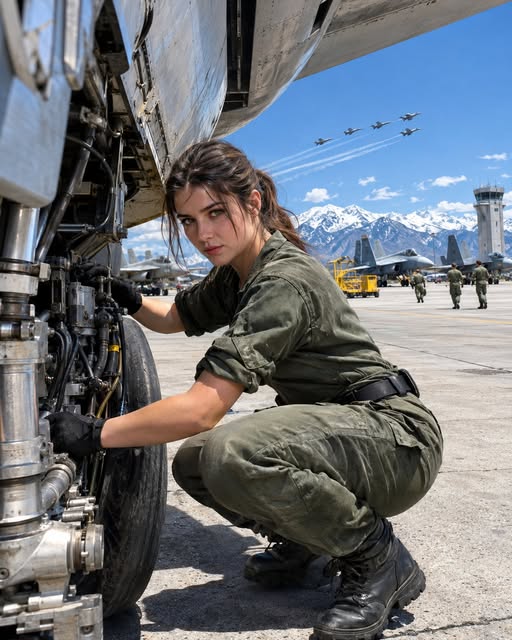
For the next two hours, I showed them the aircraft from the perspective of the people who repaired it. I explained how tiny changes in engine vibration could indicate serious mechanical problems, how hydraulic pressure affected control response, and why certain warning signals deserved immediate attention even when the instruments appeared normal.
I didn’t give them a lecture.
I asked questions.
I made them inspect components, examine damaged parts, and explain what they thought might happen if something failed at altitude.
By the end of the session, even Sarah had stopped challenging every sentence.
When the group left, Danny remained behind.
“Not bad, old man,” he said, leaning against a toolbox.
“Old man?”
“You’re almost a legend now. I figured I should start treating you like one.”
I threw a cleaning rag at him.
He laughed, then became serious.
“There’s something you should know. Not everybody is happy about your new position.”
I already suspected that.
“Captain Voss?”
Danny nodded.
“He’s been telling people that what happened last Tuesday was reckless. He thinks the colonel is rewarding someone who broke every rule in the book.”
I looked toward the hangar doors.
“Maybe he’s right about the rules.”
“Come on. You saved us.”
“That doesn’t mean I made every decision correctly.”
Danny didn’t answer.
And that was the beginning of my second problem.
The first problem was proving that a mechanic could teach pilots.
The second was discovering that saving a base didn’t automatically make everyone trust you.
Three days later, I was summoned to Colonel Reyes’s office.
Major Kessler was already there, standing beside a large monitor. Captain Voss sat in the chair opposite the colonel, looking unusually pleased with himself.
“Close the door,” Reyes said.
I did.
She pointed toward the monitor.
“An investigation team has completed its preliminary review of Tuesday’s incident. They’re questioning the circumstances surrounding your unauthorized simulator training and the decision to put you in the cockpit.”
I nodded.
“I expected that.”
Voss leaned forward.
“Then perhaps you also expected them to discover that you never received formal flight certification.”
“I did.”
“And that you operated a military fighter without authorization?”
“Yes.”
“Do you understand how serious that is?”
I looked directly at him.
“Very serious.”
He seemed disappointed that I wasn’t arguing.
The colonel raised a hand.
“Captain, let him speak.”
I explained everything.
I told them where I had found the simulator, how I had repaired it, how I had studied flight manuals, and how I had spent thousands of hours learning its systems.
I also told them something I hadn’t mentioned during the emergency.
The simulator had never been connected to classified combat systems. I had never accessed restricted military networks or obtained operational credentials. My training had been entirely independent, based on publicly available flight principles and the simulator’s limited software.
But I made no attempt to excuse what I had done.
“I knew I wasn’t authorized to fly,” I said. “I also knew that four enemy aircraft were approaching a base with no pilots available to defend it. I made a decision. I accept responsibility for it.”
Voss shook his head.
“Convenient explanation.”
“No,” I replied. “An explanation. Not an excuse.”
The room became quiet.
Colonel Reyes leaned back.
“There’s another issue. The intelligence report that sent our squadron east was false.”
Major Kessler changed the screen.
A map appeared, showing the squadron’s route, the radar contacts, and several communication points.
“Someone supplied our command with inaccurate intelligence,” he explained. “The enemy knew exactly when our aircraft would leave Ridgeway. They also knew our remaining aircraft would be unable to respond quickly.”
My stomach tightened.
“You’re saying the attack was planned?”
“We’re investigating that possibility,” Reyes answered.
Voss stood.
“With respect, Colonel, this is an intelligence matter. We shouldn’t turn a maintenance incident into a conspiracy.”
Reyes gave him a cold look.
“Nobody asked you to.”
He sat down.
Before the meeting ended, the colonel handed me a document.
My temporary instructional assignment was suspended pending the investigation. I would return to my regular maintenance duties until the review was complete.
I read the paper twice.
Then I signed it.
Walking back to the hangar, I felt something I hadn’t expected.
Relief.
For six years, I had carried a secret that separated me from everyone around me. Now it was out in the open, and I no longer had to pretend that the nights in the simulator had never happened.
But I had also learned that the truth could cost you something even when you believed you had done the right thing.
That evening, I went to the storage room behind the hangar.
The old simulator was still there.
Its cracked seat, faded control panels, and worn-out monitor looked exactly as they had six years earlier.
I switched it on.
The familiar startup sound filled the room.
For a moment, I imagined my father standing beside me.
He had never been a military pilot. He had worked as an aircraft engineer before retiring, and he had spent much of my childhood explaining how machines worked.
When I was ten, he once took me to an airfield.
I remember standing beside him as a small training aircraft climbed into the afternoon sky.
I had asked him why he never became a pilot himself.
He had smiled.
“Because understanding how something flies is sometimes more important than being the one holding the controls.”
I hadn’t understood him then.
Now I thought I finally did.
The next morning, something unusual happened.
A sealed envelope arrived at my workshop.
Inside was a handwritten note from Lieutenant Mitchell.
It read:
“Sir, I spent last night reviewing the hydraulic system diagrams you showed us. I realized I’ve flown that aircraft for three years without ever understanding how its backup pressure system actually works. I would appreciate another lesson whenever you’re allowed to teach.”
I read it twice.
Then I placed the note inside my toolbox.
It wasn’t a promotion.
It wasn’t an award.
But somehow, it meant more.
Over the following week, the investigation became increasingly complicated.
Two intelligence officers arrived from headquarters. They interviewed the radar operators, examined communication logs, and reviewed the flight records of every aircraft involved in Tuesday’s emergency.
The first discovery was that the false intelligence report had originated from a compromised communications terminal.
The second was more troubling.
Someone had accessed the base’s maintenance database shortly before the squadron was dispatched.
At first, nobody understood why.
Then Major Kessler came to find me.
He carried a printed maintenance record.
“Look at this,” he said.
It was the service history of Danny’s fighter.
The aircraft I had flown during the attack.
According to the database, its hydraulic pump had been replaced six days before Tuesday.
But the record showed that the replacement component had been delivered from a supplier that didn’t exist.
I frowned.
“That’s impossible. I installed that pump myself.”
“Exactly.”
He placed another document beside it.
Someone had altered the electronic maintenance record to make it appear that the aircraft had received a different component.
I examined the serial numbers.
Then I noticed something.
The altered record had been approved using a maintenance supervisor’s digital authorization.
Captain Voss’s.
I looked up.
“Have you spoken to him?”
“Not yet. We’re checking whether his credentials were used by someone else.”
I carefully placed the documents on the table.
“Major, there’s something else.”
“What?”
“During my inspection, I found a small discrepancy in the aircraft’s pressure readings. It wasn’t dangerous, but it didn’t match the replacement pump’s specifications. I corrected it before Tuesday.”
Kessler stared at me.
“Why didn’t you report that?”
“I did. In the original maintenance notes.”
He immediately called the investigation team.
Within hours, the entire maintenance department was being reviewed.
Captain Voss was removed from his operational duties while investigators examined the records.
He was furious.
When he saw me outside the hangar, he stopped directly in front of me.
“You think you’re a hero now?”
I said nothing.
“You’ve been here eleven years, and suddenly everyone thinks you’re some kind of miracle worker. You have no idea how this place operates.”
“Maybe not,” I replied. “But I know how to read a maintenance report.”
His expression hardened.
“Be careful what you accuse people of.”
“I’m not accusing anyone.”
“Good. Because you wouldn’t want to discover that your little secret has consequences.”
I held his gaze.
“I already know it does.”
He walked away.
For the first time, I wondered whether the attack on Ridgeway had been connected to my decision to fly.
And whether someone had known exactly what I would be forced to do.
Two nights later, I received a phone call from Danny.
“Come to the hangar. Now.”
His voice sounded strange.
“What’s wrong?”
“Something happened to Sarah’s aircraft.”
I grabbed my jacket and hurried outside.
When I arrived, several technicians were gathered around one of the fighters. Sarah stood beside the cockpit, pale and visibly shaken.
“What happened?” I asked.
She pointed toward the aircraft’s control panel.
“During the preflight inspection, I noticed an unusual pressure fluctuation. Then the backup warning system activated.”
I moved closer.
“Did you shut everything down?”
“Immediately.”
“Good.”
I inspected the system with two other mechanics.
After twenty minutes, I found the problem.
A small section of the hydraulic control assembly had been tampered with. It was subtle enough to escape a rushed inspection, but serious enough to create a dangerous control failure during flight.
Someone had deliberately interfered with the aircraft.
Sarah looked at me.
“Would it have failed in the air?”
I didn’t answer immediately.
“It might have.”
Her eyes widened.
“How long would it have taken?”
“Long enough to make recovery difficult. Maybe impossible.”
Danny swore under his breath.
Major Kessler arrived shortly afterward with two security officers.
The base was placed under heightened security.
No aircraft could fly without an additional independent inspection.
And every maintenance record was checked manually.
The following morning, Colonel Reyes called an emergency meeting.
She had news.
Captain Voss had been arrested.
Investigators had discovered that his authorization credentials had been used to alter several maintenance records and that he had communicated with an outside contact shortly before the false intelligence report was transmitted.
At first, he denied everything.
Then the investigators found the money.
Payments had been deposited into an account linked to a relative of his. The transfers began several months earlier and increased shortly before Tuesday’s attack.
He had been supplying information about Ridgeway’s aircraft readiness, patrol schedules, and defensive capabilities.
The attack had been designed to destroy the fuel depot while the squadron was away.
The enemy fighters had not simply appeared by chance.
They had been waiting.
And the false maintenance record on Danny’s fighter had been part of a larger plan to ensure that even the aircraft remaining at the base would be unreliable.
I sat in silence as Colonel Reyes explained the findings.
Finally, she looked at me.
“There’s something else you need to know.”
I waited.
“The enemy leader’s aircraft was recovered from a forced landing several miles beyond the eastern ridge. He survived. During interrogation, he confirmed that their mission was to destroy the fuel depot and eliminate our ability to support returning aircraft.”
I nodded slowly.
“Did he say anything about the pilot who intercepted them?”
The colonel paused.
“He did.”
She opened a folder.
According to the report, the enemy leader had been surprised by the aircraft’s behavior during the pursuit. He had expected a conventional defensive response. Instead, he encountered someone who understood the terrain, avoided unnecessary engagement, and forced his formation to separate.
He had assumed I was an experienced combat pilot.
When he learned I had been a mechanic, he reportedly refused to believe it.
Danny laughed quietly.
“Guess you gave him something to think about.”
Nobody else laughed.
Because the truth was becoming difficult to ignore.
My flight had not only protected the base.
It had exposed a security failure that could have cost hundreds of lives.
But there was still one problem.
The investigation into Voss’s actions did not erase my own violations.
A week later, I was ordered to attend a formal disciplinary hearing.
The room was filled with senior officers.
Colonel Reyes sat at the center of the panel. Major Kessler was present, along with two representatives from military aviation command.
They reviewed my unauthorized simulator use, my lack of formal certification, and my decision to operate a fighter without completing the required flight training.
One officer asked the question I had been expecting.
“Do you believe that saving the base justifies breaking military aviation regulations?”
I thought carefully before answering.
“No, sir.”
He raised an eyebrow.
“Explain.”
“Regulations exist because people can die when procedures are ignored. I understand that better than most. I also understand that there are moments when people must make difficult decisions. But I don’t believe one successful outcome makes every decision leading to it acceptable.”
“Then why did you do it?”
I looked around the room.
“Because four enemy aircraft were approaching a fuel depot containing enough fuel to support hundreds of returning personnel. Our trained pilots were forty minutes away. I believed I could keep those aircraft occupied until help arrived. I made that decision knowing the risks.”
“And you would make it again?”
I paused.
“If the same circumstances existed, I would do everything possible to protect those people. But I would also want a system in place that meant a mechanic never had to make that choice again.”
The officer lowered his pen.
For several seconds, nobody spoke.
Then Colonel Reyes leaned forward.
“That brings us to the recommendation.”
She explained that military command had reviewed the incident and the lessons from the investigation.
They were establishing a new aircraft readiness and emergency response program at Ridgeway. It would bring pilots, mechanics, radar operators, and maintenance specialists into joint training exercises.
The objective was simple.
Every person on the base would understand not only their own responsibilities but also how their decisions affected everyone else’s survival.
As for me, my unauthorized flight would remain on my record. I would receive a formal reprimand and lose my eligibility for unsupervised flight operations until completing an approved training and certification process.
I accepted the decision.
But there was something I hadn’t expected.
They offered me a position as technical training coordinator for the new program.
It wasn’t a pilot’s position.
It wasn’t a reward for breaking the rules.
It was an opportunity to build something better.
I signed the assignment papers that afternoon.
Three months passed.
Ridgeway began to change.
The old training rooms were renovated. The abandoned simulator was moved into a proper instructional facility and connected to an approved training system.
A second simulator was installed, allowing instructors to demonstrate emergency situations and mechanical failures.
I worked with Major Kessler to develop a curriculum that combined flight theory, mechanical understanding, emergency decision-making, and teamwork.
We called it the Integrated Flight Readiness Program.
At first, some pilots resisted.
They didn’t like spending hours in maintenance workshops or listening to mechanics explain systems they believed they already understood.
But the attitude changed after the first major exercise.
During a simulated flight emergency, a pilot received a warning indicating a possible hydraulic failure.
His initial response was to follow the standard checklist.
But Sarah noticed something unusual in the supporting pressure readings.
She remembered our earlier lesson and questioned the initial diagnosis.
The team investigated the simulated fault and discovered that the actual problem was a secondary control-system failure.
The pilot adjusted his response and completed the exercise safely.
Afterward, he approached me.
“I’ve flown for six years,” he said. “Nobody ever taught me to question the first explanation.”
I nodded.
“That’s why we practice.”
Sarah became one of the strongest students in the program.
She still had her competitive streak, but she had learned to listen. Danny volunteered to help with the practical sessions, often using his own experiences to explain why seemingly minor maintenance details mattered.
Even some of the senior pilots began attending.
And gradually, the distinction between the people who flew the aircraft and the people who repaired them began to disappear.
We were all part of the same team.
Then, six months after the attack, the base received another warning.
This time, the threat was real.
An aircraft carrying a senior military delegation was scheduled to land at Ridgeway. Weather conditions had deteriorated across the region, and the aircraft reported a malfunction in its landing guidance system.
The incoming pilot requested emergency assistance.
The control tower immediately activated its emergency procedures.
But as the radar operators examined the aircraft’s position, another problem appeared.
A storm system was moving rapidly across the northern ridge. Visibility was dropping, and the main runway approach was becoming increasingly difficult.
Colonel Reyes entered the control room.
“How much time do we have?”
“Approximately twelve minutes before the weather reaches the approach corridor,” the controller replied.
“Can the aircraft divert?”
“Negative. The nearest alternative airfield is beyond its safe reserve fuel range.”
The pilot’s voice came through the radio.
“Ridgeway Tower, this is Falcon Two. We’re experiencing unstable landing guidance. Requesting updated approach information.”
I stood behind the controller, watching the instruments.
The colonel turned toward me.
“Can your team help?”
I looked at the radar display.
“Yes. But we’ll need everyone.”
I called Sarah, Danny, and Major Kessler.
Within minutes, the maintenance team was checking the runway lighting and backup guidance systems. The radar operators prepared an alternative approach procedure, while the flight instructors coordinated directly with the incoming pilot.
I took the aircraft’s technical specifications and reviewed its available backup systems.
The pilot had lost one of his navigation displays, but his primary flight controls remained functional.
We weren’t going to put someone in the air who wasn’t qualified.
We weren’t going to improvise a dangerous maneuver.
We were going to use every trained person and every approved procedure available.
“Falcon Two, Ridgeway Tower,” I said into the communications system. “Your primary guidance signal is unstable. We have activated the backup approach system. Stand by for instructions from our controller.”
The pilot responded immediately.
“Understood. We have approximately eight minutes of reserve before we need to reconsider our options.”
Sarah stood beside me, studying the technical diagrams.
“There’s another issue,” she said.
“What?”
“The crosswind is stronger than the original forecast. If the aircraft uses the main approach, it may exceed its recommended landing limits.”
I examined the latest weather readings.
She was right.
“Can we use the alternate runway?”
Danny checked the inspection records.
“Surface is clear, but the lighting system is operating at reduced capacity.”
The colonel looked at me.
“What do you recommend?”
I considered the options.
“Activate the backup lighting, deploy the emergency ground team, and give the pilot the updated wind readings. Let him make the final approach decision.”
Reyes nodded.
The controller transmitted the information.
For several minutes, the control room was silent except for radio communications.
Then the pilot responded.
“Ridgeway, we have the runway in sight.”
Sarah leaned closer to the radar screen.
“Altitude stable.”
Danny watched the landing gear indicators.
“Gear confirmed.”
The aircraft descended through the rain.
One hundred feet.
Seventy.
Forty.
The landing gear touched the runway.
The aircraft bounced once, settled, and rolled forward until it came to a complete stop.
Nobody spoke for a second.
Then the control room erupted in applause.
The pilot’s voice returned over the radio.
“Ridgeway Tower, Falcon Two. We’re safely on the ground. Thank you for getting us home.”
Colonel Reyes turned toward me.
“That’s what your program was supposed to accomplish.”
I looked at Sarah and Danny.
“No, Colonel. That’s what the whole team accomplished.”
She smiled.
And for the first time since the day I had confessed my secret, I felt that I had finally found the right place.
Not in the cockpit.
Not behind a toolbox.
But somewhere between the two.
A place where experience, knowledge, and responsibility could work together.
A year after the original attack, Ridgeway held a small ceremony to recognize the people who had contributed to the base’s recovery and improved training program.
The colonel asked me to speak.
I stood in front of the assembled personnel, looking at the same faces I had worked beside for more than a decade.
Danny was near the front.
Sarah stood beside him.
Major Kessler was there, and even the maintenance crews who had once considered me just another mechanic were listening.
I held a small photograph in my hand.
It was an old picture of my father standing beside an aircraft engine.
“I used to think that learning to fly meant getting into a cockpit,” I began. “For six years, I spent my nights trying to become a pilot without anyone knowing.”
A few people smiled.
“But I eventually learned that flying is only one part of aviation. The people who inspect the engines, monitor the weather, maintain the radar, prepare the runway, and make decisions under pressure are just as important.”
I looked toward the mechanics standing along the back wall.
“An aircraft may have one person holding the controls, but it takes an entire team to bring that aircraft home.”
I paused.
“My father once told me that the sky doesn’t care about your rank. It only cares whether you understand it. I used to think he was talking about flying.”
I glanced at Colonel Reyes.
“Now I think he was talking about something much bigger. The sky doesn’t care whether you’re a colonel, a captain, a pilot, or a mechanic. When things go wrong, it doesn’t ask for your title. It asks whether you know what to do, whether you can trust the people beside you, and whether you’re willing to take responsibility for your decisions.”
The room remained silent.
Then the applause began.
After the ceremony, Sarah approached me.
“Sir, can I ask you something?”
“Of course.”
“Do you ever regret not becoming a pilot earlier?”
I looked toward the runway.
A fighter was preparing for takeoff, its engines producing a deep rumble that vibrated through the ground beneath our feet.
“Sometimes,” I admitted. “I wonder what might have happened if I had told someone about the simulator six years ago.”
“What do you think would have happened?”
“I might have received proper training sooner. I might have avoided a lot of trouble.”
She laughed.
“That’s probably true.”
“But I also might never have understood how much I had to learn.”
She considered that.
Then she asked, “Do you still want to fly?”
I smiled.
“More than ever.”
Two months later, after completing the required medical examinations, formal training, and certification process, I received permission to begin supervised flight instruction.
It was a strange feeling sitting in a training aircraft again.
This time, however, there was no secret.
No hidden simulator.
No pretending that I knew more than I did.
My instructor was a young pilot named Lieutenant Sarah Mitchell.
She had volunteered for the assignment after completing her instructor qualification.
As we sat in the cockpit, she adjusted her headset and looked at me.
“Ready, sir?”
I glanced at her.
“You’re asking me?”
“Well, someone has to make sure you follow the checklist.”
I laughed.
“Fair enough.”
She guided me through the preflight procedures, and I followed every instruction carefully.
When the aircraft finally lifted off, the world opened beneath us.
The mountains stretched toward the horizon. The base became smaller, and the runway looked like a thin gray line against the green landscape.
For a moment, I felt like the ten-year-old boy standing beside his father at that old airfield.
But this time, I wasn’t simply watching someone else fly.
I was finally doing it the right way.
After landing, Sarah helped me climb out.
“How was it?”
I took off my helmet.
“Better than the simulator.”
She grinned.
“That’s what everyone says.”
I looked back at the aircraft.
For six years, I had believed that the simulator was the place where my dream lived.
Now I understood that it had only been the beginning.
That evening, I returned to the storage room behind the hangar.
The old simulator was still there, although it had been restored and moved into the training facility.
I sat in its worn seat one last time.
The screen flickered to life, displaying the familiar digital runway.
I remembered every night I had spent there.
The failures.
The crashes.
The endless hours studying flight mechanics.
The fear of being discovered.
And the secret I had carried for so long.
Then I noticed a small envelope resting on the control panel.
It was from Colonel Reyes.
Inside was a photograph of the entire training team standing in front of the hangar.
On the back, she had written:
“Some people are born to lead from the front. Others teach everyone how to get there. Ridgeway is stronger because you chose to do both.”
I smiled and placed the photograph beside the simulator.
A few minutes later, Danny appeared in the doorway.
“You’re still hiding back here?”
“Just remembering something.”
He looked at the old machine.
“You know, the new recruits keep asking about the famous mechanic who secretly taught himself to fly.”
I shook my head.
“Please don’t call me famous.”
“Too late. It’s already happening.”
He walked over and pointed at the simulator.
“One question, though. If you could go back six years, would you do it all again?”
I thought about the question.
Would I spend six years secretly teaching myself?
Would I hide my ambition because I was afraid people wouldn’t understand?
Would I wait until an emergency forced me to reveal something I should have shared much earlier?
“No,” I finally answered.
Danny looked surprised.
“No?”
“I’d still learn. I’d still work hard. I’d still follow that dream. But I wouldn’t hide it. I’d find someone willing to teach me, accept that I had things to learn, and do it properly.”
Danny nodded.
“Sounds reasonable.”
I stood and switched off the simulator.
As we walked toward the hangar, I heard the engines of an aircraft starting somewhere outside.
The sound no longer reminded me of a secret I had to protect.
It reminded me of everything that had changed.
The next morning, I found a young mechanic waiting outside my office.
He was barely twenty years old, with oil stains on his uniform and an expression I recognized immediately.
“Sir, may I ask you something?”
“Go ahead.”
“I heard you used to practice flying on an old simulator. Is that true?”
I smiled.
“Yes.”
He hesitated.
“I’ve always wanted to learn, too. But I’m only a mechanic. I didn’t think someone like me could ever become a pilot.”
I looked at him for a long moment.
Then I pulled out a chair.
“Sit down.”
He did.
I opened a drawer and took out a blank training application.
“First, understand something. Being a mechanic doesn’t mean you have to remain a mechanic forever. And wanting something more doesn’t mean you’re ungrateful for what you already have.”
His eyes brightened.
“But there’s something else,” I continued. “A dream isn’t permission to ignore responsibility. If you want to fly, we’ll help you find the proper training. You’ll study, you’ll work, you’ll make mistakes, and you’ll learn. But you won’t have to do it in secret.”
He looked down at the application.
“Thank you, sir.”
I handed him a pen.
“Don’t thank me yet. The first thing you’re going to learn is how much you don’t know.”
He laughed.
And in that moment, I understood something I had missed during all those lonely nights behind the hangar.
My greatest achievement had never been proving that a mechanic could fly a fighter.
It had been creating a place where the next mechanic wouldn’t have to prove his worth through a desperate act.
Years earlier, I had taken to the sky because I wanted to discover what I was capable of.
On that Tuesday, I had flown because people needed help.
But what happened afterward taught me something far more important.
Talent can save a moment.
Knowledge can prevent a mistake.
And a team that trusts one another can protect an entire future.
I still think about my father whenever I hear an aircraft taking off.
I sometimes wonder what he would have said if he had seen me that Tuesday, racing down a rain-soaked runway in a fighter I had spent years repairing.
Perhaps he would have been proud.
Perhaps he would have reminded me that I had taken a terrible risk.
Knowing him, he probably would have done both.
But I think he would have been happiest about what happened after the flight.
Because the boy who once dreamed of flying alone had finally learned how to help others rise.
And that, I believe, was what he had been trying to teach me all along.
The sky doesn’t care about your rank. It doesn’t care how many medals you wear or how important your title sounds. It only reveals who you are when everything becomes uncertain.
Sometimes the person who saves the day isn’t the one everyone expects.
Sometimes the quietest person in the room has spent years preparing for a moment nobody else could see coming.
And sometimes the greatest way to honor a dream isn’t simply to achieve it yourself.
It’s to open the door so someone else can follow.
Because a true legacy isn’t measured by how high you manage to fly.
It’s measured by how many people you help rise after you.