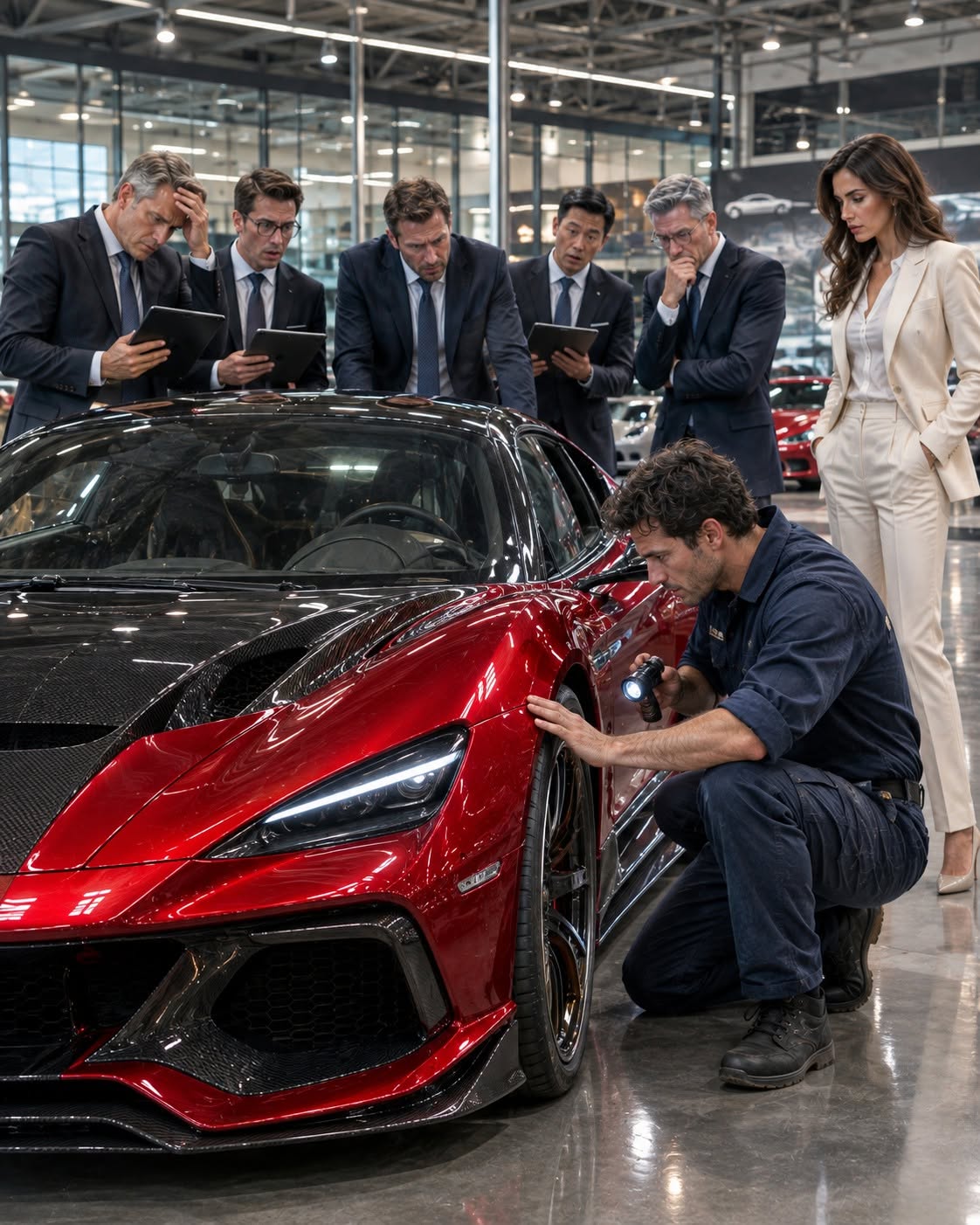
Five elite engineering teams had spent hours trying to start a billionaire’s luxury sports car. Then a mechanic in an ordinary work shirt walked into the garage
THE MECHANIC WHO KNEW TOO MUCH
“Then there’s something I need to ask you…”
Eleanor stood beside the driver’s door, her eyes fixed on me. The engine was still ticking softly as it cooled, and the five engineering teams remained gathered around the vehicle.
I closed the latch on my toolbox.
“Go ahead.”
She hesitated before speaking.
“Twenty-three years ago, a senior engineer at our European research facility disappeared from the automotive industry. His name was Daniel Carter. He was considered one of the most brilliant powertrain engineers of his generation. Do you know him?”
For the first time that afternoon, I felt my confidence disappear.
I looked at her carefully.
“Why are you asking?”
Eleanor reached into her handbag and pulled out a thin black folder.
“Because I believe you’re the man I’ve been looking for.”
Nobody spoke.
One of the engineers looked from Eleanor to me, clearly trying to understand what was happening.
I stared at the folder.
On its cover was a familiar logo. A silver eagle surrounded by a circle.
I hadn’t seen that symbol in more than two decades.
It belonged to Veyron Automotive, the manufacturer where I had once worked as a senior powertrain development engineer.
I slowly exhaled.
“Where did you get that?”
Eleanor opened the folder.
Inside was an old photograph showing six engineers standing beside an experimental sports car. They were younger, smiling, and covered in grease after what appeared to have been a successful testing session.
I recognized every face.
And I recognized the man standing in the middle.
Me.
“That’s Daniel Carter,” Eleanor said quietly. “The engineer who designed the original adaptive powertrain architecture used in this vehicle.”
I nodded.
“That was a long time ago.”
She studied my face.
“Why did you leave?”
I looked toward the car.
“Because sometimes knowing how something works isn’t enough to protect it from the people who control it.”
That answer seemed to surprise her.
Before she could ask another question, a tall engineer in a dark blue suit stepped forward.
His name was Marcus Reed, and he had been leading one of the five technical teams.
“With all due respect, Eleanor, this is getting a little ridiculous. We have a vehicle that has successfully started. We should finish our inspection and move on.”
Eleanor didn’t look at him.
“Marcus, I haven’t finished.”
He folded his arms.
“Whatever his previous position was, we still need documented evidence before we accept his conclusions.”
I almost smiled.
Twenty-three years ago, I had heard that exact tone from people who were more interested in protecting their positions than solving problems.
“He’s right about one thing,” I said.
Everyone turned toward me.
“The car started, but that doesn’t mean the problem is solved.”
Marcus frowned.
“What are you talking about? The engine is running perfectly.”
I walked back toward the front wheel.
“That sensor didn’t move by itself.”
I pointed to the bracket I had just adjusted.
“The mounting screws show signs of recent disturbance. Someone moved this assembly deliberately.”
A younger engineer crouched beside me.
“That’s possible, but why would anyone do that?”
“To trigger a safety lockout,” I answered. “And to make the problem look like an electronic failure.”
Marcus shook his head.
“That’s speculation.”
I didn’t argue.
Instead, I asked Eleanor a question.
“When did this car last receive a major service?”
“Three days ago. At our manufacturer’s authorized facility.”
“Who had access to it?”
“Several technicians. The service manager. My driver. Why?”
I examined the bracket again.
“Because whoever touched this knew exactly which component to adjust. This wasn’t an accidental mistake.”
The garage became unusually quiet.
Eleanor turned toward Marcus.
“Can your team check the maintenance records?”
“Of course,” he replied, although his expression had changed.
He signaled to one of his engineers.
Within minutes, a laptop was connected to the vehicle’s diagnostic interface.
The engineer examined the maintenance history, then frowned.
“There’s something strange here.”
“What?” Eleanor asked.
“The vehicle’s service log shows a temperature sensor calibration performed yesterday evening. But the record of the technician who authorized it is missing.”
Marcus immediately stepped closer.
“That shouldn’t be possible.”
The engineer continued scrolling.
“There’s also a maintenance override recorded at 11:47 p.m. The system identifies the access card, but the employee profile has been deleted.”
Eleanor’s expression hardened.
“Deleted by whom?”
Nobody answered.
I stood up and looked at the group.
“Now you understand why I didn’t want everyone celebrating just because the engine started.”
Eleanor closed the folder.
“Daniel, I need you to come upstairs with me.”
I glanced at my toolbox.
“I’ve got a garage to run.”
“Please.”
There was something in her voice that made me stop.
It wasn’t the tone of a billionaire accustomed to giving orders.
It was the voice of someone who had just discovered that the problem in front of her was much bigger than she had imagined.
I agreed.
But before leaving, I turned to Marcus.
“Don’t let anyone touch that bracket again. Photograph everything, preserve the service logs, and don’t reset the diagnostic history.”
He nodded reluctantly.
For the first time that afternoon, he seemed willing to listen.
THE SECRET I HAD BURIED
Eleanor’s private office occupied the top floor of the hotel.
It was a beautiful room overlooking the city, with glass walls, expensive furniture, and a long conference table.
But I barely noticed any of it.
My attention was on the photograph she had placed in front of me.
Twenty-three years earlier, I had been part of a small team developing an advanced powertrain control system for Veyron Automotive.
Our project was called AURORA.
The idea was simple but ambitious: create a vehicle whose mechanical and electronic systems could communicate continuously, adjusting performance and safety functions in real time.
It was supposed to make high-performance vehicles more efficient, more reliable, and safer.
I had spent six years helping develop the architecture.
My specialty was understanding the relationship between mechanical components and electronic control systems.
I believed the most sophisticated computer in the world was useless if the physical machine underneath it wasn’t properly understood.
At the time, my closest colleague was a brilliant systems engineer named Thomas Hale.
Thomas and I worked together almost every day.
We argued over designs, tested prototypes through the night, and celebrated every small breakthrough.
He was more than a colleague.
He was my friend.
Then, shortly before the first major production release, I discovered something troubling.
Several safety limits in the AURORA system had been modified.
The changes were designed to make the vehicles appear more powerful during performance testing, but they also reduced certain protective margins under extreme conditions.
I reported the issue.
My concerns were dismissed.
A week later, I discovered that the modifications had been approved under my engineering credentials.
Someone had used my authorization.
I confronted Thomas.
He looked exhausted.
“Daniel, you don’t understand the pressure we’re under,” he told me.
“People’s safety isn’t negotiable,” I replied.
He looked away.
“Sometimes the company has to make difficult decisions.”
I knew then that something had changed between us.
I refused to sign the final approval documents.
Two days later, the company announced that I had voluntarily resigned after disagreements with management.
The internal investigation blamed me for delaying the project.
My professional reputation collapsed almost overnight.
I lost my position, my savings, and eventually the house I had bought with my wife.
Thomas never contacted me again.
I moved to a small town, opened an independent repair shop, and tried to build a life that didn’t depend on anyone believing my version of events.
My wife, Margaret, stood beside me through the worst years.
When people asked why I had abandoned such a promising career, she always gave the same answer.
“Because he wanted to be able to sleep at night.”
She passed away eight years ago.
Since then, I had found comfort in simple work.
Fixing an engine.
Helping a stranded driver.
Teaching a young apprentice how to diagnose a problem without immediately blaming the computer.
I had stopped thinking about AURORA.
Until that afternoon.
Eleanor’s voice brought me back to the present.
“Daniel, I know about the investigation.”
I looked at her.
“What investigation?”
She turned her laptop toward me.
A document appeared on the screen.
It was an internal Veyron Automotive report dated twenty-three years earlier.
The final page contained a familiar signature.
Thomas Hale.
My former friend had signed a statement claiming that I had deliberately altered the safety architecture.
I stared at the document.
“Where did you find this?”
“My father was one of the original investors in Veyron. He kept a private archive of documents relating to the company’s early development.”
She paused.
“When he died, I inherited everything.”
I leaned back.
“Why are you showing me this?”
“Because I’m the new majority shareholder of Veyron Automotive.”
I blinked.
That was something I hadn’t known.
Eleanor continued.
“For the past eighteen months, I’ve been investigating irregularities in the company. Financial records, engineering approvals, internal reports. I’ve found evidence that someone has been concealing technical problems for years.”
She opened another file.
“Three months ago, I discovered a confidential report connecting the original AURORA project to several recent vehicle failures.”
My stomach tightened.
“How many?”
“Four serious incidents. All involving the same powertrain architecture.”
“And the company?”
“They blamed maintenance errors, unauthorized modifications, and driver behavior.”
I looked at the screen.
The architecture I had helped create was still being used.
But the system had evolved.
Someone had changed it.
“Why did you search for me?” I asked.
Eleanor looked directly at me.
“Because my father believed you were the only person who truly understood the original system. Before he died, he told me something I never forgot.”
She opened a small handwritten note.
The handwriting was old-fashioned and slightly shaky.
It read:
If the AURORA system ever becomes a danger, find Daniel Carter. He will know where the truth is buried.
For several seconds, I couldn’t speak.
I had spent twenty-three years believing that everyone who mattered had forgotten me.
Apparently, one person hadn’t.
“There’s something else,” Eleanor said.
“What’s that?”
She hesitated.
“The vehicle in the garage wasn’t supposed to be here today.”
I frowned.
“What do you mean?”
“It was scheduled for a confidential inspection at our European engineering facility. Someone changed the transport arrangements at the last minute and sent it to this hotel.”
I looked at her.
“Why?”
“Because I was supposed to drive it to a private meeting tomorrow.”
She took a breath.
“And that meeting concerns the future of Veyron Automotive.”
I began to understand.
The car hadn’t simply broken down.
Someone had made sure it would stop.
And perhaps the person responsible knew exactly who might be called to fix it.
THE NAME ON THE SCREEN
The next morning, Eleanor arranged an emergency meeting at Veyron’s regional headquarters.
I almost refused to attend.
I hadn’t worn a suit in years, and I had no interest in walking into a room full of executives who might still remember the man they had once blamed for their mistakes.
But Eleanor insisted.
“You don’t have to prove anything to them,” she said. “I just need someone who understands the technology.”
When we arrived, twelve executives were waiting.
Marcus Reed was there, along with several senior engineers from the previous day’s inspection.
At the far end of the table sat an older man with silver hair.
I stopped walking.
Thomas Hale.
He looked different.
His face was thinner, his hair almost completely white, and his posture had lost the confidence I remembered.
But I recognized him immediately.
He looked at me.
For a moment, neither of us spoke.
Then he stood.
“Daniel.”
I nodded.
“Thomas.”
Eleanor noticed the exchange.
“You two know each other?”
“Very well,” I answered.
Thomas slowly sat down.
The meeting began.
Eleanor presented the evidence she had gathered over the previous eighteen months.
There were altered service records, unexplained software updates, missing engineering approvals, and a series of safety incidents that had never been properly investigated.
The room grew increasingly uncomfortable.
Marcus finally interrupted.
“These documents don’t prove intentional wrongdoing. Software systems are complicated. Mistakes happen.”
I looked at him.
“Of course they do. That’s why we investigate them.”
He frowned.
“Are you suggesting the company deliberately compromised its own vehicles?”
“I’m suggesting someone needs to examine the original engineering records before making excuses.”
Thomas remained silent.
Eleanor turned toward him.
“Thomas, you led the technical division responsible for these systems. Can you explain why the calibration records were altered?”
Thomas adjusted his glasses.
“The current platform is far more complicated than the original AURORA design. There have been hundreds of revisions over the years.”
“That wasn’t my question,” Eleanor replied.
He looked down.
I studied him.
There was something familiar in his expression.
Not confidence.
Fear.
“Thomas,” I said quietly, “do you remember the prototype we tested in Stuttgart?”
His head lifted.
“The black one?”
“The one that repeatedly overheated during high-load testing.”
He nodded.
“You remember what we discovered?”
He said nothing.
I continued.
“The temperature sensor wasn’t giving us an accurate reading because the mounting bracket was vibrating under certain conditions. We redesigned it, reinforced the mounting points, and changed the calibration procedure.”
Thomas looked at me.
“That was twenty-three years ago.”
“Exactly. And yesterday, I found the same vulnerability on Eleanor’s car.”
The room went silent.
I leaned forward.
“Someone had moved the sensor bracket just enough to trigger a safety lockout. But the service records show that a calibration override was performed before the vehicle arrived at the hotel.”
I turned toward the engineering team.
“That means the problem wasn’t simply a loose component. Someone deliberately altered the system and then erased the evidence.”
Marcus shifted in his chair.
“That’s a serious accusation.”
“It’s a serious machine,” I replied.
Eleanor placed another document on the screen.
It was a record of the access card used to authorize the previous night’s service operation.
A name appeared.
Thomas Hale.
Everyone turned toward him.
His face lost its color.
For a long time, he stared at the screen.
Then he slowly removed his glasses.
“I can explain.”
Eleanor’s voice was cold.
“Then explain.”
Thomas looked at me.
And what he said next was something I had never expected to hear.
“I didn’t move the bracket to destroy the car. I moved it because I was trying to stop something much worse.”
THE REAL REASON
Thomas asked for the room to be cleared.
Eleanor refused.
“Whatever you have to say, you can say it in front of everyone.”
He nodded slowly.
Then he opened a briefcase and removed a small encrypted storage device.
“Six months ago, I discovered that a group within the company had been conducting unauthorized experiments on the AURORA architecture.”
He connected the device to the conference room computer.
A series of engineering reports appeared.
The project involved a new software package called VECTOR.
It was designed to give vehicles greater autonomous control over certain performance and safety functions.
On paper, it was an impressive innovation.
In reality, it contained a dangerous flaw.
The software could override certain sensor readings when the system detected inconsistent information.
Instead of always shutting down, the vehicle could sometimes substitute calculated values for actual measurements.
Under ordinary conditions, this might not create an obvious problem.
But during certain high-temperature operating conditions, the system could make decisions based on incorrect data.
A vehicle might continue running when it should enter a protective shutdown.
I felt a chill.
“Who approved this?”
Thomas looked at the floor.
“Marcus.”
Everyone turned toward the engineering director.
Marcus stood abruptly.
“That’s nonsense.”
Thomas continued.
“The company was preparing to demonstrate VECTOR to potential investors. They needed impressive performance numbers. Several safety warnings were suppressed during testing.”
Eleanor’s expression darkened.
“And the four incidents?”
Thomas nodded.
“Two were directly connected to the experimental software. The other two are still being investigated.”
I stared at him.
“Why didn’t you report this?”
Thomas closed his eyes.
“Because I was responsible for the original system. I knew what would happen if the truth came out.”
“That’s not an answer.”
“I was afraid.”
His voice cracked.
“Twenty-three years ago, I chose the company over you. I told myself it was temporary. I told myself I could fix things from the inside. But every year, the compromises became bigger.”
He looked at me.
“When I discovered what Marcus was doing, I tried to stop him. I moved the sensor bracket on Eleanor’s vehicle because I wanted the car to enter a safe lockout before the demonstration.”
I stared at him.
“You could have told her.”
“I tried. My messages were intercepted. I didn’t know who I could trust.”
“Then why did you erase the service record?”
He lowered his head.
“Because I knew the company would trace it to me before I could provide the evidence.”
The room was silent.
I understood what he was saying.
But understanding wasn’t the same as forgiving.
“You put people at risk,” I said.
Thomas nodded.
“I know.”
“And you used the same system you once helped me design.”
“I know.”
“Then you should have known better.”
He had no answer.
Eleanor turned toward Marcus.
“Is any of this true?”
Marcus looked around the room.
For a moment, I thought he might deny everything.
Then he smiled.
It wasn’t a friendly smile.
“You people are making a mistake.”
He picked up his phone.
“The VECTOR project has already been approved by the board. The contracts have been signed. The demonstration is scheduled for tomorrow. You can’t stop it because of some old engineering reports.”
Eleanor stood.
“I can stop anything that puts customers in danger.”
Marcus looked directly at her.
“Not without evidence.”
Thomas pushed the storage device toward her.
“Everything is here. Original testing records, internal messages, and the complete list of modified approvals.”
Marcus’s expression changed.
He reached for the device.
But Eleanor moved it out of his reach.
“Security,” she said.
Two members of the building’s security team entered.
Marcus began shouting about lawyers, shareholders, and contractual obligations.
But the meeting was already over.
For the first time in twenty-three years, the truth was no longer buried.
Yet I knew the hardest part was still ahead.
THE DEMONSTRATION
The following morning, Veyron Automotive was scheduled to unveil its newest flagship vehicle at a private event.
Hundreds of journalists, investors, and industry representatives had gathered at a testing facility outside the city.
The centerpiece was a silver prototype equipped with the VECTOR system.
Eleanor had already ordered the demonstration suspended.
But the board had not agreed.
Several directors feared the financial consequences of canceling the event.
They argued that the technical issues were exaggerated and that the company could address them after the launch.
Eleanor called me at six in the morning.
“Daniel, I need your help.”
I was standing in my garage, preparing to open for the day.
“What happened?”
“The board has refused to postpone the demonstration. They’re claiming Thomas’s evidence is unreliable.”
I looked at the old photograph hanging above my workbench.
“What do you want me to do?”
“I want you to inspect the prototype.”
I was quiet for a moment.
“Does the vehicle contain the same architecture?”
“Yes.”
“Then I’ll come.”
Two hours later, I stood inside the testing facility.
The silver prototype was surrounded by cameras and engineers.
Marcus wasn’t there.
He had been suspended pending an investigation, but several executives were still determined to proceed.
A senior engineer approached me.
“We’ve completed the standard inspection. The vehicle is safe.”
I looked at him.
“Have you completed an independent mechanical inspection?”
He hesitated.
“Not yet.”
“Then you haven’t completed the inspection.”
I walked around the prototype.
Everything looked immaculate.
The bodywork was perfect, the wheels were spotless, and the interior looked like something from the future.
But I wasn’t interested in how beautiful the car looked.
I wanted to understand how it behaved.
I connected a diagnostic instrument and began reviewing the temperature sensor data.
At first, everything appeared normal.
Then I noticed something.
The sensor readings were being corrected by the VECTOR software.
The system was no longer relying entirely on the physical measurements.
It was calculating what it believed the readings should be.
I looked at the engineer.
“Who approved this calibration method?”
He checked the screen.
“It’s part of the new software package.”
“That’s not what I asked.”
He said nothing.
I continued examining the system.
Then I found the real problem.
The sensor wasn’t simply miscalibrated.
A secondary safety threshold had been altered.
If the primary sensor produced an inconsistent reading, the software could ignore it and continue operating using a calculated value.
Under certain conditions, that could delay a protective shutdown.
I stepped away from the vehicle.
“Nobody starts this car.”
An executive immediately approached.
“That’s absurd. The demonstration is in less than an hour.”
I pointed to the screen.
“Look at the secondary safety threshold.”
He glanced at the figures.
“I don’t understand what I’m looking at.”
“Then you should be even more concerned about letting this vehicle operate.”
Eleanor arrived moments later.
She looked at the diagnostic display.
“Can you prove it’s dangerous?”
I nodded.
“Yes. But I need the original calibration files and a controlled test environment.”
She turned to the technical director.
“Get him everything he needs.”
The next forty minutes were tense.
We compared the prototype’s current configuration with the original AURORA safety specifications.
The differences were unmistakable.
Several protective limits had been changed.
Some of the modifications were small.
Others were significant.
The final report showed that the software could produce misleading temperature data under specific operating conditions.
I printed the results and handed them to Eleanor.
She read the first page.
Then the second.
Her expression became increasingly serious.
“How long has this been happening?”
“Based on these records, at least fourteen months.”
She looked toward the stage where the unveiling was scheduled.
A large screen displayed the words:
THE FUTURE OF PERFORMANCE.
People were already taking their seats.
Eleanor turned toward me.
“Can you explain this to them?”
I looked at the crowd.
I hadn’t spoken in front of hundreds of people since my career ended.
My hands suddenly felt unfamiliar.
But I thought about the four incidents.
I thought about the engineers who had raised concerns and been ignored.
And I thought about the people who would eventually buy these vehicles, trusting that someone had made sure they were safe.
“Yes,” I said.
“I can.”
THE MOMENT EVERYTHING CHANGED
The event began at ten o’clock.
A presenter introduced the company, praised its engineering achievements, and described VECTOR as a revolutionary advancement in automotive technology.
Then Eleanor walked onto the stage.
She took the microphone.
“Before we begin, I have an announcement.”
The audience settled.
“Today’s demonstration has been canceled.”
A murmur spread through the room.
The presenter looked confused.
Eleanor continued.
“We have identified serious discrepancies in the safety configuration of the vehicle scheduled for today’s demonstration. Until an independent investigation is completed, Veyron will not release this technology.”
An executive near the front immediately stood up.
“Eleanor, we need to discuss this privately.”
She ignored him.
“We have spent years telling customers that innovation means progress. But progress without responsibility is simply recklessness.”
She gestured toward me.
“Today, I want you to hear from someone who helped build the foundation of this technology.”
I walked onto the stage.
The lights were brighter than I expected.
Hundreds of faces looked up at me.
Some were curious.
Others were skeptical.
I placed my toolbox beside the microphone.
“I used to work for Veyron Automotive,” I began. “Twenty-three years ago, I helped develop the original AURORA powertrain architecture.”
A few people in the audience exchanged glances.
“I left the company after refusing to approve changes that I believed would compromise safety. For many years, I thought that chapter of my life was over.”
I paused.
“But yesterday, I discovered that the same engineering principles were still being used. And I also discovered that some of the safeguards we built had been altered.”
I displayed the diagnostic results.
Then I explained the problem in simple terms.
I told them how a sensor could provide inaccurate information, how software could interpret that information incorrectly, and how a safety system could make a dangerous decision if its protective limits were weakened.
I didn’t exaggerate.
I didn’t insult anyone.
I simply showed the evidence.
When I finished, a journalist raised her hand.
“Are you saying that the company knowingly sold unsafe vehicles?”
I considered the question.
“I’m saying the company needs to investigate what happened, identify everyone responsible, and make sure every affected customer is protected. That’s more important than finding the most dramatic headline.”
Another journalist asked:
“Do you blame the engineers?”
I shook my head.
“No. Most engineers want to build something they can be proud of. But even the most talented people need the courage to speak when something is wrong.”
A man in the second row stood.
“Why should we trust you? You haven’t worked in the industry for decades.”
I looked at him.
“That’s a fair question.”
Then I opened my toolbox.
Inside was an old metal identification badge.
The edges were scratched, and the photograph had faded.
I placed it on the table.
“This badge belonged to the engineer who signed the original safety architecture. I kept it because I never wanted to forget why I left.”
I looked around the room.
“I may not have the newest equipment. I may not have a team of hundreds. But I know what I designed, I know what I tested, and I know what happens when people stop asking whether something is safe.”
Nobody interrupted.
Then someone began applauding.
A few more joined.
Within seconds, the entire room was standing.
I hadn’t expected it.
I certainly hadn’t come looking for it.
But as I looked across the audience, I realized that for the first time in twenty-three years, I no longer felt the need to defend myself.
The evidence had spoken.
A CONVERSATION TWENTY-THREE YEARS LATE
The investigation lasted four months.
Independent specialists examined the VECTOR software, reviewed the original engineering records, and inspected vehicles equipped with the affected architecture.
Their findings confirmed the problems we had identified.
The company issued a recall, suspended the software rollout, and established an independent safety review board.
Marcus Reed and several other executives were removed from their positions after evidence of unauthorized modifications and concealed reports was presented to the appropriate authorities.
Thomas Hale cooperated fully with the investigation.
He also publicly admitted his role in the events that had destroyed my career.
One afternoon, he came to my garage.
I was replacing a worn alternator when I heard a car pull into the driveway.
I looked up.
Thomas stepped out.
For several seconds, neither of us moved.
Then he walked toward me.
“I wasn’t sure you’d see me.”
I wiped my hands.
“You’ve found the place.”
He glanced around.
The garage was small, with two work bays, an old refrigerator, and shelves crowded with spare parts.
It was nothing like the engineering facilities where we had once worked.
But I had built it with my own hands.
Thomas looked at the tools on the wall.
“You always said you’d rather have one good wrench than a hundred people telling you what was wrong.”
I almost laughed.
“Some things don’t change.”
He became serious.
“Daniel, I owe you an apology.”
I waited.
“I knew you were innocent when the company blamed you. I had seen the original reports. I knew the authorization had been forged.”
His voice trembled.
“But I was afraid of losing my position. My family depended on my income. I told myself that if I stayed, I could eventually correct everything.”
He looked down.
“Instead, I let them destroy your reputation.”
I didn’t answer immediately.
I thought about the years I had spent rebuilding my life.
The nights when I wondered whether I had made the wrong decision.
The opportunities I had lost.
The friends who had disappeared.
Then I looked at Thomas.
“Do you know what hurt the most?”
He shook his head.
“It wasn’t losing my job. It wasn’t losing the house or the money. It was knowing that the person who understood exactly why I was fighting had chosen to stand on the other side.”
Thomas’s eyes filled with tears.
“I’m sorry.”
I nodded.
“I believe you.”
He looked relieved.
But I wasn’t finished.
“That doesn’t mean everything is suddenly the same. Trust isn’t something you can repair with one conversation.”
“I understand.”
We stood in silence.
Then I handed him a cup of coffee.
It wasn’t a grand reconciliation.
There was no dramatic handshake.
Just two older men standing in a small garage, finally saying things they should have said decades earlier.
Sometimes that is the best beginning people can hope for.
THE OFFER
A week later, Eleanor visited my garage.
She arrived without a driver, wearing jeans and a simple jacket.
I was surprised to see her.
“Everything all right?”
She smiled.
“Better than it was four months ago.”
She looked around the garage.
“I’ve been thinking about something.”
I put down my wrench.
“That sounds expensive.”
She laughed.
“Not necessarily.”
Then she placed a document on my workbench.
It was a proposal.
Veyron Automotive wanted me to return as an independent chief engineering adviser.
The position would allow me to review safety-critical systems, supervise independent testing, and help establish a new engineering training program.
The compensation was substantial.
More money than I had earned in several years combined.
I read the document twice.
Then I closed it.
“I appreciate the offer.”
Eleanor smiled.
“That sounds promising.”
“But I can’t accept it.”
Her smile faded slightly.
“May I ask why?”
I pointed around the garage.
“Because this place belongs to me. I built it when I had nothing else. I don’t want to spend the rest of my life sitting in executive meetings, explaining why a bolt needs to be tightened properly.”
She looked disappointed.
“Then what would you accept?”
I thought for a moment.
“I’d help you build something different.”
“What?”
“A training center. Not another expensive research facility filled with people competing over titles. A place where young engineers can learn how machines actually work.”
I continued.
“Let them spend time in workshops. Let them take things apart. Let them understand the relationship between software and physical components. Teach them that a warning light isn’t an inconvenience. It’s a conversation between a machine and the person responsible for it.”
Eleanor listened carefully.
“And what would you want in return?”
“Nothing for myself.”
I paused.
“But I want the program to be open to students who can’t afford expensive engineering schools. I want scholarships for people from ordinary backgrounds. And I want the safety department to report independently, without pressure from sales or marketing.”
Eleanor smiled.
“That can be arranged.”
I raised an eyebrow.
“Just like that?”
“Just like that.”
She picked up the proposal.
“I think we should rewrite it.”
And that was how the Carter Engineering Initiative began.
THE FIRST STUDENT
One year later, I stood inside a newly renovated training workshop on the outskirts of the city.
It wasn’t a glamorous building.
There were no marble floors or expensive decorations.
Instead, it had workbenches, engines, diagnostic equipment, classrooms, and a large open space where students could work on real machines.
The first group consisted of thirty young people.
Some came from technical colleges.
Others had learned mechanical skills by helping their parents repair vehicles.
One young woman named Lily stood near the back.
She was nineteen and had traveled several hours to attend the program.
During the first week, she barely spoke.
But she was always the first to arrive and the last to leave.
One afternoon, I found her staring at a dismantled engine.
“What’s wrong?” I asked.
She pointed toward a small sensor assembly.
“I understand what the computer says, but I don’t understand why the reading changes when the engine vibrates.”
I smiled.
“Good.”
She looked confused.
“Good?”
“That means you’ve found a question worth asking.”
I pulled up a chair.
We spent the next hour examining the mounting bracket, the wiring, and the way vibration affected the sensor.
At the end, she looked at me.
“Why don’t they teach this in our regular classes?”
“Because sometimes people become so interested in the answers that they forget how important the questions are.”
She smiled.
A few months later, Lily presented a project on sensor reliability and mechanical vibration.
Her work was selected for a national engineering competition.
She won first place.
When the judges asked what inspired her, she gave a simple answer.
“My instructor taught me that the most important problem in a machine isn’t always the biggest component. Sometimes it’s the smallest thing everyone else overlooks.”
I watched from the audience.
For some reason, I thought about Margaret.
She would have loved that moment.
THE LAST VISIT
Three years after the incident, Eleanor returned to the training center.
She had brought a framed photograph.
It showed the silver sports car from the hotel garage.
Beside it stood five engineers, Thomas, Eleanor, and me.
Everyone was smiling.
She placed it on the wall near the entrance.
“Do you remember that day?” she asked.
“Unfortunately, yes. My knees hurt just thinking about that garage floor.”
She laughed.
Then her expression became thoughtful.
“Do you know what changed the most after that day?”
I looked at her.
“The company?”
“Not the company. Me.”
She walked toward the workshop windows.
“I used to think leadership meant hiring the smartest people, buying the best equipment, and making sure everyone followed the plan. I believed that if I surrounded myself with enough experts, the right answers would eventually appear.”
She turned toward me.
“But that day, five teams couldn’t solve a problem that you noticed in minutes.”
I shook my head.
“They weren’t stupid. They were looking at the wrong things.”
“Exactly.”
She smiled.
“And I nearly made the same mistake. I almost dismissed you because you didn’t look like someone who belonged in that garage.”
I looked down at my worn work shirt.
“That’s why I keep wearing it.”
She laughed.
We stood together for a moment, watching the students working.
One group was examining an electric motor.
Another was studying an old transmission.
Lily was helping a younger student troubleshoot a diagnostic problem.
Eleanor spoke again.
“There’s one thing I’ve always wanted to ask you.”
“What?”
“That day, when I asked how you could be so sure about the sensor bracket, you never really answered me. What made you recognize the problem so quickly?”
I considered the question.
Then I looked across the workshop.
“Experience.”
She waited.
“But not the kind you get from collecting certificates or reading technical reports. I had seen that exact design years earlier. I remembered the way it behaved, the mistakes we made, and the solutions we tested.”
I paused.
“More importantly, I remembered that machines don’t care how important the person working on them is. They respond to reality, not someone’s job title.”
Eleanor smiled.
“That’s a good lesson.”
“It’s a lesson I learned the hard way.”
I turned toward the old photograph on the wall.
For years, I had believed my career ended when I left Veyron Automotive.
I had measured my success by the position I lost, the projects I never finished, and the recognition that never came.
But standing in that workshop, surrounded by young people learning to build things with their own hands, I finally understood something.
My career hadn’t ended.
It had simply changed direction.
I no longer designed engines for wealthy customers.
I helped build people who might one day design something better.
And that was worth more than any title.
Before Eleanor left, she stopped beside the photograph.
“Do you ever regret walking away from your old life?”
I thought about the question.
Then I shook my head.
“No.”
“Not even a little?”
“Sometimes I regret the years I spent believing that losing a position meant losing my purpose. But I don’t regret refusing to approve something I believed was wrong.”
She nodded.
I continued.
“Money can buy the newest diagnostic equipment. A company can hire the most expensive engineers. A billionaire can own the finest machine in the world.”
I looked toward the students.
“But none of those things can replace integrity, curiosity, or the courage to admit when something isn’t right.”
Eleanor smiled.
Then she walked toward the exit.
I returned to my workbench, where a young student was waiting with a confused expression.
“Mr. Carter?”
“Yes?”
“I think I’ve found something strange in this engine.”
I put down my coffee and walked over.
“Show me.”
He pointed toward a small metal bracket.
I crouched beside him.
For a moment, I studied the component.
Then I smiled.
“Well, that’s interesting.”
The student leaned closer.
“Is it serious?”
“Maybe. But let’s not guess. Let’s find out.”
And together, we began examining the machine.
Outside, the afternoon sun fell across the workshop floor.
Somewhere in the distance, an engine started.
I listened to its steady rhythm and smiled.
Twenty-three years earlier, I had walked away from a company because I refused to compromise what I believed in.
I had thought that decision cost me everything.
Now I knew the truth.
Sometimes the greatest measure of success isn’t how high you climb, how much money you earn, or how many people know your name.
It’s whether you can look at the work you’ve done, the people you’ve helped, and the choices you’ve made—and know that you never had to sacrifice your integrity to get there.
And sometimes, the person who sees what everyone else has missed isn’t the one with the biggest office, the newest computer, or the most impressive title.
Sometimes, he’s simply the mechanic who never stopped paying attention.