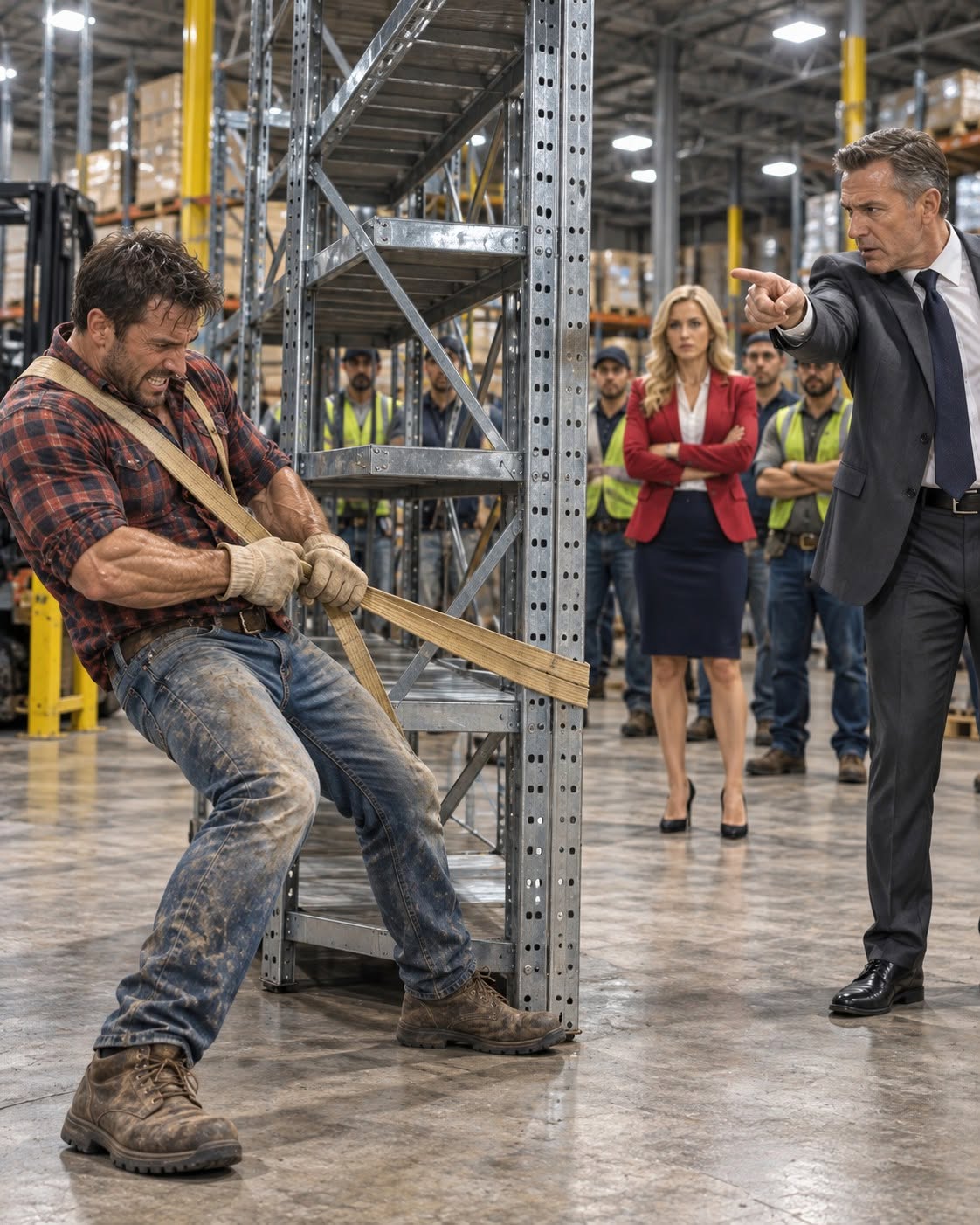
Every Friday at exactly 5:00 p.m., Nathan Mercer was forced to drag a heavy metal shelf across the warehouse floor
The following Monday, Nathan Mercer walked into the warehouse wearing the same faded work shirt he had worn for years. But for the first time in a long time, he no longer felt the need to keep his head down.
His new position on the industrial maintenance and safety team came with a modest office, a proper desk, and a salary that finally allowed him to sleep without calculating how many days remained before rent was due. Yet Nathan knew better than to believe that one promotion could erase every wound the past three years had left behind.
He still woke before dawn, still packed Sophie’s lunch, and still checked his bank account out of habit. Some fears took longer to disappear than the circumstances that created them.
What he didn’t expect was how quickly people would begin treating him differently.
Employees who had barely acknowledged him before now stopped to shake his hand. Supervisors praised his technical knowledge. A few people who had laughed when Julian forced him to drag the shelf suddenly seemed eager to become his friends.
Nathan accepted their greetings politely, but he paid attention to something else.
When an employee reported a damaged conveyor belt, he made sure the issue was recorded. When a new worker admitted he didn’t understand a safety procedure, Nathan took the time to explain it. And when a supervisor suggested postponing an inspection to meet a shipping deadline, Nathan calmly refused.
“We can make up for lost time,” he said. “We can’t make up for someone getting hurt.”
Word of that conversation traveled quickly through the building.
Some managers respected him for it. Others began to regard him as a problem.
Nathan understood that change was rarely welcomed by everyone, especially by people who had grown comfortable with the old way of doing things.
Then, three weeks after Julian’s dismissal, the warehouse faced its first serious test.
It happened on a rainy Thursday morning.
A shipment of electronic components had arrived late, leaving the distribution team under pressure to meet a major client’s deadline. Pallets filled the loading bays, forklifts moved constantly through the aisles, and supervisors hurried between workstations, demanding that everyone move faster.
Nathan was inspecting a conveyor system near the western loading area when he heard a sharp metallic click.
He stopped immediately.
The sound came again.
Click. Click.
It was faint, almost swallowed by the noise of the machinery, but Nathan recognized it. A bearing was failing somewhere inside the conveyor’s drive assembly.
He shut down the nearest section and opened the inspection panel.
The problem was worse than he expected. The bearing had overheated, damaging the surrounding housing. If the system continued running under a heavy load, the assembly could seize. In the worst case, a moving belt could throw components into the adjacent work area.
Nathan photographed the damage and submitted an urgent shutdown notice.
Five minutes later, Daniel Brooks, the warehouse’s new operations supervisor, arrived with a tight expression.
“Tell me you’re not shutting down the entire western line.”
“I’m shutting down the affected section until we determine whether the damage has spread.”
“Do you have any idea what this delay will cost us?”
“I know what a failure could cost us.”
Daniel glanced toward the loading bays, where workers were already waiting for instructions.
“Mercer, Julian is gone. We don’t need another person turning every little problem into a crisis.”
Nathan felt the old tension return to his shoulders.
For a moment, he was back at that worktable, watching Julian smirk while everyone else pretended not to see.
Then he remembered Sophie’s face when she had asked whether they could afford another bottle of medicine.
He had endured humiliation because he had feared losing everything.
He would not risk another person’s safety for the same reason.
“This isn’t a personal disagreement,” Nathan replied. “The inspection report is in the system. If you want the line restarted, you’ll need an independent assessment confirming it’s safe.”
Daniel’s jaw tightened.
“You’ve been here five minutes in your new role, and already you’re acting like you run the building.”
“No,” Nathan said quietly. “I’m acting like the equipment matters.”
Daniel walked away without answering.
By noon, the western line remained closed. The client had been notified of a possible delay, and senior management was demanding an explanation.
Nathan spent the afternoon coordinating with an external engineer. Their examination revealed a second damaged component hidden behind the drive assembly. It had been deteriorating for months.
The engineer looked at the inspection photographs and shook his head.
“Another few hours of operation under that load, and we might have had a serious accident.”
Nathan felt no satisfaction.
He imagined the people working beside that conveyor, the forklift operator who passed it every few minutes, and the employees who would have been blamed if something went wrong.
He had stopped a machine.
He might have saved someone’s life.
That evening, Evelyn Reed called him into her office.
On her desk lay the maintenance report, the engineer’s findings, and an email from Daniel complaining that Nathan had disrupted operations without sufficient authorization.
Evelyn read the complaint aloud, then set it down.
“Tell me what happened.”
Nathan explained everything, including Daniel’s warning about his new role.
When he finished, Evelyn leaned back in her chair.
“Do you know why I chose you for this position?”
“Because I understand the equipment?”
“Partly. But technical knowledge can be taught. What impressed me was that you continued documenting hazards even when nobody rewarded you for it.”
She paused.
“You know what worries me, Nathan? Julian wasn’t the only person who allowed a dangerous situation to continue. He was simply the person who made his behavior impossible to ignore.”
Nathan looked at the report.
“Then we need to make it harder for anyone else to do the same thing.”
For the next several weeks, he worked with the safety team to develop a new reporting system. Employees could submit concerns directly to an independent safety officer. Every report received a tracking number, a deadline for review, and a documented resolution. Supervisors could no longer quietly erase a warning without leaving a record.
Evelyn approved the changes.
Daniel did not welcome them.
He began questioning Nathan’s decisions in meetings, suggesting that his inspections were unnecessarily thorough and his recommendations too expensive. Whenever a repair threatened to delay a shipment, Daniel demanded additional justification.
Nathan responded with measurements, photographs, and maintenance histories.
He never insulted Daniel. He never raised his voice.
He simply refused to replace evidence with convenience.
Then came the night that changed everything.
At 11:40 p.m., Nathan received an emergency call from the warehouse.
A storm had knocked out power to part of the facility. The backup electrical system had activated, but a section of the automated storage area was no longer responding correctly. Several employees were still inside the affected zone, attempting to secure the inventory before the next shift arrived.
Nathan dressed quickly and drove through the rain.
When he reached the warehouse, warning lights flashed above the loading doors. Emergency generators rumbled in the distance, and supervisors were gathered around a control panel.
Daniel stood in the center of the group, visibly agitated.
“The system keeps reporting a fault,” he said. “We need to reset the controller and get the storage units moving again.”
Nathan examined the screen.
“Who is inside the automated zone?”
“Three employees. They’re finishing the inventory count.”
“Have they been evacuated?”
Daniel hesitated.
“They’re experienced. They know the equipment.”
“That wasn’t my question.”
Nathan looked at the system diagram. A power interruption had affected one of the position sensors. The controller could no longer reliably determine whether a mobile storage rack had reached its designated stopping point.
Restarting the system without verifying the sensor and confirming that the area was clear could cause a rack to move unexpectedly.
“Do not reset it,” Nathan said.
Daniel turned toward him.
“We’ve already lost hours. If we miss this shipment, the client could cancel the contract.”
“And if we restart the system while people are inside, they could be crushed.”
“We have procedures for this.”
“Then follow them.”
Daniel stepped closer.
“You think you can keep telling everyone what to do because the CEO likes you?”
Nathan felt the room go silent around them.
“This has nothing to do with the CEO,” he answered. “Get those employees out.”
He activated the emergency stop and instructed the team to isolate the affected equipment according to the site’s emergency procedures. The safety team began accounting for every employee in the zone while an electrician checked the backup system.
Minutes passed.
Then ten.
The rain hammered against the warehouse roof.
Finally, two employees emerged from the storage area, followed by a third carrying a flashlight. All three were shaken but unharmed.
The electrician continued his inspection.
At 12:26 a.m., he discovered that the faulty sensor had caused one storage rack to stop short of its expected position. Had the automated system restarted under the wrong position data, another rack could have moved into it, creating a dangerous collision.
Nathan stood beside the control panel, watching the engineer record the findings.
Daniel said nothing.
But the worst part of the night had not yet arrived.
During the investigation, the electrician discovered that a maintenance override had been activated earlier that evening. It had allowed the system to continue operating despite an intermittent sensor warning.
The override had been authorized using Daniel’s credentials.
When Evelyn arrived at the warehouse the following morning, she requested the access logs and spoke with every employee involved.
Daniel insisted he had approved the override only because the system appeared stable. He claimed he had expected the maintenance team to resolve the warning before the next shift.
Nathan presented the electronic records showing that the warning had first appeared two days earlier. His team had submitted a request to inspect the sensor, but the request had been marked low priority by operations management.
The records also showed that Daniel had approved continued operation after receiving the warning.
Evelyn’s expression hardened.
“Did you understand what this warning meant?”
Daniel stared at the table.
“I believed the risk was manageable.”
“Based on what assessment?”
“I was trying to protect the shipment.”
Evelyn folded her hands.
“You were protecting a deadline. Those are not the same thing as protecting this company.”
Daniel attempted to defend himself, arguing that Nathan’s strict approach made normal operations impossible.
Nathan remained silent until Evelyn turned to him.
“Do you have anything to add?”
He looked at Daniel, then at the three employees who had been brought into the meeting as witnesses.
“I think people make mistakes,” Nathan said. “I have made them too. But when a machine tells us something is wrong, we have to investigate. And when someone reports a danger, the answer cannot depend on whether the person reporting it has enough power to make us uncomfortable.”
Nobody spoke.
He continued.
“The problem isn’t that we stopped the system last night. The problem is that we nearly needed an accident to convince us the warning mattered.”
Evelyn ordered a formal investigation and suspended Daniel’s authority over equipment overrides while it proceeded.
The findings were delivered ten days later. Daniel had repeatedly downgraded safety issues to protect shipping targets, failed to ensure that requested inspections were completed, and authorized an override without the required technical clearance.
He was dismissed.
This time, the warehouse did not erupt in whispers or nervous laughter.
Employees understood that the decision had not been made because someone had embarrassed a manager. It had been made because documented choices had put people at risk.
For the first time in years, workers began reporting problems before those problems became emergencies.
And Nathan discovered something he had never expected: the hardest part of standing up for what was right was not facing one cruel boss. It was building a workplace where nobody had to depend on a brave person appearing at exactly the right moment.
Months passed.
The warehouse grew safer, although the transition was neither easy nor cheap. Some shipments were delayed. Some aging equipment had to be replaced. Managers complained about additional inspections, and executives demanded proof that the changes were worth their cost.
Nathan helped provide it.
His team tracked failures prevented, repairs completed, and hazards resolved before anyone was injured. Gradually, the company learned that safety was not an obstacle to productivity. It was one of the foundations that made productivity possible.
Evelyn later appointed Nathan to lead a new technical training program for maintenance workers across several distribution centers.
The promotion brought another increase in salary, but the greatest reward came on a Saturday morning when Sophie accompanied him to a company family event.
She was wearing a yellow dress and carrying her battered toy rabbit, its repaired ear now reinforced with a small piece of blue fabric.
As they entered the warehouse’s training room, a group of employees greeted Nathan warmly.
One of them crouched to Sophie’s height.
“Your dad is the person we call when we think something isn’t safe.”
Sophie looked up at Nathan.
“Because Daddy knows how to fix everything?”
The employee smiled.
“Because your dad knows when something needs fixing, even when other people don’t want to listen.”
Sophie considered that answer seriously.
Then she took Nathan’s hand.
“I’m glad you fixed the shelf, Daddy.”
Nathan’s smile faded into something gentler.
“I didn’t fix that shelf, sweetheart. We took it out of service because it wasn’t safe.”
“But you tried to fix it.”
“I did.”
“Even when they were mean to you?”
Nathan knelt beside her.
For a moment, he struggled to find words simple enough for a child to understand.
“Sometimes people are mean because they think being powerful means they can make other people feel small. But being strong isn’t about making someone else feel small, and it isn’t about letting someone hurt you forever.”
Sophie tilted her head.
“Then what is it?”
“It’s doing what you know is right, even when it’s difficult. And knowing that you deserve to be treated with kindness, too.”
She wrapped her arms around his neck.
Nathan held her close, breathing in the familiar scent of her shampoo. He thought about the long nights after his wife’s death, the overdue rent notices, the empty refrigerator, and the Fridays when he had dragged that damaged shelf while pretending the laughter did not hurt.
He had once believed survival meant enduring whatever came his way.
Now he understood that survival was only the beginning.
A good life required more than putting food on the table. It required dignity, safety, and the courage to refuse to let fear become an excuse for wrongdoing.
That afternoon, Nathan took Sophie to a small park near their apartment. They shared sandwiches on a bench and watched children chase one another across the grass.
For the first time in years, he had enough money to put aside a little each month. Their apartment was still modest, and he still had responsibilities that sometimes kept him awake at night. Grief had not vanished, and no promotion could bring his wife back.
But there was food in the refrigerator, medicine in the cabinet, and a growing sense that tomorrow might be kinder than yesterday.
As the sun began to set, Sophie pulled the toy rabbit from her backpack.
“Daddy, can you teach me how to fix things when I grow up?”
Nathan laughed softly.
“Of course.”
“Even big things?”
“Especially big things.”
She thought for a moment, then asked, “What if nobody listens to me?”
Nathan looked at his daughter, whose world was still small enough to believe that every problem had an answer if only someone knew how to find it.
“Then you keep your facts,” he told her. “You ask for help from people you trust. You speak clearly, and you don’t let anyone convince you that your voice doesn’t matter. And if someone is in danger, you do what you safely can to protect them.”
Sophie nodded as though he had given her a secret worth keeping.
Then she rested her head against his arm.
Across town, the warehouse continued its work. Trucks arrived and departed, conveyor belts carried their loads, and thousands of packages moved toward homes and businesses. Most people would never know how many quiet decisions had kept those operations running safely.
They would never know about the damaged shelf, the ignored reports, or the man who had refused to stop caring simply because nobody seemed to care about him.
That was all right with Nathan.
He no longer needed humiliation to be witnessed before he believed it mattered. Nor did he need applause to know that honest work had value.
What mattered was that workers could report a danger without fearing retaliation. What mattered was that a father could return home and look his daughter in the eyes, knowing he had not sacrificed someone else’s safety to protect his paycheck. What mattered was that Sophie was growing up in a world where strength did not have to mean cruelty, and kindness did not have to mean surrender.
On the following Friday, at exactly five o’clock, Nathan passed the place where the metal shelf had once stood.
A new, properly inspected unit occupied the area. Its wheels were secure, its frame was intact, and its maintenance records were displayed in the company’s tracking system.
Nobody ordered Nathan to move it.
Nobody gathered to laugh.
A young maintenance assistant approached him with a clipboard.
“Mr. Mercer, I found a problem with one of the loading bay supports. I’m not sure it’s serious, but I wanted to report it.”
Nathan took the clipboard and examined the photographs.
“Good catch,” he said. “Let’s inspect it together.”
The young man hesitated.
“I’m sorry if this turns out to be nothing. I don’t want to cause trouble.”
Nathan looked at him with the same patience he had once wished someone would show him.
“Reporting a concern isn’t causing trouble. Ignoring a real danger is what causes trouble.”
Together, they walked toward the loading bay.
The shift ended. Workers collected their bags, exchanged goodbyes, and headed home. Beyond the warehouse doors, the evening sky glowed orange over the Ohio highway.
Nathan drove home, where Sophie was waiting with a drawing she had made at daycare. It showed a tall man holding the hand of a little girl. Above them, she had drawn a bright yellow sun.
At the bottom, in uneven letters, she had written: MY DADDY IS BRAVE.
Nathan studied the drawing for a long time.
He knew he wasn’t brave every day. There had been moments when fear had nearly silenced him, when he had wondered whether doing the right thing was worth the risk. He had not won every battle through courage alone. Sometimes, he had survived because he was stubborn. Sometimes, because he had a daughter who needed him. And sometimes, because another person had finally chosen to listen.
He placed the drawing on the refrigerator, where it would greet him every morning.
Then he lifted Sophie into his arms.
“I love you, Daddy,” she whispered.
“I love you more than anything.”
That night, after Sophie fell asleep, Nathan sat at the kitchen table and opened a small notebook. He had begun keeping it after his wife’s death, recording expenses, repairs, and reminders for the difficult days ahead.
On a fresh page, he wrote a single sentence:
Never confuse the power to endure something with the obligation to accept it.
He read the words twice before closing the notebook.
For years, he had believed his silence was the price of being a good father. He had thought that protecting Sophie meant making himself small enough to avoid being noticed, no matter how much it hurt.
But his daughter had never needed a father who could endure every insult without complaint. She needed one who could teach her the difference between patience and fear, between humility and humiliation, and between keeping the peace and allowing injustice to continue.
Nathan had not changed the world in one dramatic moment. He had changed one workplace, one procedure, one decision at a time. He had learned that courage did not always arrive as a loud speech or a spectacular act. Sometimes it looked like a maintenance report filed for the third time. Sometimes it meant shutting down a dangerous machine while a room full of people demanded that it keep running. Sometimes it meant admitting that something was wrong and refusing to look away.
And sometimes, courage meant accepting help when it finally came.
The damaged shelf had once been a symbol of Nathan’s powerlessness. In the end, it became a reminder that no job title could make cruelty acceptable, no deadline could make a preventable injury worthwhile, and no person’s poverty could erase their right to dignity.
There would always be people like Julian, people who mistook fear for respect and obedience for loyalty. There would always be people who stayed silent because speaking seemed too costly.
But there could also be people who chose to listen, who recorded the truth, who stood beside a frightened coworker, and who refused to let convenience become more important than another human life.
Nathan couldn’t promise Sophie that she would never meet someone who tried to make her feel small.
He couldn’t promise her that doing the right thing would always bring a reward.
What he could promise was that her worth would never depend on another person’s approval, and that she would always have the right to speak when something was wrong.
In the quiet apartment, with the little girl’s drawing bright against the refrigerator, Nathan finally understood the lesson his difficult years had been trying to teach him.
Being strong was never about how much suffering a person could carry without making a sound.
It was about knowing what deserved to be carried, what needed to be changed, and when the courage to speak could protect someone else from having to suffer at all.
And that was the lesson Nathan hoped Sophie would remember long after she had forgotten the story of the warehouse shelf.
Because the greatest victory was not that the man who had humiliated him had lost his position.
It was that Nathan had kept his compassion without surrendering his dignity, had found his voice without becoming cruel, and had turned the pain he endured into something that made life safer for others.
The world had not become perfect.
But somewhere, in a warehouse outside Columbus, Ohio, a worker could now raise a concern without being laughed at. A machine could be stopped before it hurt someone. A manager could be held accountable for the choices he made.
And one little girl could grow up watching her father do honest work, stand up for what was right, and come home with his head held high.
Sometimes, that is how meaningful change begins.
Not with a powerful person making a grand promise, but with an ordinary person refusing to look away.
And not with the question, “How much can I endure?”
But with a better one:
“What can I do to make sure the next person doesn’t have to endure this, too?”