Britney tore my federal access card into pieces on our mother’s spotless kitchen floor, then smirked
Agent Harris waited for Britney to answer, but she kept looking at our mother as if Mom could somehow make the people in our kitchen disappear.
For the first time in her life, Britney had run out of people willing to clean up her mess before she had to face it.
“I was angry,” she finally said. “I didn’t think she would take it this far.”
Agent Harris made a note on his clipboard.
“Anger explains a possible motive. It doesn’t answer my question. Did you take the credential and deliberately destroy it?”
Britney’s lips tightened.
“Yes.”
Mom let out a sharp breath.
“Britney, don’t say anything else until your father gets here.”
Agent Harris glanced at her.
“She has the right to seek legal counsel. That decision is hers. Neither you nor I will make it for her.”
I stood beside the kitchen counter, still wearing the uniform I’d come home in, watching my mother discover that her usual methods of controlling a conversation weren’t working.
For years, she had been able to end almost any disagreement by declaring that I was too sensitive, too serious, or too obsessed with my career.
If Britney broke something, I was told to be understanding.
If Britney missed a commitment, I was expected to adjust my plans.
If I objected, Mom would remind me that family was supposed to come first.
But the torn pieces of my access card sat inside a clear evidence bag, and no amount of family history could put them back together.
Agent Harris turned toward me.
“Ma’am, I need you to walk me through the sequence of events from the moment you entered the house. Start with the time you arrived.”
I did exactly that.
I told him about the thirty-two-hour rotation, the forty-eight hours of mandatory rest, Britney’s demand that I attend her bridal tasting, and the argument that followed.
I described the pouch, the card, her refusal to return it, and the moment I heard the plastic crack.
I also told him about the call from Colonel Donovan and the accelerated deployment window.
Harris listened without interrupting.
When I finished, he asked whether anyone else had seen Britney destroy the card.
“My mother was here.”
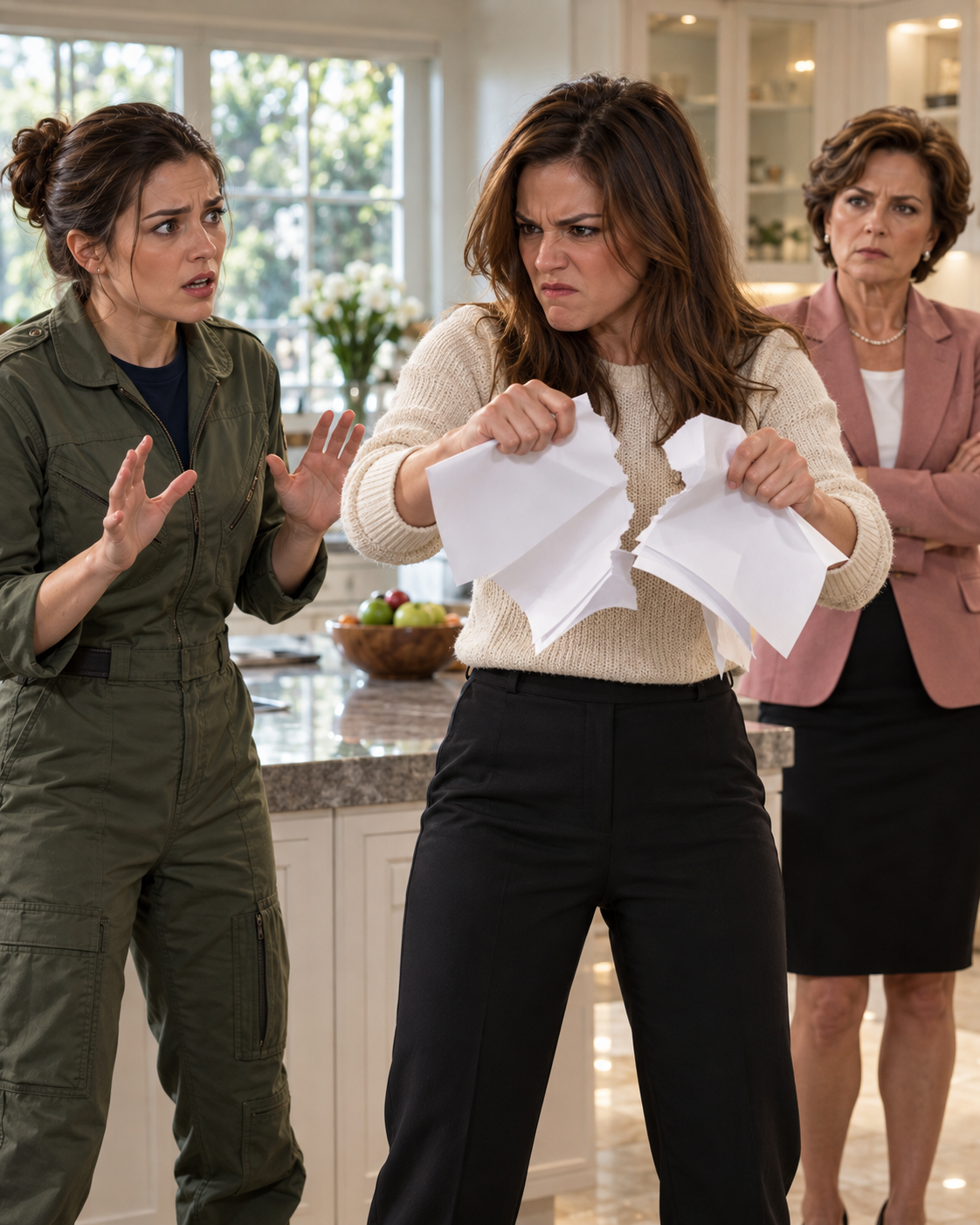
Mom immediately shook her head.
“I saw an argument. I didn’t see anything that would justify treating my daughter like a criminal.”
Harris turned to her.
“Did you see Britney take the credential?”
Mom hesitated.
“I saw her holding something.”
“Did you see her tear it?”
Her eyes flicked toward the evidence bag.
“I heard a noise.”
“That wasn’t my question, ma’am.”
The silence that followed was more revealing than any answer she could have given.
Britney crossed her arms.
“Mom, tell him I didn’t mean anything by it.”
Mom looked at her, then at me.
“I don’t think she understood what it was.”
“I told her,” I said quietly. “Twice.”
“You were shouting at her.”
“I was trying to stop her.”
“And now look what you’ve done,” Mom snapped. “You’ve brought federal agents into your own mother’s house.”
I looked around the kitchen.
The white cabinets, the polished counters, the little vase of flowers Mom had been arranging when I walked in.
Everything looked exactly as it had an hour earlier.
Only now, two investigators were photographing the floor, documenting the damaged credential, and asking questions that Mom couldn’t redirect.
“I didn’t bring them here,” I said. “Britney did.”
For once, Mom had no immediate response.
Agent Harris asked us to remain available while his team completed its initial documentation.
One agent photographed the area around the kitchen island. Another recorded the names of everyone present and collected the information needed for the investigation.
No one announced that Britney was going to prison.
No one promised that she would be charged with a particular federal offense.
The agents were careful about what they said, and I appreciated that more than I could explain.
My sister had done something serious. What happened next would depend on the facts, the applicable rules, and the decisions of the authorities responsible for the case.
I wasn’t there to decide her punishment.
I was there to report what had happened to a government credential entrusted to me.
My phone vibrated again.
Colonel Donovan.
I stepped into the adjoining hallway and answered.
“Sir.”
“Give me the current status.”
I explained that the OSI agents had arrived, that the credential fragments were secured, and that I had answered their initial questions.
“Good. Has anyone else handled the credential since it was damaged?”
“Not that I’m aware of, sir. I collected the visible fragments before the agents arrived.”
“Understood. Follow their instructions. Do not attempt to use the damaged credential or arrange an informal replacement. The security office will determine the proper recovery process.”
“Yes, sir.”
He paused.
“I also need you to understand something. Your deployment assignment is not the only consideration here. We have to establish whether the credential’s destruction created an access-control issue, whether any other information was exposed, and what steps are required to restore your authorization.”
“I understand.”
“Your orders have changed. Your reporting status will be handled through the appropriate channels. Don’t try to solve the scheduling problem yourself.”
“Yes, sir.”
His tone softened slightly.
“You did the right thing by reporting it immediately.”
I hadn’t realized how badly I needed to hear that until he said it.
For the past hour, my mother had treated my actions as a betrayal of the family.
Britney had treated them as an attack on her wedding.
My commander treated them as what they were: a security incident that needed to be handled properly.
When I returned to the kitchen, my father had arrived.
Richard had built a successful corporate consulting business, and he carried himself with the confidence of a man accustomed to having his calls returned.
He entered in a charcoal suit, took one look at the agents, and immediately assumed control of the room.
“I’m Richard Mitchell. Britney is my daughter. I understand there’s been a misunderstanding.”
Agent Harris introduced himself.
“We’re investigating the destruction of a government-issued credential.”
“My daughter was upset. She made a mistake. I’m sure there’s a reasonable way to resolve this without turning it into a federal matter.”
Harris remained composed.
“Sir, the nature of the incident determines how it will be handled. Your daughter may consult an attorney. We won’t speculate about the outcome before the investigation is complete.”
Dad looked at me.
“Why didn’t you just take the card away from her?”
I stared at him.
“I tried.”
“You’re stronger than she is.”
“That doesn’t change what happened.”
He lowered his voice.
“You could have stepped back. You could have let her calm down.”
“She had the card in her hand.”
“Then you could have called me before calling your commander.”
I felt the exhaustion in my bones, but I kept my voice level.
“Dad, my commander called me. My deployment window had changed, and he asked me to confirm my credential status. I reported the incident because I was required to report it.”
He rubbed his forehead.
“Now we have agents in the house, a wedding tasting tomorrow, and your mother is beside herself.”
I almost laughed at the absurdity of that sentence.
A government credential had been deliberately destroyed, and somehow the wedding tasting still occupied a place in his list of urgent concerns.
“What would you have preferred?” I asked. “That I lie to my commander?”
He looked away.
“I would have preferred that you use some judgment.”
For a moment, the kitchen was quiet enough that I could hear the refrigerator humming.
I thought about all the times I’d swallowed my anger to keep the peace.
The birthday dinners I’d missed because of duty.
The holidays I’d rearranged around leave schedules.
The money I’d sent home when Dad’s business had a difficult quarter, even though he never told our relatives about it.
The way Mom described Britney as the sensitive one and me as the capable one, as if capability meant I could absorb any amount of unfairness without complaint.
I had spent years believing that being the dependable daughter meant being the daughter who never made anyone uncomfortable.
I was beginning to understand how convenient that arrangement had been for everyone else.
Agent Harris approached Dad.
“Sir, we’d like to speak with Britney privately. She can have legal counsel present if she chooses. We’ll explain the process before proceeding.”
Dad immediately stepped between them and Britney.
“She isn’t going anywhere without an attorney.”
“That is her choice,” Harris replied.
Dad turned toward Britney.
“Don’t answer anything else.”
She nodded quickly.
Then, as the agents began arranging the next steps, she looked at me.
“You’re really going to let them do this?”
I felt something inside me shift.
Not anger. Not satisfaction.
Something quieter.
“I didn’t destroy your future, Britney. I reported what happened.”
Her eyes filled with tears.
“You know what this is going to do to my wedding.”
I looked at the wedding binder still lying open on the island.
A photograph of a white tent surrounded by flowers filled one page. On the next was a handwritten schedule of appointments, deposits, tastings, and fittings.
I’d seen that binder before.
Months earlier, I’d offered to help pay for some of the arrangements when Britney’s fiancé, Ethan, had lost several weeks of work.
I’d transferred the money without asking for anything in return.
I hadn’t told our parents because I didn’t want Britney to feel embarrassed.
Now she was looking at me as if I’d deliberately chosen the worst possible day to inconvenience her.
“I know you’re upset,” I said. “But you don’t get to decide that my orders stop mattering because your plans matter more.”
She wiped her face with the heel of her hand.
“I didn’t know it would become this big.”
“You knew I told you to stop.”
She opened her mouth, then closed it again.
For the first time that afternoon, she seemed unable to find a version of the story in which she was the only person who had been wronged.
The agents completed their initial work and explained that they would need to follow up as the investigation progressed.
Britney was not dramatically dragged out of the house.
There were no shouted accusations, no instant verdict, and no cinematic declaration that her life was over.
There were questions, records, statements, and the possibility of legal consequences that would take time to determine.
That was how real investigations worked.
And it was precisely that uncertainty that frightened my family.
Before leaving, Agent Harris spoke with me privately.
“We’ll coordinate with your security office regarding the credential and any further documentation. If you remember anything else, contact us through the official channel.”
“Understood.”
He glanced toward the kitchen.
“Don’t discuss the details of the investigation publicly. Keep your account factual, and let the process proceed.”
“I will.”
When the agents departed, the house felt strangely hollow.
Dad went into the living room to make calls.
Mom began picking up the flowers she’d abandoned earlier, rearranging stems that hadn’t moved.
Britney stood beside the island, staring at her wedding binder.
I went upstairs to shower and pack a fresh uniform.
My phone rang again before I reached the bathroom.
This time, it was the security office at my base.
They needed me to verify several details and confirm that I had not shared my credential or allowed anyone to use it.
I answered carefully, following the instructions I’d been given.
The officer explained that the replacement process would require formal verification and that my authorization status would be reviewed before I resumed duties requiring that credential.
I was not told that my entire unit had been compromised.
I was not told that every aircraft had been grounded.
The actual consequences were serious enough without inventing additional ones.
My immediate assignment would be affected, and the security team needed to establish the scope of the incident before clearing me.
By the time I finished the call, my shower water had gone cold.
I changed, sat on the edge of the bed, and looked at the family photograph on my dresser.
It had been taken three years earlier at Thanksgiving.
Dad stood in the center, Mom beside him, Britney leaning against his shoulder, and me at the end of the row in civilian clothes I’d borrowed because my luggage had been delayed.
Everyone was smiling.
I remembered that afternoon clearly.
Britney had been upset because Ethan hadn’t proposed yet. Mom spent most of dinner reassuring her that the proposal would happen soon.
When I mentioned that I’d received a new qualification at work, Dad congratulated me, then returned to asking Britney whether she’d chosen a venue.
I hadn’t minded at the time.
Or perhaps I had minded and simply decided it wasn’t worth admitting.
I put the photograph facedown.
Then I lay back on the bed and closed my eyes.
For the first time since returning home, I had nothing to do but wait.
I slept for four hours before a knock on the door woke me.
Mom stood in the hallway, holding a mug of tea.
“Your father wants us downstairs.”
“Is something wrong?”
“He wants to talk as a family.”
I looked at the mug.
“Did he call an attorney?”
“Yes.”
“Then he can talk to the attorney about the investigation.”
“This isn’t just about the investigation,” she said. “It’s about us.”
I nearly told her that she’d had plenty of opportunities to think about us before Britney tore my credential apart.
Instead, I got up and followed her downstairs.
Dad was seated at the dining table with his laptop open.
Britney sat across from him, her eyes swollen from crying.
A folder lay between them.
Dad gestured toward an empty chair.
“Sit down.”
I remained standing.
“What is this?”
“An opportunity to settle things before they get worse.”
He opened the folder.
Inside was a typed statement describing the incident as an accident caused by confusion over a personal identification card.
It said Britney had picked up the card without understanding its importance and had damaged it during a moment of distress.
It also suggested that I had exaggerated the seriousness of the incident because of an existing disagreement about the wedding.
I read the document twice.
Then I set it down.
“This isn’t what happened.”
Dad leaned back.
“It’s a proposed statement. You don’t have to sign it exactly as written.”
“It says she accidentally damaged a personal card. She deliberately tore a government credential after I told her to stop.”
“She was upset.”
“So was I.”
“That’s not the point.”
“Then what is the point?”
His jaw tightened.
“The point is that we have a chance to prevent a misunderstanding from becoming something that follows your sister for the rest of her life.”
I looked at Britney.
“Did you tell him you knew what the card was?”
She stared at the table.
“I knew it was important.”
“Did you know I was ordered to protect it?”
“I don’t know.”
“Did I tell you to give it back?”
She whispered, “Yes.”
“Did you tear it anyway?”
Her eyes filled again.
“Yes.”
I turned back to Dad.
“You can’t call that an accident just because the truth is inconvenient.”
He closed the folder.
“You’re prepared to destroy your relationship with your sister over this?”
I took a breath.
“No. I’m refusing to lie about what she did.”
Mom sat down beside Britney.
“Families make mistakes. We forgive each other.”
“Forgiveness isn’t the same as falsifying a report.”
“You make everything sound so cold.”
I looked at her for a long moment.
“I spent my entire childhood learning how to be the person who didn’t need anything. I thought that was what made me easy to love.”
Her expression changed, but I continued before I could lose my nerve.
“Every time Britney crossed a line, I was told to be patient. Every time I said no, I was told to be more understanding. I kept doing it because I thought eventually you’d see that I was trying.”
Mom’s fingers tightened around her mug.
“We love you.”
“I know you love me. I’m not sure you’ve ever understood that loving me doesn’t mean you can keep asking me to sacrifice things you would never ask Britney to sacrifice.”
No one spoke.
I picked up the proposed statement and slid it back across the table.
“I won’t sign this. If the investigators ask me questions, I’ll answer truthfully. That’s all I’m going to do.”
Dad’s face hardened.
“Then don’t expect us to protect you when this comes back on you.”
I stared at him.
“Protect me from what? The consequences of telling the truth?”
He didn’t answer.
I returned upstairs, packed the rest of my belongings, and called my unit to confirm my reporting instructions.
The next morning, I left the house before sunrise.
Mom stood by the front window as I loaded my duffel into the car.
She didn’t come outside.
Britney didn’t appear at all.
I drove toward the base beneath a pale gray sky, feeling the exhaustion that sleep hadn’t managed to erase.
I had expected the worst part of the incident to be the security investigation.
I was wrong.
The worst part was discovering how quickly my family had decided that my duty was negotiable, my word was inconvenient, and my sister’s comfort was worth more than either.
At the base, I reported as instructed and completed the necessary security interviews.
The credential was formally documented as destroyed, and my identity and authorization were verified through approved procedures.
I was temporarily removed from duties requiring the affected credential while the review proceeded.
The deployment team adjusted its personnel plan.
I hated that part more than I wanted to admit.
I had trained for my role, prepared for the mission, and spent months ensuring I was ready to perform it.
Now, because of a choice I hadn’t made, I had to wait while others determined what I could safely and lawfully do.
My commander didn’t offer empty reassurance.
He told me the review would take as long as necessary.
He also made it clear that I would not be punished for reporting a security incident promptly and accurately.
I held on to that distinction.
A week passed before I heard from Britney.
Her first message contained only six words.
I hope you’re happy with yourself.
I read it once, then put my phone away.
An hour later, another message arrived.
Ethan knows what happened. He’s furious.
I didn’t respond.
The following day, she called.
I almost let it go to voicemail, but something made me answer.
“What?”
She was crying.
“Ethan wants to postpone the wedding.”
I closed my eyes.
“I’m sorry you’re hurting.”
“Don’t do that.”
“Do what?”
“Talk like you’re some kind of professional counselor. You know what I mean.”
I waited.
“He said he doesn’t know if he can marry someone who treats people like this.”
I sat down at my desk.
“Like what, Britney?”
“Like I’m nothing.”
“That’s not what happened.”
“You could have told them you didn’t want to press charges.”
“I didn’t decide whether charges would be brought. I reported what happened.”
“You’re my sister!”
The words came out so loudly that I had to move the phone away from my ear.
“Yes,” I said when she quieted. “I am.”
“Then why didn’t you help me?”
I thought about the pieces of the card on the kitchen floor.
I thought about Dad’s statement, Mom’s flowers, and the way Britney had looked at me while asking whether I was really going to let the investigators do their jobs.
“I would have helped you if you’d handed the card back,” I said. “I would have helped you if you’d admitted what happened without trying to make me lie. I would still help you find a way forward that doesn’t depend on pretending you did nothing wrong.”
She sniffed.
“It’s easy for you to say. You’re not the one who might lose everything.”
“No. I’m the one who had to report what happened, accept the consequences to my assignment, and then sit at a table while our father asked me to falsify the story.”
There was a long silence.
Finally, she said, “I didn’t know Dad was going to ask you to sign that.”
“But you knew the statement wasn’t true.”
She didn’t answer.
I heard someone speaking in the background, probably Ethan.
“I’m not asking you to forgive me,” she said eventually. “I just want you to understand why I did it.”
“Then tell me the truth.”
She began to speak, stopped, and tried again.
“I thought if you couldn’t go on the deployment, you’d have to stay. I thought we’d have another chance to make things right before the wedding.”
I looked down at my hands.
“You wanted to force me to choose your wedding over my orders.”
“I wanted you to choose me.”
The admission was so small that I almost missed it.
For years, I had interpreted Britney’s demands as entitlement. That had certainly been part of it, but underneath her selfishness was something she’d never known how to admit.
She believed that my willingness to leave was proof that I didn’t love her enough to stay.
I understood where that belief might have come from.
I didn’t accept what she’d done with it.
“You could have told me you were scared I’d miss the wedding,” I said. “You could have told me you wanted me there. I might not have been able to promise anything, but I would have listened.”
“You always make everything sound simple.”
“No. I’m saying there were choices you could have made that didn’t involve destroying something that wasn’t yours.”
She cried quietly for a while.
I didn’t fill the silence.
At last, she asked, “Do you hate me?”
“No.”
“Then why does it feel like you do?”
“Because I’m not making this disappear for you.”
She hung up without saying goodbye.
I sat at my desk for several minutes afterward.
I wished the conversation had fixed something.
It hadn’t.
But for the first time, Britney had admitted what she wanted instead of disguising it as a demand.
That was a beginning, even if it wasn’t a particularly good one.
The investigation continued over the next several weeks.
I provided a written statement, answered follow-up questions, and cooperated with the personnel responsible for reviewing the credential incident.
My account remained the same because the facts hadn’t changed.
The investigators reviewed the available evidence and considered the circumstances surrounding the destruction.
I learned that Britney had sought legal counsel.
I also learned that the authorities would make their own decisions about whether the evidence supported any formal action.
I didn’t contact them to demand punishment.
I didn’t call them to request leniency.
I answered what they asked and let the process move forward.
My deployment assignment had already been adjusted, and I wasn’t restored to my previous role simply because time had passed.
The security office needed to complete its review, verify the required safeguards, and issue the proper replacement credential.
When the new credential was finally authorized, I completed the prescribed verification process.
It was an ordinary administrative appointment in a fluorescent office with a printer humming in the corner.
No dramatic music.
No applause.
Just a signature, a verification check, and a new credential issued through the appropriate channels.
The officer handed it to me.
“Keep it secure.”
“I intend to.”
I placed it in the approved holder and checked the closure twice.
Then I went back to work.
The experience changed the way I understood responsibility.
Before, I had thought responsibility meant absorbing the inconvenience created by other people.
Now I understood that responsibility sometimes meant refusing to make someone else’s mistake easier to repeat.
I couldn’t control the investigation.
I couldn’t undo the damage to my assignment.
I couldn’t make my family understand my job by explaining it more patiently.
I could only do my part honestly.
Eventually, I was cleared to resume the duties for which I was authorized.
My unit had moved forward without me in the original slot, and another opportunity would have to be arranged according to operational needs.
I was disappointed, but I was not finished.
There would be other assignments.
There would be other chances to serve.
And I would no longer pretend that a boundary was a betrayal just because someone I loved disliked it.
The first real update about Britney came from Dad.
He called on a Sunday afternoon while I was folding laundry.
“The investigation is still being handled,” he said. “Her attorney is dealing with the authorities.”
“I understand.”
“She’s been very upset.”
“I imagine she has.”
He paused, apparently waiting for me to ask for details.
When I didn’t, he continued.
“Ethan has postponed the wedding. They haven’t broken up, but he’s asked her to work through some things before they set another date.”
“That sounds reasonable.”
“You don’t seem very sympathetic.”
“I am sympathetic. I just can’t make the decision for them.”
Dad exhaled.
“I’ve been thinking about what happened in the kitchen.”
I sat down on the edge of the bed.
“All right.”
“I shouldn’t have asked you to sign that statement.”
It was the first apology I had ever heard him offer without immediately attaching an excuse.
I let him continue.
“I was worried about Britney. I thought if we could keep this contained, we could protect her from something permanent.”
“You were trying to protect her from the consequences.”
“Yes,” he admitted. “And I put you in the position of having to choose between the truth and the family.”
I stared at the laundry basket.
“You didn’t have to put me in that position.”
“I know.”
The words were quiet.
I wanted to feel relieved, but the apology didn’t erase the years that had come before it.
Still, I recognized that he was trying to say something he had never said out loud.
“I’m not asking you to fix everything today,” I told him. “But if we’re going to have a relationship, I need you to stop treating my boundaries as an attack.”
“I’ll try.”
It wasn’t a perfect answer.
It was, however, more honest than the ones he’d given me before.
Mom called two days later.
She didn’t apologize immediately.
Instead, she asked whether I was sleeping enough, whether I was eating properly, and whether my replacement credential had been issued.
I answered each question.
Then she said, “I keep thinking about the kitchen.”
“So do I.”
“I was so worried about Britney that I didn’t stop to think about what you were dealing with.”
I waited.
“I saw you gathering those pieces off the floor, and I told you to print another card. I made it sound like your work was nothing.”
My throat tightened.
“Yes,” I said. “You did.”
“I was wrong.”
I looked out the window at the afternoon light falling across the parking lot.
“Thank you for saying that.”
She sniffed.
“I don’t expect you to forget it.”
“Good. Because I won’t.”
A small, surprised laugh escaped her.
It was the first time in weeks that our conversation had felt like one between two adults rather than a negotiation in which one of us was expected to surrender.
We didn’t resolve everything that afternoon.
We talked for twenty minutes, then ended the call.
It was enough.
Britney remained the hardest person to hear from.
For a while, she sent nothing but occasional messages about wedding arrangements that had been postponed.
I didn’t answer those.
I wasn’t going to pretend the incident was over just because the conversation had become uncomfortable.
Then, nearly three months after the day in the kitchen, a letter arrived at my apartment.
It was handwritten.
I recognized Britney’s looping script before I opened it.
She began by saying she was sorry, but the apology that followed was different from the ones she’d offered before.
She didn’t blame her anxiety.
She didn’t blame Mom for taking her side.
She didn’t say that I had ruined her wedding.
She wrote that she’d spent most of her life believing that if she felt hurt, someone else had to fix it.
When I refused to attend the tasting, she’d interpreted my refusal as proof that I didn’t care about her.
Instead of admitting she felt rejected, she’d decided to make me pay for it.
She had known the credential was important.
She had heard me tell her to stop.
She had torn it anyway.
Then she’d expected our mother, our father, and me to protect her from the truth.
The last paragraph was the shortest.
I don’t know what happens with the investigation, and I know I don’t get to control that. I don’t expect you to tell anyone I’m a good person. I want to become someone who doesn’t do things like this again.
I read the letter twice.
Then I put it in a drawer.
I didn’t call her immediately.
An apology was not a key that unlocked the relationship exactly as it had been before.
If anything, the letter made me more aware of how much work remained.
But I was grateful she’d finally named what she’d done without asking me to rename it for her.
A week later, I agreed to meet her at a coffee shop halfway between my apartment and our parents’ house.
She arrived early.
When I walked in, she stood up so quickly that her chair scraped against the floor.
For a moment, neither of us knew whether to hug.
We settled for an awkward nod and sat down.
Britney looked different without the wedding binder and carefully rehearsed enthusiasm.
She looked tired.
“I wasn’t sure you’d come,” she said.
“I wasn’t sure I should.”
She nodded.
“That’s fair.”
We ordered coffee.
For several minutes, we talked about ordinary things: work, the weather, a cousin who had just moved to another state.
Then she placed both hands around her cup.
“Ethan and I are still together,” she said. “We’re seeing a counselor. We haven’t picked a new wedding date.”
“I’m glad you’re working on things.”
“He told me he needs to know I can hear no without turning it into a punishment.”
I looked at her.
“What did you tell him?”
“That he was right.”
It was the first answer she’d given me in a long time that didn’t sound like a defense.
She looked down at her coffee.
“I used to think you got to leave because you had your career. I thought everyone else had to stay behind and deal with things while you went off and did whatever you wanted.”
“I don’t do whatever I want.”
“I know that now.”
She swallowed.
“I think I was jealous. You could go somewhere and be good at something. People trusted you. When you came home, I wanted you to act like being my sister mattered more than all of that.”
I considered my answer carefully.
“Being your sister does matter to me.”
She nodded, eyes shining.
“But you can’t measure that by whether I abandon my responsibilities whenever you want me to.”
“I know.”
“And you can’t destroy something of mine and expect me to prove my love by hiding it.”
“I know.”
She didn’t ask me to forgive her.
That mattered more than she probably realized.
We sat together for nearly an hour.
Before we left, she asked whether we could meet again sometime.
“I’d like that,” I said. “But we have to take it slowly.”
She nodded.
“I understand.”
For the first time, I believed she might.
The investigation eventually reached its formal conclusion through the appropriate authorities.
I wasn’t asked to decide what consequences Britney should face, and I didn’t attempt to influence the outcome through family pressure.
There were no magical words that made the incident disappear.
The destroyed credential remained part of the official record, and Britney had to confront the seriousness of what she had done.
Whatever legal consequences applied were determined through the proper process, not by my anger or my parents’ influence.
I was relieved when the uncertainty ended.
I was also relieved that I hadn’t compromised my integrity trying to make the outcome more comfortable for everyone.
Months later, Britney and Ethan held a much smaller wedding.
I attended because I wanted to, not because someone had threatened, begged, or guilted me into it.
Before the ceremony, Britney found me standing alone near the garden entrance.
She was wearing a simple ivory dress, and her hands trembled slightly as she adjusted the flowers around her wrist.
“I know this probably isn’t the right time,” she said, “but I want to thank you for coming.”
“I wouldn’t have missed it if I could be here.”
She looked at me carefully.
“Even after everything?”
“Especially after everything. I want us to have a chance to do better.”
Her eyes filled, but she smiled.
“I don’t expect you to forget.”
“Good.”
She laughed softly.
Then she took a breath.
“I used to think you were the strong one, so I assumed you didn’t need anyone to stand up for you.”
I looked toward the rows of chairs where our parents were waiting.
“Being strong doesn’t mean I don’t need people.”
“I know.”
She hesitated.
“I’m sorry I made you feel like you had to choose between your family and yourself.”
That apology reached a place in me the others hadn’t.
I stepped forward and hugged her.
It wasn’t a declaration that everything was forgiven.
It was a promise that the possibility of a relationship still existed.
When the ceremony began, I sat beside Mom.
She took my hand briefly, then released it so I could settle comfortably in my chair.
Dad stood near the aisle, looking nervous in a way I’d never seen at his business events.
For once, nobody asked me to make the day easier for someone else.
I was allowed to be there simply because I was her sister.
Later, as the guests gathered beneath the string lights, Britney came over carrying two slices of cake.
She handed me the smaller one.
“Chocolate,” she said. “I remembered.”
I looked at the plate, then at her.
“You did.”
She sat beside me, and we ate in comfortable silence.
There was no grand speech about family.
No promise that we’d never hurt each other again.
Just two sisters learning that love was not a contest in which one person’s needs had to erase the other’s.
I still kept my boundaries.
I still followed my orders.
And I still carried my credentials in the approved holder, secured exactly as required.
But when I thought about that afternoon in my mother’s kitchen, I no longer remembered only the sound of plastic breaking.
I remembered the moment I finally stopped trying to earn the right to be taken seriously.
The new credential in my pocket was an ordinary piece of government-issued plastic, carefully protected and properly authorized.
The real thing I’d recovered, though, was something no replacement process could issue me.
The right to say no without apologizing for being who I was.