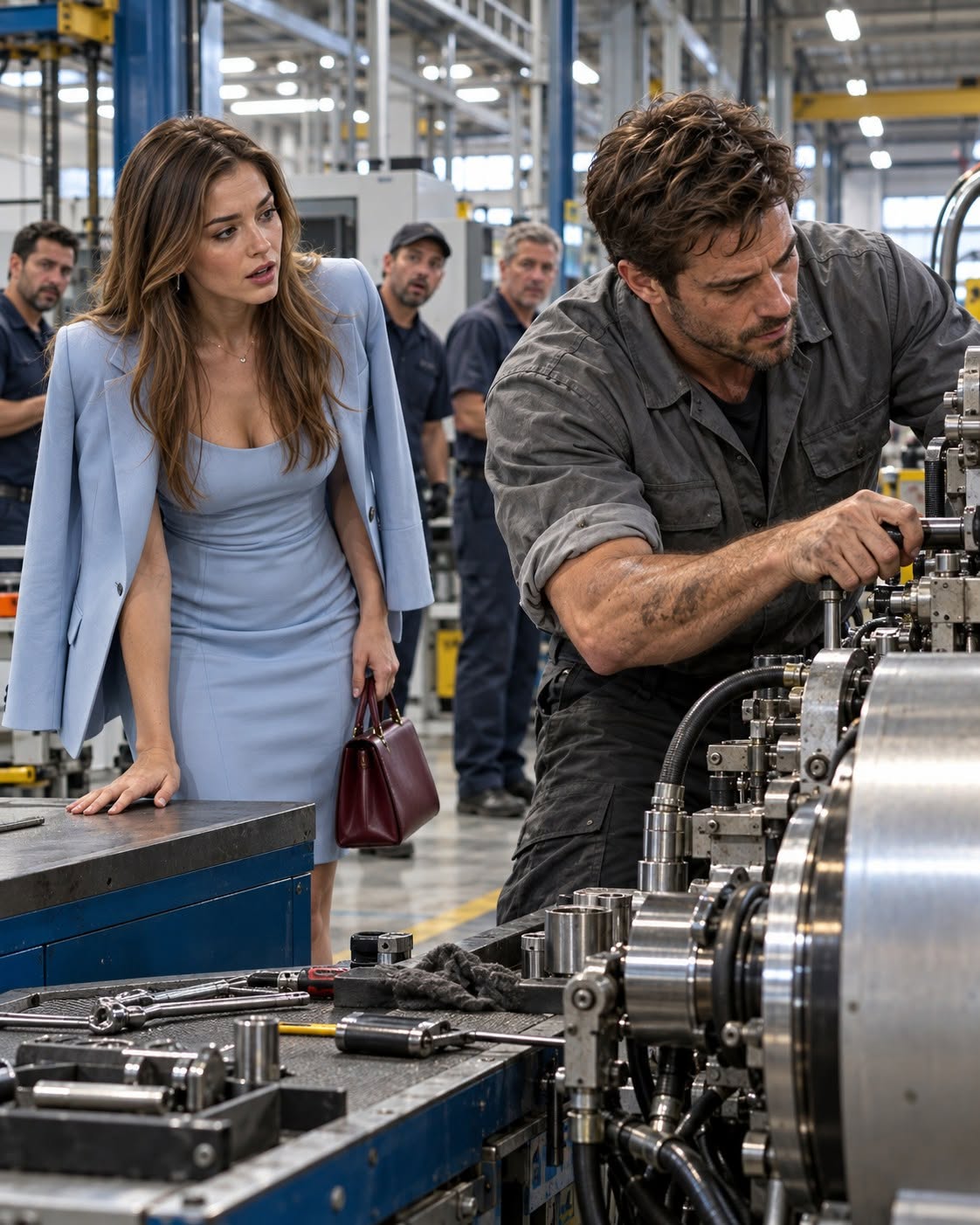
At 4:03 a.m., the CEO of a Detroit manufacturing giant found me buried inside a $4.7 million machine that seventeen engineers had failed to fix for two weeks.
The message from my supervisor contained only eleven words.
“Emergency board review at noon. Bring every tool, report, and witness.”
I read it twice, hoping the words would somehow change the second time.
They didn’t.
Clara stood beside me, her hand still extended between us. Behind her, the morning sun reflected off the windows of the medical clinic, turning the glass into sheets of gold. For the first time since I’d met her, she looked less like the woman who ran a billion-dollar company and more like someone who had just discovered how easily everything she had built could collapse.
“What’s wrong?” she asked.
I handed her my phone.
She read the message, then looked at the folder tucked beneath my arm.
“They’re moving faster than I expected.”
“Are they going to fire me?”
“Not if I can help it.”
“That’s not an answer.”
She took a slow breath. “No, Daniel. It isn’t.”
I appreciated her honesty more than I would have appreciated another promise.
My entire life had taught me that promises were easy when someone else had nothing to lose. I’d heard them from landlords, creditors, former employers, and people who said they’d help me raise Lily before disappearing the moment things became difficult.
Clara Vance had more to lose than all of them combined.
Yet she was standing there, preparing to walk into a room full of powerful people who might destroy her company to protect their own reputations.
And I was the reason they were gathering.
“I haven’t signed anything,” I said.
“I know.”
“If I accept this position, they’ll say you hired me because I fixed one machine.”
“They can say whatever they want.”
“They’ll say I don’t belong there.”
Clara’s expression hardened.
“Then make them explain why seventeen engineers couldn’t do what you did.”
She turned toward the parking lot.
“Come on. We have a meeting to prepare for.”
I glanced through the clinic window at Lily.
She was sitting on the examination bed, drawing on the back of a prescription sheet while the nurse helped her drink some water. Her cheeks had regained a little color, and the terrible wheezing that had frightened me all night had finally eased.
For the first time in days, I could breathe without feeling as though something was crushing my chest.
I wanted to stay beside her.
I wanted to take her home, make her soup, and pretend the world wasn’t waiting to decide whether we deserved a better life.
But Lily looked up and saw me through the glass.
She lifted her stuffed rabbit and waved.
I waved back.
Then I turned to Clara.
“All right,” I said. “Let’s go.”
At 11:47 a.m., I walked into the executive conference room wearing borrowed clothes and shoes that pinched my toes.
The suit belonged to Clara’s assistant, a quiet man named Marcus who was approximately six inches taller than me. The sleeves hung past my wrists, and the trousers had been folded twice at the ankles.
I looked like a mechanic who had accidentally wandered into somebody else’s future.
Around the long black table sat nine directors, three senior executives, the chief engineer, and the plant supervisor who had sent the message.
At the far end sat Richard Harlan, the board’s vice chairman.
He was a silver-haired man with a narrow smile and the polished confidence of someone who had never needed to ask permission to enter a room.
A thick binder rested in front of him.
He glanced at me, then at my shoes.
“Ms. Vance,” he said, “I assume this is the mechanic we’re here to discuss.”
“My name is Daniel Carter,” I replied.
Harlan looked mildly surprised.
“Of course it is.”
Clara took her seat at the head of the table.
“Let’s begin.”
The first twenty minutes were worse than I’d imagined.
The chief engineer presented the Goliath’s maintenance history, highlighting the repeated shutdowns, the failed diagnostic procedures, and the fact that the machine had been returned to operation without a formal engineering review.
Then Harlan opened his binder.
“Mr. Carter,” he said, “did you alter a safety-critical industrial press without authorization?”
“Yes.”
The room went silent.
Clara shifted in her chair, but I continued before anyone could interrupt.
“I made a temporary mechanical correction after identifying a fault that the existing diagnostic process hadn’t detected. I documented the location and condition of the damaged mounting bracket. I also left the machine available for inspection.”
“You admit you bypassed established procedure?”
“No. I didn’t bypass the safety interlock. I corrected the physical condition that was triggering it.”
“Without testing.”
“With the tests available to me at the time.”
Harlan smiled.
“That’s a convenient distinction.”
“It isn’t a distinction, sir. It’s the difference between making a safety system lie and fixing the problem it’s reporting.”
Someone at the far end of the table shifted uncomfortably.
Harlan closed his binder.
“You’re a maintenance mechanic. You have no engineering degree, no authority to approve design changes, and no experience managing a department. Yet the CEO has apparently decided to make you a director.”
“That is a separate question,” Clara said sharply.
“Is it? Or is this an emotional decision based on a dramatic story about a poor single father and his sick child?”
My face grew hot.
For a second, I was back on the factory floor, listening to men with clean hands explain why my observations didn’t matter because my name wasn’t printed on a university diploma.
Then I remembered Lily sleeping on that pile of foam.
I remembered the sound of her cough.
And I remembered the machine coming back to life.
“With respect, Mr. Harlan,” I said, “my daughter has nothing to do with whether that bracket was cracked.”
His smile faded.
“Then let’s discuss the bracket.”
I reached into my bag and removed a clear evidence pouch containing photographs I’d taken before the repair, along with the original maintenance measurements and a sketch of the assembly.
The chief engineer leaned forward.
Harlan barely glanced at the material.
“We have the company’s own records.”
“Then you should have noticed something.”
I placed two printouts beside the photographs.
The first showed the Goliath’s sensor readings during the afternoon. The second showed the same readings at 3:52 a.m., shortly before the final shutdown.
“Look at the temperature difference,” I said. “The machine behaved normally when the factory was warm. As the temperature dropped, the sensor began registering intermittent vibration. Every time that happened, the control system entered a protective shutdown.”
The chief engineer frowned.
“We saw the temperature variation.”
“But you treated it as a software anomaly because the sensor itself passed its daytime calibration.”
I pointed to the bracket.
“The fracture opened slightly as the metal contracted. That allowed the sensor to vibrate against its mounting point. The signal was real. The conclusion drawn from it was wrong.”
Harlan tapped his pen against the table.
“And your brass shim solved the problem?”
“It stabilized the mounting point. It was a diagnostic and recovery measure, not a substitute for replacing the damaged component.”
“Then you admit the repair was temporary.”
“Yes.”
He leaned back as if I’d finally given him the confession he wanted.
“Which means the machine could fail again.”
“Any machine can fail again.”
I met his eyes.
“The question is whether we understand why.”
For the first time, Clara smiled.
It lasted only a second, but I saw it.
Then Harlan turned toward the chief engineer.
“Do you agree with this explanation?”
The engineer studied the photographs for a long time.
Finally, he said, “The thermal behavior is plausible.”
“Plausible?” I asked. “Or correct?”
His jaw tightened.
“We would need to reproduce the conditions.”
“Then let’s do that.”
I slid another page across the table.
“I recommend a controlled overnight test with calibrated vibration monitoring, thermal measurements, and an independent safety engineer present. We inspect the bracket under the same operating conditions, replace it with a properly manufactured component, and verify every safety function before returning the press to production.”
The chief engineer examined the page.
“You prepared this already?”
“On the drive here.”
Harlan’s expression changed.
He hadn’t expected me to offer a plan.
He had expected me to defend myself until I ran out of words.
But machinery had never cared whether I was nervous. It only cared whether I understood what was happening.
And for once, I had the attention of people who could do something about it.
Clara folded her hands.
“I support the proposed test.”
Harlan looked at her.
“Of course you do. You brought him here.”
“No,” she replied. “I brought the evidence here. The evidence speaks for itself.”
The meeting should have ended there.
It didn’t.
Because Harlan had one final document.
He slid a printed report across the table, and I recognized the Goliath’s control-system logs immediately.
“There’s another matter,” he said. “The press was reportedly restored to operation at approximately 4:18 a.m. However, the production system recorded an unauthorized configuration change shortly before the shutdown. We have reason to believe Mr. Carter may have altered more than the mechanical assembly.”
My stomach tightened.
“I never touched the software.”
“The record suggests otherwise.”
He turned the report toward the room.
A highlighted entry showed an access event under the maintenance supervisor’s credentials.
The timestamp was 3:58 a.m.
I stared at it.
I hadn’t used the supervisor’s login.
I hadn’t even entered the control cabinet.
“That’s not my access record,” I said.
“Yet the event occurred during your shift.”
“Other people were working.”
“Can you identify them?”
I looked toward the plant supervisor.
He stared at the table.
Something about that silence bothered me more than Harlan’s accusations.
“Mr. Lewis,” I said, “who was in Sector 4 before I repaired the bracket?”
The supervisor swallowed.
“I don’t recall everyone who passed through.”
“Then perhaps the access logs can.”
Harlan shut the binder.
“This is precisely why we cannot promote people who disregard the chain of command. Mr. Carter’s conduct may have compromised a critical production system. Until we determine what happened, I move that the proposed appointment be suspended and that he be removed from the plant pending investigation.”
Several directors nodded.
Clara rose from her chair.
“I object.”
“You can object all you like,” Harlan said. “The board has a duty to protect this company.”
“And so do I.”
“The board will vote.”
For the first time since the meeting began, I felt the floor shifting beneath me.
I’d been so focused on proving that I could fix a machine that I hadn’t considered what would happen if someone decided the truth was less useful than a convenient scapegoat.
Clara looked at me.
I could see the anger in her eyes, but beneath it was something else.
Uncertainty.
She was beginning to understand that this wasn’t simply a disagreement over my qualifications.
Someone wanted the Goliath failure to remain a mystery.
And someone was willing to use me to keep it that way.
Then a voice came from the doorway.
“Before anyone votes, I think you should see this.”
It was Marcus, Clara’s assistant.
Behind him stood a young woman carrying a laptop and a small black case.
I recognized her from the plant’s engineering office.
Her name was Priya Shah, and I’d seen her working late several nights during the Goliath crisis.
Harlan’s face went pale.
“Who authorized you to enter this meeting?”
Clara answered before Priya could.
“I did.”
Priya set her laptop on the table.
“I’ve been reviewing the system logs since yesterday,” she said. “There’s a discrepancy between the maintenance access record and the physical controller’s audit trail.”
Harlan stood.
“This is a personnel matter.”
“No,” Priya said. “It’s a technical matter.”
She connected her laptop to the room’s display.
Two columns appeared.
The first contained the production system’s record of the alleged configuration change.
The second contained the controller’s independent audit data.
“The maintenance server records an access event at 3:58 a.m.,” Priya explained. “But the controller itself shows no corresponding configuration change. Its safety parameters remained unchanged.”
The chief engineer leaned closer.
“That doesn’t make sense.”
“It does if the server record was altered or incorrectly attributed.”
Harlan’s voice sharpened.
“Are you accusing someone of tampering with company records?”
“I’m saying the records don’t agree. I’ve also traced the maintenance account’s activity.”
Priya clicked the screen.
A second set of timestamps appeared.
The account had been used remotely from an administrative workstation on the executive network.
Not from the factory floor.
Not from the maintenance office.
And not from my terminal.
A murmur spread around the table.
Harlan stared at the display.
“Those logs are incomplete.”
“Then we should preserve the original files and have an independent forensic team examine them,” Priya replied.
She paused.
“There’s one more thing.”
A third window appeared.
It showed a message sent three weeks earlier from an executive account to an external industrial consultancy.
The subject line read: Goliath Replacement Assessment — Preliminary Findings.
The message described a proposed replacement of the press with a competing system, even though the Goliath had not yet experienced its first shutdown.
I read it twice.
The company had been preparing for the machine to fail before it actually did.
Clara’s expression became unreadable.
“Who sent that?”
Priya looked toward Harlan.
“The account belongs to Richard Harlan’s office.”
The room erupted.
Harlan slammed his hand on the table.
“This is absurd. I requested contingency planning. That’s my responsibility as a director.”
“Contingency planning isn’t the problem,” Clara said. “The timing is.”
Priya opened the attached proposal.
The consultancy had recommended scrapping the Goliath, transferring the production contract to another facility, and selling part of the Detroit plant’s equipment.
The projected transaction would benefit a private investment group that had recently acquired a significant stake in one of the company’s competitors.
The group had also been lobbying the board to break up our manufacturing division.
The pieces began to fit together.
The missed deadline.
The unexplained failures.
The rush to replace an expensive machine.
The sudden accusations against the mechanic who had finally made it run.
I looked at Harlan.
“Did you know what was wrong with the press?”
He said nothing.
“Did you know the bracket was damaged?”
“That’s enough,” he snapped.
But his silence had already answered a different question.
He knew that a shutdown would create an opportunity.
He might not have caused the original mechanical failure. We had no proof of that, and neither did anyone else in the room.
But he had tried to turn the crisis into a weapon.
He had wanted the company to act before anyone examined the evidence.
And when the machine came back to life, he’d needed a new explanation for why the recovery couldn’t be trusted.
Clara looked around the table.
“I want an independent audit of every Goliath-related record, every replacement proposal, and every communication with outside consultants. Effective immediately.”
Harlan’s face reddened.
“You don’t have the authority to order an investigation into a director’s conduct without a vote.”
“Then let’s vote.”
She turned toward the other directors.
“Who here believes we should investigate these discrepancies before taking action against Mr. Carter?”
One hand rose.
Then another.
Then four more.
Harlan looked around the table as the majority formed against him.
For the first time that day, he appeared genuinely afraid.
The board suspended his involvement in the Goliath review pending an independent investigation. It also withdrew the motion to remove me from the plant.
But nobody declared victory.
Not yet.
The evidence required verification. The production deadline remained dangerously close, and the Goliath still needed a permanent repair and a full safety inspection.
Clara dismissed the meeting and ordered the recovery team to assemble.
As the directors filed out, Priya approached me.
“You know,” she said quietly, “I tried to raise the temperature issue during the first week.”
“What happened?”
“My manager told me the problem had already been classified as a software fault. I was instructed to stop investigating the mechanical assembly.”
“Why didn’t you push harder?”
Her eyes dropped to the laptop.
“Because I was afraid I’d lose my job.”
I knew that fear.
I’d lived inside it for years.
“Next time,” I told her, “bring me the measurements. We’ll make them explain why the numbers don’t matter.”
She looked up.
“You’re not angry?”
“At you? No. I’m angry that you thought you had to choose between doing your job and keeping it.”
That afternoon, I returned to Sector 4.
The Goliath stood silent behind its safety barriers, waiting for the inspection team.
The brass shim I’d installed was still in place.
I didn’t touch it.
Instead, I walked the team through the failure, showing them the damaged bracket, the mounting point, and the exact conditions under which the vibration had occurred.
We ran the controlled test after the factory temperature had dropped.
The readings confirmed my explanation.
The vibration returned as the damaged bracket contracted.
This time, the monitoring equipment captured every movement.
Nobody could dismiss it as a software anomaly.
A replacement bracket was manufactured to the correct specification, inspected, installed, and tested. The team then verified the interlocks, emergency stops, guarding, and operating limits under the supervision of an independent safety specialist.
The press passed its final acceptance checks just before dawn the following day.
When the production line started, nobody cheered at first.
We simply watched the machine complete one cycle.
Then another.
Then a third.
The warning lights stayed green.
A production supervisor checked the output count and looked at me.
“We’re back.”
I nodded.
“We’re back.”
The next forty-eight hours were a blur of production schedules, quality checks, and engineers reviewing the data. The company recovered enough time to negotiate a revised delivery schedule with its customer, avoiding the immediate cancellation that had threatened the contract.
The plant’s workers kept their jobs.
For now, that was the victory that mattered most.
Two weeks later, the independent investigation confirmed that the maintenance access event had been misattributed through an unauthorized change to the server-side record. Investigators found evidence that Harlan’s office had attempted to use the discrepancy to justify a rapid restructuring before the technical review was complete.
They did not establish that Harlan had deliberately caused the Goliath’s mechanical failure.
But they did establish that he had pushed for a replacement contract while withholding relevant information from the board and had attempted to discredit employees whose findings complicated that plan.
He resigned before the board could complete its disciplinary process.
The company referred the record tampering for further investigation and strengthened its controls over maintenance data and executive approvals.
Clara never called it revenge.
She called it accountability.
And she made sure the same standards applied to everyone, including herself.
Then came the question I’d been avoiding since the night I crawled inside the Goliath.
My appointment.
Clara summoned me to her office on a gray Monday morning.
This time, I wore my own clothes.
My work boots were scuffed, my shirt had a faint grease stain near the pocket, and I had stopped worrying about whether my sleeves looked expensive enough.
A new folder lay on her desk.
“Director of Mechanical Reliability,” she said. “The board has approved it.”
I stared at the title.
“All of them?”
“All but one.”
“Who?”
She smiled.
“One director requested a second opinion. The independent safety specialist reviewed your recovery plan and recommended your appointment.”
I opened the folder.
The salary was more than I’d ever imagined earning. The benefits included medical coverage for Lily, paid leave, and a training budget for professional development.
There was also a formal authority structure, a team assignment, and a clear requirement that safety-critical repairs be reviewed and approved through established engineering procedures.
It wasn’t a miracle promotion.
It was a real job, with real responsibilities and consequences.
Clara watched me read.
“I want you to know something,” she said. “I’m not hiring you because you fixed one machine. I’m hiring you because you recognized a problem everyone else had stopped questioning. You documented your findings. You were willing to defend them when it mattered.”
I closed the folder.
“What if I make a mistake?”
“You will.”
I blinked.
She leaned forward.
“Every person in this company makes mistakes. The question is whether we build a system where people can report them early, investigate them honestly, and correct them before someone gets hurt.”
I thought about Priya, afraid to challenge her manager.
I thought about the seventeen engineers who had spent two weeks searching for a software problem because the first diagnosis had become the only acceptable answer.
And I thought about the way Harlan had used credentials and authority to make a convenient story sound more believable than the truth.
“I’ll accept,” I said.
Clara extended her hand.
This time, I shook it without hesitation.
Three months later, I stood in front of a room full of engineers, maintenance technicians, and production supervisors.
The Goliath was running smoothly behind the glass wall.
A new monitoring system tracked temperature, vibration, and mounting stress. Maintenance teams could flag unusual behavior without waiting for a manager to classify it. Every critical repair was documented, and every employee had a clear path to raise a safety concern.
Priya had joined my reliability team.
Her first project was a review of the plant’s older presses, several of which showed the same pattern of temperature-sensitive vibration.
We caught two developing faults before they caused unplanned shutdowns.
Neither repair made the news.
Neither earned a standing ovation.
But thousands of production hours were saved, and workers went home at the end of their shifts without being asked to gamble their safety against a deadline.
That was what success looked like when nobody was watching.
My life changed, too.
I replaced the alternator in my Ford Ranger, paid off the bills that had been keeping me awake, and moved Lily into a small house with a patch of grass out back.
Her cough disappeared after treatment, and she returned to school with the energy of a child who believed every ordinary day was an adventure waiting to happen.
One evening, she sat at the kitchen table drawing a picture of me at work.
In the drawing, I was standing beside an enormous machine, wearing a blue shirt and holding a wrench almost as big as my arm.
Beside me stood Clara, who had been visiting the plant that afternoon.
Above our heads, Lily had drawn a bright yellow sun.
I smiled.
“Is that me?”
“Yes.”
“Why is my wrench so big?”
“Because you fix the biggest things.”
I laughed and kissed the top of her head.
Then she pointed to Clara.
“Is she your boss?”
“Yes, sweetheart.”
“Does she tell you what to do?”
“Sometimes.”
Lily considered this for a moment.
“Does she listen when you tell her things?”
I looked at the drawing again.
“Yes,” I said. “She does.”
Lily nodded as if that settled everything important about the world.
And maybe, in a way, it did.
The following spring, Clara visited our house for dinner.
She arrived without her usual entourage, carrying a grocery bag filled with ingredients because Lily had insisted on making homemade pizza.
We ate at the kitchen table, where Clara listened to my daughter explain the complicated rules of a board game she had invented.
Halfway through dinner, Clara glanced around the little house.
“You know,” she said, “when I first found you in that machine, I thought you were going to be another problem I had to solve.”
I raised an eyebrow.
“That’s a flattering memory.”
She laughed.
“I was wrong. You were the person who helped me see the problem I was actually facing.”
“Which was?”
“That I’d built a company full of people who were afraid to tell me when something was wrong.”
She looked toward the window, where the evening light rested on the grass.
“I thought leadership meant having the answers. I thought people trusted me because I was in charge. But the truth is, I had made it safer to agree with me than to challenge me.”
I understood that more than she knew.
“People don’t stop noticing problems just because they’re afraid to speak,” I said. “They just learn to keep quiet about them.”
Clara nodded slowly.
“That’s the lesson I should have learned years ago.”
After dinner, she helped Lily wash the plates while I cleared the table.
I watched them laughing over a mountain of soap bubbles and realized that the most important thing Clara had given me wasn’t the salary, the title, or even the opportunity to build a better future.
It was the chance to stop believing that my life had to remain small simply because other people had decided what I was worth.
For years, I’d thought being a good father meant keeping my head down, accepting whatever work I could get, and making myself invisible enough to avoid trouble.
I had confused survival with security.
But that night at the factory, when I asked a powerful woman to hand me a wrench, something changed.
I stopped waiting for someone to notice that I had something valuable to offer.
And Clara, for all her authority and success, did something just as important.
She listened.
Not because I had a title.
Not because I had a degree.
Not because I could promise her an easy victory.
She listened because the truth mattered more than the person delivering it.
The Goliath press eventually became one of the most reliable machines in the plant. Engineers from other facilities came to study its monitoring system, and the company began training managers to encourage questions rather than punish uncomfortable answers.
I never forgot the brass shim.
I kept it in a small frame on my office shelf, beside Lily’s drawing of the machine.
It wasn’t a trophy. It was a reminder.
A piece of metal had helped reveal a flaw in a machine.
A frightened engineer had helped reveal a flaw in a company.
And one exhausted mechanic had learned that a person’s worth could not be measured by the condition of his clothes, the balance in his bank account, or the letters after his name.
Sometimes the person who sees the problem most clearly is the one everyone else has learned to overlook.
Sometimes the bravest thing a leader can do is admit they don’t have all the answers.
And sometimes the decision that changes your life begins with something as ordinary as accepting a wrench from a stranger.
Years later, when new employees asked me how I became director of mechanical reliability, I never told them I had saved the company.
That wasn’t the truth.
I told them about a broken bracket, a sick little girl, a CEO who chose to listen, and a room full of powerful people who almost let fear decide what happened next.
Then I told them the lesson I hoped they’d carry with them long after they left the factory.
Never mistake someone’s position for the full measure of their ability, and never let someone’s lack of status become an excuse to ignore what they know.
Because machines fail when people stop questioning what they think they understand.
Companies fail when people become more concerned with protecting their reputations than finding the truth.
And people fail one another when they decide that a person’s circumstances make their voice less worthy of being heard.
That night, I had fourteen dollars in my bank account, a broken truck, and a daughter who needed me.
I thought I was the man who had run out of options.
I was wrong.
I still had my hands, my experience, my judgment, and the courage to speak when it mattered.
More importantly, I had someone willing to listen.
And sometimes, that’s all it takes to begin again.