At 33,000 feet over the Atlantic, two engines exploded within seconds of each other. A moment later, our right wing began tearing apart
THE LAST FLIGHT OF VIPER
Part Three: The Woman Behind the Call Sign
The applause inside the aircraft continued long after the engines had gone silent.
I remained in the captain’s seat, my hands resting on the controls, staring through the windshield at the Icelandic runway. The emergency crews were moving around us, flashing red lights reflecting against the wet pavement. Beyond them, two F-22 Raptors were completing their final approach.
We had made it.
Three hundred people who had boarded that aircraft expecting an ordinary journey were alive.
But something inside me told me the most difficult part of the day had not yet begun.
“Captain Jenkins?”
I turned.
David was standing behind my seat. His face was pale, and there was still a slight tremor in his hands.
“Yes?”
“There’s something I think you should see.”
He held out a tablet. On its screen was a military photograph of a much younger woman standing beside an F/A-18 Super Hornet. She wore a flight suit, a helmet tucked under one arm, and an expression that looked almost identical to the one I had worn during the emergency.
Underneath the photograph were three words.
LIEUTENANT COMMANDER SARAH JENKINS.
CALL SIGN: VIPER.
NAVY CROSS RECIPIENT.
I stared at it for a moment.
“I haven’t seen that picture in years.”
David swallowed.
“Why didn’t you tell us?”
I unfastened my seat belt.
“Because it wasn’t relevant to the job.”
He looked at the damaged aircraft outside.
“Captain, today it might have been the most relevant thing about you.”
I wanted to disagree, but I couldn’t.
Before I could answer, a ground crew member appeared at the cockpit door.
“Captain Jenkins, Major Blade is requesting permission to meet you.”
I looked toward the runway.
“Tell him I’ll be there shortly.”
As I stood, my knees nearly gave way. The adrenaline that had carried me through the emergency was finally disappearing, leaving behind exhaustion, bruised muscles, and a headache that felt like a hammer striking the inside of my skull.
Sam noticed.
“Easy, Captain.”
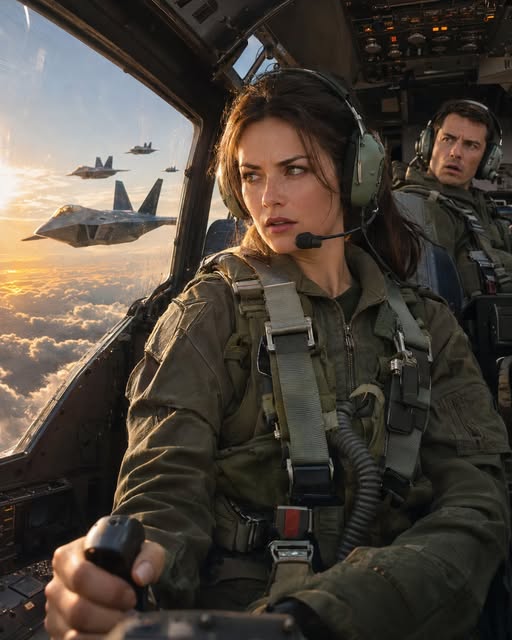
He offered his arm.
For the first time in several hours, I accepted someone’s help.
We walked down the emergency stairs into the cold Icelandic air.
Passengers were already being escorted toward the terminal. Some were wrapped in blankets. Others were crying into their phones, telling their families that they were alive.
An elderly woman approached me.
She was perhaps seventy years old, with silver hair and a small blue scarf around her neck.
“Are you the captain?”
“Yes, ma’am.”
She reached for my hand.
“My husband was sitting in row twenty-seven. He has a heart condition. When the plane started shaking, I thought I was going to lose him.”
Her voice broke.
“He kept telling me not to be afraid. But I knew he was terrified.”
I squeezed her hand.
“Is he all right?”
She nodded, tears gathering in her eyes.
“He says he wants to thank you.”
I glanced toward the terminal, where an emergency medical team was helping passengers.
“Tell him he doesn’t owe me anything. I’m just glad you’re both here.”
The woman shook her head.
“No, Captain. You don’t understand. My husband and I were celebrating our fiftieth wedding anniversary. We thought today might be our last trip together. You gave us the chance to have another one.”
She hugged me.
I stood there, unable to speak.
In combat, I had received medals, commendations, and official letters describing my actions in language that made everything sound clean and uncomplicated.
But nothing had ever felt quite like that embrace.
Then I heard a familiar voice behind me.
“Viper.”
I turned.
Major Blade was standing a few feet away, still wearing his flight suit. Captain Torch stood beside him.
Blade was younger than I remembered from his voice, perhaps in his early forties. His expression was serious, but his eyes carried something close to disbelief.
He extended his hand.
“Lieutenant Commander Jenkins. It’s an honor.”
I shook it.
“Captain Jenkins these days.”
He smiled.
“Of course. Sorry. Old habits.”
Torch stepped forward.
“I’ve heard stories about you.”
“Most of them are probably exaggerated.”
He laughed.
“Not the one about the carrier landing during the storm.”
My smile disappeared.
For a moment, I was no longer standing on an Icelandic runway.
I was twenty-nine again, flying through darkness over the Pacific, with rain hammering my canopy and an aircraft carrier appearing beneath me like a narrow strip of steel in an endless black ocean.
That had been the night I earned my call sign.
Not because I was fearless.
Because I had been terrified and flown anyway.
Blade studied my face.
“There’s something else, Captain.”
I waited.
“We received a request from our command. They want a complete account of the emergency, including your identity and your military service.”
I nodded.
“That’s reasonable.”
He hesitated.
“There’s also a request from Washington.”
My stomach tightened.
“From whom?”
“Admiral Thomas Reed.”
The name landed harder than I expected.
I hadn’t spoken to Thomas Reed in eleven years.
He had been my commanding officer during my final deployment. He was also the man who had personally signed the recommendation for my Navy Cross.
“Did he say why he wanted to speak with me?”
Blade looked uncomfortable.
“He said to tell you that the past has finally caught up with Viper.”
I looked away.
Apparently, retirement had not been enough to bury everything.
An hour later, I sat in a small conference room inside Keflavik Airport. David and Sam had gone to give their statements to the investigators. The passengers were being transferred to hotels, and the aircraft had been surrounded by technical teams.
A cup of untouched coffee sat in front of me.
My phone had not stopped vibrating.
There were missed calls from the airline, messages from people I barely knew, and several notifications showing my military photograph circulating online.
Someone had already posted the story.
A civilian cargo pilot with a secret Navy past had saved 300 people.
The headline was dramatic. The photograph was old. The details were incomplete.
But the story was spreading.
Then the door opened.
A tall man with gray hair walked inside.
Admiral Thomas Reed.
He was older now. His shoulders were slightly bent, and his hair had turned almost completely white. But his eyes were exactly as I remembered them.
“Still drinking coffee without touching it, Jenkins?”
I stood.
“Admiral.”
He gestured toward the chair.
“Sit down. You’re not in my squadron anymore.”
I sat.
For several seconds, neither of us spoke.
Then he placed a folder on the table.
Inside were photographs, military reports, and a document stamped with a classification marking.
I recognized the first photograph immediately.
It showed a damaged fighter jet sitting on the deck of an aircraft carrier. Its nose was crushed, and one wing was bent at an impossible angle.
I remembered that aircraft.
I remembered the mission.
And I remembered the pilot who hadn’t returned.
“Why are you showing me this?” I asked.
Reed folded his hands.
“Because the Navy wants to recognize you again.”
I stared at him.
“I already received my decorations.”
“This isn’t about another medal.”
He pushed the folder closer.
“There’s a new aviation safety program being developed. They want experienced pilots to train the next generation. Your actions today have brought your name back into public attention, and several people believe you could help.”
I leaned back.
“Admiral, I’m forty-two years old. I fly cargo. I have no interest in returning to military life.”
He nodded.
“I expected you to say that.”
“Then why are we having this conversation?”
His expression changed.
“Because I also know why you left.”
The room seemed suddenly smaller.
I looked down at the photographs.
Eleven years earlier, during a night operation, my wingman, Lieutenant Daniel Cross, had been hit by enemy fire. His aircraft was losing fuel and control. I had been ordered to return to the carrier, but I stayed with him, guiding him toward a safer flight path.
He never made it.
His final transmission had been directed to me.
“Viper, get home.”
I had followed orders after that.
But I had never really come home.
For years, I blamed myself for surviving.
I could still hear Daniel’s voice whenever an engine coughed unexpectedly or a warning alarm sounded.
I had eventually left the Navy, telling everyone I wanted a quieter life.
That was true.
It was simply not the whole truth.
Reed watched me carefully.
“You spent eleven years believing you abandoned him.”
My jaw tightened.
“Don’t.”
“Sarah, you followed the emergency protocol. You made the right decisions.”
“I was supposed to bring him back.”
“You were supposed to bring yourself and the rest of your flight home. Daniel knew that.”
I pushed the folder away.
“You weren’t there.”
“No,” Reed replied quietly. “But I read every report. I spoke to the rescue teams. I heard the recordings.”
He paused.
“Daniel’s final words weren’t an accusation. They were an instruction. He wanted you to survive.”
I stared at the table.
For eleven years, I had imagined that sentence differently.
I had heard it as a farewell.
Now, for the first time, I wondered whether I had misunderstood it.
Reed stood.
“You don’t have to return to the Navy. You don’t have to accept anything. But you should stop treating your survival like a crime.”
He walked toward the door, then stopped.
“One more thing. Daniel’s daughter is here in Iceland.”
I looked up.
“What?”
“She’s twenty-one now. She’s studying aviation engineering in Germany. She was one of the passengers on your aircraft.”
My heart seemed to stop.
Reed turned back.
“She was sitting in row eighteen.”
I remembered that row.
A young woman with dark hair had been crying when the emergency announcement came. I remembered seeing her holding a small photograph against her chest.
“What’s her name?”
“Emily Cross.”
For several seconds, I couldn’t move.
The conference room door opened again.
A young woman stood there.
She was tall, with dark brown hair and familiar eyes. She wore a gray sweater and held a small photograph in her hand.
“Captain Jenkins?”
I stood slowly.
“Emily?”
She nodded.
“Admiral Reed told me you were here.”
Her fingers trembled as she held out the photograph.
It showed a younger man standing beside an F/A-18, one arm around a little girl.
Daniel.
And Emily.
“I was six when my father died,” she said. “I don’t remember everything about him. But I remember that photograph.”
I couldn’t look away from it.
“He used to tell me stories about a pilot named Viper. He said she was the best wingman he had ever flown with.”
My throat tightened.
“Your father was an extraordinary man.”
She nodded.
“He also told me that if anything ever happened to him, I shouldn’t blame the people who came home.”
I felt the room tilt slightly.
Emily took a breath.
“When the aircraft started falling apart today, I thought I was going to die. I thought I would never get to finish my studies or see my mother again.”
She looked directly into my eyes.
“Then I heard your voice over the cabin speakers. You sounded so calm. And I remembered what my father used to say about you.”
I swallowed.
“What did he say?”
She smiled through her tears.
“He said Viper never promised that everything would be fine. She just made sure everyone had the best chance of getting home.”
I covered my mouth.
For the first time in eleven years, I cried for Daniel without feeling angry at myself.
Emily stepped forward and hugged me.
And somewhere in that small airport conference room, a part of my past finally became quiet.
The following morning, I woke up in a hotel room overlooking the cold Icelandic coastline.
For the first time in years, I slept without dreaming about a burning fighter jet.
But peace did not last long.
At 8:15 a.m., my phone rang.
It was David.
“Captain, have you seen the news?”
I sat up.
“What happened?”
“There’s a press conference scheduled. The airline wants you to attend. Apparently, the story has gone international.”
I rubbed my eyes.
“Tell them I’m not interested in becoming a celebrity.”
“I already told them.”
“And?”
“They said the reporters are waiting anyway.”
I sighed.
Within an hour, I was standing in front of a row of cameras.
Behind me stood David, Sam, Major Blade, and Captain Torch. Admiral Reed had also arrived.
The reporters were asking questions before I had even reached the microphone.
“Captain Jenkins, is it true you were a decorated Navy fighter pilot?”
“Did you really fly more than four thousand hours in combat aircraft?”
“Why did you hide your identity?”
“Do you believe your military training saved everyone aboard?”
I looked at the microphones.
Then I looked at David and Sam.
I could have told them about the Navy Cross.
I could have described the missions, the medals, the training, and the years I had spent flying aircraft that could turn a human being into a collection of mistakes in less than a second.
But none of that was what mattered.
I stepped toward the microphone.
“Yesterday, 300 people boarded an aircraft expecting to reach their destination. They didn’t board because they wanted to meet a decorated pilot. They didn’t care about my military history. They simply trusted the crew to get them there.”
The room became quiet.
“I want to make something clear. I did not save those passengers alone. First Officer David Miller kept the aircraft stable when the situation was deteriorating. Sam Vance worked through failing systems while alarms were sounding around him. The ground controllers helped us find a path to safety. The F-22 pilots stayed with us when they could have returned to base.”
I paused.
“And every passenger aboard that aircraft trusted us to do our jobs.”
A reporter raised her hand.
“But Captain, would you say your military background gave you an advantage?”
I considered the question.
“Yes. Training matters. Experience matters. But experience is only useful when you remain willing to listen, learn, and trust the people around you.”
Another reporter asked the question I had been expecting.
“Why did you leave the Navy and become a civilian cargo pilot?”
I looked toward the window.
For a moment, I thought about giving the usual answer.
A quieter life.
A different career.
A desire for normality.
Instead, I told the truth.
“Because I lost someone I loved in service. And for a long time, I confused moving forward with forgetting him.”
No one interrupted.
“I thought that if I stopped flying combat missions, I could leave that part of my life behind. But yesterday, when those engines failed, I realized something. My past wasn’t something I needed to hide. It was something I could use to help people.”
I stepped away from the microphone.
The applause began slowly.
Then it grew.
I did not smile for the cameras.
I simply stood there and let the moment pass.
Three days later, the investigation into the aircraft’s failure began producing preliminary findings.
The explosion had been caused by a catastrophic mechanical failure in an engine assembly. The resulting debris had damaged critical systems, and the subsequent hydraulic failures had made the aircraft extremely difficult to control.
Investigators were still examining every detail.
Some aviation experts praised the crew’s decisions. Others questioned whether the aircraft should ever have been dispatched in the condition it was in.
I refused to speculate.
There would be time for investigations, reports, and difficult questions.
What mattered was that the passengers had survived.
But the story was not finished.
On the fourth day, I received a call from the airline’s chief executive.
He offered me a promotion, a substantial salary increase, and a position overseeing flight safety and emergency training.
I was surprised.
“Why me?”
“Because, Captain Jenkins, we need someone who understands what happens when procedures meet reality.”
I looked out at the Icelandic sky.
“Give me a few days to think about it.”
He agreed.
That evening, I met Emily Cross for dinner.
She was returning to Germany the following morning, but she wanted to speak with me before leaving.
We sat near a window overlooking the harbor. She ordered tea, and I ordered coffee.
For a while, we talked about ordinary things.
Her studies.
Her mother.
Her plans to become an aerospace engineer.
Then she placed a small envelope on the table.
“My mother asked me to give you this.”
I opened it carefully.
Inside was a handwritten letter.
The handwriting was unmistakable.
Daniel’s.
My hands began to shake.
The letter had been written several months before his final mission. It was addressed to me, though I had never received it.
Emily explained that her mother had found it among his belongings only recently.
I unfolded the paper.
“Sarah,
If you’re reading this, it probably means I’ve finally found the time to write something I’ve been meaning to tell you.
You always think you have to carry everything yourself. You don’t.
The best pilots I’ve ever known weren’t the ones who never made mistakes. They were the ones who knew when to trust their crew.
You have a habit of believing that being strong means never needing anyone.
One day, I hope you learn that it means something different.
It means being brave enough to let other people stand beside you.
Take care of yourself, Viper.
And if you ever get the chance, teach someone else to fly.
The world needs more people who know how to bring others home.
Daniel.”
I read it twice.
Then a third time.
Emily watched me quietly.
“He wrote that before his last mission,” she said. “My mother thinks he knew how dangerous things could become.”
I folded the letter carefully.
“Thank you for bringing this to me.”
She smiled.
“I think he would have wanted you to have it.”
That night, I made a decision.
I called the airline the following morning and accepted the safety training position.
But I added one condition.
I wanted to build a program that trained pilots and flight crews to work together during extreme emergencies. It would combine technical knowledge, decision-making under pressure, communication, and psychological resilience.
I wanted every pilot to understand that an emergency was not a test of ego.
It was a test of teamwork.
The airline agreed.
Within six months, the first training center opened in Hamburg.
We named it the Daniel Cross Aviation Safety Initiative.
The program began with a simple sentence written across the entrance:
THE MISSION IS NOT TO BE FEARLESS. THE MISSION IS TO BRING EVERYONE HOME.
I returned to flying occasionally, but my days became filled with training sessions, simulator exercises, and conversations with young pilots who believed that confidence meant having all the answers.
I taught them otherwise.
I taught them that the most dangerous words in aviation were sometimes, “I’ve got this.”
I taught them to speak up when something felt wrong.
I taught them to trust their instruments, question assumptions, and respect the people sitting beside them.
And every year, on the anniversary of the Atlantic emergency, I invited David, Sam, Blade, Torch, and several of the passengers to gather with us.
The first anniversary was especially memorable.
The elderly woman with the blue scarf attended with her husband.
He was walking slowly with a cane, but he was smiling.
He handed me a small package.
Inside was a photograph of the two of them standing in front of the aircraft at Keflavik.
On the back, he had written:
“Fifty years together. And thanks to you, we’re working on fifty-one.”
I laughed.
Then I cried.
David had also changed.
He had become a training captain, and Sam was now supervising aircraft systems instruction.
During the gathering, David approached me with two cups of coffee.
“Captain, remember when you told me to watch my airspeed instead of researching your biography?”
I smiled.
“Vividly.”
He handed me a cup.
“I still tell that story to every new pilot I train.”
“Please tell them the part where you nearly lost your lunch.”
He laughed.
“That part stays between us.”
Later that evening, Major Blade called from his base.
He was unable to attend, but he had sent a message.
“Viper, the Raptors still owe you an escort. Next time, let’s make it a routine flight.”
I smiled at the screen.
For the first time, the call sign no longer felt like a burden.
It felt like a reminder.
Two years after the emergency, I was invited to speak at a military aviation conference in Virginia.
I almost declined.
Public speaking had never been my strength, and I had no desire to become the woman whose identity was defined by one dramatic landing.
But when I saw the list of attendees, one name caught my attention.
Emily Cross.
She had graduated with honors in aerospace engineering and was presenting a research project on aircraft structural safety.
I accepted.
The conference hall was filled with pilots, engineers, military officers, and aviation students.
When I stepped onto the stage, I saw Emily sitting in the front row.
She smiled and gave me a small wave.
I began my speech.
“People often ask me what it takes to become a great pilot. They expect me to talk about courage, precision, reflexes, or thousands of hours in the cockpit.”
I paused.
“Those things matter. But they are not enough.”
I looked across the audience.
“I once believed that my greatest responsibility was to control the aircraft. Now I understand that my greatest responsibility is to protect the lives entrusted to me.”
I told them about the Atlantic.
About the explosions.
About the damaged wing.
About the moment when David had looked at me and said there was no way we could make it.
And about the young woman in row eighteen whose father had taught me something I had forgotten.
I did not tell them every detail of Daniel’s death.
Some memories deserved to remain private.
But I shared his final lesson.
“Being strong doesn’t mean carrying everything alone. Sometimes, the strongest thing a leader can do is trust the people beside them.”
The hall remained silent.
Then I noticed something in the second row.
A young woman in a flight suit was crying.
After the presentation, she approached me.
“Captain Jenkins?”
“Yes?”
“I’m Lieutenant Rachel Morgan. I’m about to begin advanced fighter pilot training.”
I smiled.
“Congratulations.”
She hesitated.
“I’ve been told that women in combat aviation have to work twice as hard to earn half as much respect. Sometimes I wonder if I’m strong enough.”
I studied her face.
I remembered being twenty-two, standing beside my first fighter aircraft, wondering whether I belonged in a world where almost everyone expected me to fail.
I placed a hand on her shoulder.
“Listen carefully. You don’t have to prove that you’re stronger than everyone else. You have to become the best pilot you can be. Learn your aircraft. Respect your crew. Admit when you don’t know something. And never let anyone convince you that asking for help makes you weak.”
She nodded.
Then she asked a question I had not expected.
“Do you still fly as Viper?”
I looked toward Emily, who was watching us from a short distance away.
“Sometimes.”
Rachel smiled.
“Then I hope I get to fly beside you one day.”
I laughed.
“Keep training. Maybe you will.”
That evening, I returned to my hotel and opened the small wooden box where I kept Daniel’s letter.
Beside it was my Navy Cross.
I had not displayed the medal for years. It had remained hidden in a drawer, almost as though I were embarrassed by what it represented.
I took it out and placed it beside the letter.
For the first time, I understood that neither object represented perfection.
The medal represented service.
The letter represented friendship.
And both reminded me that a life was measured not by how many battles someone won, but by what they gave to the people around them.
A few months later, I received another unexpected invitation.
Keflavik Airport was dedicating a new emergency response training facility, and they wanted me to attend the opening ceremony.
I returned to Iceland on a cold November morning.
The runway looked exactly as I remembered it.
I stood near the observation area, watching aircraft take off into the gray sky.
A young airport employee approached.
“Captain Jenkins?”
I turned.
“Yes?”
He smiled.
“My father was on that flight. He was sitting in row twenty-seven.”
I recognized the story immediately.
“The gentleman celebrating his fiftieth anniversary?”
The young man nodded.
“He still talks about you. He says you gave him and my mother another chance to grow old together.”
I felt a familiar warmth in my chest.
“How are they?”
“Doing well. They just celebrated their fifty-third anniversary.”
I laughed.
“That’s wonderful.”
The young man hesitated before speaking again.
“My father told me something else. He said that when the aircraft was falling, he looked around and saw everyone praying. Then he heard your voice. He said it wasn’t loud, but it was steady. And somehow, that made him believe we weren’t going to die.”
I looked toward the runway.
“Your father was braver than he knows.”
The young man smiled.
“So were you.”
I didn’t answer.
Because I had finally learned that courage was not always something you could recognize in yourself.
Sometimes, it was something other people saw when you were too busy doing what needed to be done.
Before leaving Iceland, I visited the small memorial near the airport.
There were names engraved on a stone wall, honoring those who had lost their lives in aviation accidents across the North Atlantic.
I placed a small photograph of Daniel beside the memorial.
Then I stood there for several minutes.
“I think I finally understand,” I whispered.
The wind moved across the grass.
For the first time, I did not ask him to forgive me.
I simply thanked him.
Thanked him for the lessons.
For the friendship.
For the letter.
And for reminding me that surviving was not the same as living.
When I returned to Germany, I continued working at the training center.
The years passed.
My hair gradually turned gray, and my flight hours became fewer. But every time I entered a simulator, I remembered that terrible afternoon over the Atlantic.
Sometimes, new pilots asked whether I regretted leaving the Navy.
I always gave them the same answer.
“No. I regret believing that my life had to belong to only one uniform.”
Because I had been a fighter pilot.
I had been a civilian cargo captain.
I had been a woman who lost a friend and spent years trying to outrun the memory.
And I had been a captain responsible for 300 lives when the sky seemed determined to take them away.
All those women were me.
None of them needed to disappear for another to exist.
On my forty-fifth birthday, Emily visited the training center.
She brought a small package wrapped in brown paper.
Inside was a miniature model of an F/A-18 Super Hornet.
Beside it was a handwritten note.
“To the woman who taught my father that courage means coming home, and taught me that the sky belongs to anyone willing to earn their place in it.
Thank you for bringing us home.
Love,
Emily.”
I placed the model on my desk, beside Daniel’s photograph.
That afternoon, I walked into the simulator room where a new group of pilots was preparing for their first emergency training exercise.
One of them looked up.
“Captain Jenkins, are you watching our session?”
I smiled.
“Actually, I’m flying with you.”
He looked surprised.
“Really?”
I nodded toward the simulator.
“Let’s see what you’ve learned.”
The exercise began normally.
Then the warning lights flashed.
An engine failure.
A hydraulic malfunction.
A sudden loss of control.
The young pilot froze for a moment.
I remembered that feeling.
I leaned forward.
“Take a breath. Tell me what you see.”
He looked at the instruments.
“Engine failure. Hydraulic pressure dropping.”
“Good. What do you need?”
He hesitated.
“Help.”
I smiled.
“Excellent answer.”
His copilot began working through the checklist. The flight engineer adjusted the simulated systems. Together, they stabilized the aircraft and completed the emergency landing.
When the exercise ended, the young pilot removed his headset.
“I thought you were going to expect me to handle everything myself.”
I shook my head.
“That’s how people get into trouble.”
He smiled.
“Thank you, Captain.”
I looked around the room.
At the young pilots.
At the instructors.
At the aircraft models lining the walls.
And at the photograph of Daniel watching over all of us.
For years, I had believed that the story of Viper ended when I left the Navy.
I had been wrong.
Viper had never been just a call sign.
It was every lesson I had learned, every person I had protected, every mistake I had survived, and every life I had helped prepare for the next emergency.
And Sarah Jenkins had never been a disguise.
She was the woman who had carried those lessons into a different world.
That evening, I walked outside the training center.
A passenger aircraft was climbing into the evening sky, its lights slowly disappearing into the clouds.
I watched until it became a tiny point of light.
Then I heard a familiar voice behind me.
“Captain?”
It was Rachel Morgan.
She was now a qualified fighter pilot, and she had come to visit before beginning her first operational deployment.
“Yes, Lieutenant?”
She smiled.
“I wanted to tell you something. My instructor asked me who inspired me to become a pilot.”
I raised an eyebrow.
“And what did you say?”
She looked toward the sky.
“I said there was a woman who taught me that courage isn’t about being fearless. It’s about knowing why you have to keep going.”
I felt my eyes grow warm.
“That’s a pretty good answer.”
She laughed.
Then she asked the question I had heard many times before.
“Do you ever miss being Viper?”
I looked at the aircraft disappearing into the clouds.
“Sometimes.”
“And what do you miss most?”
I thought about the carrier decks, the roar of afterburners, the endless blue horizon, and the friends whose voices I could still remember.
Then I thought about 300 passengers stepping safely onto the runway in Iceland.
About Emily.
About Daniel.
About the young pilots waiting inside.
I smiled.
“The flying was wonderful. But the best part was always knowing someone was counting on me.”
Rachel nodded.
For a moment, we stood together in silence.
Then she saluted.
I returned it.
Not because I was an admiral.
Not because I had received a medal.
And certainly not because a newspaper had once called me a hero.
I returned it because I knew what it meant to stand beside someone who had chosen to serve.
That night, I went home and placed Daniel’s letter in a new frame.
Underneath it, I added a small inscription:
SOME PEOPLE FLY TO REACH THE SKY. OTHERS FLY TO BRING SOMEONE HOME.
I turned off the light and stood by the window for a moment.
Outside, the world was quiet.
No alarms.
No emergency calls.
No warning lights.
Just the ordinary peace I had once believed I needed to spend my entire life searching for.
And I finally understood something.
I had not lost myself when I left the Navy.
I had not found myself again when I saved those 300 passengers.
I had simply spent years believing that I had to choose between the woman I had been and the woman I wanted to become.
But a person’s past is not a prison.
It is a foundation.
The things we survive can become the very things that allow us to help someone else survive.
And sometimes, the greatest act of courage is not climbing into the cockpit, facing an impossible emergency, or earning a medal.
Sometimes, it is allowing yourself to heal.
To forgive yourself.
To accept that you are still worthy of a future, even after everything you have lost.
My name is Sarah Jenkins.
I am a civilian cargo pilot.
I am a teacher, a mentor, and a woman who once flew under the call sign Viper.
And if you ask me what the most important moment of my life was, I won’t tell you about the Navy Cross.
I won’t tell you about the F-22 Raptors or the damaged aircraft over the Atlantic.
I’ll tell you about the moment three hundred people stepped onto solid ground, looked at one another, and realized they had been given another chance.
Because that was the day I finally understood why I had learned to fly.
Not to prove that I was fearless.
Not to show the world what I could do.
But to bring people home.
And that, I believe, is what makes a true hero: not the secrets they carry, the medals they earn, or the extraordinary things they can do, but the lives they touch and the people they refuse to leave behind.