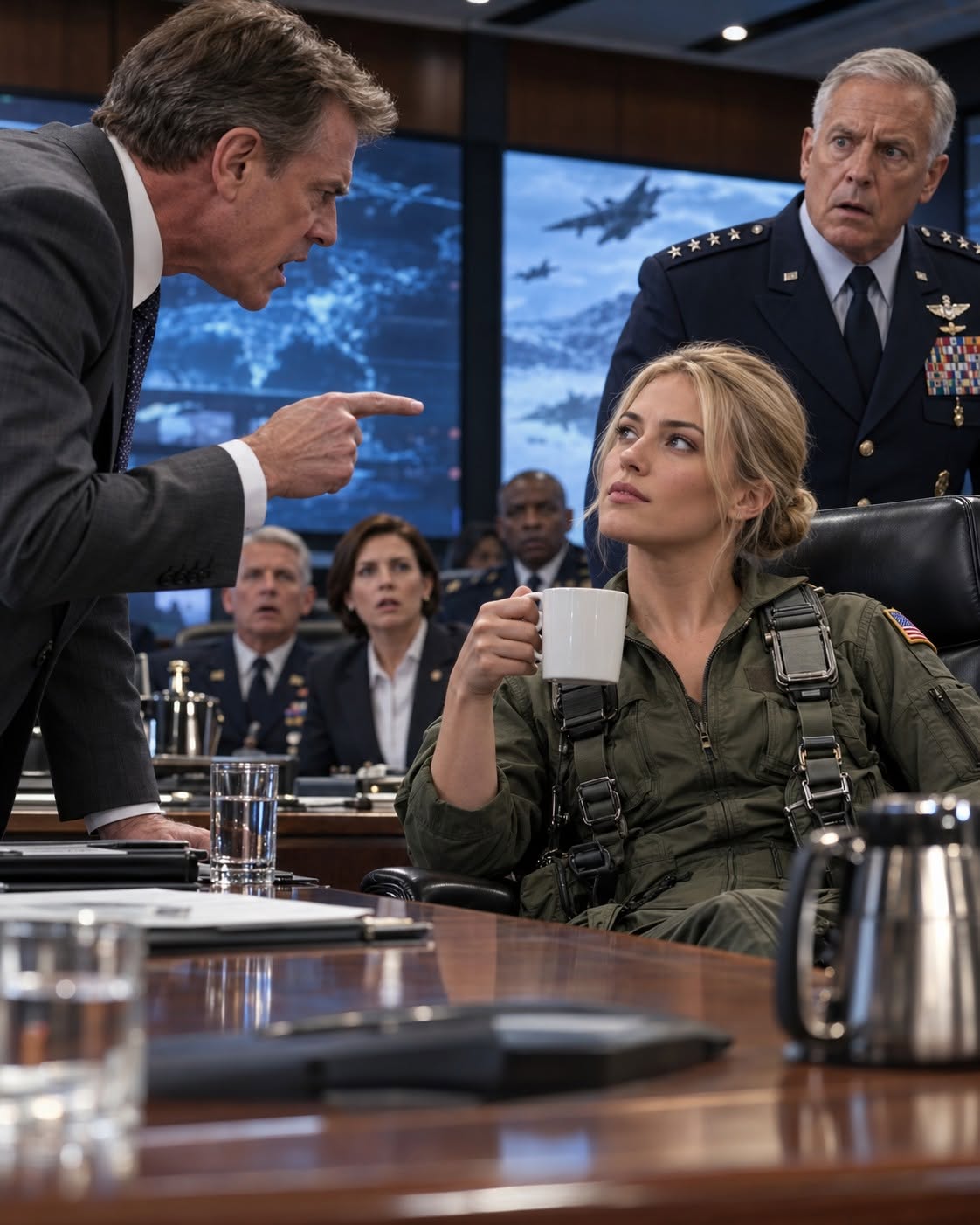
Arthur Pendleton slid a stack of paperwork across the Pentagon conference table and pointed toward the coffee station without even looking at me.
I looked at General Callahan for several seconds before answering.
“Sir, I want to fly again.”
“I know.”
“And I don’t want this injury to become the reason I spend the rest of my career behind a desk.”
Callahan nodded slowly.
“Then don’t let it. But understand something, Wraith. There are moments when leadership means getting into the cockpit. There are other moments when it means making sure the person in the cockpit has a chance to come home.”
I looked down at the Eglin report.
The highlighted numbers seemed to stare back at me.
“When does the review begin?”
A faint smile crossed his face.
“Tomorrow morning. Six hundred hours. And I’d suggest you get some sleep. You’re going to need it.”
I extended my hand.
“I’ll be there, sir.”
He shook it firmly.
And just like that, my recovery took a direction I hadn’t expected.
I wasn’t going back to the sky yet.
But I wasn’t finished fighting for the people who flew through it.
THE INDEPENDENT REVIEW
The next morning, I walked into a secure conference room at the Pentagon carrying three folders, a laptop, and a cup of coffee I’d poured myself.
For the first time in weeks, nobody had asked me to prepare refreshments.
General Callahan had assembled a review team consisting of military flight-test engineers, software specialists, operational safety officers, and two representatives from the Air Force’s independent acquisition oversight office.
He had also appointed Colonel Rebecca Hayes as the team’s technical director.
Hayes was a woman in her late forties with silver beginning to show in her dark hair. She had spent more than two decades investigating aircraft incidents and had a reputation for asking questions nobody wanted to answer.
She looked at my medical file before looking at me.
“C4 fracture?”
“Yes, ma’am.”
“Flying restrictions?”
“Temporary. I’m awaiting another evaluation.”
“Good. Then let’s establish something immediately. You’re here because of your technical expertise, not because General Callahan likes your flying record. If your conclusions are wrong, I’ll challenge them. If they’re right, I’ll defend them.”
I appreciated that more than I expected.
“Understood, ma’am.”
She pointed toward an empty chair.
“Let’s find out what Kessler Aerospace has actually built.”
For the next several days, we examined everything.
The original test reports.
The software architecture.
The system’s performance under simulated combat conditions.
The engineering change requests.
The internal communications between Kessler’s development team and the Pentagon acquisition office.
The more we uncovered, the worse the situation became.
The latency problem wasn’t an isolated event.
It had appeared in several test runs, although the duration and severity varied. In some instances, the displays recovered automatically. In others, the system continued presenting outdated information until the pilot changed operating modes.
The most troubling discovery came from a series of internal engineering notes dated nearly four months earlier.
An engineer named Daniel Mercer had identified the same problem and recommended delaying the next integration milestone.
His report contained a warning that stopped me cold.
Under sustained high-G conditions, the display may retain previously received data while presenting it as current. This creates a false sense of situational awareness and could lead to an incorrect pilot response.
Someone had marked the recommendation as noncritical.
Someone else had approved the change.
The final document had been rewritten to describe the issue as a minor display synchronization irregularity.
I read the approval chain twice.
“Who changed the classification?” I asked.
Hayes leaned over my shoulder.
“Let’s find out.”
The answer was Arthur Pendleton.
But Pendleton wasn’t the only person involved.
Several emails showed that he had personally pressured engineering managers to keep the project on schedule. His messages repeatedly referred to the upcoming contract award and the financial consequences of missing the deadline.
One message was particularly revealing.
We cannot afford to introduce a safety concern at this stage. The customer needs confidence, not another reason to delay approval.
The message was followed by a request to revise the language in the next technical summary.
I felt my jaw tighten.
A pilot’s life had become a scheduling inconvenience.
Then Hayes noticed something else.
“Wait. Go back to the test logs.”
She enlarged a timestamp.
“Why does this event appear in the engineering archive but not in the official safety submission?”
I compared the records.
It wasn’t just one missing event.
Three separate test runs had been excluded from the final summary.
All three involved the same display freeze.
And all three had occurred during maneuvers above six Gs.
We now had evidence that the problem had been identified, documented, and deliberately minimized.
But there was still a question nobody could answer.
Why hadn’t the software engineers corrected it?
THE ENGINEER WHO TRIED TO WARN THEM
On the fifth day of the review, we located Daniel Mercer.
He was a senior software integration engineer at Kessler Aerospace. He had worked on the Vanguard project since its earliest development phase and had personally written several of the monitoring routines.
When he entered the interview room, he looked exhausted.
He carried a thick binder and placed it on the table.
“I assume you’ve already seen my original report.”
“We have,” Hayes replied. “We’d like to understand what happened after you submitted it.”
Mercer stared at his hands.
“I was told the problem was being handled.”
“By whom?”
“Mr. Pendleton. He said the integration team had agreed it was an acceptable risk.”
“Did you agree?”
“No.”
His answer came immediately.
“Did you tell him that?”
“Several times.”
Mercer opened the binder and removed a printed email.
“I refused to sign the revised safety assessment. Two days later, I was removed from the flight-test integration group and reassigned to documentation support.”
My stomach tightened.
“They moved you because you wouldn’t approve the report?”
“They told me I wasn’t being collaborative.”
He gave a humorless laugh.
“Apparently, raising a safety concern is considered a lack of teamwork when someone has already promised the customer everything will be fine.”
Hayes examined the email.
“Did you preserve the original test data?”
Mercer nodded.
“I kept copies of the raw logs, the source-code revisions, and the internal defect tracking records. I wasn’t sure anyone would ever ask for them.”
He slid a small encrypted storage device across the table.
I looked at it.
“What exactly is on here?”
“Every version of the affected software module, including the build that produced the display freeze. I also included the change history.”
Hayes immediately instructed the technical team to preserve the device under the investigation’s evidence procedures.
Then Mercer looked directly at me.
“I saw your name in the announcement about the review.”
I nodded.
“I was the one who flagged the Eglin results.”
He seemed relieved.
“Thank you.”
“For what?”
“For refusing to let them bury it.”
I thought about the weeks I’d spent carrying coffee and organizing paperwork while Pendleton treated me like I didn’t belong in the room.
“I almost didn’t say anything.”
“But you did.”
His words stayed with me long after the interview ended.
That afternoon, Hayes called an emergency review meeting.
The evidence showed that the Vanguard software had a fundamental problem with how it handled incoming sensor data under certain high-load conditions.
The system’s display process could become overloaded, and its recovery mechanism didn’t always distinguish between current and previously received information.
In other words, the screen could look perfectly normal while showing the pilot an outdated picture of the battlespace.
It was worse than a blank display.
A blank display told a pilot something was wrong.
A frozen display could convince a pilot that everything was working.
Hayes closed the file.
“We have enough to recommend a formal suspension of the program’s operational approval. But we need to understand whether this can be fixed without rebuilding the entire architecture.”
I looked at the software diagram.
“I think we can identify the failure point.”
Hayes raised an eyebrow.
“Think?”
“I’d like to see the source code and reproduce the test conditions before making a recommendation.”
“Then that’s your assignment.”
For the first time in months, I felt the familiar excitement of solving a problem that mattered.
Not because I wanted recognition.
Because somewhere, a pilot was going to depend on the answer.
THE SECOND DISCOVERY
Three weeks into the review, our team successfully reproduced the display freeze in a controlled simulation.
The results were consistent with the Eglin reports.
But when we examined the recovery mechanism, we found another problem.
The software did not reliably flag the age of incoming data when the processing queue became overloaded.
It could continue displaying the last available image without giving the pilot an unmistakable warning that the information was stale.
I stared at the simulation screen.
“That’s the real danger.”
One of the engineers, Captain Lewis, leaned closer.
“What do you mean?”
“The display isn’t just delayed. The pilot has no reliable way to distinguish between current information and information that stopped updating.”
Captain Lewis frowned.
“So even if the system eventually recovers, the pilot may already have made a decision based on the wrong picture.”
“Exactly.”
We developed a proposed solution involving independent data-age monitoring, a more robust warning mechanism, and a redesigned recovery process.
It wasn’t a simple software patch.
It required changes to the way information was validated and presented.
But we were making progress.
Then, on a Thursday afternoon, everything changed.
Colonel Hayes entered the lab carrying a printed notice.
“The contractor has submitted a formal response to the investigation.”
I looked up.
“What does it say?”
“They’re disputing the test methodology and claiming the display failures resulted from an unusual laboratory configuration.”
I almost laughed.
“That’s not what the original Eglin data shows.”
“I know. But there’s more.”
She placed the notice on the table.
“Pendleton’s legal team is claiming that the original report was incomplete and that your involvement in the review creates a potential conflict of interest.”
I felt my stomach drop.
“My conflict?”
“They’re suggesting that your conclusions are influenced by your personal experience as a fighter pilot.”
I stared at the document.
“They want to discredit the findings by discrediting me.”
“That’s what it looks like.”
For a moment, the room seemed smaller.
I’d spent years earning my reputation in the cockpit. I’d trusted my training, followed the procedures, and accepted the consequences of every decision.
Now a defense contractor was trying to turn my experience into evidence that I couldn’t be objective.
Hayes watched me carefully.
“Do you want to step away from the review?”
I thought about the question.
If I left, Pendleton could claim the investigation had lost its central technical witness.
If I stayed, every conclusion I made would be scrutinized.
I straightened the papers.
“No, ma’am.”
“Are you sure?”
“Yes. But I want every test independently witnessed, every assumption documented, and every result reviewed by someone who has no connection to me.”
Hayes smiled slightly.
“That’s the answer I was hoping for.”
The next morning, we invited two independent flight-test engineers from another installation to observe the simulation.
We gave them the original test conditions, the raw data, and the opportunity to challenge our findings.
They reproduced the failure.
Then they reproduced it again.
And again.
There was no ambiguity.
The Vanguard system had a serious safety defect.
This time, nobody could dismiss the evidence as one injured pilot’s opinion.
THE HEARING
Six weeks after the original presentation, a formal acquisition oversight hearing was convened.
Arthur Pendleton appeared before the review panel accompanied by two attorneys and several Kessler Aerospace executives.
He looked different.
The expensive watch was still on his wrist, but his usual confidence had disappeared.
General Callahan sat at the center of the table.
Colonel Hayes presented the technical findings first.
She explained the display freeze, the missing test records, the altered defect classification, and the failure of the system’s recovery mechanism.
Daniel Mercer testified next.
He described the original warning, the pressure to revise the assessment, and his reassignment after refusing to approve the revised document.
Then it was my turn.
I walked to the witness table with my report in front of me.
Pendleton looked directly at me.
For a moment, I remembered him sliding those papers across the table and pointing toward the coffee station.
I remembered the way he’d dismissed my warnings without even reading them.
But I wasn’t there to settle a personal score.
I was there because the evidence mattered.
Hayes began with a straightforward question.
“Captain, explain why this defect presents a threat to operational safety.”
I described what could happen during a high-G maneuver when a pilot’s displays stopped updating.
I explained the difference between a clearly annunciated system failure and an apparently normal display containing stale information.
I explained how even a technically brief delay could become dangerous when combined with the workload, time pressure, and physical demands of aerial combat.
Then one of the panel members asked:
“Would an experienced pilot necessarily recognize the problem?”
I paused.
“No, sir. That’s precisely why it’s dangerous. A pilot can compensate for an instrument that announces a failure. But when a system presents old information as current, the pilot may not know that compensation is necessary.”
The room fell silent.
Pendleton’s attorney stood.
“Captain, isn’t it true that you have been medically grounded from flight operations?”
“Yes.”
“And isn’t it true that you have a personal interest in proving your technical judgment is still relevant?”
I looked at him.
“My medical status has nothing to do with whether the software works.”
“Yet you have built your career around flying fighter aircraft.”
“Yes.”
“So your perspective is subjective.”
I took a breath.
“My perspective is informed by what happens inside a fighter cockpit. The test results are objective. Anyone in this room can examine them, reproduce the failure, and reach the same conclusion.”
Hayes placed the independent test report on the screen.
“That’s exactly what our external reviewers did.”
The attorney sat down.
Then General Callahan leaned forward.
“Mr. Pendleton, you’ve heard the testimony. Do you still maintain that the Vanguard system had no outstanding safety concerns?”
Pendleton adjusted his tie.
“General, I believe the issue has been exaggerated. The software was undergoing normal development, and our company was confident that any remaining discrepancies could be resolved during routine integration.”
Callahan’s expression hardened.
“Then perhaps you can explain why your company removed three failed test runs from the final safety summary.”
Pendleton looked toward his attorneys.
“I’d need to review the specific records.”
“They are displayed behind you.”
He turned.
The timestamps appeared on the screen.
Then came the internal emails.
The revised engineering report.
The approval signatures.
And finally, the message instructing the team not to introduce a safety concern before the contract presentation.
Nobody spoke.
Callahan folded his hands.
“You didn’t merely misunderstand a technical problem, Mr. Pendleton. You had information that contradicted your public assurances, and you allowed those assurances to stand.”
Pendleton’s face reddened.
“Our intention was never to endanger anyone.”
Callahan’s voice remained calm.
“Intentions don’t keep pilots alive. Reliable systems do.”
The hearing lasted another two hours.
By the end, the panel recommended suspension of the Vanguard contract pending a complete redesign and independent certification.
The procurement office referred the document-handling allegations for a separate investigation.
Kessler Aerospace was ordered to preserve all relevant technical records and cooperate with the inquiry.
Pendleton was removed from the project.
As we left the hearing room, I heard someone call my name.
It was Daniel Mercer.
He extended his hand.
“I never thought they’d actually listen.”
I shook it.
“They listened because you kept the evidence.”
He looked down.
“I almost deleted those files.”
“But you didn’t.”
He smiled faintly.
“Neither did you.”
THE PRICE OF DOING THE RIGHT THING
The victory didn’t feel like a victory at first.
There were months of additional technical work ahead.
The Vanguard software needed extensive redesign, followed by a complete series of stress tests and independent safety evaluations.
Several engineers had to be reassigned.
The acquisition schedule was pushed back.
And the investigation into Pendleton’s conduct continued.
But the most difficult part of the story was happening somewhere else.
My medical recovery had reached a critical point.
The fracture in my C4 vertebra had healed, but the Air Force medical team still needed to determine whether I could safely tolerate the physical demands of high-performance flight.
My next evaluation was scheduled for Monday morning.
I arrived at the medical center early.
The physician reviewed my imaging results, examined my neck mobility, and asked me to complete several physical assessments.
Then he sat down.
“Your recovery has been good,” he said. “But we need to discuss the risks of returning to high-G operations.”
I waited.
“Your injury has healed sufficiently for us to consider a return-to-flight evaluation. That doesn’t mean unrestricted clearance. You’ll need a carefully supervised progression, additional testing, and approval from the flight medicine authority.”
I nodded.
“When can I begin?”
“After the next review board.”
For the first time in months, I allowed myself to smile.
It wasn’t clearance.
But it was a door opening.
That afternoon, General Callahan called me into his office.
He had the medical update on his desk.
“I heard you may be getting back in the air.”
“Possibly, sir.”
“Good.”
He pushed another document toward me.
It was an official recommendation appointing me as the military technical lead for the revised Vanguard safety program.
I stared at it.
“Sir, I thought my assignment was temporary.”
“It was.”
“Then why the appointment?”
“Because the work isn’t finished. And because I believe the people responsible for fixing this system should understand the consequences of getting it wrong.”
I hesitated.
“Does accepting this mean I’ll be removed from flying?”
“Not necessarily. That’s a decision for your medical authority and command. But I won’t pretend the responsibilities won’t compete for your time.”
I looked at the appointment letter.
I had spent years measuring my life in sorties, missions, and hours in the air.
The idea of staying on the ground longer still hurt.
But I had learned something during the review.
The sky didn’t belong only to the people flying through it.
It also depended on the people designing, testing, maintaining, and questioning the systems that made those flights possible.
“I’ll accept,” I said.
Callahan nodded.
“I thought you might.”
Then he added something I never forgot.
“Wraith, don’t confuse being grounded with being defeated. The mission doesn’t always end when you leave the cockpit.”
THE FIRST FLIGHT
Four months later, the revised Vanguard system completed its final independent safety evaluation.
The engineering team had redesigned the data-validation process and introduced a separate monitoring mechanism that could identify stale information and trigger an unmistakable warning.
The new version underwent thousands of simulated operating cycles.
It was tested under high workload, communication interruptions, sensor delays, and sustained high-G conditions.
Whenever the incoming data became unreliable, the system clearly identified the problem.
No more silent freezes.
No more misleading displays.
The independent evaluation team approved the revised software for the next stage of operational testing.
It wasn’t a declaration of perfection.
No responsible engineer would ever make that promise.
It was evidence that the system had met the required safety standards under the conditions it had been tested against.
Daniel Mercer was restored to the integration team and appointed technical director of the software reliability group.
The Air Force also introduced a revised reporting procedure requiring critical safety defects to be independently tracked, even when program managers disputed their classification.
As for Arthur Pendleton, the formal investigation concluded that he had knowingly misrepresented the status of unresolved safety issues and interfered with the reporting process.
He was barred from further participation in the Vanguard program, and his conduct was referred to the appropriate authorities for additional action.
I didn’t attend the meeting where his access was formally terminated.
I had no desire to watch him lose his position.
What mattered was that his decisions could no longer endanger the people who trusted the system.
Then, on a cool October morning, I received the message I’d been waiting for.
My medical waiver had been approved for a supervised return-to-flight evaluation.
I read it three times.
Then I sat quietly at my desk.
For months, I’d imagined this moment.
I’d imagined running toward the flight line, climbing into the cockpit, and feeling the familiar vibration of the aircraft beneath me.
But when it finally happened, I didn’t shout or celebrate.
I simply closed my eyes.
And for the first time since the injury, I allowed myself to believe that I might actually fly again.
The following morning, I arrived at the squadron before sunrise.
The flight line was quiet.
A crew chief stood beside an aircraft with a maintenance tablet in his hand.
When he saw me, he smiled.
“Morning, Captain. Been a while.”
“Too long.”
He glanced toward the aircraft.
“She’s ready for you.”
I ran my hand along the side of the fuselage.
The metal was cold beneath my fingertips.
For a moment, I remembered the day the missile had forced me into that high-G maneuver.
The violent pressure.
The warning lights.
The sudden pain in my neck.
The long months of rehabilitation.
And the quiet fear that perhaps my flying career had ended without my permission.
My flight instructor approached.
“Ready?”
I nodded.
We completed every checklist carefully.
The medical restrictions were reviewed.
The emergency procedures were briefed.
The aircraft was inspected.
There were no shortcuts.
When I finally climbed into the cockpit, I felt something I hadn’t felt in months.
Home.
The canopy closed above me.
The engines came alive.
I listened to the familiar sounds through my headset as the ground crew completed the final checks.
Then the tower cleared us for departure.
We taxied to the runway.
I held the brakes, brought the engines up, and waited for the final signal.
“Wraith, cleared for takeoff.”
I released the brakes.
The aircraft surged forward.
The runway blurred beneath me.
And then the ground fell away.
I was flying again.
Not in combat.
Not on a mission.
Just a supervised evaluation flight under carefully controlled conditions.
But as the aircraft climbed into the morning sky, I felt tears forming beneath my visor.
I had missed this more than I could explain.
The evaluation proceeded according to plan.
We performed basic handling checks, gradual changes in altitude, and a series of carefully monitored maneuvers.
No aggressive high-G operations.
No unnecessary risks.
Just a disciplined return to the cockpit.
When we landed, my instructor turned toward me.
“How’s the neck?”
“Good.”
“How’s the aircraft?”
“Beautiful.”
He smiled.
“Then welcome back.”
I stepped down onto the tarmac and removed my helmet.
General Callahan was waiting near the hangar.
I hadn’t expected him to come.
“Well?” he asked.
I tried to keep my expression professional.
“Aircraft performed as expected, sir.”
“And the pilot?”
I smiled.
“She’s still learning.”
He laughed.
Then he became serious.
“I’m proud of you, Wraith.”
“Thank you, sir.”
He looked toward the aircraft.
“You know, when you first walked into that conference room, I thought you were going to tell me about a technical problem.”
“I was, sir.”
“I know. But you ended up reminding an entire department what its responsibilities were.”
I looked at him.
“Sir, I was just doing my job.”
“That’s the point,” he replied. “Sometimes doing your job means refusing to do what everyone expects of you.”
WHAT THE SKY TAUGHT ME
A few weeks later, I returned to the Pentagon for the final Vanguard program review.
The conference room looked almost exactly as it had on the day Pendleton presented his original claims.
The same long table.
The same display screens.
The same coffee station.
But the atmosphere was different.
There were no polished sales speeches or exaggerated promises.
The new presentation included the original failures, the corrective actions, the independent test results, and the remaining limitations.
Daniel Mercer stood beside me as the technical team answered questions.
When the briefing ended, a young lieutenant approached.
“Captain, may I ask you something?”
“Of course.”
“Is it true that you were working as an assistant when you first discovered the defect?”
I smiled.
“Something like that.”
He hesitated.
“Why didn’t you correct Mr. Pendleton when he treated you that way?”
I thought about the question.
“I could have corrected him immediately. But I was more interested in understanding the system he was asking us to trust.”
“Weren’t you angry?”
“Of course I was. But anger wasn’t going to prove the software was unsafe. The data did that.”
He nodded.
“Did you ever worry about what would happen to your career if you spoke up?”
I looked at the lieutenant.
“Every single day.”
He seemed surprised.
I continued.
“Being brave doesn’t mean you never feel afraid. It means you understand what’s at stake and decide that staying silent would cost more.”
The lieutenant thanked me and walked away.
I turned toward the window.
Beyond the Pentagon, the sky was clear.
Somewhere above the clouds, fighter pilots were training, trusting their aircraft, their instruments, and the people who had designed the systems around them.
I thought about how close we had come to putting an unreliable system into their hands.
I thought about Daniel Mercer, who had risked his position to preserve the truth.
I thought about Colonel Hayes, who had insisted that every finding be independently verified.
And I thought about General Callahan, who had stopped a room full of powerful people from silencing someone they had mistaken for an insignificant employee.
Most of all, I thought about the moment I had stood up from the back of that conference room.
I hadn’t known what would happen.
I hadn’t known whether anyone would believe me.
I hadn’t known whether I’d ever fly again.
I had only known one thing.
If I remained silent, someone else might pay for it.
That evening, I returned to the squadron.
My flight gear was waiting in my locker.
Beside it was a small envelope from General Callahan.
Inside was a photograph taken during my first evaluation flight.
I was standing beside the aircraft, helmet tucked under one arm, smiling at the camera.
On the back, he’d written a short message:
The best pilots don’t just know how to fly. They know when something isn’t safe to fly.
I placed the photograph above my desk.
Then I looked at the small silver nameplate beneath it.
CAPTAIN — TACTICAL INTEGRATION AND FLIGHT OPERATIONS.
For years, I had believed my greatest contribution would always happen at thirty thousand feet.
I understood now that I had been wrong.
Sometimes the most important mission begins in a quiet room, with a report nobody wants to read.
Sometimes courage looks like refusing to sign a document.
Sometimes leadership means listening to the person everyone else has overlooked.
And sometimes saving lives means having the patience to stay on the ground until the truth is ready to fly.
I was still Wraith.
I still wanted the sky.
I still had a long road ahead before I could return to unrestricted combat operations.
But I no longer measured my worth by how many hours I spent in the air.
Because the most important day of my career hadn’t been the day I flew my first fighter.
It hadn’t been the day I earned my callsign.
It hadn’t even been the day I returned to the cockpit.
It had been the morning I stood up in a room full of powerful people and said something they didn’t want to hear.
“General, that’s not what the test data shows.”
And if I ever found myself in that position again, I knew exactly what I would do.
I would stand up.
I would bring the evidence.
And I would speak.
Because rank can command attention, money can buy influence, and confidence can fill a conference room.
But none of them can change the truth.
And when people’s lives depend on it, the truth is the one thing nobody has the right to bury.