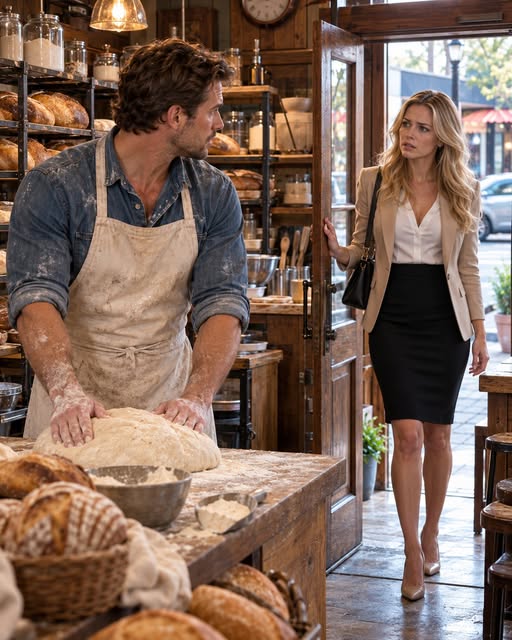
After eleven years of perfect attendance, I was fired in front of my coworkers for asking for a few days to be with my hospitalized mother. Three weeks later, the same woman who called me a failure walked into my bakery, laughed at my new job, and left without realizing she had just insulted the owner. My name is Daniel, and for eleven years, I made sure a massive food manufacturing plant in Ohio never shipped a product that failed quality inspection. I knew every machine on the production floor, every safety procedure, and every number that mattered. If a batch was wrong, I caught it. If a system failed, I stayed late to fix it. I had built my reputation on one simple promise: people could count on me. At home, I was a single father trying to give my child a stable life while caring for my aging mother, Evelyn. I didn’t have much room for mistakes, so I worked hard, saved what I could, and kept my head down. Then Mom collapsed. The doctors admitted her to the hospital, and suddenly, the carefully organized life I’d spent years maintaining became a series of unanswered calls, medical decisions, and bills I couldn’t afford to ignore. I went to my CEO, Helena Cross, and requested a short leave to be with my mother. Helena was known for her immaculate suits, sharp voice, and belief that personal problems had no place in business. She listened to my explanation, glanced at her tablet, and told me the company couldn’t afford unreliable employees. I tried to explain that this was an emergency. She called a meeting with my department and fired me in front of everyone. “Your absence demonstrates a lack of commitment,” she announced. “If you can’t prioritize your responsibilities, you’re not suited for a corporate environment.” Nobody spoke. A few coworkers stared at the floor. Others looked at me with the uncomfortable expression people wear when they’re relieved the disaster has happened to someone else. I walked out carrying a cardboard box containing eleven years of my life. By the end of the week, the whispers had reached our small town. Some people thought I’d done something wrong. Others said I’d been foolish to risk a secure job over a family emergency. None of them offered to pay Mom’s medical bills. I had savings, but they were disappearing quickly. I needed income, and I needed it soon. Then I saw the bakery on Fuller Street. It was a tired little building with peeling paint, a stubborn front door, and an oven that barely worked. Its owner, Beatrice Finch, had spent years trying to keep it alive. She was ready to let it go. The price was low for a reason. The business was failing, the equipment needed repairs, and there was no guarantee anyone would come through the door. I used nearly every dollar I had left to buy it. When I told Mom, she was still in her hospital bed. She looked at me for a long moment before reaching for my hand. “Daniel, failing on your own terms is better than spending your whole life succeeding in a place that doesn’t care whether you live or die.” I held on to those words when the first week brought more expenses than customers. I scrubbed grease off the floors until my hands cracked. I repaired broken oven controls, learned the bakery’s stubborn quirks, and woke before dawn to knead dough. After closing, I visited Mom, then returned to prepare for the next morning. Some days, I baked forty loaves and sold six. People passed the windows without looking inside. A few familiar faces stopped by just long enough to ask whether I’d finally lost my mind. I smiled, cleaned the counter, and tried again. Beatrice became my first regular customer. She offered advice without pretending the road ahead would be easy. “Good bread takes patience,” she told me one morning. “So does building something worth keeping.” Slowly, people began returning. They noticed the crust, the warmth, and the care behind every loaf. For the first time in years, I was building something that belonged to me. Then Helena Cross walked through my front door. She was dressed for an important meeting, checking her phone as she approached the counter. Flour covered my apron, and exhaustion had changed my face enough that she didn’t recognize me. She glanced around the modest shop and gave a small, nervous laugh. “So this is what happens when someone can’t hold down a real job,” she said. I could have told her exactly who stood behind that counter. Instead, I kept my voice steady, served her bread, and accepted her payment without a word about my past. She left convinced she had witnessed my defeat. A few days later, a nationally known food show producer named Samuel Thorne entered the bakery. He tasted one slice of my bread, paused, and asked who had made it. Then he introduced himself and offered me something I had never dared to expect: a feature on his national television show. I looked at the man standing across my counter, hardly believing what I was hearing. But before I could answer, Samuel explained there was one important thing we needed to discuss first. The next part is in the comments. If you were in my position, would you take the opportunity without hesitation, or protect the fragile business you’d fought so hard to build? Second Sunday · · Tác giả Samuel pulled a chair up to the counter and explained that his show wasn’t simply looking for another bakery with a good recipe. He wanted to tell the story behind the food, and he believed mine was worth telling. He asked about my years in quality control, the reason I’d left the factory, and how I’d managed to keep the bakery running with so little money. I told him the truth. I explained that I’d been fired while my mother was hospitalized, that I’d spent almost everything I owned buying the shop, and that some mornings I still worried there wouldn’t be enough customers to cover the bills. Samuel listened without interrupting. Then he told me the production team could arrange a visit, film the baking process, and introduce my bread to viewers across the country. The exposure could bring customers from beyond our town and give the bakery a chance to grow. It sounded like the break I’d been praying for. Then came the practical questions. Could I produce enough bread if orders surged? Could I afford additional ingredients, packaging, and staff? What would happen if the episode aired and the demand lasted only a week? My oven was still unreliable, and I couldn’t risk disappointing customers who had finally begun trusting me. Samuel didn’t promise that television would make me successful. He said the opportunity was real, but the work afterward would be mine. That evening, I visited Mom and told her everything. For the first time since her emergency, she smiled without looking exhausted. “You’ve spent your life proving you can meet someone else’s standards,” she said. “Maybe now you get to decide what success looks like.” I wanted to believe her. But back at the bakery, I found a stack of unpaid invoices beside the register and a handwritten note from Beatrice reminding me that the oven needed another repair before the following week. I had a decision to make. Accept the television feature and risk stretching the bakery beyond what it could handle, or turn it down and keep growing slowly, one loaf at a time. For eleven years, I’d been punished for putting my family first. Now, for the first time, nobody was ordering me to choose. And somehow, that made the decision harder. I picked up the phone to call Samuel, then looked through the window at the first customers gathering outside in the morning light. I still hadn’t decided what to tell him. …And the story isn’t over yet.
I stood behind the counter, watching the first customers gather outside my bakery, and realized something I hadn’t understood when I bought the place.
For the first time in eleven years, the decision in front of me belonged entirely to me.
There was no supervisor waiting for an answer. No CEO measuring my loyalty. No department meeting where someone else would decide whether my life was important enough to deserve consideration.
There was only a phone in my hand, a bakery that was slowly becoming something special, and a chance that might never come again.
I dialed Samuel.
“Daniel,” he answered almost immediately. “Have you had a chance to think about it?”
“I have. And I want to say yes, but I need to be honest about something.”
“Go ahead.”
“My oven is unreliable. I have almost no staff, and I can’t promise that I could handle a sudden flood of orders. I don’t want your show introducing people to a bakery that can’t deliver what it promises.”
Samuel was quiet for a moment.
Then he laughed softly.
“That’s exactly why I wanted to talk to you.”
I frowned.
“What do you mean?”
“Most people I meet want to know how quickly we can make them famous. You’re worried about whether you can serve the customers properly. That’s a good problem to have.”
He explained that the production team could schedule filming several weeks ahead. We could show the bakery as it really was, including the challenges, instead of pretending I had a perfect operation.
He also suggested that I contact a local equipment supplier and a small business development organization. He couldn’t promise funding, but he knew people who might help me prepare for the attention.
“I don’t want to turn your life upside down for a television segment,” he said. “I want to tell a story that people will remember. And I think your story deserves that.”
I looked at the handwritten note Beatrice had left beside the register.
The oven needed repairing.
The rent was due in twelve days.
My savings were nearly gone.
Yet outside, three people were waiting to buy bread.
“All right,” I said. “I’ll do it.”
“Excellent. We’ll send you the details tomorrow.”
After hanging up, I stood completely still for several seconds.
Then the bell above the door rang, and my first customer of the morning stepped inside.
“Morning, Daniel. Anything fresh?”
I smiled.
“Everything is fresh. You’re just in time.”
That afternoon, I told Beatrice about my decision.
She listened while wiping flour from her hands, then studied me with an expression I couldn’t quite read.
“Television, huh?”
“That’s right.”
“Well, I suppose I’d better start wearing my good apron.”
I laughed.
But she didn’t.
“Daniel, I want you to understand something. A television crew can bring people through that door, but it can’t make them come back. That’s still your responsibility.”
“I know.”
“And don’t let anyone convince you that you have to become something different just because a camera is watching.”
Her words stayed with me.
The next morning, I visited an equipment supplier in the neighboring town. His name was Martin Reeves, a broad-shouldered man with gray hair and a habit of speaking while examining whatever was in front of him.
When I explained my situation, he inspected the oven and shook his head.
“This thing has been through a war.”
“I know.”
“Parts are discontinued. I can repair it, but I wouldn’t trust it with a large production schedule.”
My stomach sank.
“How much for a replacement?”
He gave me a number that made my mouth go dry.
I thanked him and left without making a commitment.
That evening, I sat at the kitchen table with my bills spread out in front of me. My daughter, Lily, came downstairs carrying her schoolbooks.
She was twelve, old enough to recognize worry even when I tried to hide it.
“Are we going to lose the bakery?”
I looked up.
“Why would you ask that?”
“Because you keep staring at those papers. And you haven’t been sleeping.”
I pulled out the chair beside me.
“Things are tight, sweetheart. But we’re working on it.”
She hesitated before asking another question.
“Would you have to go back to the factory?”
The thought made my chest tighten.
“I don’t know. But whatever happens, we’ll figure it out.”
She looked at the papers, then at me.
“I could help after school. I can put the bread in bags and write the labels.”
I smiled and brushed a strand of hair away from her face.
“Your job is to be a kid. My job is to make sure you have a future.”
She hugged me.
“Maybe your job is to let people help you sometimes.”
I didn’t have an answer.
The following day, Beatrice arrived carrying an old metal cash box.
She placed it on the counter and pushed it toward me.
“Open it.”
Inside were several envelopes, a small notebook, and a stack of receipts.
“What is this?”
“Accounts from the bakery’s old customers. People who used to buy bread here before business went downhill.”
I flipped through the notebook. Some names had telephone numbers beside them. Others had notes about their favorite products.
“Why are you giving me this?”
“Because I want this place to survive.”
She pointed to a page near the back.
“There’s a church on Maple Avenue. They used to order thirty loaves every Sunday. A nursing home across town bought rolls twice a week. And there’s a family restaurant that always wanted fresh sandwich bread.”
I looked at her.
“You remember all this?”
“I owned this place for twenty-three years, Daniel. I may have gotten older, but I haven’t forgotten how to run a business.”
For the next several days, we worked through the list.
Some customers had moved away. Some businesses had changed owners. But a surprising number remembered the bakery.
When I called the church, the administrator sounded delighted.
“We’ve been buying supermarket bread since Beatrice closed the old account. If you can deliver early Sunday morning, we’d love to start ordering again.”
The nursing home agreed to a trial order.
The restaurant requested samples.
Slowly, the bakery began to look less like a desperate gamble and more like a business with a future.
Then something unexpected happened.
A woman named Margaret Lewis came in one afternoon and asked whether I was the owner.
“Yes, ma’am. How can I help you?”
She introduced herself as the director of a local community foundation. She had heard from Martin Reeves that I was trying to repair my equipment before a television feature.
“Martin mentioned that you have a background in food quality control.”
“I worked in manufacturing for eleven years.”
“Then you understand consistency and safety.”
“I do.”
She handed me a business card.
“Our foundation has a small grant program for neighborhood businesses that preserve local jobs. We don’t give money away without reviewing applications, but I think you might qualify.”
I thanked her, barely believing what I was hearing.
Three days later, I submitted an application.
A week after that, Margaret called.
The foundation approved a grant that covered most of the cost of a reliable commercial oven.
I sat on the flour-covered floor after hanging up and laughed.
For months, every unexpected expense had felt like another door closing.
Now, one had opened.
Martin helped install the new oven, and Beatrice insisted on bringing lunch for everyone who worked on it.
When we finally switched it on, the bakery filled with the warm smell of fresh bread.
I placed my first batch inside.
For eleven years, I had watched machines produce food for millions of people. I had checked temperatures, inspected packaging, and signed off on production records.
But standing in my own bakery, watching that oven work, felt more satisfying than anything I had experienced in the factory.
Because this time, every loaf carried my name.
Two weeks later, Samuel and his production crew arrived.
There were cameras, microphones, lights, and people carrying equipment through the narrow front door.
I had never felt so nervous.
Samuel shook my hand.
“Ready?”
“As ready as I’ll ever be.”
The filming began with the bakery’s history. Beatrice told the crew about the years she had spent keeping the business alive. She spoke about the old customers, the broken oven, and the day she decided to sell.
Then they filmed me mixing dough.
Samuel asked why I had chosen bread.
I looked down at the flour covering my hands.
“Because bread is honest. You put good ingredients into it, give it time, and treat it properly. You can’t rush every step and expect the same result.”
He nodded.
“And what happened at your previous job?”
I took a breath.
“I spent eleven years making sure a large company never sent unsafe products to customers. I was proud of that work. But when my mother became seriously ill, I asked for a few days to be with her. My employer decided that made me unreliable.”
The camera continued rolling.
“I was fired in front of my coworkers. I won’t pretend it didn’t hurt. It did. I had built my life around that job.”
“What changed?”
I glanced toward the front window, where Lily was helping Beatrice arrange paper bags.
“I realized that being dependable doesn’t mean allowing everyone else to decide what you’re allowed to care about.”
Samuel let the silence settle before asking his next question.
“Do you regret leaving?”
“I didn’t choose to leave. But I don’t regret what I built afterward.”
The interview continued for several hours.
At one point, Samuel asked me to prepare the bread that had become our most popular product: a simple country loaf with a crisp golden crust and a soft interior.
I explained how I adjusted the hydration, allowed the dough to ferment slowly, and checked the temperature of every batch.
He tasted a slice.
Then another.
“Daniel, I think I understand now.”
“Understand what?”
“Why people are coming back.”
The episode was scheduled to air three weeks later.
Until then, I tried to keep life normal.
We expanded our Sunday deliveries, hired a part-time baker named Carlos, and brought in a college student to help at the counter during busy hours.
Mom was finally recovering enough to leave the hospital and begin rehabilitation at home. Her progress was slow, but each week brought another small victory.
On the day she returned home, Lily decorated the bakery with handwritten signs.
WELCOME HOME, GRANDMA.
Mom cried when she saw them.
I hugged her carefully, afraid of hurting her.
“You’re supposed to be resting,” I told her.
“I’ve been resting for weeks. Now I want to eat something that wasn’t cooked in a hospital kitchen.”
Everyone laughed.
For the first time in months, our family sat around the same table without discussing medical bills, emergency calls, or what might happen next.
I thought the hardest part was behind us.
I was wrong.
Three days before the television episode aired, my phone rang.
The caller ID displayed an unfamiliar number.
“Hello?”
“Daniel, this is Helena Cross.”
For a moment, I couldn’t speak.
I hadn’t heard her voice since the day she fired me.
“How did you get my number?”
“I saw your bakery’s promotional announcement. Someone sent me the link.”
Her tone was as controlled as I remembered.
“I understand you’re appearing on Samuel Thorne’s show.”
“That’s correct.”
There was a brief pause.
“I suppose congratulations are in order.”
“Thank you.”
“I wanted to discuss something. The company has been reviewing its employee retention policies. Your departure raised a few questions.”
I almost laughed.
“Questions?”
“We’re conducting an internal review. I would appreciate an opportunity to speak with you privately.”
I looked through the bakery window at Carlos carrying a tray of rolls.
“About what?”
“About the circumstances surrounding your termination.”
I remembered the conference room. The silent coworkers. Her expression as she announced that I was no longer suitable for the company.
“You fired me because I asked to spend time with my hospitalized mother.”
“Daniel, I believe there may have been misunderstandings on both sides.”
“No, Helena. There weren’t.”
Her voice became sharper.
“I am trying to handle this professionally.”
“So am I.”
She ended the call without saying goodbye.
I stood there for a long time.
I had imagined confronting Helena countless times. In those imagined conversations, I had always been angry, always had something devastating to say.
But now that she had called, I felt something different.
I was no longer desperate for her approval.
And that was more powerful than any argument I could have made.
The night before the show aired, Beatrice came over to help us prepare.
We had already baked extra loaves, arranged additional supplies, and organized a system for handling online orders.
I was checking the delivery schedule when she placed a hand on my shoulder.
“Are you worried?”
“A little.”
“About the orders?”
“About everything. What if people watch the show and decide the bakery isn’t worth visiting? What if we get overwhelmed? What if this all disappears as quickly as it started?”
Beatrice smiled.
“Then we’ll make more bread tomorrow.”
I looked at her.
“That’s your answer?”
“It’s bread, Daniel. Not a miracle. You make it one batch at a time.”
The next evening, we gathered in the bakery after closing.
Mom sat near the window with a blanket over her knees. Lily had made popcorn. Carlos brought a cake from his apartment, and Beatrice insisted that everyone sit down before the episode began.
When the show opened, I saw my bakery on the screen.
The peeling paint was gone from the footage only because the production crew had found the right angle. The old counter looked beautiful under the studio lights. Beatrice appeared, smiling as she told her story.
Then I appeared on screen.
I watched myself describe the factory, the firing, and the decision to buy the bakery.
When the segment reached the moment I spoke about my mother, I heard her quietly sniffle beside me.
Lily took my hand.
The episode ended with Samuel standing outside the bakery, holding a loaf of our bread.
“Sometimes the best thing that can happen to a person is being forced to discover that their worth was never determined by the place that employed them.”
The screen faded.
For a few seconds, nobody spoke.
Then Lily jumped up.
“You’re famous!”
I laughed and pulled her into a hug.
But the real surprise came the next morning.
At 5:30, I arrived at the bakery expecting a normal day.
Instead, there were people standing outside.
Dozens of them.
Some had driven from neighboring towns. Others had seen the show and wanted to try the bread. A local radio reporter was waiting near the entrance.
My phone was already filled with messages.
The online order system had received hundreds of requests overnight.
Carlos stared at the crowd.
“Daniel, what are we going to do?”
I looked at the people waiting outside.
Then I remembered the promise I had made to myself.
Never sell someone something you cannot deliver.
“We’re going to be honest,” I said. “We’ll serve what we can make today, and we’ll take advance orders for the rest of the week.”
We put a sign on the door explaining our limited production capacity.
Some customers left disappointed, but most appreciated the honesty.
By noon, we had sold everything.
By the end of the week, we had more orders than we could fulfill.
The bakery had finally become what I had hoped it might be.
But success brought another challenge.
A large regional grocery chain contacted me about supplying bread to several of its stores.
The proposed contract was enormous.
It offered more money than I had earned in the previous several years combined.
The representative, a man named Richard, visited the bakery with a folder full of documents.
“We can help you expand production,” he explained. “We’ll provide distribution, marketing, and shelf space. All you need to do is meet our volume requirements.”
I studied the numbers.
They were impressive.
But the production schedule was aggressive. The contract required quantities that would force us to purchase industrial equipment and hire a much larger workforce.
Richard noticed my hesitation.
“What’s the problem?”
“I need time to review everything.”
He smiled.
“Daniel, opportunities like this don’t wait forever.”
I knew that was true.
I also knew what it felt like to build my entire life around someone else’s expectations.
That evening, I discussed the offer with Mom.
She read through the figures carefully.
“Could this help you?”
“It could make us a lot of money.”
“That’s not what I asked.”
I sighed.
“It could also change everything about the bakery.”
She handed the papers back.
“Then decide what you want it to become before deciding what you want it to earn.”
The next morning, I called Richard.
I declined the contract.
He sounded genuinely surprised.
“You’re turning down a national growth opportunity?”
“I’m turning down a commitment I can’t fulfill without sacrificing the quality that brought customers here.”
“You’re making a mistake.”
“Maybe. But it’s my mistake to make.”
After the call, I felt strangely peaceful.
We continued expanding, but carefully. We added a second shift, invested in a larger mixer, and established agreements with local suppliers.
I also began offering paid apprenticeships to people who wanted to learn baking and food production.
One of our first apprentices was a young woman named Emily.
She had left a previous job after taking time off to care for her father. Her employer had treated her absence as a lack of dedication.
When she told me her story during the interview, I recognized the exhaustion in her eyes.
“Do you think you’ll have trouble working early mornings?” I asked.
“No, sir. I can manage.”
“That’s not what I asked. I asked whether you’ll have trouble.”
She looked confused.
I smiled.
“We’ll build a schedule that works. I need someone who can make good bread, not someone who has to pretend they don’t have a family.”
She started the following Monday.
Months passed.
The bakery became a familiar part of the neighborhood. We introduced new products, expanded our delivery service, and began donating bread to a local shelter at the end of each week.
Mom continued recovering.
Lily grew more confident and occasionally helped with the weekend orders, although I made sure she still had time for school, friends, and the ordinary adventures of being twelve.
And Beatrice?
She became the unofficial grandmother of the entire bakery.
She complained about the music Carlos played, criticized my cinnamon rolls whenever they weren’t perfect, and insisted that nobody could arrange the display shelves correctly except her.
I wouldn’t have traded her for anything.
Then, one Thursday afternoon, Helena Cross walked through my door again.
This time, she didn’t look at her phone.
She stood near the entrance, examining the busy counter and the customers sitting beside the windows.
I recognized her immediately.
So did Beatrice.
She glanced at me, but I gave a small shake of my head.
Helena approached the counter.
“Daniel.”
“Good afternoon, Helena. What can I get for you?”
She looked uncomfortable.
“I’d like to speak with you.”
“I’m working. But I can take your order.”
Her eyes moved toward the display.
“One country loaf, please.”
I wrapped the bread and placed it in a paper bag.
She paid, then hesitated.
“I watched your episode.”
“Thank you.”
“You’ve done well.”
“We’ve worked hard.”
She looked around again.
“I heard about the foundation grant. And the grocery contract you turned down.”
I said nothing.
Finally, she lowered her voice.
“I owe you an apology.”
The words surprised me.
She continued.
“When you asked for leave, I was under pressure to meet production targets. I believed allowing exceptions would weaken discipline across the company. I made a decision based on what I thought was best for the business.”
I looked at her.
“And what about what was best for the employee?”
She lowered her eyes.
“I didn’t consider it properly.”
For a moment, I was back in that conference room.
I remembered standing in front of my coworkers, holding my cardboard box, trying to understand how eleven years could be dismissed in less than five minutes.
“I spent a long time thinking that if I worked hard enough, people would eventually recognize my value,” I said. “But the day you fired me taught me something different.”
Helena looked up.
“What?”
“An employer can appreciate your work and still fail to appreciate you as a person. I confused those two things for a long time.”
She swallowed.
“I understand that now.”
“Do you?”
She nodded.
“The company has changed its leave procedures. We’ve introduced emergency family leave and revised how managers handle requests. I also recommended that your termination be reviewed.”
I leaned against the counter.
“Why?”
“Because it was wrong.”
I studied her face, searching for the arrogance I remembered.
It wasn’t entirely gone, but something had changed.
“Thank you for saying that,” I replied.
She seemed to expect more.
Perhaps she thought I would celebrate. Perhaps she expected me to tell her that everything was forgiven.
Instead, I handed her the bag.
“Your bread is ready.”
She accepted it.
“Would you consider coming back to the company as a consultant? We could use someone with your quality control experience. The compensation would be substantial.”
I almost smiled.
“That’s kind of you, but I have work here.”
“You wouldn’t have to give up the bakery.”
“I know. But I don’t want to spend my days helping another company understand something I learned the hard way.”
She nodded slowly.
Before leaving, she turned toward me once more.
“I hope you know that I didn’t intend to destroy your life.”
I thought about that.
“Maybe you didn’t. But you don’t have to intend to hurt someone for the damage to be real.”
She stood silently.
Then she walked out.
This time, I watched her leave without feeling the need to prove anything.
A few minutes later, Beatrice approached me.
“Well?”
“Well what?”
“Did you forgive her?”
I considered the question.
“I don’t know if forgiveness is something I can decide in one afternoon.”
Beatrice nodded.
“That’s fair.”
“But I don’t hate her anymore.”
“That’s a start.”
I returned to the counter.
There were orders to fill, customers to serve, and bread rising in the kitchen.
Life continued.
Several weeks later, Helena sent me a letter.
It wasn’t a business proposal or an attempt to repair her public image. It was a short, handwritten apology.
She acknowledged that she had treated employees as numbers and had confused authority with leadership. She said the changes at the company were long overdue.
At the end, she wrote something that stayed with me:
“I used to believe that a strong organization was one where nobody needed special consideration. I now understand that a strong organization is one where people can face difficult moments without fearing they will lose everything.”
I placed the letter in a drawer.
Not because I wanted to remember the woman who fired me, but because I wanted to remember the lesson.
A year after buying the bakery, we celebrated our first anniversary.
The little building on Fuller Street no longer had peeling paint. The front door had been repaired, the windows were clean, and the smell of fresh bread drifted down the sidewalk every morning.
We had seven employees, including Carlos and Emily. The Sunday church order had grown into several regular community deliveries.
We weren’t rich.
We still had bills, equipment problems, and mornings when the dough refused to cooperate.
But we were stable.
More importantly, we were happy.
On the anniversary morning, I stood outside with Mom and Lily as Beatrice unlocked the front door.
A small crowd had gathered.
Some customers brought flowers. Others carried cards. One elderly man brought a photograph of the bakery from twenty years earlier.
Samuel had even sent a message congratulating us on the anniversary.
But the most meaningful moment came when Lily handed me a folded piece of paper.
“Read it,” she said.
It was a drawing she had made.
The bakery stood in the center, with little figures around it. Mom was sitting beside the window. Beatrice was holding a tray. Carlos and Emily stood near the oven.
And I was behind the counter.
Above the drawing, she had written:
“HOME IS WHERE PEOPLE MATTER.”
I felt my throat tighten.
“Do you like it?” she asked.
“I love it.”
She hugged me.
“I wanted you to have something to remember.”
I looked at the drawing again.
For eleven years, I had believed that my worth came from never missing a day, never making a mistake, and never asking for anything.
I thought being a good employee meant sacrificing whatever was necessary to keep the company satisfied.
I had been wrong.
The factory had given me experience. It had taught me discipline, precision, and the importance of doing work properly. I would never deny that.
But it had also taught me what could happen when people forgot that employees were human beings.
Losing that job had nearly broken me.
It had left me frightened, angry, and uncertain about how I would provide for my family.
Yet somewhere between repairing an old oven and baking my first successful loaf, I had discovered something I had never found in that enormous manufacturing plant.
A reason to wake up that had nothing to do with pleasing someone who held power over me.
I looked at the people gathered inside the bakery.
Some had helped me when I had nothing. Others had arrived when they saw an opportunity. All of them had become part of something larger than a business.
And I finally understood what Mom had meant in that hospital room.
Failing on your own terms can be better than succeeding in a place that doesn’t care whether you live or die.
But perhaps there was something even more important.
Success isn’t simply having the freedom to choose your own path.
It’s creating a place where other people don’t have to sacrifice their humanity just to walk beside you.
That morning, we served free coffee and bread to everyone who came through the door.
Mom sat at her favorite table. Lily helped arrange the pastries. Beatrice complained that I had cut the anniversary cake unevenly.
And I laughed.
Because eleven years of perfect attendance had never made me feel as proud as that one ordinary morning in a little bakery on Fuller Street.
I had lost a job.
I had not lost my ability to work, to love, or to begin again.
And the woman who once called me a failure had unknowingly helped me discover the difference between having a career and having a life.
I still keep my old employee identification card in a drawer behind the register.
Not as a reminder of what Helena took from me.
But as a reminder of what I will never allow anyone to take again.
My time with my family.
My dignity.
And the freedom to decide what matters.
Because at the end of the day, nobody should have to choose between being a good employee and being a good son, daughter, parent, or human being.
And no amount of money, recognition, or perfect attendance is worth forgetting the people who make life worth living.
Sometimes the door that closes in front of you is the very thing that forces you to discover the door you were meant to open.
Mine happened to lead to a small bakery.
And every morning, when I unlock that stubborn front door and smell the first loaves coming out of the oven, I know I made the right choice.
Not because everything worked out perfectly.
But because, for the first time, I am building a life I don’t have to apologize for living.