“You’ve got forty hungry men to feed, thirty-six empty bread pans, and enough flour to last until tomorrow.”
Instead of reaching for the skillet, Daniel threw his arm around Abigail’s waist and pulled her against his chest.
The heavy iron pan struck the floor with a deafening crash, scattering hot grease across the wooden boards.
Abigail barely had time to catch her breath before Daniel grabbed her hands.
“Are you burned?”
“No, I don’t think so.”
“Let me see.”
He examined her fingers, then her wrists, his enormous hands surprisingly gentle.
That was when Abigail noticed the angry red mark spreading across his forearm.
“Daniel! You’re hurt!”
He glanced down as though the injury belonged to someone else.
“It’s nothing.”
“Sit down.”
“Abigail—”
“Daniel Hayes, sit down before I knock you down myself.”
For the first time since arriving at High Ridge, Abigail heard him laugh.
She fetched cool water and clean linen, carefully tending his burn while he watched her.
“You could have caught that skillet,” she murmured.
“Probably.”
“Then why didn’t you?”
His expression softened.
“Because I was more worried about catching you.”
Abigail’s fingers stopped moving.
For several seconds, neither spoke.
Then the kitchen door opened, and Walter Briggs, the ranch foreman, stepped inside.
His eyes traveled from Daniel’s bandaged arm to Abigail’s flushed cheeks.
“Am I interrupting something?”
Daniel stood.
“What is it, Walter?”
“Three calves missing from the northern pasture. Thought you’d want to know.”
Daniel followed him outside, but not before giving Abigail a look that kept her awake long after the kitchen fire had burned low.
The following morning, she discovered something that made her forget all about romance.
Someone had entered the pantry during the night.
A sack of dried beans was missing.
So were two packages of salt pork and nearly twenty pounds of cornmeal.
Abigail checked the lock. There were no signs of damage.
Only three people carried keys to that room.
Herself, Daniel, and Walter Briggs.
She brought the inventory book to Daniel’s office.
“Someone is stealing your supplies.”
Daniel looked up sharply.
“You’re certain?”
“I know what was in that pantry yesterday. Food doesn’t grow legs.”
He studied her figures.
“Walter’s managed supplies here for eleven years.”
“I’m not accusing him.”
“But you suspect him.”
“I suspect anyone who can open that door.”
Daniel leaned back, troubled.
Walter had worked for his father before him. He had taught Daniel to ride, mend fences, and recognize cattle sickness.
Accusing him of theft was almost like accusing family.
“Give me a few days,” Daniel said.
Abigail nodded.
But she didn’t have a few days to spare.
The temperature dropped so low that water froze inside the bunkhouse. Snow buried the lower fences, and the wind howled through the mountains like an injured animal.
Every meal became a careful calculation.
Abigail stretched beef with barley, turned leftover bread into pudding, and simmered bones until every drop of nourishment had been extracted.
Then, on Thursday afternoon, Walter arrived with unexpected company.
A beautiful young woman stepped down from his wagon, wrapped in an expensive fur coat.
Her name was Eleanor Whitmore.
She was the daughter of a wealthy cattle buyer from Cheyenne.
And judging by the way she threw her arms around Daniel, she knew him considerably better than Abigail did.
“Daniel! You impossible man. I’ve been trying to reach you for weeks.”
Daniel returned her embrace politely.
“What are you doing here?”
“Father sent me to discuss business. Although I certainly wouldn’t mind discussing something else.”
Walter chuckled.
Abigail watched from the kitchen window until Eleanor turned and noticed her.
“Is that your new cook?”
Daniel nodded.
“Abigail Turner.”
Eleanor smiled.
“Well, she certainly looks like someone who knows her way around a dinner table.”
Walter laughed again.
Daniel didn’t.
“She’s the reason my men aren’t starving.”
Eleanor’s smile faltered.
That evening, Abigail served supper in the main house.
Eleanor barely touched her stew.
“Goodness, Daniel. Is this what you eat every night?”
“Better than anything I’ve eaten in years.”
“I suppose standards change when a man lives so far from civilization.”
Abigail collected the empty bread basket without answering.
She had endured remarks like Eleanor’s since childhood. People had always noticed her size before discovering whether she was clever, hardworking, or kind.
Her former employer had once told her that no respectable man would marry a woman who looked capable of lifting him.
She had laughed at the time.
Then cried alone in her bedroom.
She had promised herself never to let another person’s cruelty determine her worth.
But watching Eleanor sit beside Daniel, slender and elegant, Abigail found that old promise difficult to remember.
Later that night, she overheard Walter speaking with Eleanor in the hallway.
“Your father won’t find a better opportunity,” Walter whispered.
“And Daniel?”
“He’ll agree when he realizes he has no choice.”
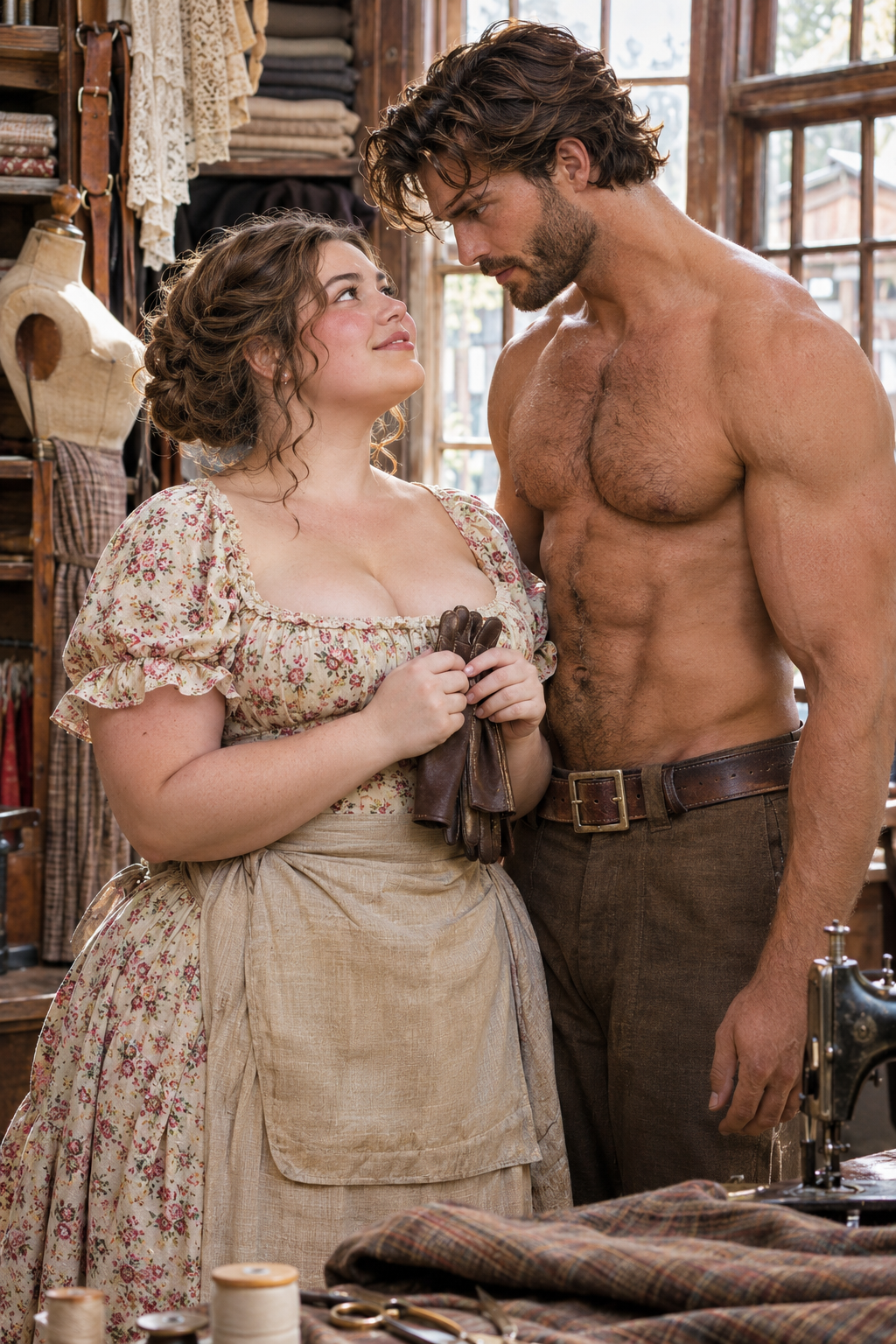
Abigail stopped behind the kitchen door.
“What about the cook?” Eleanor asked.
Walter’s voice hardened.
“I’ll handle her.”
Abigail stepped backward, accidentally striking a metal bucket.
The conversation stopped.
Walter appeared around the corner.
“Something you need, Miss Turner?”
“Just cleaning.”
His smile never reached his eyes.
“Then I suggest you stick to that.”
The next morning, Abigail found Daniel examining a contract.
Eleanor stood beside his desk.
“My father is offering a generous price,” she said. “With your winter expenses and the losses you’ve suffered, you’d be foolish to refuse.”
Abigail set down Daniel’s coffee.
“What losses?”
Eleanor looked irritated.
“Private business.”
Daniel answered anyway.
“Nearly a hundred cattle unaccounted for since autumn. Missing supplies. Expenses that don’t match our earnings.”
“And your father wants to buy the ranch?” Abigail asked Eleanor.
“Part of it. The southern grazing land.”
Daniel shook his head.
“I’m not selling.”
Eleanor placed a delicate hand on his shoulder.
“You might feel differently when winter is over.”
Abigail returned to the kitchen with a terrible suspicion.
Someone was deliberately weakening High Ridge Ranch.
Missing cattle meant lost income.
Missing supplies meant additional expenses.
And if Daniel became desperate enough, Eleanor’s father could purchase valuable land for a fraction of its worth.
But suspicion wasn’t proof.
Abigail needed evidence.
She found her first clue in the stable.
One of the younger cowboys, a nineteen-year-old named Tommy Reed, was repairing a harness when she approached him.
“Tommy, have any wagons left the ranch recently?”
He hesitated.
“Mr. Briggs takes one out sometimes.”
“Where?”
“Old logging cabin beyond Miller’s Creek.”
“What’s out there?”
“Don’t know. He told me it was none of my business.”
Abigail thanked him and returned to the kitchen.
That afternoon, she prepared a fresh batch of bread and deliberately left the pantry unlocked.
Before supper, she sprinkled flour across the floor near the storage room entrance.
By midnight, someone had walked through it.
The footprints led toward the back door.
Abigail followed them outside.
Snowflakes stung her cheeks as she crossed the yard and approached the stable.
A lantern flickered inside.
Walter was loading sacks onto a wagon.
Another cowboy stood beside him.
It was Hank Miller, the same man who had mocked Abigail on her first day.
“Hurry up,” Walter snapped. “Whitmore wants everything moved before the next storm.”
“What if Hayes finds out?”
“He won’t.”
Abigail’s stomach tightened.
She turned to leave.
A loose board cracked beneath her boot.
Walter raised his lantern.
“Who’s there?”
Abigail hurried behind the stable, slipping through the darkness until she reached the kitchen.
Her hands trembled as she locked the door.
She had finally discovered the truth.
Now she needed to survive long enough to tell Daniel.
At sunrise, she hurried toward the main house.
Walter was already there.
Daniel stood beside his desk, holding a small leather pouch.
“Abigail,” he said slowly. “Come inside.”
Something in his expression frightened her.
Walter folded his arms.
“Found that beneath her mattress this morning.”
Daniel emptied the pouch onto his desk.
Gold coins spilled across the wood.
Abigail stared at them.
“I’ve never seen those before.”
Walter sighed dramatically.
“Twenty dollars missing from the ranch cashbox. Supplies disappearing since she arrived. I hate to say it, Daniel, but we’ve been trusting the wrong person.”
Abigail turned toward him.
“You planted that money.”
“Now she’s accusing me.”
“I saw you loading stolen supplies last night.”
Walter laughed.
“Did you?”
“Hank was helping you.”
“Then ask Hank.”
Daniel sent for him.
When Hank arrived, he refused to meet Abigail’s eyes.
“Were you moving supplies last night?” Daniel asked.
“No, sir.”
Abigail felt as though the floor had disappeared beneath her.
“Hank, tell him the truth.”
“Don’t know what you’re talking about.”
Walter shook his head.
“She’s desperate.”
Daniel remained silent for a long moment.
Then he looked at Abigail.
“Did you take the money?”
“No.”
“Did you steal anything from this ranch?”
“Not one thing.”
He nodded.
“That’s good enough for me.”
Walter’s mouth fell open.
“Daniel, you’ve got the evidence right there!”
“I also have a woman who has spent every waking hour keeping this ranch alive.”
Daniel gathered the coins.
“Abigail stays.”
Walter’s face turned purple.
“You’re making a mistake.”
“Then it’s mine to make.”
After Walter and Hank departed, Abigail stood motionless beside the desk.
“Why did you believe me?”
Daniel approached her.
“Because I know what kind of woman you are.”
“You’ve known Walter eleven years.”
“And you’ve shown me more honesty in a month than most people manage in a lifetime.”
Abigail blinked back tears.
Daniel reached for her hand.
But before he could speak again, the ranch bell began ringing frantically.
A cowboy burst through the door.
“Fire! The hay barn’s burning!”
Daniel ran outside.
Flames climbed the barn walls, swallowing the dry timber despite the falling snow.
Men rushed forward with buckets.
Horses screamed from the adjoining stable.
Abigail grabbed a blanket and hurried toward the chaos.
“Where’s Tommy?” someone shouted.
Another cowboy pointed toward the burning building.
“He went inside to get the horses!”
Daniel disappeared through the smoke before anyone could stop him.
Abigail’s heart nearly stopped.
The roof groaned.
Seconds passed.
Then a minute.
Two horses burst through the doorway, followed by Daniel carrying Tommy over his shoulder.
The young cowboy was unconscious.
“Get him inside!” Abigail shouted.
Daniel stumbled.
A burning beam crashed behind him, sending sparks across his coat.
Abigail rushed forward, smothering the flames with her blanket.
Together, they dragged Tommy into the kitchen.
He coughed violently but began breathing more easily.
Daniel’s face was blackened with soot.
Blood ran from a cut above his eyebrow.
Outside, the hay barn collapsed.
By evening, nearly half the ranch’s winter feed had been destroyed.
The men gathered in the bunkhouse, exhausted and frightened.
Without hay, hundreds of cattle could die.
Without supplies, the men might follow.
Walter stood near the fireplace.
“Whitmore’s offer is still on the table.”
Daniel looked at him.
“Interesting timing.”
Walter stiffened.
“I’m trying to save this ranch.”
“Are you?”
Before the argument could continue, Tommy spoke from his bed.
“Mr. Hayes?”
Daniel knelt beside him.
“What is it, son?”
“I saw who started the fire.”
The room fell silent.
Tommy swallowed.
“Mr. Briggs. He was pouring lamp oil against the wall.”
Walter lunged toward him.
Daniel intercepted him, grabbing his coat and slamming him against the wall.
“Don’t you dare touch that boy.”
Walter struggled.
“Little fool doesn’t know what he saw!”
Hank suddenly stood.
“He does.”
Everyone turned.
Hank’s face was pale.
“I helped Walter steal the supplies. We moved cattle to Whitmore’s property, too. Walter promised me money.”
He looked at Abigail.
“She told the truth.”
Walter reached inside his coat.
A pistol appeared in his hand.
“Everybody stay back!”
Daniel released him.
Walter backed toward the door.
“You think you can prove anything? You’ll all freeze before the sheriff gets here!”
He rushed outside, mounted his horse, and disappeared into the storm.
Nobody followed.
The snow was falling so heavily that the stable could barely be seen from the bunkhouse.
Eleanor packed her belongings within the hour.
Daniel stopped her at the front door.
“Did you know?”
She lifted her chin.
“My father is a businessman.”
“That’s not an answer.”
“He wanted the land. Walter offered to help.”
Daniel stared at her in disgust.
“You were willing to let forty men starve for a piece of property?”
Eleanor’s expression hardened.
“Don’t pretend you’re better than everyone else, Daniel. By spring, you’ll be begging my father for help.”
She left with two hired drivers.
Abigail watched their wagon disappear.
For the first time, she understood just how much danger they were in.
Exposing Walter hadn’t solved their problems.
Their food was still missing.
Their hay was gone.
And the worst storm of the winter had only begun.
Daniel gathered the crew.
“We’ll slaughter cattle if necessary. Nobody goes hungry while there’s a steer standing on this property.”
Abigail stepped forward.
“What about the logging cabin?”
Hank looked up.
“There’s food there. Lots of it. Walter stored everything before moving it to Whitmore’s.”
“How far?” Daniel asked.
“Six miles.”
Outside, the wind rattled the windows.
Six miles might as well have been sixty.
But Daniel was already reaching for his coat.
Abigail caught his sleeve.
“You can’t go alone.”
“I’m taking Hank and three men.”
“Then I’m coming.”
“Absolutely not.”
“You need someone who knows which supplies to bring back first.”
“Abigail, it’s dangerous.”
“So is staying here without food.”
Daniel looked into her determined face.
He knew arguing was useless.
Before dawn, they left with two wagons and six horses.
Snow reached the animals’ knees.
The journey took nearly five hours.
When they finally reached the cabin, Abigail could hardly believe what she saw.
Flour barrels.
Sacks of beans.
Smoked meat.
Sugar, salt, coffee, dried apples.
There was enough food to sustain the ranch for months.
Behind the cabin stood a smaller building packed with stolen hay.
Daniel removed his hat.
“All this time.”
Abigail touched his arm.
“We found it. That’s what matters.”
Then a gunshot shattered the silence.
One of the horses collapsed.
Walter emerged from behind a tree.
His beard was covered in ice, and his eyes were wild.
“You should’ve taken the offer, Daniel.”
The cowboys froze.
Walter pointed his pistol toward Abigail.
“This woman ruined everything.”
Daniel stepped between them.
“Put the gun down.”
“Move.”
“No.”
Walter’s finger tightened around the trigger.
Abigail saw Hank creeping behind the cabin.
She needed to keep Walter distracted.
“How much did Whitmore promise you?” she asked.
“Shut your mouth.”
“Enough to buy your own ranch?”
Walter’s expression changed.
“I worked eleven years for that family. Eleven years! His father promised me land, and I got nothing.”
Daniel stared at him.
“My father never told me that.”
“Of course he didn’t!”
“You could have asked me.”
“I shouldn’t have had to!”
For one brief moment, Walter’s anger gave way to something sadder.
Then Hank tackled him from behind.
The pistol fired.
Daniel jerked backward.
Abigail screamed.
He fell into the snow.
The cowboys wrestled Walter to the ground while Abigail dropped beside Daniel.
Blood spread across his shoulder.
“Daniel!”
He opened his eyes.
“I’m all right.”
“You are not all right!”
“Still bossing me around?”
She pressed cloth against the wound.
“Don’t you dare die on me.”
His smile disappeared.
“Wasn’t planning to.”
The return journey became a race against darkness.
They loaded the wagons, bound Walter’s hands, and wrapped Daniel in blankets.
Halfway home, one wagon wheel broke.
The wind grew stronger.
Daniel slipped into unconsciousness.
Abigail refused to abandon him.
She ordered the men to transfer the supplies and Daniel onto the remaining wagon, leaving behind whatever could wait.
By the time High Ridge appeared through the snow, her fingers were numb and her throat was raw from shouting encouragement to the exhausted horses.
The ranch hands rushed forward.
Daniel was carried inside.
Abigail stayed beside him throughout the night.
She cleaned his wound, stopped the bleeding, and prayed harder than she had ever prayed before.
Near dawn, Daniel opened his eyes.
“Abigail?”
She leaned forward.
“I’m here.”
“Did we get the food?”
She laughed through her tears.
“Yes, you ridiculous man.”
“Good.”
He closed his eyes again.
Then his fingers tightened around hers.
“I love you.”
Abigail stopped breathing.
Daniel looked at her.
“Should’ve told you before.”
She lowered her forehead against his hand.
“I love you, too.”
For the next three weeks, the ranch slowly recovered.
The recovered supplies filled Abigail’s pantry. The men retrieved the remaining hay when the weather improved.
Walter was taken into custody when the sheriff finally reached High Ridge.
Hank confessed everything, including the location of the stolen cattle. He agreed to testify against Walter and Whitmore, accepting responsibility for his own crimes.
Before leaving with the sheriff, he approached Abigail.
“I don’t expect you to forgive me.”
She studied him.
“Then don’t waste your life expecting it. Become someone who deserves it.”
Hank lowered his head.
“Yes, ma’am.”
Spring arrived beneath a brilliant blue sky.
Grass appeared along the hillsides, calves stumbled beside their mothers, and the kitchen windows could finally be opened.
Daniel’s shoulder healed.
One morning, Abigail found him chopping firewood again.
“You’re supposed to be resting.”
“Doctor said I could work.”
“Doctor didn’t say you could be foolish.”
Daniel grinned.
“Marry me.”
Abigail nearly dropped the basket she was carrying.
“What?”
He set down his axe.
“I’ve been trying to think of a proper way to ask. Turns out I’m terrible at proper.”
He pulled a small velvet box from his pocket.
Inside lay a simple gold ring.
“I don’t need someone to impress wealthy cattle buyers. I don’t need someone who looks pretty sitting in my parlor.”
He took her hands.
“I want the woman who argues with me, feeds my men, sees trouble before I do, and makes this place feel like home.”
Abigail’s eyes filled.
“Even when I’m old and gray?”
“Especially then.”
“And if I get bigger?”
Daniel smiled.
“Then I’ll have more woman to love.”
She laughed, cried, and finally managed to say yes.
They married beneath the cottonwood trees that June.
Tommy carried the rings. The cowboys decorated the yard with wildflowers, and Daniel surprised Abigail by baking their wedding cake himself.
It leaned considerably to the left.
Abigail declared it perfect.
Years later, High Ridge became one of the most prosperous ranches in Wyoming.
But Abigail never forgot that first terrible winter.
She established a supply house where struggling families could receive flour, beans, and meat without paying a penny.
Daniel supported her without hesitation.
Above its entrance hung a wooden sign.
NO ONE LEAVES HUNGRY.
One afternoon, a frightened young woman arrived seeking employment.
She was broad-shouldered, poorly dressed, and ashamed of her appearance.
“I’m afraid I’m not much to look at,” she whispered.
Abigail smiled and handed her an apron.
“Good thing I’m hiring a cook and not a painting.”
From the doorway, Daniel laughed.
The young woman smiled for the first time.
And Abigail understood that everything she had endured had brought her to this moment.
She could not change the cruel words people had spoken to her.
But she could make certain those words never determined another woman’s future.
That evening, Daniel found her watching the sunset from their porch.
He sat beside her and wrapped an arm around her waist.
“Remember the day you nearly dropped that skillet?”
Abigail leaned against him.
“Of course.”
“Best thing that ever happened to me.”
“You burned your arm.”
“Small price to pay.”
She laughed softly.
Below them, warm light spilled from the kitchen windows. Their children played near the barn, and the smell of fresh bread drifted across the ranch.
Abigail had arrived at High Ridge with little more than a suitcase and a talent nobody had bothered to appreciate.
She had been judged by her appearance, betrayed by men she had tried to feed, and nearly robbed of the happiness she deserved.
Yet she had never allowed bitterness to change her generous heart.
And in the end, the woman they once believed would eat them out of house and home had given them something far more valuable than bread.
She had taught them that a person’s worth could never be measured by the space they occupied, but by the lives they touched, the courage they showed, and the kindness they chose when the world gave them every reason to be cruel.
But Abigail’s greatest test of kindness was still waiting for her.
It came twelve years after the winter that had nearly destroyed High Ridge Ranch.
On a cold November morning, a stranger appeared at the kitchen door.
His coat was torn, his boots were held together with pieces of rope, and his gray beard concealed most of his face.
“Ma’am,” he whispered. “Could you spare something to eat?”
Abigail was preparing breakfast when she turned toward him.
The wooden spoon slipped from her hand.
“Walter?”
The man lowered his head.
Walter Briggs looked nothing like the proud foreman who had once commanded forty cowboys.
Prison had aged him. Poverty had taken whatever pride remained.
“I didn’t know where else to go,” he admitted.
Abigail stood motionless.
Memories returned with painful clarity.
The stolen supplies. The burning barn. Daniel bleeding in the snow.
This was the man who had nearly taken everything from her.
Walter stepped backward.
“I understand. I’ll leave.”
“Wait.”
He stopped.
Abigail pulled out a chair.
“Sit down.”
She placed a bowl of beef stew before him, followed by two thick slices of warm bread.
Walter stared at the food.
His hands began trembling.
“After what I did?”
“Being hungry isn’t a crime, Walter.”
He covered his face and wept.
Daniel entered the kitchen moments later.
When he recognized Walter, his expression darkened.
“What are you doing here?”
Walter immediately stood.
“I’m leaving.”
Daniel looked at Abigail.
She quietly shook her head.
“Let him finish eating.”
Daniel remained beside the doorway.
For several minutes, the only sound was Walter’s spoon scraping against the bowl.
Finally, Walter spoke.
“I spent eleven years blaming your father for breaking his promise. Then I spent ten years in prison blaming you for putting me there.”
He looked down at his ruined hands.
“Only recently did I realize the man responsible for destroying my life was sitting beside me every morning.”
Daniel said nothing.
Walter swallowed.
“I can’t undo what I did. But I wanted you both to know how sorry I am.”
Abigail sat across from him.
“Sorry is a beginning. What you do afterward is what matters.”
Walter nodded.
“Would you know anyone who might hire an old man?”
Daniel studied him for a long time.
Then he pulled on his gloves.
“The southern fence needs repairing.”
Walter looked up in disbelief.
“You’d give me work?”
“I’ll give you a chance. Earning my trust again is your responsibility.”
Walter’s eyes filled with tears.
“I won’t disappoint you.”
“See that you don’t.”
Over the following months, Walter became the hardest-working man on the ranch.
He never complained about the cold, never asked for special treatment, and never took more than he was offered.
One afternoon, Daniel discovered that Walter had been using part of his wages to purchase supplies for Abigail’s charitable food house.
He said nothing about it.
But the following week, Walter received a better coat and a pair of new boots.
By Christmas, something extraordinary happened.
Hank Miller returned to High Ridge.
After serving his sentence, Hank had spent years working on farms across Montana. He had married, raised two daughters, and eventually saved enough money to purchase a small ranch.
He arrived with a wagon loaded with flour.
“Figured I owed this place a few sacks,” he told Abigail.
She smiled.
“Only a few?”
Hank laughed.
“Some debts take a lifetime to repay.”
When he discovered Walter repairing a gate near the stable, both men stood silently for several moments.
Then Hank extended his hand.
Walter accepted it.
Neither needed to explain what the gesture meant.
That Christmas Eve, nearly a hundred people gathered inside the newly expanded dining hall at High Ridge.
Ranch hands, neighboring families, travelers, and children filled the long wooden tables.
Abigail’s eldest daughter helped serve bread while her younger son carried bowls of stew.
Daniel stood beside the fireplace, watching his wife move through the crowded room.
Her hair had begun turning gray.
Her hands bore the marks of years spent cooking and working.
To Daniel, she was more beautiful than the day they had met.
Tommy Reed, now the ranch foreman and a father himself, raised his glass.
“Before we eat, I think someone deserves a few words.”
Abigail frowned.
“Tommy, don’t you dare.”
The room erupted in laughter.
He continued anyway.
“Twelve years ago, most of us thought a cook was just someone who put food on a table. Then Mrs. Hayes came along and showed us how wrong we were.”
He glanced around the room.
“She saved this ranch. She saved my life. And she taught a bunch of stubborn cowboys how to behave like decent men.”
Someone shouted from the back.
“Some of us are still learning!”
More laughter followed.
Tommy smiled.
“To Abigail Hayes.”
Every person in the room raised a glass.
Abigail wiped her eyes with the corner of her apron.
Daniel approached her and kissed her forehead.
“Looks like you’re stuck with us.”
“Lord help me,” she replied.
Years continued passing.
High Ridge prospered, but its greatest reputation had little to do with cattle or money.
Travelers knew they could find shelter there during storms.
Widows knew their children would never go hungry.
Men who had made mistakes knew they could earn an honest living if they were willing to change.
And women who had spent their lives being told they weren’t good enough discovered a place where their abilities mattered more than their appearance.
Abigail grew old surrounded by people whose lives she had helped transform.
On her seventieth birthday, Daniel brought her a small wooden box.
Inside was the original inventory book from her first winter at High Ridge.
She laughed when she recognized it.
“Why on earth did you keep this?”
“Open it.”
The first pages contained her careful calculations of flour, potatoes, and cornmeal.
But the remaining pages were filled with handwritten messages.
There were letters from former ranch hands, families she had fed, women she had employed, and children who had grown into adults because someone had offered them help when they needed it most.
One message came from Walter.
He had written it shortly before his death.
“You gave me bread when I deserved nothing from you. You gave me the chance to become a better man when I believed it was too late. Whatever goodness remained in my life began at your kitchen table.”
Abigail pressed the book against her chest.
Daniel sat beside her.
“Still think you were only a cook?”
She smiled through her tears.
“I was a pretty good cook.”
“The best.”
They watched their grandchildren playing beneath the same cottonwood trees where they had married decades earlier.
The mountains stood unchanged in the distance.
Winter would come again, as it always did.
But High Ridge was ready.
There were full barns, stocked pantries, strong fences, and people who understood that surviving difficult times required more than money.
It required looking after one another.
Daniel reached for Abigail’s hand.
“Would you change anything?”
She thought about the insults, the hunger, the betrayal, and the terrible night she had nearly lost him.
Then she looked at their family.
“Not if changing it meant losing this.”
He kissed her hand.
“Neither would I.”
Long after Abigail and Daniel were gone, their children continued operating High Ridge Ranch.
The little supply house became a larger community kitchen.
Above its doorway remained the original wooden sign, weathered by decades of Wyoming winters.
NO ONE LEAVES HUNGRY.
And beneath it, their grandchildren added another sentence.
EVERYONE DESERVES A PLACE AT THE TABLE.
Because Abigail Turner had left behind something greater than a successful ranch.
She had left a legacy of compassion that outlived every insult ever spoken against her.
Her story became a reminder that strength wasn’t measured by how much power a person possessed, but by how gently they used it.
That forgiveness did not erase the past, but could prevent the past from destroying the future.
And that sometimes, the greatest fortunes in life began with something as simple as sharing a loaf of bread with someone who had nowhere else to go.
The woman who had once arrived at High Ridge wondering whether she would be worth keeping had become the very heart of the place.
And generations later, whenever fresh bread came out of the old ranch kitchen, someone would tell her story again.
Not because Abigail had been extraordinary in appearance.
But because she had chosen to be extraordinary in character.
And that was a beauty no passing year could ever take away.
THE END.